INTRODUCTION
Drought stress is one of the major environmental stresses that negatively influences wheat growth and productivity worldwide (Shabbir et al. Reference Shabbir, Waraich, Ali, Nawaz, Ashraf, Ahmad, Awan, Ahmad, Irfan, Hussain and Ahmad2016). Wheat yield is particularly sensitive to drought stress at vegetative and reproductive stages (Qadir et al. Reference Qadir, Saeed and Cheema1999). Improving grain yield (GY) under limited water conditions has become increasingly important in arid regions of the world (Zhang et al. Reference Zhang, Cheng, Edwards, Chen, Wang, Yang, Liu, Tan, Wang, Liu, An, Dai, Zhou, Zhang, Jia, Jin and Johnson2008).
The role of selenium (Se) in plants under water stress conditions has not been well established. Although Se is not involved in various vital metabolic processes in plants, it may help the plants to reduce the damage caused by oxidative stress under various physiological pressures (Hanson et al. Reference Hanson, Garifullina, Lindblom, Wangeline, Ackley, Kramer, Norton, Lawrence and Pilon-Smits2003; Seppänen et al. Reference Seppänen, Turakainen and Hartikainen2003). The positive role of Se in mitigating various abiotic stresses such as salinity (Hasanuzzaman & Fujita Reference Hasanuzzaman and Fujita2011), heavy metals (Kumar et al. Reference Kumar, Bijo, Baghel, Reddy and Jha2012), high temperature (Djanaguiraman et al. Reference Djanaguiraman, Prasad and Seppänen2010), ultra-violet B radiation (UV-B) (Yao et al. Reference Yao, Chu and Ba2010) and drought (Nawaz et al. Reference Nawaz, Ashraf, Ahmad, Waraich, Shabbir and Bukhari2015a , Reference Nawaz, Ahmad, Ashraf, Waraich and Khan b ) is well documented. Moreover, several approaches viz. seed priming (Nawaz et al. Reference Nawaz, Ashraf, Ahmad and Waraich2013), seed coating (Bittman et al. Reference Bittman, Buckley, Zaychuk and Brown2000), soil application (De Temmerman et al. Reference De Temmerman, Waegeneers, Thiry, Du Laing, Tack and Ruttens2014), fertigation (i.e. the injection of fertilizers, soil amendments and other water-soluble products into an irrigation system; Nawaz et al. Reference Nawaz, Ahmad, Ashraf, Waraich and Khan2015b ) and foliar spray (Chilimba et al. Reference Chilimba, Young, Black, Meacham, Lammel and Broadley2012; Wang et al. Reference Wang, Wang, Mao, Zhao and Huang2013) are reported to supply Se to plants. However, most of the above studies either involved short-term experiments or were carried out under controlled conditions. The ultimate goal of sustainable agriculture cannot be achieved without development of drought mitigation strategies under field conditions.
Selenium application method and rates affect its uptake and concentration in plants (Curtin et al. Reference Curtin, Hanson, Lindley and Butler2006). Priming of plant seeds with Se is considered as an easy, low cost, low risk and effective approach to improve plant tolerance under stressful environments (Nawaz et al. Reference Nawaz, Ashraf, Ahmad and Waraich2013; Ibrahim Reference Ibrahim2014). Soil and/or foliar application of Se fertilizers (agronomic biofortification) are often used to improve the Se concentration of food. Moreover, plants act as an effective buffer that can protect humans from toxic Se intake that may take place with direct Se supplementation (Hartikainen Reference Hartikainen2005). The application of selenate fertilizers (soil and/or foliar application) has proved to be more effective for increasing plant Se concentrations than selenite fertilization (Gissel-Nielsen et al. Reference Gissel-Nielsen, Gupta, Lamand and Westermarck1984; Singh Reference Singh1991) and hence selenate is the predominant form of Se used in Se fertilization of plants (Broadley et al. Reference Broadley, White, Hammond, Zelko and Lux2007). The chemical form of Se, soil characteristics, time of foliar and method of basal application affect the relative effectiveness of soil or foliar-applied Se fertilizers (Lyons et al. Reference Lyons, Stangoulis and Graham2003).
Wheat (Triticum aestivum L.) is a major food grain crop in Pakistan and plays a vital role in the agriculture-based economy of the country. More than 2 million tonnes of wheat is produced per annum in the country; however, its average yield of 2·75 t/ha is much lower than many agriculturally advanced countries of the world. Many factors contribute to low wheat yield in Pakistan, but availability of inadequate water for crop growth or recurrent droughts contribute significantly in this regard. Moreover, irrigation systems in Pakistan are not efficient and a significant portion of water is lost before it reaches farmers’ fields. The present study was designed with the hypothesis that the positive role of Se in mitigating water stress in wheat is closely associated with its method and time of application.
MATERIALS AND METHODS
Experimental site and layout
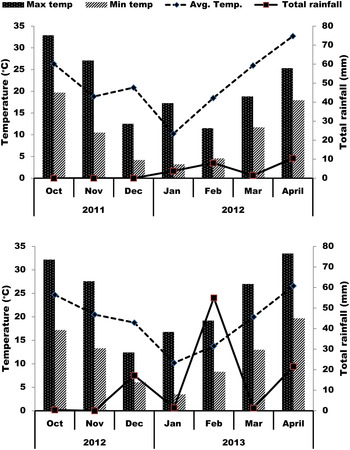
The experimental activities were carried out at the Research Farm of the Department of Crop Physiology, University of Agriculture, Faisalabad, Pakistan (31°25′00″N, longitude 73°5′ 21″E, 186 m a.s.l.). The procedure described by Ramos et al. (Reference Ramos, Faquin, Guilherme, Castro, Ávila, Carvalho, Bastos and Oliveira2010) was used to estimate total soil Se content, whereas other physiochemical characteristics of soil at the site were determined according to the method of Jackson (Reference Jackson1962), with results as follows: total Se content = 0·065 mg/kg, saturation percentage = 39%, pH = 7·1, organic matter content = 0·8%, available nitrogen (N) = 26 mg/kg, available phosphorus (P) = 5·29 mg/kg and available potassium (K) = 97 mg/kg. The average rainfall in the region was 346 mm with slightly more than half in the summer (Kharif) season. The weather data of the experimental site with respect to minimum and maximum temperature (°C), relative humidity (%) and rainfall (mm) of the experimental site from 2011/12 and 2012/13 are presented in Fig. 1.
Meteorological data for field experiments during the wheat growth season in 2011/12 and 2012/13.

The healthy and physically pure seeds of two indigenous spring wheat cultivars, viz. Kohistan-97 and Pasban-90, characterized in a previous study (Nawaz et al. Reference Nawaz, Ashraf, Ahmad, Waraich and Shabbir2014) as drought-tolerant and sensitive, respectively, were obtained from Ayyub Agricultural Research Institute, Faisalabad, Pakistan. The experiments were laid out in a split-split block design with three replications. The net plot size for each treatment was 0·9 × 5 m2 with a net total area of 15 × 27 m2 and the sowing was done, keeping row to row distance at about 23 cm during the spring wheat growth season (Rabi) on 17 November 2011 during the first year and on 15 November 2012 during the second year.
Water stress levels and selenium treatments
Drought stress was imposed by withholding irrigation from Zadoks growth stage (GS) 28–38 (stress at tillering stage) and GS 65–75 (stress at anthesis stage) (Zadoks et al. Reference Zadoks, Chang and Konzac1974). During 2011/12, the no stress treatment received 397 mm water (375 mm irrigation + 22 mm rainfall) during the complete wheat growth season, whereas water-stressed plants received 322 mm water (300 mm irrigation + 22 mm rainfall). Similarly, in the next year (2012/13) the normal plants received 413 mm water (315 mm irrigation + 98 mm rainfall), whereas the plants exposed to drought stress received 338 mm water (240 mm irrigation + 98 mm) during the whole crop growth period.
Sodium selenate (Na2SeO4), obtained from Sigma-Aldrich (USA), was used for the development of Se solutions. For Se seed priming, a 75 µm Se solution was prepared by soaking seeds in Na2SeO4 solution for 24 h at 25 °C and then dried to their original moisture level before sowing. For Se fertigation and foliar application, Se solutions of 7·35 and 7·06 µm, respectively, were developed by dissolving Na2SeO4 in distilled water. The atomic absorption spectrometry technique was used to verify the Se concentrations, prepared in triplicate, following the method published by Krishnaiah et al. (Reference Krishnaiah, Kumar, Suvardhan, Chiranjeevi, Bunch, Madha Suresh and Vasantha Kumaran2003). The plants were fertigated with Se at GS 13 (Zadoks et al. Reference Zadoks, Chang and Konzac1974) and were foliarly sprayed at GS 35 (early booting/tillering stage) and GS 70 (anthesis stage) using a compression sprayer of 1 litre capacity containing a suitable surfactant (0·1% Tween-20). The foliar spray treatments were repeated after 1 week for each stage to ensure complete Se distribution on all leaves. The control plants for foliar treatments were sprayed with the same amount of distilled water containing 0·1% Tween-20. Selenium levels were selected on the basis of earlier experiments performed for the optimization of Se levels for seed treatment (Nawaz et al. Reference Nawaz, Ashraf, Ahmad and Waraich2013) and fertigation and foliar spray (Nawaz et al. Reference Nawaz, Ashraf, Ahmad, Waraich and Shabbir2014).
Leaf water status
The top fully expanded leaf was used for the determination of water potential (Ψw) 1 week after the imposition of water stress, using a pressure chamber (PMS, Model 615D). The readings were taken early in the morning (between 06·30 and 08·30 h), since early morning measurements are considered more accurate and sensitive indicators of water stress in plants (Cole & Pagay Reference Cole and Pagay2015).
The fully expanded five young leaves from each treatment were collected for determination of leaf relative water contents (RWC). The leaves were weighed immediately to record fresh weight (FW) and later dipped in distilled water for 24 h. The leaves were then taken out, wiped with tissue paper and the turgid weight (TW) was recorded. The dry weight (DW) was recorded by weighing the samples after 72 h at 68 °C. The following formula reported by Mayak et al. (Reference Mayak, Tirosh and Glick2004) was used for the estimation of leaf RWC.
 $${\rm RWC}\, = \,[({\rm FW} - {\rm DW})/({\rm TW} - {\rm DW})] \times 100$$
Crop management and harvesting
Recommended doses of N, P and K as urea (110 kg N/ha), diammonium phosphate (70 kg P2O5/ha) and potassium sulphate (50 kg SOP/ha), respectively, were applied. All P and K was applied at sowing but N was applied in three equal split doses at sowing, GS 13 and GS 32. Weeds were controlled manually and were uprooted at first instance. Plants were grown up to maturity and data regarding yield and yield components was recorded at harvesting, carried out on 15 April 2012 and 21 April 2013. A steel quadrat of 1 m2 was used to randomly harvest plants from each treatment. Total number of tillers from randomly selected quadrats in each plot was counted at the final harvest and then average number of tillers for each plot was recorded. Ten plants selected at random from each quadrat were tagged and labelled properly to record spike length, number of spikelets/spike, number of grains/spike and thousand-grain weight. Grain yield was estimated from grains obtained from manually threshed spikes of plants harvested from 1 m2, weighed (g) on an electric balance and later converted to t/ha. The harvest index (HI) was calculated using the following formula:
 $${\rm HI}\, = \,[{\rm Economic \ yield/Biological \ yield}]\, \times \,100$$
where economic yield = GY, and biological yield = grain + straw.
Shoot selenium concentration
Dried, ground material (1 g) of above-ground plant tissues (shoot and leaves) was homogenized to estimate Se accumulation in shoot using inductively coupled plasma atomic emission spectroscopy (ICP-OES; Optima 2100-DV Perkin-Elmer) following the procedure of Nawaz et al. (Reference Nawaz, Ashraf, Ahmad, Waraich, Shabbir and Bukhari2015a ).
Statistical analysis
The data recorded were analysed statistically using analysis of variance (ANOVA) and the STATISTIX Computer Program (Version 8.1) was used for Least Significant Difference (LSD) test at P < 0·05 to compare the significant means.
Cost : benefit analysis
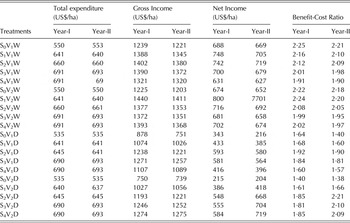
The economic feasibility of exogenous Se supply methods was calculated using a cost : benefit analysis following reports of Jafar et al. (Reference Jafar, Farooq, Cheema, Afzal, Basra, Wahid, Aziz and Shahid2012). The amount of Se applied in the present study was 75, 7·35 and 7·06 µm for Se seed priming, fertigation and foliar spray, respectively. The cost of Se required for each method was calculated on the basis of the amount of sodium selenate used to make each solution. Other costs included labour or machinery used for the application of treatments, crop production operations such as seedbed preparation, seed, amount of water used for irrigation, fertilizing, plant protection measures, harvesting and threshing (Table 4).
RESULTS
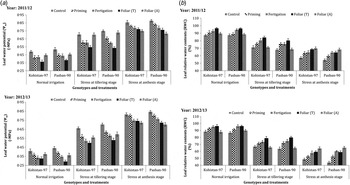
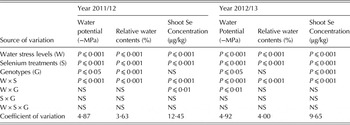
Plant water status was significantly influenced (P < 0·01) by limited supply of water to wheat plants at tillering or anthesis during both years, i.e. 2011/12 and 2012/13 (Table 1). It was noted that exposure to water stress at anthesis caused 20 and 22% more reduction in leaf water potential (Ψw) than at the tillering stage during 2011/12 and 2012/13, respectively (Fig. 2a ). During 2011/12, wheat plants sprayed with foliar Se at tillering maintained significantly (P < 0·01) higher Ψw (–0·37 MPa) than all other methods under water deficit conditions. Likewise, the foliar spray of Se at tillering resulted in the highest Ψw (–0·52 MPa) in plants water stressed at tillering or anthesis during 2012/13 (Fig. 2a ). The imposition of water stress at anthesis caused 12 and 17% more reduction in leaf RWC than at tillering during 2011/12 and 2012/13, respectively (Fig. 2b ). It was noted that foliar spray of Se at tillering resulted in the highest RWC (96·5%) in plants grown under normal conditions. Similarly, it also resulted in the maximum RWC in plants water stressed at tillering (82·3%) or anthesis (66·5%) (Fig. 2b ).
Effect of exogenous selenium (Se) supply on leaf water status i.e. (a) leaf water potential (−MPa) and (b) relative water contents (%) of two wheat (Triticum aestivum L.) genotypes under normal water supply, stress at tillering stage and stress at anthesis stage during 2 consecutive years i.e. 2011/12 and 2012/13. Values are mean ± standard error.

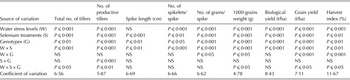
Summary of the analysis of variance (ANOVA) for leaf water potential (−MPa), relative water contents (%) and shoot selenium (Se) concentration in two wheat genotypes exposed to exogenous Se supply under drought stress in the years 2011/12 and 2012/13

Significant differences are indicated by P levels.
NS, not significant.
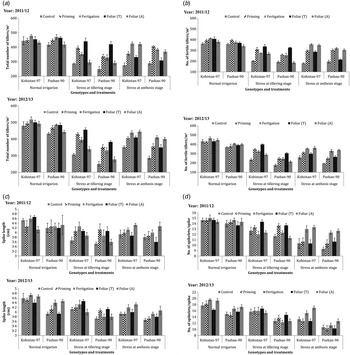
Drought stress reduced the number of tillers by 24% in 2011/12 and 27% during 2012/13 in plants water stressed at tillering, while production of tillers was 20% less in plants subjected to drought stress at anthesis during both years (Fig. 3a ), with respect to their control (normal supply of water). It was observed that fertigated plants maintained the highest values of 474·33 and 502·0, respectively, and exhibited non-significant difference from Se foliar application at tillering (459·33 and 492·67) and Se seed priming (448·50 and 481·83) under normal conditions. Water-stressed plants supplied with foliar Se at tillering produced the maximum number of tillers (430·17) in 2011/12; however, Se fertigation gave the highest value (424·83) in plants exposed to limited water conditions at anthesis during 2012/13 (Fig. 3a ).
Effect of exogenous selenium (Se) supply on yield components viz. (a) total number of tillers/m2, (b) number of fertile tillers/m2, (c) spike length (cm) and (d) number of spikelets/spike of two wheat (Triticum aestivum L.) genotypes under normal water supply, stress at the tillering and anthesis stages during 2 consecutive years i.e. 2011/12 and 2012/13. Values are mean ± standard error.

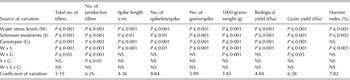
During the first year (2011/12), the maximum productive tillers (332·22) were recorded in plants fertigated with Se and differed non-significantly from Se seed priming (327·78) and foliar application at tillering (323·67). A similar trend was observed during 2012/13, when plants fertigated with Se maintained the highest value (353·33), with non-significant difference from Se foliar application at tillering (348·83) and anthesis (341·89) (Fig. 3b ). Likewise, Se fertigation gave significantly higher values (4·19 and 4·23 cm) for spike length during 2011/12 and 2012/13, respectively (Fig. 3c ). A non-significant difference was observed for number of spikelets/spike among different methods of exogenous Se supply in the first year (2011/12) (Table 2), however highly significant differences (P < 0·01) were recorded among these methods in the year 2012/13 (Table 3). The plants supplied with foliar Se at anthesis gave the highest value (15·72) for this variable, and showed non-significant difference from the value (15·39) obtained by Se fertigation (Fig. 3d ).
Summary of the analysis of variance (ANOVA) for total number of tillers, total number of fertile tillers, spike length (cm), number of spikelets/spike, number of grains/ spike, 1000-grains weight (g), biological yield (t/ha), grain yield (t/ha) and harvest index (%) in two wheat genotypes exposed to exogenous selenium supply under drought stress in the year 2011/12. Significant differences are indicated by P levels

NS, not significant.
Summary of the analysis of variance (ANOVA) for total number of tillers, total number of fertile tillers, spike length (cm), number of spikelets/spike, number of grains/ spike, 1000-grains weight (g), biological yield (t/ha), grain yield (t/ha) and harvest index (%) in two wheat genotypes exposed to exogenous selenium supply under drought stress in the year 2012/13. Significant differences are indicated by P levels

NS, not significant.
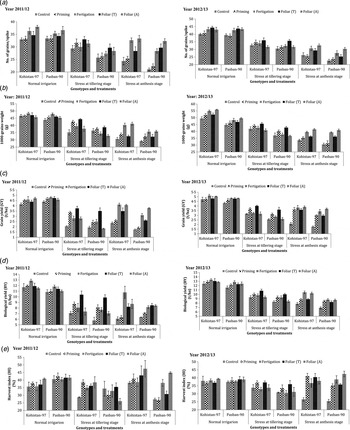
During 2011/12, the plants supplied with foliar Se at anthesis produced the maximum number of grains/spike (37·33), closely followed by Se fertigation (35·83) under normal conditions. However, Se foliar spray at tillering or anthesis gave the highest values, i.e. 31·33 and 32·82, respectively, in water-stressed plants (Fig. 4a ). Similarly in 2012/13, the foliar Se spray at tillering resulted in maximum number of grains/spike (44·00), closely followed by Se fertigation (43·17) and Se foliar spray at anthesis (43·00) under normal conditions. The plants that were water-stressed at tillering maintained the highest value (35·83) for this variable by Se foliar spray at tillering (Fig. 4a ). Fertigation of plants with Se gave the maximum value (41·09 g) for thousand-grain weight during 2011/12 and did not differ significantly from the values obtained by Se seed priming (40·14 g) and Se foliar application at tillering (39·84 g) for this variable (Fig. 4b ). In the second year (2012/13), the foliar Se spray at anthesis exhibited the highest grain weight (44·24 g) and had no significant difference from the values obtained for Se fertigation (43·76 g) and Se foliar application at tillering (43·36 g) (Fig. 4b ).
Effect of exogenous selenium (Se) supply on grain yield characteristics viz. (a) no. of grains/spike, (b) 1000-grains weight (g), (c) grain yield (t/ha), (d) biological yield (t/ha) and (e) harvest index (%) of two wheat (Triticum aestivum L.) genotypes under normal water supply, stress at the tillering and anthesis stages during 2 consecutive years i.e. 2011/12 and 2012/13. Values are mean ± standard error.

The Pasban-90 (drought sensitive) control plants fertigated with Se gave the highest GY (4·79 t/ha) in the first year of study (2011/12) and exhibited non-significant difference from Kohistan-97 (drought tolerant) for other methods of exogenous Se supply under normal conditions. Similarly, Se fertigation resulted in the highest GY (4·11 t/ha) closely followed by Se foliar spray at anthesis (4·06 t/ha) under water deficit conditions (Fig. 4c ). However, the different methods of exogenous Se supply differed (but non-significantly) for GY during 2012/13 with the minimum value (3·10 t/ha) obtained in plants with no Se applied (Fig. 4c ). The fertigation of plants with Se also resulted in maximum (12·34 t/ha) biological yield (BY) under normal supply of water (Fig. 4d ), whereas foliar spray of Se at tillering gave the highest BY (10·12 t/ha) in those plants water-stressed at tillering during 2011/12 (Fig. 4d ). A similar trend was recorded during the second year (2012/13), where plants water-stressed at tillering exhibited maximum BY (10·35 t/ha) following Se foliar spray at tillering (Fig. 4d ). Likewise, the plants supplied with foliar Se at anthesis gave the maximum value (39·88%) for HI during 2011/12 (Fig. 4e ), which differed non-significantly from the values obtained by Se foliar application at tillering (37·36%). The fertigation of plants with Se (36·84%) and Se seed priming (36·17%) also increased HI by 8 and 6% as compared with no Se supply (34·15%) (Fig. 4e ).
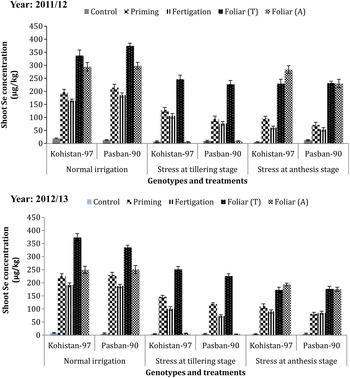
Accumulation of Se in shoots was markedly influenced by drought stress during both years (Table 1). It was noted that exposure to water stress at tillering and anthesis reduced Se content by 56 and 39%, respectively during 2011/12 (Fig. 5). A similar trend was recorded during the second year (2012/13), where limited water supply resulted in 54 and 47% less Se accumulation in shoots at tillering and anthesis, respectively (Fig. 5). Foliar Se supply at tillering resulted in maximum Se content in control plants (354·70 µg/kg) as well as those exposed to water stress at tillering (238·83 µg/kg) and anthesis (175·01 µg/kg). Moreover, the accumulation of Se in shoots was found to be 8% higher in the drought-tolerant (Kohistan-97) than sensitive (Pasban-90) genotype (Fig. 5).
Effect of exogenous selenium (Se) supply on accumulation of Se (μg/kg) in shoot of two wheat (Triticum aestivum L.) genotypes under normal water supply, stress at the tillering and anthesis stages during 2 consecutive years i.e. 2011/12 and 2012/13. Values are mean ± standard error.

The results indicated that Se supply methods resulted in the maximum return and cost : benefit ratio under water deficit conditions, whereas a non-significant effect of Se on net income was noted under normal conditions. Selenium fertigation and foliar spray were found to be the most economical as well as an effective method with respect to Se seed priming, whereas no Se supply resulted in the minimum net income and cost : benefit ratio (Table 4).
Economic analysis (to nearest US$) for the effects of exogenous selenium (Se) supply on wheat yield under normal and water deficit conditions

S0, no Se; S1, Se priming @ 0·75 µm; S2, Se fertigation @ 0·75 µm; S3, foliar application at tillering; S4, foliar application at anthesis; V1, Kohistan-97 (drought tolerant); V2, Pasban-90 (drought sensitive); W, normal water supply; D, drought stress.
DISCUSSION
Drought stress is one of the major limiting factors to achieving sustainability in agricultural crop production (Waraich et al. Reference Waraich, Ahmad, Saifullah, Ashraf and Ehsanullah.2011). A significant decrease in wheat yield under water deficit conditions suggests that the identification and development of drought mitigation strategies to not only improve yield in drought prone areas but to also bring the arid and desert regions of the world under cultivation is of prime importance. The results of present study showed that different methods of exogenous Se supply positively influenced yield and yield components and markedly improved yield under both normal and water deficit conditions. These results support previous studies, carried out under controlled conditions (lysimeter experiments), which found that Se can be used as an effective water-stress ameliorant for improving wheat yield (Nawaz et al. Reference Nawaz, Ashraf, Ahmad, Waraich, Shabbir and Bukhari2015a , Reference Nawaz, Ahmad, Ashraf, Waraich and Khan b ). Contrary to Nawaz et al. (Reference Nawaz, Ashraf, Ahmad, Waraich, Shabbir and Bukhari2015a , Reference Nawaz, Ahmad, Ashraf, Waraich and Khan b ) and the current work, Tang et al. (Reference Tang, Wang, Yang and Lv2011) and Grant et al. (Reference Grant, Buckley and Wu2007) were of the view that Se has no significant influence on GY of wheat. However, Sajedi et al. (Reference Sajedi, Ardakani, Naderi, Madani and Boojar2009) and Valadabadi et al. (Reference Valadabadi, Shiranirad and Farahani2010) observed similar results to those of the current study in maize and rapeseed, respectively, reporting that water-stressed plants treated with Se exhibited significantly higher values for total dry weight, leaf area index (LAI), relative growth rate (RGR), crop growth rate (CGR), yield and water use efficiency with respect to control plants (no Se supply).
The improvement in wheat yield by exogenous Se supply might be attributed to its pivotal role in regulating metabolic and enzymatic processes including photosynthesis (Habibi Reference Habibi2013), water status and antioxidant machinery (Djanaguiraman et al. Reference Djanaguiraman, Devi, Shanker, Sheeba and Bangarusamy2005). Moreover, Se also plays an important role in chlorophyll (Germ et al. Reference Germ, Stibilj, Osvald and Kreft2007) and protein synthesis (Good & Zaplachinski Reference Good and Zaplachinski1994) and enhances the uptake of essential nutrients (Feng et al. Reference Feng, Wei, Tu and Wu2009), which improves yield in cereals. The maintenance of favourable water status in cells is considered a prime defence mechanism in water-stressed plants (Passioura & Fry Reference Passioura and Fry1992; Kaldenhoff et al. Reference Kaldenhoff, Ribas-Carbo, Sans, Lovisolo, Heckwolf and Uehlein2008). The current results showed that the treatment of plants by Se significantly improved Ψw under both normal and limited water conditions. Selenium significantly increases water retention in plant tissues through increasing uptake of water by the root system without decreasing transpiration rate (Kuznetsov et al. Reference Kuznetsov, Kholodova, Kuznetsov and Yagodin2003). The results of the present study showed that exogenous Se supply resulted in less negative Ψw and is in line with the reports of Germ et al. (Reference Germ, Stibilj, Osvald and Kreft2007) who noted higher Ψw in Se treated potato plants under water deficit conditions. Likewise, Sajedi et al. (Reference Sajedi, Ardakani, Naderi, Madani and Boojar2009) also reported a significant increase in yield and water use efficiency of maize plants by Se foliar application. The addition of Se in growth medium improved leaf Ψw of maize plants under severe drought stress conditions (Shen et al. Reference Shen, Turakainen, Seppänen and Mäkela2008). Emam et al. (Reference Emam, Khattab, Helal and Deraz2014) suggested that Se application increases the concentrations of organic and non-organic osmoprotectants that improve water retention in plant tissue. In the present study, the foliar-applied Se at tillering also markedly enhanced the RWC of water-stressed plants. Wang (Reference Wang2011) reported that the combined treatment of Trifolium repens L. plants with polyethylene glycol (PEG) and Se increased RWC more than PEG treatment alone. Similarly, Habibi (Reference Habibi2013) found that Se-treated barley plants exhibited high RWC under normal conditions. Proietti et al. (Reference Proietti, Nasini, Del Buono, D'Amato, Tedeschini and Businelli2013) noted similar results in olive trees and suggested that the stimulating effect of Se might be due to increased membrane integrity (Hartikainen et al. Reference Hartikainen, Xue and Piironen2000) or reduced photo-oxidation (Seppänen et al. Reference Seppänen, Turakainen and Hartikainen2003).
A significant increase in number of productive tillers by exogenous Se supply indicates its vital role in seedling establishment and early growth through development of vegetative structure and production of assimilates to fill an economically important sink (Boldrin et al. Reference Boldrin, Faquin, Ramos, Boldrin, Ávila and Guilherme2013). The current results are in agreement with the report of Djanaguiraman et al. (Reference Djanaguiraman, Devi, Shanker, Sheeba and Bangarusamy2005), who observed that Se significantly influences water status of moisture-stressed seedlings and activates plant hormones responsible for cell expansion to improve growth at early stages. Selenium also promotes the development of healthier and more vigorous radicles with extensive root hairs, which significantly increase root activity under water deficit conditions (Yao et al. Reference Yao, Chu and Wang2009). It is noteworthy that in the current work, Se foliar spray was more effective at tillering than anthesis, which supports the findings of Smrkolj et al. (Reference Smrkolj, Stibilj, Kreft and Germ2006) and Kahakachchi et al. (Reference Kahakachchi, Boakye, Uden and Tyson2004) that actively growing plant parts such as young leaves and seeds accumulate large amounts of Se, which facilitates seedling establishment and leads to improved productivity at later stages. Selenium-mediated increases in wheat yield is consistent with the findings of Yao et al. (Reference Yao, Chu, He, Liu, Li and Yue2013), who recorded significant increase in yield attributes such as spike length, weight per spike and GY by exogenous Se supply. Similar results were reported by Zahedi et al. (Reference Zahedi, Rad and Moghadam2012) in canola cultivars and Proietti et al. (Reference Proietti, Nasini, Del Buono, D'Amato, Tedeschini and Businelli2013) in olive trees under water deficit conditions. In contrast, Tadina et al. (Reference Tadina, Germ, Kreft, Breznik and Gaberščik2007) noted that Se foliar application was only favourable for well-watered buckwheat; however, it did not significantly improve the biomass of water-stressed plants. Likewise, no marked effect of Se supply on growth and yield of soybean was observed by Yang et al. (Reference Yang, Chen, Hu and Pan2003), whereas Germ et al. (Reference Germ, Stibilj, Osvald and Kreft2007) recorded a significant decrease in growth of potatoes treated with Se. The application of Se at the proper concentration and time is essential to minimize its potential growth-restricting role, since it may become toxic at high levels as reported by Shen et al. (Reference Shen, Turakainen, Seppänen and Mäkela2008), who found that the application of low Se doses significantly increased the dry weight of maize and improved the stress recovery of plants.
The uptake and accumulation of Se is highly influenced by pH, iron oxides/hydroxides, adsorption of Se on clay contents, organic matter and metal oxides content of soil, which determines the bioavailability of Se to plants (Kabata-Pendias Reference Kabata-Pendias2001). It is well reported that exogenous Se supply increases its concentration in plant tissues (Chilimba et al. Reference Chilimba, Young, Black, Meacham, Lammel and Broadley2012; Boldrin et al. Reference Boldrin, Faquin, Ramos, Boldrin, Ávila and Guilherme2013; Han et al. Reference Han, Li, Xiong, Tu, Chen, Li and Xie2013; Wang et al. Reference Wang, Wang, Mao, Zhao and Huang2013). Wheat is regarded as one of the most efficient Se accumulators among cereal crops such as rice, maize, barley, oats, etc. (Lyons et al. Reference Lyons, Stangoulis and Graham2003). It is observed that Se accumulation is higher in actively growing tissues (Kahakachchi et al. Reference Kahakachchi, Boakye, Uden and Tyson2004) and that shoots and leaves accumulate more Se than root tissues (Zayed et al. Reference Zayed, Lytle and Terry1998). It was noted in the current work that plants sprayed with Se at tillering accumulated more Se in shoots, whereas control plants with no Se applied contained negligible amounts of Se. The current results are in agreement with the reports of Smrkolj et al. (Reference Smrkolj, Stibilj, Kreft and Germ2006) and Kahakachchi et al. (Reference Kahakachchi, Boakye, Uden and Tyson2004), who were of the view that Se supply at early stages results in the accumulation of large amounts of Se in shoots, which facilitates seedling establishment and enhances productivity at later stages. Xu & Hu (Reference Xu and Hu2004) suggested that Se influences antioxidant activities that lead to higher Se accumulation in shoots of water-stressed plants (Lyons et al. Reference Lyons, Genc, Soole, Stangoulis, Liu and Graham2009).
In the current study, Se foliar supply and fertigation resulted in the highest wheat yield in both genotypes. The current results are in agreement with the findings of Teimouri et al. (Reference Teimouri, Hasanpour and Tajali2014), who noted that Se foliar spray at stem elongation and flowering markedly improved wheat yield under drought-stress conditions. The current study found that Se fertigation and foliar spray are the most effective Se supply methods, which further confirms that Se is more effectively absorbed through roots and leaves. Selenium transport through xylem and phloem markedly influences accumulation of ions in plant cells through its interaction with the plasmalemma and metabolic cell processes (Pazurkiewicz-Kocot et al. Reference Pazurkiewicz-Kocot, Galas and Kita2003). Hydroponic conditions provide a better medium to study the uptake efficiency of Se: it not only removes the limitations of heterogonous soil conditions but also provides more reliable information about Se accumulation by different genotypes (Nawaz et al. Reference Nawaz, Ashraf, Ahmad, Waraich and Shabbir2014). The rate and method of Se application are reported to affect Se translocation within crops, while other factors such as yield may also affect grain Se concentration through dilution effects, i.e. a low-yielding crop in a dry area may have higher grain Se than a high-yielding crop grown on an irrigated site (Curtin et al. Reference Curtin, Hanson, Lindley and Butler2006). The variation between drought-tolerant (Kohistan-97) and susceptible genotypes (Pasban-90) for Se accumulation might be due to the differences in maintenance of tissue turgor, physiological activities, water uptake from soil and reduction in water loss through stomata (Nawaz et al. Reference Nawaz, Ahmad, Ashraf, Waraich and Khan2015b ; Terzi & Kadioglu Reference Terzi and Kadioglu2006).
CONCLUDING REMARKS
The present study confirms the hypothesis that the time and method of Se application plays a critical role in improving wheat yield under water deficit conditions. The cost : benefit analysis showed that Se fertigation and foliar spray are the most profitable methods for improving wheat yield under drought stress conditions. It is concluded that the application of Se as fertigation or foliar spray at tillering is the most viable and effective method for improving wheat yield in drought-prone areas of the world.
We are highly thankful to Higher Education Commission of Pakistan (HEC) for providing financial grant (Project Pin No. 074-1969-AV4-185). The technical assistance of Mr. Ghulam Farid, Research Assistant at Nuclear Institute for Agriculture and Biology, Faisalabad (Pakistan) is also highly appreciated.