


Introduction
The idea of commitment, understood as preparedness to carry out an intention in anticipation of countervailing reasons (Bratman, Reference Bratman1999: 2–4; Chartier, Reference Chartier2018: 3; Elster, Reference Elster2000; Gilbert, Reference Gilbert and LaFollette2013: 6, Reference Gilbert2014: 899; Schelling, Reference Schelling2006), plays a pivotal role in Elinor Ostrom’s understanding of self-governed, collective resource systems (Ostrom, Reference Ostrom1990: 44, Reference Ostrom1999: 2, Reference Ostrom2000: 152, Reference Ostrom2010a: 660; Ostrom et al., Reference Ostrom, Walker and Gardner1992: 404–405). Indeed, collective self-governance works because people trust that others are committed to the rules. This shared belief creates reliable compliance without the need for constant, invasive monitoring (Ostrom, Reference Ostrom1990: 15, also pp. 29, 89; Reference Ostrom1999: 2–3). The way in which such commitment informs agents’ choices within Ostrom’s framework is, however, a matter of controversy. Lewis and Petersen (Reference Lewis and Petersen2023), drawing on the work of Amartya Sen (Sen, Reference Sen1977, Reference Sen1985, Reference Sen2004), argue that once a system’s rules are in place, agents have no reason to act contrary to their permissible goals. They have no reason, then, to make choices that do not directly make them better off. This does not preclude individual creativity and experimentation (Lewis, Reference Lewis2017; Lewis and Runde, Reference Lewis and Runde2025: 9). Such reflexive (what Hollis Reference Hollis1977 might call active) conduct is, however, on the Lewis-Petersen view, guided by incentive and appetite for risk (Lewis and Petersen, Reference Lewis and Petersen2023: 40). We need not invoke commitment to account for it. Choices that count as direct self-regulation (choices made because they align choice with firm intention) have no place, on their reading, in Ostrom’s account of the behavioural foundations of stable collective systems.Footnote 1
However, in recent work, Paniagua (Reference Paniagua2022) attaches great significance to actors’ within-system decisions to align choice with commitment, seeing this as a central lesson of Elinor Ostrom’s work. As Ostrom herself noted (Ostrom, Reference Ostrom2012), the decision structures of large-scale polities (national and supra-national) consist typically of a nested hierarchy. At community level, informational asymmetries and impracticalities of monitoring and enforcement entail that the achievement of a range of policy objectives (e.g., in public health and education) require spontaneous compliance. Such co-production of social outcomes (Paniagua, Reference Paniagua2022: 221–22; Ostrom and Ostrom, Reference Ostrom, Ostrom, Emanuel and avasa1979: 26; see also Vincent Ostrom, Reference Ostrom1973/2008: Ch. 7) is not, then, achieved by threat or positive sanction but relies on agents’ active alignment of their conduct with objectives to which they are committed. Paniagua is, perhaps, clearest in the abstract to his 2022 paper that ‘the production of public health requires citizens to actively adopt precautionary and cooperative measures’, italics added. He provides examples of spontaneous compliance in education and health at pages 223 and 225, respectively.
Acts of co-production, so understood, are examples of what I will call unobserved compliance: individual decisions to align conduct with the expectations the given society would positively sanction, where non-compliance would likely go unnoticed by agencies with the authority to apply sanctions. Of course, much compliant behaviour is done privately and so is in that sense unobserved – to invert Iris Young’s formulation, ‘we live not only in history but also in our houses’ (cf. Young, Reference Young2011: 87). However, I use the phrase ‘unobserved compliance’ to distinguish between acts that are likely to be effectively monitored (e.g., the filing of tax returns) and those that are not (for example, insider trading).Footnote 2
The acts of unobserved compliance that Paniagua identifies with co-production are acts that are done for reasons of commitment rather than fear of sanction and involve just the kind of reflexive self-regulation that Lewis and Petersen say does not feature in Ostrom’s framework, once a system’s rules are settled, i.e., in agents’ everyday lives.Footnote 3
There is evidence in Ostrom for each of these interpretations. On the one hand, she adopts a conception of agency in which incentive is alone decisive for agents’ choices. Where there is commitment to a particular plan of action, this is reflected in the relative costs of available options. The regret or shame, for example, of failing to align choice with prior commitment provides an incentive to remain committed (Crawford and Ostrom, Reference Crawford and Ostrom1995: 595; Ostrom, Reference Ostrom1990: 15–16, Reference Ostrom2010b: 160, Ostrom et al., Reference Ostrom, Walker and Gardner1992: 415, n1). Yet Ostrom also observes that the need to actively resist temptation, and so the need to act on commitment, is ‘ever present’ (Ostrom, Reference Ostrom1990: 15, also pp. 29 & 89). There is, she says, a need to actively avoid temptation to act against the collective interest (Ostrom, Reference Ostrom2010b: 156) and to keep to one’s commitments, within-system (ibid: 161).Footnote 4
Moreover, there is an attitudinal dimension to commitment in Ostrom’s thinking. The idea of credible commitment (e.g., Ostrom, Reference Ostrom1990: 44) contains a distinction between commitment as a type of decision – one that implies firm intention – and the attitude that is required of an agent if they are (in the face of challenges) to keep to their intended plan. At 2005: 14, for example, Ostrom says, ‘When the interactions yielding outcomes are productive for those involved, the participants may increase their commitment to maintaining the structure of the situation as it is, so as to continue to receive positive outcomes’ (italics added), implying a distinction between commitment as decision and the attitudinal dimension required to regulate its strength. Although Paniagua, I would argue, correctly reflects this attitudinal aspect in his account of the role of commitment in Ostrom (co-producers must, by implication, show strength of will), Lewis and Petersen do not.Footnote 5
This controversy reveals a tension in Ostrom’s work. Self-governing systems, she recognises, depend for their stability on unobserved compliance, acts of self-control (of active commitment) that align personal choices with collective interest, even in the absence of binding pressure (Ostrom, Reference Ostrom1990: 44). Ostrom also makes provision for such self-moderation in the evident attitudinal dimension she associates with effective commitment. Yet throughout her work, it is incentive that is decisive for individual choice. Where commitment matters, it influences choice only indirectly by the way it changes the costs and benefits of personal decisions (e.g., Crawford and Ostrom, Reference Crawford and Ostrom1995). Decisions to act on commitment, then, do essential work in Ostrom’s thesis to secure stability, yet despite their fundamental role they have limited explanatory status. She presents a stable system as one in which agents are adequately incentivised to carry out their positional responsibilities, and in which commitment bears explanatory power to the extent that it shapes incentives. Yet stability depends more fundamentally, in her work, on unobserved compliance, moments when agents decide to comply despite the absence of direct incentive.
The purpose of this paper is to resolve this tension. It is argued that unobserved compliance, as I have defined it, is necessary for the stability of self-governing systems and that such compliance depends primarily on agents’ strength of commitment – the degree of their preparedness to resist the temptation, in private, to not comply with institutional rules and expectations. A distinction is drawn, moreover, between two types of commitment: a type that is associated with within-system, for example work-based, responsibilities; and the commitment an agent has to the system as such. Reading this distinction back into Ostrom’s thesis provides the explanatory role for unobserved commitment that her theory arguably lacks.
In section one, I contrast the Lewis-Petersen and Paniagua accounts of commitment in Ostrom and argue that Paniagua’s view is more faithful to Ostrom’s intention. The work of Michael Bratman and Margaret Gilbert is drawn on to help underline the productive distinction between the decisional and attitudinal dimensions of commitment. A second section argues that reading Paniagua’s interpretation back into Ostrom reveals a problematic tension in her work and finds its roots in Ostrom’s exclusive use of an incentive-based account of choice. The alternative conception of agency and how it relates to the two types of commitment is proposed in section three, where I also consider two natural objections to my thesis. A final section concludes.
Two interpretations of the role of commitment in Ostrom
Lewis and Petersen (Reference Lewis and Petersen2023) draw on the choice-theoretic work of Amartya Sen to evaluate the role that commitment plays in Elinor Ostrom’s theoretical framework. In their interpretation of Ostrom, agents commit to a course of action when deciding whether to adopt new rules (Lewis and Petersen, Reference Lewis and Petersen2023: 857–858). Once rules have been implemented, however, within-rules conduct is directed towards specific, personal goals – and so ‘commitment’ is not a relevant explanatory category when explaining the conduct of agents in everyday contexts. To help us to understand their analysis, it is helpful to refer to a distinction that Sen adopts in his work on commitment.
Sen has long urged economists to recognise a distinction between a person’s reason for the choices they make and their preferences (Sen, Reference Sen1994: 385–387; see also Reference Sen1973, Reference Sen1977, Reference Sen1993, Reference Sen1997). We may think a person’s preferences are inconsistent, for example, when in fact their choices are sensitive to context or norm (Sen, Reference Sen1993: 499–501), or, more generally, regulated by a second-order rationale (Sen, Reference Sen1977). Relating this to commitment, Sen distinguishes (in particular, Sen, Reference Sen2004: 36–37) between a decision to commit and the way that such a decision, once made, constrains future choices. A commitment is, for Sen, a decision made for a reason, a decision not therefore directly (for example, causally, or physiologically) traceable to a motivating factor such as a desire or inclination, as such (Sen, Reference Sen2004: 35). Once made, however, a commitment typically informs an agent’s choices by the way it conditions what they then ought to see as permissible, strategically sensible, or consistent with their plan (see also Schelling, Reference Schelling2006). According to Sen’s picture, then, a committed person is one who has made a decision to commit. This ought to inform the type of choice they subsequently make but need not entail further acts of reflexive self-regulation.
The distinction between acts of commitment and the structure they impose on choice is found elsewhere in, for example, Margaret Gilbert’s work on joint commitment (Gilbert, Reference Gilbert and LaFollette2013, Reference Gilbert2014). For Gilbert, when two or more people decide to do something together this creates expectations in each that all are (owing to their commitment) obliged to respect. Commitment, she says, has a psychological dimension (the decision) and a normative dimension (the entailed constraint): commitment is ‘in a broad sense a psychological matter. One’s being committed is a normative matter…if, for example, Jack decides to go swimming tomorrow, and does not change his mind, then, all else being equal, he will act in error if he fails to go swimming tomorrow’ (Gilbert, Reference Gilbert2014: 6).
In Michael Bratman’s work on commitment (particularly his later work), a decision to commit carries authority over future choices that it is a matter of temporal rationality to accommodate (Bratman, Reference Bratman1987, Reference Bratman1999, Reference Bratman2001, Reference Bratman2007, Reference Bratman2009, Reference Bratman2024). Commitment creates a ‘self-governing policy’ that ‘has a claim to agential authority – a claim to speak for the agent – in large part because of its role in the cross-temporal organisation of the agent’s thought and action..’ (Bratman, Reference Bratman2004: 330). Sánchez-Cuenca’s (Reference Sánchez-Cuenca1998) understanding of commitment betrays the same structure, it being a way for an actor to manipulate their environment, which ‘manipulation typically takes the form of either restricting one’s discretion or self-imposing costs that modify the consequences of one’s choices’ (Sánchez-Cuenca, Reference Sánchez-Cuenca1998: 78, 80).
Lewis and Petersen appear to identify this type of separation in Ostrom’s theoretical framework – a separation of commitment’s decisional and structuring components. A decision to commit is associated, they argue, with the choice to adopt rules for a collective resource system (Lewis and Petersen, Reference Lewis and Petersen2023: 857). This will typically involve a choice to adopt a rule-system of such complexity that the likelihood it will better achieve agents’ aims may be largely opaque. In this situation, the primary rationale for choice cannot be merely instrumental (recall Buridan’s ass Sen, Reference Sen1973), particularly if it is thought of as an adaptive system (Lewis, Reference Lewis2017) that may develop in unpredictable ways. Such a choice requires a considered evaluation of the options that cannot refer to the agent’s own goals, per se, as justification for the choice made. In this way, in the Lewis-Petersen view, a decision to continue to participate in a collective resource system in the face of significant rule changes constitutes an act of commitment.
In contrast, it is their view that within-rules choice has a different character. Choices made in carrying out positional or professional responsibilities may be informed by agents’ commitments (to norms, to formal prohibitions, loyalties, and so on). However, acts of choice within the system are, in their view, instrumental, intended to further given, personal goals (Lewis and Petersen, Reference Lewis and Petersen2023: 857–858). There is thus, in Ostrom, as Lewis and Petersen interpret her work, a schism between decisions that are taken to adopt rules for a collective resource system (these typically require an act of commitment) and within-rules choices that may reflect commitment but are not themselves decisions to commit.
However, the reading that Lewis and Petersen present of Sen pays arguably too little attention to the attitudinal dimension of commitment in his work. In his account of how agents can overcome the sub-optimal collective outcome associated with the canonical prisoner’s dilemma, Sen proposes that each be presumed to act on as-if preferences, preferences they would have were they to be directly informed by collective interest (Sen, Reference Sen1985: 346). It seems reasonable, then, as Lewis and Petersen do, to consider such preferences as norm governed. This, however, delivers an arguably faulty interpretation of Sen’s intention. Agents’ preferences remain as-if. While they choose to act according to these hypothetical preferences, there is an abiding temptation that each must overcome in order to successfully keep to the commitment to act on their as-if rather than their actual preferences. What this requires is not only a decision to act on as-if preferences but to actively moderate their choices so as to successfully carry out their intention. This requires an attitude toward commitment that is captured by ideas of, for example, determination or fortitude, volitional qualities that may vary in strength over time and between persons.
Indeed, the attitudinal dimension of commitment, while rarely considered explicitly by Bratman and Gilbert, is arguably a necessary component of their theses. In Bratman’s work, the acceptance of the practical authority of a commitment is not merely decisional but reflects an attitude towards it. In Gilbert’s work, what enables a person to keep to the normative requirement to honour a joint commitment is not the obligation per se, but active self-regulation, where, again, this reflects the agent’s attitude to what (according to Gilbert) is required.
Once we recognise the attitudinal dimension of commitment, we are led, I would argue, to query the divide in Lewis and Petersen’s analysis of Ostrom’s theory between the role of commitment in the formation of rules and its role in the lives of rule-followers. Ostrom refers on many occasions to the temptation to break the rules. For temptation to be in view, we cannot presume that agents are unreflectively obedient. This implies that there must be self-regulation on the part of agents reflecting their attitude toward their personal commitments (to work, to expectations of position, and so on).
An alternative reading of Ostrom has been offered recently by Pablo Paniagua (Reference Paniagua2022). Paniagua’s reading appears supportive of the idea that within-rule commitment in Ostrom has an attitudinal as well as a decisional dimension. A key lesson from Ostrom, he suggests, is that self-governing systems rely for their success on spontaneous compliance (in particular, Paniagua, Reference Paniagua2022: 229; see also Rayamajhee et al., Reference Rayamajhee, Shrestha and Paniagua2021). The temperate sanctions and non-intrusive monitoring in such systems mean that many compliant acts are unobserved at the point of choice. Indeed, the act of monitoring itself, given the personal responsibility afforded monitors, requires frequent acts of unobserved compliance (e.g., Crawford and Ostrom, Reference Crawford and Ostrom1995). A defining characteristic of such unobserved acts, as has been noted, is that they are not (indeed, being in this sense private, cannot be) directly controlled by sanction or reward, at the point of choice. They require active self-moderation, and they are acts that are not only informed by commitment but that constitute a decision to act in accordance with it.
Such acts are characteristically vulnerable to temptation. Overcoming this is not merely decisional but requires strength of conviction, determination to do the right thing, and so on, which belong to the attitudinal dimension of commitment. Paradigmatic is the decision to isolate during a pandemic where there are no outward signs of infection (Paniagua, Reference Paniagua2022: 222). Deciding to isolate is not alone enough. Adherence to decisions like this requires the attitudes (e.g., persistence and restraint) that are necessary for successful self-management. Commitment, then, for Paniagua, contra Lewis and Petersen, is a feature of within-rules choices. Pivotal to the distinction between their two accounts is, I suggest, Paniagua’s inclusion (albeit, largely implicit) of the attitudinal dimension of commitment, and its importance to self-moderation in the face of temptation.
There is reason to think that Paniagua’s interpretation of the role of commitment in Ostrom’s thesis is accurate. Consider, for example, the support that he draws from Ostrom’s ‘decentralisation theorem’ (Ostrom, Reference Ostrom2011: 370; Paniagua, Reference Paniagua2022: 229). According to this theorem, the most efficient way to mitigate the negative effects of non-compliant conduct is to concentrate efforts close to their source. Only where such externalities cannot be managed locally should higher-order authority be called upon. But there are types of action that have negative societal effects and for which non-compliance will typically occur unobserved. The example of self-isolation has been mentioned. Other examples include self-administered medicine, personal educational effort, domestic fire prevention, responsible parenting, and so on (Alford, Reference Alford2014: 302, 310; Aligica and Tarko, Reference Aligica and Tarko2013: 732; Ostrom et al., Reference Ostrom, Parks, Whitaker and Percy1978: 383). Compliance in this type of scenario can, in principle, be incentivised but technical issues around the monitoring and punishment of such activities, and broader political concerns around, for example, excessive intrusion, create a de facto private sphere, in which system-designed incentives are neutralised. But why must we invoke commitment to explain these types of choices? Parents who put effort into their children’s cultural education, for example, might surely do that because they are incentivised to see their children flourish. Why aren’t Lewis and Petersen right, then, that this kind of within-rules behaviour is instrumental and so explicable with reference to solely interest-oriented reasoning?
For Lewis and Petersen, Sen views commitment as goal-displacing (Lewis and Petersen, Reference Lewis and Petersen2023: 861 & n.17). On this (natural) interpretation of what Sen says, commitment entails a disconnect between the reasons for a person’s actions and their personal motivations. Committed action is exclusively ‘non-self-goal’ (cf. Sen, Reference Sen1985: 341, 347). On this reading, Lewis and Petersen would appear to be right that commitment and the personal goals involved in everyday life are unrelated. Their reading of commitment is not, however, compulsory.
Philip Pettit presents a critique of Sen’s work on commitment (Pettit, Reference Pettit2005: esp. 18–19) in which he argues that commitment ought not to be viewed as goal-displacing. To view it this way, he argues, violates a fundamental tenet of rational choice theory, that choice tracks personal motivation. To avoid this error, as Pettit sees it, Sen must avoid a goal-displacing account. Commitment can at most be ‘goal-modifying’ (Pettit, Reference Pettit2005: 18) – a person might aim, for example, for a group-based objective but only insofar as it engages them. This view of commitment is, moreover, consistent with the challenge a person might experience in aligning their will with their intention. Goals so adopted need not, as Pettit puts it, ‘mainline my mind, as it were, and take possession of it’ (Pettit, Reference Pettit2005: 20). It is possible, then, on this approach to view long-term (e.g., educational, health, or community-oriented) objectives as being both ‘self-goal’ and reflective of personal commitment.
The cultural education of a child may then, to recall the example, be motivated by long-term incentives and so be self-goal while still requiring commitment. Being motivated does not necessarily make it easy for a person to inculcate self-discipline, say, in a particularly recalcitrant child at the end of a demanding day. For this, the long-term incentives may not sustain motivation, requiring active, recurrent self-regulation on the part of, in this example, the parent. This case shares a central feature with Paniagua’s self-isolating individual during a pandemic. The choice requires strength of will in the face of temptation to take an easier path. On each occasion that attention needs to be paid to the child, the long-term incentive (the child’s academic success, say) is likely to be weaker than the present temptation to be neglectful. It would be incorrect then to characterise attention to the child’s education as being wholly determined by incentive (or, indeed, routine or habit, Fleetwood, Reference Fleetwood2008; Hodgson, Reference Hodgson2010; James, Reference James1914).
As has been pointed out, the stability of self-governing systems derives, in part, from the belief participants have that others are acting in good faith. Given this presumption, monitoring and the threat of punishment for non-compliance encourage compliant behaviour in large part through the reassurance they provide of the widespread compliance of others. Ostrom (Reference Ostrom1990: 94–95) acknowledges the influence of Margaret Levi’s ideas in this regard (Levi, Reference Levi1989); a similar point is made in Vidal (Reference Vidal2003: 30–31 & 46). However, the stability of a collective resource system depends more fundamentally on unobserved compliance, opportunities that participants have to act contrary to collective interest, in secret, that they do not take. These choices cannot be explained solely by system-designed incentives because they are scenarios in which incentives have no direct purchase. They can, however, be accounted for if we characterise them as acts of commitment, decisions to self-regulate in the face of temptation to act against collective interests. As has been noted, Ostrom recognises this deep source of stability. There is a difficulty, however, when we try to read Paniagua’s interpretation into Ostrom’s work.
The difficulty and its root
I have so far suggested that Ostrom sees the need for agents to overcome temptation by self-moderation and recognises that such acts are a fundamental source of social stability. Yet the act of self-moderation does not play an explicit explanatory role in her theory. This section attempts to uncover the roots of this lacuna.
Note first the distinction Ostrom makes between (1) a social context and (2) the behavioural rules that ‘animate’ it (Crawford and Ostrom, Reference Crawford and Ostrom1995: 583). The context, which includes the agential characteristics of the members of a given society (such as their attitudes and motivations) and their institutional environment (the rules they face), as such, lacks a bridge between factors that structure choice (motivations, rules) and actual choice. To provide such a bridge, to animate a collective system, Ostrom says – and here she displays her Popperian convictions (Ostrom, Reference Ostrom1990: 38; Popper, Reference Popper and Miller1967) – what is needed is ‘a theory of action’ (Crawford & Ostrom, ibid.; Ostrom, Reference Ostrom2005: 99). This tells us how agents respond to the normative requirements and expectations that constitute their institutional setting.
The theory of action that Ostrom chooses to characterise conduct is the rational actor model (e.g., Ostrom, Reference Ostrom2009a, Reference Ostrom and Levin2009b). Fundamentally unchanged since its early formulations in, for example, Bentham (Reference Bentham1789: 1) and Jevons (Reference Jevons1871: Ch.3), according to the rational actor model, agents’ actions track personal net benefit. This is fully consistent with Ostrom’s simultaneous adoption of bounded and exploratory conceptions of behaviour (e.g., Ostrom, Reference Ostrom1990: 34) because the model requires only (and for Ostrom, secundum Popper) that agents act in their best interest at point of choice. Critiques of Ostrom’s behavioural assumptions in Lewis (Reference Lewis2017) and Tarko (Reference Tarko, Lemke and Tarko2021) emphasise the broad-based nature of Ostrom’s approach to behaviour. Indeed, it is true (e.g., Ostrom, Reference Ostrom1991: 238 & 242) that she thought an inclusive approach to explanations of human behaviour to be productive. However, in her actual theoretical writing, Ostrom cleaves to a net-reward model of agency, in which – at point of choice – the option that offers highest return is the one that is chosen. It is this that animates her models, which animation has its roots in Popper (Ostrom, Reference Ostrom1990: 38).
The presumption that what is decisive for choice is net reward at the point of choosing enables Ostrom to employ rational choice theory, including game-theoretic modes of analysis. It facilitates the creation of analytical models and the use of experimental work to complement the empirical inquiry that is characteristic of her research. However, it also entails that the only way commitment can inform choice, in Ostrom’s theory, is through its impact on the costs and benefits of action. In her 1995 paper with Sue Crawford, for example, not only external but also internal bases of commitment shape choice through their impact on a (delta) parameter (Crawford and Ostrom, Reference Crawford and Ostrom1995: 588) that reflects the psychic costs associated with the regret, shame, and so on of failing to follow through on a commitment (cf. Ostrom, Reference Ostrom2014: 12).
This method of representing commitment is, however, problematic. Private acts of self-moderation (acts of unobserved compliance) are not influenced directly by institutional incentives (the wage rate, threats of punishment, and so on). Equally, it would be mistaken to suppose that such acts can be adequately explained by internal bases of commitment (loyalty, integrity, and the like), on the presumption that these provide internally generated incentive. To suppose that such incentives, those that commitment itself provides, are decisive for choice in private settings would misrepresent such choice scenarios. In such settings, agents are tempted to misbehave. A presumption that incentives, grounded in commitment, are decisive for choice in such scenarios would obviate the need for agents to wrestle with temptation. Where agents choose to comply, though unobserved, it must be an active decision that guides their choices, an act of self-regulation.
Toward an alternative model
Ostrom notes in her work the distinction between a framework, a theory, and a model (Ostrom, Reference Ostrom1991: 243, n.1, Reference Ostrom2005: 27). Although a framework provides the rationale for the inclusion of select variables of interest, theory shapes how they interrelate. A model then gives logical structure to those loose relationships. Consumer theory, for example, contains agents defined by type of activity and relevant scenarios (a framework), relates them via presumed motivations (theory), and employs functional logic (a model). The choice model Ostrom adopts, I have claimed, is one in which commitment affects choice via its effect on incentives, and this is so because, in the model, reward is always decisive. The model represents the relationship between commitment and incentive as one way – commitment creates incentive (as has been mentioned, by, for example, encouraging a person to anticipate the regret of failing to align actual choice with firm intention).
However, one can attribute to Ostrom a more nuanced theoretical stance, one in which the relationship between commitment and incentive is bi-directional or symbiotic. On this, quite natural reading, where there is convincing evidence of widespread compliance it provides incentive to comply and, reciprocally, moderates the degree of sanction that is needed to encourage compliant conduct. Furthermore, it need not be seen as problematic that the (one-directional) model does not reflect in its logic the (bi-directional) conception of the commitment-incentive relationship that may be ascribed to Ostrom at the level of theory. Mathematisation is typically reductive.
However, recall the definition of stability at footnote 1, above. The relevant problematic is one in which there might be evident stability – agents appear to be fulfilling their positional responsibilities, for example – while quite unobserved they are acting against collective interests. It is this combination of observed stability and simultaneous unobserved instability that Ostrom moots but fails to represent. It has been noted that Ostrom’s incentive-based account of the influence of commitment on choice cannot accommodate the temptation that is characteristic of unobserved choice scenarios. It is important to note that appeal to Ostrom’s arguably more nuanced, bi-directional account of the role of commitment in choice (an account that might be observed at the theoretical level) is similarly unable to articulate the character of choice in unobserved settings. This is because situations in which unobserved non-compliance may arise are beyond the control of the system’s incentive structure. This suggests that neither Ostrom’s theory nor her model is adequate to account for moments that require unobserved compliance. This is important, moreover, because such moments pose (as Ostrom herself says) an ever-present threat to system stability.
These observations indicate the central challenge facing any attempt to provide an alternative rendition of the relationship between commitment and incentive in this context. Not only must the commitment-incentive relationship be such that it represents unobserved decisions to comply as moments of temptation, it must also account for the constant, simultaneous presence of both observed compliance and the possibility of unobserved non-compliance. That is, the simultaneous presence of evident stability with abiding systemic fragility. To attempt to meet these theoretical requirements in a way that is consistent with Ostrom’s overall framework, it is helpful to distinguish two types of commitment and their different roles within Ostrom’s work.
Two types of commitment in Ostrom
As has been noted, commitment plays a crucial stabilising role in Ostrom’s account of self-organising collective resource systems. There are two ways in which commitment performs this function in her work, forming a distinction that Ostrom never fully articulated, seemingly because she had limited use for the idea of commitment per se. First, she notes an abiding characteristic of self-organising systems, that members tend to be invested in the condition of the system as a whole. While each stands to gain personal reward through their labour, each is also aware of the shared reliance of the collective on the system’s success overall. It is, Ostrom suggests, a mark of successful self-organising systems that there be, for example, a sense of a shared future, a narrative that invokes their common circumstance (Ostrom, Reference Ostrom1990: 21 & 26, Reference Ostrom and Levin2009b: 215). She notes, for example, in relation to discount rates, where there is temporal insecurity of resources, the vulnerability of the system gives its preservation direct significance (Ostrom, Reference Ostrom1990: 34–35). Indeed, where collective projects have been successful, Ostrom notes, ‘the continuing commitments of the appropriators to their institutions have been substantial in these cases’ (Ostrom, Reference Ostrom1990: 59, italics added; Reference Ostrom2010c: 325). This awareness of collective interest is the basis of the first form of commitment (let us call it C1).
Commitment of type C1 played an increasingly important role in Ostrom’s thinking. In a paper from 2000, she speculates that nascent civilisations – emerging during the Pleistocene-Holocene transition – depended for their survival, ‘not only on aggressively seeking individual returns but also on solving many day-to-day collective action problems’. (Ostrom, Reference Ostrom2000: 143). Collective action necessarily requires, in this account, a dual orientation on the part of participants: a concern for self and recognition of the impact of personal conduct on collective outcomes (a duality that is missing, interestingly, from, say, Mandeville (Reference Mandeville1714), and that Young (Reference Young2011) wanted to invigorate). A key, foundational element is what Ostrom calls ‘contingent self-commitment’ (Ostrom, Reference Ostrom2000: 152), preparedness to obey norms and formal rules where there is sufficient surety that others will too. The way that C1 underpins self-moderation is in this way fundamental to the explanatory success of Ostrom’s framework. To see this, note the relationship in Ostrom’s work between a tendency toward self-moderation on the part of participants, and the incentive structure they face. Where individuals are predisposed to moderate their behaviour (owing to type-C1 commitment), it is possible to temper incentives accordingly. Self-monitoring can be effective in this environment, and sanctions can be weaker, or of a more guardrail nature, precisely because agents are capable of a degree of self-restraint that obviates the need for, for example, highly punitive sanctions administered by an alien agency (Ostrom and Ostrom, Reference Ostrom and Ostrom2004: 131–132, sec. B).
This first form of commitment, then, creates the bases of endogenous sources of governance. But while shared values, a common language (or vernacular Ostrom and Ostrom, Reference Ostrom and Ostrom2011: 130), a common narrative and trust underpin C1, a society formed on this basis alone is insufficiently stable. While collaboration creates opportunities for collective action, it also, Ostrom notes,
..creates potential for chaos unless the language of rule-ordered relationships can be used to establish mutual expectations about how to behave in hypothetical situations…To make rules binding in human relationships requires that some be assigned authority to impose sanctions (evils) on others. All human societies are Faustian bargains; potentials for doing evil are necessary to achieving the common good. (Ostrom and Ostrom, Reference Ostrom and Ostrom2004: 109; see also Aligica and Boettke, Reference Aligica and Boettke2011: 39–40; Ostrom, Reference Ostrom1990: 36).
Widespread commitment to the system does not, then, create intrinsically harmonious societies. Ostrom does not challenge the core presumption of two of her principal bêtes noires, Garrett Hardin (Reference Hardin1968) and Mancur Olson (Reference Olson1965), that people are typically feeble when faced with temptation. What C1 delivers is the possibility of self-organisation, through self-monitoring, that Hardin and Olson, (what Paniagua might call broadly social planner or Pigouvian theorists, Paniagua, Reference Paniagua2022) fail to appreciate. However, while type-C1 commitment encourages obedience, it is nonetheless the case that stable social organisation requires adequate incentives at the level of individual choice, within system. Indeed, Ostrom explicitly eschews an organic vision of the bases of social cohesion (Ostrom, Reference Ostrom2010c: 317) and attaches fundamental importance to the need for self-moderating individuals to be, nonetheless, adequately incentivised to sustain effort with respect to their responsibilities.
Type-C1 commitment, then, is acknowledged to be a source of cohesion but also fragile. While there is less need for threats and enticements than would be required in a community of agents who are not committed in this way, incentives are nonetheless required to bolster motivational fragility. For example, one would expect greater husbandry to be volunteered by a community that expects its descendants to be invested in the successful management of the communal resources; and this will undergird a light-touch role for incentives. At the same time, however, Ostrom recognises that self-moderating agents, however strong their commitment are, being human, are likely akratic, and so incentives are not merely decorative. And it is here, in the role that commitment makes to ensuring that incentives provide the essential function of guiding individual, positional, and professional conduct, that we find Ostrom’s second type of commitment (call this C2).
It is in this second sense that commitments need to be credible (Ostrom, Reference Ostrom1990: 43–44). Even where there is widespread trust in a collective that mutually beneficial rules have been agreed to in good faith, it ought to be recognised that temptation not to comply is ever present. Indeed, there will be ‘situations in which the potential benefits will be so high that even strongly committed individuals will break norms’ (Ostrom, Reference Ostrom1990: 36). Achieving credible commitment at the level of individual choice while maintaining autonomy at the group level is the art of self-governance. Incentives must be in place to encourage compliance while not removing discretion. What makes such a balance possible is the way that commitment to the system and to institutions per se (C1) enables lighter touch incentives.
There is, however, an important characteristic of the relationship between C1 and C2 that Ostrom appears not to register. Ostrom notes herself that temptation is an abiding feature of the lives of agents in self-organised systems. She says, ‘By “successful” I mean institutions that enable individuals to achieve productive outcomes in situations where temptations to free-ride and shirk are ever present’ (Ostrom, Reference Ostrom1990: 15, italics added; also pp. 29, 89). Agents must actively resist temptations to cheat. Without active, effortful self-moderation (acts of commitment), tempered incentives are likely to be a weak form of control. We are supposed to believe, it seems, that adequate (credible) incentives are what secure compliance but in many instances acts of non-compliance will be unobserved (because ‘it may be possible to steal.. without being observed’ (Ostrom, Reference Ostrom1990: 44), or owing to corrupt practice (Ostrom, Reference Ostrom2005: 277), see also, for example, Aligica, Reference Aligica2014, 111; Ostrom, Reference Ostrom2005: 20–21). This is not a minor point. Indeed, as has been highlighted, opportunities for the main chance with negligible risk of sanction abound in a system of limited controls; and individual resistance to such opportunities cannot be down to the effect of incentives. This is because, being unobserved, such acts are inherently discretionary.
Commitment and incentive: symbiotic, constitutive
Type-C1 commitment represents, then, commitment to the system as such. It reflects a person’s attachment to or identification with a collective resource system grounded in the interest they have in seeing the system thrive. Personal and communal narrative may be interwoven, for example, in a way that underpins C1. It is productive, I suggest, to characterise the relationship between C1, so understood, and system incentives (those associated with institutional rules and personal responsibilities) as constitutive. On this characterisation, incentives are constituted as such by a person’s commitment to the system per se.
From one perspective, this is trivial. It would be eccentric were I committed, in a C1 sense, to the twelfth century chivalric code. From the perspective of the engaged individual (from their immanent point of view) (cf. Williams, Reference Williams1981), however, the constitutive relationship between C1-type commitment and incentives calls attention to an important source of systemic fragility. If, for example, the communal narrative with which a person identifies is undermined then a crucial reason for their attachment to the system as such may come under threat. This is of great consequence for the attempt at theoretical corrective that is being presented here. This is because such reasons for (type-C1) commitment are a key source of the strength of will that undergirds the capacity for self-regulation in unobserved scenarios. Weakness in this type of commitment increases the likelihood of bad faith compliance as agents visibly comply but act against the collective interest in secret.
Associating disenchantment with the system as such with a corrosion of type-C1 commitment makes it possible to represent the simultaneous presence of evident stability with instability arising from unobserved sources. To see this, recall the meaning of type-C2 commitment. It is commitment of this type, I have suggested, that is in a bi-directional relationship with system incentives. C2 includes commitment to positional responsibilities, to work effort, to social norms, and so on, and may, as discussed above, both enhance and be enhanced by the effectiveness of incentives. The central point, however, is that this symbiotic relationship between C2 and system incentives may be operational, and working well, while C1-type commitment is corroding. The distinction between C1 and C2 commitment, then, permits a representation of system stability that has its dual (observed and unobserved) aspects simultaneously in view. Evident compliance is combined with the abiding fragility that is associated with the ever-present potential for subterfuge – a weakness that requires active self-regulation, given that unobserved scenarios lie outside the incentive structure.
Two objections
A natural objection to the proposed C1–C2 (or dual commitment) framework (call this objection #1) is that threats of punishment that are effective deterrents to relevant kinds of misconduct will regulate both agents’ observed and unobserved behaviours equally well by increasing the cost of non-compliance. According to objection #1, there is no domain of conduct beyond the reach of system incentives that is relevant to stability. A second objection (#2) argues that the considerations that inform type-C1 commitment are merely type-C2 considerations writ large. For example, a concern that the mechanism for collective decision making is undemocratic (a type-C1 consideration in my scheme) might be argued to affect within-system motivation directly. That being so, the C1–C2 hierarchy would be theoretically redundant, there being no constitutive role for a higher-order type of commitment. In this section I rebut objection #1, which rebuttal entails, I will suggest, a cogent rejection of objection #2 as well.
An example that is well known to students of Ostrom will help ground my response. Arun Agrawal (Reference Agrawal2005) documents the transition towards decentralised forestry management that followed resistance by local communities to the imposition of colonial laws in the early twentieth century in the Kumaon region of Northern India. Resistance in this historical example, which involved Kumaon communities setting fire to state-requisitioned pine forests, provides an instructive example of unobserved non-compliance. The chances of individual protestors being apprehended were negligible owing in large part to the complicity of the wider community (Agrawal, Reference Agrawal2005: 4–5). A general lesson – learnt here and in analogous scenarios (Agrawal and Ostrom, Reference Agrawal and Ostrom2001: 498–499; Peluso, Reference Peluso1992: 145–146) – is that supra-local authority is unlikely to secure stable collective resource management unless there is decisional autonomy at community level (Ostrom, Reference Ostrom2014). But there is a richer point that helps to address the objections raised in this section.
The state authority’s response to intractable resistance was to devolve decisional authority to the dispersed local communities in the Kumaon region (e.g., Agrawal, Reference Agrawal2005: 103). The devolved governance structure, however, was engineered to fulfil the strategic and commercial interests of the colonial state (Agrawal, Reference Agrawal2005: 113). Community-level modes of organisation, over which there was local discretion, were constrained to be consistent with macro requirements around the depletion of tree stock (Agrawal, Reference Agrawal2005: 83, 116, see also Table 1, Limits on council’s authority, p.115). To understand how the Kumaon system eventually achieved stability, it is not enough, then, to know that there was increased local discretion over the rules that governed everyday practice. It is necessary also to consider why the community accepted the higher-order – or constitutional (Ostrom, Reference Ostrom1990: 52) – constraints on their discretion.
The dual commitment framework

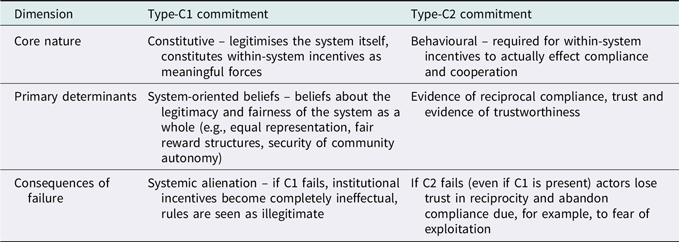
Table 1. Long description
A table comparing two types of commitment, Type-C1 and Type-C2, across various dimensions. The table has three columns: Dimension, Type-C1 commitment, and Type-C2 commitment. It has five rows including the header row. Row 1: Dimension, Type-C1 commitment, Type-C2 commitment. Row 2: Core nature, Constitutive – legitimises the system itself, constitutes within-system incentives as meaningful forces, Behavioural – required for within-system incentives to actually effect compliance and cooperation. Row 3: Primary, determinants, System-oriented beliefs – beliefs about the legitimacy and fairness of the system as a whole (e.g., equal representation, fair reward structures, security of community autonomy). Row 4: Evidence of reciprocal compliance, trust and evidence of, trustworthiness. Row 5: Consequences of failure, Systemic alienation – if C1 fails, institutional incentives become completely ineffectual, rules are seen as illegitimate, If C2 fails (even if C1 is present) actors lose trust in reciprocity and abandon compliance due, for example, to fear of exploitation.
For Agrawal, obedience to resource-oriented rules fostered an awareness of the environment as such, which ultimately aligned traditional practice with colonial imperatives around felling (Agrawal, Reference Agrawal2005: Ch6). Agrawal draws on Foucault’s post-Hobbesian analysis of power and subjectivity (Burchell et al., Reference Burchell, Gordon and Miller1991). For our purposes, it is sufficient to note that within-system methods of behaviour control cannot explain the decline in unobserved misconduct in the Kumaon case. The number and geographical dispersal of Kumaoni communities, along with widespread complicity, meant that penalties could not be enforced. This undermines the contention of objection #1 that incentives that effectively deter misconduct in observed scenarios perforce regulate behaviour in unobserved contexts – and the point is quite general. Logistical challenges, complicity and subterfuge can insulate wrongdoers from punishment.
Moreover, the disconnect between threat and conduct entails that the reduction in rule-breaking in the Kumaon case cannot be explained by within-system rules (type-C2 considerations) per se. What was required was a belief that autonomy under the new system would be adequate and assured. To understand the case, it is productive, then, to invoke type-C1 considerations, and in a way that underlines their constitutive character. For C2-type incentive-based mechanisms to work, they had to be constituted as such by type-C1 commitment. Again, being structural, the point is inherently generalisable.
The following table is intended to aid comparison of the two types of commitment.
Conclusion
Commitment plays a crucial role in Elinor Ostrom’s account of self-governing collective resource systems. It helps to procure stability in the presence of only moderate incentives. It is common to think that the mechanism by which commitment plays this role is through its effect on observed compliance – obedience to rules, professional reliability, and so on. However, also crucial for system stability is unobserved compliance – instances in which agents decide not to act against the collective interest even though they could do so with impunity. A key characteristic of unobserved compliance is that it requires that agents actively self-moderate. This exposes a difficulty in Ostrom’s theoretical framework. She represents at-point-of-choice decisions as incentive driven and so cannot give acts of commitment the explanatory role they ought to have in her theory. In this paper, a corrective has been suggested which distinguishes between commitment to the system as such and within-system commitment to positional, for example, work roles. This permits a representation in which stability evidently persists within system, while commitment to the system as such corrodes. This may allow us to better model self-governing systems and also to analyse contemporary issues relating to the fragility of democratic systems more broadly (see Berman, Reference Berman2021; Cramer, Reference Cramer2016; Zhirnov et al., Reference Zhirnov, Antonucci, Thomeczek, Horvath, D’Ippoliti, Mongeau Ospina, Krouwel and Kersting2024).

 Open access

