Healthcare expenditure is affected by the size of a population as well its demographics, medical care price, medical utilization rate, and high-tech medical utilization (Reference Kung, Tsai, Yaung and Liao5). Among the preceding factors advanced medical equipment utilization may be one of the most important factors that may influence healthcare expenditure (Reference Okunade and Murthy6). Magnetic resonance imaging (MRI) is a high technology medical imaging equipment that has been widely used in the medical field since the 1980s. MRI has become a popular diagnostic tool because of its accuracy and low radiation emission. The public's increasing access to health information and their exposure to private health facilities that offer MRI technology, has also contributed to their increase in use.
Hospitals in the private sector have incentives to purchase expensive high-tech equipments to attract more patients and, thus, generate more revenues (Reference Tsai and Li9). MRI scanners became available in the early 1990s in Iran. Initially the scanners were only available in tertiary level and university teaching hospitals. Gradually, private health facilities started acquiring this technology and made it available to the general public.
The Health Care system in Iran is a combination of both public and private systems in urban areas and a referral system in rural areas. The private system allows patients to choose their healthcare provider and even allows them to receive medical care from several providers at the same time. As such, some private healthcare providers may readily offer MRI technology without restrictions.
Patients’ demand for medical services may be influenced by the cost of the services. On the other hand, patients’ demand for medical services is less likely to be influenced by the cost of service when a patient is faced with low user fees (Reference Kung, Tsai, Yaung and Liao5). Most insurance providers in Iran cover MRI related expenses leaving approximately 25–30 percent of the expenses to the patients. As a result, most patients find MRIs as both accessible and affordable medical intervention.
Because private healthcare providers expect a substantial and speedy return on their equipment investment and also reduce the probability of medical malpractice, there is potential space for “supplier induced demand” situations that increases utilization of MRIs. In the United States (US) the break even volume, defined as the number of examinations needed to meet costs of an MRI facility, is estimated to be approximately 1,400 examinations (Reference Bell1). This value is much higher in Iran; the average cost of a single noncontrast MRI in Iran is approximately $78 (US) and its direct expenses for imaging center are estimates to be approximately 24 USD. On the other hand, the cost of a MRI scanner in Iran is similar to that in the United States (i.e., $1–1.5 million), depending on the type and brand of the MRI. Consequently, this might encourage private radiology centers to perform a higher number of MRIs to break even faster and make profit.
Healthcare expenditure is influenced by the number of health providers in a particular setting. It has been shown in the United States that when the number of practicing physicians increases a higher number of healthcare resources are used (Reference Brown, Brown, Sharma, Hollands and Smith2). Similarly, it has been demonstrated that factors such as hospital physicians to population ratio, MRI units to population ratio and family income, all affect MRI utilization (Reference Kung, Tsai, Yaung and Liao5). In Iran, the number of medical practitioners has been steadily increasing in the past 20 years. According to the Iranian medical council, roughly 94,000 medical doctors are registered as medical practitioners in Iran. Given Iran's population of 70,472,846 (8) (as of 2006) the doctor to population ratio is approximately 1:750 indicating a significant increase in the past 15 years.
From 1993 to 2003, there has been a twenty-fold increase in the number of MRI units per million inhabitants in Iran (Reference Palesh, Fredrikson, Jamshidi, Jonsson and Tomson7) and 67 percent of them are installed in private health facilities (Reference Palesh, Fredrikson, Jamshidi, Jonsson and Tomson7). We, therefore, sought to explore the prevalence of MRI overuse in private clinics in Tehran, Iran.
MATERIALS AND METHODS
This study was a survey among private MRI centers in Tehran. Data were gathered using a two-step random sampling method.
The first step was a cluster random sampling among MRI reports in private MRI centers in Tehran; five MRI centers were randomly selected. The second step involved systematic random sampling over time. We systematically selected 1 month (July to November 2005) for every center. When we gathered the reports of 1 specific month at a specific center, we omitted that month's reports from all other centers.
All MRI reports were reviewed by a physician and findings were recoded as normal, abnormal, or substantial changes identified. MRI reports indicating no anatomical or physiological abnormality were recoded as “normal.” Reports indicating abnormal findings that emerged either medical or surgical treatment were recoded as “abnormal.” Minimal abnormalities which were deemed clinically insignificant and required no further interventions were recorded as “substantial changes identified.”
Data were entered by two different investigators. Any discrepancies were resolved by looking at the original MRI reports. For categorical data analysis, Chi-squared statistics and Fisher's exact test were used. Other descriptive statistics were also performed using STATA (version 8). Charts were generated by SPSS 13. The Study protocol was approved by the Ethics Committee at The Ministry of Health and Medical Education.
RESULTS
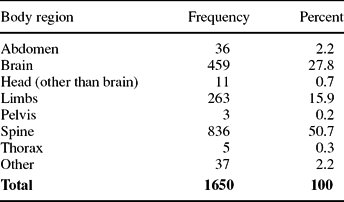
All the MRI centers agreed to participate in this study and provided data. In total, 1,650 MRI reports were collected through five private radiology centers. Each center contributed 17.5 percent to 22.5 percent of the total sample size. The mean age of the men, who constituted 47 percent of the total patient population, was 40 ± 17 years. Women constituted 53 percent of the studied cases, and their mean age was 44 ± 16 years. Approximately, 94.4 percent of the MRI scans were of the spine, brain, or the extremities (Table 1).
Distribution of Body Regions among Studied MRI Reports

Low back pain was the most frequent patient complaint that led to MRI scan of the spine (94.7 percent), followed by paresthesia (4.4 percent) and trauma (0.7 percent).
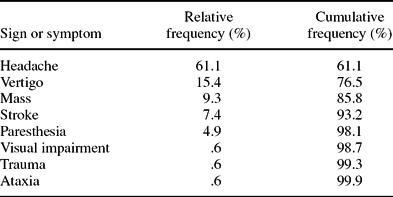
Headache was the most frequent symptom that was evaluated by a MRI scan of the brain region. Table 2 illustrates the different reasons for which MRIs were used in brain region.
Distribution of MRI Use in Brain Region by Disorder

Evaluation of pain was the most common reason for which a MRI scan was ordered for the upper and lower limbs (93.9 percent), followed by trauma (4 percent) and paresthesia (2 percent).
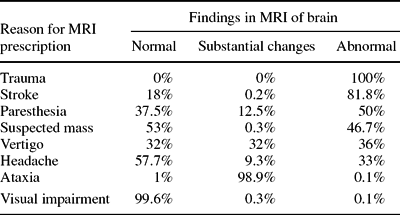
Of all the MRI reports, 17.2 percent had normal findings while 54.6 percent of the reports had abnormal findings. Approximately 28 percent of the reports had indicated substantial changes (Table 3). MRI reports from the spine, limbs, and abdomen showed more frequent abnormal findings than MRI scans of other regions (Table 3). Among the three regions most commonly examined by MRI, abnormal findings in the spine were the most common, whereas in brain were the least common (p < .05). Among the MRIs that were ordered for the brain, patients who were referred for evaluation of trauma represented the most frequent abnormal findings followed by stroke and paresthesia (Table 4). Normal reports in patients complaining from headaches, constituted 9.8 percent of total demand for MRI scans. This number was computed by multiplying the percentage of Brain MRIs (27.8 percent) of which 61.1 percent were ordered for headaches. Among those ordered for headaches 57.7 percent had normal findings (27.8 percent × 61.1 percent × 57.7 percent = 9.8 percent).
Distribution of Abnormal MRI Findings in Different Regions

MRI Results in the Brain Region by Disorder Type

Indeed, 59 percent of all of the normal MRI reports (which constitutes 17 percent of all scans) were from the brain region MRI in view of the fact that 27.8 percent of all the studied MRI reports belonged to brain region (Table 1) and 35.8 percent of these reports had resulted in normal report (Table 3).
Normal reports in patients complaining from low back pain, constituted 4 percent of total demand for MRIs in view of the fact that 8.3 percent of MRIs ordered for spine region had resulted in normal findings (Table 3), while low back pain was the cause of MRI orders in 94.7 percent of the spine region which in turn constituted 50.7 percent of all MRI reports (8.3 percent × 94.7 percent × 50.7 percent = 3.99 percent).
DISCUSSION
The Health Care system in Iran has created an opportunity for MRI overuse. We studied the number of MRI scans resulting in Normal findings as an indicator of its overuse in Iranian capital, Tehran. Unnecessary MRI is most likely to result in normal findings rather than abnormal, although not all MRIs with normal result could be considered unnecessary.
We did not find strong evidence of vast overuse of MRI in our setting. Only a small fraction of MRI reports (17 percent) in our study yielded normal results. The most frequent MRIs with normal findings were observed in the brain region and the most common indication for brain MRIs were headaches (Table 2). In addition, the most frequent number of “normal finding” of MRIs in the brain region belonged to patients suffering from headaches. The percentage of normal findings for headaches in our study was deemed to be similar to findings from other studies. For example, Jordan et al. showed that 50 percent of MRI examinations that were ordered to work up adults’ headache had resulted in normal findings. In the same study, only 1.5 percent of MRI scans resulted in a clinically significant finding (Reference Jordan, Ramirez and Bradley4). Cooney et al. showed that abnormal brain MRI findings were present in only 16 percent of patients with migraine. This value would be as low as 6 percent among those with no existing risk factors for migraine (Reference Cooney, Grossman, Farber, Goin and Galetta3). A similar study by Tsushima and Endo indicated 55 percent normal findings and 44 percent minimal changes in patients with recurrent headache in Japan (Reference Tsushima and Endo10). These results are similar to our findings, although we found slightly higher percentage of normal findings among those diagnosed with headache compared with both the US and Japanese studies (8;Reference Tsushima and Endo10).
Controlling the use of MRI for all signs and symptoms is not practical. Demand management protocols should focus on specific signs or symptoms that are common and when worked up by means of MRI, a small percentage of patients represent abnormal findings. In this manner, implementation of a few clinical practice protocols would prevent majority of unnecessary MRI investigation. Development of clinical practice guidelines for prescription of MRI for headache appears to be necessary. Using suitable guidelines for this single symptom might reduce total demand for MRI use up to 9 percent. Moreover, development of effective guidelines to prescribe MRI for work up of low back pain might reduce total demands for MRI use by up to 4 percent.
Our study is subject to limitations. Due to the study design, we were not able to evaluate whether the MRI scan was necessary for every single patient. However, similar frequency of normal findings in MRI scans compared with other studies diminishes the concern about over use of MRI in general. Negative MRI scans may also be beneficial to clinicians and patients. Such findings may alleviate patients’ concerns and prevent unnecessary follow-up interventions.
The ratio of MRI units to population in Tehran is the highest in the country (Reference Palesh, Fredrikson, Jamshidi, Jonsson and Tomson7); therefore, lack of evidence of overuse in this area makes it less likely to face MRI overuse in other provinces or regions in the country. There is a need for studies specifically designed to evaluate the suitability of MRIs for headache and low back pain in light of our findings that the majority of MRI reports for these conditions result in normal findings. There is also a need for management protocols to take different approaches in the case of abnormal MRI findings.
CONCLUSION
The proportion of MRI scans with normal findings was not critically high; therefore, we did not find evidence of MRI overuse in Tehran where the MRI units to population ratio is highest in the country. There is still need for specific studies evaluating indication of MRI for individual patients. Using effective clinical practice guidelines for prescription of MRI for headache and low back pain seems essential.
CONTACT INFORMATION
Soheil Saadat, MD, MPH, PhD (soheil.saadat@gmail.com), Research Assistant, Professor of Epidemiology, Sina Trauma Research Center, Tehran University of Medical Science, Tehran, Iran; Sina Trauma Research Center, Sina Hospital, Hassan Abad Square, Imam Khomeini Avenue, P.O. Box 11365/3876, Tehran, Iran
Seyed Mohammad Ghodsi, MD (ghodsism@sina.tums.ac.ir), Assistant Professor, Department of Neurosurgery, Tehran University of Medical Sciences, Tehran, Iran; Chief, Department of Neurosurgery, Shariati Hospital, Tehran University of Medical Sciences, Tehran, Iran; Sina Trauma Research Center, Sina Hospital, Hassan Abad Sqaure, Imam Khomeini Avenue, P.O. Box 11365/3876, Tehran, Iran
Kavous Firouznia, MD (k_firouznia@yahoo.com), Associate Professor, Department of Radiology, Tehran University of Medical Sciences, Tehran, Iran; Chief, Angiography and Endovascular Treatment Section, Medical Imaging Center, Imam Khomeini Hospital, Tehran University of Medical Sciences, Tehran, Iran; Medical Imaging Center, Imam Hospital, Keshavarz Boulevard, Tehran, Iran
Mahyar Etminan, PharmD, MSc (Epid) (metminan@shaw.ca), Assistant Professor of Medicine, University of British Columbia; Center for Clinical Epidemiology and Evaluation, Vancouver Coastal Health Research Institute, Vancouver, British Columbia, Canada
Khadijeh Goudarzi, MSc (kh_gudarzi@yahoo.com), Secretary of Applied Research, Deputy of Health, Ministry of Health & Medical Education, No. 425, Hafez Street, Tehran, Iran
Kourosh Holakouie Naieni, PhD (holakoin@sina.tums.ac.ir), Professor of Epidemiology, Department of Epidemiology and Biostatistics, School of Public Health & Institute of Public Health Research, Tehran University of Medical Sciences, Keshavarz Boulevard, Tehran, Iran