In spite of the significant expansion of the private sector in China, the strategic sectors of the economy are still dominated by a relatively small number of large state-owned companies. Most of these companies originated in the old command economy and were part of the heavy-industry-oriented development process initiated by China in the 1950s. Thus they are mostly located in the oil, steel and machine-building, power and energy, chemicals, transportation and telecommunications industries, and in the financial sector. They are increasingly market-oriented and are rapidly internationalizing, with public listings on stock exchanges abroad. However, they are still state-owned and form part of larger business groups with parent companies at the centre of their operations.
Many scholars take the view that economic reform in authoritarian systems is likely to lead to increased liberalization and in the long run, as new social groups demand political influence, to some form of democracy.Footnote 1 This is the so-called “King's Dilemma” which many authoritarian regimes confront.Footnote 2 However, in the Chinese case economic liberalization and pluralization do not seem to have led to political liberalization. In fact, the Chinese case appears to prove that economic liberalization and political control can go hand in hand. Thirty years of economic reform in China have created strong and relatively independent business groups, which have contributed to the pluralization of the Chinese polity. Yet the leaders of the most important of these companies are not appointed by their relevant company boards, but by the Party-state. They are business leaders as well as Party and state cadres, and constitute an integrated part of the power system.
Although still under-researched, relations between Party and government in China have been the subject of increasing numbers of studies in recent years.Footnote 3 This growing literature has not only deepened our knowledge of the general governance system in China, but has also provided new knowledge on leadership selection and recruitment, and on how the Party appoints and manages government leaders through the nomenklatura system.Footnote 4 However, there is only a handful of studies on Party–business relations and there are hardly any on the Party's role in appointing and managing Chinese business executives.Footnote 5 This is unfortunate, since Party–business relations increasingly influence decision-making processes and policy outcomes in the Chinese polity.
The core issue is how to maintain a balance between the new emerging forces of business leaders – who have benefitted and continue to benefit from economic reform – and the Party-state. These business leaders are an iconic symbol of China's economic growth, representative of powerful endogenous and exogenous forces. The endogenous factors stem from economic reform and development, which have effectively defined national strategic priorities since the Third Plenum of the 11th CCP Central Committee of December 1978. The exogenous factors are intimately related to the capitalist globalization process and the consolidation of global big business during the 1980s and 1990s. The Party-state has recognized that China must take advantage of these endogenous and exogenous forces in order to maintain economic growth and development and not be left behind as it was during the Mao era.
On the other hand, it is essential for the Party that these forces do not precipitate a fragmentation of its political control. Therefore the Party has taken two important steps. First, it has created good career opportunities and offered favourable salary remuneration to the business leaders. Second, it has sought to maintain central control by integrating such leaders more deeply into the nomenklatura system, thereby ensuring Party control over the appointment and management of Chinese business executives.
In order to illustrate this balance, I have coined the concept of “fragmented integration” to denote the fact that economic reform has created important new interest groups, which, however, have been integrated into the Party-state through the Party's personnel control or nomenklatura.
Much of the material for this article comes from open sources in the form of Chinese newspapers and official government or company websites as well as secondary scholarly material. However, the discussion of nomenklatura management of Chinese enterprises is based on internal sources that are not readily available. In addition, the article draws on the findings of several interviews which I have conducted with high-ranking Chinese officials and business leaders. Given the sensitivity of leadership selection and appointment in China, this interview material is also not publicly available.
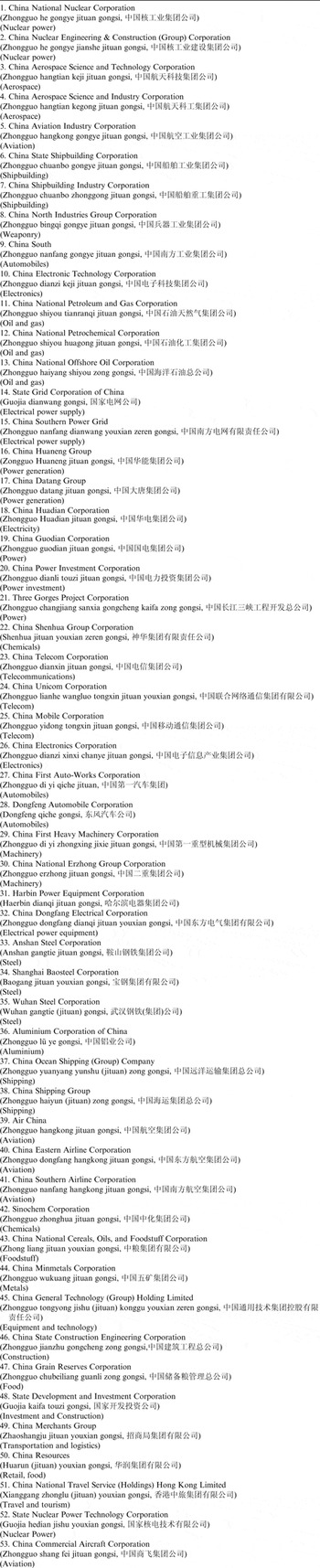
The business groups that are discussed in this paper are the 121 business groups managed by the State-owned Assets Supervision and Administration Commission (SASAC) on behalf of the State Council. In particular, the paper focuses on the 53 largest companies that in reality come under the central nomenklatura as their leaders are appointed and managed by the Organizational Department of the Central Committee of the Chinese Communist Party (CCP). The CEOs of these companies have ministerial or vice-ministerial status and equal government ministers and vice-ministers in rank. The nomenklatura companies operate on their own and have direct contact with government ministries. They therefore do not need to work through business associations to convey their opinions and views.Footnote 6 Business associations are simply too weak to play a major role at this level in China.Footnote 7 Consequently this article does not include any detailed discussion of the role of business associations in the politics of business group formation and leadership selection in China.
Administrative Reform and Business Group Formation
Before the initiation of industrial and economic reform in 1979, business groups did not exist in the People's Republic of China.Footnote 8 Enterprises were not independent production units, but were part of the centralized economic planning system. Resources were mobilized and allocated according to material balances worked out by central planners in Beijing. The industrial sector was regarded as the mainstay of the socialist economy and a development strategy was adopted which focused on heavy industry and high investment rates. Although this development strategy was questioned after the Great Leap Forward, it was never seriously challenged and it persisted until the late 1970s.
The heavy-industrial development model based on central mobilization and allocation of economic resources was bureaucratically very top heavy. In 1981, the central government had 100 ministerial-level working departments (gongzuo bumen 工作部门), of which no fewer than 65 were responsible for economic management.Footnote 9 There were, for example, eight machine-building ministries, as well as a number of ministries within the power and energy sector, such as the Ministry of Metallurgy, Ministry of Electricity, Ministry of Coalmining and Ministry of Petroleum. In addition, a number of commissions dealing with overall as well as sectoral planning existed.Footnote 10 All these ministries and commissions were symptomatic of a bloated central bureaucracy that was incompatible with the reformers' goal of creating a more efficient and market-friendly economic environment. The response was to take two institutional initiatives. First, the Chinese leadership implemented a thorough administrative streamlining programme, which reduced the number of central-level government organs to 61. As a result, the number of machine-building industries was reduced to one, while some of the commissions were abolished, including the State Capital Construction Commission, the State Machinery Commission and the State Commission for Energy Resources.
The other initiative was the creation of a number of enterprises to take responsibility for functions that previously had been handled by central ministries. Thus, streamlining of the Ministry of Petroleum resulted in the establishment of three new major companies: China National Offshore Oil Corporation (1982), China Petrochemical Corporation (1983) and China National Petroleum Corporation (1988). As a result of these institutional and allied initiatives the Ministry of Petroleum was emptied of its functions and abolished in 1988.Footnote 11
Similar changes took place in other sectors of the economy. Successive administrative reforms sought to create a slimmer and more efficient state. This meant clarifying which functions the state should continue to uphold and which functions should be handed over to market forces or society. The new companies which were carved out of the old state structure in this way were often manned with former bureaucrats who merely changed their bianzhi 编制 status from administrative bianzhi (xingzheng bianzhi 行政编制) to the bianzhi of industrial enterprises (qiye bianzhi 企业编制).Footnote 12
For the bureaucrats transferred to the new corporations it was important to retain their status in the administrative hierarchy. Corporations such as CNPC and Sinopec fought hard to obtain the ministerial-level status that would give their leaders the same rank as ministers and vice-ministers in the State Council. In China, rank is associated with prestige, but it also has practical implications since administratively only layers at the same level can communicate (duikou 对口) and negotiate directly, so lower rank for the new corporations would therefore mean that contacts with the central ministries would take place at a lower level of the bureaucracy. The newly formed corporations succeeded in obtaining ministerial-level (buji 部级) rank.
National Champions
Several hundred business groups were formed in the early 1990s.Footnote 13 Initially, the Chinese authorities designated 100 of these to receive government support. They were intended and expected to operate with considerable autonomy and were encouraged to be active internationally. In 1997–98, another initiative was taken in an effort to create a “national team” of large internationally competitive Chinese enterprises.Footnote 14
They were selected within sectors considered to be of strategic importance, including power generation, coal mining, automobiles, electronics, iron and steel, machinery, chemicals, constructions material, aerospace and pharmaceuticals. A number of policies were put in place to support the “national team.” These included the use of tariffs, as well as non-tariff barriers such as the imposition of technology transfer and local sourcing requirements for foreign firms. National team members also enjoyed enhanced management rights in running their businesses, including in areas such as profit retention, investment and international trade. They were allowed to establish their own financial companies, which operated in a manner similar to that of to the banks in the Japanese Keiretsu system.Footnote 15 National team enterprises were also at the forefront of the move to list Chinese enterprises on stock markets in China and abroad.Footnote 16 By the end of the 1990s almost all of them were listed on one of the two domestic stock markets, and about half of them had listed companies abroad.
The overarching goal behind the policy of selecting and nurturing a national team of large enterprises was to create truly global Chinese companies that could compete with the large multinational companies that dominated global production chains. China was no longer content to be the workshop of the world. Its leadership also aspired to create global brands which could enter the more profitable segments of global production chains (design, branding, marketing) as lead companies or systems integrators.Footnote 17
Zhu Rongji's Reforms
In 1998 Zhu Rongji spearheaded a new round of administrative reform. It involved reducing the number of ministerial-level working departments to 29.Footnote 18 Of great importance for the status and functioning of the business groups was that a number of ministries such as the Ministry of Coal Industry, Ministry of Machine-Building Industry, Ministry of Metallurgic Industry, Ministry of Power, Ministry of Chemical Industry – in fact the old branch ministries associated with the Soviet administrative model and the heavy-industrial development strategy – were reorganized into bureaus and placed under the management of the State Economic and Trade Commission (SETC). This not only involved transferring the bianzhi of the former ministries to the SETC, thereby strengthening the SETC in terms of personnel, but also resulted in the strengthening of the relative status and position of large companies and business groups. They no longer had a ministerial counterpart to speak to and liaise with. Rather their point of contact was the new bureaus, but since these had lost their previous ministerial status, their power over the business groups within their specific areas was greatly weakened. The diminishing power and influence of the former ministries were also reflected in significant bianzhi reductions. For example, when the Ministry of Metallurgical Industry was downgraded to a state bureau affiliated with the SETC, it suffered a cut in staff from 300 to only 80.Footnote 19 This relatively poorly manned bureau was expected to regulate the whole industry, including huge steel SOEs, such as Baosteel (Baogang 宝钢), Angang 鞍钢, Wugang 武钢 and Pangang 攀钢. Thus Zhu Rongji's administrative reform in 1998 had the unanticipated consequence of strengthening the hand of business groups vis-à-vis the state.
The large companies were also strengthened by a restructuring that left two to three dominant players in each sector. In the oil and gas industry, for example, China National Petroleum Corporation (CNPC) and Sinopec were restructured into integrated oil companies in which upstream and downstream activities were combined. CNPC was to continue to focus its activities on North and Northeast China, especially the Daqing oilfield, while Sinopec did so on South and East China. China National Offshore Oil Corporation (CNOOC) was to continue to concentrate on offshore oil and gas exploration and production, often in co-operation with foreign investors. Meanwhile, Sinochem continued to operate primarily within the trading sector of China's oil and chemical products. As a consequence of this overhaul, local companies in refinery and petrochemical manufacturing as well as in domestic wholesale and retail were wiped out.Footnote 20
In 2000 CNPC listed its subsidiary PetroChina on the stock exchanges of New York and Hong Kong, generating huge capital inflows. In 2001 the Sinopec Corporation carved out its best assets to form Sinopec, which was listed on the stock exchanges of Hong Kong, London, and New York. The same year CNOOC followed suit and floated its shares in New York and Hong Kong. These listings too were also associated with huge capital gains for the listing firm or its immediate parent which kept the revenues from these IPOs. In sum, the business groups in the oil industry not only gained autonomy in their business operations, they also became powerful in terms of their ability to generate capital and to augment their value in terms of market capitalization.
Small Kingdoms
In 2003, the central authorities instituted yet another administrative reform. One of the more important measures was the establishment of the SASAC, embracing divisions of the SETC and of the Ministry of Finance that had previously been responsible for supervising and managing state-owned assets, as well as the Central Enterprise Work Commission.Footnote 21 The new commission was charged with exercising ownership authority over China's largest SOEs on behalf of the State Council, the underlying rationale being that, left on their own, these companies would not necessarily pursue overall national interests.Footnote 22 The establishment of SASAC was also intended to facilitate a human resources role vis-à-vis these centrally managed companies. However, the authority of SASAC did not include receiving dividends from the SOEs nor did it extend to appointing CEOs and top senior managers of the largest companies. Consequently the power of SASAC over the big SOEs was limited. The business groups effectively had become “small kingdoms.” At the time of writing, there are 121 central SOEs. They constitute the current membership of China's “national team” and aspiring Chinese multinationals.Footnote 23
Another problem was the understaffing of personnel in many government organs. It has often been argued that China's government structure is too big in terms of administrative organs and personnel.Footnote 24 However, in reality this is often far from true. For example, the energy department of the National Development and Reform Commission (NDRC) was staffed with fewer than 30 people, of whom only three were responsible for collecting and processing energy data. Yet, this tiny number of staff was entrusted with the task of administering huge energy assets and investment. By contrast, the Department of Energy in the US employs 14,000 people, of whom 600 work on data collection and analysis.Footnote 25 Similar problems existed in the electrical power industry. The Electric Power Department of the former SETC had a staff of only 16 people, which is clearly inadequate for regulating China's huge power industry.Footnote 26 As a result, ministries and bureaus often had to rely on the business groups when they needed additional staff to collect data or draft new plans and regulations. The 1998 restructuring had turned them into business operations that left comparatively little power to the administrative government agencies. Because business groups had the resources and manpower needed by the government, their bargaining power over the government increased.
The power of the business groups was further strengthened by a fragmentation of policy-making. The energy sector illustrates this problem well. In terms of energy administration, the major institutions in addition to the SASAC were the NDRC, the Ministry of Commerce and the Ministry of Land and Resources. The NDRC oversaw and coordinated work related to national strategies and policies, including long- and medium-term energy plans, as well as import and export plans and major investment projects. It was also the institution that decided when and how much to adjust oil, gas and other energy prices. The Ministry of Commerce, established in 2003, was in charge of domestic and international trade and international economic co-operation. The responsibilities of the Ministry of Land and Resources focused on issues related to utilization of natural resources, including land, mineral reserves and marine resources. Approval to carry out oil and gas exploration and production had to be obtained from the Ministry of Land and Resources. In short, rather than there being a single Ministry of Energy to co-ordinate and take overall responsibility, there were a number of ministries and agencies that did not always share the same interests or pursue the same policies.
Under the old economic command system, ministries and enterprises used to stand in one line. Power, authority and resources came from the ministries and departments and flowed downwards to the factories. As a consequence of economic and administrative reform, this has all changed. Enterprises are now responsible for their own economic operations and operate under market conditions. For companies listed abroad these “market conditions” are international market conditions. During the early reform process many enterprises still made huge losses and were dependent on substantial government subsidies.Footnote 27 This is no longer the case. Most business groups make sizeable profits and since they do not pay dividends to their shareholders (mainly the state) they have accumulated immense economic resources. This has contributed to the shift in the power relationship between enterprises and the state.
The origin of this shift in the economic relationship between enterprises and government dates back to 1994, when in the wake of tax reforms the State Council ruled that the SOEs were no longer required to remit their after-tax profits to the government. As companies grew more and more powerful, there was increasing criticism of their hoarding of funds. At least in theory, however, it is not correct to suggest that all SOEs did not pay out a dividend. Listed companies, the profitable spin-offs from larger enterprise groups, did pay dividends to the enterprise group parent company. But despite their state-owned status, the parent company did not pass on such dividends to the government.Footnote 28 Rather they retained the profit and used the surplus cash according to their own preferences. Most of this retained profit was used for reinvestment, contributing significantly to the extremely high investment rate in China in recent years.Footnote 29
Critics of these huge SOE profits have argued that the state has borne the costs of corporate sector restructuring, having effectively assumed the responsibilities of meeting the costs associated with laid off workers and staff retirements. The shedding of such responsibilities by the new listed SOEs has played a big part in increasing their profits.Footnote 30 But now that the state faces huge challenges in the delivery and financing of key social services, such as education and health, the continued isolation of SOE profit from normal budgeting processes can hardly be justified.
Following several years of groundwork, in 2007 the SASAC managed to convince the State Council to pass a set of regulations which introduced a system whereby profits would be remitted to the government.Footnote 31 In fact, the remittance rates for after-tax profits were very low. Most SASAC firms would remit only 5 per cent of their after-tax profits, and the maximum 10 per cent would apply to only 17 companies.Footnote 32 However, the impact of this important change was offset by a decision to unify and lower the corporate income tax rate from 33 per cent to 25 per cent from January 2008 in order to bring SOEs in line with foreign-invested enterprises (FIEs), which enjoyed a 25 per cent rate.Footnote 33 In short, the business groups have continued to control most of their huge profits and, despite public criticism, still only hand over a fraction of such profits to their nominal owners.Footnote 34
In sum, after 30 years of economic and administrative reform, a group of very powerful business groups had emerged. They generated huge profits, which they used for reinvestment and the payment of comparatively high salaries to their staff (in particular to their CEOs). They were often able to block state initiatives which they perceived to be contrary to their own interests. They derived legitimacy by symbolizing China's economic rise.Footnote 35
The Party Strikes Back
Nevertheless, the Party and state are not without means to influence the business groups. In recent years, the government has established a regulatory framework designed to set the parameters for economic activities of large enterprises. Even more important in terms of authority and power relations, the Party controls the appointment of CEOs and presidents of the most important companies. It does so through a number of mechanisms, of which the so-called nomenklatura system is the most important.
Nomenklatura can be defined as “a list containing those leading officials directly appointed by the Party as well as those officials about whom recommendations for appointment, release or transfer may be made by other bodies, but which require the Party's approval.”Footnote 36 This means that the nomenklatura list in fact comprises two lists. One of these is handled solely by the Central Organizational Department (COD) at the Party centre; the other involves management by other state and Party organs. The Party centre mainly focuses on the former list, but also has the authority to exercise veto power over the latter. Moreover, the nomenklatura system includes lists of personnel recommended for future appointment. Through this elaborate system the Party controls the selection and appointment of leaders to the most important positions in Chinese society. At the central level, the COD manages a list of top positions in government and Party organs at central and provincial level as well as the heads of the most prestigious institutes of higher learning.
The documents concerning the establishment of SASAC do not openly disclose that, even though SASAC was charged with the appointment and management of leadership positions in the central SOEs, 53 of the most important corporations were in fact on the central nomenklatura list and therefore managed not by SASAC but by the CCP's COD.Footnote 37 These 53 corporations comprise China's major companies within sectors considered to be of strategic importance, including electricity generation (ten), nuclear power (three), oil and gas (three), chemicals (two), iron and steel (three), machinery (two), metals (two), aviation (five), aerospace (two), electronics (three), telecommunications (four), automobiles (two), shipping and shipbuilding (four), transportation and logistics (two), construction material (two), food and foodstuff (three), and weapons (one) (see Table 1).Footnote 38 These are the true heavyweights among China's major companies. Their top executives have ministerial-level status and, in terms of rank, are equal to State Council ministers and provincial governors.
Chinese Business Groups on the Central Nomenklatura

System of Rotation
An instrument of control associated with the nomenklatura system is the so-called cadre transfer system. For leading cadres below ministerial and vice-ministerial level, the rules require that they must be transferred after their second term, i.e., after a maximum period of ten years.Footnote 39 For top-level cadres this rule is even more strictly observed and transfers occur more frequently. Such transfers take place at the discretion of the ultimate power holders in Beijing and are managed and implemented by the COD under the direction of the Standing Committee member in charge of the Party's personnel work. How this works in practice and how decisions are made are shrouded in much mystery. Some research has been undertaken on the transfer of cadres between the centre and the provinces and vice versa.Footnote 40 However, there is a dearth of literature on the transfer of business leaders.
Employees in the Chinese SOEs are on the state payroll and part of the bianzhi of production enterprises. They are not necessarily Party members and will normally advance their careers within the same firm.Footnote 41 However, enterprise CEOs are almost always Party members. They are ranked similarly to civil servants, but they are not really part of the civil service system in the sense that they enjoy a different remuneration and fringe benefit system. What integrates them with civil servants is the fact that the upper layers of the civil service system as well as the business managers are Party members and therefore are also regarded as Party cadres. In this role and capacity they are part of the nomenklatura and the Party therefore has the authority to move them around between companies and between companies and government/Party organs. This is done in a similar way to that in which the Party rotates top civil servants and Party cadres. The result is that this elite group has work experiences across various sectors of Chinese society.Footnote 42
The career of Wei Liucheng 卫留成 is a good example. Before he was transferred to Hainan in 2003 to serve as Governor of the province, he served as General Manager and Chairman of CNOOC from Reference Liu1999 to 2003.Footnote 43 Three years later, when Wang Xiaofeng 汪啸风 stepped down as Hainan Party Secretary, the Party centre appointed Wei Liucheng as his replacement. Thus during a period of three to four years Wei occupied leading Party, government and business positions. Another example is the current Vice-Premier, Wang Qishan 王岐山. He has worked as head of the Construction Bank of China (1994–97), Vice-Governor of Guangdong (1998–2000), Party Secretary in Hainan, and Mayor of Beijing (2003–2007) before becoming Vice-Premier.Footnote 44 A third example is Xiao Yaqing 肖亚庆 who served for four years as president of Aluminium Corporation of China and was instrumental in negotiating a major investment deal with the Australian mining company, Rio Tinto. In February 2009 Xiao was transferred to the post of Deputy General Secretary of the State Council.Footnote 45 A fourth example is Zhang Qingwei 张庆伟, who was General Manager of China Aerospace Science and Technology Corporation before he became, in 2007, Minister of the Commission of Technology, Science and Industry for Defense.Footnote 46 As a result of the administrative reform in March 2008, this commission was merged with the newly formed Ministry of Industry and Information and Zhang was transferred to become chairman of the board of a new company, the Commercial Aircraft Corporation of China which was formed to develop and manufacture large passenger aircrafts.Footnote 47
There is very little information available about how systems of appointment and rotation really function at the top of the Chinese power system. Very little is also known about how Chinese business executives are selected and appointed. In general, there will always be internal candidates waiting in line to get the top job. They will have been selected from among a pool of candidates on the basis of so-called “democratic recommendation” (minzhu tuijian 民主推荐). If they do not get the job, it is because the COD has other plans, often shaped by the influence of a Politbureau Standing Committee member. A CEO from one of the top nomenklatura business groups has described how the system works in the following way: in his company there are two candidates for the position as CEO when the current leader steps down.Footnote 48 The first step in selecting this leadership group is the identification of a pool of candidates, worked out on the basis of consultation, suggestions, recommendations and deliberation (yunniang 酝酿) among company employees. The next step is that SASAC selects, with the approval of the COD, a list of ten top names from whom the employees elect, by voting, their nominees, ranked by choice. If SASAC/COD disagrees with the result, a second round of voting will take place. In short, a lengthy process of nomination, recommendation, voting and interview takes place before two candidates for CEO are selected. When the incumbent CEO steps down, SASAC in consultation with the company board, recommends which of the two candidates should be the new leader, subject to approval by the COD.
Company employees prefer internal promotion, since this gives them a big say in the selection process. By contrast the COD and the Party leadership often prefer their own external candidates, perhaps with a view to reward potential allies and future leaders with a well-paid job (rent-seeking). Considerations of controlling important industries may also play a strong role. The COD and SASAC recently published a notice for the “open recruitment” of 12 senior executives from China and/or abroad for 12 central SOEs.Footnote 49 Among them were the general manager positions for Dongfeng Motor Corporation, China State Construction Engineering Corporation, China Travel Service (Holdings) Hong Kong Limited, and State Nuclear Power Technology Corporation. All four companies belong to the group of nomenklatura companies. It is true that this signifies an important new procedure for hiring nomenklatura company executives. However, the final say will still rest with COD.
Corporate Leaders in the Central Committee
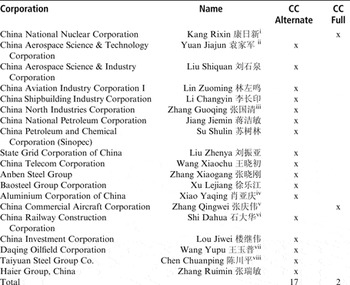
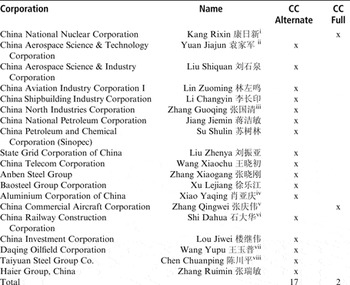
In contrast to entrepreneurs from the private sector, a significant number of the business leaders from the state sector are represented in important Party fora such as the Central Committee. In 2002 they were for the first time admitted to the Central Committee as a distinct group sitting alongside representatives from central government and Party institutions, the provinces, the military and the academic world. Thus, 18 were elected, including two full members and 16 alternate members.Footnote 50 The two full members were Li Yizhong 李毅中, Chairman and President of Sinopec, and Zhang Qingwei, President of China Aerospace, Science and Technology Commission.
There were also 18 corporate leaders elected to the 17th Central Committee in 2007. Kang Rixin 康日新, General Manager of China National Nuclear Corporation, was the only full member among them. Zhang Qingwei was still a full member, but he had moved to a government position as head of China's National Industry and Technology for Defence Commission. However, he moved back to the corporate world when, in March 2008, he was appointed to head the new China Commercial Aircraft Corporation (see above). This corporation now appears as number 53 on the list of large SOEs under SASAC. Another full member, former CEO of Sinopec Li Yizhong, was moved to the SASAC, in 2003 and in 2007 became minister in charge of the newly formed Ministry of Industry and Information. In January 2008 Chen Chuanping 陈川平, Chairman of Taiyuan Steel Company, was transferred to the provincial government of Shanxi to serve as Vice-Governor.Footnote 51 In a similar way Wang Yupu 王玉普 left Daqing Oilfield Corporation in August 2009 to become Vice-Governor in Heilongjiang and in June 2010, Shi Dahua 石大华 was transferred from the China Railway Construction Corporation to SASAC to head the Board of Supervisors for Key State-Owned Enterprises.Footnote 52 Finally Kang Rixin was relieved of his job in September 2009 and stripped of his membership of the CCP.Footnote 53 He was officially expelled from the 17th Central Committee at its fifth plenary session in October 2010.
As a result of these changes, 14 business groups are now represented in the Central Committee (see Table 2), compared with 19 in 2007. With the addition of China Commercial Aircraft Corporation, 12 of these are on the central nomenklatura list. There is no doubt that business group representation in the Central Committee will increase again at the 18th Party Congress in 2012, as the large business groups still play a key role in Chinese society.
Business Group Leaders Elected to the 17th Central Committee (2007)
Notes:
iKang Rixin was officially expelled from the Central Committee at the fifth plenary session in October 2010.
iiPresident of the company is Ma Xingrui, but Vice-President Yuan Jiajun holds the company's seat in the Central Committee.
iiiVice-President and Party Secretary of China North Industries Corporation. Promoted to President in the group in October 2008.
ivAppointed Deputy General Secretary of the State Council in March 2009.
vTransferred from the State Council in March 2008.
viTransferred to SASAC in June 2010.
viiAppointed Vice-Governor in Heilongjiang in August 2009.
viiiAppointed Vice-Governor in Shanxi in January 2008.
Sources:
China Directory 2009; China Directory 2011; Journal of Current Chinese Affairs, Data Supplement (March Reference Data2009), (January 2011); http://english.cpcnews.cn/92243/6287715.htm (accessed April 27, 2009).
The above examples of rotation and transfer, and the representation of important corporations in the Central Committee show the close interaction that now exists between Party, government and business.Footnote 54 It also highlights a growing tendency of taking advantage of the experiences the Chinese leaders in big business represent. Many of them have important managerial skills and an exposure to the global economy that offer real benefits to the Chinese government.Footnote 55
As in the case of the appointment of CEOs in nomenklatura companies, Central Committee members are elected through a process of consultation, recommendation and nomination. In this process, nomenklatura companies are also consulted. Once a CEO has been elected member of the Central Committee he/she will try to influence policy-making within his/her field of expertise.Footnote 56
Problems and Challenges
The Party-state's instruments of control also work in the opposite direction: i.e., through career advancement and circulation in the power system, leaders with a background in business have an opportunity to advance the interests of the business groups and industrial sectors in which they have worked. They also have an opportunity to protect and promote associates and subordinates in their former workplace. Thus it has been suggested that the business leaders from the large business groups form interest groups.Footnote 57
There are occasional reports in the Chinese media which discuss the role of business in Chinese politics from an interest group perspective. A good example is an article in Caijing 财经 from October 2009,Footnote 58 which argues that some state monopolies have taken advantage of their public power to form special interest groups that seek to generate profits and advance political influence. In the mining sector state-owned companies and a “few privileged power groups” largely appropriated the country's mining resources. Special interest groups are also common in real estate, finance and energy sectors. The article warns that the penetration of the country's political and judicial systems by special interest groups “is most alarming.” These interest groups also seek political voices and have taken advantage of the transition from central resource allocation to market allocation to influence political circles, often by engaging in corrupt practices. Interestingly, the article argues that in order to combat hidden business–government collusion, the Chinese government should rely on institutional and democratic procedures to coordinate and resolve conflicts among various groups. However the government appears to be unwilling to embrace such procedures, which would be tantamount to recognizing and accepting the role of interest groups in Chinese society.
According to Skilling's classic work on interest groups in Communist societies, an interest group can be defined as “an aggregate of persons who possess certain common characteristics and share certain attitudes on public issues, and who adopt distinct positions on these issues and make definite claims on those in authority.”Footnote 59 However, whether or not these business leaders develop positions on public issues that are distinct from those of other groups is another matter. It is also difficult to substantiate that they make definite and coordinated claims on the top political leaders. Moreover, it is unclear through which mechanisms interest groups could exert their influence and channel their specific interests to the policy making centre, except through personal connections and networks. Finally, interest group politics presupposes the existence of a political system characterized by political pluralism of a kind that is obviously absent in the Chinese party-state. The Party remains in control and does not allow interest articulation to coalesce into group formation. In this way, the embryonic split between business group leaders, i.e., interest groups based on economic interests, and old-style cadres who stress ideology and policy issues, is contained.
However, even though the Chinese power system is centralized and controlled by the CCP, control and power is not absolute and, as mentioned above, the emergence of powerful business groups has contributed to the fragmentation of policy-making. The “fragmented authoritarianism” model offers useful insight into the working of this process.
This model posits that authority below the very apex of the Chinese political system is fragmented.Footnote 60 At this level power and authority are in the hands of a tiny number of people. They preside over a huge bureaucracy subdivided into various systems (xitong 系统) according to functional divisions of authority. Central–local relations and various territorial, and often conflicting, levels of authority contribute further to a fragmented polity. Within the economic arena, a corporatization process has taken place resulting in the emergence of large business groups that operate according to market conditions. For the companies listed abroad these market conditions are globally defined. Thus, they represent forces and interests that have a fragmented impact on the centralized power system.Footnote 61 On the other hand, the business groups are economic entities in which the Chinese Party-state is the dominating share-holder. Their CEOs are not appointed by their own boards, but by the Party's Central Organizational Department or the SASAC. In this sense, the business groups are integrated into the system. To characterize this combination of fragmentation and integration I would like to propose the notion of “integrated fragmentation” or “fragmented integration.”
Integrated fragmentation in certain aspects echoes the “bureaucratic politics model.” This model posits that leaders of bureaucracies try to maximize their own organization's bureaucratic interests, and in doing so, they seek to promote their own organization's “health,” measured in terms of their budget, bureaucratic independence, size, and so on.Footnote 62 In actual decision-making, according to this line of thought, bureaucratic agencies influence policy outcome via their representatives in the decision-making elite (the Politbureau or the Central Committee). Moreover, policy decision is the result of hard bargaining among top leaders representing different bureaucratic interests.
As applied to China, the bureaucratic model seems to coincide neatly with the bureaucratic behaviour of Chinese officials and institutions. However, it does not fully capture the impact and role of the big SOEs. They are no longer an extended arm of a bureaucratic planning system, but embedded in an emerging market logic.Footnote 63 From this perspective their interests will be defined not only by bureaucratic considerations, but also by profit motives and market forces.
On the other hand, the big SOEs benefit greatly from state support and favourable policies, and their leaders are an integrated part of the power system. They enjoy huge salaries and considerable fringe benefits. When they are rotated to a government job, it is usually associated with substantive salary reductions.Footnote 64 However, they tend to accept the transfer, which indicates integrative mechanisms that transcend pure pecuniary rewards and market logic.
Conclusion
There are few studies of Chinese business groups that take a public management perspective. Some analysis exists of how Chinese SOEs were corporatized and how they changed their corporate governance structures.Footnote 65 But there is a dearth of literature on how business groups have evolved and grew strong and how they have benefitted from successive rounds of administrative reform. The relationship between the Party and big business in China is even less understood.
The present article shows that Chinese business groups have grown into huge and diversified enterprises possessing significant economic and political clout. They have succeeded in generating enormous resources through listings in China, as well as abroad, and through huge profits which they mainly retain within the group. In the political arena they have demonstrated their influence by obstructing the creation of new ministries and regulatory commissions that would otherwise limit their powers. The heads of these business groups have ministerial or vice-ministerial status and often outrank the state administrative organs and bureaus that are supposed to regulate their activities. Business group leaders elected to the Central Committee are now recognized as a distinct group similar to representatives from Party and government institutions, the provinces and the military. The increased role of these business leaders prompts the question of whether such developments presage the emergence of distinct interest groups that could challenge Party and state authority and create a fragmented polity.
However, in the nomenklatura system the Party possesses a powerful instrument of control to wield over the business groups. Through this system the Party controls the appointment and promotion of the heads of the most important state-owned enterprises. Moreover, the nomenklatura system enables the Party to rotate leaders in big business from a position as CEO in one company to a similar position in another state-owned company, or from a position as business leader to a post in the state apparatus or in the Party, and vice versa. Such transfers take place, even though they may involve considerable salary reductions, as, for example, when a CEO is moved from a major oil company to the governorship of a province. Due to Party control of the nomenklatura system the development of formal interest groups is made difficult. Thus, forces of integration arrest a trend towards fragmentation, creating a hybrid situation of integrated fragmentation.
Some studies have argued that corruption, preferential policies for selected groups, particularistic decision-making and other such phenomena have come to define the Chinese economic and political system. However, these factors have only limited explanatory power. The key factor that holds the Chinese system together and makes it work both in government and business appears to be personnel control. By wielding personnel control, the Party maintains the balance of power between the Party state and Chinese big business.Footnote 66 The nomenklatura system prevents business leaders from successfully challenging Party rule and helps to ensure that the achievements and the continued growth of the business sector will benefit the Party and contribute to regime stability.
Further research is needed on the details of how personnel control is managed at the apex of the decision-making process. Who decides how to appoint/promote/rotate government and business leaders, and when and how are such decisions translated into implementation? Why do some business leaders keep their job for a long period of time, whereas others are frequently rotated? Is it possible to draw some general conclusions for post-socialist transitions from the Chinese experience of combining economic liberalization and development with strong political control? These are some of the issues which need further investigation.