Introduction
Reading is one of the most important milestones a child achieves throughout development. It is also a complex cognitive task to fulfil, involving the mapping of new orthographic representations into a set of pre-existent phonological representations in our lexicon (e.g., Grainger, Lété, Bertrand, Dufau & Ziegler, Reference Grainger, Lété, Bertrand, Dufau and Ziegler2012). Many children struggle in mastering this important skill, which often has a negative impact not only on learning and academic success, but also in other lifelong accomplishments as citizenship, employment, and income (e.g., Hernandez, Reference Hernandez2011; Maughan, Pickles, Hagell, Rutter & Yule, Reference Maughan, Pickles, Hagell, Rutter and Yule1996; Spreen, Reference Spreen, Bakker and Van Der Vlugt1989). Estimates indicate that almost 20% of all school-aged children are at risk of reading difficulties (e.g., Grigorenko, Reference Grigorenko2000), and that about 3% to 10% of them reveal reading impairments despite normal IQ and adequate educational and socioeconomic opportunities (e.g., Shaywitz, Reference Shaywitz1998; Snowling, Reference Snowling2001). Hence, ascertaining the processes and mechanisms by which children learn to read is of utmost importance not only to deepen our understanding of how this complex skill is achieved, but also to contribute to the development of programs aimed to enhance reading abilities and/or to help children who struggle with reading problems to overcome their difficulties.
An important line of research in this domain focuses on examining the factors that affect reading between the letter level of representation and the word (lexical) level of processing, which includes sublexical units such as phonemes (e.g., Pelli, Farell & Moore, Reference Pelli, Farell and Moore2003; Rastle & Brysbaert, Reference Rastle and Brysbaert2006; Seidenberg, Reference Seidenberg1988), bigrams (e.g., Conrad, Carreiras, Tamm & Jacobs, Reference Conrad, Carreiras, Tamm and Jacobs2009; Doignon & Zagar, Reference Doignon and Zagar2005; Seidenberg, Reference Seidenberg and Coltheart1987; Seidenberg & McClelland, Reference Seidenberg and McClelland1989), syllables (e.g., Álvarez, Carreiras & Perea, Reference Álvarez, Carreiras and Perea2004; Campos, Oliveira & Soares, Reference Campos, Mendes and Soares2018, Reference Campos, Mendes and Soares2019; Carreiras, Álvarez & de Vega, Reference Carreiras, Álvarez and de Vega1993; Prinzmetal, Treiman & Rho, Reference Prinzmetal, Treiman and Rho1986; Rapp, Reference Rapp1992), and morphemes (e.g., Rastle, Davis & New, Reference Rastle, Davis and New2004; Schilling, Rayner & Chumbley Reference Schilling, Rayner and Chumbley1989). Of these, the syllable has received a great amount of attention due mostly to its importance both in speech perception (e.g., Mehler, Dommergues, Frauenfelder & Segui, Reference Mehler, Dommergues, Frauenfelder and Segui1981; Morais, Content, Cary, Mehler & Segui, Reference Morais, Content, Cary, Mehler and Segui1989; Sebastián-Gallés, Dupoux, Segui & Mehler, Reference Sebastián-Gallés, Dupoux, Segui and Mehler1992) and production (e.g., Cholin, Levelt & Schiller Reference Cholin, Levelt and Schiller2006; Schiller, Reference Schiller1997). In an example of one of these studies, Morais et al. (Reference Morais, Content, Cary, Mehler and Segui1989) investigated if there was a syllabification process during speech recognition with Portuguese illiterates and ex-illiterates. To this extent, the authors presented participants with short sentences and asked them to detect the occurrence of a CV or a CVC target syllable in CV and CVC words that appeared within those sentences. So, in the sentence “O homem fechou a garagem [The man closed the garage]” they could be asked to detect the segment /gA/ or /gAr/. Results showed that participants had a higher number of correct detections when the target bearing word had the same syllable boundary of the target syllable they were meant to detect. Thus, in the example sentence given above, they would have a higher number of detections for /gA/ than for /gAr/, since the first target corresponds to the first syllable of the word “garage”, while the other does not. This syllable effect was observed for CV and CVC target syllables, and for both groups of participants, suggesting that syllable processing is not dependent on formal instruction and happens naturally. Evidence of syllable effects were also observed in speech production studies, as for instance in the study of Cholin et al. (Reference Cholin, Levelt and Schiller2006). In their experiment, the authors’ goal was to test the existence of a mental syllabary by which we quickly retrieve syllables during speech processes. They presented participants with high- or low- frequency first-syllables which they were instructed to name as quickly and accurately as possible. In their hypothesis, if the mental syllabary consists of retrievable representations corresponding to syllables, then the retrieval process should be sensitive to frequency differences. Their results showed a significant syllable frequency effect, with high-frequency first syllables being more quickly produced than low-frequency first syllables, which went in accordance to their predictions. Besides the evidence obtained in these studies, it's also important to mention that the fact that in alphabetic languages, learning to read rests heavily on a spoken language foundation (e.g., Goswami & Bryant, Reference Goswami and Bryant1990; Shankweiler, Crain, Brady & Macaruso, Reference Shankweiler, Crain, Brady, Macaruso, Gough, Ehri and Treiman1992; Snowling, Reference Snowling1991) and that phonological units are activated during reading (e.g., Jared, Levy & Rayner, Reference Jared, Levy and Rayner1999; Van Orden, Pennington & Stone, Reference Van Orden, Pennington and Stone1990), have also been pointed out as reasons why the syllable should be an important sublexical unit during silent reading.
Indeed, evidence for the relevance of the syllable has been obtained in visual word recognition with adult skilled readers from not only syllable-timed languages with clear syllabic boundaries such as Spanish (e.g., Álvarez et al., Reference Álvarez, Carreiras and Perea2004; Álvarez, Carreiras & Taft, Reference Álvarez, Carreiras and Taft2001; Álvarez, Carreiras & de Vega, Reference Álvarez, Carreiras and de Vega2000; Carreiras, Álvarez & de Vega, Reference Carreiras, Álvarez and de Vega1993; Carreiras & Perea, Reference Carreiras and Perea2002; Perea & Carreiras, Reference Perea and Carreiras1998) and French (e.g., Chetail & Mathey, Reference Chetail and Mathey2009a; Conrad, Grainger & Jacobs, Reference Conrad, Grainger and Jacobs2007; Mathey & Zagar, Reference Mathey and Zagar2002), but also from stress-syllable languages with less-clear syllabic boundaries as EP (e.g., Campos, Mendes & Soares, Reference Campos, Mendes and Soares2018, Reference Campos, Mendes and Soares2019). Yet, studies focusing on tracking when the syllable emerges as a functional unit of lexical access during reading acquisition and how it evolves as literacy unfolds are scarce, and the studies conducted so far have led to some inconsistencies.
One of the first studies aimed at investigating if developing readers use the syllable to guide visual word recognition was conducted by Colé, Magnan, and Grainger (Reference Colé, Magnan and Grainger1999). The authors presented fifth-grade French children with a visual segment detection task in which consonant-vowel (CV; e.g., so.leil [sun]) and consonant-vowel-consonant (CVC; e.g., sol.dat [soldier]) French first-syllable structure words were preceded either by CV (e.g., SO) or CVC (e.g., SOL) syllables displayed on the computer screen for 150 ms. Participants were asked to decide whether the syllable presented before corresponded, or not, to the first syllable of the target word (note that the dots in the examples were only included here to facilitate comprehension but were not presented in the experiment). As expected, results showed facilitative effects for French words preceded by syllables that corresponded to the first syllable of the words (e.g., SO-so.leil or SOL-sol.dat) when compared to those preceded by syllables that did not correspond to the first syllable of the words (e.g., SOL-so.leil or SO-sol.dat), though for CVC words the advantage of the syllable congruent condition over the syllable incongruent condition was observed in the accuracy data. Other studies conducted in other languages using the same paradigm with children from either early (e.g., Doignon & Zagar, Reference Doignon and Zagar2006; Jiménez, García, O'Shanahan & Rojas, Reference Jiménez, García, O'Shanahan and Rojas2010; Maïonchi-Pino, Magnan & Écalle, Reference Maïonchi-Pino, Magnan and Écalle2010) or later stages of reading acquisition (e.g., Colé & Sprenger-Charolles, Reference Colé and Sprenger-Charolles1999; Doignon & Zagar, Reference Doignon and Zagar2006; Maïonchi-Pino et al., Reference Maïonchi-Pino, Magnan and Écalle2010) observed similar results, hence suggesting that children use the syllable as a sublexical unit for the recognition of both CV and CVC first-syllable structure words from early stages of reading acquisition. Recently, Álvarez, García-Saavedra, Luque, and Taft (Reference Álvarez, García-Saavedra, Luque and Taft2017), also found evidence for the use of the syllable in second- and sixth-grade Spanish developing readers using a new (word spotting) paradigm. Specifically, in this paradigm, children were asked to decide whether a monosyllabic Spanish word was or not embedded in the beginning of visually presented Spanish disyllabic pseudowords as FIN.LO, or BER.NO, for example. In this specific case, children should respond “yes” to the Spanish pseudoword FIN.LO because FIN corresponds to a real monosyllabic Spanish word, whereas they should answer “no” to the Spanish pseudoword BER.NO, because BER is not a Spanish word. Note that, in the stimuli used, the authors also manipulated the congruency of the syllabic boundary of the monosyllabic words embedded in the pseudowords, which could be consistent (e.g., FIN.TO), or inconsistent (e.g., FI.NUS) with the existing (FIN) monosyllabic Spanish word. In both grades results showed that children were faster at recognizing the monosyllabic words embedded in the pseudowords when the syllable boundary was consistent rather than inconsistent with the target word (i.e., faster at recognizing FIN in FIN.TO than in FI.NUS), which was taken as indicative of the use of the syllable by beginning and intermediate readers.
Additional evidence for the role of the syllable in developing readers comes from other studies asking children to decide whether a string of letters presented at the centre of the computer screen corresponded or not to a real word (i.e., the standard lexical decision task [LDT]) in which the frequency of the first syllable was manipulated (e.g., Chetail & Mathey, Reference Chetail and Mathey2009b; Luque, López-Zamora, Álvarez & Bordoy, Reference Luque, López-Zamora, Álvarez and Bordoy2013). As in previous studies conducted with adult skilled readers (e.g., Álvarez et al., Reference Álvarez, Carreiras and Taft2001; Carreiras et al., Reference Carreiras, Álvarez and de Vega1993; Conrad et al., Reference Conrad, Grainger and Jacobs2007; Mathey & Zagar, Reference Mathey and Zagar2002; Perea & Carreiras, Reference Perea and Carreiras1998), these studies assumed that, if printed words were parsed into syllables, words containing high-frequency first-syllables should be recognized slower than words containing low-frequency first-syllables because the former would activate more lexical candidates and generate more lexical competition than the latter. As expected, Chetail and Mathey (Reference Chetail and Mathey2009b) with fifth-grade French children, and Luque et al. (Reference Luque, López-Zamora, Álvarez and Bordoy2013) with second- and fourth-grade Spanish children, found longer RTs for words from larger syllabic neighbourhoods. These results are accounted by a recent implementation made in the Multiple read-out model (MROM; Grainger and Jacobs, Reference Grainger and Jacobs1996), the Multiple read-out model with a syllabic layer by Conrad and colleagues (MROM-S; Conrad, Tamm, Carreiras & Jacobs, Reference Conrad, Tamm, Carreiras and Jacobs2010), the only computational model of visual word recognition that has implemented syllable-sized units to account for the inhibitory syllable frequency effect observed in languages like Spanish and French (see Conrad et al., Reference Conrad, Tamm, Carreiras and Jacobs2010 for details). There is another model, however, that also postulates the existence of a syllable layer of word processing, though it takes a different approach to the MROM-S: the model for polysyllabic word reading by Ans, Carbonnel, and Valdois (Reference Ans, Carbonnel and Valdois1998). According to it, words can be recognized by two different processes, a global reading strategy or an analytic reading strategy. In the first strategy, words would be recognized as a whole, whilst in the latter they would be segmented into their syllable components. In this model the authors propose that whilst expert readers read most words through the global reading strategy, the opposite would be true for the developing readers, who would read most words through the analytic reading strategy. Thus, the younger the readers, the more they would rely on a syllable-segmentation strategy during visual word recognition. Nonetheless, there have been some studies that place some questions into this assumption, as they have not yielded such straightforward results when it comes to syllable effects with young readers, particularly those in the beginning stages of reading acquisition. For example, Jiménez and Hernández (Reference Jiménez and Hernández2000) in a study with first-grade Spanish children manipulating the frequency of the first syllable, as in the studies of Chetail and Mathey (Reference Chetail and Mathey2009b) and Luque et al. (Reference Luque, López-Zamora, Álvarez and Bordoy2013), did not find any differences between high- and low-frequent first-syllable words. Also, Katz and Baldasare (Reference Katz and Baldasare1983) and Chetail and Mathey (Reference Chetail and Mathey2009c), in studies with English and French second-grade children, respectively, using the standard LDT where words were presented segmented according either to their syllable boundaries or not, by using slashes or different colours (e.g., pa/per, p/aper), failed to show any signs of syllable effects. In both studies, facilitative syllable effects (i.e., faster RTs for pa/per than p/aper) were only observed for the less-skilled readers in a post-analysis considering children's reading performance as assessed by standardized reading tests.
Hence, from the studies presented above, it is not clear if and when, during reading development, the syllable emerges as a functional unit of visual word recognition. The inconsistency of the results can emerge from different sources, like the use of different tasks and paradigms (e.g., visual segment detection task, LDT, word spotting), the use of different reading proficiency groups (from first- to fifth-grade children), and also the use of different languages. Specifically, the languages used have more or less clear syllable boundaries, and they also differ on the level of orthography-phonology opacity, which might strongly influence the level of activation of phonological representations during reading, and hence the stage at which certain sublexical units, such as the syllable, might come into play. Moreover, it is also important to note that some of the tasks used so far did not provide compelling evidence towards the use of the syllable as a sublexical unit at early stages of visual word recognition. Indeed, to decide if a given syllable is embedded in the beginning of a subsequent word, as in the visual segment detection task, participants only have to read the beginning of the word to successfully complete the task, and there is no way of assuring that the lexical access was actually reached. Furthermore, in the visual segment detection task, as well as in the LDT in which the words appeared explicitly segmented according to their syllable-boundaries, or not, by the use of slashes or different colours, the conscious manipulation of the syllable prevents us from drawing conclusions about the existence of an automatic activation of syllable-size units at early stages of visual word recognition. Although the word spotting task provides a more implicit mode of syllable processing, the use of pseudowords also raises some problems. There have been both studies showing (e.g., Álvarez et al., Reference Álvarez, Carreiras and de Vega2000; Chetail, Reference Chetail2014), and not showing (e.g., Campos et al., Reference Campos, Mendes and Soares2018; Ferrand & New, Reference Ferrand and New2003; Muncer & Knight, Reference Muncer and Knight2012) syllable effects with pseudowords. Hence, they appear to be less straightforward than syllable effects with words. Besides, in the word spotting task, there is also no way of assuring that participants read the full string of letters (pseudowords) as in the lexical decision task, for instance.
The best way to overcome these limitations is to use the masked priming paradigm combined with a LDT, as Álvarez et al. (Reference Álvarez, Carreiras and Perea2004) did with Spanish adult skilled readers (see also Chetail & Mathey, Reference Chetail and Mathey2009a and Campos et al., Reference Campos, Mendes and Soares2018, Reference Campos, Mendes and Soares2019, for a similar procedure with French and EP expert readers, respectively) and also Chetail and Mathey (Reference Chetail and Mathey2012) with French intermediate readers. Specifically, following Álvarez et al. (Reference Álvarez, Carreiras and Perea2004), Chetail and Mathey (Reference Chetail and Mathey2012) presented sixth-grade French children with CV (e.g.,VO.LUME [volume]) and CVC (e.g., VUL.CAN [volcano]) French words that were preceded by briefly presented (67 ms) primes that could be either syllable congruent (e.g., vo.liar-VO.LUME, vol.tie-VOL.CAN [vulcan]) or syllable incongruent (e.g., vol.cer-VO.LUME, vo.ode-VOL.CAN) with the targets. Results showed that children were faster at recognizing words preceded by syllable congruent primes than by syllable incongruent primes, thus suggesting that the syllable acts indeed as a sublexical unit that aids lexical access at early stages of visual word recognition, as previously observed with French adult skilled readers (e.g., Chetail & Mathey, Reference Chetail and Mathey2009a). However, conversely to the results obtained with adult skilled readers, not only in French (Chetail & Mathey, Reference Chetail and Mathey2009a), but also in Spanish (Álvarez et al., Reference Álvarez, Carreiras and Perea2004), or in EP (Campos et al., Reference Campos, Mendes and Soares2018, Reference Campos, Mendes and Soares2019), the advantage of the syllable observed by Chetail and Mathey (Reference Chetail and Mathey2012) with intermediate French developing readers was found for CV and CVC first-syllable French words alike. In those studies with expert readers, the advantage of the syllable congruent condition over the syllable incongruent condition (indicative of facilitative syllable priming effects) was restricted to CV words (i.e., faster responses to ba.lieux-BA.LANCE [balance] than bal.veux-BA.LANCE, but not to ba.lave-BAL.CON [balcony] than bal.nat-BAL.CON), giving rise to the syllable structure effect that remains largely unexplained in the literature. Although both Álvarez et al. (Reference Álvarez, Carreiras and Perea2004) and Chetail and Mathey (Reference Chetail and Mathey2009a) have suggested that this effect might rely on the fact that the majority of words in Spanish and French have a CV first-syllable structure, thus making CV syllables be activated even when a CVC syllable is presented, in languages such as EP this issue may be more complex. Indeed, the difference between the number of CV and CVC words in the EP lexicon, as obtained from the Procura-PALavras (P-PAL) lexical database (freely available at http://p-pal.di.uminho.pt/tools; see Soares, Medeiros, Simões, Machado, Costa, Iriarte, Almeida, Pinheiro & Comesaña, Reference Soares, Medeiros, Simões, Machado, Costa, Iriarte, Almeida, Pinheiro and Comesaña2014a, Reference Soares, Iriarte, Almeida, Simões, Costa, Machado and Perea2018), is much less pronounced in EP than in other languages (see Campos et al., Reference Campos, Mendes and Soares2018 for more details), thus requiring further explanation. Furthermore, it is worth pointing out that not even the few computational models of visual word recognition that explicitly assume the existence of a syllable layer (see the models of Ans et al., Reference Ans, Carbonnel and Valdois1998 and Conrad et al., Reference Conrad, Tamm, Carreiras and Jacobs2010) make any predictions of a mechanism that can explain why syllable structures may modulate the role of the syllable during visual word recognition.
Concerning the results obtained by Chetail and Mathey (Reference Chetail and Mathey2012) with sixth-grade French children, although these were interesting and overcame many of the limitations observed in previous studies with developing readers, there are still some issues left unanswered. For example, because the authors only used intermediate (i.e., sixth-grade) readers, the extent to which syllable effects can be also observed at early stages of reading acquisition (beginning readers) and to which kind of words (CV and/or CVC) remains open. Moreover, the issue of the syllable structure effect was largely overlooked.
The experiments reported in this paper were designed to directly address these issues by using third-grade (Experiment 1) and fifth-grade (Experiment 2) EP developing readers who performed a LDT (go/no-go), combined with a sandwich masked priming paradigm (Lupker & Davis, Reference Lupker and Davis2009). We opted for the go/no-go variant of the LDT, as many other studies with developing readers (e.g., Perea, Soares & Comesaña, Reference Perea, Soares and Comesaña2013; Soares, Perea & Comesanã, Reference Soares, Perea and Comesaña2014b; Soares, Lages, Oliveira & Hernández, Reference Soares, Lages, Oliveira and Hernández2019), since Moret-Tatay and Perea (Reference Moret-Tatay and Perea2011) demonstrated that it is more appropriate for young readers as it decreases RTs and increases accuracy rates. Additionally, we also chose to use the sandwich variant of the masked priming paradigm because the brief presentation of the target (i.e., around 33 ms) before the presentation of the prime seems to boost masked priming effects that are typically of small size, particularly with developing readers, and also because it contributes to mitigate neighbourhood effects at early stages of visual word recognition (see Perea, Mallouh & Carreiras, Reference Perea, Mallouh and Carreiras2014; Stinchcombe, Lupker & Davis, Reference Stinchcombe, Lupker and Davis2012). Finally, in addition to the syllable congruent and incongruent conditions, we also used an ‘extra’ unrelated condition, as in the Chetail and Mathey (Reference Chetail and Mathey2009a) and Campos et al. (Reference Campos, Mendes and Soares2018, Reference Campos, Mendes and Soares2019) studies, plus an ‘extra’ identity prime condition, in which primes and targets were repeated. Note that only including an unrelated baseline condition, which both congruent and incongruent condition were compared to, allows the establishment of genuine facilitative or inhibitory syllable priming effects, as the direct comparison of syllable congruent and incongruent conditions only allows to conclude for differences in processing. The use of the additional identity prime condition is also highly recommended in masked priming studies with young children to assure that the priming task is working appropriately even when no other effects are observed (see Soares et al., 2014b, Reference Soares, Lages, Oliveira and Hernández2019; Perea et al., Reference Perea, Soares and Comesaña2013 for examples). Since reliable masking priming syllable effects were already observed with EP adult skilled readers in studies using a similar paradigm (Campos et al., Reference Campos, Mendes and Soares2018, Reference Campos, Mendes and Soares2019), the main question at stake here is if syllable effects in EP can be noticeable with non-skilled readers and at which stage of reading development (beginning and intermediate). This would also provide valuable insights into the role that language characteristics might play in the emergence of syllable effects in different languages. Álvarez et al. (Reference Álvarez, García-Saavedra, Luque and Taft2017) and Luque et al. (Reference Luque, López-Zamora, Álvarez and Bordoy2013) have suggested that because, in more opaque languages, readers take longer to automatize the reading process, syllable effects might not emerge as early as in a transparent language such as Spanish, as readers might still heavily rely on a letter-by-letter strategy of reading. Besides, it is also possible that other language characteristics can also affect the emergence of syllable effects in reading. For instance, EP is a language with fuzzier syllable boundaries than French or Spanish, and with a greater syllable complexity and diversity than observed in most of the Romance languages (see Campos et al., Reference Campos, Mendes and Soares2018 for details). Consequently, masked priming syllable effects might only be noticeable at later (intermediate) stages of reading acquisition, and for CV and CVC words alike, as observed in most of the studies conducted with developing readers. Although in EP Campos et al. (Reference Campos, Mendes and Soares2018) only observed reliable syllable priming effects for CV words are mentioned, it is important to note that this was an unexpected result because not only had previous studies investigating the role of the syllable during EP speech recognition found syllable effects for both CV and CVC words (Morais et al., Reference Morais, Content, Cary, Mehler and Segui1989), but also because in EP the difference between CV and CVC words is less pronounced than in other languages, as previously mentioned.
General method
Materials
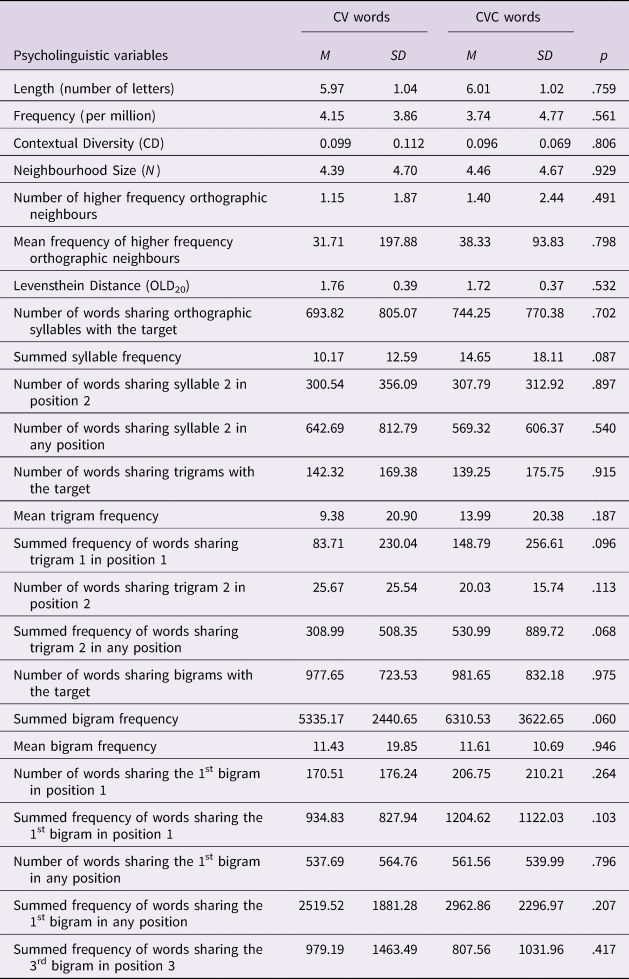
A total of 144 EP words were selected from the ESCOLEX database (Soares, Medeiros et al., Reference Soares, Medeiros, Simões, Machado, Costa, Iriarte, Almeida, Pinheiro and Comesaña2014a) as targets. ESCOLEX is an EP grade-level lexical database that provides several word frequency statistics for 6- to 11-year-old children (first to sixth grade) computed from elementary textbooks (see Soares et al. (Reference Soares, Medeiros, Simões, Machado, Costa, Iriarte, Almeida, Pinheiro and Comesaña2014a) for details). Half of the words had a CV first-syllable structure (e.g., ru.mor [rumour], ca.racol [snail]) while the other half had a CVC first-syllable structure (e.g., cis.ne [swan], per.fume [perfume]). For each group of words (CV and CVC), half were disyllabic, and the other half were trisyllabic. CV and CVC words were matched in several psycholinguistic variables shown to affect EP word processing (e.g., Soares et al., Reference Soares, Machado, Costa, Iriarte, Simões, Almeida, Comesaña and Perea2015, Reference Soares, Lages, Silva, Comesaña, Sousa, Pinheiro and Perea2019) (see Table 1) as obtained both from the ESCOLEX (Soares et al., Reference Soares, Medeiros, Simões, Machado, Costa, Iriarte, Almeida, Pinheiro and Comesaña2014a) and the P-PAL lexical databases (e.g., Soares et al., Reference Soares, Iriarte, Almeida, Simões, Costa, Machado and Perea2018).
Psycholinguistic variables matched between CV and CVC words.

Four hundred and thirty-two pseudoword primes were also created and assigned to one of three priming conditions: (i) 144 pseudowords that shared the first three letters and the first syllable with the target (i.e., syllable congruent condition – e.g., ru.mes-RU.MOR [rumour], cis.ra-CIS.NE [swan]); 144 pseudowords that shared the first three letters, but not the first syllable with the target (i.e., syllable-incongruent condition – e.g., rum.ba-RU.MOR, ci.ser-CIS.NE); and (iii) 144 pseudowords that neither shared the first three letters nor the first syllable with the target (i.e., unrelated condition – e.g., va.cra-RU.MOR, zar.vo-CIS.NE). Additionally, the 144 words used as targets were also used as primes in the identity prime condition (e.g., ru.mor-RU.MOR, cis.ne-CIS.NE). A set of 144 pseudowords were also created as targets for the purpose of the LDT. Pseudoword targets were created by replacing one or more letters from other EP words with similar lexical characteristics to the experimental words used in the task. The manipulation for the pseudowords targets was the same as for the word targets (i.e., syllable congruent condition- e.g., la.sor-LA.SES, vor.mo-VOR.CA; syllable incongruent condition- e.g., las.mo-LA.SES, vo.rus-VOR.CA; unrelated condition- e.g., be.zos-LA.SES, cas.za-VOR.CA; and identity condition- e.g., la.ses-LA.SES, vor.ca-VOR.CA). Four lists of materials were created to counterbalance targets across the prime conditions. Participants were randomly assigned to each list, though assuring the same number of participants per list (n = 9). In each list, participants responded to the full set of words and pseudoword targets (N = 288), with one third of each associated to the different prime conditions. The full list of prime-target pairs is presented in the Appendix A which can be found at https://bit.ly/37pTmKf.
Procedure
The experiments were run in a quiet room in the schools attended by the participants in groups that did not exceed four children per experimental session. Presentation of the stimuli and recording of responses were controlled by the DMDX software (Forster & Forster, Reference Forster and Forster2003). Participants performed a go/no-go LDT combined with a sandwich masked priming technique, as mentioned before. The go/no-go task entailed 288 trials (144 words and 144 nonwords) that were randomly presented to the participants. Each trial consisted of a sequence of four visual events presented at the centre of the computer screen: (i) a forward mask (#######) presented for 500 ms; (ii) the target, presented in uppercase for 33 ms (Courier New, size 14); (iii) the prime, presented in lowercase for 50 ms (Courier New, size 14); and (iv) the target again, presented in uppercase (Courier New, size 14) until participants response or until 2,500 ms had elapsed. An interval of 1,000 ms between trails was used. Participants were asked to decide as quickly and accurately as possible if the string of letters presented in uppercase (targets) at the centre of the computer screen constituted or not a real EP word. If participants considered that the target was a real word, they were instructed to press the M key on the keyboard (sim [yes] response). Conversely, if they considered that it was not a real word, they were instructed to refrain from responding and to wait until a new letter string appeared at the computer screen. Three pauses were introduced during the experiments (each 96 trials) to allow participants to rest. Participants decided when to continue with the task by pressing the spacebar in the computer's keyboard. Participants were not informed about the presence of the primes before target presentation. Prior to the experimental trials, participants received eight practice trials (four words and four pseudowords) with the same manipulation as the experimental trials to familiarize them with the task. None of the participants reported having perceived the primes when asked after the experiment. The whole session lasted approximately 25 minutes in the fifth-grade group, and 35 minutes in the third-grade group. Written informed consent was obtained from the parents of the children involved in the experiments. The study was approved by the local Ethics Committee (University of Minho, Braga, Portugal).
Experiment 1 (Beginning Readers)
Participants
Thirty-six third-grade children (M age = 8;7; SD age = 0;4; 22 female) from two private schools of Braga took part in the experiment. All were native speakers of EP with normal or corrected-to-normal vision, and did not have any reading or learning disorder, as reported by their teachers.
Materials and procedure
See the General Method section.
Results
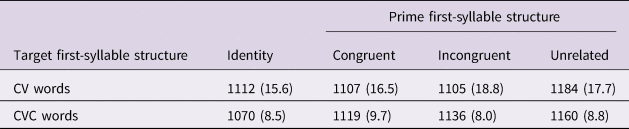
Latency (RTs in ms) and accuracy (% of correct responses) were analysed for word targets with linear mixed effects (lme) models using the R software (Bates, Maechler & Bolker, 2011). Incorrect responses (12.96% of the word data) and correct responses below 500 ms and above 2,000 ms, as well as above and below 3 SD of the mean RTs of each participant per experimental condition were also excluded from the latency analysis (5.89%). The lme on RTs were conducted with participants and items as crossed random intercept with the two repeated-measure factors: Type of prime (identity|congruent|incongruent|unrelated) and Type of target (CV|CVC) with random slope per subject but not per item (see Barr, Levy, Scheepers & Tily, Reference Barr, Levy, Scheepers and Tily2014; but also Matuschek, Kliegl, Vasishth, Baayen & Bates, 2017). All factors were treated as fixed factors in the analyses. For accuracy, we used a generalised lme with logistic link function and binomial variance. The models were fit by using the lme4 R library (Bates et al., 2011) and the lmerTest R library in order to contrast simple effects with differences of least squares means. For the effects that reached statistical significance, the second degree of freedom of the F statistic was approximated with Satterthwaite's method (see Satterthwaite, Reference Satterthwaite1941; and, Khuri, Mathew & Sinha, Reference Khuri, Mathew and Sinha1998 for a review). The p-values were adjusted with Hochberg's method for all post-hoc comparisons equal or below .05 (see Benjamini & Hochberg, Reference Benjamini and Hochberg1995, and Hochberg, Reference Hochberg1988 for details). Table 2 presents the mean RTs (in ms) for the correct responses and the % of errors (in brackets) for the CV and CVC target words used by prime condition.
Mean of lexical decision times (in ms) and of the errors (%) on target words by experimental condition in the beginning readers group (third-grade students).

On the accuracy data there were no statistically significant results.
Results on the latency data revealed a main effect of the type of prime, F(3, 4056.1) = 16.3146, p < .001 indicating that participants were faster in the identity prime condition than in the unrelated condition (81 ms, difference, p < .001), and also in the identity prime condition than in the syllable incongruent condition (32 ms difference, p = .033). The difference between the identity and the syllable congruent conditions was not statistically significant (23 ms, p = .068). Furthermore, the effect showed that participants were also faster both in the syllable congruent (58 ms difference, p < .001) and in the syllable incongruent conditions (50 ms difference, p = .001) than in the unrelated condition. The difference between the syllable congruent and syllable incongruent conditions were statistically non-significant (8 ms difference). The interaction between the two factors also failed to reach statistical significance.
Taken together, these findings showed that, although third-grade EP readers were faster at recognizing CV and CVC words preceded by syllable congruent and syllable incongruent primes than unrelated primes, thus revealing significant priming effects in both conditions, the difference between syllable congruent and syllable incongruent primes failed to reach statistical significance, hence failing to show genuine syllable masked priming effects for EP beginning readers. Note that, for a genuine syllable effect to be observed, participants should present significantly faster responses in the syllable congruent condition than in the syllable incongruent condition, which would indicate that the masked priming effect observed was not a product of the orthographic overlap between primes and targets. In the following section the results obtained with intermediate EP readers are presented.
Experiment 2 (Intermediate Readers)
Participants
Thirty-six fifth-grade students (M age = 10;6; SD age = 0;3; 20 female) from the same private schools as Experiment 1 took part in the experiment. All participants were native speakers of EP, with normal or corrected-to-normal vision. As in Experiment 1, none of the children had any reading or learning disorder, as reported by their teachers.
Materials and procedure
See the General Method section.
Results
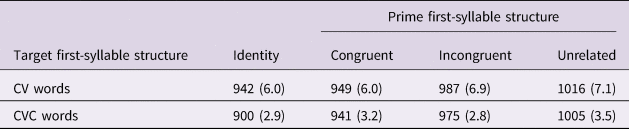
The analyses and trimming procedures used in Experiment 2 followed those adopted in Experiment 1. Incorrect responses (4.82% of the word data) and outliers (3.68%) were excluded from the analysis. Table 3 presents the mean RTs for the correct responses and the % of errors (in brackets) on each experimental condition.
Mean of lexical decision times (in ms) and of the errors (%) on target words by experimental condition in the intermediate readers group (fifth-grade students).

On the accuracy data no effects reached statistical significance.
Results on the RT data, showed a main effect of the type of prime, F(3, 4590.6) = 31.9817, p < .001, indicating that participants were faster at recognizing words preceded by identity primes than both unrelated (90 ms difference, p < .001) and syllable incongruent primes (60 ms difference, p < .001), as in Experiment 1, and also faster at recognizing words preceded by identity primes than by syllable congruent primes (25 ms difference, p = .008). The type of prime effect also showed that fifth-graders were also faster at recognizing words preceded by syllable congruent primes (65 ms difference, p < .001) and syllable incongruent primes than by unrelated primes (30 ms difference, p = .001) and, critically, that the difference between syllable congruent and syllable incongruent primes reached statistical significance (35 ms difference, p = .009).
The findings allow us to establish the emergence of a genuine masked priming syllable effect at this stage of EP reading acquisition and, importantly, that this effect was virtually the same for CV and CVC words, as predicted. Indeed, although both syllable congruent and syllable incongruent primes produced facilitative masked priming effects, as both differentiated significantly from the unrelated condition, as in Experiment 1, participants were still significantly faster in the syllable congruent condition than in the syllable incongruent condition. This result leads us to interpret the advantage of the syllable congruent condition as an early and automatic activation of the syllable per se and not a product of the orthographic overlap between prime and target as observed in third-grade EP children.
General discussion
The importance of the syllable as a phonological unit, and also the fact that reading rests heavily on a spoken language foundation, at least in alphabetic languages, has led several authors to propose that, above the letter level, the syllable acts as relevant sublexical unit during lexical access and reading. Although several studies conducted with expert readers have provided strong evidence for an automatic activation of syllables at early stages of visual word recognition (e.g., Álvarez et al., Reference Álvarez, Carreiras and Perea2004; Campos et al., Reference Campos, Mendes and Soares2018, Reference Campos, Mendes and Soares2019; Chetail & Mathey, Reference Chetail and Mathey2009a), studies are scarcer on developing readers investigating the extent to which the syllable also plays a role at early stages of visual word recognition, and at what stage during reading development. Moreover, the few studies conducted so far have used different tasks and paradigms, and also groups of developing readers with different levels of reading proficiency and recruited from languages with different characteristics, which may contribute to explain the inconsistency of the results observed in the developing reading literature. Here we used a LDT (go/no-go), combined with the sandwich variant of the masked priming paradigm with beginning (third-graders) and intermediate (fifth-graders) EP readers to overcome the limitations of previous studies, and to further examine the developmental trajectory of syllable effects at early stages of visual word recognition in EP, an intermediate-depth stress-timed language, where syllabification is less clear and more complex than in French and Spanish.
The results obtained from lme analyses were clear-cut and showed that, in EP beginning (third-grade) readers, there was no evidence of genuine syllable effects, as both syllable congruent and syllable incongruent conditions produced similar facilitative priming effects in the recognition for both CV and CVC words. Indeed, besides the advantage of the identity prime condition over all the other prime conditions, and the advantage of the syllable congruent and incongruent conditions over the unrelated condition, the difference between the syllable congruent and incongruent conditions, indicative of genuine syllable effects, did not reach statistical significance. This finding suggests that the facilitation observed in these conditions results from the orthographic overlap between primes and targets for CV and CVC words alike, and not from the share of the syllable per se. In the intermediate reader group (fifth-graders), however, the results seem to support the view that the syllable really acts as a sublexical unit at early stages of word recognition in EP. Not only did the syllable congruent and incongruent conditions differentiate from the unrelated condition, but, importantly, they distinguish between each other with fifth-graders being significantly faster at recognizing CV and CVC words preceded by syllable congruent primes than by syllable incongruent primes.
These findings are in line with our predictions and with the results obtained by Chetail and Mathey (Reference Chetail and Mathey2012) with sixth-grade French children, though not with the results obtained from other masked priming studies conducted with expert readers both in EP (Campos et al., Reference Campos, Mendes and Soares2018, Reference Campos, Mendes and Soares2019), and in other languages (e.g., Álvarez et al., Reference Álvarez, Carreiras and Perea2004; Chetail & Mathey, Reference Chetail and Mathey2009a). Indeed, conversely to what we found with fifth-readers, in these studies, reliable syllable effects were observed for CV, but not for CVC words, which has been accounted for by the fact that CV syllables are much more frequent than CVC syllables at least in languages as Spanish and French (e.g., Álvarez et al., Reference Álvarez, Carreiras and Perea2004; Chetail & Mathey, Reference Chetail and Mathey2009a). This might make the visual recognition system to develop a bias towards the processing a CV syllable even when a word has a CVC first-syllable instead. In EP, however, as mentioned before, the difference between the number of words presenting a CV and a CVC syllable structure is much less pronounced than in those languages. This made Campos et al. (Reference Campos, Mendes and Soares2018) anticipate the absence of a syllable structure effect in EP adult skilled readers in accordance with which has been previously observed in speech recognition by Morais et al. (Reference Morais, Content, Cary, Mehler and Segui1989) with literate and illiterate EP adult native speakers. Nonetheless, the results showed that reliable masked priming syllable effects were only observed for CV words, as previous studies in the Spanish (e.g., Álvarez et al., Reference Álvarez, Carreiras and Perea2004) and French (e.g., Chetail & Mathey, Reference Chetail and Mathey2009a) languages also demonstrated. Other variables, like the number of syllable neighbours of CV and CVC words, were put forward by Campos et al. (Reference Campos, Mendes and Soares2018) as alternative explanations. Indeed, although Campos et al. (Reference Campos, Mendes and Soares2018) matched the CV and the CVC words used in their experiment in several psycholinguistics measures, including the number of words sharing the same first syllable in the EP lexicon, this control was made regardless of syllable position. So, considering not only recent studies showing that the first syllable plays a more relevant role during visual word recognition than syllables in other positions (see for instance Álvarez et al., Reference Álvarez, Carreiras and de Vega2000), but also the definition of syllable neighbour, which states that it refers to words that share the same syllable in the same position (Perea & Carreiras, Reference Perea and Carreiras1998), and with the same word length (Chetail & Mathey, Reference Chetail and Mathey2011), it is possible that the difference in the number of neighbours sharing the first syllable might account for the results. Specifically, the authors proposed that the denser syllable neighbourhood of CV words relative to CVC words, when considering the first position, may have made CV words be more easily activated in the visual recognition system, thus justifying the results. This explanation was further supported by a recent study conducted by Campos et al. (Reference Campos, Mendes and Soares2019), where the authors ruled out syllable complexity (CVC syllables are more complex than CV syllables and, hence, might require more time to be fully activated) as an alternative explanation for the syllable structure effect observed in EP by increasing prime durations from 50 ms to 67 ms and 82 ms (see Campos et al., Reference Campos, Mendes and Soares2019 for details). It is also worth noting that the use of the sandwich masked priming paradigm in the current work with EP developing readers could have also contributed to the absence of the syllable structure effect both in third- and fifth-reader children as this paradigm also allows to better control for neighbourhood effects, as mentioned in the introduction (Lupker & Davis, Reference Lupker and Davis2009). Note that, conversely to the conventional masked priming paradigm (Forster & Davis, Reference Forster and Davis1984), the brief presentation of the target before the prime in this variant of the paradigm pre-activates the target representation, hence minimizing the influence of other similar lexical competitors on target recognition.
Nevertheless, even though Chetail and Mathey (Reference Chetail and Mathey2012) did not advance any explanation for the fact that sixth-grade French children showed reliable masked priming paradigm syllable effects both for CV and CVC words, which contrasts with the results observed with French adult readers (e.g., Chetail & Mathey, Reference Chetail and Mathey2009a), we can anticipate that, in intermediate stages of reading acquisition, children may indeed rely on the use of the syllable for lexical access and word recognition, and, in a wider way, than adult expert readers do. Although current models of visual word recognition cannot account for this developmental trajectory of the syllable structure effect (see for instance the MROM model by Grainger & Jacobs, Reference Grainger and Jacobs1996), we can anticipate that, because children rely more strongly on the sublexical than on the lexical route during visual word recognition, as the whole-word orthographic representations are still being developed, intermediate readers, particularly from languages with deep and intermediate-depth orthographies, rely more on the phonological recodification processes, thus making syllable effects to be observed both for CV and CVC words. Furthermore, this view is also supported by the Ans et al.'s (1998) model – which suggests that at early stages of reading acquisition children read most words by segmenting them into their syllable components – and also by studies conducted with expert readers showing that in tasks recruiting phonological processes more extensively, as in speech recognition (e.g., Mehler et al., Reference Mehler, Dommergues, Frauenfelder and Segui1981; Morais et al., Reference Morais, Content, Cary, Mehler and Segui1989), syllable effects were observed for CV and CVC words alike.
It is also worth mentioning that EP beginning readers failed to show any signs of reliable syllable effects, which is in accordance with our predictions. Since EP is an intermediate-depth stress-timed language with a more complex pattern of syllabification than syllable-timed languages like Spanish and French, and less straightforward grapheme-to-phoneme conversion rules, unlike Spanish (which is a shallow language) it is possible that reading processes in EP would take longer to be automatized: hence making reading, at the earliest stages of reading acquisition, occur through a slower serial letter-by-letter decoding strategy (see Álvarez et al., Reference Álvarez, García-Saavedra, Luque and Taft2017; Luque et al., Reference Luque, López-Zamora, Álvarez and Bordoy2013 for similar arguments). However, with increased exposure to print and accumulated experience, children are able to develop sublexical orthographic representations that allow them to recognize words in a faster and efficient way by using units above letter-level. From this theoretical framework, it is possible that, because of the characteristics of the EP language, our beginning readers are still at a more immature stage of reading acquisition, hence making syllable effects to be noticeable only at a later (intermediate) stage. Note that, although our beginning readers were third-grade readers, the experiment was conducted at the beginning of the school year, thus making their reading skills to be more similar to second-grade children, which might explain the results – note that previous masked priming studies conducted with EP second-grader children also failed to observed any significant effects besides identity priming effects (see for instance Soares et al., 2014b for a study aimed to track the developmental trajectory of the consonantal bias in EP developing readers).
Taken together, the present results seem to suggest that, as exposition to print increases and literacy unfolds, syllable effects are observed for CV and CVC words alike, at least in a reading stage where sublexical orthographic representations above the letter-level of processing are already at stake, allowing the syllable to play a functional role at early stages of visual word recognition. However, as readers become more proficient, it is also possible that the visual word recognition system also begins to take into consideration other fine-grained variables, like the number of times a given syllable appears in a given position in the lexicon and/or the number of words sharing the same syllable in a given (first) position, to optimize reading. Nonetheless, more studies are needed to better understand the syllable structure effect in skilled readers, particularly using measures highly sensitive to the time course of processing as event related potentials (ERPs). Current models of visual word recognition should also be further developed to account for this syllable structure effect. Bear in mind that, although the MROM-S model of Conrad et al. (Reference Conrad, Tamm, Carreiras and Jacobs2010) and the model of Ans et al. (Reference Ans, Carbonnel and Valdois1998) have proposed the existence of a syllable layer during the process of visual word recognition, neither of them specify the mechanisms by which a word is syllabified into its components, nor how the syllable structure might affect this process and might change as reading proficiency unfolds. Additionally, from a more applied point of view, considering that the syllable acts indeed as a mediator between the letter level of representation and the word level of processing, it might be relevant to develop teaching techniques focused on using a syllable approach to reading, not only with normal children that have no history of language or reading related disorders, but also to those who might reveal some type of reading or language disabilities.
Acknowledgements
This study was conducted at the Psychology Research Centre (PSI/01662), University of Minho, and supported by the Grant PD/BD/128464/2017 and also from the Grant POCI-01-0145-FEDER-028212 from the Portuguese Foundation for Science and Technology and the Portuguese Ministry of Science, Technology and Higher Education through national funds, and co-financed by FEDER through COMPETE2020 under the PT2020 Partnership Agreement.