IntroductionFootnote 1
Each summer, in early August, dozens of knights and their squires assemble in the otherwise quiet Dalmatian hinterland, in the small Croatian town of Sinj, to hold an equestrian tournament. Exhibiting richly embroidered historical costumes with baize dolman and marten-fur busby, they compete on horseback, trying in full gallop to spear an iron ring hanging from a rope across the racetrack with a three-meter-long lance, and parading to brass fanfares, canon shots, and loud cheers and rounds of applause of the audience.
And only a week later, on Assumption Day (Velika Gospa), tens of thousands of pilgrims from all over the country flock to the Sanctuary of Our Lady of Sinj to commemorate the divine intervention of the Virgin Mary in a legendary defeat of attacking troops of the Ottoman Empire. In 2015, these two spectacles merged to a media mass event and major nation-wide tourist attraction, as the date marked the 300-year anniversary of the historic battle against the invasion and defeat of the numerically far superior Ottoman army in 1715. The summer months were declared Dani Alke i Velike Gospe, “Days of the Alka and the Assumption,” and the Sinj Tourist Board started a major multimedia campaign promoting dozens of events to direct the attention to “Inland Dalmatia.”Footnote 2
But the tournament Sinjska Alka and the annual Marian pilgrimage are far more than folkloristic festivals marking regional religious identity. Both events are based on master narratives of a violent past, heroic self-defense, and divine intervention, which are systematically activated and adjusted to retrospectively account for legacies of (endured as well as exercised) political violence in the region. The area surrounding Sinj was not only recurrently fought over territory from the sixteenth to eighteenth centuries due to its location on the Triplex Confinium, the triple Ottoman-Habsburg-Venetian frontier. It also witnessed some of the most extreme violence both in World War II and in the post-Yugoslav wars. This position at the intersection of several key axes of European symbolic geography and, in more recent times, also of fascism, democracy, and Communism, has been invoked as central to understanding the region as an area of fertile cross-cultural contact as well as a site of violent civilizational shifts (Ballinger 2004). Memories of a violent past are mainly employed with reference to the Ottoman and Communist eras, World War II, and, more recently, the Croatian War of Independence (1991-1995), which is commonly referred to as domovinski rat, or Homeland War. The narrative memorial practices, however, are not so much an attempt to analyze and live with a traumatic past determined by violence (Vergangenheitsbewaltigung), but aim at adapting to new political realities and challenges, as they unfold since Croatia’s EU accession in 2013. This, I argue, is largely achieved by invoking notions of locality and authenticity, which are subsumed under the label of “tradition.”
The 300-year festivities in close collaboration with the local tourist board extended the engagement with local history through popular performance techniques by adding new aspects and initiatives of rationalizing the past and staging “tradition.” The various concepts and practices - including performance, mimesis, replication, and imitation - that were at stake in Sinj’s re-enactment and celebration of past events were part of a carefully crafted resuscitation of lived experience within the frameworks of (politicized) commemoration, cultural heritage, and the commodification of the past. The media representations and performances by which this was done consisted of an elaborately produced feature-length documentary film employing various “living history” scenes, a re-enacted theatrical performance or folk play with amateur actors at the historic battle/apparition site, a museum exhibition, and the inauguration of the “theme park Sinjska Alka,” featuring local costumes, parades, and popularized variations of the classic Alka tournament. I will closely analyze these presentations with regard to their specific engagement with past and present life-worlds, and assess their respective theatrical realization and appropriation of a violent history. While one of the underlying motifs undoubtedly is to draw attention to and enhance the region' s attraction as a tourist destination, I am also assessing re-enactment' s epistemological and political claims by asking whether these interactive engagements with history are mainly ardent reproductions affirming a status quo, or rather take an active stance in promoting and/or re-inventing heroic olden times to advance economic and socio-political conditions in the present (Gegenwartsbewaltigung).
My study is based on 15 months of stationary anthropological field research in Sinj that I conducted from April 2004 to September 2005 as part of my doctoral dissertation, together with regular annual visits between 2006 and 2015 (Schauble Reference Schauble2011, Reference Schauble2014). In the course of my years of research I could observe in detail how the political tone and meaning of the Alka tournament has dramatically changed from an openly right-wing and nationalist propaganda platform, celebrating militancy and essentialized notions of ethnicity and “the homeland,” to a symbol of freedom and independence, representing Croatia in Europe (Schauble Reference Schauble2014,57-74). While the Sinjska Alka was habitually conceptualized as a localized narrative of victimization through oppression and misgovernment under Ottoman rule, resistance to foreign invasion and exploitation, and (divine) selection, it has more recently become a site of national cultural heritage. In addition to changing memory practices, I could also closely follow the various preparations and initiatives ahead of the 300-year celebrations in Sinj, some of which - such as the erection of an oversized Marian statue and the building of the Alka museum - were initiated years in advance of the anniversary. Year after year, new elements of re-staging the 1715 siege have been added, suggesting a longing for past triumph and the affirmation of divine selection in an actual climate of political, social, and economic marginalization. Attending the festivities in the summer of 2015, I could then ascertain the shift of the Alka from an annual tournament toward a series of re-enactments that serve as vehicles of (an imagined) historical continuity.
A close analysis of the vicissitudes of the political meaning of these events and their public staging provides valuable insights into two interconnected mechanisms: how a violent past is (re-)interpreted and made sense of on a local level, and how local memories and narratives of violence and resistance are transferred into official collective memory and eventually historiography. In the following, I will outline the various and at times rather playful practices of returning to one' s origins by commemorating, staging, and celebrating “tradition” that is at the core of the 2015 festivities in Sinj.
Historical context: narratives and commemorations of victimhood and divine salvation
The medieval fortress Castrum regale Zyn (“royal town of Sinj”) was located at the border between the Venetian and Ottoman Empires.Footnote 3 Due to its strategic location, it was particularly heavily fought over and since the mid-fifteenth century, Ottoman troops repeatedly attacked the region to gain access to the Adriatic coast.Footnote 4 According to a legend that is widely propagated today, in August 1715 roughly 60,000 Ottoman soldiers besieged the town but the 700 local defenders refused to surrender. The townspeople gathered to pray in front of a Marian painting to ask for divine protection. Said painting had previously been rescued from a monastery in Bosnia and won the reputation of containing miraculous powers; it was said that the Turks would cease to win their battles wherever the painting emerged. The population of Sinj thus prayed for several days while the siege persisted. Suddenly, however, the Turks were struck with thirst and dysentery and at daybreak on 15 August, a floating lady in a white dress appeared outside the fortification wall. The attackers were terrified at the sight and took immediate flight. Soon thereafter, the news of the Marian apparition in Sinj spread around the country and the townspeople, who attributed the defeat of the Turks to the aid of the Marian apparition, referred to the painting as Cudotvorna Gospe Sinjske (“Miraculous Lady of Sinj”) ever since. As parts of Dalmatia had been under Turkish rule for almost two centuries, the ultimate defeat of the Ottoman troops was commonly embraced as miraculous salvation. The battle gave birth to a legendary tale about local heroism and a myth about the divine liberation from the “Ottoman yoke.”
In commemoration of the successful defense of Sinj and the alleged divine intervention, the chivalrous game called the Alka of Sinj or Sinjska Alka was established.Footnote 5 The horseman leading the cavalcade carries a banner with the emblem of the Miraculous Lady of Sinj and canons are shot from the historic castle where the Marian apparition is said to have taken place. A week later, on Assumption Day, Velika Gospa (literally translated as “Great Madonna”), the miraculous painting is carried through the narrow streets of Sinj in a procession followed by ten thousands of pilgrims. During this event the local population commemorates their ancestors' exodus from Bosnia in 1687 together with the divine intervention in the battle of 1715. The Alka cavalrymen, called Alkari, are the main local dignitaries who feature prominently during the festivities and are a visible reminder of the historical background of this customary celebration. Versions of the legendary battle of 1715 are also commonly recited in church sermons, during local political rallies, and on other public occasions. The drama has also inspired various folk tales, literary works, popular songs, and children' s stories and forms an integral part of the folkloristic repertoire in the Cetina region.
Drawing upon the medieval tradition of chivalrous competitions or mock fights called giostre (from Latin juxtare, “to approach, to come together, to meet”) the Alka was first inaugurated as a parade and later established as a veritable tournament. It is considered the direct descendant of knightly tournaments common throughout Europe and in parts of the near East in the Middle Ages and Renaissance. Historically, it has also always had a religious connotation and is inseparably linked to the commemoration of the 1715 Marian apparition and celebration of Velika Gospa (Assumption Day).
However, under state socialism the tournament changed in its standing. Marshal Josip Broz Tito was aware of the explosive potential of the Alka regarding Croatian separatist attempts and actively re-interpreted the games as a major secular folkloristic event and all-Yugoslav cultural asset. Taking into consideration that the very town of Sinj had been a partisan stronghold during World War II and that in the years following 1945 only members of the Communist Party could be part of the Alka Tournament Association, Tito, like other rulers or heads of government before (and after) him, exploited and shaped the symbolic significance of the Alka according to his own political agenda.Footnote 6
After Tito' s death in 1980 and then after the disintegration of Yugoslavia when nationalist sentiment began to grow in the former constitutive republics, the ideals of autonomy and liberation from oppression represented originally by the Alka provided fertile ground for mobilization in the emerging political situation. With the outbreak of military conflict during the 1990s, historical references to armed self-defense and readiness for combat -as they had frequently been evoked in relation to the Alka - took on a new meaning. In this way, the Alka soon became a symbol of Croatian heroism and self-defense in the country’s bid for independence. The first president of the Republic Croatia, Franjo Tuctman, succeeded in constructing a Croatian imaginary of a small, victimized country with the greatness to overcome oppression and to fight heroically for its independence. This mechanism is crucial not only in understanding the national rhetoric and symbolism that facilitated the violent break-up of Yugoslavia, but also in helping to decipher the language and rationale concerning the resurgence of nationalism in current political debates on Croatia' s role within Europe.
The battle of Sinj has become central to the interpretation of the history of Croatia as Antemurale Christianitatis,or “bulwark of Christianity” - indicating that Croats and their ancestors have successfully protected, and still protect, the borders of Western European Christian Europe.Footnote 7 The concrete historical presence of the Ottoman Empire has traditionally been conceived as an Oriental, genuinely non-European element, which still prevails in prevalent discourses linking Balkanism to “the Ottoman legacy.” Up to today, Croatian nationalism is constructed in vehement, direct opposition to the idea that Croatia is part of the Balkans, a region strongly associated with its Ottoman, and therefore Muslim, legacy (Todorova Reference Todorova1997; Bjelic and Savic Reference Bjelic and Savic2005; Zanic Reference Zanic2007; Schauble Reference Schauble2014; Haj-darpasic Reference Hajdarpasic2015).
Already during the Homeland War (1991 -1995) the ancient antagonism against the “evildoers from the East” was significantly re-interpreted, where this time not neighboring Bosnian Muslims but the mainly Serbian-led JNA (Yugoslav People’s Army) and Serbian paramilitary forces were perceived as the main threat. In the context of this discourse, Serbian and Ottoman/Turkish troops become interchangeable under the label of “attackers from the East” against whom Croatia bravely defended herself. This fact, however, did not alter the importance of the historic battle of 1715 for Croatian self-stylization as guards and protectors of the Occident.
In 2001, for example, the 286th Alka was staged as a nationalist rally in support of Mirko Norac. A local of a village near Sinj, Norac was the first Croatian general to be convicted of war crimes and crimes against humanity during the Homeland War. When he was sentenced to 12 years' imprisonment by a court in Rijeka, this caused huge protests; the Alkari of Sinj announced that they would defend him, with their own blood if need be and declared him honorary Duke of the Alka tournament from 2001 to 2005. Under the slogan “Mirko, ne damo te, cekamo te na alci!” [“Mirko, we don't hand you over, we await you at the Alka”] supporters of Norac protested nationwide against his persecution and extradition to the ICTY and accused the government of treason. The town council of Sinj proclaimed that it “fully supported the popular rage that the indictments provoked” and the mayor of Sinj declared that the people of Sinj and the Cetina region stood under the special protection of Our Lady of Sinj who had led her knights in the war so that the Croatian nation could finally gain freedom. In these protests, a very strong anti-government sentiment prevailed and then Prime Minster Ivica Racan and then president Stjepan Mesic were publicly discredited, for example with their liberal-left government referred to as “Khmer Rouge,” thus hinting not only at their alleged Communist agenda but also indirectly accusing them of betraying their own people by extraditing heroic Croatian “defenders” (Schauble Reference Schauble2014, 53ff).
Until today, the battle of Sinj is construed as decisive for the entire Croatian people and celebrated as a defense of the borders of (Christian) Europe. When the Sinjska Alka was inscribed on UNESCO’s world intangible cultural heritage list in 2010, however, the symbolic potential of the tournament had to be decoupled from its centuries-old militant and mutinous connotation. The increased international attention along with Croatia' s new status as an EU member necessitated an active reinterpretation of the Alka, highlighting its significance as a folkloristic performance and continuation of Dalmatian “tradition” rather than the celebration of a gory battle against (Muslim) invaders. In 2012, for example, the organizers staged a relatively undramatic Alka event. Up to the opening of the actual tournament it was not clear if ex-general Mirko Norac would participate in the games and many people eagerly anticipated his appearance. In November 2011 he had been released from prison on probation and the 2012 Alka would be the first occasion for him to appear in public. Therefore it came as a surprise that not only was he not present in person but that no mention of his name was made throughout the entire tournament. The speakers omitted any reference to him and hence avoided any allusions to the supposedly unjust conviction of Croatian generals and rants of hate against the International Criminal Tribunal for the former Yugoslavia (ICTY). Instead, the Turkish ambassador Burak Oziigergin visited the games as the first representative from Turkey in nearly 300 years. His presence was enthusiastically acclaimed by the audience and highlighted as a sign of reconciliation and settlement of centuries-old animosities.
Nevertheless, the underlying gist remains one of readiness for battle against intruders that tends to lend itself to ethno-nationalist ideas. The rationale of this narrative is crucial for understanding the role of Alka concerning nationalist tendencies in current political debates on Croatia' s role within Europe.
In the following sections I will present various attempts by local actors to reshape the meaning of the Sinjska Alka. The reinterpretation of the battle of 1715 and the ensuing Marian apparition currently affects a number of public discourses and displays and takes place in different media formats. I will focus on four different examples: a documentary film, a re-enacted folk play, musical performances, and finally the presentation and commercialization of “tradition” in the tourist industry. These different examples all include re-enactments and variations of the theme of the Alka, and they all eventually contribute to the creation and establishment of the Sinjska Alka as a potentially new national Croat epic. I argue that the application to inscribe Alka on the UNESCO’s world intangible cultural heritage list, the production of the Alka film, and the construction of the Alka museum are all attempts to transfer Alka from a locally restricted phenomenon and narrative to a recognizable trademark that represents Croatia in Europe and beyond. The resignification of Alka as a potential new national epic also implies the transfer of the event from popular memory to official cultural memory and necessitates the detachment from concrete political positions and programs, and particularly the decoupling from recent violence in the region.
Alka - the film
In the run-up to the 300th-anniversary festivities, the Alka Knights Society together with Croatian Radiotelevision co-produced a monumental 70-minute docudrama (“dokumentar-noigrani film”) simply entitled “Alka.” The film is a major effort to inscribe the 1715 battle into official history, and establish the Alka narrative as a national epic whose significance extends local and regional frames of reference. According to the DVD blurb, the documentary aims at showing the tournament' s “importance in the local, Croatian, European, and world contexts,” and subtitled versions are available in various languages.
The film that premiered at the opening ceremony of the 300-year festivities is a high-budget production that elaborately reconstructs historical scenes surrounding the 1715 battle in the manner of period drama films, complementing them with expert interviews, 3D animations of historic maps, and spectacular contemporary landscape photography. The possibilities of the medium film are fully exhausted in creating a commemorative re-enactment of the crusade against the Ottomans and the history of the Sinjska Alka as a significant historical milestone. In this sense “Alka” is a significant contribution not just to local historiography, but for the politics of remembering in Croatia in general. The re-enactments are so authentic and accurate that the film itself seems to intend to contribute to the production of cultural memory by providing an objective source of what had happened in the area of Sinj from the seventeenth century onwards.
The first scene of the documentary features a re-enactment of the visit of Emperor Franz I to Sinj in 1818, when the locals staged a solemn Alka for him. This starting point is meant to stress the longevity as well as political significance of the games throughout history. The town of Sinj and the Cetina region of Dalmatia are situated within the Austro-Hungarian Empire and hence established as part of (Christian) Europe. In the scenes to follow, the film goes further back around another 150 years, reenacting the exodus of the Christian population from Rama in today' s Bosnia. In 1687 around two dozen Franciscan friars and about 5000 people fled from the Ottomans and forced conversion to Islam and eventually settled in Sinj and the hitherto uninhabited Cetina region. Fleeing on foot and by horse-drawn carriages these first settlers brought a Marian painting with them that later gained the reputation of holding miraculous powers. The film paints the picture of a laborious but peaceful existence of these peasants in their new home - until the Ottoman army and their auxiliary units attack Sinj in 1715, in a battle referred to as the “Second Morean War,” the “Small War,” or the “War of Sinj.”
The scenes are accurately reconstructed based on a large number of historic documents, records and maps, including a recently discovered report of Sinj’s proveditor Zorzi Balbi, dated 30 September 1715. In addition, the diary of an unknown Venetian soldier who participated in the battle and vividly described combat scenes features prominently throughout the film. Excerpts of these historic documents are recounted and brought to life through the re-enactments; similarly, the ancient fort and siege camps are scenically re-built, and historic maps and engravings are animated, all conveying a sense of living history.
The numerical superiority of the Ottoman army is impressively conveyed by a drone flight over hundreds of rows of tents in the siege camp, and enlivened through realistic displays of everyday life scenes and battle preparations of the occupying forces. While they are under attack, people within the fortress of Sinj pray to the Marian painting for divine protection. The depiction of the actual battle scenes is quite extensive and graphic, and only comes to an end when the Virgin Mary appears like a cloud of smoke in the sky - an apparition, which according to written sources could only be seen by the attackers, not by the people of Sinj themselves. The attackers flee and their unlikely defeat is celebrated as divine intervention. The miracle is ascribed to the painting of Gospa Sinjska, which is later crowned with gold coins by the archbishop - another scene that is reenacted in the film “Alka.” The interviewed scientists have no unanimous explanation of this “miracle,” but poor logistics on the part of the Ottoman headquarters, internal quarrels and a dysentery epidemic, as well as fear of reinforcement through additional Venetian troops are mentioned as possible rationalizations of the inexplicable withdrawal of the superior Ottoman army.
Scenes featuring re-enactments in historic costume and faithful decor are alternated with current documentary footage of the Sinjska Alka, thus linking the games with the legendary battle and highlighting the direct continuation of history in the present. Today' s Alkari and their squires are presented as direct descendants of a historical armed formation of the territorial army of Venetian Dalmatia. The film creates a sense of continuation and the Alkari are staged as living history, or rather a kind of “survival;” an effect that is even reinforced by Alkari posing motionless in full attire and being staged like real-life museum exhibits.Footnote 8 The directors of the film decided to fuse documentary and fictionalized reconstructions in a format that combines entertainment and history lesson. The result is an opulent drama in which more than 1200 locals staged as extras. The reenacted history scenes are interspersed with classic talking heads style interviews with historians, archeologists, collectors, art and film historians, restorers, Alka horsemen, and local dignitaries whose role is to (scientifically) validate the narrative and endorse its significance for Croatian history. Great detail is given to the “authenticity” of the architecture, costumes, weapons, and military equipment, and in the final credits of the film it is mentioned that the restoration of Alka uniforms and the fashioning of replicas took 40 years' work in the Croatian Conservation Institute.
To highlight the optical appeal and media compatibility of the games, the film can further fall back on a multiplicity of documentary audio-visual materials. The games were a motive that fascinated early photographers and cinematographers alike; the first photographs of the event were already taken in 1875 and film footage exists from as early as 1921. From 1967 onwards the Sinjska Alka was regularly broadcast live on Croatian TV. The wide reception and ongoing attraction authenticate the tournament as the marker of local identity. The accompanying text to the film states that the Alka of Sinj was founded for the local people “as a lasting commemoration of the heroism of their forebears, and as an incentive to generations to preserve not only the warlike spirit of the defenders against the enemy, but also competition in nobility, propriety and workmanship.”
“This is a contest,” the booklet continues, “that has, through centuries of tradition, woven itself into the nation, become its undeniable driving force, bearer of popular pride.” While the film confirms that the Alka has continually been used as a stage for political leaders to propagate their respective programs, the use of the metaphor that the Alka tournament has itself “woven into the nation” stresses the longevity and immutability with which the event is inseparably linked to Croatian identity.
The final words spoken in the “Alka” film, are “[t]he Alka is a huge memory in miniature as it has lasted about 300 years. It is also a portrait of Croatian political history from the 18th to the 21st century.” The interpretation of the significance of the Alka as condensed national history expands the Alka narrative to an epic scope that encapsulates and expresses the essence or spirit of the entire Croatian nation. The defeat of the Ottoman troops in 1715 is released from its local restriction to Sinj and the Dalmatian hinterland and (re-)con-structed as a crucial event in the development of national identity - based on the ethos of endurance, love of freedom, and Christian faith.
In sum, the example of the lavishly produced film illustrates how the violent history of Dalmatia in general and the Sinjska Alka in particular is reconceptualized as heroic narrative, yet without reproducing either the Antemurale myth or the widespread litany of victimization and historical injustice. One of the central (self-)victimization tropes - namely that the Croatian nation has systematically been persecuted - has suffered more than any other, and is consequently per se innocent of committing any injustice or war crime. This point is frequently employed in ethno-nationalist discourse, but is absent in this film, as are any references to recent violence in the region. The film interprets the Alka tournament as a performance of traditionalism and local pride, but it does so without blame, “othering,” or a political postulation attached to it. The “Alka” film can thus be seen as a successful attempt to re-signify the previous meaning of the festival as a celebration of the Antemurale role and essentialist notions of local, regional, and national identity. This, however, cannot be said about some of the other recently installed stagings of the battle of 1715. In my next example, I will analyze a local performance that tends to enforce stereotypes and antagonism inherent in the Alka narrative, rather than refuting them.
“Relive the siege of Sinj 1715”
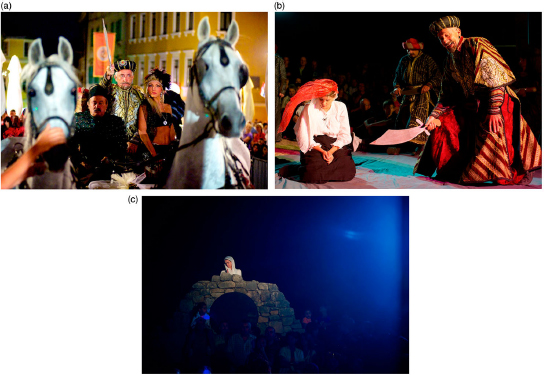
A few years ago, the local tourist board initiated another Alka-related spectacle, namely the “Predstava Opsada Sinja 1715,” or “The 1715 Siege of Sinj Performance“ - a re-staging of the historical battle and Marian apparition with amateur actors. The performance takes place annually in August at the original location, namely in the ruins of the ancient fortress of Sinj (see Figure 1(a-c)).
(a-c). The 1715 Siege of Sinj Performance, a fictionalized re-enactment of the historic battle and Marian apparition. Photos: Copyright © 2017 Sinj Tourist Board. All rights reserved.

Contrary to the ornate film that puts great emphasis on the accuracy of historical narrative and costume, the amateur performance plays with cultural and racial stereotypes and inventively stretches the historic narrative. The town provides a playful backdrop like is the case for living history programs in open-air museums. In a sense, Sinj is transformed into an open-air museum for an evening. While some people continue sitting in outside cafes and bars, chatting and having drinks, a horse carriage of a Turkish pasha dashes through the marketplace to canon shots and a herald announces the attack of the Ottomans, while a blind seer, not unlike Tiresias in Greek tragedy, foretells disaster and bloodshed (see Figure 1a). The leader of the Turks/Ottomans - an orientalist depiction of the historic figure of Mehmed Pasha, the Grand Vizier of the Ottoman Empire - is adorned with an oversized turban and flanked by two half-naked women in transparent oriental robes.
The second part of the performance takes place within the walls of the ancient fortress, where the alleged Marian apparition had occurred and where a chapel and Marian statue have since been built. The audience has to follow the actors, stumbling uphill in the pitch dark, which adds to the improvised and slightly extemporary feel of the show. On the hill above the town, the spectators sit on the ground and wait for the continuation of the story. Some have brought picnics and their own folding chairs and people cheerfully chat throughout the performance. The play itself is partly staged and partly improvised -in the Croatian language - and is primarily directed at a local audience, and not at tourists or visitors. When I attended in 2015, mainly local families and hundreds of children attended the spectacle and entertainment was noticeably more important than historical accuracy. The visitors all knew the narrative and could sing along with the songs. Children would loudly point out if they recognized an actor and kept running through the scenes.
The practice of re-playing a preceding event has, along with living history performances, become an increasingly popular occurrence in art as well as in theme parks and history museums in the late twentieth and early twenty-first centuries (Schneider Reference Schneider2011, 2). Yet, religious passion plays and pageants have a much longer tradition and the phenomenon to stage a past event is not new (Agnew Reference Agnew2004, 328). The performance in Sinj follows indeed in the tradition of passion plays; the simplicity of scenery, dialog, action, and costumes and the blending of religious and secular elements are remnants of the tradition of medieval plays.
During the performance in Sinj, the narration switched back and forth between scenes in the camp of the besiegers and the besieged within the town gates of Sinj, and the spectators' attention was directed by spotlights. While the Ottomans/Turks tried to seduce the belly-dancing beauties, the population of Sinj kept piously praying to the image of Gospa Sinjska. The writer of the performance, a theater director from Split, created the polemical story of a girl who was kidnapped and dishonored by the Ottomans/Turks and then sent back to Sinj to convey the message that the town should surrender (see Figure 1b). In this fictionalized version the Ottomans/Turks also capture a local man of Sinj whom they try to force to marry to one (or more) of the half-naked women in the intruders' camp and to convert to Islam. These scenes are accompanied by exhaustive yet highly cliched and sexist belly-dancing performances. In contrast to the representations from the Ottoman/Turkish camp, the commanders in Sinj together with Franciscan monks try to come up with a military strategy to avoid bloodshed while the population stays calm and prays to the painting of Gospa Sinjska. Meanwhile, the prisoner in the camp withstands the temptation, and in the end he is, along with the entire town of Sinj, redeemed by the miraculous appearance of the Virgin Mary. Finally, the Virgin briefly appears behind a stone, glamorously lit in purple-pink light and through a loudspeaker, she proclaims the liberation of Sinj and the defeat of the heathens (see Figure 1c). In the 2015 performance, the actors started to intone the hymn of Gospa Sinjska which is usually sung in church, and the spectators solemnly joined in, thus transforming the theater play in a quasi-religious celebration.
The simplistic message of this bigoted and outright racist performance is that the Ottomans/Turks were hedonistic, polygamous, and bloodthirsty intruders who threatened to kill or convert the god-fearing locals, who, in turn, proved steadfast and worthy of divine intervention. And although one might argue that this is just a playful theater performance primarily directed at entertaining children, the underlying moral has more far-reaching implications. Zlatko Skrbis, for example, has argued that Marian apparitions and cults “presuppose [...] the existence of the very same principle that underpins nationalist imagining: the idea of election/chosenness and an associated perception of divinely ordained special-ness“ (Skrbis Reference Skrbis2005, 445). The frequent references to and commemorations of the miraculous Marian intervention in the 1715 battle in various media representations underline the significance of Sinj as an important site of the Croatian people’s resistance to foreign intruders and proliferate the idea of Croatian chosenness.
The seemingly innocent performance illustrates how nationalist historical consciousness is currently being (re-)constructed with the aid of religious imagery and language. The legend of the historic battle of Sinj intensifies the consciousness that hostility and betrayal describe Croatia' s prevailing relationship to her neighbors. As a quasi-paranoid model of historical awareness, the legend had been invigorated and systematically evoked in the course of the so-called Croatian Homeland War (1991-1995). Using a rather similar rhetoric of bravery and moral superiority, a number of accounts symbolically link the historic battle of 1715 to the Homeland War - a war in which many Croatians perceived themselves again as the violated victims of a hostile expanding power; this time not the Ottoman Empire, but the Serbian-led Yugoslav People’s Army. The military offensive known as Operacija Oluja, “Operation Storm“ (1995), was carried out in the Krajina region in the immediate vicinity of Sinj and was particularly suited to this association, as the majority of the Croatian population interpreted this brief “operation” as an act of self-defense that turned into a rather unexpected military victory.Footnote 9
The year 2015 also happened to mark the twentieth anniversary of Operacija Oluja, which was celebrated by a major military parade and commemoration ceremony in Zagreb on August 4, organized by the Croatian Defense Ministry. On the Serbian side, leading politicians proposed three days of mourning in commemoration of the approximately. 200,000 Serbs who were forced to flee from the advancing Croatian army. Meanwhile in Sinj, the soldiers of the Croatian Army who fought in the Homeland War and the defenders of the fortress of Sinj in 1715 were synonymously referred to as branitelji,or “defenders of the homeland” in local parlance. And although the connection could have admittedly been exploited in a far more radical and openly nationalistic way (as was done in 2001, for further details see Schauble Reference Schauble2014, 54ff), the coincidence was far too obvious to be omitted. It was then newly elected president Kolinda Grabar-Kitarovic who, during her visit to the 300-year celebration in Sinj, stressed Alka’s great significance for Croatian national identity, despite many impediments in the past. “But now we can celebrate in Croatia and express our patriotism always and everywhere. Alka is a message that the Croatian people have never led wars of conquest but have just heroically defended their homeland,” she said in her speech, adding that this heroism “was crowned by the Operation Storm, whose 20th anniversary we have celebrated recently with a magnificent parade in Zagreb and in Knin. I am proud that we have shown the dignity of a winner.”Footnote 10 With this statement the Croatian president created a direct historic continuation from the battle of 1715 to Operacija Oluja in 1995, and, with reference to the 1715 event, simultaneously denied any political responsibility for the recent military offensive.
In my view, the seemingly lighthearted re-enactment of the past at the annual performance in Sinj is therefore not just a gimmick or harmless tourist event, but a remnant and continuation of the earlier Antemurale narrative. Not directed at an international audience, “The 1715 Siege of Sinj Performance” exposes a deeply conservative ethos that attempts to root local identity and moral virtue in the bygone time of fighting against the Turks and celebrates the past as a model for the present. With my next example, the adaptation of the 1715 battle in popular Croatian musical performances, I will show how difficult it is to persistently decouple the Alka narrative from its traditionalist, rightist political connotation and association with the nationalist narratives surrounding the Homeland War.
Concert and conference
The Alka of Sinj is not just a spectacular folkloristic event and popular tourist attraction, but the narrative surrounding it extends to academia and appeals to scholarly interest (beyond social anthropology and ethnology) as well. In May 2015, leading up to the festive event, the Croatian Academy of Science and Arts organized a four-day International Scientific Conference on the 300th Anniversary Celebration of the Glorious Defence of Sinj 1715 (1715-2015).Footnote 11 The conference contributions included theological interpretations of the “Turkish siege” of 1715, an assessment of Our Lady of Sinj and the Alka in the Communist period, as well as a Mariological discussion of the image of Our Lady of Sinj in art history. The conference then concluded with a concert by Marko Perkovic Thompson on Saturday night, and a church service celebrated by the rector of the Croatian Catholic University (Zagreb) the next morning.
The detail that Perkovic, better known as “Thompson”-whose name originates from the eponymous American submachine gun that was used in the wars of the former Yugoslavia and favored by soldiers and civilians alike - gave a concert in the context of a scientific conference held in a Franciscan monastery, is, despite the known connection between church politics and nationalist ideology, rather disturbing. Thompson, a former army volunteer, is widely known for his far-right patriotic stance and during the years of the Homeland War he openly called for taking the fight into Serbia which even “contravened the state discourse of Croatia fighting a non-aggressive defensive war” (Baker Reference Baker2010, 38). Regularly sporting the slogan “za dom spremni” (“ready for the home”) a salute used by the fascist Ustase, during his concerts or as battle cry in his songs, Thompson' s brand of patriotic folk-rock stands for Croatia' s fascist legacy and remains a symbol of aggressive, uncompromising nationalism. In the late 1990s, Thompson celebrated his post-war comeback, using his veteran status to present himself as a spokesman for veterans' social issues and by stressing his local ties in the form of “nostalgia for his native Dinaric village” (Baker Reference Baker2010, 79). Thompson was at the forefront of the ensuing far-right revival and in the first years of the new millennium popular music became “one of the most important fields where contests over memory and historical revisionism were played out as Croatia stood between protectionist isolation and EU accession,” as Catherine Baker puts it (Baker Reference Baker2010, 93). In his songs he frequently utilizes religious rhetoric along with an historical and epic symbolism that evokes narratives of Croatian heroism, innocence, and divine selection (Baker Reference Baker2010; see also Schauble Reference Schauble2014, 210ff). Therefore, the decision to invite Thompson to play a concert at an academic conference organized by Franciscan friars in the context the 300th anniversary in Sinj was quite daring, to say the least. I would even go so far as to assert that by this move, the Franciscans of Sinj subverted the attempt of the (secular) organizers to commemorate the anniversary as apolitical and neutral as possible by giving the event their very own twist. Even if they claimed to have invited Thompson only for his Dinaric regionalism and the frequent religious references in his songs (to the Mother of God in general, and Gospa Sinjska in particular), his performance is always that of a warrior and he presents himself as “a guardian of war memory and Croatian values - his frequently quoted triad 'God, family and homeland' ('bog, obitelj i domovina' )” (Baker Reference Baker2010, 96).
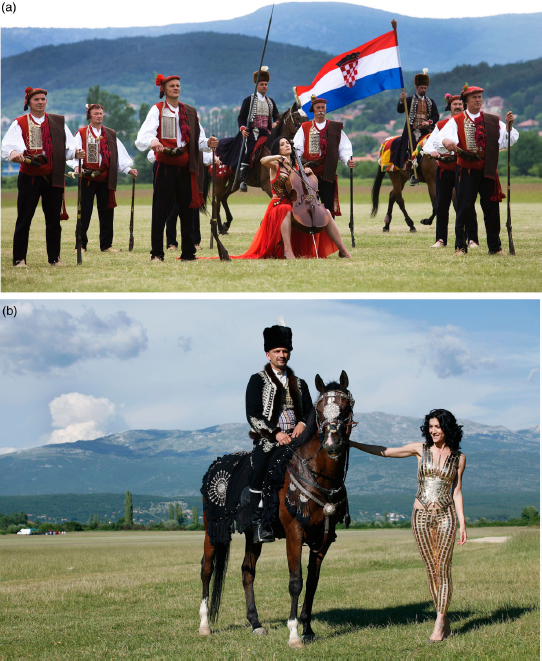
Another musician who featured prominently during the 300-year festivities is famous Croatian cellist Ana Rucner. Not only did Rucner play live in Sinj, but she also released a highly acclaimed music video entitled “Alkarski ponos” (“The Alkar’s pride”) together with the Zagreb philharmonic orchestra and “Klapa Sinj,” an all-male a-cappella music group whose main feature is four-part harmony singing without instruments, which premiered at the concert in Sinj.Footnote 12 The song is a compilation of three patriotic musical pieces, presented in Klapa style with Rucner as main soloist.Footnote 13 Klapa is a form of traditional Dalmatian singing that literally translates as a “group of friends” and that traces its roots to littoral church singing (Caleta Reference Caleta1997). The main themes of “Klapa Sinj” are commonly the Dinaric Mountains, the River Cetina, the Sinjska Alka, as well as Gospa Sinjska; in 2012 Dalmatian Klapa was inscribed on the UNESCO Representative List of the Intangible Cultural Heritage of Humanity.Footnote 14 The promotional Alka music video “Alkarski ponos”, however, is not as much as folkloristic performance, combining folk and classical music traditions, as a highly patriotic media spectacle, utilizing the Alka narrative of external threat and heroic readiness for combat. The lyrics include lines such as “Oh Croatian men, let us stand up against the barbarians, against the barbarians from the East” and celebrate the willingness to fight for and possibly die for one’s homeland. One verse of U boj, u boj (“To battle, to battle”), taken from an aria of the opera Nikola Subic Zrinski, reads:

The bloodthirsty text is backed by rather kitschy, overtly color-corrected images featuring aerial footage of Sinj, close-ups of the statue of Virgin Mary, galloping Alka horsemen in slow-motion who carry the Croatian flag, singers in traditional costumes, and of course Rucner playing the Cello with her long hair floating in the wind (see Figure 2 (a-b)).
(a-b) Stills of Ana Rucner’s promotional Alka Music Video. Photos Biljana Gaurina /CROPIX

Rucner strategically placed the release of “Alkarski ponos” in summer 2015 and took advantage of the nationwide and international attention surrounding the 300th anniversary of the tournament. The release of the compilation was a great success. However, unlike her other promotional videos for the Croatian Tourist Board - such as her 2013 release “Croatia - the New Tourism Star of the European Union,” an extension of her previous promotional film “Ode to Joy” which won the “Tourism Oscar” in 2012Footnote 15 - the message of “Alkarski ponos” is not primarily directed at an international audience. Or rather: what works as a picturesque promotional video with folkloristic elements (such as the Klapa singing and the costumes) on one level transports a highly nationalistic message on another level. As the song texts are not subtitled and the historico-political context of the Alka games is not explained, “Alkarski ponos” might appeal to a tourist audience as folkloristic performance with classical elements, whereas for local audiences, it contains many historical and cultural references and uses epic symbols that propagate the narrative of Croatia' s heroic battle against invasive forces from the East.
Not unlike the example of the “Siege of Sinj 1715” performance, these two musical performances are versions of commemorating a violent past as heroic self-defense and preservation of one’s “culture” despite centuries of oppression which is finally rewarded with the creation of an independent Croatian state. This narrative is basically a continuation of Tudman’s 1990s' rhetoric and ideology, which also always includes a plea for the legitimacy and dignity of the Homeland War.
In other words, the musical performances of Thompson and Rucner foster the perpetuation of the “war folklore” of the early 1990s that the official organizers of the 300th anniversary celebrations, the producers of the “Alka” film, and the curators of the Alka museum so anxiously tried to suppress by re-interpreting the Alka as innocuous cultural heritage site. In the course of my fieldwork I observed a significant difference between the “official” image of the Alka tournament as it is currently propagated by institutions such as the Alka Knights Society and the Sinj Tourist Board, and local discourses and practices of commemoration. The official account is directed at an international audience and must be accessible without detailed knowledge of local history - this version does not promote political allusions and cross-references and clearly focuses on the rather abstract concepts of “tradition” and cultural heritage. Local discourse and practices of commemoration, on the other hand, are emotionally charged and still very much tied to memories of the Homeland War, repetition of the Antemurale narrative and (self-)victimization discourses that exempt Croatia and Croatians from any collective responsibility for committed atrocities during the Homeland War. In these accounts, the Alka tournament still features as major historical references to armed self-defense; they exemplify the blending of past and present forms of subjugation that is employed to substantiate the image of a marginalized and victimized yet heroic and brave Croatian nation in need of self-protection.
In my last example I will focus on the tourist industry and show how in tourism the Homeland War is omitted from representations of national history in an attempt to portray Croatia as a more stable place for investment and travel (Rivera Reference Rivera2008). What is more, the revised official image of the Alka tournament is even employed to symbolically revise the public image of former indicted war criminals.
Croatia 365: commercializing heritage
After Croatia’s EU accession in 2013, the Croatian National Tourist Board launched the campaign “Croatia - the New Tourism Star of the European Union” replacing the successful postwar promotion under the slogan “The Mediterranean as It Once Was,” which had already stressed the country’s “unspoiled Europeanness” (Schauble Reference Schauble2014, 299ff). In 2015 the board introduced yet another initiative called “Croatia 365” with the aim to extend the tourist season beyond the summer months. The promotional campaigns harness the notion ofcultural heritage and authenticity, and the latest attempt to diversify Croatian tourism focuses on the six categories culture, outdoor, biking, health and wellness, wine and gastronomy, and meetings.
One of the promotional projects of this campaign is the “Theme Park Sinjska Alka” (“Tematski Park Sinjska Alka”) which was drafted and made a strategic priority of the Government and the Ministry of Culture in 2012. Not unlike the initiative “Croatia 365,” the “Theme Park Sinjska Alka” is an attempt to draw international attention to the Alka tournament and make it part of a tourist infrastructure that is accessible all year around, and not just a point of interest for a few days in August. The “Theme Park Sinjska Alka” is one of about 20 similar projects through which the Croatian Tourism Development intends to boost the tourist infrastructure and increase tourist spending in rural areas by investing 7 billion Euros and creating 30,000 new jobs by 2020. This initiative proclaimed the great tourist potential of the Alka and the first step and most important component of the theme park was the construction of an Alka Museum in Sinj.
The opening of the museum on 8 August 2015 was one of the major events in the context of the 300th anniversary celebration. It is a very modern building that combines the highest architectural, scenographic, scientific, and museological standards. Its construction in the monumental former Alka court building dating from 1760 was financed by the Croatian government, the Ministry of Culture, the Split-Dalmatia county, and the City of Sinj; between 2007 and 2015, the Croatian Ministry of Culture alone contributed close to five million Euro to the renovation of the building and the permanent exhibition. The permanent exhibition itself includes Alka costumes and equipment, written and visual records, three-dimensional exhibits (for example a complete life size Alka procession), video installations, and a multimedia reconstruction of the battle of 1715, including a hands-on section where visitors can themselves place canon shots or fend-off “Turks.” In short, the museum exhibits combine material and immaterial, tangible and intangible aspects of heritage that largely conveys an image of Alka that is not primarily based on emotionality, but on historic documents and facts. In the “Alka” film, Stipe Jukic, current president of the Alka Knights Society, insists that “in the future, the Alka of Sinj must be an event that is not just held one day in August, but living all year round.” To make the Alka come alive all year round clearly means to grant it the status of “living history”-it also means to gradually transform it into a folkloristic touristic spectacle by way of commodified public display and performance, while increasingly stripping it of its erstwhile significance as a marker of local mar-ginalization and political as well as socio-economic deprivation.
A few weeks ahead of the museum' s inauguration, Prime Minister Zoran Milanovic, who also acted as president of the Organizing Committee of the 300th anniversary of the Sinjska Alka, visited the prestigious new development, accompanied by his deputy and Minister of Regional Development and EU Funds, the Defense Minister, as well as Minister of Tourism. This top-flight assembly of politicians also brought with them a group of businessmen and investors, amongst them retired generals Ivan Cermak and Ante Gotovina,Footnote 16 who will also be sponsoring the theme park. While Cermak was commander of the Croatian Army’s Knin corps during the 1995 Operation Storm, ex-lieutenant general Ante Gotovina commanded the Split corps. In 2000, they were both signatories to the now famous “Twelve Generals' letter,” an open letter signed by generals of the Croatian armed forces that criticized the government, politicians, and media for alleged criminalization of the Homeland War. Later, they were indicted for war crimes by the ICTY in The Hague on charges of operating a joint criminal enterprise for the purpose of permanently removing the Serb population from the Krajina by force and of crimes against humanity. In the ensuing trial, Cermak was acquitted of all charges in April 2011, while Gotovina was first found guilty and sentenced to 24-year imprisonment, but was then also acquitted of all charges by the Appeals Chamber in November 2012, as is well known. Today, they are both successful businessmen in Croatia and the Alka theme park seems the perfect project for investment for them and their public image: through the current reinterpretation of the Alka tournament - that is, the attempted exemption of its right-wing nationalist and violent hostile connotation and transformation to an icon of cultural heritage that represents Croatia internationally - the theme park has the potential to become a flagship project for symbolizing change and pro-European sentiment in Croatia, based on nostalgia as foundation of cultural heritage and tourism. This is a position (or rather, vision) that Cermak as well as Gotovina actively promote regarding their own public personae as “Misters Clean” and might even be able to use for their own long-term rehabilitation (Schauble Reference Schauble2014, 210ff).
Concluding remarks
With the initial plan of the Alka Knight Society to nominate the Alka tournament for UNESCO’s list of intangible cultural heritage, a process of revision began. The attempt to bring the Alka, and thus the whole of Croatia, to a global stage, necessitated a carefully crafted campaign to reframe the local meaning and prevailing militant and rightist political connotation of the tournament. Nothing less is required than the inauguration of the Alka as a new national epic, based on a decoupling of its previous significance as an event by which a local community commemorated its subjugation under Ottoman rule and celebrated its own victory as a sign of divine chosenness and sublimity. The re-signification involved in this was not an easy task, and the efforts are still ongoing. In this article I have shown how the 300th anniversary of a victory against the troops of the Ottoman Empire has been used as an occasion and platform to represent Croatian national history and “tradition” to international audiences through cultural reframing. I have also shown, however, that the interpretative framework of the domestic audiences - for example local visitors of “The 1715 Siege of Sinj Performance,” listeners of the Rucner and/or Thompson concerts, but also wider Croatian TV and radio audiences - differ considerably from the readings presented to international audiences. Many Croatian citizens do not share the officially promoted image of their country, promote alternative narratives of Croatian history and “tradition,” or are opposed to the pressure that accompanies the processes of becoming and being a member of the European Union (i.e. compliance with the ICTY, implementation of minority rights, etc.). At present, these two incompatible “commemorative strands” exist side by side.
Interestingly, the official UNESCO description of the Alka underscores the dilemma inherent in the cultural reframing of the tournament, when somewhat clumsily describing it as a celebration of the “historical co-existence and cultural exchange between two different civilizations.”Footnote 17 As previously mentioned, local audiences did by no means celebrate the Alka to commemorate peaceful “co-existence” or “cultural exchange”-quite the contrary. Over the years, the narrative of the battle of 1715 had formed a template through which later conflicts, such as the Homeland War, were interpreted and understood.
It was already mentioned earlier that in the early 2000s the tournament was used as a platform to articulate fierce nationalist and anti-European sentiment along with opposition against the ICTY, and fueled rather than appeased existing antagonisms in the region. This political stance was of course no longer acceptable or wanted as soon as the Alka started to receive international attention. Rather, the association of the Alka tournament with acts of violence or even war crimes jeopardized the whole project of creating and institutionalizing the Alka tournament as a new all-Croatian epic and major tourist attraction.
In a recent article on the “management dilemma” of Croatia in representing the country’s “difficult past” on an international stage, the sociologist Lauren Rivera has argued that the government has strategically “omitted the war from representations of national history and repositioned Croatia as identical in history and culture to its Western European neighbors” (Rivera Reference Rivera2008, 613). Rivera focuses mainly on international tourism as a governmental activity managed by the Croatian National Tourist Board and assesses tourism as the key component in reshaping Croatia' s public international image. Noticing that “the state' s choice not to publicly commemorate the war is unique in the context of tourism practices,” she concludes that circumventing the stigma of the Homeland War was, and still is, central to Croatia’s new image as a (safe) part of Western Europe (Rivera Reference Rivera2008,620). She even goes as far as to suggest that the deliberate suppression and covering of Croatia' s “dark” historical moments may have had a precursor in the Tito regime, where Word War II atrocities were never publicly commemorated by the state (Rivera Reference Rivera2008, 627). While Rivera’s assessment is overtly generalizing, simplified, and arguably erroneous - especially regarding the public and often manifestly contested commemoration of war atrocities committed in World War II over the years - she certainly has a point with respect to the selective marketing of Croatia as a tourist destination after the violent break-up of Yugoslavia in the 1990s.
With reference to Rivera’s findings regarding the omission of the Homeland War, I would therefore describe the current reframing of the Alka tournament as part, if not the present highlight, of the country' s aggressive post-war marketing campaign and its attempts to be seen as a part of Europe, not as part of the “war-torn” Balkans. Therefore, Croatian cultural heritage and Croatian “tradition” are portrayed as an integral part of West European culture - and which event would serve this purpose better than a battle in which Christian Croats defended the borders of Europe against Muslim invaders?
In recent years, and even more so since the 300th anniversary of the Alka tournament in 2015, the previously marginalized community in the Dalmatian hinterland has been catapulted into the national and international spotlight, has become an economic hopeful, and can no longer credibly claim its systematic victimization. These developments give reason to suspect that the wider recognition of the Alka would promote a further defusing of the subversive and potentially volatile political capacity of the event. The active refram-ing of the Alka tournament in the production of national cultural heritage is less oriented toward the past but implies the vision of a political future within Europe, along with economic development in the tourist sector. The official recognition of Alka as intangible cultural heritage by UNESCO experts, the construction of the Alka theme park with government and EU funds, and the high-budget production of the “Alka” film all have transformed and transported the event and its narrative to an assumed “non-conflictual arena” (Harvey Reference Harvey2000, 168), whereby Alka is now increasingly institutionalized as national epic and purposefully decoupled from any connotation with recent violence in the region.