1. Introduction
Heb 10.5–10 quotes and interprets Ps 40.6–8 (LXX 39.7–9).Footnote 1 Hebrews introduces the psalm by placing it on the lips of Christ who speaks (λέγει)Footnote 2 the psalm when he enters (εἰσερχόμενος) the κόσμος.Footnote 3 The exact relationship between Jesus ‘entering the world’ and his speaking these words is somewhat unclear; however, Christ speaks the words either just prior to or at his incarnation.Footnote 4 Elsewhere in Hebrews, the Son is described as the pre-existent heir who created the universe and sustains all things,Footnote 5 so when Christ ‘enters the cosmos’ in 10.5, he is not born into existence. Rather, the pre-existent Christ is born into the earthly realm to share fully in the human condition (2.14–18; 4.15; 5.7–8). Jesus speaks the words of Psalm 40 to the Father, so that they are spoken as intratrinitarian dialogue that explains the purpose of Jesus’ incarnation.Footnote 6
This article will examine what Christ says to the Father in Heb 10.5–7 and how Psalm 40 illuminates the purpose of Christ's entrance into the created universe. It will argue that Christ's life, death, resurrection and ascension are a sacrificial offering – in fact, the only sacrificial offering – that achieves the salvific will of God. We will begin by discussing Hebrews’ source text of Psalm 40 to discern whether the author of Hebrews makes any possible changes to the text that might reflect his interpretation of it. The rest of the article consists of two central arguments. First, it argues that Heb 10.5–10 contrasts two sacrificial orders: Levitical sacrifice and Christ's sacrifice. In order to make this argument, we will have to (a) demonstrate how Hebrews understands Psalm 40 to talk about an eschatological sacrifice or another sacrificial order even though the Old Testament context of Psalm 40 does not clearly do so, (b) address scholarly arguments that Heb 10.5–10 does not depict Jesus’ offering as a cultic or sacrificial offering, and (c) respond to those who see Christ's obedience and not his sacrifice as the primary focus of the passage. In so doing, we will argue that Christ's sacrificial offering of his body and blood is the sacrifice that achieves God's salvific will. Second, once we have established that Hebrews contrasts two sacrificial orders, we will discuss the relationship between the two orders. When interpreting Psalm 40, Hebrews highlights that God both commands Levitical sacrifice and does not desire or take pleasure in it. The second half of the article will discuss this tension and suggest that the tension is resolved when Heb 10.5–10 is viewed in the broader context of Heb 10.1–18 and the Levitical sacrifices are considered prophetic shadows that participate in the eschatological reality of Christ's sacrifice.
2. Vorlage and Changes
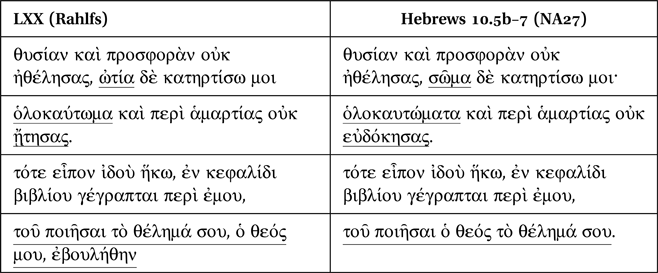
Before we can discuss how Hebrews appropriates Psalm 40, we need to establish (to the extent that is possible) Hebrews’ Vorlage or source text, because any changes that the author made to his source text may reflect his theology.Footnote 7 Scholars agree that Hebrews was working with a Greek translation of Psalm 40,Footnote 8 and a quick comparison of Rahlfs’ Septuagint version of Psalm 40 with Hebrews’ quotation of Psalm 40 highlights four textual questions that have been the focus of scholarly attention (see Table 1).
Psalm 40 in LXX Rahlfs and Hebrews

First, did Hebrews’ Vorlage contain σῶμα (body) or ὠτία (ears)? While ὠτία would be a literal translation of אָזְנַיִם, the manuscript evidence overwhelmingly supports σῶμα, as Greek translations appear to view the Hebrew phrase ‘my ears you have pierced’ as a synecdoche for the making and giving of the entire human body (σῶμα). Due to the overwhelming manuscript evidence, a scholarly consensus has arisen that the author of Hebrews did not introduce σῶμα into the text but inherited it from his Vorlage.Footnote 9
Second, did Hebrews’ Vorlage have the singular ὁλοκαύτωμα or plural ὁλοκαυτώματα? While the manuscript evidence is split,Footnote 10 a majority of scholars conclude that the plural ὁλοκαυτώματα is in Hebrews’ source text. Hebrew manuscripts have a singular, but the plural ὁλοκαυτώματα was already in circulation in Greek translations and occurs in all traditions that also read ηὐδόκησας. Further, it seems unlikely that the author would change ὁλοκαύτωμα to ὁλοκαυτώματα while leaving θυσίαν καὶ προσφορὰν singular in the previous line (cf. 9.8).Footnote 11
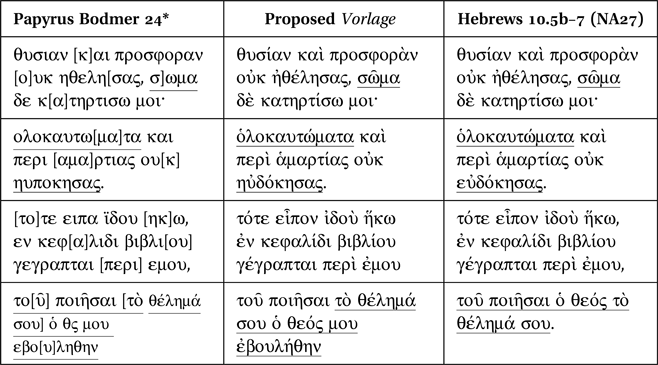
Third, did Hebrews’ Vorlage read ἐζήτησας (‘demand’), ᾔτησας (‘ask for’) or ηὐδόκησας (‘desire’), which are all represented in the manuscript tradition?Footnote 12 While ἐζήτησας is the most attested, Hebrews’ Vorlage did not necessarily have the oldest or most attested reading. There are a number of similarities between Hebrews’ version of Psalm 40 and the Psalms manuscript Papyrus Bodmer 24, and ηὐδόκησας is similar to Papyrus Bodmer 24's ηὐπόκησας, which may be a scribal misspelling of ηὐδόκησας. In addition, the author of Hebrews often follows his Vorlage,Footnote 13 and texts that contain ηὐδόκησας consistently have ὁλοκαυτώματα. As a result, many scholars think that ηὐδόκησας – which is close to the εὐδόκησας found in Hebrews – was probably found in Hebrews’ source text.Footnote 14 Still, we need to consider the possibility that Hebrews did not receive εὐδόκησας (‘desire’) from his source text but changed it from ᾔͅτησας (‘ask for’) or ἐζήτησας (‘demand’). Would such a potential alteration of the text reveal how the author of Hebrews reads and interprets Psalm 40? If Hebrews altered the text to εὐδόκησας, this change may not impact his reading of the text at all, as God desiring is similar to him asking for or demanding.Footnote 15 Yet, such a change may be intentional to emphasise criticism of sacrificeFootnote 16 or to avoid saying that God did not ask for or demand sacrifices when in fact he did ask for and demand them.Footnote 17 Since Heb 10.5–10 includes both a critique of Levitical sacrifice and tension between God commanding sacrifices in the law while not taking pleasure in them, not much rides on whether the author of Hebrews inherited εὐδόκησας or made this choice himself. Either way, Hebrews 10 grapples with God's rejection of what he commands.
Fourth, scholars agree that Hebrews alters the final line of Psalm 40, by moving ὁ θεός before τὸ θέλημά and ending the citation without including ἐβουλήθην. As a result of these alterations, τοῦ ποιῆσαι no longer modifies ἐβουλήθην to express the psalmist's desire to do God's will, but τοῦ ποιῆσαι modifies ἥκω and identifies the purpose of Jesus’ coming into the world – i.e to do God's will. Christ did not desire to do God's will; he did it.Footnote 18 Whereas Levitical sacrifices could not achieve the will of God, Christ did.
Thus, the author of Hebrews appears to primarily follow his Vorlage when citing Psalm 40, which is supported by the existence of a Greek translation (Papyrus Bodmer 24) that closely resembles Hebrews’ text form (see Table 2).Footnote 19 While it is possible that Hebrews changed the text to include εὐδόκησας (though this form is very close to ηυποκησας in Papyrus Bodmer 24), the clear changes to the text that are unanimously agreed upon are the changes to the final line that emphasise the accomplishment of God's will.
Papyrus Bodmer 24 and Hebrews

* Text reproduced from R. Kasser and M. Testuz, Papyrus Bodmer xxiv: Psaumes xvii–cxviii (Cologny: Bibliotheca Bodmeriana, 1967) 86.
3. Psalm 40 Speaks of Another Offering
With our Vorlage in place, we are ready to consider how Psalm 40 functions in Hebrews as intratrinitarian dialogue, and our first observation is that Hebrews picks up and uses Psalm 40 because it speaks of another offering. While this statement may seem obvious, it is seldom stated in the literature. Scholars regularly point out that Hebrews roots the newness of God's speech ‘in these last days . . . to us by a Son’ (1.1) in the Old Testament. For the author, Ps 95.7–8 speaks of another rest (4.1–11), Ps 110.4 speaks of an eternal priesthood in the order of Melchizedek (5.5–6; 7.15–17), Jer 31.31–4 speaks of a new covenant (8.8–12; 10.16–17), and Exod 25.40 speaks of a heavenly sanctuary. Another rest, another priesthood, another covenant, another sanctuary. What is often left off these lists is Psalm 40 and another sacrifice.
Why might Psalm 40 get left off these lists? Perhaps because Psalm 40 does not appear – at least when left in its Old Testament context – to suggest another sacrifice. The psalmist probably understood God's displeasure with sacrifice in Ps 40.6 to be synchronous with the psalmist's intention to do God's will in vv. 7–8. Hebrews, however, focuses attention on the word τότε (‘then’) in the phrase, ‘then [τότε] I said’, so that τότε becomes the key to the passage.Footnote 20 Hebrews not only repeats this word again in v. 9, but expands the temporal notion of τότε by adding ἀνώτερον – ‘first’ – to v. 8. The result is a temporal interpretation of Psalm 40 that distinguishes between ages and covenants, so that the psalm can contrast the sacrifices during the first covenant that did not please God with a God-pleasing offering under the new covenant. The author of Hebrews may have felt empowered to interpret the psalm in this way due to the phrase εἰς τὸ τέλος (‘regarding completion’) in the superscript of the Greek translations of Psalm 40. While there is dispute whether the translators would have intended any eschatological significance when rendering the phrase εἰς τὸ τέλος, it is likely that first-century readers of Psalm 40 who considered themselves to live in the last days (ἐπ’ ἐσχάτου τῶν ἡμερῶν, Heb 1.1) would easily understand such a phrase as giving warrant for an eschatological interpretation of the psalm.Footnote 21 Hebrews, in this way, understands Psalm 40 to speak of another or an eschatological sacrifice.
4. Two Kinds of Sacrificial Offerings
Once Hebrews understands Psalm 40 to introduce another sacrifice, the placement of the eschatological sacrifice within the psalm places it in contrast with Levitical sacrifices, so that Psalm 40 compares two kinds of cultic, bodily/bloody sacrifices.Footnote 22 Yet, to affirm the cultic nature of Christ's offering, we have to address a number of competing claims. For instance, some see in Hebrews an extension and expansion of the cult criticism present in the Psalms and Prophets that pits sacrifice against acts of piety and obedience.Footnote 23 Psalm 40 is often identified as one of the texts that affirm such a distinction, so that when the author of Hebrews uses Psalm 40, he is drawing a contrast between sacrifices of animals and sacrifices of obedience, between the bloody Levitical sacrifices and the obedience of Christ. For example, Gert Steyn contends: ‘The author understands Ps 40 (39) to be a statement that the Lord does not desire sacrifices and offerings, but purity of heart, whereas the Pentateuch requires sacrifices to be offered.’Footnote 24 Since Hebrews – following the psalmist – contrasts sacrifice with obedience, Christ's ‘offering of his body’ is not about his offering the ultimate cultic sacrifice but about his supreme act of obedience – i.e. he was obedient unto death. Hebrews is not contrasting two cultic sacrifices or two cultic orders, because Christ's death is not cultic and Christianity has no cult.Footnote 25
There are a few problems with viewing Hebrews’ use of Psalm 40 as a contrast of sacrifice and obedience. First, it misses the point of the prophetic criticism of sacrifice. While there are a number of texts in the Psalms and Prophets that are critical of Levitical sacrifices,Footnote 26 these passages do not call for the end or replacement of sacrifices. Rather, they criticise the abuse of the sacrificial system and call for piety, righteousness and repentance to accompany sacrifice. The prophetic criticism never pits sacrifice against obedience; rather, it calls for true sacrifices – i.e. sacrifices accompanied by obedience. Put differently, faithful worshippers understood that sacrifices were a demonstration of their obedience, devotion and piety.
Second, Hebrews does not interpret Psalm 40 in a way that pits sacrifice against obedience;Footnote 27 rather, he contrasts two kinds of cultic, bodily/bloody sacrifices. The quoted portion of Psalm 40 in Heb 10.5–7 contrasts θυσίαν, προσφοράν, ὁλοκαύτωματα and περὶ ἁμαρτίας with Christ's σῶμα. The body that Christ receives at his incarnation becomes his offering, as 10.10 notes that ‘we have been sanctified through the offering of the body (διὰ τῆς προσφορᾶς τοῦ σώματος) of Jesus Christ’. The term προσφορά identifies the σῶμα as a cultic offering, and σῶμα identifies the cultic offering as a bodily and bloody offering. In order to be a high priest, Christ needed something to offer (8.3), and he offers his body. Christ's offering is not merely an offering of obedience because his offering is a bodily offering.Footnote 28
Georg Gäbel has argued that the ‘offering of the body of Jesus Christ’ in 10.10 is not a cultic offering,Footnote 29 since σῶμα (body) is not a cultic word (i.e., it is not used anywhere else to refer to sacrificial material) and, therefore, does not identify a cultic sacrifice. Instead, σῶμα represents Christ's lived obedience that culminates in his death. The construction προσφορᾶς τοῦ σώματος refers to a non-cultic self-giving of his entire life lived in obedience. This interpretation requires Gäbel to argue that Hebrews plays with the word προσφορά in this passage. While the psalm uses προσφορά in the list of earthly Levitical sacrifices, Hebrews contrasts the Levitical sacrificial offering with the non-cultic offering of Christ. Christ came into the world (10.5) in order to do the will of God, so the focus of the passage for Gäbel is not on a sacrificial death but on bodily obedience.
Pace Gäbel, there are several reasons why we should understand the phrase ‘offering of the body of Jesus Christ’ to refer to a cultic offering. (1) The noun προσφορά and its cognate verb προσφέρω are used throughout Hebrews to refer to Levitical offerings and the offering of Levitical sacrifices (5.1, 3, 4; 9.7, 9; 10.1, 2, 18).Footnote 30 (2) The verb προσφέρω is used to describe Christ's high priestly need for ‘something to offer (προσενέγκῃ)’ (8.3), his offering himself in the heavenly realm (ἑαυτὸν προσήνεγκεν in 9.14 and προσφερῃ ἑαυτόν in 9.25) and his being ‘offered (προσενεχθεὶς) once to bear the sins of many’ (9.28). Thus, ‘offering’ terminology is used of Christ's sacrificial offering of himself in the heavenly sanctuary which achieves release from sins.Footnote 31 (3) Hebrews carries on from 10.10, using the noun προσφορά and verb προσφέρω in vv. 11–14. In these verses, the offering (προσφέρων) of Levitical sacrifices (θυσίας) is contrasted with Christ's offering (προσενέγκας) a single sacrifice (μίαν . . . θυσίαν) for sins (vv. 11–12). Therefore, when the author begins v. 14 by referring to Christ's μιᾷ προσφορᾷ, the προσφορά (offering) must be understood in light of vv. 11–12 in a cultic manner. A cultic understanding of προσφορά in v. 14 is confirmed by the presence of other words and concepts used in cultic contexts throughout Hebrews including the perfection (7.28; 9.9; 10.1) and sanctification (9.13; cf. 10.10; 13.12) of believers and the singularity of Christ's sacrifice (7.27; 9.12, 26, 28; 10.10, 12).Footnote 32 The cultic understanding of Christ's προσφορά in v. 14 and προσενέγκας θυσίαν in v. 12 confirm that Christ's ‘offering of his body’ in v. 10 is a cultic offering.Footnote 33
Since we have identified Christ's offering of his body as cultic and sacrificial, we have to address a key debate related to this text: where and when does that offering take place? Because v. 5 introduces Psalm 40 by alluding to Christ's incarnation, some scholars contend that Christ's offering is his earthly death on the cross.Footnote 34 However, in recent years, others have argued that Christ's sacrifice includes a sequence of events spanning his life, death, resurrection and ascension.Footnote 35 In particular, just as the presentation of Levitical offerings took place in the sanctuary, so the presentation of Christ's sacrifice or body to God takes place in the heavenly sanctuary and not on earth on the cross. David Moffitt makes an exhaustive argument based on Hebrews’ use of the righteous sufferer image in Psalm 40 to conclude that Christ's ‘offering of his body’ in 10.10 comes after the deliverance of the righteous sufferer through resurrection.Footnote 36 R. B. Jamieson has critiqued and refined Moffitt's argument to ultimately come to a similar conclusion about Heb 10.5–10 – i.e. Christ comes into the world with a body at his incarnation with the intent of offering that body in the heavenly realm.Footnote 37 In this way, Heb 10.5–10 embodies the full sequence of Christ's sacrifice from earth to heaven; from birth to cross to tomb to heavenly sanctuary; from incarnation to death to resurrection to ascension.
5. The Will of God in Christ's Sacrificial Offering
Now that we have established that Christ's offering is cultic/sacrificial, we must turn to the relationship between Christ's offering and the will of God, because this relationship is another way in which scholars have elevated obedience over sacrifice. Heb 10.5–10 emphasises the will of God. Not only does the author of Hebrews alter the final quoted line of Psalm 40 to highlight Christ's achievement of God's will, but the interpretation of the psalm in the following verses focuses on the will, as he requotes ‘Here I am, I have come to do your will (θέλημα)’ (v. 9) and then mentions the will (θελήματι) in v. 10. Thus, in the few changes the author makes to his Vorlage and in the few words he uses to interpret the psalm, much of his interpretive energy is focused on the will. Since the will seems so central to the passage, a natural question arises: what is the will? Bernhard Weiss has observed two facets of the will, especially as it is summarised in 10.10. He notes that the ‘will of God’ is understood both christologically and soteriologically – christologically: Christ became incarnate in order to obediently do the will of God; soteriologically: Christ's offering achieves salvific effects, such as the ‘being made holy’ (ἡγιασμένοι ἐσμέν) of v. 10.Footnote 38
Many scholars strike a balance between the christological and soteriological aspects of the will of God in their expositions of Psalm 40. They balance Christ's obedience with the atoning effects of his sacrificial offering.Footnote 39 However, some recent studies have emphasised Christ's obedience over his sacrificial salvation. For instance, Ronald van der Bergh focuses on Hebrews’ changes to his Vorlage, notes that many of the changes relate to doing God's will, and concludes that ‘it is clear that the crux of the argument set out by the writer himself in Heb 10.8–10 is obedience to the will of God, not sacrifice per se’.Footnote 40 Other studies have focused on the larger context of Psalm 40, which describes a righteous sufferer who is delivered because of his obedience, to argue that Hebrews uses Psalm 40 to highlight Jesus as the obedient, righteous sufferer. Moffitt, for instance, summarises Hebrews’ use of Psalm 40: ‘the author uses Ps 40 to present Jesus as the one who perfectly lived the very obedience to God that the new covenant promises. Christ, in other words, obeyed God's will completely during his time on earth.’Footnote 41 Moffitt's highlighting of Christ's obedience does not mean that he rejects Christ's salvific cultic offering. On the contrary, he affirms that Jesus presents ‘his body to God as a fully effective atoning offering’ and contends that it is ‘Jesus’ life of faithful obedience’ that ‘enables his body to be offered to God as the sacrifice that fully satisfies what God desires’.Footnote 42 Yet, the focus and function of Hebrews’ appropriation of Psalm 40 is on obedience. Timothy Bertolet similarly highlights the righteous sufferer background of Psalm 40 and notes that Christ's ‘obedient activity that he carries out for the Father . . . entails his self-sacrifice’.Footnote 43 Again, Bertolet does not reject the sacrificial aspect of Christ's work. He notes that Jesus’ obedience to ‘the will of his Father culminated in his obedience unto death where he served as a sacrifice of atonement for the people of God’.Footnote 44 Yet, once again, Christ's obedience is primary, and Christ's sacrifice is secondary. Jesus was obedient unto death, obedient unto sacrifice. Obedience entails sacrifice.
This order should be flipped. Moffitt and Bertolet emphasise Christ's obedience due to their metaleptic reading of Psalm 40 in Hebrews 10. However, Hebrews’ explicit interpretation of Psalm 40 should be given preference over possible inferences from the larger context of Psalm 40, especially when those readings run counter to the explicit emphasis on sacrifice and when the metaleptic connections are not found in the immediate context of Heb 10.5–10 but are mostly found later (10.32, 36–8) in a paraenetic section.Footnote 45 Hebrews gives Psalm 40 a new speaker, a new context and a new covenant, resulting in a new interpretation. Therefore, rather than allowing the context of Psalm 40 to dictate the interpretation of Hebrews, we should focus on how Hebrews interprets the psalm, and the focus of Heb 10.5–10 is primarily on the soteriological and secondarily on the christological, primarily on identifying the sacrifice that truly saves and secondarily on the obedience of Christ. In other words, sacrifice entails obedience.Footnote 46 That sacrifice is primary over obedience does not mean that obedience is absent from Heb 10.5–10. Such an assertion would be impossible. Christ, in speaking the words of Psalm 40, both identifies himself as the righteous sufferer of the psalmFootnote 47 and articulates the purpose of his incarnation – the obedient completion of God's will. In the broader section of 10.1–18, the new covenant quotation of Jer 31.33 in Heb 10.16 makes obedience through the internalisation of the law a key theme.Footnote 48 Further, themes of Christ's obedience and faithfulness are found throughout Hebrews. However, that does not mean that Christ's obedience is the focus of Hebrews’ use of Psalm 40 or that the references to God's desire, pleasure or will are about obedience.
God's will in Heb 10.5–10 is his soteriological will. Hebrews uses Psalm 40 to contrast the Levitical sacrifices that were not according to God's desire (θέλω) and pleasure (εὐδοκέω) with the offering of Jesus’ body that accomplishes God's will (τοῦ ποιῆσαι ὁ θεὸς τὸ θέλημά σου).Footnote 49 The Levitical sacrifices were never the true desire, never the true pleasure, never the true salvation. The sacrifice that God always desired is the offering of the incarnate Son. Therefore, when Christ speaks the words ‘I have come to do your will, O God’ (10.7, 9), he is articulating his intention to bring the salvific will of God the Father to fruition. The relationship between God's will and Christ's sacrifice is clarified in Heb 10.10: ‘according to his will (ἐν ᾧ θελήματι) we have been sanctified through the offering of the body of Jesus Christ once for all’. The pronoun ᾧ in the phrase ἐν ᾧ θελήματι has God – not Christ – as the referent.Footnote 50 Hebrews 10.10 is not talking about Christ's obedience or will but about the Father's will, and the Father's will is the salvation of his children (e.g. Heb 2.10–18).Footnote 51 In this context, the salvific good that is identified is consecration or sanctification (ἁγιάζω). ‘The will of God that Christ came to accomplish is the will by which we are intimately transformed and consecrated by God.’Footnote 52
Thus, God's will in Heb 10.5–10 is concerned primarily with the soteriological (Christ's salvific offering) and secondarily with the christological (Christ's obedience). While Christ's earthly obedience is a prerequisite for his appointment to priesthoodFootnote 53 and his holy life qualifies him as a blameless victim,Footnote 54 these themes are not the focus of the text but underly it. What Hebrews is explicitly concerned about is identifying which sacrifice accomplishes God's will. The means by which Christ achieves the soteriological will of God is through (διά) the offering of his body.Footnote 55 The identification of will with salvation highlights the fact that only one sacrifice achieves the salvific will of God. Christ's offering achieves the will ἐφάπαξ, ‘once for all’ (10.10),Footnote 56 whereas Levitical sacrifices do not please God and are not willed by God (10.5–6). Heb 10.1–4 offers some of the most critical statements about Levitical sacrifices, arguing that they did not achieve salvific realities, and 10.5–10 uses Psalm 40 to explain why: only one single sacrifice accomplished God's salvific will.
6. God's Command versus God's Pleasure
In contrast to Christ's sacrifice which achieved God's will (θέλημα), God did not desire (θέλω) or take pleasure in (εὐδοκέω) the Levitical sacrifices listed in Ps 40.6. This contrast creates tension, because it identifies something that God commanded as something he does not take pleasure in and does not desire. Hebrews, in fact, seems to emphasise this apparent tension. The author repeats the divine lack of desire and pleasure in Levitical sacrifices in 10.8a and then immediately reminds the readers in 10.8b that these were offered ‘according to the law’. This section will consider the implications that (1) Levitical sacrifices did not please God and (2) yet were commanded by God.
God's not desiring (ἠθέλησας) or taking pleasure (εὐδόκησας) in sacrifice recalls Old Testament passages where God does not accept certain sacrifices. Leviticus outlines the ritual actions that will lead to the sacrifices being acceptable (δεκτός) and God receiving (δέχομαι) them.Footnote 57 If they are not performed in these ways, the offerer will not be credited with the benefit of the offering (esp. Lev 7.18). In addition to right ritual actions, God's acceptance of a sacrifice depends on the dispositions and moral actions of the offerer. When the Israelites tried to use sacrifices to cover up for their deliberate unrighteousness (e.g. lack of covenant faithfulness) and continued impiety (e.g. abusing the poor and widows), God declared that he did not accept (προσδέχομαι; δεκτός) or take pleasure (εὐδοκέω) in these offerings.Footnote 58 For instance, due to their covenant violations, God states in Jeremiah that ‘if they fast, I will not hear their petition, and if they offer burnt offerings and sacrifices, I will not have pleasure in them (οὐκ εὐδοκήσω ἐν αὐτοῖς)’ (Jer 14.12; NETS). In contrast, what God desires is ‘a broken spirit’, ‘a broken and humbled heart’ (LXX Ps 50.19).Footnote 59 He desires his people to be clean, to cease evil deeds, to do good, to seek justice for the widow and to defend the orphan (Isa 1.16–17). When these actions and dispositions are present, God ‘will delight (εὐδοκήσεις) in a sacrifice of righteousness, in offering and whole burnt offerings; then they will offer calves on your altar’ (LXX Ps 50.21; NETS). The psalmist does not here suggest that acts of piety replace sacrifice – otherwise the psalm would not end with calves on the altar. Rather, the psalmist is highlighting that the dispositions of the offerer must match the intentions of the sacrifice in order for the offering to be acceptable and efficacious (similarly Sir. 34.23–35.14). Not all sacrifices please God and are acceptable.
When Hebrews interprets Psalm 40, it appropriates the possibility that sacrifices might not be acceptable and pleasing to God.Footnote 60 While it explicitly states that the Levitical sacrifices are not pleasing, the implication is that only Christ's sacrifice is pleasing to God. Since efficacy is only given when the offering is acceptable, the presence of εὐδοκέω in Heb 10.6, 8 suggests that only Christ's sacrifice attains efficacy, a conclusion affirmed above by the identification of God's will with his salvific will. It is possible that the apostolic witness about Christ led Hebrews to identify Christ as the pleasing offering. Both at Jesus’ baptism (Matt 3.17; Mark 1.11; Luke 3.22) and transfiguration (Matt 17.5), God states that he is well pleased (εὐδόκησα) with Jesus, his beloved (ἀγαπητός). These brief allusions to Isa 42.1 and the Suffering Servant are affirmed by the quotation of Isa 42.1–4 in Matt 12.18–21, which includes the description of Jesus as ‘my servant whom I have chosen, the one I love (ὁ ἀγαπητός μου), in whom I take great delight (εὐδόκησεν)’ (Matt 12.18).Footnote 61 That Hebrews relates εὐδοκέω in Psalm 40 to the Suffering Servant of Isaiah may be confirmed by Hebrews’ allusion to the Suffering Servant tradition of Isaiah 53 in Heb 9.26, 28.Footnote 62 Further, Paul in Eph 5.2 says that Christ ‘gave himself up for us, a fragrant offering and sacrifice to God (θυσίαν τῷ θεῷ εἰς ὀσμὴν εὐωδίας)’. The identification of a sacrifice as a sweet or fragrant smell to God is the primary image used in the Old Testament and Second Temple literature to identify an offering as acceptable to God.Footnote 63 Thus, if Hebrews knew a tradition of Christ's offering being ‘fragrant to God’, he would easily identify the ‘pleasing’ or ‘acceptable’ sacrifice of Psalm 40 with Christ.
Since Levitical sacrifices are not ‘pleasing’, they presumably do not obtain efficacy. Some scholars see in Heb 10.5–10 a rejection of Levitical sacrifice based on its inefficacy and draw connections between the cult-critical statements in Heb 10.1–4 and the interpretation of Psalm 40 in 10.5–10. In vv. 1–4, the author argues that the Levitical sacrifices were insufficient to make the worshipper perfect (v. 1), to ultimately cleanse their conscience from sins (v. 2) and to take away sins (v. 4). And the repetition of the sacrifices demonstrates their ultimate insufficiency (v. 3).Footnote 64 As a logical inference of this critique (διό, v. 5), the author quotes and interprets Psalm 40 and does several things to accentuate the plurality of sacrifices and consequently God's displeasure with them. In v. 8, he reiterates Ps 40.6, but rearranges the two parallel statements so that the sacrifices are listed together – ‘sacrifices and offerings, burnt offerings and sin offerings’ – and so are the statements of God's displeasure – ‘you did not desire, nor were you pleased with them’. Further, Hebrews makes all references to sacrifices plural by changing θυσίαν to θυσίας and προσφοράν to προσφοράς. Combined, these changes emphasise the plurality and repetition of every kind of sacrifice and recall the critique in vv. 1–4.Footnote 65 Plurality and repetition, in this instance, mean insufficiency. Due to these connections, some scholars conclude that ‘every feature of [Hebrews’] interpretation [of Psalm 40] underscores God's radical rejection of all OT sacrifices as a means of atonement’Footnote 66 or that Hebrews quotes Psalm 40 because it is one of the Old Testament texts that speak to ‘the futility of the Old Testament sacrifices’.Footnote 67
While God's not being pleased by Levitical sacrifices seems to lead to radical critiques and rejections of the Levitical system, God's not being pleased needs to be held together with God still commanding the sacrifices. Immediately after the emphatic restatement of the plurality of sacrifices and God's not desiring them in v. 8a, Hebrews affirms that the sacrifices were ‘offered according to the law (κατά νὸμον)’. God commanded sacrifices, offerings, whole burnt offerings and sin offerings, and the law is part of what God spoke long ago to the ancestors in many and various ways (Heb 1.1). Hebrews declares the law ‘valid’ (βέβαιος, 2.2), so that disobedience to the law would lead to punishment (2.2; 10.28). Further, according to the law, sacrifices, offerings, burnt offerings and sin offerings achieved salvific effects including atonement, forgiveness and purification. Thus, one cannot conclude that Hebrews considers Levitical sacrifices to achieve no efficacy, because to reject these effects is to reject the speech of God to the ancestors through the prophets (1.1). While Hebrews identifies a change in covenants (and consequently law and priesthood, 7.12, 22; 8.6) and elevates Christ's priesthood and sacrifice over those offered according to the law (see esp. κατὰ νόμον in 7.5; 8.4; 9.19, 22; cf. 7.12, 19, 28; 10.1), the law is still divine speech with divine authority. Further, the efficacy of the Levitical sacrifices is implicit in the logic of Hebrews (see below). In particular, when Heb 10.18 says, ‘Where there is forgiveness (ἄφεσις) of these, there is no longer any offering for sin’, the logic requires that Levitical sacrifices achieved forgiveness (ἄφεσις). They are no longer necessary because what they achieved – forgiveness – has now been finally and fully accomplished. Thus, on the one hand, Hebrews says God did not will Levitical sacrifices in the sense that he did not desire (ἠθέλησας) or take pleasure (εὐδόκησας) in them; on the other hand, God did will Levitical sacrifices because he commanded them in the law (κατά νὸμον).Footnote 68
God's commanding sacrifices seems to stand in direct contrast with his lack of desire and pleasure in them, and many scholars have highlighted this tension. Van der Bergh notes that Hebrews ‘first quotes the psalm that goes against the grain of the Pentateuch (stating that it is not sacrifices that God requires), and then draws attention to this fact’.Footnote 69 Craig Koester points out that ‘Hebrews’ most radical point is not the rejection of sacrifice in general, but its rejection of the sacrifices prescribed by the Law. God was the giver of the Law, and to say that the Law's sacrifices could not remove sins implied that God prescribed sacrifices that could not remove sins.’Footnote 70 Thus, a tension exists as God both commands sacrifice and does not desire or take pleasure in it. Hebrews both affirms that only Christ's new covenant offering is pleasing and efficacious and maintains the validity, goodness and efficacy of the sacrifices performed under the first covenant.Footnote 71
7. Shadow of the Good Things to Come
The tension of God commanding but not taking pleasure in Levitical sacrifices may be resolved by the larger frame of 10.1–18, in particular the opening phrase: ‘the law has only a shadow (σκιάν) of the good things to come and not the true form (εἰκόνα) of these realities’. The author of Hebrews here contrasts the shadow (σκιάν) with the reality (εἰκόνα). While 10.1 explicitly identifies the law (νόμος) as the shadow, the rest of the section (10.1–18) applies the shadow–reality distinction to sacrifice. The sacrifices, offerings, burnt offerings and sin offerings mentioned in Psalm 40 are the ‘shadow of the good things to come’, while Christ's obedient offering of his body is ‘the reality itself’ (9.11, 15).Footnote 72 Levitical sacrifice is the shadow and Christ's offering the reality.
As a shadow, Levitical sacrifice has a form similar to the reality, but the reality is better.Footnote 73 In such a relationship, there are both similarities, since the shadow shares a form with the reality, and differences, since the shadow is not the reality. These similarities and differences are highlighted throughout chapters 8–10. Just like the Levitical high priest, Christ entered a sanctuary to offer gifts and sacrifices for sins; unlike the Levitical high priest, Christ entered the heavenly sanctuary and offered a single offering of himself to attain full perfection and redemption (8.1–6; 9.1–15, 23–28; 10.11–14). There are three aspects to the σκιάν–εἰκόνα distinction that impact the interpretation of sacrifice in Heb 10.1–18.
Prophetic
First, because the shadow – Levitical sacrifices – came before the reality itself, the Levitical sacrifices function prophetically, not only anticipating the sacrifice that would come later but showing a sketch or model of what it would look like. This prophetic notion is confirmed in Hebrews’ use of Psalm 40. Christ speaks the psalm, and in the context of mentioning his self-offering in accordance with the will of God, he says, ‘in the scroll of the book it is written of me’ (10.7). It is unclear what exactly the contents of the scroll are – whether the scroll is the law or (due to Hebrews’ eschatological and christological reading of the psalm) the entire Old Testament.Footnote 74 Yet, the focus in Psalm 40 and in Hebrews 10 is on sacrifice, so that we can conclude that the pertinent contents of the scroll are the portions of the law (and the rest of the Old Testament) that talked about sacrifice. Christ says that these Scriptures are talking about his sacrifice. Levitical sacrifice anticipated and patterned what would come in the reality, what would come in Christ's sacrifice.Footnote 75 The prophetic function of Levitical sacrifices is one of the reasons why God commanded them, even if he did not desire them. While his true desire is the reality not the shadow, he commands and requires Levitical sacrifices to teach about and anticipate the future reality.
Participatory
Second, the shadow participates in the reality. The only other place that the word σκιά is used in Hebrews is in 8.5, where it identifies the earthly sanctuary as a ‘shadow’ of the heavenly sanctuary, and its usage there may be instructive for its usage in 10.1. The earthly sanctuary in 8.5 is described as a ‘sketch and shadow of the heavenly one’ (ὑποδείγματι καὶ σκιᾷ τῶν ἐπουρανίων),Footnote 76 and similar to the sacrificial shadow–reality contrast, the shadowy, earthly sanctuary has a similar form to the heavenly sanctuary, corresponding in all things (πάντα in quotation of Exod 25.40 in Heb 8.5).
The identification of the earthly sanctuary as a ‘shadow’ does not, however, diminish or invalidate the earthly sanctuary. Rather, the shadow identity validates the sanctuary. Hebrews 8.5 quotes Exod 25.40, which records that Moses made the tabernacle after the pattern (τύπος) shown to him on the mountain. Being a sketch (ὑπόδειγμα) and shadow (σκιά) of the heavenly sanctuary was not a bad thing; on the contrary, being a shadow of the heavenly reality legitimised the earthly sanctuary. The only sanctuary on earth that was legitimate and true was the sanctuary patterned after the heavenly.
The legitimisation of the shadow sanctuary relies on the shadow having a genuine, yet limited, participation in the reality. God dwells in his heavenly temple or sanctuary (2 Sam 22.7; Pss 11.4; 18.6; 29.9; Mic 1.2; Hab 2.20), but he also promises to dwell in the shadow, the earthly sanctuary. Isa 6.1–8 even depicts the two temples as connected. Hebrews affirms this participatory nature of the tabernacle but highlights how the participation of the shadow in the reality was limited. Although God was present with his people in the sanctuary, the people did not have access to him as long as the first tabernacle (σκηνή) and its corresponding covenant were in legal force (Heb 9.8). Thus, the earthly tabernacle participated in (the benefits of) the heavenly tabernacle because God was present; yet, that participation was limited because full access to God was not yet available.
The shadow–reality contrast may function in a similar way as it relates to sacrifice.Footnote 77 The correspondence in form between the Levitical sacrifices and Christ's sacrifice serves to validate the Levitical sacrifices. Second Temple literature not only legitimated the temple by describing it as a shadow of the heavenly temple but also legitimised the earthly, Levitical cult by showing how it paralleled or shadowed the heavenly cult.Footnote 78 Earthly sacrifices that imitate the heavenly sacrifices are efficacious. Hebrews similarly highlights the correspondence between the earthly (Levitical) sacrifices and the heavenly (Christ) sacrifice, which may imply that the Levitical sacrifices were efficacious because they imitated Christ's offering.
The Levitical effects are dependent on the shadow having a genuine, yet limited participation in the benefits of the reality. In terms of Levitical sacrifice, the benefits are the efficacies of atonement, forgiveness and purification. Hebrews affirms that Levitical sacrifices addressed the problem of sins (5.1, 3; 7.27; 9.7; 13.11) and achieved purification (9.22) and the forgiveness (ἄφεσις) of sins (9.22; 10.18). Since the law (νόμος) repeatedly identifies atonement, forgiveness and purification as the effects achieved through Levitical sacrifice,Footnote 79 it seems likely that Hebrews maintains this view of old covenant sacrifices.Footnote 80 Still, the participation is limited, because key benefits of Christ's sacrifice are not attributed to the Levitical sacrifices but are explicitly identified as not achieved: access to God (9.1–10), perfection (9.9; 10.1, 14), redemption (9.12, 15) and purification of the conscience (9.9, 14; 10.2).
Understanding Levitical sacrifices as having real-yet-limited participation in Christ's sacrifice is another key to resolving the tension between God's commanding but not taking pleasure in Levitical sacrifices. God only takes pleasure in Christ's offering, which means that only Christ's offering is received and achieves efficacious salvific benefits. Yet, God still commands the Levitical sacrifices, because he allows those sacrifices to participate (in a limited way) in the reality. In other words, ‘the blood of goats and bulls’ (Heb 9.13) does not please God nor does it attain efficacy; yet, God promised that when the Levitical sacrifices were offered, there would be atonement and forgiveness. As shadows, those sacrifices anticipated the good sacrifice and effects that were coming (9.11; 10.1). Effects only finally achieved in Christ's sacrifice, but effects promised ahead of time by God to be given when the sacrifices were performed. Those promises of God find a ‘yes’ in Jesus when he offers himself.Footnote 81 In this way, the Levitical sacrifices (shadow) participate in the efficacy of Christ's sacrifice (reality).
Eschatological
Third, the shadow–reality contrast has a temporal or eschatological implication. Heb 10.1–18 begins with the shadow–reality distinction (v. 1) and ends with the conclusion that ‘there is no longer any sacrifice for sin’ (v. 18) – i.e. the Levitical sacrifices are offered no more. If the shadow anticipates and points to the reality (prophetic) and if the shadow participates in a limited but not full way in the reality (participatory), then once the reality is present, there is no longer need for the shadow (temporal or eschatological). Hebrews comes to this conclusion immediately in 10.5–10. Once Christ's offering is introduced in Hebrews’ interpretation of Psalm 40 (Heb 10.9a), the author immediately asserts: ‘he sets aside the first to establish the second’ (10.9b). With the arrival of the eschaton (Heb 1.1) comes the reality, which means the shadows are no longer necessary.Footnote 82
8. Conclusion
When Christ speaks to the Father using the words of Psalm 40, he is not contrasting or replacing sacrifice with obedience. Rather, he is stating that his life, death, resurrection and ascension will be a cultic offering that will ultimately please God and be accepted. As the truly salvific and redemptive sacrifice that pleases the Father, it achieves the salvific will of God. While the Levitical sacrifices could not achieve the salvific will, God did still command them. The Levitical sacrifices were shadows of the eschatological reality (i.e. Christ's offering). As shadows, they anticipated the sacrifice to come and participated in it, so that the worshippers received the atonement and forgiveness that God promised. Yet, once the eschatological reality was present, the shadows were no longer needed; once the salvific will is achieved ἐφάπαξ, there is no need for further sacrifices.