“When it comes to the future, there are three kinds of people: those who let it happen, those who make it happen, and those who wonder what happened.”—John M. Richardson
Aguinis et al. (Reference Aguinis, Ramani, Campbell, Bernal-Turnes, Drewry and Edgerton2017) address an issue of upmost importance for the field of industrial-organizational (I-O) psychology: recruitment. The ability to attract and retain talented individuals is a principle determinant of success in a knowledge-driven economy (Yu & Cable, Reference Yu, Cable and Kozlowski2012). The focal article notes that future practitioners and researchers are commonly exposed to the field of I-O psychology for the first time via introductory courses taken during their undergraduate education. A study by Rose et al. (Reference Rose, Drogan, Spencer, Rupprecht, Singla, McCune and Rotolo2014) likewise suggests that introductory courses are among the most popular channels through which business and human resource professionals learn about I-O psychology. Consequently, the information communicated in these courses not only shapes the beliefs and behaviors of those who might one day produce/provide the goods/services of I-O psychology, but also those who might consume them. Introductory courses are, therefore, both an important recruitment source as well as an important marketing channel. Aguinis et al. provide a much-needed content analysis of the information communicated to students through introductory textbooks and offer insight into the ways in which this information may affect the future of I-O psychology. Building from their analysis of content, this commentary offers an approach to program evaluation that utilizes the principles of brand management to better understand how the messages communicated to students impact their beliefs about the field. Moving from analysis to evaluation is a logical next step in making a desired future for I-O psychology.
Program evaluation involves systematically collecting and analyzing information that answers questions about the effectiveness and efficiency of projects, policies, or programs. It is an invaluable tool for organizations that are pursuing strategic objectives (Edwards, Scott, & Raju, Reference Edwards, Scott and Raju2003). Regarding the information communicated to students in introductory I-O psychology courses, there are several objectives relating to concerns expressed by Aguinis et al. (Reference Aguinis, Ramani, Campbell, Bernal-Turnes, Drewry and Edgerton2017) (e.g., top students will be drawn to working with scholars in business schools), as well as other leaders in the field (e.g., the need to distinguish I-O psychology from its business school counterparts; Ryan & Ford, Reference Ryan and Ford2010), that are pertinent to the future of I-O psychology. These objectives are to (a) create an image of I-O psychology in students’ minds that is accessible and consistent with the desired identity of the field, and (b) recruit students to continue their education in I-O psychology by enrolling in additional undergraduate courses or graduate programs. An approach to program evaluation that is appropriate for both objectives is strategic brand management.
A brand refers to a “name, term, sign, symbol, or design, or combination of them which is intended to identify the goods and services of one seller or group of sellers and to differentiate them from those of competitors” (Kotler, Reference Kotler1991, p. 442). Branding is used to create unique identities for similar entities in nearly all areas of consumer decision making (Keller, Reference Keller1998), including job choice (Lievens & Highhouse, Reference Lievens and Highhouse2003). Through marketing efforts and personal experiences, consumers develop brand images that represent their beliefs about the tangible (e.g., four-wheel drive) and intangible (e.g., built tough) attributes that characterize branded entities (e.g., Ford trucks). These images form the basis for consumer behavior and have been shown to reliably influence people's attitudes and decisions about products/services as well as employment opportunities (Keller, Reference Keller1993; Yu & Cable, Reference Yu, Cable and Kozlowski2012). Brands that are well-positioned in the marketplace occupy specific niches in the minds of consumers (Davies & Miles, Reference Davies and Miles1998). They succeed by creating points of parity with competitors in areas where competitors are trying to gain advantages while also creating points of difference to achieve advantages over competitors in other areas (Keller, Reference Keller2000).
Effective brand management requires regularly auditing and tracking brand images. These efforts identify consumers’ beliefs about the strengths and weaknesses of brands, and reveal disparities in the ways in which brands are perceived by producers and consumers (Davies & Chun, 2002). Conducting an audit of the brand images held by students who have recently completed or are about to complete an introductory I-O psychology course would provide valuable information concerning these future professionals’ beliefs about the field. By partnering this information with research like the content analysis conducted by Aguinis et al. (Reference Aguinis, Ramani, Campbell, Bernal-Turnes, Drewry and Edgerton2017), it would be possible to identify various aspects of instructional programs (e.g., textbooks) that affect their usefulness for accomplishing the aforementioned objectives.
Auditing the Brand Image Beliefs of Introductory I-O Psychology Students
Several audits examining the brand image of I-O psychology have been conducted. Rose et al. (Reference Rose, Drogan, Spencer, Rupprecht, Singla, McCune and Rotolo2014), for example, investigated differences between business and HR professionals concerning their awareness and perceptions of the field. Nolan, Islam, and Quatarone (Reference Nolan, Islam and Quartarone2014) surveyed the general public to examine differences in their beliefs about and intentions toward the fields of I-O psychology, business administration, and HR management. Building upon the methods and findings of these studies, an approach is offered for how to audit the brand image beliefs of introductory I-O psychology students.
The first step in conducting a brand audit is to determine who will participate and how they will provide information. Students who have just completed or are about to complete an introductory I-O psychology course are the population of interest for the proposed audit. To the best of my knowledge, a database identifying the colleges and universities that offer introductory I-O psychology courses does not exist. Consequently, securing a large sample of the population may require working with publishers of I-O psychology textbooks and members of Society for Industrial and Organizational Psychology (SIOP) to identify these institutions. Brand audits are commonly conducted via online surveys, which are relatively easy to administer and allow for both quantitative and qualitative information to be collected from large samples. Accordingly, the proposed audit would be conducted via an online survey administered once each semester by a designated SIOP taskforce.
The next step in conducting a brand audit is to develop a framework that outlines what information will be collected about the target brand as well as a selection of other brands that compete in the marketplace. For the proposed audit, these brands include I-O psychology along with its business school counterparts (i.e., organizational behavior, business administration, HR management). Because the brands correspond to areas of study rather than products or services, it may be useful to personify the brands by having participants respond to questions about professionals who have training in these fields rather than the fields themselves (cf. Nolan et al., Reference Nolan, Islam and Quartarone2014). The information collected about brands commonly corresponds to the “three key ingredients” of consumer-based brand equity, which are brand awareness, the differential effect of brand image, and consumer response (Keller, Reference Keller1998).
Brand awareness refers to consumers’ ability to recognize and recall information about a brand under various conditions (Keller, Reference Keller1998). For the proposed audit, operationalizing awareness in this way offers little value given the population of interest should all be highly aware of the target brand. However, collecting data on the number of students who are enrolled in introductory I-O psychology courses would provide valuable information that could be used to evaluate the effectiveness of other initiatives, like SIOP's The Educational Outreach (THEO) program, which aims to increase high school students’ awareness of the field.
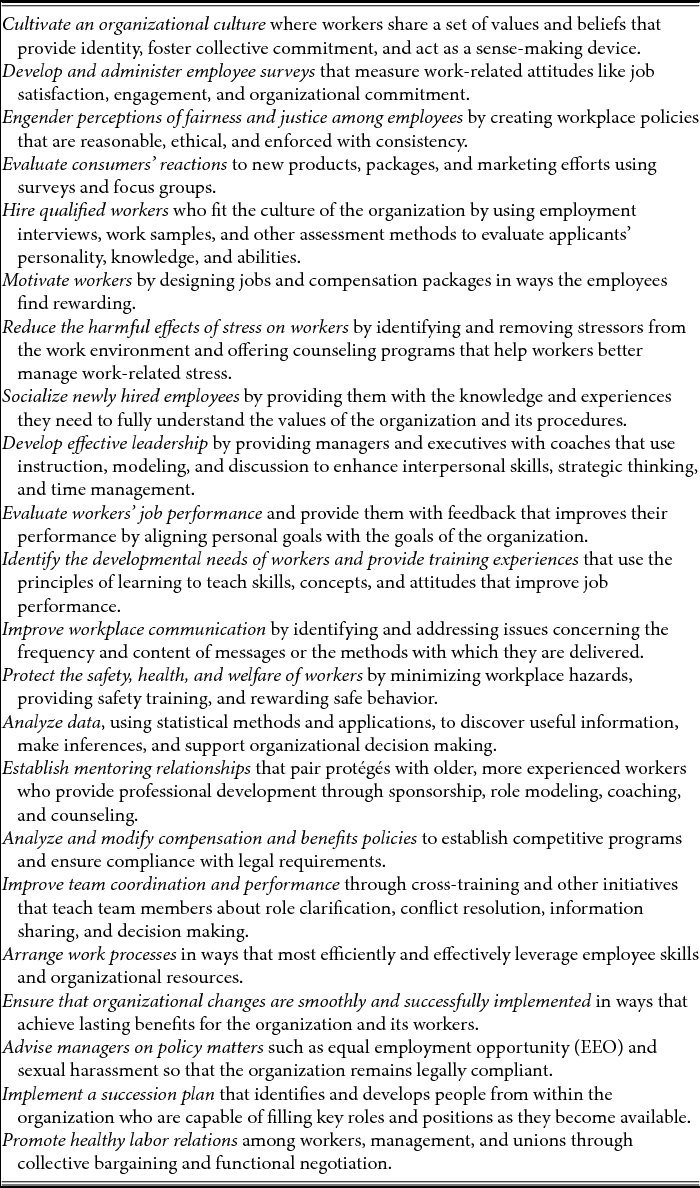
The differential effect of brand image refers to unique, favorable associations that distinguish a brand from competing brands in the minds of consumers (Keller, Reference Keller1998). People associate both instrumental functions and symbolic meanings with branded entities. Instrumental functions concern the objective, physical, and tangible attributes that appeal to consumers’ desire to maximize gains and minimize losses (Katz, Reference Katz1960). The instrumental functions most relevant to I-O psychology are beliefs about the products and services that professionals with training in the field are able to provide. Nolan et al. (Reference Nolan, Islam and Quartarone2014), for example, found that people generally believed that consultants with training in I-O psychology were significantly more capable of reducing the harmful effects of stress on workers, improving workplace communication, conducting research, and engendering perceptions of fairness/justice among employees than consultants with training in business administration or HR management. The proposed audit would ask introductory I-O psychology students to rate professionals with training in the various fields concerning their ability to provide products and services corresponding to the “Recommended Areas of Competence” outlined in SIOP's Guidelines for Education and Training in Industrial-Organizational Psychology. Twenty-five instrumental functions from the brand audit conducted by Nolan et al. (Reference Nolan, Islam and Quartarone2014) are included in Table 1 as examples for consideration.
Table 1.
Task Statements Communicating Instrumental Functions
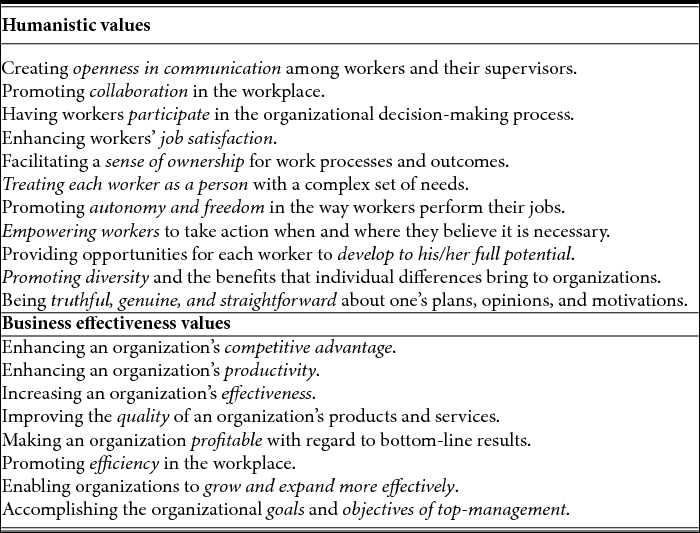
The symbolic meanings associated with brand images concern subjective, abstract, and intangible attributes (e.g., personality traits, values) that appeal to people's needs to maintain their self-identity, enhance their self-image, and express their beliefs and values (Aaker, Reference Aaker1999). Symbolic information helps consumers differentiate among brands that offer similar instrumental functions and has been shown to meaningfully influence attitudes and behavior (Lievens & Highhouse, Reference Lievens and Highhouse2003). The symbolic meanings most relevant to I-O psychology are beliefs about professional values. Professional values provide purpose, inform decision making, and serve as points of personal reflection and self-evaluation (Lefkowitz, Reference Lefkowitz2005). I-O psychology is a field guided by both humanistic and business effectiveness values. Humanistic values pertain to workers’ physical and mental health, whereas business effectiveness values concern organizational productivity, profitability, and competitive advantage (Church, Burke, & Van Eynde, Reference Church, Burke and Van Eynde1994). The proposed audit would ask students to rate professionals with training in the various fields on the extent to which they value outcomes and behaviors that correspond with humanistic and business effectiveness principles. Nineteen value statements from the brand audit conducted by Nolan et al. (Reference Nolan, Islam and Quartarone2014) are included in Table 2 as examples for consideration.
Table 2.
Value Statements Communicating Symbolic Meanings (Arranged by Category)
In addition to quantitative ratings of instrumental and symbolic associations, the proposed audit would also include open-ended questions designed to provide qualitative information about students’ perceptions of the strengths and weaknesses of each field. Using this approach, Rose et al. (Reference Rose, Drogan, Spencer, Rupprecht, Singla, McCune and Rotolo2014), for example, found that business and HR professionals believed I-O psychology had strengths relating to improving workplace performance and understanding workers, and weaknesses relating to subjective conclusions and labor costs. By partnering qualitative and quantitative information, the proposed audit would provide a more complete understanding of students’ brand image beliefs.
Consumer response refers to the attitudes, intentions, and behaviors that result from marketing a brand (Keller, Reference Keller1993). Students in introductory I-O psychology courses may one day produce/provide the goods/services of I-O psychology or they might consume them. Consequently, the proposed audit would ask students questions about their attitudes toward the field of I-O psychology (e.g., attraction, interest), intentions to pursue additional training in I-O psychology (e.g., additional undergraduate courses, graduate programs), and thoughts about hiring a professional with training in I-O psychology to address a range of organizational issues they may one day experience (e.g., employee turnover, poor job performance, deviant behavior).
Concluding Comments
Aguinis et al. (Reference Aguinis, Ramani, Campbell, Bernal-Turnes, Drewry and Edgerton2017) provide a much-needed analysis of I-O psychology textbooks and offer insight into the ways in which their contents may affect the future of the field. This commentary outlines an approach to program evaluation that can be used in conjunction with research like that presented in the focal article to better understand how the messages communicated to students impact their beliefs about and intentions toward the field of I-O psychology. By utilizing the principles of brand management, the proposed approach would not only provide valuable information about students’ beliefs concerning the capabilities and values of professionals trained in I-O psychology but also those of professionals trained in the field's business school counterparts (i.e., organizational behavior, business administration, HR management). Knowledge of point-of-parity and point-of-difference associations is critical information for determining how to effectively position brands in a shared marketplace (Keller, Reference Keller1998).




 You have
Access
“When it comes to the future, there are three kinds of people: those who let it happen, those who make it happen, and those who wonder what happened.”—John M. Richardson
Aguinis et al. (Reference Aguinis, Ramani, Campbell, Bernal-Turnes, Drewry and Edgerton2017) address an issue of upmost importance for the field of industrial-organizational (I-O) psychology: recruitment. The ability to attract and retain talented individuals is a principle determinant of success in a knowledge-driven economy (Yu & Cable, Reference Yu, Cable and Kozlowski2012). The focal article notes that future practitioners and researchers are commonly exposed to the field of I-O psychology for the first time via introductory courses taken during their undergraduate education. A study by Rose et al. (Reference Rose, Drogan, Spencer, Rupprecht, Singla, McCune and Rotolo2014) likewise suggests that introductory courses are among the most popular channels through which business and human resource professionals learn about I-O psychology. Consequently, the information communicated in these courses not only shapes the beliefs and behaviors of those who might one day produce/provide the goods/services of I-O psychology, but also those who might consume them. Introductory courses are, therefore, both an important recruitment source as well as an important marketing channel. Aguinis et al. provide a much-needed content analysis of the information communicated to students through introductory textbooks and offer insight into the ways in which this information may affect the future of I-O psychology. Building from their analysis of content, this commentary offers an approach to program evaluation that utilizes the principles of brand management to better understand how the messages communicated to students impact their beliefs about the field. Moving from analysis to evaluation is a logical next step in making a desired future for I-O psychology.
Program evaluation involves systematically collecting and analyzing information that answers questions about the effectiveness and efficiency of projects, policies, or programs. It is an invaluable tool for organizations that are pursuing strategic objectives (Edwards, Scott, & Raju, Reference Edwards, Scott and Raju2003). Regarding the information communicated to students in introductory I-O psychology courses, there are several objectives relating to concerns expressed by Aguinis et al. (Reference Aguinis, Ramani, Campbell, Bernal-Turnes, Drewry and Edgerton2017) (e.g., top students will be drawn to working with scholars in business schools), as well as other leaders in the field (e.g., the need to distinguish I-O psychology from its business school counterparts; Ryan & Ford, Reference Ryan and Ford2010), that are pertinent to the future of I-O psychology. These objectives are to (a) create an image of I-O psychology in students’ minds that is accessible and consistent with the desired identity of the field, and (b) recruit students to continue their education in I-O psychology by enrolling in additional undergraduate courses or graduate programs. An approach to program evaluation that is appropriate for both objectives is strategic brand management.
A brand refers to a “name, term, sign, symbol, or design, or combination of them which is intended to identify the goods and services of one seller or group of sellers and to differentiate them from those of competitors” (Kotler, Reference Kotler1991, p. 442). Branding is used to create unique identities for similar entities in nearly all areas of consumer decision making (Keller, Reference Keller1998), including job choice (Lievens & Highhouse, Reference Lievens and Highhouse2003). Through marketing efforts and personal experiences, consumers develop brand images that represent their beliefs about the tangible (e.g., four-wheel drive) and intangible (e.g., built tough) attributes that characterize branded entities (e.g., Ford trucks). These images form the basis for consumer behavior and have been shown to reliably influence people's attitudes and decisions about products/services as well as employment opportunities (Keller, Reference Keller1993; Yu & Cable, Reference Yu, Cable and Kozlowski2012). Brands that are well-positioned in the marketplace occupy specific niches in the minds of consumers (Davies & Miles, Reference Davies and Miles1998). They succeed by creating points of parity with competitors in areas where competitors are trying to gain advantages while also creating points of difference to achieve advantages over competitors in other areas (Keller, Reference Keller2000).
Effective brand management requires regularly auditing and tracking brand images. These efforts identify consumers’ beliefs about the strengths and weaknesses of brands, and reveal disparities in the ways in which brands are perceived by producers and consumers (Davies & Chun, 2002). Conducting an audit of the brand images held by students who have recently completed or are about to complete an introductory I-O psychology course would provide valuable information concerning these future professionals’ beliefs about the field. By partnering this information with research like the content analysis conducted by Aguinis et al. (Reference Aguinis, Ramani, Campbell, Bernal-Turnes, Drewry and Edgerton2017), it would be possible to identify various aspects of instructional programs (e.g., textbooks) that affect their usefulness for accomplishing the aforementioned objectives.
Auditing the Brand Image Beliefs of Introductory I-O Psychology Students
Several audits examining the brand image of I-O psychology have been conducted. Rose et al. (Reference Rose, Drogan, Spencer, Rupprecht, Singla, McCune and Rotolo2014), for example, investigated differences between business and HR professionals concerning their awareness and perceptions of the field. Nolan, Islam, and Quatarone (Reference Nolan, Islam and Quartarone2014) surveyed the general public to examine differences in their beliefs about and intentions toward the fields of I-O psychology, business administration, and HR management. Building upon the methods and findings of these studies, an approach is offered for how to audit the brand image beliefs of introductory I-O psychology students.
The first step in conducting a brand audit is to determine who will participate and how they will provide information. Students who have just completed or are about to complete an introductory I-O psychology course are the population of interest for the proposed audit. To the best of my knowledge, a database identifying the colleges and universities that offer introductory I-O psychology courses does not exist. Consequently, securing a large sample of the population may require working with publishers of I-O psychology textbooks and members of Society for Industrial and Organizational Psychology (SIOP) to identify these institutions. Brand audits are commonly conducted via online surveys, which are relatively easy to administer and allow for both quantitative and qualitative information to be collected from large samples. Accordingly, the proposed audit would be conducted via an online survey administered once each semester by a designated SIOP taskforce.
The next step in conducting a brand audit is to develop a framework that outlines what information will be collected about the target brand as well as a selection of other brands that compete in the marketplace. For the proposed audit, these brands include I-O psychology along with its business school counterparts (i.e., organizational behavior, business administration, HR management). Because the brands correspond to areas of study rather than products or services, it may be useful to personify the brands by having participants respond to questions about professionals who have training in these fields rather than the fields themselves (cf. Nolan et al., Reference Nolan, Islam and Quartarone2014). The information collected about brands commonly corresponds to the “three key ingredients” of consumer-based brand equity, which are brand awareness, the differential effect of brand image, and consumer response (Keller, Reference Keller1998).
Brand awareness refers to consumers’ ability to recognize and recall information about a brand under various conditions (Keller, Reference Keller1998). For the proposed audit, operationalizing awareness in this way offers little value given the population of interest should all be highly aware of the target brand. However, collecting data on the number of students who are enrolled in introductory I-O psychology courses would provide valuable information that could be used to evaluate the effectiveness of other initiatives, like SIOP's The Educational Outreach (THEO) program, which aims to increase high school students’ awareness of the field.
The differential effect of brand image refers to unique, favorable associations that distinguish a brand from competing brands in the minds of consumers (Keller, Reference Keller1998). People associate both instrumental functions and symbolic meanings with branded entities. Instrumental functions concern the objective, physical, and tangible attributes that appeal to consumers’ desire to maximize gains and minimize losses (Katz, Reference Katz1960). The instrumental functions most relevant to I-O psychology are beliefs about the products and services that professionals with training in the field are able to provide. Nolan et al. (Reference Nolan, Islam and Quartarone2014), for example, found that people generally believed that consultants with training in I-O psychology were significantly more capable of reducing the harmful effects of stress on workers, improving workplace communication, conducting research, and engendering perceptions of fairness/justice among employees than consultants with training in business administration or HR management. The proposed audit would ask introductory I-O psychology students to rate professionals with training in the various fields concerning their ability to provide products and services corresponding to the “Recommended Areas of Competence” outlined in SIOP's Guidelines for Education and Training in Industrial-Organizational Psychology. Twenty-five instrumental functions from the brand audit conducted by Nolan et al. (Reference Nolan, Islam and Quartarone2014) are included in Table 1 as examples for consideration.
Task Statements Communicating Instrumental Functions
The symbolic meanings associated with brand images concern subjective, abstract, and intangible attributes (e.g., personality traits, values) that appeal to people's needs to maintain their self-identity, enhance their self-image, and express their beliefs and values (Aaker, Reference Aaker1999). Symbolic information helps consumers differentiate among brands that offer similar instrumental functions and has been shown to meaningfully influence attitudes and behavior (Lievens & Highhouse, Reference Lievens and Highhouse2003). The symbolic meanings most relevant to I-O psychology are beliefs about professional values. Professional values provide purpose, inform decision making, and serve as points of personal reflection and self-evaluation (Lefkowitz, Reference Lefkowitz2005). I-O psychology is a field guided by both humanistic and business effectiveness values. Humanistic values pertain to workers’ physical and mental health, whereas business effectiveness values concern organizational productivity, profitability, and competitive advantage (Church, Burke, & Van Eynde, Reference Church, Burke and Van Eynde1994). The proposed audit would ask students to rate professionals with training in the various fields on the extent to which they value outcomes and behaviors that correspond with humanistic and business effectiveness principles. Nineteen value statements from the brand audit conducted by Nolan et al. (Reference Nolan, Islam and Quartarone2014) are included in Table 2 as examples for consideration.
Value Statements Communicating Symbolic Meanings (Arranged by Category)
In addition to quantitative ratings of instrumental and symbolic associations, the proposed audit would also include open-ended questions designed to provide qualitative information about students’ perceptions of the strengths and weaknesses of each field. Using this approach, Rose et al. (Reference Rose, Drogan, Spencer, Rupprecht, Singla, McCune and Rotolo2014), for example, found that business and HR professionals believed I-O psychology had strengths relating to improving workplace performance and understanding workers, and weaknesses relating to subjective conclusions and labor costs. By partnering qualitative and quantitative information, the proposed audit would provide a more complete understanding of students’ brand image beliefs.
Consumer response refers to the attitudes, intentions, and behaviors that result from marketing a brand (Keller, Reference Keller1993). Students in introductory I-O psychology courses may one day produce/provide the goods/services of I-O psychology or they might consume them. Consequently, the proposed audit would ask students questions about their attitudes toward the field of I-O psychology (e.g., attraction, interest), intentions to pursue additional training in I-O psychology (e.g., additional undergraduate courses, graduate programs), and thoughts about hiring a professional with training in I-O psychology to address a range of organizational issues they may one day experience (e.g., employee turnover, poor job performance, deviant behavior).
Concluding Comments
Aguinis et al. (Reference Aguinis, Ramani, Campbell, Bernal-Turnes, Drewry and Edgerton2017) provide a much-needed analysis of I-O psychology textbooks and offer insight into the ways in which their contents may affect the future of the field. This commentary outlines an approach to program evaluation that can be used in conjunction with research like that presented in the focal article to better understand how the messages communicated to students impact their beliefs about and intentions toward the field of I-O psychology. By utilizing the principles of brand management, the proposed approach would not only provide valuable information about students’ beliefs concerning the capabilities and values of professionals trained in I-O psychology but also those of professionals trained in the field's business school counterparts (i.e., organizational behavior, business administration, HR management). Knowledge of point-of-parity and point-of-difference associations is critical information for determining how to effectively position brands in a shared marketplace (Keller, Reference Keller1998).