Introduction
The Zingiberales in general, and members of the Zingiberaceae in particular, have not been well studied with respect to seed dormancy and seed germination. Seeds of Zingiberaceae have a capitate or fully developed linear embryo, a small endosperm and a relatively large, hard or mealy starchy perisperm (Goldberg, Reference Goldberg1989). A few authors have reported successful seed germination for species of this family, e.g. Hedychium spicatum (Giri and Tamta, Reference Giri and Tamta2012), Elettaria cardamomum (Dahanayake, Reference Dahanayake2014) and Amomum subulatum (Bhowmick and Chattopadhyay, Reference Bhowmick and Chattopadhyay1960). In some species, seeds germinated within about 1 month and were considered to be non-dormant (Schemske, Reference Schemske1983), while seeds of other species require many months to germinate and presumably have physiological dormancy (PD) (Chanchula et al., Reference Chanchula, Jala and Taychasinpitak2013; Dahanayake, Reference Dahanayake2014; Rivai et al., Reference Rivai, Wardani and Devi2015). In the case of Alpinia malaccensis (Rivai et al., Reference Rivai, Wardani and Devi2015) and Globba spp. (Chanchula et al., 2013), seed scarification significantly increased germination percentages. However, little is known about the responses of dormant seeds of Zingiberaceae to the sequence of seasonal temperature changes in the habitat. Thus, the objectives of the present study were to determine the dormancy breaking and germination requirements of Alpinia galanga (L.) Willd. seeds by conducting a move-along experiment (Baskin and Baskin, Reference Baskin and Baskin2003) and to identify the kind of seed dormancy.
The genus Alpinia Roxb. (Schumann, Reference Schumann1904) (Zingiberaceae), with over 230 species, occurs from Sri Lanka and the Western Ghats of India to China, Japan, all of South-East Asia, the Pacific region and Australia as far south as northern New South Wales (Smith, Reference Smith1990; Larsen et al., Reference Larsen, Lock, Maas, Maas and Kubitzki1998). A. galanga is the type species of the genus and grows only in the Western Ghats and north-eastern parts of India and in Thailand. The species flowers between April and December (Kerala Forest Research Institute, 2011 ), but there are no data on its fruit set. Seed availability is very low, and the species is usually propagated vegetatively by dividing the rhizome into pieces.
Materials and methods
Plant material
Seeds produced by plants of A. galanga grown in Indonesia were obtained from Mia Myers (rare seed collector) in Claremont, California, USA, in May 2012, March 2013 and July 2014. The seeds acquired in May 2012 were 1–2 months old and were used for preliminary experiments and anatomical studies. Seeds freshly collected in March 2013 and July 2014 were used in the experiments within 2 weeks after collection. One hundred dry seeds were weighed individually on a Sartorius CPA225D microbalance (Sartorius, Göttingen, Germany) and their length and breadth measured.
All experiments were conducted in aseptic conditions so that the seedlings could be used in further in vitro experiments. Seeds were surface sterilized with a 0.1% solution of Carbendazim for 5 min (Shields et al., Reference Shields, Robinson and Ansow1984) followed by 0.1% mercury chloride (HgCl2) for 5 min (Ramakrishna et al., Reference Ramakrishna, Lacey and Smith1991). After each sterilization procedure, seeds were rinsed with sterile distilled water for 2 min. Then, seeds were dried in a laminar air-flow chamber over autoclaved (121°C and 100 kPa for 15 min) Whatman grade-one filter paper that absorbed the extra moisture. Finally, the seeds were packed in autoclaved paper covers and placed in Fisher heavy glass desiccators (Fisher Scientific, Waltham, Massachusetts, USA) with calcium chloride, for desiccation at culture-room temperatures (25 ± 2°C).
Seed imbibition
The mass of sterilized dry seeds was determined, and then each seed was placed in a separate glass test tube (25 cm × 1.5 cm) on absorbent cotton saturated with 1/4 strength Murashige and Skoog media macroelements (Murashige and Skoog, Reference Murashige and Skoog1962), which were sterilized by autoclaving before use (hereafter, cotton substrate). After 1 d of imbibition, seeds were transferred to autoclaved pre-weighed micro-centrifuge tubes following air drying over autoclaved Whatman grade-one filter paper in a laminar air-flow chamber, to remove surface moisture aseptically, and the percentage mass increase of each individual seed was calculated.
Seed anatomy and seedling morphology
The in vitro imbibed seeds of intermediate size (c. 5.5 mm length) were sectioned longitudinally using a dissecting microscope, and seed and embryo lengths were measured using an ocular micrometer. Photographs were taken using a Sony DSC-T70 camera (Sony, Park Ridge, New Jersey, USA).
Move-along experiment for germination
A move-along experiment (Baskin and Baskin, Reference Baskin and Baskin2003, Reference Baskin, Baskin, Guerrant, Havens and Maunder2004) was used to determine the optimum sequence of simulated habitat temperatures for dormancy break and germination. There were two treatments: Series A (20/10 → 25/15 → 30/20°C) and Series B (30/20 → 25/15 → 20/10°C), with each regime representing day and night (12/12 h) temperatures for winter (20/10°C), spring/autumn (25/15°C) and summer (30/20°C) extending for 8 weeks. These temperature regimes represent the average maximum and minimum temperatures for each season of the year for a period of 106 years (from 1901 to 2007) in north-eastern India (Indian Institute of Tropical Meteorology) where A. galanga is native. Control seeds were incubated at 20/10, 25/15 and 30/20°C for the duration of the experiment. Treatments and controls were replicated three times with 15 seeds each, and seeds were incubated on the cotton substrate and exposed to light (12 h of 25 μmol m−2 s−1, 400–700 nm, cool white fluorescent light each day). Seeds were transferred from one temperature regime to another in the two series (see Table 1). Two criteria were used to evaluate germination: (1) minimum time for any seeds to germinate; and (2) maximum germination percentage after 24 weeks. Germination data were collected at 1-week intervals for 24 weeks.
Cumulative germination (mean % ± SD) of Alpinia galanga seeds in three experiments. Within each experiment, the means in a row or in a column followed by the same lower-case letter are not significantly different (P < 0.05)

Effect of temperature on embryo growth
Twenty fresh seeds were incubated separately on the cotton substrate in light at 10, 15, 20, 25 and 30°C for 60 d. At 10-d intervals, three seeds from each temperature were dissected as described in the section on seed anatomy. Embryo length and seed length were used to calculate the embryo length to seed length (E:S) ratio. Seeds in which the operculum had opened were not used for this study since they were considered to have germinated.
Effect of dry storage and gibberellic acid on germination
The summer to winter temperature series (Series B) was applied to seeds after 2 and 4 months of dry storage over calcium chloride in a desiccator at 25°C. Three replicates of 15 seeds each were used per treatment, and seeds were sterilized before use. Fresh (not dried, stored) seeds in the warm stratification series (Series B) were used as the control for this experiment.
Four-month-old dry-stored seeds were sterilized and treated with 25 and 50 mg l−1 gibberellic acid (GA3) for 24 h and then transferred to the cotton substrate in test tubes for incubation in light at 30/20°C. The 4-month dry-stored seeds (described above) served as the control for this experiment.
Statistical analysis
A standard one-sample t-test was done on seed imbibition data. A one-way analysis of variance (ANOVA) followed by Duncan's Multiple Range test was used for comparing means (SPSS 16.0 software; SPSS Inc., Chicago, Illinois, USA) in the move-along, effect of dry storage in summer move-along (Series B) and effect of dry storage plus GA3 pre-treatment in summer move-along (Series B) experiments. The significance was set to P = 0.05, and data were normalized prior to analysis.
Results
Plant material
Mean (± SD) mass of the 100 seeds was 30.12 ± 4.07 mg, with a maximum of 38.44 mg and a minimum of 21.28 mg. Mean (± SD) length was 5.51 ± 0.91 mm, and width was 3.32 ± 0.09 mm. Seeds were somewhat irregularly trigonal-bipyramidal in shape with one end blunter than the other. The frequency distribution of seed mass resembled a normal curve, and the majority of seeds fell in the mass category between 22.78 and 36.80 mg. The seeds in this mass range were used in the experiments.
Seed imbibition
Mean (± SD) percentage increase in mass of seeds incubated on the moist germination substrate for 1 d was 17.5 ± 1.9%. Thus with t(99) = 80.5 and P = 0 in the one-sample t-test, the null hypothesis of no increase in seed mass due to imbibition was dismissed.
Seed anatomy and seedling morphology
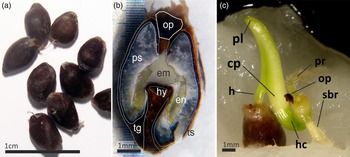
Seeds had a small, differentiated, capitate embryo in the centre of the seed over a stage-like hypostase and a distinct operculum that opened during germination (Fig. 1). Mean (± SD) length of the initially imbibed embryo was 1.22 ± 0.11 mm, and it was 2.75 ± 0.29 mm just prior to germination, i.e. before the operculum opened. The E:S ratio of the initially imbibed seeds was 0.21, and it was 0.47 just prior to germination.
Whole seeds (a), longitudinal section of seed (b) and seedling (c) of Alpinia galanga. cp, Coleoptile; em, embryo; en, endosperm; h, haustorium; hc, hypocotyle; hy, hypostase; op, operculum; pl, primary leaf; pr, primary root; ps, perisperm; sbr, shoot-borne root; tg, tegmen; ts, testa.

Move-along experiment for germination
The minimum time for seeds to germinate in the move-along experiment was 6 weeks, in Series A (20/10 →25/15 →30/20°C) and in the control at 20/10°C (Table 1). The maximum germination percentage after 24 weeks in the move-along experiment was 86.7 ± 6.7%, and it occurred in Series A (Table 1).
Effect of temperature on embryo growth
In seeds incubated at constant temperatures of 10, 15, 20, 25 and 30°C, 20°C was optimal for embryo growth (Fig. 2). At 20°C, embryo length increased from 1.40 ± 0.04 to 2.72 ± 0.07 mm in 60 d. Substantial embryo growth also occurred at 10, 15 and 25°C, but little growth occurred at 30°C. The maximum E:S ratio just before germination was 0.47.
Changes in the embryo:seed length (E:S) ratio during 60 d of incubation at five constant temperatures. Bars are ± SE.

Effect of dry storage and GA3 on germination
Seeds dry stored for 2 and 4 months and then subjected to Series B (30/20 → 25/15 → 20/10°C) started germinating in 6 and 5 weeks, respectively. Seeds dry stored for 4 months treated with 50 mg l−1 GA3 started germinating in 2 weeks. The minimum time for seeds to germinate in the move-along experiment was 7 weeks.
Dry storage of seeds for 4 months increased the maximum germination after 24 weeks in Series B (30/20 → 25/15 → 20/10°C) from 66.7 ± 6.7% to 93.3 ± 6.4%, and when 4 months of dry storage were coupled with treatment with 50 mg l−1 GA3 germination increased to 95.6 ± 3.8% (Table 1).
Discussion
Germination of seeds in Series A (starting with winter) of the move-along experiment showed that the initial winter conditions (20/10°C) are sufficient for dormancy break. Seeds also germinated in Series B, but they did so at a slower rate and to a lower percentage than in Series A. Thus, these results suggest that the seeds, which are usually shed during autumn, undergo dormancy break and embryo growth during winter and germinate in spring. However, there are no reports on seed germination of A. galanga in their natural habitat. The embryo in seeds of A. galanga grew at 15, 20 and 25°C, with 20°C being the most favourable (Fig. 2). Furthermore, seeds afterripened during dry storage for 4 months, thereby decreasing the time to germination and increasing the germination percentage, as defined by earlier studies (Finch-Savage and Leubner-Metzger, Reference Finch-Savage and Leubner-Metzger2006).
The hypostase centres the embryo in the middle of the seed (Fig. 1b); thus, the embryo needs to grow only part of the seed length before germination can occur. That is, if the embryo was at the base of the seed, the embryo would need to grow almost twice the length it actually grows prior to the time germination takes place.
Seeds of A. galanga are water permeable, thus they do not have physical dormancy. Furthermore, since seeds of A. galanga needed a period of afterripening or a long period of incubation on a wet substrate to germinate to high percentages, the underdeveloped embryo also has PD, i.e. the seeds have morphophysiological dormancy (MPD). This is the first report of MPD in the Zingiberaceae. Pretreatment of 4-month-old dried seeds with GA3 did not significantly increase the final germination percentage (Table 1), nor did it enhance germination of fresh seeds (Ravi, unpublished data). However, GA3 pretreatment of 4-month-old dried seeds decreased the time to start of germination by 3 weeks, indicating that GA3 was effective in breaking some of the PD.
There are nine levels of MPD, and they are distinguished based on the temperature required for embryo growth, temperature required to break PD, response to GA3 and timing of radicle and shoot emergence (Baskin and Baskin, Reference Baskin and Baskin2014). The levels of MPD are divided into two groups: simple, in which the embryo grows at temperatures suitable for warm stratification (≥15°C); and complex, in which the embryo grows at temperatures suitable for cold stratification (0–10°C) (Baskin and Baskin, Reference Baskin and Baskin2014). Since the optimum temperature for embryo growth in seeds of A. galanga was 20°C, we conclude that seeds have one of the simple levels of MPD. The only requirement for embryo growth and radicle and shoot emergence in seeds of A. galanga was warm stratification. Furthermore, there was no delay between radicle and shoot emergence (i.e. not epicotyl MPD); therefore, we conclude that the seeds have non-deep simple MPD.
The dormancy formula for non-deep simple MPD is C1Bb, where ‘C1’ denotes non-deep PD, ‘B’ an underdeveloped embryo, and ‘b’ a warm temperature requirement for embryo growth (Baskin and Baskin, Reference Baskin and Baskin2014). There are two types of non-deep simple MPD: C1bBb is the dormancy formula for Type 1 and C1aBb for Type 2. The difference between the two is that PD in Type 1 is broken by warm temperatures (subscript b of C1b) and PD in Type 2 by low temperatures (subscript a of C1a). Since dormancy break and germination of A. galanga seeds only required exposure to warm temperatures, its dormancy formula is C1bBb.
Acknowledgements
We thank J.H. Franklin Benjamin, Botanical Survey of India for his suggestions and Jerry M. Baskin for reviewing the manuscript.
Financial support
R.G.B. thanks Bharathidasan University, Tiruchirappalli, Tamil Nadu, India for providing the University Research Fellowship (2010–2013).
Conflicts of interest
None.