Palmer amaranth and barnyardgrass are considered to be two of the most prominent weeds in soybean production in the midsouthern United States today and are currently resistant to six and seven herbicide sites of action, respectively (Heap Reference Heap2016; Norsworthy et al. Reference Norsworthy, Griffith, Griffin, Bagavathiannan and Gbur2014). Additionally, both weed species have shown the ability to significantly reduce crop yield if not controlled. For example, a density of only eight Palmer amaranth plants per square meter, present at soybean emergence, reduced grain yield by 78% (Bensch et al. Reference Bensch, Horak and Peterson2003). In soybean, Vail and Oliver (Reference Vail and Oliver1993) found a 10%, 25%, and 50% reduction of yield with respective barnyardgrass densities of 42, 110, and 250 plants per meter of row. Herbicide resistance in weeds can leave growers with limited control options yet serious repercussions in terms of reduced yield when escaped weeds are allowed to interfere with the crop throughout the growing season.
Preventing weed seed inputs to the soil seedbank is an effective means of reducing the impact of weeds on subsequent crops (Walsh et al. Reference Walsh, Newman and Powles2013). Additionally, weed seeds can be redistributed on the soil surface at the time of harvest, causing further spread of the weed population (Walsh and Powles Reference Walsh and Powles2014). Without competition, Palmer amaranth can produce up to 1 million seeds per plant (Keeley et al. Reference Keeley, Carter and Thullen1987; Nordby et al. Reference Nordby, Hartzler and Bradley2007), whereas when in competition with soybean, this species can produce over 250,000 seeds per plant (Schwartz et al. Reference Schwartz, Norsworthy, Young, Bradley, Kruger, Davis, Steckel and Walsh2016; Sellers et al. Reference Sellers, Smeda, Johnson, Kendig and Ellersieck2003; Ward et al. Reference Ward, Webster and Steckel2013). Barnyardgrass can produce up to 34,000 seeds per plant when emerging early in a crop (Bosnic and Swanton Reference Bosnic and Swanton1997).
Alternative, nonchemical weed control practices are needed to help control herbicide-resistant or escaped weeds (Walsh et al. Reference Walsh, Newman and Powles2013). Harvest weed seed control (HWSC) tactics have been developed that include various cultural and mechanical management practices to decrease the number of weed seeds replenishing the soil seedbank. There are many challenges associated with preventing inputs to the soil seedbank, the most significant of which are preventing seed return over a large area and decreasing the diversity of the weed seedbank (Norsworthy et al. Reference Norsworthy, Ward, Shaw, Llewellyn, Nichols, Webster, Bradley, Frisvold, Powles, Burgos, Witt and Barrett2012; Swanton and Weise Reference Swanton and Weise1991). The length of time that seeds remain viable in the soil seedbank determines how long best management practices must be used to reduce the seedbank and decrease the number of herbicide-resistant seed (Norsworthy et al. Reference Norsworthy, Ward, Shaw, Llewellyn, Nichols, Webster, Bradley, Frisvold, Powles, Burgos, Witt and Barrett2012). Previous research has shown that Palmer amaranth and waterhemp [ Reference Sellers, Smeda, Johnson, Kendig and EllersieckAmaranthus tuberculatus (Moq.) Sauer] retain approximately 99% and 95% of seed production, respectively, at soybean maturity (Schwartz et al. Reference Schwartz, Norsworthy, Young, Bradley, Kruger, Davis, Steckel and Walsh2016). Similarly, Goplen et al. (Reference Goplen, Shaeffer, Becker, Coulter, Breitenbach, Behnken, Johnson and Gunsolus2016) showed that giant ragweed (Ambrosia trifida L.) retained 80% of its seed at the time of soybean harvest. Furthermore, a diverse weed seedbank can allow for a multitude of weeds to emerge at varying times, either in one growing season or over many. However, little research has been conducted on weed seed retention after soybean maturity even though delays in harvest typically occur. Thus, the objective of this study was to determine the percentage of total Palmer amaranth and barnyardgrass seed production that was retained on the plant at soybean maturity and following delays in crop harvest.
Materials and Methods
Data Collection
Field experiments were conducted at the University of Arkansas Research and Extension Center in Fayetteville, Arkansas in 2015 and 2016. The soil at the field site is characterized as a Leaf silt loam (fine, mixed, active, thermic Typic Albaquults) with 34% sand, 53% silt, 13% clay, 1.5% organic matter, and a pH of 6.9. Planting took place on May 19, 2015, and May 22, 2016, using ‘Pioneer 95L01’ soybean (maturity group IV LibertyLink cultivar) on 97-cm-wide bedded rows. Palmer amaranth and barnyardgrass plants were seeded in the greenhouse on the same day and then transplanted to the field 2 weeks after soybean planting in 2015. In 2016, Palmer amaranth and barnyardgrass were seeded in the field at the time of soybean planting and were later thinned to a single plant per hill. The weeds were spaced every one meter along the row. Once the crop emerged, ten plants of each species were tagged. For both years, the plants were located in the center of the furrow between the soybean rows. The soybean crop was kept weed-free throughout the growing season by covering the weeds with buckets and then applying glufosinate at 0.53 kg ai ha−1. Weeds that were not controlled by this application were removed by hand every other week throughout the growing season. Once barnyardgrass and Palmer amaranth plants began to flower, four greenhouse trays (F1721 Tray, TO Plastics, Inc. Clearwater, MN), measuring 0.2 m2 each (0.8 m2 total with the four trays combined), were placed around the bottom of the ten randomly chosen plants to collect any seed shed from the plant. The trays were lined with mesh fabric so that rainfall could pass through the trays, but the seeds would be contained. The fabric was adhered to the trays using all-purpose silicon caulk. The greenhouse trays were emptied weekly using a portable vacuum, and the collected debris was placed into coin envelopes for counting.
The experiment culminated one month after soybean maturity, which was October 1 and October 3 in 2015 and 2016, respectively. At the conclusion of the experiment, the plants that were sampled weekly throughout the growing season were harvested to obtain a final seed count and determine the percentage of seed retention. Final seed counts were obtained by threshing the seed then counting out five lots of 1,000 seeds and calculating an average weight. Then the entire seed sample was weighed to provide the estimated number of seeds per sample. Additionally, the aboveground biomass was oven-dried at 66 C for 3 days and weighed.
To quantify seed production, five Palmer amaranth plants and five barnyardgrass plants were collected each week throughout the growing season, beginning when the tagged plant collections began. All of the seeds on each of these plants were counted. These plants were taken out of the same field as the tagged seed retention plants and emerged the same way as the tagged plants, but were randomly chosen plants that were destructively harvested weekly. As in the seed shatter experiment, the dry weight of the aboveground biomass and seed retained on the plant were determined.
Statistical Analysis
Data (biomass, estimated total number of seeds per plant, and percent seed retention) were analyzed with a two-way ANOVA using a mixed model analysis in SAS 9.3 (SAS Institute Inc., Cary, NC). In the model, species and day after soybean planting (DAP) were the fixed effects, while plant was a random effect. Significance was assessed at P<0.05. A first-order autoregressive covariance structure (type=ar(1) in Proc Mixed) was used in the model as it returned the lowest Akaike’s information criterion fit statistic compared with unstructured or compound symmetry. Means separation of significant interactions and, when appropriate, main effects, were based on LSMeans tests. There was no significant difference between years for percent seed retention, thus a multiple linear regression analysis was performed to determine if a combination of variables affected seed retention.
Results and Discussion
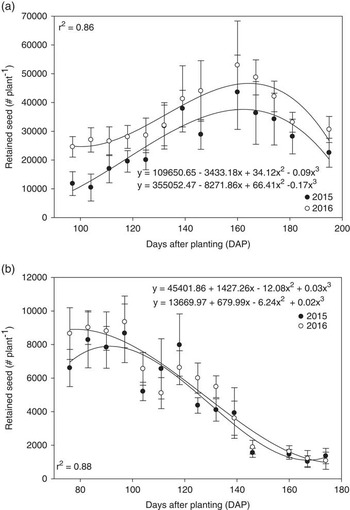
Biomass (in grams) and seed count estimates for both species showed a difference between years. Palmer amaranth biomass, regardless of year (P=0.009), ranged from 34 to 102 grams per plant, with a mean of 55±12 and 67±16 grams per plant in 2015 and 2016, respectively (data not shown). Barnyardgrass biomass (P=0.02) ranged from 10 to 58 grams per plant with a mean of 24±4 and 28±4 grams per plant in 2015 and 2016, respectively. No trends in biomass were seen over time for either species or year. Seed production for Palmer amaranth ranged from 10,440 to 59,370 seeds per plant (2015 mean, 26,508±6,490; 2016 mean, 35,991±7,158). Barnyardgrass seed production per plant ranged from 1,030 to 9,350 regardless of year (2015 mean, 4,920±1,000; 2016 mean, 5,360±890) (Figure 1). Mean seed production was similar to that reported in a previous study that examined seed production for Palmer amaranth (mean 13,384±27,363 to 60,221±21,991) and waterhemp (mean 11,833±2,277 to 82,811±15,051) in soybean fields across the United States (Schwartz et al. Reference Schwartz, Norsworthy, Young, Bradley, Kruger, Davis, Steckel and Walsh2016). Furthermore, Palmer amaranth seed production was close to values reported in additional studies (Dalley et al. Reference Dalley, Kells and Renner2004; Jha et al. Reference Jha, Norsworthy, Bridges and Riley2008). However, total seed production of Palmer amaranth in this study was lower than that reported in previous studies. For example, it has been documented that Palmer amaranth can produce upwards of 600,000 seeds per plant for plants grown in the absence of soybean interference (Keeley et al. Reference Keeley, Carter and Thullen1987; Massinga et al. Reference Massinga, Currie, Horak and Boyer2001). Conversely, barnyardgrass produces>20-fold fewer seeds per plant (Bagavathiannan et al. Reference Bagavathiannan, Norsworthy, Smith and Neve2011) than does Palmer amaranth. Barnyardgrass seed production was overall lower than figures reported in the literature, with some reports stating that this species can produce up to 35,000 seeds per plant (Bagavathiannan et al. Reference Bagavathiannan, Norsworthy, Smith and Neve2011). However, between years the number of seeds produced was similar. The variation in seed production could be due to differing environmental factors or management practices relative to those seen in previous studies.
Mean (±SE) seed production over time for a) Palmer amaranth (n=65) and b) barnyardgrass (n=70) in 2015 (closed circles) and 2016 (open circles). Soybean maturity occurred at 147 days after planting.

There was an interaction between time (DAP) and retained seed per plant for each species in both years (Palmer amaranth, P<0.0001; barnyardgrass, P=0.03) (Figure 1). Both Palmer amaranth and barnyardgrass showed similar trends in 2015 and 2016. Inflorescence development began at 76 and 82 DAP in 2015 and at 81 DAP and 93 DAP in 2016 for barnyardgrass and Palmer amaranth, respectively. Palmer amaranth exhibited an increase in retained seed, and the number of retained seeds peaked at 160 DAP both years (Figure 1a). At 160 DAP, Palmer amaranth produced 43,580±1,290 and 59,370±15,400 seeds per plant in 2015 and 2016, respectively. Retained seed began to decline within seven days of the peak seed production both years (Figure 1a). Barnyardgrass seed production began around 70 DAP and was highest between 76 and 97 DAP (2015, 8,670±1,750; 2016, 9,350±1,540) (Figure 1b). Retained seeds per plant had a linear decline until 160 DAP and remained static until 175 DAP. Soybean fully matured at 146 and 148 DAP in 2015 and 2016, respectively. Thus, at the time of soybean maturity Palmer amaranth had not yet reached its maximum seed production, whereas barnyardgrass had already shattered about 60% of its seed. These data show that Palmer amaranth is a viable candidate for HWSC, whereas barnyardgrass may not be. Knowing when specific weeds begin to shatter seed is vital to understanding how to best control them.
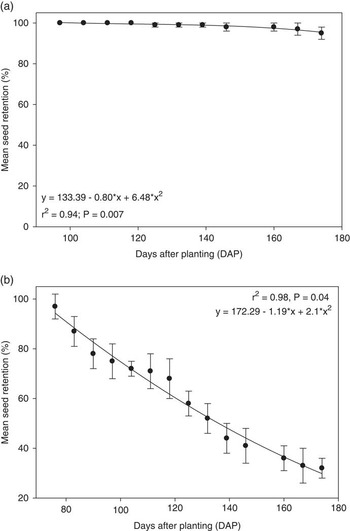
Although retained seed did not reach its maximum until after soybean maturity for Palmer amaranth, the seed retention of this species and for barnyardgrass is a more critical factor than soybean maturity date. At the time of soybean maturity, Palmer amaranth and barnyardgrass had retained 98% and 43% of their seeds, respectively. One month (28 days) after soybean maturity, Palmer amaranth still retained 95% (2015, 32,607; 2016, 40,029 seeds per plant) of its seeds (Figure 2a), whereas barnyardgrass retained only 32% (2015, 433; 2016, 389 seeds per plant) (Figure 2b). This translates to each Palmer amaranth and barnyardgrass plant losing a mean of 0.1% (721 seeds) and 0.3% (95 seeds) of its seeds daily after harvest, respectively. These results align with those reported in previous research on Palmer amaranth phenotypes found in soybean fields across the United States, where 95% to 99% seed retention occurred at soybean maturity (Schwartz et al. Reference Schwartz, Norsworthy, Young, Bradley, Kruger, Davis, Steckel and Walsh2016). Similarly, work by Walsh and Powles (Reference Walsh and Powles2014) in Australia found that rigid ryegrass (Lolium rigidum Gaudin), wild radish (Raphanus raphanistrum L.), brome grass (Bromus spp.), and wild oat (Avena fatua L.) retained 85%, 99%, 77%, and 84% of seed at wheat (Triticum aestivum L.) maturity, respectively.
Mean percent seed retention for a) Palmer amaranth (n=182) and b) barnyardgrass (n=196) over time. Data pooled across years. Soybean maturity occurred 147 days after planting.

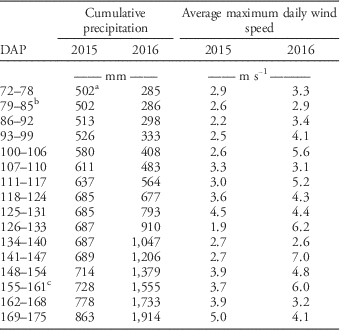
Cumulative rainfall (mm) and maximum wind speeds from planting until 28 days after maturity were determined to not have a significant impact on the periodicity of seed shed (Table 1). Although there was three times as much cumulative rainfall in 2016 than there was in 2015, most of the rainfall occurred from planting to when inflorescence began, and therefore did not greatly impact seed shatter. Other factors that could influence seed shatter include environmental factors, such as timing of the first killing frost, and crop maturity time. The first killing frost both years occurred mid-November. Palmer amaranth females often do not begin to dry down and shatter seed until the first killing frost (visual observation), whereas males senesce and dry down soon after the final pollen grains are shed. Crop maturity date could have an impact on seed shatter by the crop drying down earlier or later in the season. For example, crops that mature earlier may have higher weed seed retention at the time of harvest than do later-maturing crops, because there is a greater chance for additional flushes of emergence or for escaped weeds to grow larger. This study highlights the complex interaction between soybean maturity and the competitive nature of weeds through seed-shatter timing. Previous research has shown, however, that four common weed species (wild oat, cleavers (Galium spp.), wild mustard (Sinapis arvensis L.), and green foxtail [Setaria viridis (L.) Beauv]) in field pea (Pisum sativum L.), an early maturing crop, and spring wheat, a late maturing crop, showed no significant difference in weed seed retention at the time of harvest (Burton et al. Reference Burton, Beckie, Willenborg, Shirtliffe, Schoneau and Johnson2016). The four weed species showed moderate (70%) to high (>90%) weed seed retention. This could change with delayed harvest in specific cropping systems.
Cumulative precipitation (mm) and average maximum wind speed (m s−1) data collected weekly from a weather station on the research site from the first week of plant collection to the first frost in 2015 and 2016. Soybean maturity occurred at 147 days after planting (DAP).

a Initial precipitation values are cumulative from planting (May 19, 2015 and May 22, 2016) to 71 days after planting (DAP).
b Barnyardgrass reached the maximum amount of seed produced during this week in both years.
c Palmer amaranth produced the maximum amount of seed during this week in both years.
At-harvest and post-harvest management practices, such as HWSC tactics, are critical for long-term management of escaped weeds that exist in the crop; especially those with high seed retention at the time of harvest, like Palmer amaranth. The results reported here indicate that with even one or a few escaped weeds, the soil seedbank can be replenished at the time of crop harvest. However, other factors such as seed persistence, herbivory, percentage of viable seed, and dormancy all have profound effects on the soil seedbank. Previous research has shown that the soil seedbank, and consequently the aboveground weed community, were strongly related to management practices and geography (Schwartz et al. Reference Schwartz, Gibson, Gage, Matthews, Jordan, Owen, Shaw, Weller, Wilson and Young2015). Furthermore, weed escapes may be occurring due to a failing herbicide management program, increasing the risk of herbicide resistance (Norsworthy et al. Reference Norsworthy, Ward, Shaw, Llewellyn, Nichols, Webster, Bradley, Frisvold, Powles, Burgos, Witt and Barrett2012). Determining which weed species have high seed retention at the time of harvest will allow for a more proactive post-harvest management approach. The Harrington Seed Destructor has been shown to be highly effective in Australia on common weeds in wheat production, providing 95%, 93%, 99%, and 99% seed destruction on rigid ryegrass, wild radish, brome grass, and wild oat, respectively (Walsh and Powles Reference Walsh and Powles2014). Further investigation into the use of the Harrington Seed Destructor in the United States on weeds in soybean and other cropping systems is critical to mitigating further inputs into the soil seedbank. Incorporating another potentially highly effective tool into current management practices is essential to growers today. Growers must recognize that even a small percentage of weed seed that shatters prior to soybean harvest may cause a shift in the population to plants that potentially mature earlier or shatter seed prior to crop harvest. Thus, knowing the biology and ecology of the weeds present in a field, and gaining knowledge on time of seed shatter, can allow for the incorporation of HWSC tactics into management strategies for these escaped weeds at or after harvest.
Acknowledgements
The authors would like to express their gratitude to the students and staff for their assistance with this research, as well as the University of Arkansas Systems Division of Agriculture.