The management of cultural diversity represents one of the greatest challenges for Western Societies. The history and situation of the Canary Islands turn this region into a crossroad of transnational migrations that join European, African and South American migrants, causing an important social impact in the islands. In the case of African immigrants, even though their presence in the region is historical, it is especially since the “cayuco boat crisis” in 2006, when more than 30.000 Africans immigrants arrived in little boats called “cayucos”, that African immigrants are at the center of the political and media agenda of the Canary Islands (Cea D’Ancona & Valles, 2011).
Although African immigrants do not represent a quantitatively significant immigrant group in the Canary Islands, they are considered as a prototype of the image of negative immigration. This image has been prompted and amplified by social media and legitimated by some governmental discourses (Rodríguez, Reference Rodríguez2010). The surveys carried out by the Sociobarometer of Canary Islands have shown that the perception of immigration in the Canary Islands is rather negative, and an important proportion of the population considers that immigration is one of the main problems of their society (Gobierno de Canarias, 2010). Studying the explanations that Canarians give of such a problem appears as an important goal of research aiming to improve attitudes towards immigrant groups. Thus, the development of adequate measures concerning attributions about immigration and establishing the relations between these attributions and prejudice toward those groups would be a first step in that direction. On the other hand, as numerous national (SOS Racismo, 2013) and local (De Torres & Pinyol, Reference De Torres and Pinyol2013) reports have underlined, social intervention to combat racism needs to renovate its intervention tools in order to be effective in the prevention of new forms of racism (Buraschi & Aguilar, Reference Buraschi and Aguilar2017; Paluck & Green, Reference Paluck and Green2009; Pedersen, Walker, & Wise, Reference Pedersen, Walker and Wise2005). One of this intervention strategies which has been receiving consistent support as a way of prejudice reduction towards outgroups has been the induction of empathy (Stephan & Finlay, Reference Stephan and Finlay1999), more specifically empathic concern, understood as an emotional response of compassion and concern caused by witnessing an individual member of an out-group in need or distress, on favorable attitudes to the group as a whole (Batson et al., Reference Batson, Polycarpou, Harmon-Jones, Imhoff, Mitchener and Bednar1997, Todd & Galinsky, Reference Todd and Galinsky2014, for a review). The present studies focus on the interplay of attributions concerning immigration and prejudice towards immigrant groups and on the effects of inducing empathic concern towards members of these groups.
Attributions about poverty and attitudes toward immigrant groups
Early work by Pettigrew (Reference Pettigrew1979) established a connection between attributions and intergroup attitudes. He proposed the concept of the “ultimate attribution error” which involves a “systematic patterning of intergroup miss-attributions that serves to defend a negative stereotyped view shaped in part by prejudice” (p. 464). In general terms, it involves a negativity effect, when explaining out group behavior, that contributes to maintain a negative stereotype of the group. In the review of research by Hewstone (Reference Hewstone1990) on the final attribution error, he pointed out the existence of a group self-serving bias when trying to explain social differences between groups. In one study (Hewstone & Jaspars, Reference Hewstone and Jaspars1982) the explanations of the higher unemployment rates of blacks compared to whites in Britain, given by black respondents involved less personal attributions than those given by white participants, and more attributions to white authority figures given by blacks than by whites.
Kluegel (Reference Kluegel1990) using General Social Survey data in the USA from 1977–1989 was able to show that explanations by the white majority of the black-white economic gap included both structural, based on discrimination, and individualist explanations. In the latter he distinguished between traditional and motivational explanations. The traditional individualist explanations referred to genetic ability differences, while motivational ones referred to lack of will and effort. The latter seem to be persistent and associated to opposition to measures to promote racial economic equality. He considers that those who use motivational explanations are prejudiced, but at the same time do not want to appear so, very much in line with modern forms of racism.
Another aspect of attributions more closely related to the present work is the study by Cozzarelli, Wilkinson, and Tagler (Reference Cozzarelli, Wilkinson and Tagler2001) who studied in the USA the relationship between core American values, as the Protestant Work Ethic, and attributions of poverty by university students. They found positive and significant relations between these values, negative stereotypes of poor people and internal attributions of poverty.
Another domain of intergroup attributions, more directly related to our present work, has to do with beliefs about the causes of poverty in migrants’ countries of origin as an important dimension of prejudice towards them. Several studies have linked negative attitudes towards certain groups to causal attributions more closely related to personal aspects of their members than to situational factors (Cozzarelli et al. Reference Cozzarelli, Wilkinson and Tagler2001).
In a study carried out with high school students in the Canary Islands, Betancor et al. (Reference Betancor, Quiles, Morera, Rodríguez, Rodríguez, Delgado and Acosta2002) showed how individuals with more prejudiced attitudes highlighted personal causes to explain the socioeconomic situation of groups target of prejudice. In their study, participants filled out the Perceived Causes of Third World Poverty Scale by Hine and Montiel (Reference Hine and Montiel1999), as well as Bogardus’ Social Distance Scale. The results supported the relationship between the type of cause attributed to poverty and prejudice toward immigrants. Specifically, when personal causes were considered to be responsible for poverty in third world countries, the attitudes towards three different outgroups (Moroccans, South Americans, and Africans) were less favorable, and participants were less willing to contact them than when external causes were stated. Likewise, Cantó, Perles, and San Martín (Reference Cantó, Perles and San Martín2012), in a study about attitudes toward Maghrebian immigrants in Andalusia in the South of Spain, showed that higher blatant prejudiced (Pettigrew & Meertens, Reference Pettigrew and Meertens1995) participants attributed to a greater extent the poverty of Maghreb countries to personal causes, whereas more egalitarian individuals attributed their poverty to structural causes.
Another study, which we will describe later in greater detail (Vescio, Sechrist, & Paolucci, Reference Vescio, Sechrist and Paolucci2003), showed that situational attributions of difficulties experienced by an individual member of the Afro American minority in the USA were associated to more favorable attitudes to their group as a whole.
Modern Racism and Attributions of poverty of migrant countries
Modern Racism as one of the new forms of prejudice against the Afro-American minority, which has played a role in the post-civil rights movement context in the USA, may be an interesting factor to be considered in the situation of change involved in raising immigration in Europe and more specifically in Spain. McConahay (Reference McConahay, Dovidio and Gaertner1986) describes Modern Racism as based in two roots, negative affect toward the minority and moralistic Protestant ethic conservatism (p. 93). It involves the beliefs that discrimination of the minority is not a problem anymore and that Afro-Americans are pushing too hard in their demands, which are unfair. Therefore, they are receiving undeserved favors, attention and status by the institutions. These beliefs indirectly invoke certain personal characteristics that make the minority unworthy of that special treatment, the Modern Racism scale comprises these beliefs. McConahay (Reference McConahay, Dovidio and Gaertner1986), in accordance to other proponents of new forms of prejudice, points out that modern racists try to avoid being considered prejudiced and thus only show bias in judgement when other factors can be invoked to justify the judgement and decision.
In Spain, Navas (Reference Navas1998) adapted the Modern Racism scale (McConahay, Reference McConahay, Dovidio and Gaertner1986) to the context of immigration of Maghreb to Andalusia. The factor analysis performed yielded two main factors: The first included the views that immigrants are achieving more than they deserve and so are threatening equality and justice; the second involved a denial of discrimination and prejudice and the explanation of their disadvantaged position to lack of effort. Modern Racism was associated to experiencing less positive emotions, and more negative ones toward the immigrants as well as beliefs of negative consequences of immigration for the Spaniards.
It appears as an adequate instrument to apply to the context of immigration in Spain and it may be well suited to explore the relationships between prejudice and attributions of poverty in countries of origin of migrants. As Modern Racism takes into account personal factors of immigrants to explain their disadvantaged position in Spain it would likely it would be related to the use of internal attributions to explain de poverty in the countries of origin, with the advantage that it is a complex issue only indirectly related to immigration and it would easier to use these internal attributions without risking being considered as prejudiced.
Perspective-taking, empathic concern and improvement of intergroup relationships
One of the strategies used to improve intergroup relations, that has received increasing attention in the past two decades is that of taking the perspective of outgroup members to look at effects on attitudes about the outgroup as a whole. Several studies demonstrate that emphatic perspective-taking towards an individual experiencing difficulties, stigmatization or discrimination may lead to an increase of empathy towards this person. This increase of empathy goes beyond the person in distress and also includes his or her membership group, going so far as to improve the attitudes towards that group (Batson et al., Reference Batson, Polycarpou, Harmon-Jones, Imhoff, Mitchener and Bednar1997). They induced empathy to individual members of stigmatized groups, as a young woman with AIDS, or a homeless and this induction led to more positive attitudes to their respective groups. In the case of the individual member of a highly stigmatized group, convicted murders, immediate improvement of attitudes was weak; however, it was followed by stronger effects some weeks after.
Another study was able to show how these improved attitudes translated into behaviors. Batson, Chang, Orr, and Rowland (Reference Batson, Chang, Orr and Rowland2002) showed that university students who listened to an interview with a drug addict after empathy induction allocated more student senate funds to an agency to help drug addicts. In his first studies Batson and co-workers (1997) proposed a three-stage model to explain the efficacy of perspective-taking in the promotion of prosocial behavior: (a) Adopting the perspective of a needy individual, the member of a stigmatized group, increases empathic feelings towards this individual, (b) these empathic feelings lead to an appraisal of the individual’s well-being, and (c) this appraisal may be extended to the stigmatized group as a whole if the group dimension is salient.
Within the framework of the Batson model, Huici, Tejero, Bustillos, Gómez, and Molero (Reference Huici, Tejero, Bustillos, Gómez and Molero2007) carried out studies in the Spanish immigration context, presenting a video interview of a Moroccan or Ecuadorian immigrant who talked about the difficulties experienced in the immigration process. They focused on the mediating role of emphatic concern, the coincidence between self and out-group perception and the attribution processes on the improvement of attitudes, behavioral intentions and feelings toward Ecuadorian and Moroccan immigrants. Their findings showed that emphatic concern was a more important mediator than the level of coincidence or overlap between the self-image and the out-group image or than the attribution processes about the difficulties experienced by the immigrant.
Summing up, and according Todd and Galinsky (Reference Todd and Galinsky2014) comprehensive review of perspective taking effects in intergroup relations, there are many beneficial effects of this strategy in different domains, including behaviors, as approach oriented reactions, helping, and reduction of stereotyping and stereotypic explanations of behavior of outgroup members. Research has also focused on different processes involved, such as activating empathy as described earlier (Batson et al., Reference Batson, Polycarpou, Harmon-Jones, Imhoff, Mitchener and Bednar1997), or augmenting the overlap between the perception of the self and that of the outgroup member. Galinsky & Moskowitz (Reference Galinsky and Moskowitz2000) were able to show that the reduction of stereotypes about the elderly after taking the perspective of an older person shown in a photograph, through imagining a day in his life and trying to be in his place, was mediated by an overlap between the perceptions of participants self and the outgroup of the elderly. This last research procedure has been repeatedly used in many experiments in this domain by Galinsky and co-workers.
Perspective taking and attributions about outgroups
An early study focused on effects of empathy induction on the actor-observer effect in attributions (Regan & Totten, Reference Regan and Totten1975). This effect consists in the tendency to explain owns behavior externally and others behavior internally. In their study, they altered the phenomenological perspective of the observer, by inducing perspective taking, to look at its effect on observer attributions. Participants watched a videotape of a get acquainted conversation after instructions either to observe a target conversant or to empathize with her. They were able to show that taking the perspective of a target person through empathy resulted in attributions relatively more situational and less dispositional, that is, less based on personal characteristics than in the observation condition.
At the intergroup level as mentioned earlier, Vescio et al (Reference Vescio, Sechrist and Paolucci2003) identified two mediating factors between perspective-taking and its effects: empathy and causal attributions. In their studies, participants who adopted the perspective of an Afro-American student scored higher on empathy and attributed more importance to situational factors when explaining his difficulties as a result of his membership in a negatively stereotyped group; they also expressed more favorable attitudes towards Afro-Americans than the participants who were asked to focus on the objective listening to the student’s narration. In the study of effects of empathy induction towards individual members of immigrant groups in Spain, described earlier, Huici and co-workers (2007) found that an increase in empathic concern for the individual immigrant was related to a decrease of the personal attributions of difficulties experienced by him.
Difficulties derived from discrimination may be attributed to the features of the group such as lack of motivation or integration, etc. Todd, Bodenhausen and Galinsky (Reference Todd, Bodenhausen and Galinsky2012), examining explanations of inequalities in the USA, showed that participants who adopted the perspective of an Afro-American or South-American individual displayed higher awareness of the discrimination suffered by both these groups, rather than referring to personal causes. This increase of awareness of discrimination also involved an increase in the support to positive actions and social policies in favor of these minorities.
As far as we know, no previous work has addressed the issue of changing attributions about social conditions of immigrant groups, as poverty, through perspective taking considering the level of prejudice which may hinder the effects of perspective taking.
The present research
In this research, we focus on the relationship between poverty attributions and prejudice toward immigrants in high school students, who in the near future will receive increasing numbers of immigrants in their schools. We also want to test the hypothetical effects of perspective-taking and prejudice on causal attributions of poverty.
Thus, the first question to be addressed in the present work was to develop an instrument of explanations concerning a complex issue, as Third World poverty connected to immigration, and also to determine how these explanations are related to Modern Racism. Preliminary information was collected with an adolescent sample using the Perceived Causes of Third World Poverty Scale (Hine & Montiel, Reference Hine and Montiel1999), in its Spanish adaptation by Betancor et al. (Reference Betancor, Quiles, Morera, Rodríguez, Rodríguez, Delgado and Acosta2002).
The second goal, addressed in Study 1, was to identify the factorial structure of these attributions and to test the relationship of this measure with the Modern Racism Scale (McConahay, Reference McConahay, Dovidio and Gaertner1986, Navas, Reference Navas1998), employing Sub-Saharan immigrants as the outgroup. Drawing on the notion of underserved treatment, that immigrants are receiving, included in the scale, we may expect that it will related to internal attributions of poverty, as one of the origins of immigration. On the other hand, poverty in the Third World may appear to participants as such a complex and distant issue, that its explanation may not be perceived as directly related to prejudice, and modern racist may fill free to express their true opinion.
The main goal of Study 2 was to consider the effects of empathy on poverty attributions. Instead of examining the explanations of the behavior of individual members of outgroups, like most of the studies in this area, we want to consider the explanations of the causes of a more complex phenomenon, such as poverty in emigration countries, as means of legitimation or de-legitimation of migration itself. Thus, we want to see if taking the perspective of an individual member of the immigrant group may change these attributions reducing the use of personal explanations of poverty in the countries of origin.
A second goal of Study 2 is to consider how the level of prejudice, or Modern Racism towards immigrants moderates the effects of perspective taken. We expect that only low in Modern Racism participants will reduce internal explanations of poverty in migrant countries as a result of perspective taking, in line with previous research about perspective taking and attributions about difficulties endured by of individual members of outgroups (Vescio et al., Reference Vescio, Sechrist and Paolucci2003). We expect that high modern racist may try to maintain their beliefs of the absence of discrimination as well as their views that lack of motivation and effort is the cause of their difficulties in an indirect way through attributions of personal causes of poverty, which may not be interpreted as a clear sign of prejudice.
Preliminary Study
Objectives. The aim of this study was to verify the understanding of the items of the Perceived Causes of Third World Poverty of Hine and Montiel, Reference Hine and Montiel1999, adapted to Spanish by Betancor et al., Reference Betancor, Quiles, Morera, Rodríguez, Rodríguez, Delgado and Acosta2002) by adolescents, as well as to collect information to modify it, using discussion groups. This procedure was in line with Vollhardt (Reference Vollhardt2010), who used open-ended questions to obtain explanations that are more meaningful to participants. We used discussion groups with participants from the same population (high school students) as those of the main studies. This study was performed to determine adolescents’ items comprehension.
Method
Participants
The sample included 54 high-school students (56% females), with a mean age was 16.50 years (SD = .63).
Procedure
The Spanish adaptation of the Perceived Causes of Third World Poverty (Hine & Montiel, Reference Hine and Montiel1999) the Attribution of Poverty Scale (Betancor et al., Reference Betancor, Quiles, Morera, Rodríguez, Rodríguez, Delgado and Acosta2002) was administered to the students of a secondary school in Santa Cruz de Tenerife, within the context of participatory evaluation of the Education for Development Workshop held by a Canary Island NGO in 2013. This scale presents a total of 22 items, only statements were present to the participants, without response interval.
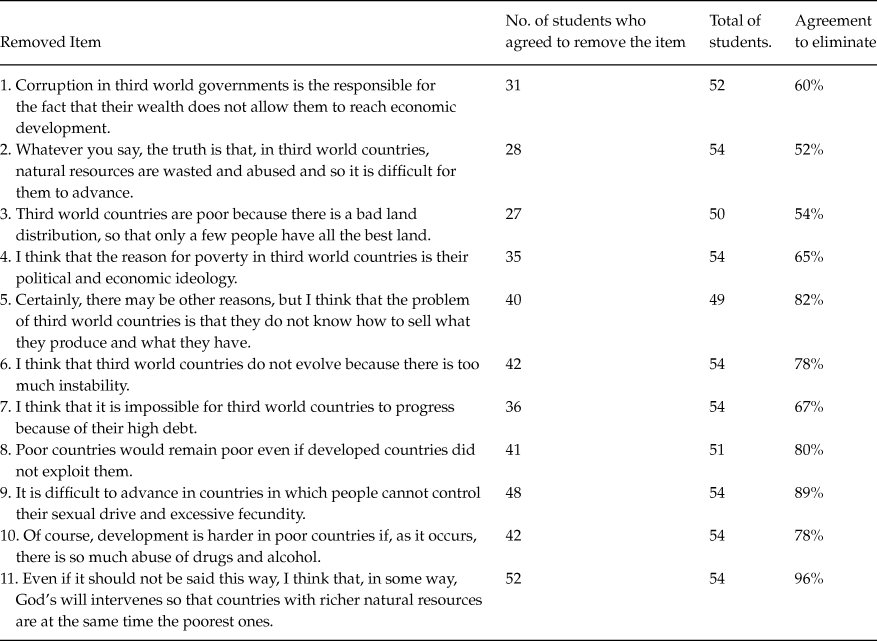
In a second phase, the students were divided into 6 groups and instructed to discuss the items of the questionnaire, their content, form and their own level of item comprehension for half an hour. In a third phase, the results of each group were displayed to the entire group and each item was discussed. With the selection criterion of at least 51% of participants’ approval, some items were modified or removed and new items were chosen. Finally, the students were requested to organise all the items into categories.
Results
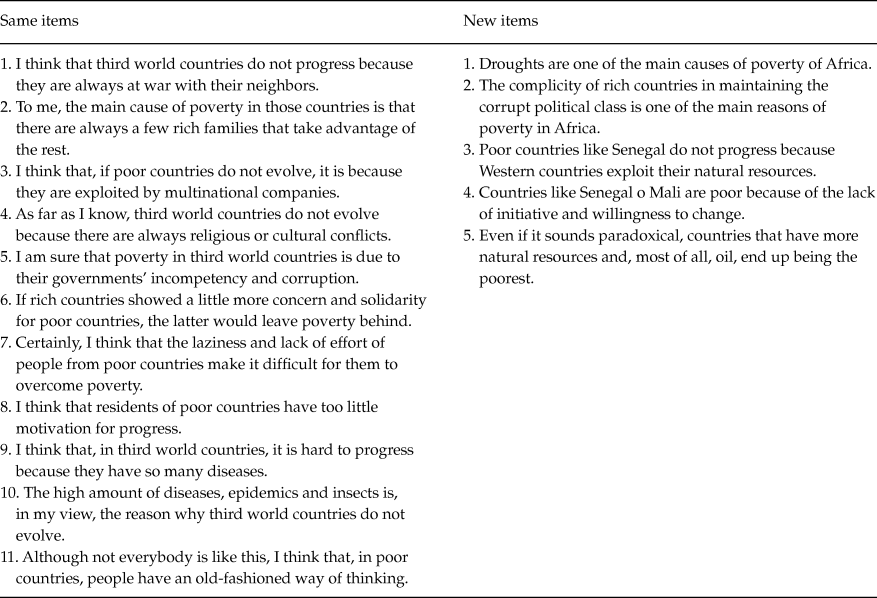
Eleven items were removed and five were added to the initial Spanish adaptation by Betancor et al. (Reference Betancor, Quiles, Morera, Rodríguez, Rodríguez, Delgado and Acosta2002).
Removed Items

The main reasons for eliminating these items were: The perceived ambiguity of some questions and the offensive nature of one of the items. Regarding new items, four out of five were related to the responsibility of western countries. With respect to item categorization, the groups quickly reached an agreement, enumerating four categories: Attributions related to natural or uncontrollable phenomena, attributions related to personal aspects of the African population, attributions related to the responsibility of Western countries and attributions related to the conflict and government corruption in African countries. This categorization coincides to some extent with the dimensions identified by Betancor et al. (Reference Betancor, Quiles, Morera, Rodríguez, Rodríguez, Delgado and Acosta2002): structural causes, personal causes and fatalist causes. However, the individuals of the discussion group separated the structural causes depending on who is deemed responsible: African governments or Western countries.
Study 1
The main objective of this study is to identify the factorial structure of our modification of the Perceived Causes of Third World Poverty (Hine & Montiel, Reference Hine and Montiel1999), in the Spanish adaptation by Betancor et al. (Reference Betancor, Quiles, Morera, Rodríguez, Rodríguez, Delgado and Acosta2002). As a second goal, we intend to test the relationship of this measure with the Modern Racism Scale (McConahay, Reference McConahay, Dovidio and Gaertner1986), employing African immigrants as outgroup.
The relationship between blatant prejudice and personal attribution has already been studied by Cantó et al. (Reference Cantó, Perles and San Martín2012). As mentioned earlier, we chose the Modern Racism Scale because it places more emphasis on the values of the “Protestant Ethics” (individual freedom of choice, equal opportunities, individual effort, self-discipline, etc), and emphasizes the undeserved treatment immigrants are receiving, so we expect that personal attributions may represent a moral justification for inequality.
Method
Participants
The sample included 102 high-school students (59% females), mean age 16.62 years (SD = .72).
Measures
Causal Attributions of Poverty Scale: We employed a total of 16 items from the modified scale of Betancor et al. (Reference Betancor, Quiles, Morera, Rodríguez, Rodríguez, Delgado and Acosta2002) aimed at Sub-Saharan immigrants (see Table 2). Items were rated on a Likert-type format ranging from 1 (completely disagree) to 7 (completely agree). Higher scores indicate greater poverty attributions.
Causal Attributions of Poverty Scale Modification

Modern Racism Scale (McConahay, Reference McConahay, Dovidio and Gaertner1986): The Spanish adaptation by Navas (Reference Navas1998) was employed in order to test prejudice toward African immigrants (ie. Over the last years, African immigrants have achieved more than they deserve; Discrimination against African immigrants is not a problem in our country). Items were rated on a Likert-type format ranging from 1 (completely disagree) to 7 (completely agree). Higher scores indicate higher Modern Racism. This measure shows a good reliability index (α = .81).
Procedure
Questionnaires were administered in a regular class. First, the Causal Attributions of Poverty Scale was administered, and then, the Modern Racism Scale. The investigation was presented as a study of social perception.
Analytic strategy
Firstly, we tested the factorial structure and reliability of the Causal Attributions of Poverty Scale. Secondly, correlational analysis with the Modern Racism Scale was performed.
Results
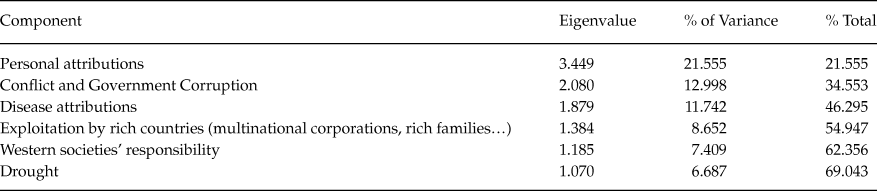
An exploratory factor analysis (EFA) was carried out employing generalized least squares with varimax rotation. The Kaiser-Mayer-Olkin test showed relative sample adequacy (KMO = .653), while Bartlett’s sphericity test (χ2 = 435,792, p < .0001) indicated that EFA was an adequate analytic strategy, and the relationships among the items could be analyzed. The initial EFA yielded six factors that explained 69% of the variance.
Percentage of Variance Explained by the Six Components

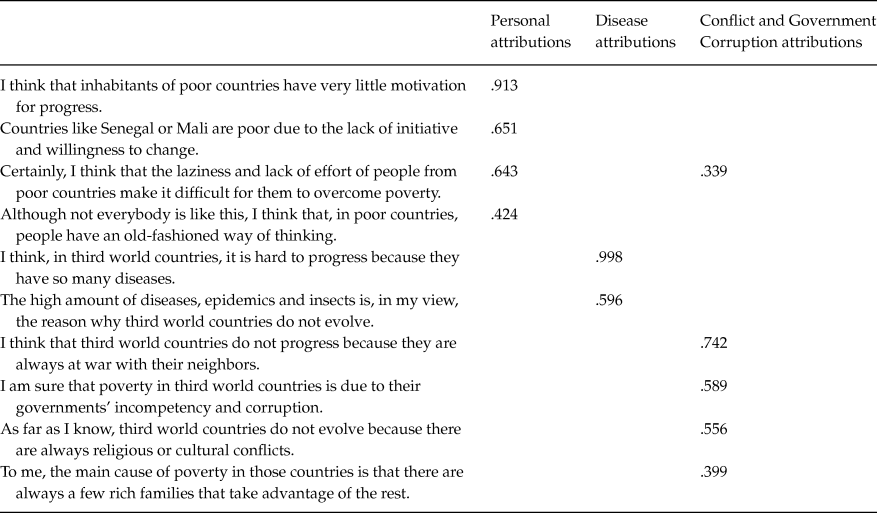
Therefore, we performed an additional EFA, considering only the first three factors (Personal attributions, Conflict and government corruption attributions, and Disease attributions) because each one accounted for more than 10% of the variance.
Factor Structure of the Final Causal Attributions of Poverty Scale

Note: Generalized Least Squared method with Varimax rotation. Values lower than .03 are not presented.
Reliability index was adequate in the case of Personal attributions (α = .79), followed by Disease attributions (α = .75), and finally by Conflict and government corruption attributions (α = .65). The three attribution indexes were calculated with the mean scores of the items included in the three factors.
In a second step, correlational analyses were performed with the Modern Racism scale (Navas, Reference Navas1998). Firstly, the Modern Racism scale showed significant positive relationships with Personal attributions and Conflict and government corruption attributions but it did not present a significant relationship with Disease attributions. Personal attributions and Conflict and government corruption attributions were significantly related to each other but Disease attributions did not have any relation with the other attributions (see Table 5).
Descriptive Statistics and Pearson Correlations. Study 1

Note: ** p < .01. * p < .05.
Next, a repeated-measures MANOVA, considering the three types of attributions, was performed. We found a significant effect, of type of attributions F(1, 102) = 40.33, p < .0001, ɳ2 = .29. Participants showed fewer Personal Attributions than Conflict and government corruption attributions (D i-j = 1.45, p < .0001) or Disease attributions (D i-j = 1.12, p < .0001). However, no significant differences were found between Conflict and government corruption attributions and Disease attributions (D i-j = .33, p = .23). See Table 5.
Discussion
The dimensions found through factorial analysis only partially coincide with the categories identified by the individuals of the Preliminary Study and with the five dimensions identified by Hine and Montiel (Reference Hine and Montiel1999) (Exploitation, Poor persons’ features, Conflicts, Nature and Governments), whereas they correspond to a greater extent with the three dimensions identified by Betancor et al. (Reference Betancor, Quiles, Morera, Rodríguez, Rodríguez, Delgado and Acosta2002): Structural causes, Personal causes, Fatalist causes. The main difference between the components identified by Betancor and colleagues and the factors found in our study is the “Structural causes” dimension: In the study of Betancor et al. (Reference Betancor, Quiles, Morera, Rodríguez, Rodríguez, Delgado and Acosta2002), Structural causes includes causes related to exploitation, conflict and government. In our study, items related to “exploitation” were not significantly correlated with Conflict and government corruption. For this reason, these items were not included in the analysis.
Our participants employed more external (attributions to Disease and Conflicts and government corruption) than internal attributions. However, Modern Racism correlates positively with personal attributions as well as with attributions related to conflict. These findings show that individuals with high scores on the Modern Racism Scale tend to attribute the causes of African countries’ poverty to the African population (personal features of individuals or group relations). Correlation analysis reflects the existence of a central element in the new forms of racism: Victim-blaming, which extends to the group as a whole. This connection is in line with the results of the studies of Cantó et al. (Reference Cantó, Perles and San Martín2012) about blatant and subtle prejudice, and causal attribution of Maghreb immigrants’ poverty, in which they found a positive correlation between personal attribution, blatant prejudice and subtle prejudice. Nevertheless, in our study, the correlation was higher, and this may be due to the utilization of the Modern Racism Scale instead of the Subtle and Blatant Prejudice Scale. Considering the relationship of Modern Racism with the Protestant Ethics, in this context personal attributions may represent a moral justification for inequality, and this helps to mitigate the feeling of guilt and social responsiveness. On another hand, this pattern of results is consistent with Pettigrew´s (1979), ultimate attribution error, described earlier as the tendency to attribute negative outgroup and positive ingroup behavior internally and to attribute positive outgroup and negative ingroup behavior externally. This should be stronger among those high in prejudice. In this vein, our results show that higher prejudice mainly increases internal attribution of poverty. One should note that in our study Modern Racism is also related to attributing the causes of poverty to the out-group: Either to their intergroup conflicts or to the outgroup government.
Study 2
Our main objective was to determine whether inducing empathy through perspective taking about hardships of an individual member of the African immigrant group can ameliorate majority group members’ attributions of poverty to African immigrants. The procedure was based on that used by earlier research on empathy induction in intergroup context (Batson et al., Reference Batson, Polycarpou, Harmon-Jones, Imhoff, Mitchener and Bednar1997; Finlay & Stephan, Reference Finlay and Stephan2000). Modern Racism was also taken into account because the Study 1 displayed a significant positive relationship with Personal attributions of poverty and Conflict and government corruption attributions, which extend the causes of poverty to characteristics of the outgroup, and could be understood as a form of inequality justification.
H 1. Participants in the affective perspective-taking condition will display fewer internal attributions than in the objective condition.
H 2. Modern Racism will increase the perception of Personal attributions of poverty and Conflict and government corruption attributions, as were obtained in the Study 1.
H 3. Modern Racism moderates the effects of perspective-taking on the Personal attributions of poverty and Conflict and government corruption attributions. We expect that the reduction of Personal attributions of poverty, as well as those of Conflict and government corruption will occur only in the case of low Modern Racist participants, while no effect will be found in the case of high Modern Racists.
Method
Participants
A total of 62 high school students (57% females), with a mean age of 16.48 years (SD = .54), took part in this research. Two participants in the Perspective-taking condition and four participants in the Objective condition were removed because they did not follow the instructions, so the final sample consisted of 56 high school students.
Measures
Attributions of Poverty Scale: The ten items scale obtained in the preliminary study were employed with Sub-Saharan immigrants as the outgroup. Items were rated on a Likert-type format ranging from 1 (completely disagree) to 7 (completely agree). Higher scores indicate greater poverty attributions. This scale showed an adequate reliability index for Personal attributions (α = .73), Conflict and Government Corruption (α = .76) and Disease attributions (α = .92)
Modern Racism Scale: The Spanish adaptation by Navas (Reference Navas1998) was employed to measure prejudice toward Sub-Saharan immigrants. Items were rated on a Likert-type format ranging from 1 (completely disagree) to 7 (completely agree). Higher scores indicate high modern racism. This measure shows a good reliability index (α = .81).
Empathic feelings: Three items were used to evaluate the empathy felt toward the video’s main character. Participants indicated to what extent they felt: Affection, compassion and tenderness. Items were rated on a Likert-type format ranging from 1 (Not at all) to 7 (A lot). This scale displayed an adequate reliability index (α = .76).
Procedure
The research was presented as a memory research to limit potential bias. A 3-minute video was employed. In this, the main character, a Senegalese immigrant named Mamadou, talked about his migration experience, from the dangerous trip by canoe to Tenerife to the problems related to finding employment in the Canary Islands.
Prior to watching the video, two regular classrooms were assigned to each of the experimental conditions and received the instructions. In the Perspective-taking condition, participants received the following instructions: “Previous research has shown that the perspective that one adopts to listen to information affects memory recall. We ask you to imagine the emotions felt by the person interviewed as a consequence of his experiences, trying to connect with his feelings as much as possible”. In the Objective condition, the instructions were: “Previous research has shown that perspective that one adopts to listen to information affects the memory recall. In this case, we ask you to listen carefully and to try to be objective about the details and information of the interview.” In order to support the cover story, an initial memory task about details of the interview was included. Finally, participants completed the questionnaire with the dependent measures.
Results
Preliminary analysis
A t-test was performed in order to determine whether participants in the Perspective-taking condition showed greater empathy toward the main character. This test indicated that the experimental manipulation was successful, t(54) = 2.21, p < .0001. Participants in the Perspective-taking condition were more emphatic toward the main character (M = 4.79, SD = 1.13) than participants in the Objective condition (M = 4.14, SD = 1.14).
With regard to Modern Racism toward Africans, an ANOVA was performed to compare the Objective and Perspective-taking conditions. The two conditions were also compared with the scores in the Modern Racism Scale of the previous study because we had no control condition without the video. No statistical effects were found, F(2, 155) = 1.66, p = .19. Participants in the Objective condition (M = 2.66, SD = .89) displayed a similar level of Modern Racism as those of the Perspective-taking condition (M = 3.09, SD = .61), and the scores of Modern Racism of Study 1 without the video (M = 3.00, SD = 1.05).
Main analysis
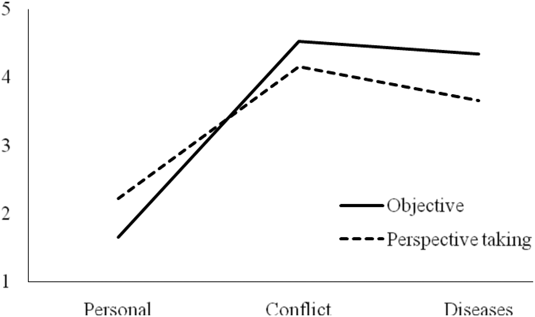
A 3 (Attributions) x 2 (Perspective taking vs. objective condition) repeated-measures MANOVA was performed. The first factor was within-subject, while the second was a between-subject factor. This analysis showed a main effect of the within-subject factor, type of attribution, F(1, 54) = 66.99, p < .0001, η2 = .55. Participants indicated greater Conflict and Government corruption attributions (M = 4.34, SD = 1.40) and Disease attributions (M = 4.00, SD = 1.86), than Personal attributions (M = 1.94, SD = 1.01). This effect was qualified by an interaction effect of the experimental treatment, F(1, 54) = 66.02, p < .017, η2 = .10. The Bonferroni multiple test comparison indicated that this interaction effect was explained by Personal attributions (D i-j = .56, p = .037), because contrary to our expectations, participants in Perspective-taking condition showed greater Personal Attributions (M = 2.21, SD = 1.14) than in those in the Objective condition (M = 1.65, SD = .77), whereas no differences were found for Conflict and Government corruption attributions (D i-j = .37, p = .33) and Disease attributions (D i-j = .68, p = .17) as a function of the experimental treatment. These results are displayed in Figure 1.
Causal Attributions by Experimental Condition.

Moderation effect of Modern Racism on Personal attributions
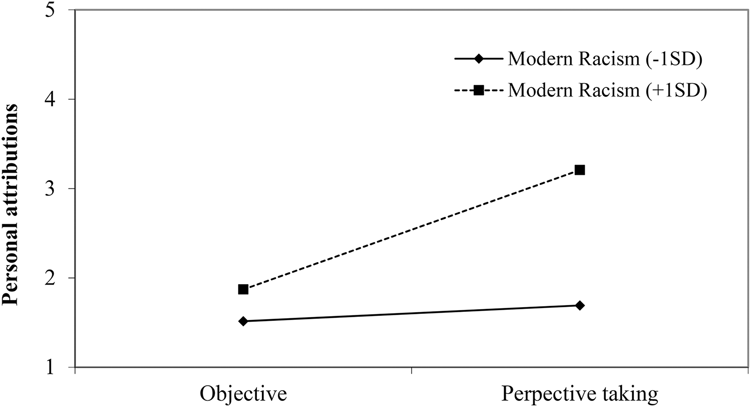
After finding that Personal attributions can be affected in an unexpected direction by Perspective-taking treatment, we checked to see if the scores on Modern Racism can explain this increase. To assess this moderator role, we estimated conditional process models (Hayes, Reference Hayes2013) in which Modern Racism moderate the effects of perspective taking on Personal Attributions. We conducted a linear regression analysis with Experimental condition was coded by 0 (Objective condition) and 1 (Perspective taking) and Modern Racism (mean-centered) as Personal attributions. We observed a positive main effect of Modern Racism (β = .36, SE = .18, t = 2.02, p = .04). The main effect of empathy induction was non significant (β = .40, SE = .26, t = .15, p = .13). Finally, an interaction effect emerged (β = .72, SE = .36, t = 2.01, p < .04).
Moderator Role of Modern Racism on Personal Attributions by Experimental Condition.

We used bootstrapping (with 10,000 resamples) to examine the 95% bias corrected confidence intervals (CIs) for the indirect effects with the PROCESS macro (Hayes, Reference Hayes2013). We entered Experimental condition as predictor, Personal attributions as the outcome, and Modern Racism as moderator. The indirect effect of Experimental condition on Personal attributions via Modern Racism was significant at high levels of Modern Racism, Modern Racism + 1SD: βab = .98, SE ab = .37, t = 2.67, p = .01, 95% CI [.24, 1.71]; but not with mean Modern Racism: βab = .41, SE ab = .26, t = 1.54, p = .13, 95% CI [–.12, .93]; and low levels of Modern Racism (βab = –.16, SE ab = .41, t = .40, p = .69, 95% CI [–.97, –.65]).
We repeated this procedure with the other two attribution dimensions. In the case of Conflict and Government corruption attributions, no effect of Modern Racism was found (β = .25, SE = .26, t = .97, p = .33), or of the experimental condition (β = –.48, SE = .39, t = 1.22, p = .23), neither the interaction (β = .62, SE = .53, t = 1.15, p = .25). These results were also replicated in the case of Disease attributions: No effect of Modern Racism was found (β = .58, SE = .35, t = 1.78, p = .10), or of the experimental condition (β = –.92, SE = .51, t = 1.82, p = .08), neither the interaction (β = –.03, SE = .69, t = .04, p = .97).
Discussion
The findings of this study do not confirm Batson et al.’s (Reference Batson, Polycarpou, Harmon-Jones, Imhoff, Mitchener and Bednar1997) model: In spite of the fact that individuals, who were in the Perspective-taking condition scored higher on the Emphatic Concern Scale towards the interviewee, they did not score lower in the personal attributions of poverty. The research reviewed earlier (Vescio et al. Reference Vescio, Sechrist and Paolucci2003, Huici et al., Reference Huici, Tejero, Bustillos, Gómez and Molero2007) showed that the effects of empathic feelings towards the target person are accompanied by more situational and less dispositional explanations of the difficulties experienced, as well as more favorable attitudes toward the group as a whole. Perhaps, poverty could be an issue too distant to reflect the positive effects of empathic feelings. On the other hand, the increase of personal explanations in the perspective taking condition needs to be qualified by the interaction found, which may account for the “paradoxical effect”: Participants in the Perspective-taking condition who scored high on the Modern Racism Scale tend to attribute the causes of poverty to personal factors more than the individuals in the Objective condition.
This result may be identified as a defense mechanism that individuals with high levels of racism put into practice to justify their position towards the out-group. On the other hand, in line with the studies of Skorinko and Sinclair (Reference Skorinko and Sinclair2013), perspective-taking may increase stereotypes because the individual uses the stereotypical information as a reference scheme to interpret the feelings of the target when this person is a clearly stereotypical member of the group. To individuals with a high level of Modern Racism, the salient stereotypes are the framework to infer what members of the stigmatized group are thinking or feeling, as well as to interpret their situation. An alternative explanation would be that, if high prejudiced participants think that immigrants have undeserved attention and respect by Spaniards, they may react defensively to the instruction of perspective taking, and consider it as yet another sign of excess of attention granted to them. Other researches have also shown other ironic effects of motivational interventions to reduce prejudice. For example, Legault, Gutsell, and Inzlicht (Reference Legault, Gutsell and Inzlicht2011) found that when individuals perceived external pressures to endorse egalitarian standard, they increase their prejudice level.
General discussion
The main objectives of the Preliminary and first study were to collect information to modify the Perceived Causes of Third World Poverty Scale (Hine & Montiel, Reference Hine and Montiel1999), in the Spanish adaptation by Betancor et al. (Reference Betancor, Quiles, Morera, Rodríguez, Rodríguez, Delgado and Acosta2002), to identify the factorial structure of our modification and to test the relationship of this measure with the Modern Racism Scale toward Sub-Saharan (McConahay, Reference McConahay, Dovidio and Gaertner1986). Correlations analysis reflects, in line with the results of other studies (Cantó et al., Reference Cantó, Perles and San Martín2012, Cozzarelli et al., 2012), the existence of a central element in the new forms of racism: Victim-blaming. Although the levels of personal attributions in our study are lower than those of other attributions, the more prejudiced participants used more personal attributions. On the other hand, the pattern of results showing lower personal attributions than disease and conflict and government corruption coincides in part with that obtained by Betancor et al. (Reference Betancor, Quiles, Morera, Rodríguez, Rodríguez, Delgado and Acosta2002) in the same context and with a similar sample, for they also found that personal attributions were lower than the other attribution categories.
The findings of the second study show a low level of personal attributions in the objective condition, which may be due to the lack of pressure felt by participants when watching the video showing the hardships endured by the immigrant. This lack of pressure may have translated in less defensiveness towards other issues related to immigration. In the same line it was found a paradoxical effect of perspective-taking: Comparing the results of individuals with high score in the Modern Racism Scale in the two experimental conditions, those who were in the Perspective-taking condition attribute causes of poverty to a greater extent to personal factors, in other words, blaming the victims for their situation.
We can interpret this result as a defense mechanism activated by individuals with a high score on the Modern Racism Scale to justify their position towards the out-group. In this sense, blaming the victim is a central element of the new forms of racism (McConahay, Reference McConahay, Dovidio and Gaertner1986). Another explanation would be that perspective taking induction may be considered by more prejudiced people as yet another way of forcing positive attitudes toward “undeserving targets”, thus personalization of the target person is tainted with negative affect for them who interpret it as undeserved attention and care, so that at the end it backfires, much in the same way as when participants perceive external source of pressure for non-prejudice responses (Legault et al, Reference Legault, Gutsell and Inzlicht2011). Todd and Galinsky (Reference Todd and Galinsky2014) also point out that the general beneficial effects of perspective taking for intergroup relations need to be qualified, in the case of negatively stereotyped targets, as one of the targets used by the Skorinko and Sinclair (Reference Skorinko and Sinclair2013) already mentioned. We may speculate that for individuals with high score on the Modern Racism Scale, prominent stereotypes are a reference to infer what the members of a discriminated group think or feel.
Our results are in line with other works that show that perspective-taking, as a strategy to improve intergroup attitudes, has, nevertheless, some limits. We agree with the views of Todd and Galinsky (Reference Todd and Galinsky2014), that some of the qualifications of general positive effects of perspective taking, need to be considered, as the moderating effects of individual differences in several variables which may facilitate of hinder these effects. In general, only a few studies have done it so far. However, it seems that there is an increasing interest for this question. Self-esteem of participants appears as a relevant individual difference variable. Perspective takers with low self-esteem (Galinsky & Ku, Reference Galinsky and Ku2004) may not benefit from this strategy. In a study with university students they used the perspective taking procedure of Galinsky and Moskowitz (Reference Galinsky and Moskowitz2000) of imagining a day in the life of an older person to see the effects on evaluations of older people in general, and considered as moderator the participants chronic self-esteem. Self-esteem showed positive effects in the perspective taking conditions, but not in the control. The impact of self-evaluations on evaluations of the older adult group was attributed to the activation of self-concept in the perspective taking condition that did not occur in the control condition.
Tarrant, Calitri and Weston (2012, Study 1) used an adaptation of the Galinsky and Moscowitz (Reference Galinsky and Moskowitz2000) procedure to a university student intergroup context, taking into account identification with the university ingroup. Perspective taking increased outgroup stereotypical views and produced a less favorable evaluation of it, but in those participants highly identified with the ingroup. Wang, Ku, Tai, and Galinsky (Reference Wang, Tai, Ku and Galinsky2014) in Singapore took into account individual perspective taking tendencies on the effects of the perspective taking intervention on stereotypes of two target groups, positively or negatively valued, doctors and construction workers. Perspective taking produced a reduction of both positive and negative stereotypes, as well as an accentuation of this reduction in participants high in perspective taking tendencies.
In a recent study (Sun, Zuo, Wu, & Wen, Reference Sun, Zuo, Wu and Wen2016) in China the moderating effects of Need for Cognitive Closure on those of Perspective taking were also shown. Participants, using the Galinsky and Moskowitz (Reference Galinsky and Moskowitz2000) procedure of perspective taking in order to see the effects on stereotypes of the target group, considering Need for Cognitive Closure (Webster & Kruglanski, Reference Webster and Kruglanski1994) as moderator variable, because high Need of Cognitive Closure involves a greater reliance on pre-existing knowledge structures as stereotypes, when compared to low Need for Closure that relies more on individuating information. As expected, the high Need for Closure participants increased their stereotypes of older adult only in the perspective taking condition, while the opposite was true for those low in Need for Cognitive Closure.
Summarizing the contributions of these studies that consider individual difference variables as moderators of effects of perspective taking would be to show that those who rely on pre-existing knowledge structures or use the stereotype of the target group as frame of reference as well as those who hold strong links with their own may not benefit from perspective taking and may be defensive when being induced to take the perspective of the outgroup. On the positive side, people with perspective taking tendencies and positive self-esteem will accentuate the positive effects of perspective taking. In the case of self-esteem, the evidence suggests that perspective taking activates the self-concept that, through overlap with the outgroup, will transfer its valence to it.
Our findings represent a contribution in this area for they suggest that levels of Modern Racism may have to be considered when evaluating the effects of perspective taking on intergroup attitudes, stereotypes and explanations of the conditions and difficulties that outgroups are enduring. This may have important practical implications in the design of intercultural, racism or discrimination campaigns. In fact, awareness campaigns directed towards a generic public and based on perspective-taking may have a negative effect, activating victim-blaming mechanisms, and making it difficult to achieve the campaigns’ goals. These findings reveal the importance of the phase of prior diagnosis before designing racism-awareness actions, and at the same time, they show the relationship between the definition of the causes of the problem and the attitudes towards a stigmatized group.
Some limitations of this study need to be taken into account in future development of this research: Individuals from the three studies were all students with a similar social demographic profile. Study 2 has a quasi-experimental design that, in spite of random group assignment but non-random individual assignation to the different experimental conditions, does not guarantee that other factors may not be affecting the results. Further research should address this issue.