The mother is usually an infant's primary caregiver and interaction partner during the first months of life, at least in most Western societies (Rennels & Davis, Reference Rennels and Davis2008). Thus, it is not surprising that maternal psychopathology can have pervasive consequences for the development of infants and children (Suveg, Shaffer, Morelen, & Thomassin, Reference Suveg, Shaffer, Morelen and Thomassin2011). Most studies in this area have focused on postnatal depression (e.g., Goodman & Gotlib, Reference Goodman and Gotlib1999; Prenoveau et al., Reference Prenoveau, Craske, West, Giannakakis, Zioga, Lehtonen and Stein2017; Tronick & Reck, Reference Tronick and Reck2009) and anxiety disorders (e.g., Glasheen, Richardson, & Fabio, Reference Glasheen, Richardson and Fabio2010; Murray, Cooper, Creswell, Schofield, & Sack, Reference Murray, Cooper, Creswell, Schofield and Sack2007; Prenoveau et al., Reference Prenoveau, Craske, West, Giannakakis, Zioga, Lehtonen and Stein2017; Reck et al., Reference Reck, Zimmer, Dubber, Zipser, Schlehe and Gawlik2013). This focus likely reflects the relatively high prevalence of these disorders, both in the general population (Bandelow & Michaelis, Reference Bandelow and Michaelis2015; Kessler & Bromet, Reference Bandelow and Michaelis2013) and in the context of pregnancy and childbirth (Fairbrother, Janssen, Antony, Tucker, & Young, Reference Fairbrother, Young, Janssen, Antony and Tucker2016; Gavin et al., Reference Gavin, Gaynes, Lohr, Meltzer-Brody, Gartlehner and Swinson2005). Affected mothers report having problems with developing a positive relationship with their child and with sensitively reacting to their infants’ needs (e.g., Loh & Vostanis, Reference Loh and Vostanis2004; Moehler, Brunner, Wiebel, Reck, & Resch, Reference Moehler, Brunner, Wiebel, Reck and Resch2006; Nicol-Harper, Harvey, & Stein, Reference Nicol-Harper, Harvey and Stein2007). Furthermore, a range of differences in behaviors can be observed within the group of mothers with mental disorders. In interactions with their infants, some depressed mothers show increased hostile and negative behavior, and others act in a disengaged way; generally, they show less positive parenting behavior and decreased sensitivity in mother–infant interaction (e.g., Korja et al., Reference Korja, Savonlahti, Ahlqvist-Björkroth, Stolt, Haataja, Lapinleimu and Lehtonen2008; Lovejoy, Graczyk, O'Hare, & Neuman, Reference Lovejoy, Graczyk, O'Hare and Neuman2000; Stein, Lehtonen, Harvey, Nicol-Harper, & Craske, Reference Stein, Lehtonen, Harvey, Nicol-Harper and Craske2009). Some mothers suffering from anxiety disorders respond less sensitively and with reduced emotional tone while interacting with their infants (Nicol-Harper et al., Reference Nicol-Harper, Harvey and Stein2007), and others engage their infants less and look more anxious (Murray et al., Reference Murray, Cooper, Creswell, Schofield and Sack2007). In the long-term, children of depressed mothers are at an increased risk for a range of difficulties such as anxiety disorders and major depressive disorders (e.g., Weissman et al., Reference Weissman, Wickramaratne, Nomura, Warner, Pilowsky and Verdeli2006), developmental disorders, impaired self-regulation, and behavioral problems like reduced social engagement, increased negativity, and poor fear regulation (for an overview, see Stein et al., Reference Stein, Pearson, Goodman, Rapa, Rahman, McCallum and Pariante2014). The long-term consequences of maternal anxiety have been less studied than those of maternal depression (Prenoveau et al., Reference Prenoveau, Craske, West, Giannakakis, Zioga, Lehtonen and Stein2017), but some studies suggest that maternal anxiety is associated with poorer child outcomes like infant distress to novelty (Reck et al., Reference Reck, Zimmer, Dubber, Zipser, Schlehe and Gawlik2013) and anxiety-depression symptoms in adolescence (Spence, Najman, Bor, O'Callaghan, & Williams, Reference Spence, Najman, Bor, O'Callaghan and Williams2002).
Although the negative relationships between maternal psychopathology, in particular, depression and anxiety, and child development are well documented (Glasheen et al., Reference Glasheen, Richardson and Fabio2010; Goodman & Gotlib, Reference Goodman and Gotlib1999), considerably less is known about mechanisms that explain this link. During the last few years, repetitive negative thinking (RNT) has been identified as one potential cognitive mechanism that might help explain how maternal mental health problems impair parenting behavior (Stein et al., Reference Stein, Craske, Lehtonen, Harvey, Savage-McGlynn, Davies and Counsell2012). Specifically, Stein and colleagues propose that RNT might “be important in mediating the impact of postnatal psychiatric disorders on child development” (Reference Stein, Lehtonen, Harvey, Nicol-Harper and Craske2009, p. 2). RNT can be defined as a perseverative cognitive activity that is negative in valence and experienced as difficult to control (Ehring & Watkins, Reference Ehring and Watkins2008). RNT processes appear to be a characteristic of a range of mental disorders such as depression, anxiety, and eating disorders (Stein et al., Reference Stein, Lehtonen, Harvey, Nicol-Harper and Craske2009), although they are referred to in different terms in the context of different disorders and vary in terms of their contents. For example, rumination (i.e., “a mode of responding to distress that involves repetitively and passively focusing on symptoms of distress and on the possible causes and consequences of these symptoms”; Nolen-Hoeksema, Wisco, & Lyubomirsky, Reference Nolen-Hoeksema, Wisco and Lyubomirsky2008, p. 400) is characteristic of depression, and worry (“a chain of thoughts and images, negatively affect-laden and relatively uncontrollable”; Borkovec, Robinson, Puzinsky, & DePree, Reference Borkovec, Robinson, Puzinsky and DePree1983, p. 10) is characteristic of a generalized anxiety disorder (Watkins, Moulds, & Mackintosh, Reference Watkins, Moulds and Mackintosh2005). Thus, while RNT can revolve around different themes in different disorders, its pervasive negative quality and the difficulty to control the occurring thoughts appear to be shared core features. In line with such a transdiagnostic view, Stein et al. (Reference Stein, Lehtonen, Harvey, Nicol-Harper and Craske2009) suggested that, across different mental disorders, RNT, which they referred to as preoccupation, is associated with a narrowed focus of attention and responsiveness to the environment, and increased self-absorption. From this perspective, mothers who engage in RNT are likely to be less sensitive and responsive when interacting with their infants, because they might not pick up and interpret their child's communicative signals appropriately. This, in turn, might affect different areas of development in the infant, such as learning about reliable associations between stimuli and maternal responses, sustained attention, joint attention, and emotion regulation (Stein et al., Reference Stein, Lehtonen, Harvey, Nicol-Harper and Craske2009).
Some recent studies support these ideas (Müller, Teismann, Havemann, Michalak, & Seehagen, 2013; Schmidt et al., Reference Schmidt, Seehagen, Hirschfeld, Vocks, Schneider and Teismann2017; Schmidt, Seehagen, Vocks, Schneider, & Teismann, Reference Schmidt, Seehagen, Vocks, Schneider and Teismann2016; Stein et al., Reference Stein, Craske, Lehtonen, Harvey, Savage-McGlynn, Davies and Counsell2012). For example, in an experiment by Stein et al. (Reference Stein, Craske, Lehtonen, Harvey, Savage-McGlynn, Davies and Counsell2012), mothers who suffered from either a generalized anxiety disorder or a major depressive disorder or who were healthy were randomly assigned to a worry/rumination prime condition or a neutral prime condition. Mothers’ responsiveness (the ability to respond sensitively to infant cues and needs) toward their infants was assessed before and after priming. In mothers suffering from generalized anxiety disorder and major depressive disorder, the induction of RNT lead to reduced responsiveness and to reduced vocalizations of their infants, with the effect being larger in the generalized anxiety disorder group. Priming had a reversed effect on healthy mothers’ behavior such that they showed greater engagement with their infants. Thus, at least in mothers suffering from generalized anxiety disorder, RNT appears to impact on their ability to react to their infants’ signals. In another study, O'Mahen, Boyd, and Gashe (Reference O'Mahen, Boyd and Gashe2015) tested parental problem-solving effectiveness in depressed mothers who were either induced to engage in RNT or to distract from troubling thoughts. After the induction, mothers who engaged in RNT showed poorer parental problem effectiveness and reduced confidence in their problem solving. Again, this suggests that RNT might influence parenting behavior in women affected by mental disorders. Of note, however, a recent study by Tester-Jones, Karl, Watkins, and O'Mahen (Reference Tester-Jones, Karl, Watkins and O'Mahen2017) suggested that RNT is a causal factor for changes in mother–infant interactions independent of the diagnostic status of a mother. In this study, dysphoric and non-dysphoric mothers were either induced to engage in RNT or to think about a recent concern that they had managed to resolve. Mother–infant interactions during free play were assessed before and after the induction. In comparison with mothers in the control condition, mothers who had been induced to engage in RNT showed reduced sensitivity. Sensitivity was measured through seven indicators (i.e., facial expression, verbal expression, position, affection, turn-taking, control, and choice of activity) toward their infants after the induction. This effect was not moderated by the mothers’ initial dysphoria. That is, regardless of whether or not mothers were dysphoric, RNT impaired their ability to sensitively interact with their infants. This study suggests that RNT might be a powerful influence on the quality of mother–infant interactions not only in clinical, but also in nonclinical samples.
Thus, while there is some converging evidence of a causal role of RNT for the quality of early parenting, at least two important questions remain unanswered. First, it is unknown whether mothers’ tendency to frequently engage in RNT (independent of depressive and anxious symptoms) is reflected in their behavior in mother–infant interactions even when mothers are not currently engaging in such thought processes. The studies reviewed previously found effects of RNT on mother–infant interaction when the mother was actively engaged in these thought processes at that very moment. Given that RNT is often regarded as a stable property, a trait (Nolen-Hoeksema, Reference Nolen-Hoeksema, Wisco and Lyubomirsky2008), it appears likely that there are stable and enduring differences between mothers in terms of how frequently they engage in RNT (i.e., high vs. low). At the same time, however, pregnancy and the postpartum period are times of such significant changes that some mothers’ tendency to engage in RNT could markedly fluctuate over a relatively short period of time. To obtain real-time and reliable data on the course of maternal RNT over time, it is important to include multiple measurement points, rather than assess RNT retrospectively or conduct a one-off induction of RNT. Mother–infant dyads develop their own individual way of interacting with each other over time, and infants come to prefer the type of interaction they typically have with their mothers even when interacting with strangers (Bigelow, Reference Bigelow1998; Tronick & Cohn, Reference Tronick and Cohn1989). Thus, it is conceivable that a mother's responses during a face-to-face interaction with her infant represent the result of a shared learning history. If a mother has been repeatedly consumed by RNT in the past, she might not be as adept at picking up her infant's social signals as a mother who rarely engages in RNT – even if she does not currently engage in RNT. Second, with the exception of research by Stein et al. (Reference Stein, Craske, Lehtonen, Harvey, Savage-McGlynn, Davies and Counsell2012) who explored the impact of RNT for infant vocalization, the focus of studies on the role of RNT for early parenting has largely focused on the mothers, for example, on their experiences of bonding (Müller et al., Reference Müller, Teismann, Havemann, Michalak and Seehagen2013; Schmidt et al., Reference Schmidt, Seehagen, Hirschfeld, Vocks, Schneider and Teismann2017; Schmidt et al., Reference Schmidt, Seehagen, Vocks, Schneider and Teismann2016), parental problem-solving (O'Mahen, Boyd, & Gashe, Reference O'Mahen, Boyd and Gashe2015), and sensitivity in face-to-face interactions (Tester-Jones et al., Reference Tester-Jones, Karl, Watkins and O'Mahen2017). However, the role of RNT in the transgenerational transmission of mental disorders is unclear. To fill this gap, the logical next step is to test whether differences in mothers’ tendencies to engage in RNT are associated with differences in infant behavior.
Hence, the focus of the present study was twofold, further investigating Stein et al.’s (Reference Stein, Lehtonen, Harvey, Nicol-Harper and Craske2009) proposal of RNT being a crucial link between maternal psychopathology and child development: First, we tested whether mothers with a high versus a low tendency to engage in RNT over time also differ in how often they promptly react to their infants’ signals, that is, in their contingent responses. In line with Keller, Lohaus, Völker, Cappenberg, and Chasiotis (Reference Keller, Lohaus, Völker, Cappenberg and Casiotis1999), we understand maternal contingency as the immediate reaction to vocal or mimic signals of the child. Keller et al. (Reference Keller, Lohaus, Völker, Cappenberg and Casiotis1999) found that contingency is an independent dimension of maternal behavior and can be distinguished from sensitivity. Although maternal contingency may occur without warmth and affection (Keller et al., Reference Keller, Lohaus, Völker, Cappenberg and Casiotis1999), it is linked to later attachment of security of the infant (Völker, Keller, Lohaus, Cappenberg, & Chasiotis, Reference Völker, Keller, Lohaus, Cappenberg and Chasiotis2010). There are different definitions of the constructs “sensitivity” and “responsiveness” in the literature. Whereas some researchers use these two terms synonymously (Keller, Reference Keller, Lohaus, Völker, Cappenberg and Casiotis1999) to characterize attentive, adequate, consistent, and warm parental reactivity in interactional behavior (Ainsworth, Blehar, Waters, & Wall, Reference Ainsworth, Blehar, Waters and Wall1978; Lamb & Easterbrooks, Reference Lamb, Easterbrooks, Lamb and Sherrod1981; Lamb, Thompson, Gardner, Charnov, & Estes, Reference Lamb, Thompson, Gardner and Charnov1985), others provide their own definition of each of the two terms (Shin, Park, & Kim, Reference Shin, Park and Kim2006; Stein et al., Reference Stein, Craske, Lehtonen, Harvey, Savage-McGlynn, Davies and Counsell2012). The reason for focusing on contingency in the present study was twofold. First, although it is an important aspect of maternal behavior, contingency has not been investigated in the context of RNT. Second, in the context of mother–infant interactions, contingency assesses how readily a mother responds to her child's communicative signals. Based on the phenomenology of RNT as well as Stein et al.’s (Reference Stein, Lehtonen, Harvey, Nicol-Harper and Craske2009) considerations, impairments in this ability might be a core consequence of engaging in RNT. We predicted that mothers with a strong tendency to engage in RNT would react less contingently to their infants’ behavior during a face-to-face interaction than mothers with a weak tendency to engage in RNT. Second, we hypothesized that infants of mothers who vary in their tendency to engage in RNT would differ in their reactions to an interruption of a face-to-face interaction, that is, when the mothers stop responding to their communicative bids and adopts a still-face. In the still-face task (Tronick, Als, Adamson, Wise, & Brazelton, Reference Tronick, Als, Adamson, Wise and Brazelton1978), caregivers are instructed to assume a neutral face and stop reacting to their infants’ attempt to communicate with them for a predetermined period of time, typically between 45 and 180 sec (Adamson & Frick, Reference Adamson and Frick2003). Infants from as young as 1.5 months reacted with a reduction in positive affect and visual attention to the caregiver and an increase in negative affect when exposed to their caregiver's still-face (for a review, see Mesman, von Ijzendoorn, & Bakermans-Kranenburg, Reference Mesman, Van IJzendoorn and Bakermans-Kranenburg2009). Infants’ responses during the still-face task can be predictive for internalizing and externalizing behaviors in childhood, as well as for attachment security (Cohn, Campbell, & Ross, Reference Cohn, Campbell and Ross1991; Moore, Cohn, & Campbell, Reference Moore, Cohn and Campbell2001). We predicted that infants of mothers with a strong tendency to engage in RNT would show reduced protest in reaction to their mothers’ still-face because they might have repeatedly experienced their mother becoming unresponsive before. Similarly, we predicted that these infants would show a reduced tendency to monitor their mother during the still-face phase because the situation is less novel for them. Instead, we expected that these infants, perhaps as a coping mechanism, would visually focus on their environment more than infants of mothers with a weak tendency to engage in RNT. Last, we predicted that infants of mothers with a strong tendency to engage in RNT would show increased withdrawn behavior, presumably based on previous experiences of their communicative signals remaining unanswered.
Method
Participants
This study was part of a larger longitudinal investigation of N = 163 women who were followed during pregnancy and after birth (for a full description of the sample, see Schmidt et al., Reference Schmidt, Seehagen, Hirschfeld, Vocks, Schneider and Teismann2017). The minimum age for participation was 18 years. All participants were required to speak German and had to be pregnant when included in the study. There were no inclusion criteria with regard to diagnostic status. That is, pregnant women could participate regardless of whether or not they suffered from mental health problems. Participants were recruited via advertisements in magazines, medical practices, and via the Internet throughout Germany. From the initial 163 women, a subsample of n = 65 (39.88%) women lived within a radius of 50 km of the lab and agreed to participate in standardized mother–infant observations in the laboratory, whereas n = 98 (60.12%) women either lived too far away from the lab (> 50 km) or refused to participate. Two of these mother–infant dyads were assessed but their data could not be analyzed due to technical failure. Another dyad was completely excluded from the analysis because the mother lifted her infant from his or her seat. The final sample thus consisted of n = 62 dyads (mothers’ ages: M = 32.75, SD = 4.52 years, age range: 23 to 45 years, 100% Caucasian; infants' ages: M = 15.28, SD = 1.97 weeks, age range: 11 to 19 weeks, 100% Caucasian).
Materials
Perseverative Thinking Questionnaire
The Perseverative Thinking Questionnaire (PTQ) (Ehring et al., Reference Ehring, Zetsche, Weidacker, Wahl, Schönfeld and Ehlers2011) is a German 15-item self-report measure designed to assess RNT that is perceived as pervasive, unproductive, and capturing mental capacity (e.g., “The same thoughts keep going through my mind again and again.”). All items are to be answered on a 5-point scale ranging from 0 (“never”) to 4 (“almost always”). The questionnaire has a good internal consistency (Cronbach α) with α = .95 (Ehring et al., Reference Ehring, Zetsche, Weidacker, Wahl, Schönfeld and Ehlers2011). The internal consistency in the present sample was good (T1: α = .94, T2: α = .97, and T3: α = .97).
Edinburgh Postnatal Depression Scale
The Edinburgh Postnatal Depression Scale (EPDS) (Cox, Holden, & Sagovsky, Reference Cox, Holden and Sagovsky1987; German version: Bergant, Nguyen, Heim, Ulmer, & Dapunt, Reference Bergant, Nguyen, Heim, Ulmer and Dapunt1998) is a 10-item self-report scale designed to measure maternal distress and depressive mood during the previous 7 days and has been used for assessments before (Murray & Cox, Reference Murray and Cox1990) and after (Cox et al., Reference Cox, Holden and Sagovsky1987) childbirth (e.g., “I have been able to laugh and see the funny side of things.”). The scale assesses common depressive symptoms but omits somatic symptoms that can occur (independently from depression) in the context of pregnancy and during the postpartum period (e.g., change in appetite or sleep). Each item is answered on a 4-point scale ranging from 0 to 4. A score ≥ 13 is indicative of a depressive state (Bergant, Nguyen, Heim, Ulmer, & Dapunt, Reference Bergant, Nguyen, Heim, Ulmer and Dapunt1998). In a German population, the internal consistency was α =.81 (Bergant et al., Reference Bergant, Nguyen, Heim, Ulmer and Dapunt1998). Accordingly, internal consistency was good in the present sample (T1: α = .91, T2: α = .85, and T3: α = .91).
Depression Anxiety Stress Scales
To assess anxiety, selected items from the Depression Anxiety Stress Scales (DASS) (Lovibond & Lovibond, Reference Lovibond and Lovibond1995) were used (seven items to assess anxiety). The items (e.g., Anxiety: “I was aware of dryness of my mouth.”) assess negative emotional symptoms and are rated on a 4-point scale, ranging from 0 (“did not apply to me at all”) to 3 (“applied to me very much, or most of the time”). The extent to which a person has experienced each symptom over the past week is rated. Internal consistencies (Cronbach α) for the DASS normative sample was α = .84 for the anxiety scale (Antony, Bieling, Cox, Enns, & Swinson, Reference Antony, Bieling, Cox, Enns and Swinson1998; Lovibond & Lovibond, Reference Lovibond and Lovibond1995). Internal consistencies in the current sample were α = .78. To our knowledge, there are no questionnaires available that assess anxiety specifically during pregnancy and the postpartum period.
Ages and Stages Questionnaire
After participation in the observation assessment, mothers were requested to answer the Ages and Stages Questionnaire (ASQ) (Bricker & Squires, Reference Bricker and Squires1999) at home and send it back. The ASQ is a 30-item parent-report measure designed to assess five developmental areas, that is, communication, gross motor, fine motor, problem solving, and personal social. The ASQ covers the ages 1 month to 5 years, 6 months with 21 age-appropriate questionnaires. For the purpose of the present study, we used the 4-month questionnaire, which covers the interval from 3 months, 0 days to 4 months, 30 days. For each of the described activities, mothers indicated whether their infants performed them on a 3-point scale by ticking “yes” (10 points), “sometimes” (5 points), or “not yet” (0 points). The total ASQ-scores (i.e., the sum from all five developmental areas) were used in our analyses to assess overall developmental status. The ASQ shows moderate to strong internal consistency (Cronbach α) between the assessed developmental areas and the total test score, with a range between α = .60 and α = .85 (Squires, Twombly, Bricker, & Potter, Reference Squires, Twombly, Bricker and Potter2009). Internal consistency was good in the current sample, as well as with α = .77 for the total test score.
General procedure
The longitudinal design comprised three assessment points, one during pregnancy and two after birth. For each of the first two assessments, participants completed a set of questionnaires. The third assessment consisted of two parts: (a) completion of questionnaires and (b) observation of mother–infant interactions. Participants completed the questionnaires online (27.42%) or per mail (72.58%). The observations took place in a laboratory. On average, participants completed the first assessment during their 20th week of pregnancy (M = 19.63, SD = 7.95), the second assessment at 5 weeks after birth (M = 4.79, SD = 2.39), the questionnaire part of the third assessment at 14 weeks after birth (M = 14.40, SD = 2.47), and the observation part of the third assessment at 15 weeks after birth (M = 15.42 weeks, SD = 1.97). Participants gave informed consent prior to the first questionnaire assessment. At the end of the questionnaire part of the third assessment, participants were asked whether they would be interested in participating in the observation assessment. If that were the case, appointments were arranged according to the mothers’ preferences, for times during the day when the infant was likely to be alert. For the observation assessment, participants gave informed consent at the beginning of the session. The study was approved by the ethics committee of the responsible university.
Observation assessment: setup and procedure
At the beginning, the experimenter conducted a short warm-up phase with the mother and infant. Once the mother indicated that her infant was ready, the experimenter asked her to place him or her in a car seat (MaxiCosi, Dorel Inc®), which was placed on a table (height: 50 cm). The mother sat down on a chair (height: 48 cm) placed opposite from the infant, facing the infant. The distance between the face of the mother and the infant's face was about 70 cm when the mother was in an upright sitting position. Two cameras were used to record the mother and child. One camera was positioned behind the infant, focusing on the mother's face. The other camera was positioned behind the mother, focusing on the infant's face. The recordings from both cameras were synchronized using specialized software that enabled analyzing infants’ and mothers’ behaviors with the correct relative timing. The order of tasks was fixed, with the mother–infant interaction task to assess maternal contingency being first and the still-face task being second. This was done to prevent any potential negative carry-over from the still-face procedure influencing the naturalistic mother–infant interaction task. Mothers were offered a short break between tasks. We decided against simply using the first 2 minutes of the still-face paradigm as a measure of maternal contingency mainly because (a) in that paradigm, mothers’ anticipation of the challenging second phase (the still-face phase) might have led to subtle changes in their behavior, and (b) to keep the duration of the still-face paradigm comparable with previous studies.
Contingency task
For this 5-minute task, mothers were instructed to interact with her infant as naturally as possible as they would do at home, without using toys or any other objects (Zmyj & Marcinkowski, Reference Zmyj and Marcinkowski2017). Mothers were allowed to touch their children, but not to get them out of the MaxiCosi.
Still-face task
This procedure consists of three phases (Tronick et al., Reference Tronick, Als, Adamson, Wise and Brazelton1978). For the first phase, mothers were instructed to interact as naturally as possible with their infants for 2 minutes, without using any toys. The mothers were allowed to touch their children but were asked not to lift them from the MaxiCosi. For the second phase, mothers were instructed to keep a still-face for 2 minutes (i.e., looking at the infant without smiling, talking, or touching the infant). This phase was central for the purpose of the present study. For the third phase, mothers were instructed to again interact as naturally as possible with their infants for 2 minutes. The experimenter signaled the start of the next phase to the mothers by knocking either on a window or on a door that separated the laboratory from an adjacent control room. All mothers participating in the questionnaire assessments received a small gift for their infant. All mothers participating in the observation assessment were reimbursed for travel expenses.
Coding and interrater reliabilities
Coding
Both tasks (i.e., contingency task and still-face task) were coded with the help of specialized software that enables frame-by-frame video coding (Interact 9, Mangold International GmbH, Arnstorf, Germany).
Contingency task
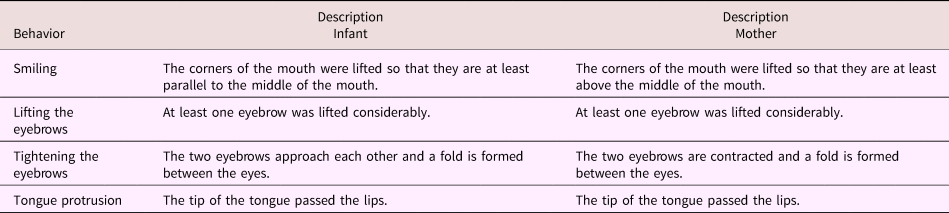
The coding of the mother–infant interaction began after a warm-up period of 2 minutes. The last 3 minutes of the 5-minute mother–infant interaction were evaluated in terms of episodes of mutual gaze between the parent and infant. Between these episodes of mutual eye contact, inactivity was coded. Thereafter, the episodes of mutual gaze were coded for four facial expressions: (a) smiling, (b) constricting the eyebrows, (c) lifting the eyebrows, and (d) tongue protrusion, as in the previous research on maternal contingent behavior (Zmyj & Marcinkowski, Reference Zmyj and Marcinkowski2017) (see Table 1 for definitions of these behaviors). Contingent maternal behavior was defined as every maternal behavior that occurred within a latency window of 1000 ms after the onset of a particular facial expression in the infant (Keller et al., Reference Keller, Lohaus, Völker, Cappenberg and Casiotis1999). When the behavior of the mother and child started simultaneously, contingent behavior was not coded. The same applied to a second maternal behavior within the latency window of 1000 ms that occurred after a first maternal behavior that was already coded as contingent behavior. If the mother performed two behaviors simultaneously, they were coded as one contingent behavior. If infants exhibited two behaviors that were followed by one maternal behavior within the latency window, the maternal behavior was considered to be contingent to both infant behaviors and was counted as two instances in which infants get contingent feedback.
Infants’ and parents’ behaviors for coding contingency*

*Source: Zmyj and Marcinkowski, Reference Zmyj and Marcinkowski2017.
Two established indicators were used to determine maternal contingency. The responsiveness index (see formula 1, Bahrick & Watson, Reference Bahrick and Watson1985) indicates the conditional probability that an expressed behavior of the mother follows an expressed behavior of the infant within a given latency window. As further specified in Keller et al. (Reference Keller, Lohaus, Völker, Cappenberg and Casiotis1999, p. 476), “the conditional probability is corrected by the unconditional probability of a maternal event during the total interactional interval. The resulting index expresses the corrected proportion of infant's event that lead to maternal responses within a specific latency window.”
Furthermore, the average number of contingent responses per minute (see formula 2, Keller, Kärtner, Borke, Yovski & Kleis, Reference Keller, Kartner, Borke, Yovsi and Kleis2005) was calculated. Together, these indices represent maternal contingency to infant behavior.
Formula 1
 $$\eqalign{&\hbox{Responsiveness index} = \displaystyle{{maternal\; contingent\; behavior} \over {infant\; behavior}}\cr&-\left( {1-e^{-\displaystyle{{maternal\; behavior} \over {total\; time}}\cdot latency\; time}} \right)$$
maternal contingent behavior = number of maternal behaviors following infants' behavior within the latency window; total time = total time of mutual gaze in seconds; latency time = 1000 ms; maternal behavior = number of maternal facial expressions; infant behavior = number of infant facial expressions; e = Euler's number
Formula 2
 $$\hbox{Mean number of contingent responses per minute} = \displaystyle{{maternal\; contingent\; behavior\;\cdot 60\;} \over {total\; time}}$$
maternal contingent behavior = number of maternal behaviors follwing infants' behavior within the latency window; total time = total time of mutual gaze in seconds; latency time = 1000 ms
Interrater reliabilities
A second independent rater coded videos of 24 mother–infant dyads. The interrater reliabilities (Cohen's kappa) of both tasks were calculated by converting files of the raw data with the file format IACT into Sequential Data Interchange Standard (SDIS) files. Afterward, these were converted into modified SDIS (MDIS) files. The program Generalized Sequential Querier (Bakeman, Quera, & Gnisci, Reference Bakeman, Quera and Gnisci2009) was used to analyze the interacting dyads and to calculate interrater reliability (cf. Zmyj & Marcinkowski, Reference Zmyj and Marcinkowski2017). The program computes two kappas to handle the complex data, that is, the time-unit kappa and the event-alignment kappa. The time-unit kappa indicates how consistent the raters were with respect to the timed sequences. That is, irrespective of the coded behavior, the onset, duration, and offset for each event of each rater, respectively, were compared and counted (Bakeman et al., Reference Bakeman, Quera and Gnisci2009). A tolerance of 1 s was included. The time-unit kappa in the present sample yielded κ = .89 - .90 (agreement of 93 %). The event-alignment kappa indicates how consistent the raters were with respect to the events. The result is a sum of the number of identically coded events. To be labeled as a pair, the two codes must be temporally close to and overlap with each other. Here, the predefined necessary overlap was 80%, with a tolerance of 2 s (Bakeman et al., Reference Bakeman, Quera and Gnisci2009). The event-alignment kappa in the present sample yielded κ = .54 (agreement of 62%). It is likely that the true value of kappa may be overestimated in the time-unit kappa and underestimated in the event-alignment kappa. Therefore, it is advisable to use both kappas, because the true value of kappa lies between the time-unit kappa and the event-alignment kappa (Bakeman et al., Reference Bakeman, Quera and Gnisci2009). Accordingly, the true value of kappa in the present sample lies between κ = .54 and .89/.90. SPSS 19 and R were used to perform the statistical analyses.
Still-face task
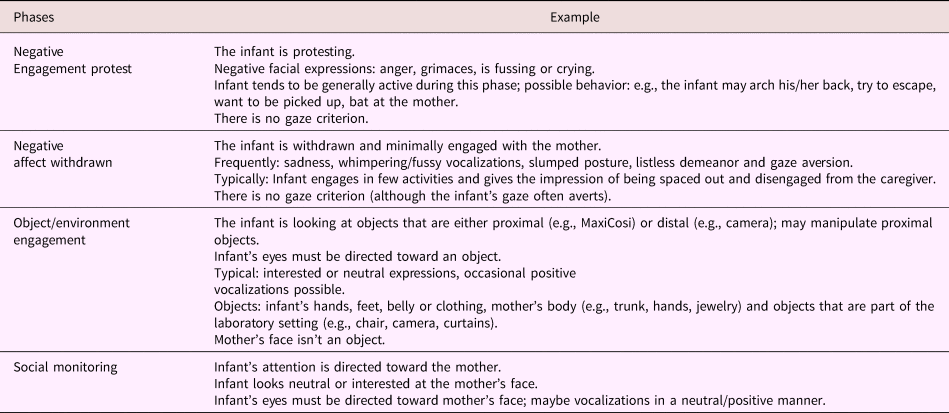
Infants’ behavior in the second phase of the still-face task was coded using the infant and caregiver engagement phases (Tronick et al., Reference Tronick, Messinger, Weinberg, Lester, Lagasse, Seifer and Liu2005; Weinberg & Tronick, Reference Weinberg and Tronick1999). This coding system includes a set of mutually exclusive codes for the caregiver and infant behavioral interactive phases. For the purpose of the present study, we focused on evaluating infants’ facial expressions and direction of gaze and intended to analyze four codes from the coding system, that is, passive-withdrawn, protest, object-environment engagement, and social monitoring (see Table 2 for definitions).
Infant and caregiver engagement phases (ICEP)*

*Source: Tronick et al. (Reference Tronick, Messinger, Weinberg, Lester, Lagasse, Seifer and Liu2005).
The percentage of time that each behavior was displayed is referred to as the duration of behavior. The duration of behavior was computed by dividing the total time that the behavior occurred by the total time of the phase. The result was multiplied by 100. The percentages allow an even more accurate calculation, with the duration of the still-face phases being relatively homogeneous (M = 118.93 s, SD = 2.24, range = 112.06–124.21). A second independent coder rated videos from 17 mother–infant dyads. The time-unit kappa yielded κ = .88 (agreement: κ = 91%–92%). The maximum true value of kappa lies between κ = .93 and κ = .95. The event-alignment kappa yielded κ = .58 (agreement of 68%). The maximum true value of kappa is κ = .84.
Results
Identification of groups
In the first step, we used a latent class analysis to classify the participants into groups with similar trajectories of rumination, as measured by the PTQ-sum score. The latent class model entailed time as the predictor and a random intercept for each participant and used a continuous link function as implemented in the lcmm function (Proust-Lima, Phillipps, & Liquet, Reference Proust-Lima, Philipps and Liquet2017). The number of classes was determined using Bayesian Information Criterion (BIC) (Nylund, Asparouhov, & Muthén, Reference Nylund, Asparouhov and Muthén2007). Comparing models with one to six different classes, we found that the model with three latent variables had the smallest BIC of all models and was thus scrutinized further. Group 1 consisted of n = 5 mothers (8.1%) whose tendency to engage in RNT decreased in the course of the study (T1: M = 37.60, SD = 8.59; T2: M = 19.20, SD = 10.33; T3: M = 12.6, SD = 8.41). Group 2 consisted of n = 17 mothers (27.4%) who exhibited a strong tendency to engage in RNT in a consistent manner (T1: M = 29.71, SD = 11.22; T2: M = 31.59, SD = 10.52; T3: M = 32.94, SD = 8.00). Group 3 consisted of n = 40 mothers (64.5%) who showed a weak tendency to engage in RNT throughout the assessments (T1: M = 15.58, SD = 6.34; T2: M = 8.83, SD = 5.56; T3: M = 9.71, SD = 6.30). Because the size of Group 1 was too small to perform any meaningful comparisons, it was excluded in the following calculations.
To answer our main research questions, we compared the behavior of mothers who had been exhibiting high levels of RNT (Group 2) during and after pregnancy with the behavior of mothers who had been exhibiting low levels of RNT (Group 3) during and after pregnancy in the mother–infant interaction task. Furthermore, we compared the behaviors of infants whose mothers had been exhibiting high levels of RNT (Group 2) with the behavior of infants whose mothers had been exhibiting low levels of RNT (Group 3) during and after pregnancy in the still-face phase.
Group differences in depressive symptoms, anxiety, and infant age and development
First, we used a t-test for independent samples to test whether mothers reporting high versus low RNT scores differed in their EPDS scores and their DASS anxiety scores at the third assessment (EPDS: high RNT group: M = 11.94, SD = 7.35; low RNT group: M = 2.63, SD = 2.25, all questionnaires were returned; DASS-Anxiety: high RNT group: M = 3.59, SD = 3.50; low RNT group: M = 0.68, SD = 0.96, overall, two questionnaires were not returned). We focused on comparing maternal anxiety and depression symptoms (rather than indicators of other disorders) due to their relatively high prevalence and their associations with child outcomes (Stein et al., Reference Stein, Pearson, Goodman, Rapa, Rahman, McCallum and Pariante2014). There were significant differences in depressive and anxiety symptoms between the two groups, EPDS: t (55) = 5.1, p < .001; DASS-Anxiety: t (53) = 3.36, p = .00. Mothers reporting high RNT scores also suffered from more depressive and anxiety symptoms. Because maternal depressive and anxiety symptoms thus differed between the groups around the time of the observation assessment, we inserted the EPDS and DASS-Anxiety scores as a covariate in each of our subsequent analyses to identify any associations with RNT that occurred independently of depressive and anxiety symptoms. We also tested whether the infants’ overall ASQ scores differed as a function of the group (high RNT group: M = 223.44, SD = 38.33; low RNT group: M = 234.21, SD = 32.68); overall, three questionnaires were not returned; for another infant, we did not obtain age-adequate ASQ data because that infant took part at 11 weeks (i.e., outside of the used ASQ's age-range) due to scheduling difficulties. The groups did not significantly differ in their ASQ scores: t (55) = -1.05, p = .30. Likewise, we tested whether the infants’ age differed as a function of the group (high RNT group: M = 15.71, SD = 1.80; low RNT group: M = 15.10, SD = 2.04). Infants’ age did not significantly differ between groups: t (55) = 1.06, p = .29.
Main analyses of contingency task and still-face task
Contingency task
Mothers who had been exhibiting high versus low levels of RNT during and after pregnancy showed a similar mean number of contingent responses per minute when interacting with their infants (high levels of RNT: M = 5.77; SD = 6.76; low levels of RNT: M = 7.86; SD = 18.10). A univariate analysis of covariance (ANCOVA) across groups (high vs. low levels of RNT) with EPDS scores and DASS-Anxiety scores as a covariate showed no significant effect of group, F (1, 51) = 0.02, p = .89. There was no significant effect of the covariates EPDS, F (1, 51) < 0.01, p = .99 and DASS-Anxiety, F (1, 51) = 0.19, p = .66. A second univariate ANCOVA across groups and with EPDS and DASS-Anxiety scores as covariates showed no difference in the responsiveness index (high levels of RNT: M = -.12; SD = 0.14; low levels of RNT: M = -.23; SD = 0.21) between mothers exhibiting high versus low levels of RNT during and after pregnancy, F (1, 51) = 0.71, p = .41. Also, there was no significant effects of either covariate, EPDS: F (1, 51) = 0.21, p = .65; DASS-Anxiety: F (1, 51) = 0.36, p = .55.
Still-face task
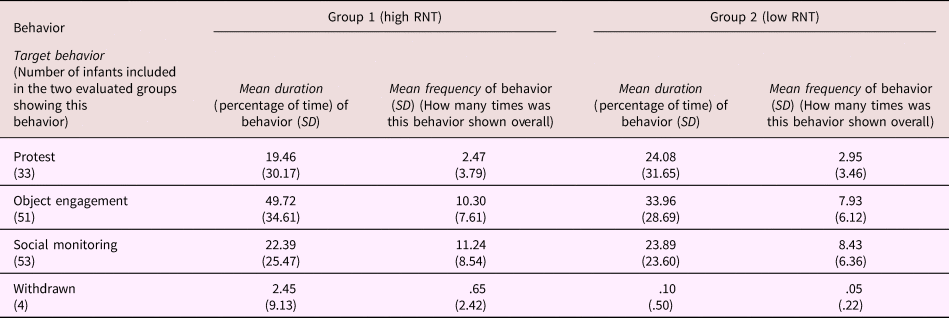
We analyzed both the duration and the frequency of the four coded infant behaviors as a function of maternal thinking style (i.e., high vs. low levels of RNT; see Table 3 for descriptive statistics).
Descriptive statistics of the still-face task for infants of mothers high versus low in repetitive negative thinking (RNT)

Because there were small deviations in the duration of the still-face phase due to procedural factors (e.g., some mothers not reacting promptly after the signal to stop displaying a still-face), we transformed the duration of target behaviors from seconds to a percentage of total time for further calculations. We also tested whether the duration of the still-face phase differed as a function of the group (high RNT group: M = 118.97 s, SD = 2.55; low RNT group: M = 119.04 s, SD = 2.05). The groups did not significantly differ in the duration of the still-face phase, t (55) = -1.06, p = .92.
Afterward, we conducted two multivariate analysis of covariance (MANCOVA) across groups (high vs. low levels of RNT) with EPDS and DASS-Anxiety scores as covariates on (a) the duration and (b) the frequency of the three infant behaviors in the still-face task described previously, that is, protest, social monitoring, and object/environment engagement. Originally, we intended to analyze the variable “withdrawn” as well. However, because only n = 4 infants included in the two groups displayed this behavior (reflected by the very low mean score, cf. Table 3), we did not consider this variable further.
Using Pillai's Trace, there was a significant difference in the duration of the three target behaviors in infants of mothers who had been exhibiting high versus low levels of RNT during and after pregnancy after controlling for the effect of the covariate, V = 0.16, F (3, 49) = 3.00, p = .04, η p2 = .16. Follow-up univariate ANCOVA revealed that there was a significant difference in the duration of object/environment engagement between infants of mothers high versus low in RNT, F (1, 51) = 8.08, p < .01, η p2 = .14. As predicted, infants of mothers high in RNT showed more object/environment engagement than infants of mothers low in RNT. There were no significant differences between groups for duration of social monitoring and duration of protest, largest F (1, 51) = 1.05, p = .31. There were no significant multivariate effects of the covariates, EPDS: V = 0.07, F (3, 49) = 1.31, p = .28; DASS-Anxiety: V = 0.07, F (3, 49) = 1.17, p = .33.
Second, we conducted a MANCOVA across groups with EPDS and DASS-Anxiety scores as a covariate on the frequency of infants’ displays of protest, social monitoring, and object/environment engagement (see Table 3 for descriptives). Using Pillai's Trace, there was a significant difference in the frequency of target behaviors in infants of mothers who had been exhibiting high versus low levels of RNT during and after pregnancy after controlling for the effect of the covariates, V = 0.16, F (3, 49) = 3.08, p = .04, η p2 = .16.
Post hoc ANCOVAs revealed that there was a significant difference in the frequency of protest between infants of mothers high versus low in RNT, F (1, 51) = 6.61, p = .01, η p2 = .12. As predicted, infants of mothers high in RNT protested less often in the still-face phase than infants of mothers low in RNT. There were no significant differences between groups for frequency of object/environment engagement and frequency of social monitoring, largest F (1, 51) = 0.24, p = .63, η p2 = .01. There were significant multivariate effects of the covariates, EPDS: V = 0.20, F (3, 49) = 3.95, p = .01, η p2 = .20; DASS-Anxiety: V = 0.20, F (3, 49) = 4.01, p = .01, η p2 = .20). The covariate, EPDS, was positively and significantly related to the frequency of object/environment engagement, F (1, 51) = 5.57, p = .02. Also, the covariate, EPDS, was positively and significantly related to the frequency of social monitoring, F (1, 51) = 9.26, p < .01. Furthermore, the covariate DASS-Anxiety was positively and significantly related to the frequency of protest, F (1, 51) = 6.15, p = .02. Last, the covariate DASS-Anxiety was negatively and significantly related to the frequency of object/environment engagement, F (1, 51) = 5.57, p = .02.
Discussion
The first aim of the present study was to determine whether an enduring maternal tendency to engage in RNT would become apparent in mothers’ behavior when interacting with their young infant, even when mothers were not induced to engage in RNT at that moment. The second aim was to test whether infants differed in their responses to a sudden communicative interruption as a function of their mothers’ tendency to engage in RNT.
We expected that mothers with a strong tendency to engage in RNT would react less contingently in the mother–infant interaction as compared with mothers with a weak tendency to engage in RNT. Contrary to our expectations, analyses revealed that mothers with a strong tendency to engage in RNT displayed contingent behavior as frequently as mothers with a weak tendency to engage in RNT. These findings provide novel insights insofar as previous studies (Stein et al., Reference Stein, Craske, Lehtonen, Harvey, Savage-McGlynn, Davies and Counsell2012; Tester-Jones et al., Reference Tester-Jones, Karl, Watkins and O'Mahen2017) assessed the effect of RNT on mother–infant interaction while mothers did versus did not engage in RNT at the time of the assessment. These previous studies left open the question of whether RNT, if it happens frequently, leaves an enduring trace in the quality of how mothers respond to their infants’ communicative signals. We did not find any evidence for such enduring consequences of high levels of RNT on maternal contingency. Thus, it seems that mothers who habitually engaged in RNT did not fundamentally lack the ability to respond contingently to their infants’ signals.
In the context of participating in this study, not having been induced to engage in RNT, and with the awareness of being video-recorded, in fact all mothers might have made a particular effort to engage in a positive, responsive interaction with their infants. From this view, the lack of difference between mothers high versus low in RNT in the observation assessment could be due to the setup in that specific situation, particularly the salience of being recorded. However, it has been shown that mother–infant dyads develop their own individual way of interacting, characterized by differences in contingent responses (Bigelow, Reference Bigelow1998; Tronick & Cohn, Reference Tronick and Cohn1989). Considering this, it seems unlikely that mothers were able to change their usual interactive style for one particular interactive episode in the context of study participation and hence acted in an atypical way. However, it is possible that idiosyncrasies in mother–infant dyads’ interactions become increasingly apparent over time. Perhaps, assessments at a later age and/or during different tasks and types of interaction would reveal systematic differences in mothers high versus low in RNT when they engage with their infants.
From an intervention point of view, our result is encouraging. The relationships between RNT and maternal behavior shown in previous studies (e.g., O'Mahen et al., Reference O'Mahen, Boyd and Gashe2015; Tester-Jones et al., Reference Tester-Jones, Karl, Watkins and O'Mahen2017) might disappear when RNT is reduced. At least when targeted during the first few months postpartum, a previous tendency to engage in RNT might not leave long-lasting traces on maternal contingency. However, these assumptions are somewhat speculative and should be considered with caution. To directly test them would require following mothers with varying tendencies to engage in RNT for a longer period postpartum and assess maternal contingent behavior repeatedly. Perhaps a strong and enduring tendency to engage in RNT would be reflected in reduced contingent behavior only after it has persisted for a longer period postpartum. Also, perhaps a decline in engagement in RNT would be followed by more contingent behavior.
Using the still-face task, we assessed potential relations between habitual maternal RNT and infant behavior. We predicted that infants of mothers with a strong tendency to engage in RNT would react to their mothers’ still-face with less protest, a reduced tendency to monitor their mother during the still-face phase, and with more visual focus on their environment than infants of mothers with a weak tendency to engage in RNT. In terms of frequency of behaviors, when all variables were considered simultaneously, our hypothesis was confirmed. There was a difference in infant behavior as a function of a group. A closer inspection of the data revealed that this overall difference was driven by a difference in only one of the three variables, namely frequency of protest. As expected, infants of mothers high in RNT protested less often during the still-face paradigm than infants of mothers low in RNT. Presumably, this lower level of protest indicates that these infants have experienced situations where their mother has become unresponsive before. Perhaps they have, in vain, protested in such situations before and over time reduced their tendency to protest due to lack of success. Our data on the duration of behaviors described below suggest that infants of mothers high in RNT might have developed a different strategy for dealing with situations where their mother instead becomes unresponsive.
Considering the duration of behavior, as predicted, there was a difference in infant behavior as a function of the group when all variables were considered simultaneously. However, a more detailed inspection of the data revealed that this overall difference was driven by a difference in only one of the three variables, namely object/environment engagement. As expected, infants of mothers exhibiting high levels of RNT spent more time examining their environment and specific objects in their environment as compared with infants of mothers with a weak tendency to engage in RNT.
One potential explanation for the difference in the duration of object/environment engagement is that gazing away from the mother could be a strategy infants use to manage their distress and regulate their emotions (Moore et al., Reference Moore, Cohn and Campbell2001). Possibly, infants of mothers with a strong tendency to engage in RNT have repeatedly experienced their mother becoming unresponsive and therefore visually focus on their environment as a learned coping mechanism. In previous studies, an increasing tendency to shift their gaze away from their mother was a consistent age-related change in infants’ behavior in the still-face task during the first half-year of life (Moore et al., Reference Moore, Cohn and Campbell2001). The present results may indicate that infants of mothers who often engage in RNT might be advanced in using this strategy. To our knowledge, these data are the first suggestion of a role of maternal RNT in shaping infant behavior.
Contrary to our expectations, there were no significant differences between the groups for duration of protest and social monitoring and for frequency of object/environment engagement and social monitoring when these variables were considered separately. It is possible that this lack of difference is a direct consequence of the fact that infants of mothers high in RNT were more focused on their environment. Presumably, focusing on other aspects of the situation than their mother helped infants regulate themselves (Moore et al., Reference Moore, Cohn and Campbell2001).
From a methodological point of view, it is noteworthy that the four coded infant behaviors, in the still-face paradigm, were mutually exclusive and hence not completely independent from each other, as specified in the coding scheme that we used. That is, when an infant displayed one of the behaviors, it was impossible for him or her to display any of the other behaviors. However, the four codes were not applied continuously such that there were times in the 120-s period in which none of the codes were applicable because none of the target behaviors were displayed (cf. Table 3). Thus, a difference in one particular behavior between groups did not necessarily result in differences in one or more of the other behaviors.
Another methodological aspect to bear in mind is the possible influence of the contingency task on maternal and infant behavior in the still-face task. However, because the contingency task is similar to experiences that mothers and infants frequently share in daily life, it seems unlikely that there were strong carry-over effects.
Another finding from the study are the significant associations between depressive symptoms and the frequency of infant object/environment engagement and social monitoring. There were also significant relations between anxiety symptoms and the frequency of protest and object/environment engagement. Infants of mothers with higher depression and higher anxiety values exhibited more object/environment engagement. This strategy could also be interpreted as a learned strategy. However, in contrast to the findings related to RNT, infants of depressive mothers tended to focus more on their mothers’ faces, and infants of anxious mothers reacted with more protest in the still-face phase. These results emphasize that the associations between maternal depressive and anxiety symptoms and infant behavior can be distinguished from those between RNT and infant behavior. RNT cannot only be seen as epiphenomenon of depression or another single disorder (Müller et al., Reference Müller, Teismann, Havemann, Michalak and Seehagen2013).
The present results indicate that a strong maternal tendency to engage in RNT during pregnancy and after birth might leave a trace in infant behavior as demonstrated during the still-face task around 4 months’ postpartum. However, these results provoke further questions. First, it is not clear whether the consequences of maternal RNT in clinical samples, whose members might engage in RNT more intensively and/or frequently, and/or preferentially in specific types of RNT (e.g., worry, rumination), compared with women in the present nonclinical sample are even more far-reaching. Second, and relatedly, the present study does not give a full account of the role of RNT for mother–infant interactions in women with a greater variety of profiles in regard to RNT. Using latent class analysis to identify patterns of perseverative thinking in our sample, the calculations yielded three groups of mothers with different tendencies to engage in RNT. The group of mothers whose tendency to engage in RNT decreased in the course of the study could not be considered in further calculations due to its very small size. Future studies with larger samples might be able to explore relations between RNT and maternal and infant behavior in mothers with more diverse profiles. Third, the use of another instrument than the PTQ for assessing RNT could provide additional insights. It has been suggested that the PTQ measures meta-cognitive beliefs about RNT, as well as the tendency to engage in RNT (Samtani & Moulds, Reference Samtani and Moulds2017). Fourth, it is possible that mothers had difficulties interacting naturally with their infants, as they otherwise would at home, due to the rather artificial interaction setting. To our knowledge, there is no empirical basis for concluding that the setting (and the awareness of being recorded) would have affected mothers of high versus low in RNT differently. However, this could be studied in future research where mothers’ behavior at home is compared with their behavior in the lab. Fifth, we studied mother–infant dyads within the first half-year after birth. Often, maternal psychopathology, of which RNT might be a core feature, is not diagnosed and treated for an extended period of time after birth (Murray & Cooper, Reference Murray and Cooper1997). It is possible that RNT starts to play an even more profound role for maternal and infant behavior when assessed over a longer period of time. In future longitudinal studies, assessments toward an infant's first birthday could be illuminating. Sixth, previous studies have found that maternal RNT is predictive of self-reported impairments in prenatal (Schmidt et al., Reference Schmidt, Seehagen, Vocks, Schneider and Teismann2016) and postnatal (Müller et al., Reference Müller, Teismann, Havemann, Michalak and Seehagen2013) mother–infant bonding.
In sum, the present results leave open the possibility that behavioral measures of bonding/attachment (again, possibly at a later stage) might be even more sensitive in revealing long-term associations between maternal RNT and infant outcomes. The present findings support the idea of RNT potentially being important in the intergenerational transmission of mental disorders. Nevertheless, the study was not experimental in nature. Hence, without identifying RNT as a causal factor for any maternal/infant behaviors observed in the present study, caution should be exercised when formulating clinical implications. If the results of the present study are confirmed in further research, and if causality could also be established, then specific interventions might be indicated that help pregnant women to identify and restructure repetitive negative thoughts (Duncan & Bardacke, 2010).