





Introduction
When weed biological control agents fail, one of the most common explanations is a mismatch in the climates of the agent’s native and introduced ranges. Indeed, temperature and precipitation underlie geographic variation in the success of at least one-third of biological control agents globally (Harms et al. Reference Harms, Cronin, Diaz and Winston2020). Low winter temperatures have likely limited the success of several weed biological control agents in North America (Diaz et al. Reference Diaz, Overholt, Samayoa, Sosa, Cordeau and Medal2008; Mukherjee et al. Reference Mukherjee, Williams, Wheeler, Cuda, Pal and Overholt2012; Harms and Shearer Reference Harms and Shearer2017). For example, winter cold prevents the flea beetle, Agasicles hygrophila Selman and Vogt (Coleoptera: Chrysomedidae), from establishing outside the coastal southeastern United States of America, leaving invasive alligatorweed, Alternanthera philoxeroides (Martius) Grisebach (Amaranthaceae), largely uncontrolled in much of its invaded range (Harms and Shearer Reference Harms and Shearer2017).
Insects are ectotherms and, as such, may risk freezing at low temperatures. The first steps towards determining the cold hardiness of an insect are to identify when freezing is possible (often via the supercooling point) and to characterise its cold-tolerance strategy (Sinclair et al. Reference Sinclair, Coello Alvarado and Ferguson2015). An insect’s cold-tolerance strategy is usually categorised as chill-susceptible (species that die from cold before ice forms), freeze-avoidant (species that remain liquid at low temperatures but are killed if ice forms), or freeze-tolerant (species that can withstand internal ice formation; Sinclair Reference Sinclair2015; Teets et al. Reference Teets, Marshall and Reynolds2023). The supercooling point of an insect is meaningful only for understanding the cold hardiness of freeze-avoidant species. Although most laboratory experiments use acute cold exposures, for example, to measure the supercooling point, it is well known that cold exposures in nature can be prolonged (Sømme Reference Sømme1996) and fluctuating (Marshall and Sinclair Reference Marshall and Sinclair2012). Furthermore, the overwintering microhabitat modulates both cold exposure and cold hardiness. Snowpack, for example, can substantially buffer microclimate temperatures, reducing exposure to extreme cold (Roberts et al. Reference Roberts, Rank, Dahlhoff, Stillman and Williams2021).
Soil moisture content can influence insect cold hardiness either positively or negatively. In soils with high moisture content, contact with external ice crystals can inoculate internal ice formation (Layne et al. Reference Layne, Lee and Huang1990). This inoculative freezing can reduce the survival of freeze-intolerant insects by inducing lethal freezing (Costanzo et al. Reference Costanzo, Moore, Lee, Kaufman and Wyman1997); conversely, some insects are freeze-tolerant when freezing is inoculated exogenously (Shimada and Riihimaa Reference Shimada and Riihimaa1988). Finally, in dry soils or in soils that are frozen for long periods, low vapour pressure can dehydrate insects, rendering them unfreezeable, a state that can include “cryoprotective dehydration” (Holmstrup et al. Reference Holmstrup, Bayley and Ramløv2002).
Hypena opulenta (Christoph) (Lepidoptera: Erebidae) was introduced to Ontario, Canada, in 2013 and to the northeastern United States of America in 2017 to control two invasive swallow-worts, Vincetoxicum rossicum (Kleopow) Barbarich and V. nigrum (Linnaeus) Moench (both Apocynaceae) (Cassagrande et al. Reference Casagrande, Weed, Hazlehurst, Tewksbury, Gassmann and Bourchier2012; Jones et al. Reference Jones, Ryan, Cappuccino, Smith, Bourchier, Vankosky and Martel2024). Adult H. opulenta emerge in the spring, mate, and lay up to 400 eggs on swallow-wort foliage (Weed and Casagrande Reference Weed and Casagrande2010). Larvae develop through four or five instars before pupating, and the moths undergo one or two summer generations before overwintering just below (∼1 cm) the surface of the soil as pupae (Hazlehurst et al. Reference Hazlehurst, Weed, Tewksbury and Casagrande2012). Hypena opulenta is specific to European swallow-worts (Weed and Casagrande Reference Weed and Casagrande2010; Hazlehurst et al. Reference Hazlehurst, Weed, Tewksbury and Casagrande2012) and has a native range from Ukraine to Central Asia in the north (∼48° N) and to Syria and Iran in the south (∼36° N). The H. opulenta released in North America were collected from Donetsk, Ukraine, in 2005 (Weed and Casagrande Reference Weed and Casagrande2010). Although H. opulenta has established at several sites in Canada and the United States of America and, in some cases, has dispersed more than 2 km from the initial release points (Bourchier et al. Reference Bourchier, Cappuccino, Rochette, des Rivières, Smith, Tewksbury and Casagrande2019; L. Tewksbury, personal communication), populations remain small, and no discernible impact on the target weeds has been observed (Jones et al. Reference Jones, Ryan, Cappuccino, Smith, Bourchier, Vankosky and Martel2024).
We have identified two probable causes for the poor population growth of H. opulenta in North America. First, shorter summer day lengths in the introduced range appear to initiate diapause after only a single summer generation (Jones et al. Reference Jones, Seehausen, Bourchier and Smith2020). Second, pupal winter mortality in the field can exceed 80%, is largely not due to predation, and is higher in cold winters (Jones et al. Reference Jones, Smith and Bourchier2022). Between 2014 and 2020, the average daily minimum air temperature in January in Ottawa, Ontario, Canada (the location of the first H. opulenta releases; Bourchier et al. Reference Bourchier, Cappuccino, Rochette, des Rivières, Smith, Tewksbury and Casagrande2019) was approximately –14 °C, compared to approximately –7 °C at the collection locale in Donetsk, Ukraine (BioSIM; Régnière et al. Reference Régnière, Saint-Amant, Béchard and Moutaoufik2017). During the same period, the extreme minimum air temperatures were approximately –40 °C and –36 °C for Ottawa and Donetsk, respectively. Hypena opulenta overwinters in the soil where temperatures are somewhat buffered, particularly when there is snow cover. A recent study in Uxbridge, Ontario, recorded a minimum temperature of –7.7 °C at a depth of 2.5 cm over the course of two winters (Jones et al. Reference Jones, Smith and Bourchier2022). Between 2014 and 2020, extreme minimum soil temperatures (mean ± standard error) at a depth of 2.5 cm were –8.5 ± 1.4 °C and –6.7 ± 3.0 °C for Ottawa and Donetsk, respectively (NicheMapR; http://bioforecasts.science.unimelb.edu.au/app_direct/soil_ncep; Kearney and Porter Reference Kearney and Porter2024). Soil moisture content in Ottawa generally peaks in late winter and therefore is at its highest during the coldest months of the year (Ouellet Reference Ouellet1975). Between 2014 and 2020, NicheMapR, version 3.3.2 (Kearney and Porter Reference Kearney and Porter2024), predicts winter (December–March) soil moisture contents of 20–40% in Ottawa and 23–34% in Donetsk. Although Donetsk is a reasonable climate match for southern Ontario, H. opulenta are likely to be exposed to slightly lower winter temperatures and slightly higher soil moisture contents in their introduced range.
Given these climatic differences, we conducted a study to determine whether they might be responsible for the high winter mortality of H. opulenta in Canada. Specifically, we asked whether H. opulenta cold tolerance is limiting overwintering survival and population growth at the insect’s Canadian release sites. Our objectives were to characterise the cold-tolerance strategy used by H. opulenta pupae, to determine the effects of prolonged cold exposure on H. opulenta overwintering survival, and to determine whether soil moisture content affects cold hardiness in H. opulenta.
Methods
Insect production
We used H. opulenta from a laboratory-reared colony maintained at the University of Rhode Island, Kingstown, Rhode Island, United States of America. This population is descended from insects originally collected in 2005 and 2012 from Donetsk, Ukraine, by CABI Switzerland (Delémont, Switzerland; Casagrande et al. Reference Casagrande, Weed, Hazlehurst, Tewksbury, Gassmann and Bourchier2012). The laboratory colony has been maintained at a rearing temperature of 20–25 °C and a 16:8-hour light:dark photoperiod. In order to induce diapause for the experiments, eggs were reared to pupation under a 12:12-hour photoperiod at 20–25 °C. Approximately three weeks after pupation, we moved pupae to plastic containers filled with damp vermiculite and kept them at 5 °C in the dark until use in our experiments. Before their use in experiments, pupae were stimulated gently with forceps to induce movement and to confirm that they were alive (Seehausen et al. Reference Seehausen, Timm, Jones, Bourchier and Smith2019). The mass (mean ± standard error) of male and female pupae used in these experiments was 87.1 ± 2.2 and 88.9 ± 1.8 mg, respectively.
Experiment 1: Cold-tolerance strategy of H. opulenta pupae in the presence and absence of external ice formation
We characterised the cold-tolerance strategy of H. opulenta pupae as described by Sinclair et al. (Reference Sinclair, Coello Alvarado and Ferguson2015). We placed 16 H. opulenta pupae (eight males and eight females) head down in 1.5-mL microcentrifuge tubes, in contact with a 36-gauge Type-T thermocouple (Omega, Laval, Quebec, Canada) held in place with cotton wool. The thermocouples were connected to a TC-08 thermocouple interface (Pico Technology, Cambridge, United Kingdom), and we recorded temperature at 0.5 Hz using Picolog software, version 6.1.8 (Picotech). We placed the microcentrifuge tubes into wells in a Peltier-cooled aluminium block (qMC16; Quantum Northwest, Liberty Lake, Washington, United States of America) and cooled them from 5 °C (the winter storage temperature of the insects) at 0.5 °C·min–1 until half of the individuals (n = 8) had frozen (identifiable from the exotherm produced by the latent heat of ice crystallisation), at which point we immediately removed all individuals to room temperature. The temperature at which each individual froze (its supercooling point) was recorded as the lowest temperature before the beginning of the exotherm, but because not all the individuals froze, we do not report mean supercooling points here. After return to room temperature, we removed the pupae from the tubes and placed them in 148-mL plastic rearing cups with damp cotton wool. Pupae were held at 5 °C in the dark for a further two weeks before being moved to 25 °C and a 16:8-hour light:dark photoperiod for development.
We considered individuals to have survived if they successfully emerged as adult moths and characterised the cold-tolerance strategy according to Sinclair et al. (Reference Sinclair, Coello Alvarado and Ferguson2015): (1) chill-susceptible – both frozen and unfrozen individuals died; (2) freeze-avoidant – frozen individuals died, but unfrozen individuals survived; and (3) freeze-tolerant – both frozen and unfrozen individuals survived. To evaluate the effect of inoculative freezing on H. opulenta pupae, we repeated the above experiment, this time dipping each pupa in a slurry of ice nucleator silver iodide (Agl) and water. We compared supercooling points of untreated and AgI-dipped individuals using an independent samples t-test and survival between frozen and unfrozen pupae separately for each sex using Fisher’s exact tests. All analyses were performed using SPSS, version 29 (IBM, Armonk, New York, United States of America).
Experiment 2: Effects of cold-exposure duration and inoculative freezing on survival of H. opulenta pupae
Our preliminary experiments indicated that H. opulenta pupae were freeze-tolerant, so we assessed survival of prolonged exposures at temperatures below the supercooling point. We cooled a new set of H. opulenta pupae at 0.5 °C·min–1 to –15 °C (chosen because we expected all pupae to freeze at this temperature) and held them for either 1 hour or 15 hours before rewarming and monitoring survival, as described above. We conducted this experiment with both dry pupae and with pupae that had been dipped in a water–AgI slurry to initiate freezing (n = 16 pupae per time per AgI combination). We maintained handling controls, pupae (n = 24) that were treated identically to the experimental pupae but were held at 5 °C. We compared survival among treatments using a generalised linear model with binomial error and logit-link function. The model included cold duration, Agl treatment, and sex as the main factors and assessed the interaction between cold duration and Agl treatment. The effect of sex on the mean freezing temperature of Agl-treated pupae was assessed using analysis of variance.
Experiment 3: Effects of soil moisture and cold duration on survival of H. opulenta pupae
We explored how soil moisture and cold exposure might interact during winter conditions to affect survival. A total of 320 pupae (140 males and 180 females) were weighed (± 0.1 mg) and haphazardly assigned in equal numbers of males and females to a treatment. We placed each pupa in a covered 148-mL plastic cup, approximately 5 mm below the surface of a 50-g mixture of sand and water (mixed to yield 7, 11, 15, 19, or 23% water content (weight/weight)). The cups were held at 5 °C in the dark for 10 days, after which each pupa was reweighed, returned to the substrate, and haphazardly assigned to receive either 0 (control), 4, 20, or 120 hours at –10 °C (n = 16 (7 male and 9 female) pupae per combination of soil moisture and cold duration). We chose –10 °C because it is lower than the temperature at which all but one of the Agl-treated pupae froze during experiments 1 and 2 but is high enough that pupae could remain unfrozen if not inoculated by external ice formation. Furthermore, –10 °C represents an extreme but realistic minimum temperature that pupae might experience in the soil in relevant parts of Ontario.
Cold exposures were conducted in a chest freezer (Frigidaire, FFFC15M4TW, Mississauga, Ontario), and the temperature of the samples was logged every minute (LogTag USA, Union, New Jersey, United States of America). The mean ± standard error temperature throughout the 120-hour cold exposure was –10.2 ± 0.02 °C. After the exposure to cold (and while still in the freezer), pupae were transferred to Styrofoam boxes to slow the rate of rewarming when moved to +5 °C in the dark for one week before being removed to individual plastic cups with moist vermiculite to determine survival, as described above. We calculated the change in mass over the 10 days before cold exposure and compared it among soil moisture treatments using a one-way analysis of variance. The effects of sex, cold duration, and moisture treatments on H. opulenta survival were compared using a generalised linear model with binomial error and logit-link function.
Results
Experiment 1: Cold-tolerance strategy of H. opulenta pupae in the presence and absence of external ice formation
During cold exposures to determine cold-tolerance strategy, half of the non-Agl-treated pupae froze at temperatures above –11.5 °C. Of the eight frozen pupae, three were male (min/max freezing temperature: –10.1 °C/–7.3 °C) and five were female (–11.5 °C/–5.3 °C). One of the three frozen male pupae and four of the five frozen female pupae survived. Of the eight untreated pupae that did not freeze, five were male (of which two survived) and three were female (of which one survived). Therefore, although five male and three female pupae died after cold exposure, there was no significant difference in mortality between frozen and unfrozen pupae for either male (n = 8, χ2 (1,6) = 0.533, P = 1.0) or female (n = 8, χ2 (1,6) = 2.880, P = 0.196) pupae. These results indicate that H. opulenta pupae are freeze-tolerant.
When treated with AgI to assess the role of inoculative freezing, seven (four male and three female) pupae froze, all at temperatures above –3.4 °C (mean ± standard error freezing temperature: –2.8 ± 0.2 °C), which were higher than the temperatures at which non-AgI-treated pupae froze (five male, three female, mean ± standard error –8.8 ± 0.8 °C, range –11.48 to –5.32 °C; t (1) = –7.169, P = 0.003). All four of the AgI-treated male pupae that froze survived, but only one of their three female counterparts survived. Of the nine Agl-treated pupae that did not freeze, four were male (of which three survived) and five were female (of which three survived). In total, seven male and four female Agl-treated pupae survived the cold exposure, and there was no significant difference in survival between frozen and unfrozen pupae (n = 16, χ2 (1) = 0.042, P = 0.635).
Experiment 2: Effects of cold-exposure duration and inoculative freezing on survival of H. opulenta pupae
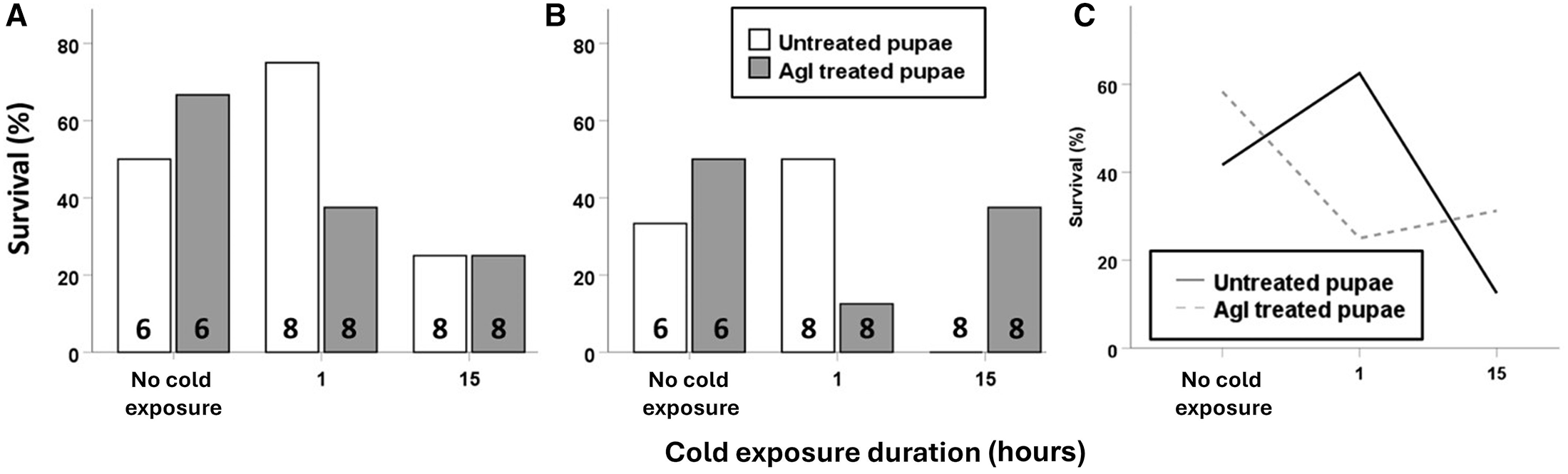
When 16 untreated pupae were exposed to –15 °C for 1 hour, only one pupa (a male) froze at –13.1 °C. Ten of the 16 pupae (four male and six female) survived this cold exposure. When 16 untreated pupae were held at –15 °C for 15 hours, four males and five females froze (mean ± standard error freezing temperature –9.6 ± 1.0 °C). Only two pupae, both females (one frozen, one unfrozen), survived the 15-hour cold exposure. A total of 12 (five male and seven female) control pupae (no cold treatment) survived handling (Fig. 1).
Effects of cold-exposure duration (0, 1, and 15 hours) and Agl treatment on survival of A, female, B, male, and C, all Hypena opulenta pupae. Bars in A and B represent the percentage of pupae that survived cold treatments, and numbers in the bars represent the number of pupae tested (n). For both untreated and water–silver iodide–treated insects, survival of control pupae (no cold exposure; n = 12) was compared with the survival of pupae exposed to –15 °C for 1 hour (n = 16) and 15 hours (n = 16). C presents the combined male and female survival of cold exposures

Figure 1. Long description
The image contains three graphs showing the effects of cold-exposure duration on the survival of untreated and Agl-treated pupae of H. opulenta. The first graph (A) is a bar graph representing the survival percentage of female pupae under no cold exposure, 1 hour, and 15 hours of cold exposure. The second graph (B) is a bar graph showing the survival percentage of male pupae under the same conditions. The third graph (C) is a line graph combining the survival data of both male and female pupae. The x-axis of all graphs represents the duration of cold exposure in hours, while the y-axis represents the survival percentage. The bars in graphs A and B indicate the percentage of pupae that survived the cold treatments, with numbers inside the bars representing the number of pupae tested. The line graph in C shows the combined survival trends for both untreated and Agl-treated pupae. The untreated pupae are represented by a solid line, while the Agl-treated pupae are represented by a dashed line. The data shows that survival rates generally decrease with longer cold exposure durations, with untreated pupae showing a more significant decline compared to Agl-treated pupae. All values are approximated.
When treated with Agl, all 16 pupae froze during both the 1-hour and 15-hour exposures to –15 °C. The freezing points of the treated pupae during these exposures did not significantly differ between sexes (n = 32, F (1,30) = 1.179, P = 0.287). One male and three females survived the 1-hour exposure at –15 °C, and three males and two females survived the 15-hour exposure at –15 °C. Across all treatments, sex did not significantly affect H. opulenta pupal survival (n = 88, χ2 (1,86) = 2.704, P = 0.100); however, significant interaction occurred between cold-exposure duration and Agl treatment (n = 88, χ2 (2,85) = 6.676, P = 0.036; Fig. 1C). Treatment of pupae with Agl did not affect survival of control pupae (no cold exposure; n = 24, χ2 (1) = 0.845, P = 0.408). Survival of untreated pupae (62%) was significantly higher than that of Agl-treated pupae (25%) after the 1-hour cold exposure (n = 32, χ2 (1) = –2.345, P = 0.021). There was no difference in survival between untreated (12.5%) and Agl-treated pupae (31.25%) after the 15-hour cold exposure (n = 32, χ2 (1) = 1.338, P = 0.188).
Experiment 3: Effects of soil moisture and cold duration on survival of H. opulenta pupae
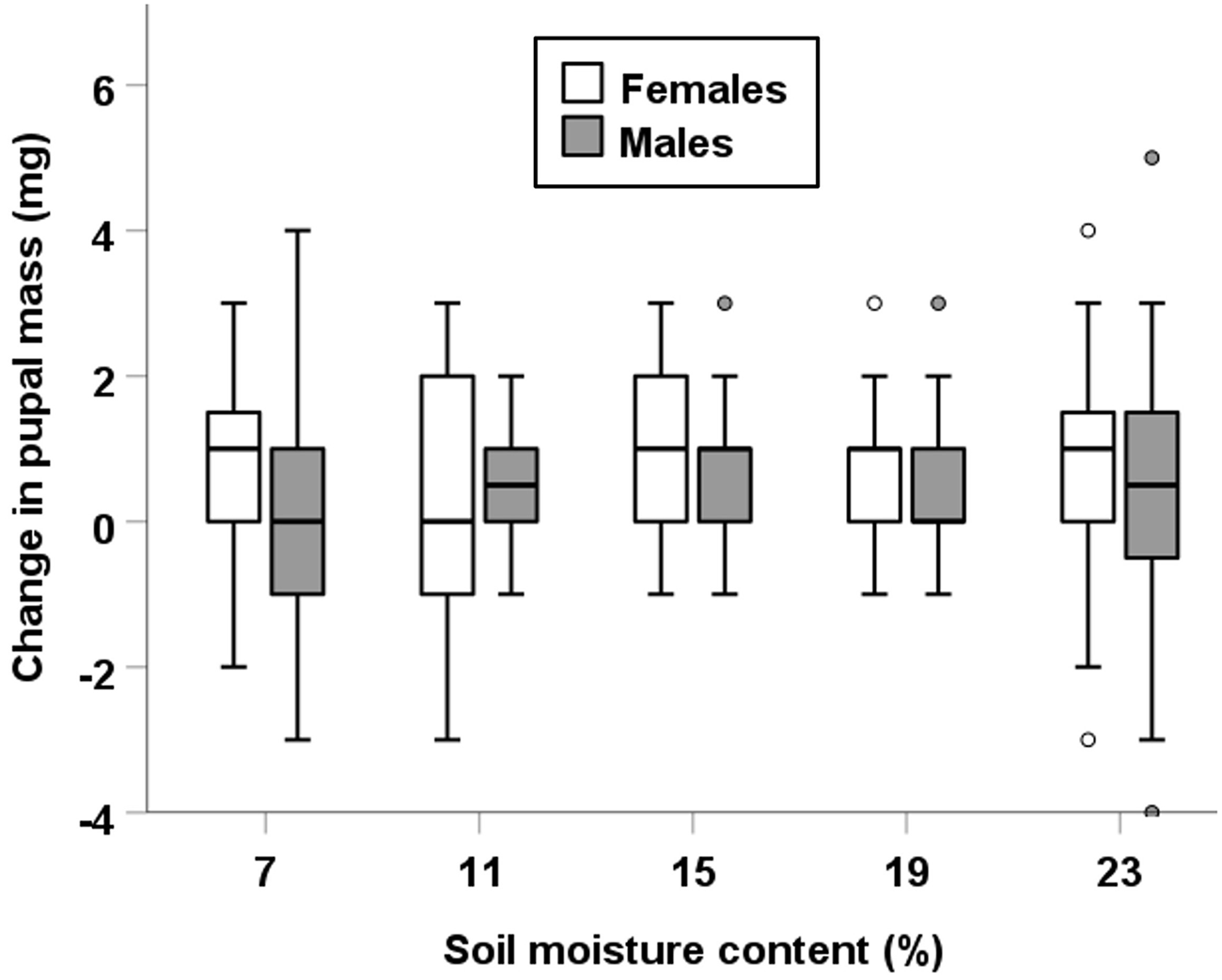
During the laboratory soil moisture bioassay, mean ± standard error change in pupal weight across all soil moisture treatments was 0.5 ± 0.09 mg during 10 days of storage across all soil moisture treatments. Neither soil moisture content (n = 320, F (4,315) = 0.831, P = 0.507) nor sex (n = 320, F (1,318) = 2.192, P = 0.140) affected the change in pupal weights over 10 days at 5 °C (Fig. 2).
Change in mass of male and female Hypena opulenta pupae after 10 days of storage in substrate at five different soil moisture levels. Box plots represent a summary of the data (minimum, first quartile, median, third quartile, and maximum). Open circles represent outliers (≥ 1.5 × interquartile range)

Figure 2. Long description
The box-and-whisker plot displays the change in mass of male and female pupae after 10 days of storage in substrate at five different soil moisture levels. The x-axis represents soil moisture content in percentage, ranging from 7 to 23 percent. The y-axis represents the change in pupal mass in milligrams, ranging from 4 to 6 milligrams. The plot includes five vertical box plots, each representing a different soil moisture level. Each box plot shows the minimum, first quartile, median, third quartile, and maximum values for both males and females. Males are represented by gray boxes, and females are represented by white boxes. Outliers are indicated by open circles. The data shows variation in pupal mass change across different soil moisture levels, with some outliers present at higher moisture levels. All values are approximated.
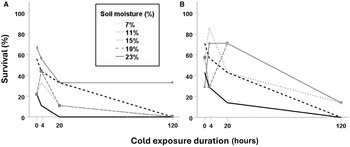
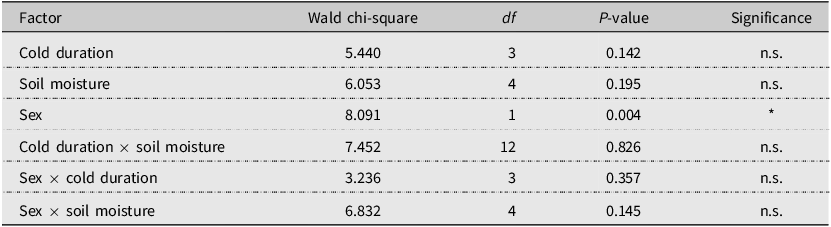
Some pupae survived exposure to –10 °C for 4 hours in all soil moisture groups, but very few pupae of either sex survived the 120-hour exposure (Fig. 3). Although male survival was slightly higher than female survival (n = 320, χ2 (1,318) = 8.091, P = 0.004), neither exposure duration (n = 320, χ2 (3,316) = 5.440, P = 0.142) nor soil moisture (n = 320, χ2 (4,315) = 6.053, P = 0.195) significantly affected survival, and no significant interaction was detected between cold-exposure duration and soil moisture content (n = 320, χ2 (12) = 7.452, P = 0.826). Neither cold-exposure duration nor soil moisture content significantly interacted with sex (Table 1).
Survival of A, female, and B, male, Hypena opulenta pupae exposed to 20 cold duration–soil moisture treatments. Pupal survival was recorded after a factorial experiment with four cold-treatment durations (0, 4, 20, and 120 hours) and five soil moisture contents (7, 11, 15, 19, and 23%). Points on the graphs represent survival of different cohorts of pupae at each cold duration–soil moisture combination (n = 16). Lines, therefore, do not depict survival of a single cohort over time

Figure 3. Long description
The image contains two line graphs labeled A and B, representing the survival percentages of female and male H. opulenta pupae, respectively, under various cold exposure durations and soil moisture levels. The x-axis represents cold exposure duration in hours, ranging from 0 to 120 hours, while the y-axis represents survival percentage, ranging from 0 to 100 percent. Each graph includes five lines corresponding to different soil moisture percentages: 7 percent, 11 percent, 15 percent, 19 percent, and 23 percent. The lines show how survival rates change with increasing cold exposure duration for each soil moisture level. In graph A, survival rates generally decrease as cold exposure duration increases, with higher soil moisture levels showing slightly better survival rates. In graph B, a similar trend is observed, but with more variability in survival rates at different soil moisture levels. Points on the graphs represent the survival of different cohorts of pupae at each cold duration-soil moisture combination, with each line connecting these points. The lines do not depict the survival of a single cohort over time but rather illustrate the overall trend across different cohorts. All values are approximated.
Statistical results for the laboratory soil moisture bioassay. The model was a generalised linear model with binomial error and logit-link function. Factors included cold-exposure duration (0, 4, 20, and 120 hours), soil moisture content (7, 11, 15, 19, and 23%), and sex. Asterisk indicates significant effects in the model (α = 0.05); n.s., not significant

Table 1. Long description
The table presents statistical results for a laboratory soil moisture bioassay, detailing the effects of various factors on survival rates. It includes six rows and five columns, with headers for Factor, Wald chi-square, df, p-Value, and Significance. The factors analyzed are cold duration, soil moisture, sex, cold duration x soil moisture, sex x cold duration, and sex x soil moisture. Each factor is associated with a Wald chi-square value, degrees of freedom, p-value, and significance level. Cold duration has a Wald chi-square value of 5.440 with 3 degrees of freedom and a p-value of 0.142, marked as not significant. Soil moisture has a Wald chi-square value of 6.053 with 4 degrees of freedom and a p-value of 0.195, also marked as not significant. Sex shows a Wald chi-square value of 8.091 with 1 degree of freedom and a p-value of 0.004, marked as significant. The interaction between cold duration and soil moisture has a Wald chi-square value of 7.452 with 12 degrees of freedom and a p-value of 0.826, marked as not significant. The interaction between sex and cold duration has a Wald chi-square value of 3.236 with 3 degrees of freedom and a p-value of 0.357, marked as not significant. The interaction between sex and soil moisture has a Wald chi-square value of 6.832 with 4 degrees of freedom and a p-value of 0.145, marked as not significant. The table indicates that while sex has a significant effect on survival, neither cold duration nor soil moisture significantly affects survival, and no significant interactions are detected between these factors.
Discussion
We characterised the cold hardiness of H. opulenta and tested the potential contributions of temperature and soil moisture to the high winter mortality observed in the insect’s Canadian release sites (Jones et al. Reference Jones, Smith and Bourchier2022). The survival of a few frozen individuals allowed for the classification of pupae as freeze-tolerant, both with and without inoculative freezing. For testing the effects of cold-exposure duration and soil moisture on pupal survival, high overall mortality (including in the handling controls) complicated the interpretation of our results. Despite this, based on overall survival, we conclude that winter temperature and soil moisture are unlikely to be limiting the success of H. opulenta in its introduced range.
Across several experiments, we observed survival of Hypena opulenta pupae after freezing, indicating that the pupae are freeze-tolerant. Overwintering in soil exposes pupae to nucleating agents, and applying an ice nucleator (AgI) significantly raised the mean freezing temperature of H. opulenta pupae but did not change their ability to survive internal ice formation. In some species, inoculative freezing increases the risk of mortality (Elnitsky et al. Reference Elnitsky, Hayward, Rinehart, Denlinger and Lee2008), whereas in others, it enhances cold hardiness by ensuring protective extracellular ice formation at a relatively high subzero temperature (Williams and Lee Reference Williams and Lee2005; Toxopeus and Sinclair Reference Toxopeus and Sinclair2018). Given our relatively small sample size, we cannot draw strong conclusions about whether inoculative freezing enhances or reduces cold hardiness in H. opulenta. Our results, however, show that H. opulenta can survive freezing with or without external inoculation, which likely facilitates survival across a wide range of soil conditions.
Although H. opulenta mortality increased with longer exposure to cold, individuals survived being frozen at –15 °C for 15 hours, both with and without external ice inoculation. During 1-hour and 15-hour cold exposures, only 31.25% and 56.25% of untreated pupae froze, respectively, suggesting that, in dry soils, many H. opulenta pupae might survive Ontario winters without freezing. Survival of Agl-treated pupae was significantly lower than that of untreated pupae after the 1-hour cold exposure but not after the 15-hour exposure. These results suggest that freezing is not optimal for the survival of overwintering H. opulenta pupae, but the results may indicate that inoculative freezing at high temperatures can facilitate survival of equilibrium ice content during long cold exposures. Equilibrium ice content occurs when the proportion of an insect’s body water that is frozen reaches thermal equilibrium at a given subzero temperature. Some insects switch between freeze avoidance and freeze tolerance, depending on the presence of nucleators, favouring freeze tolerance in wetter conditions when freeze avoidance, for example through cryoprotective dehydration, is not possible (Elnitsky et al. Reference Elnitsky, Hayward, Rinehart, Denlinger and Lee2008; Toxopeus and Sinclair Reference Toxopeus and Sinclair2018). We speculate that H. opulenta may avoid freezing altogether in relatively dry soils and that freeze tolerance might have evolved to facilitate survival in wet soils.
During the soil moisture experiment, we did not observe significant effects of soil moisture treatments or cold duration on H. opulenta survival. Although the highest rates of mortality were observed in the high soil moistures (19% and 23%) during long (120-hour) cold exposure, we lacked statistical power and cannot specifically attribute mortality to cold per se because prolonged exposures can start to cause damage from other causes, such as hypoxia or mechanical damage due to ice encasement (Sømme and Conradi-Larsen Reference Sømme and Conradi-Larsen1977; Coulson et al. Reference Coulson, Leinaas, Ims and Søvik2000). Somewhat unexpectedly, male H. opulenta were more likely than females to survive in these simulated soil exposures, perhaps indicating a trade-off between cold hardiness and future reproduction for females (see, e.g., Meuti et al. Reference Meuti, Fyie, Fiorta and Denlinger2024). This trade-off could also explain why diapausing female H. opulenta in the lab colonies produce 74% fewer larvae than those in non-diapausing generations (Kathleen Ryan, personal communication).
Will Canadian winters limit the success of H. opulenta? Hypena opulenta has similar or greater cold tolerance compared with native species in the region with similar life histories such as Ctenucha virginica (Esper) (Lepidoptera: Arctiidae) and Pyrrharctia isabella J.E. Smith (Lepidoptera: Arctiidae) (Fields and McNeil Reference Fields and McNeil1988; Layne et al. Reference Layne, Edgar and Mewith1999). Ctenucha virginica overwinters in the leaf litter as far north as Labrador, Canada, with a lower lethal temperature of around –17.8 °C in its most cold-tolerant life stage (Fields and McNeil Reference Fields and McNeil1988). Pyrrharctia isabella are minimally freeze-tolerant, but most individuals succumb to long exposures (five days) at temperatures below –5 °C (Layne et al. Reference Layne, Edgar and Mewith1999). During most winters, soil temperatures in Ottawa do not fall below –8.5 °C (estimated by NicheMapR), and H. opulenta survived temperatures well below that in both dry and wet conditions. Although it appears that low temperatures per se are unlikely to kill overwintering H. opulenta at the Canadian introduction sites, we did not account for weather-related fluctuations in temperature (including both repeated freezing and warm spells), prolonged freezing beyond five days, nor non-cold-related challenges of overwintering such as pathogens (Ferguson et al. Reference Ferguson, Kortet and Sinclair2018), water loss (Danks Reference Danks2000), energy drain (Sinclair Reference Sinclair2015), or phenological mismatches (Swain et al. Reference Swain, Judd and Cory2017; Abarca and Spahn Reference Abarca and Spahn2021). These would be interesting avenues to explore further to increase understanding of the impact of Canadian winters on H. opulenta survival.
Our results suggest that H. opulenta is sufficiently cold-tolerant to survive winter conditions throughout the range of invasive swallow-worts. These results offer hope that established H. opulenta populations in North America will eventually reach densities capable of reducing weed populations. The results can also be used to inform the biological control programme in the selection of future release locations. Even if winter mortality is high, populations that undergo two summer generations will likely build over time. More northerly release sites, with longer summer day lengths, are more attractive options because they are more likely to support multiple summer generations of the moths (Jones et al. Reference Jones, Seehausen, Bourchier and Smith2020). These sites merit increased attention based on the cold hardiness of H. opulenta.
Data availability statement
The data that support the findings of this study are available online at https://osf.io/72a6f/.
Acknowledgements
The authors are grateful to Kathleen Ryan and Lisa Tewksbury for their work rearing Hypena opulenta and to Stefane Saruhashi and Arani Cuevas-Sanchez for their assistance with cold-tolerance testing equipment. The authors are grateful for financial support from Agriculture and Agri-Food Canada, the Invasive Species Centre, the Ontario Ministry of Natural Resources and Forestry, the Canadian Wildlife Service, the Mitacs Elevate fellowship programme, and Ducks Unlimited Canada.
Funding statement
This work was supported by Agriculture and Agri-Food Canada under grant numbers J-001762 and J-002201, the Invasive Species Centre Canada under grant number 500232, the Ontario Ministry of Natural Resources and Forestry, the Mitacs Elevate fellowship programme, and Ducks Unlimited Canada.
Competing interests
The authors declare that they have no competing interests.

 Open access

