INTRODUCTION
An estimated 0.7–2.6% of older adults suffer from Major Depressive Disorder (MDD, or late life depression; LLD), with broader estimates that clinically significant depressive symptoms are present in 8–16% of adults over 65. A major public health concern and the leading cause of disability worldwide (Murray, Lopez, & Organization, Reference Murray, Lopez and Organization1996), depression has been associated with functional and cognitive impairment, and adverse outcomes such as dementia (Blazer, Reference Blazer2003; Bruce, Reference Bruce2001; Gabryelewicz et al., Reference Gabryelewicz, Styczynska, Luczywek, Barczak, Pfeffer, Androsiuk and Barcikowska2007; Kessler et al., Reference Kessler, Birnbaum, Bromet, Hwang, Sampson and Shahly2010; Regier et al., Reference Regier, Boyd, Burke, Rae, Myers, Kramer and Locke1988). In terms of associations with dementia, LLD has been implicated both as a risk factor for the development of dementia, as well as a possible dementia precursor, or prodromal symptom cluster heralding the onset of a dementia process (Byers & Yaffe, Reference Byers and Yaffe2011). The likely bidirectional relationship between these illnesses is indicated by their high rates of comorbidity, with between 20 and 50% of older adults diagnosed with different types of dementia also diagnosed with depression (Ballard, Bannister, Solis, Oyebode, & Wilcock, Reference Ballard, Bannister, Solis, Oyebode and Wilcock1996). The public health burden of both these illnesses in late life is staggering (Murray et al., Reference Murray, Lopez and Organization1996), suggesting a vital need for the better characterization of patterns of cognitive functioning, including any deficits, in LLD sufferers without dementia, and the identification of possible risk factors for cognitive decline in this population. Despite this need, few studies have identified relationships among patterns of cognitive functioning in older depressed adults without dementia as they relate to other salient clinical factors in this population, or investigated the possibility of heterogeneous subgroups of older depressed adults who might differ in their cognitive performance, with implications for intervention.
Cognitive impairments in LLD have been well studied, with some variability in the types and proportion of deficits reported. Generally, the research has shown that 60% of older adults with MDD but without dementia have one or more cognitive impairments (Butters et al., Reference Butters, Whyte, Nebes, Begley, Dew, Mulsant and Pollock2004). In terms of domains of impairment, common findings include greater difficulty with executive functioning, information processing speed, and verbal learning and memory (Koenig, Bhalla, & Butters, Reference Koenig, Bhalla and Butters2014; Lockwood, Alexopoulos, Kakuma, & Van Gorp, Reference Lockwood, Alexopoulos, Kakuma and Van Gorp2000), among others, with various possible mechanisms for the observed cognitive impairments proposed in the extant literature.
In terms of clinical factors related to current cognitive impairments and future dementia risk in LLD, age at depression onset and number of depressive episodes have been key factors assessed. For example, recurrence of depression, representing chronicity across the lifespan, has been found to increase future risk of developing dementia by 14% for each additional depressive episode (Dotson, Beydoun, & Zonderman, Reference Dotson, Beydoun and Zonderman2010), with prospective data indicating that early onset depression was a greater risk factor for eventual dementia than late onset depression (Geerlings, den Heijer, Koudstaal, Hofman, & Breteler, Reference Geerlings, den Heijer, Koudstaal, Hofman and Breteler2008). Additionally, early onset depression has been implicated in worse cognition across domains over the course of five years, even among those who remitted, compared to late onset (Riddle et al., Reference Riddle, Potter, McQuoid, Steffens, Beyer and Taylor2017). However, research has also shown that late onset depression, conceptualized as first episode after the age of 65, is associated with greater impairment in verbal learning and memory than an onset of first depressive episode earlier in life (Mackin et al., Reference Mackin, Nelson, Delucchi, Raue, Satre, Kiosses and Arean2014), and that, in addition to current cognitive complaints in older depressed adults without dementia, risk is increased for neurodegenerative disease among those with late onset, compared to early onset, depression (Steffens, Reference Steffens2017). These findings suggest that there may be distinct groups with different patterns of cognitive functioning in LLD—that is, those who have depression with co-occurring cognitive difficulties not necessarily associated with the onset of a dementia process but rather representing psychiatric symptoms, and those with depression concurrent with insidious onset of a neurodegenerative disease (Ballmaier et al., Reference Ballmaier, Narr, Toga, Elderkin-Thompson, Thompson, Hamilton and Kumar2008; Janssen et al., Reference Janssen, Pol, de Leeuw, Schnack, Lampe, Kok and Heeren2007; Sheline, Gado, & Kraemer, Reference Sheline, Gado and Kraemer2003; Steffens, McQuoid, Payne, & Potter, Reference Steffens, McQuoid, Payne and Potter2011).
In addition to depression course, treatment factors have also been implicated in cognitive functioning in LLD, with conflicting data emerging regarding the association between use of certain antidepressants, particularly selective serotonin reuptake inhibitors (SSRIs), and cognition. Though some studies have claimed an association between SSRI use and lower dementia risk (Brodrick & Mathys, Reference Brodrick and Mathys2016), others have pointed out the difficulty of disentangling improved cognition as a result of ameliorated depressive symptoms, and improved cognition as a result of pharmacological intervention (Doraiswamy et al., Reference Doraiswamy, Krishnan, Oxman, Jenkyn, Coffey, Burt and Clary2003). Still others have failed to observe a relationship between antidepressant use and cognition (Carrière et al., Reference Carrière, Norton, Farré, Wyart, Tzourio, Noize and Ancelin2017; Jones, Joshi, Shenkin, & Mead, Reference Jones, Joshi, Shenkin and Mead2016) or have implicated SSRI use as an independent risk factor in the development of dementia (Lee, Lin, Sung, Liang, & Kao, Reference Lee, Lin, Sung, Liang and Kao2016).
It is likely that the various mechanisms for the associations between clinical and treatment factors and cognition are driven by neurobiological factors, which have also been explored in LLD. Specifically, the APOE e4 allele, a well-studied risk factor for the development of Alzheimer’s disease (Savitz, Solms, & Ramesar, Reference Savitz, Solms and Ramesar2006), has been associated with depression severity in late life (Yen et al., Reference Yen, Rebok, Gallo, Yang, Lung and Shih2007), and as a synergistic mechanism in both LLD and cognitive decline (Corsentino, Sawyer, Sachs-Ericsson, & Blazer, Reference Corsentino, Sawyer, Sachs-Ericsson and Blazer2009; Geda et al., Reference Geda, Knopman, Mrazek, Jicha, Smith, Negash and Pankratz2006). In addition to APOE, amyloid burden, a hallmark of dementia pathology (Jansen et al., Reference Jansen, Ossenkoppele, Knol, Tijms, Scheltens, Verhey and Alcolea2015), has been hypothesized as a risk factor for both depression in late life (Harrington et al., Reference Harrington, Gould, Lim, Ames, Pietrzak, Rembach and Villemagne2017; Harrington, Lim, Gould, & Maruff, Reference Harrington, Lim, Gould and Maruff2015) as well as cognitive decline (Koyama et al., Reference Koyama, Okereke, Yang, Blacker, Selkoe and Grodstein2012; Wu et al., Reference Wu, Hsiao, Chen, Chen, Hsieh, Wai and Liu2014), though others have found that the amyloid accumulation in depression is explained by incipient dementia, rather than depressive symptoms alone (Direk et al., Reference Direk, Schrijvers, de Bruijn, Mirza, Hofman, Ikram and Tiemeier2013; Sun et al., Reference Sun, Steffens, Au, Folstein, Summergrad, Yee and Qiu2008). Further clarification of the relationships among neurobiological variables and cognition in LLD is thus needed.
Given the variability in findings in the literature on cognitive functioning in LLD and associated clinical and neurobiological risk factors, as well as the heterogeneity of the LLD presentation, further assessment of underlying patterns of current cognitive functioning and associations with variables that have implications for future decline is warranted. Utilizing latent class analysis (LCA), which allows for the comparison of increasingly complex models for best fit while taking into account covariates of interest (Jung & Wickrama, Reference Jung and Wickrama2008), may help to both identify subgroups of cognitive functioning in depressed older adults as well as potentially characterize those at greater risk for future decline. The extant literature often samples either cognitively normal or cognitively impaired depressed individuals exclusively, or compares the two, which may miss important subpopulations within groups assumed to be in some way homogeneous (such as “cognitively normal”). Utilizing a “person-centered” statistical analysis technique such as LCA, rather than the traditional “variable-centered” approach, can aid in investigating possible subgroups of cognitive functioning in older depressed adults, with a best-fitting model and stringent fit statistics rather than cut-off scores of arbitrary levels of statistical significance that may not be clinically relevant (Cohen, Reference Cohen1990; Jung & Wickrama, Reference Jung and Wickrama2008).
This study therefore sought to uncover latent classes of cognitive functioning in an older adult sample with clinician-diagnosed MDD, and without current dementia. Once classes were identified, possible clinical and neurobiological associations with class membership were assessed. We hypothesized that there would be a latent class with slightly lower cognitive functioning within this sample, with depression severity, APOE e4 allele, and amyloid positivity significantly predicting membership in the lower functioning cognitive class.
METHODS
Participants
Participants were 121 older adults with clinician-diagnosed MDD enrolled in the Alzheimer’s Disease Neuroimaging Initiative-Depression project (ADNI-D). The study was conducted in accordance with the Declaration of Helsinki for protection of human subjects, with procedures approved by the institutional review boards of each study site (University of California, San Francisco, and the University of Pittsburgh, respectively). All participants provided written informed consent upon their enrollment in the study. The mean age of this sample was 70.93 (SD = 5.32), with 16.26 years of education (SD = 1.96). In terms of gender, 67.8% of the sample was female. The mean depression severity was 18.22 (SD = 2.56) on the 17-item Hamilton Depression Rating Scale (HDRS) (Hamilton, Reference Hamilton1960).
Inclusion criteria were a current diagnosis of MDD, unipolar type, without psychotic features, with reported symptom severity of ≥15 on the 17-item HDRS (Hamilton, Reference Hamilton1960), and current episode lasting at least six weeks. Diagnoses of MDD were made by using the Structured Clinical Interview (SCID) for the Diagnostic and Statistical Manual of Mental Disorders-IV (Frances, Reference Frances1994), with allowable comorbidities of Generalized Anxiety Disorder or simple phobia. Other Axis I disorders, significant current neurologic illness such as epilepsy, Parkinson’s disease, traumatic brain injury, or cortical stroke, excluded individuals from participation. Those with evidence of possible dementia (<25 on the Mini Mental Status Exam) were excluded from participation as well. If inclusion criteria for the study were met, and consent was given, participants underwent a blood draw for DNA and RNA banking (with APOE genotyping), MRI imaging (DTI, CBF, and resting state fMRI), and AV-45 (florbetapir) amyloid imaging.
Procedures
Eligible participants were referred to an ADNI clinic where they underwent the core ADNI study protocol (Aisen et al., Reference Aisen, Petersen, Donohue, Gamst, Raman, Thomas and Weiner2010). They were subsequently presented to an affiliated psychiatry site for clinical assessment (SCID), depression history, and further cognitive assessment (domains and tasks beyond what is collected in the ADNI core). In this assessment, cognitive functioning was assessed across a variety of domains using a comprehensive neuropsychological battery of tests, administered in the same order for each participant. Though informed they could discontinue testing at any time for fatigue or other reasons, no participants did so.
Measures
Cognitive functioning
The domains of executive functioning, visual learning and memory, verbal learning and memory, working memory, expressive language, visual spatial functioning, and information processing speed were assessed using a variety of measures with adequate reliability and validity, as outlined below. The individual measures were scored based on available age-matched normative data, with the resulting scaled scores for each test utilized as the units of analysis to better assess patterns across tasks and within domains.
Executive functioning was assessed using the Controlled Oral Word Association Test (COWAT—FAS), a measure of phonemic fluency (Reitan & Wolfson, Reference Reitan and Wolfson1993), a measure of animal naming (Reitan & Wolfson, Reference Reitan and Wolfson1993), the Stroop Color Word Test (SCWT) (Golden & Freshwater, Reference Golden and Freshwater2002), and the Trail Making Test Part B (Reitan & Wolfson, Reference Reitan and Wolfson1993). To assess visual learning and memory, the Brief Visuospatial Memory Test (BVMT-R) was used (Benedict, Reference Benedict1997). Visual spatial processing was measured using the Benton Judgment of Line Orientation (JLO) test (Benton, Reference Benton1983) and the Motor-Free Visual Perceptual Test-3 (Colarusso & Hammill, Reference Colarusso and Hammill1972). Verbal learning and memory were assessed using three tests, two with word list stimuli and one for memory of verbally presented stories. The two list-learning tasks were the Rey Auditory Verbal Learning Test (AVLT) (Rey, Reference Rey1964) and the Hopkins Verbal Learning Test (HVLT) (Brandt, Reference Brandt1991). The Wechsler Memory Scale-Revised Logical Memory test was used to assess learning and memory for stories (Wechsler, Reference Wechsler1987). Expressive language was assessed using the Boston Naming Test (Kaplan, Goodglass, & Weintraub, Reference Kaplan, Goodglass and Weintraub1983). Working memory was measured using the WAIS Digit Span subtest (Wechsler, Reference Wechsler1997). Finally, information processing speed was assessed using the WAIS Digit Symbol subtest (Wechsler, Reference Wechsler1997), the SCWT color trial (Golden & Freshwater, Reference Golden and Freshwater2002), as well as the Trail Making Test Part A (Reitan & Wolfson, Reference Reitan and Wolfson1993).
Depression severity and history
Severity of depression symptoms was assessed using the 17-item Hamilton Depression Rating Scale (Hamilton, Reference Hamilton1960). Timing of depression onset was assessed using a dichotomous variable of early onset (first depressive episode before the age of 65) or late onset (first depressive episode after the age of 65). Participants were asked to complete a self-report depression history form in order to quantify the number of discrete episodes experienced over their lifespan, with the total number reported analyzed as a continuous variable. Lifetime use of antidepressants, measured in total months a medication was used over the lifespan, was assessed, specifically in relation to SSRIs and/or selective norepinephrine reuptake inhibitors (SNRIs), measured as separate variables.
Amyloid burden
All participants underwent AV-45 (florbetapir) amyloid imaging, with 78 scans available for analysis. Amyloid status was classified dichotomously as positive or negative based on a cutoff score of 1.10, based on National Institute on Aging findings that no individual with a mean florbetapir of less than 1.10 had an intermediate to high likelihood of AD based upon neuropathology results at autopsy (Landau et al., Reference Landau, Mintun, Joshi, Koeppe, Petersen, Aisen and Jagust2012).
APOE genotype
DNA was extracted from blood samples using commercial reagents (FlexiGene, Qiagen, Valencia, CA, USA). Two APOE single-nucleotide polymorphisms, specifically rs7412 and rs429358, were typed using allelic discrimination assays with TaqMan reagents (Applied Biosystems, Foster City, CA, USA). The genotyping results were subsequently incorporated into an algorithm, resulting in designation of e2, e3, or e4 genotypes. For the purpose of this study, genotype was analyzed as a dichotomous variable (presence or absence of 3|4 or 4|4 genotypes, referred to as e4 allele, commonly associated with increased AD risk).
Data Analysis
LCA was conducted using MPlus version 7.0 (Muthén & Muthén, Reference Muthén and Muthén2007). The final class model was chosen based on the comparison of multiple fit statistics and theoretical parsimony, with models of increasing complexity analyzed sequentially until the best-fitting model was identified (Nylund, Asparouhov, & Muthén, Reference Nylund, Asparouhov and Muthén2007). Individual cognitive measures described above were used in this analysis. Fit criteria considered as part of the decision for best-fitting model were the Akaike, Bayesian, and sample-size-adjusted Bayesian Information Criteria, entropy, Lo–Mendell–Rubin, and bootstrap likelihood ratio tests. A reduction of more than 10 points on all information criteria in models of increasing complexity is seen as an improvement in model fit, as is an entropy value closer to 1.00 and a significant Lo–Mendell–Rubin or bootstrap likelihood ratio test (measuring whether the model with k classes is significantly better fitting to the data than the model with k-1 classes) (Nylund et al., Reference Nylund, Asparouhov and Muthén2007). These statistics are then assessed in the context of theoretical parsimony, and the posterior probabilities of class membership for each individual saved for further analyses.
Once the unconditional model (best-fitting number of classes) was identified, a conditional model, assessing the impact of the clinically relevant covariates described above, was run, to assess for differential predictors of class membership. Covariates assessed in this model were age, gender, education, depression severity, age of onset of MDD (early or late), number of lifetime depressive episodes, lifetime SSRI use (in months), lifetime SNRI use (in months), amyloid status (positive or negative), and APOE e4 allele status (carrier of an e4 allele or not). Finally, post-hoc one-way analyses of variance were conducted in SPSS version 20 for differences between the classes (Nie, Hull, & Bent, Reference Nie, Hull and Bent2011).
RESULTS
Unconditional Model
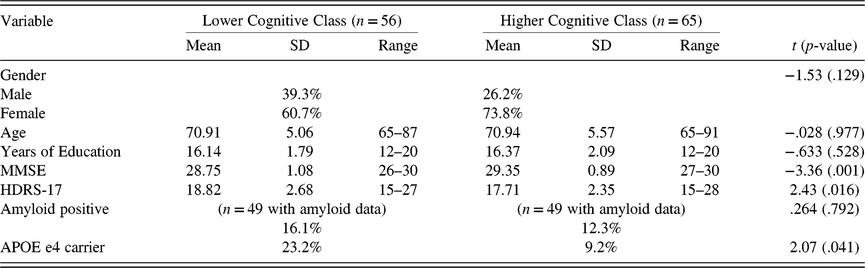
Demographic characteristics by class are presented in Table 1, as well as independent samples t-test differences between classes. Gender and APOE had a significant result on Levene’s test for equality of variances at p < .05 indicating a violation of the assumption of equal variables, and thus equal variances were not assumed for comparison t-tests on those variables. Statistically significant differences were noted between the classes on MMSE and HAMD17, however the numerical differences between means on these variables were negligible (see Table 1).
Demographic characteristics by cognitive class

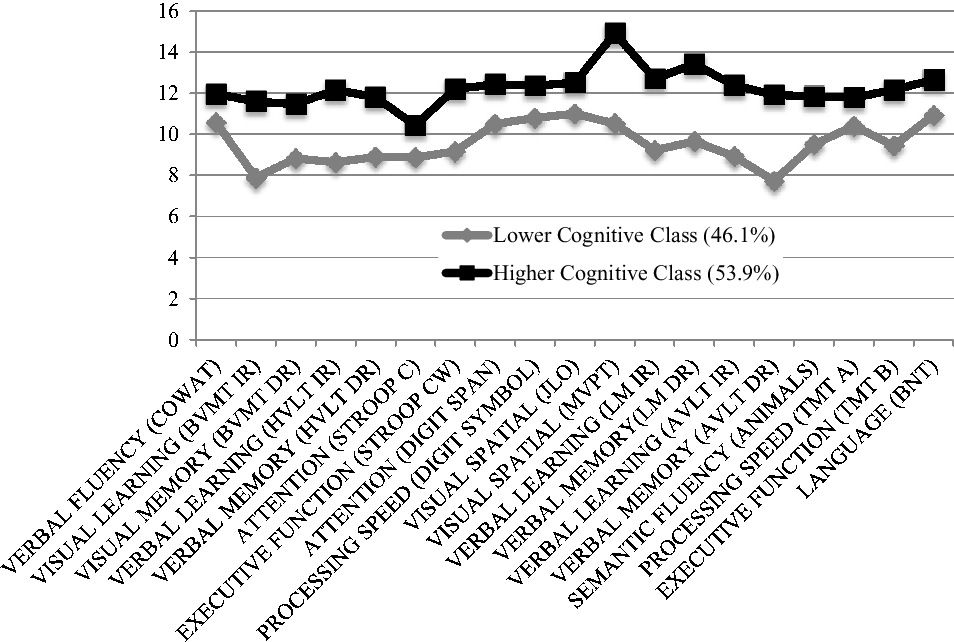
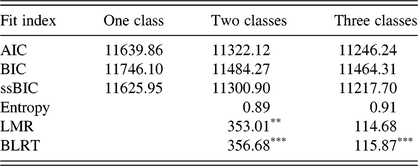
The relative model fit for testing the progressive number of classes is displayed in Table 2, from a one-class model to a three-class model. As previously stated, fit indices as well as theoretical parsimony are used to identify the most descriptive classification model. As shown in Table 2, model fit improves significantly from one to two classes, however the three-class model does not improve the fit to the data above the two-class model on several indicators of fit (e.g. non-significant Lo–Mendell–Rubin test) as well as redundancy to the two-class model in terms of theoretical interpretability and parsimony, leading to the two-class solution as the unconditional model best fitting the data. The first class, the Lower Cognitive Class, comprising 46.1% of the sample, showed, on average, lower cognitive performance across tasks than the Higher Cognitive Class, which comprised 53.9% of the sample. It should be noted that on average, however, both classes performed generally within normal limits on cognitive testing as indicated by scaled scores mostly >7, one standard deviation below the mean (see Figure 1).
Latent classes of cognitive functioning.

Fit statistics for one- to three-class models of cognition

Note. AIC = Akaike information criterion, BIC = Bayesian information criterion, ssBIC = sample-size-adjusted Bayesian information criterion, LMR = Lo–Mendell–Rubin test, BLRT = bootstrap likelihood-ratio test. Italics indicate the best-fitting number of classes. Best-fitting values of Entropy are those closer to 1.0. *p<.05, **p<.01, ***p<.001, ~p>.05.
Conditional Model
Once the two-class model was identified, a conditional model was assessed, testing whether factors of theoretical interest predicted membership in either of the cognitive classes described above. Specifically, age (B = .05, p = .32), gender (B = −.89, p = .17), education (B = −.08, p = .57), depression severity (B = .17, p = .27), age of onset of MDD (B = −.09, p = .93), number of lifetime depressive episodes (B = .09, p = .61), lifetime SSRI use (B = −.01, p = .31), lifetime SNRI use (B = .01, p = .52), amyloid status (B = −.31, p = .63), and APOE e4 allele status (B = 1.61, p = .02) were all assessed as factors in the conditional model. The only factor that predicted class membership was APOE e4, with e4 allele carriers significantly more likely to be in the Lower Cognitive Class than in the Higher Cognitive Class (OR = 4.68). No other predictors were significantly associated with class membership in this analysis.
Post-hoc analyses
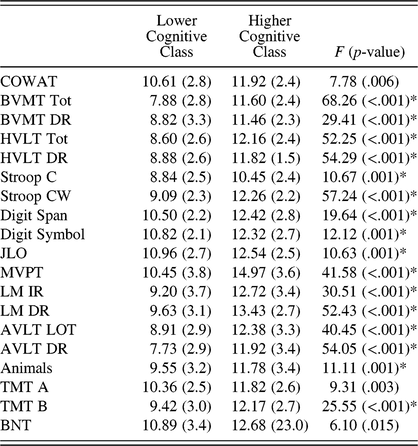
After the unconditional and conditional models were assessed, most likely class membership was assigned to each participant based on their patterns of cognitive performance and used to conduct post-hoc tests of difference between the two classes on all cognitive tasks, with 56 participants assigned to the Lower Cognitive Class and 65 participants assigned to the Higher Cognitive Class based on posterior probabilities (see Table 3). One-way ANOVAs were conducted to assess significant differences between the two classes for most tests, and chi-square tests of independence were conducted for those measures which were found to violate the assumption of homogeneity of variance. On every cognitive test utilized in building the model of cognitive classes, the Lower Cognitive Class performed significantly worse than the Higher Cognitive Class at p < .05, and the majority at p < .001. When Bonferroni corrections for multiple comparisons were applied, the cut-off for statistical significance was p < .003. Performance on most cognitive tests differed between classes at this threshold, with the exception of the COWAT, Trail Making Test Part A (marginal at p = .003), and the Boston Naming Test.
Mean scaled scores (and group differences) for cognitive measures by class

Note. COWAT = Controlled Oral Word Association Test; BVMT Tot = Brief Visuospatial Memory Test Total Recall; BVMT DR = Brief Visuospatial Memory Test Delayed Recall; HVLT Tot = Hopkins Verbal Learning Test Total Score; HVLT DR = Hopkins Verbal Learning Test Delayed Recall; Stroop C = Stroop Color Trial; Stroop CW = Stroop Color Word Trial; JLO = Benton Judgment of Line Orientation Test; MVPT = Motor Free Visual Perception Test; LM IR = Logical Memory Immediate Recall Trial; LM DR = Logical Memory Delayed Recall Trial; AVLT LOT = Auditory Verbal Learning Test Learning Over Trials; AVLT DR = Auditory Verbal Learning Test Delayed Recall Trial; TMT A = Trail Making Test Part A; TMT B = Trail Making Test Part B; BNT = Boston Naming Test
F: One-way ANOVA F statistics
* significant with Bonferroni adjustment for multiple comparisons at <.003
To further evaluate the relationship between amyloid status and APOE e4 allele by class, a chi-square test of independence was performed for amyloid status and APOE e4 status for each cognitive class. For the Lower Cognitive Class, the chi-square test was significant, that is, in the Lower Cognitive Class, there is a significant relationship between amyloid status and APOE e4 allele (χ2 = 21.99, p <.001). For the Higher Cognitive Class, however, there was no relationship between amyloid status and APOE (χ2 = .001, p =.981).
DISCUSSION
The current study assessed latent classes of cognitive functioning in a sample with LLD, as well as clinical and neurobiological predictors of membership in those classes. Results indicated that a two-class model of cognitive functioning best fit the data, with half of the sample demonstrating average or slightly above average performance across cognitive tests and the other half demonstrating performance approximately one standard deviation below the first class, though most of the scores on testing in this class were still considered to be within normal limits. These classes were found to differ significantly in their performance on every cognitive measure, with the Lower Cognitive Class performing below the Higher Cognitive Class. When possible predictors of class membership were assessed, only the presence of an APOE e4 allele predicted membership in the Lower Cognitive Class. Age, gender, education, depression severity, age of onset of depression, treatment history with SSRIs, treatment history with SNRIs, and amyloid status were not significantly associated with either class in this sample.
The presence of a lower functioning cognitive class in the best-fitting model was in line with hypotheses—indeed, the use of LCA allows for the identification of subgroups of cognitive functioning which might otherwise be overlooked given the “average” functioning of this sample as a whole. Even in the context of lower cognitive functioning, the Lower Cognitive Class still performed largely within normal limits on all neuropsychological measures given. However, given the higher level of education in this particular sample, and the lack of demographic or clinical differences between the classes, it is possible that this class may be experiencing a relative decline from a higher functioning baseline, and may be more likely to decline over time than the Higher Cognitive Class. This is particularly salient when considering markers for early identification for those individuals with higher cognitive and educational reserve, who are more likely to have a delayed diagnosis of dementia as a result of their relatively intact functioning despite the presence of neuropathology, and subsequently steeper cognitive decline once a diagnosis is made (Meng & D’Arcy, Reference Meng and D’Arcy2012; Rusmaully et al., Reference Rusmaully, Dugravot, Moatti, Marmot, Elbaz, Kivimaki and Singh-Manoux2017). Because the cognitive profile of the Lower Cognitive Class was largely within normal limits, other clinical or neurobiological indicators that a “relatively intact” cognitive profile might be a risk factor for future cognitive decline would be of great clinical utility.
Contrary to expectations, of all of the demographic, clinical, and neurobiological factors assessed, only the presence of an APOE e4 allele predicted membership in the Lower Cognitive Class. Though depression severity was expected to differentiate the classes within the conditional model of the LCA, the lack of association of severity with class membership suggests lower cognitive performance in this class was independent of depression symptom severity. It was also unexpected that amyloid positivity was not associated with cognitive performance in this sample, as it is generally understood to be a marker for probable Alzheimer’s disease. However, when post-hoc chi-square tests of independence were conducted, it appeared that amyloid status was significantly related to APOE e4 allele for the Lower Cognitive Class, but not the Higher Cognitive Class, suggesting the possibility that amyloid deposition is only related to cognitive impairment in combination with the presence of the APOE e4 allele for some individuals, or only on a particular timeline that is, as yet, inadequately understood.
There are several limitations to note that may inhibit generalizability of the current findings. Most notably, the cross-sectional nature of the design precludes both the ability to determine causality and any understanding of whether membership in a lower cognitive functioning class will in fact increase risk for further cognitive decline. Future longitudinal data from the ADNI-D project will help answer this question, as will the investigation of potential differences between this sample with depression and non-depressed matched controls. Additionally, it is worth noting that depression severity was assessed using a clinician-administered questionnaire, and it is possible that a self-report symptom inventory might have captured other aspects symptomatology that may have related more strongly with cognition (Uher et al., Reference Uher, Perlis, Placentino, Dernovšek, Henigsberg, Mors and Farmer2012). Further research including vascular risk factors and biomarkers like white matter hyperintensities may also help to disentangle risk for decline, although a previous study using LCA failed to show that executive dysfunction was related to a latent profile with more white matter hyperintensities (Sneed, Rindskopf, Steffens, Krishnan, & Roose, Reference Sneed, Rindskopf, Steffens, Krishnan and Roose2008).
In addition, the present findings can be used as a basis for hypothesis testing. Though this study showed the presence of latent subgroups within a sample of individuals all diagnosed with MDD, the likely variability of clinical history and presentation may have obscured associations between aspects of current or historical depression and treatment and cognitive functioning. Additionally, the higher level of overall educational attainment in this sample likely influenced the cognitive classes present in the data, which may have been more numerous or varied in a more demographically heterogeneous sample.
Overall, however, the use of a clinically depressed, cognitively intact older adult sample that underwent comprehensive neuropsychological, clinical, and neurobiological assessment is a significant strength of the present study. Future follow-up in this sample will allow for an assessment of whether membership in the Lower Cognitive Class at baseline is associated with cognitive decline over time, as well as whether the relationship between amyloid and APOE for the Higher Cognitive Class becomes significant in subsequent years. The predictive utility of APOE e4 is being widely investigated as a risk factor for Alzheimer’s Disease in general (Genin et al., Reference Genin, Hannequin, Wallon, Sleegers, Hiltunen, Combarros and Berr2011), with greater validity in the presence of corresponding lower level of cognitive functioning and amyloid positivity, such as the pattern differentially uncovered by class in the present sample. The interaction of APOE and cognition in a clinically depressed sample of older adults is a promising avenue for future research, especially given the relative low cost of genetic testing when compared to amyloid imaging (Caselli, Beach, Knopman, & Graff-Radford, Reference Caselli, Beach, Knopman and Graff-Radford2017). Further assessment of these latent classes, and identification of other possible predictors at different time points in the trajectory of cognitive change over time, will add greatly to understanding of mechanisms and possible avenues for intervention.
CONCLUSIONS
In a sample of older adults with depression, two classes of cognitive functioning were identified, one significantly lower than the other across neuropsychological measures, with APOE e4 allele predicting membership in the Lower Cognitive Class. The Lower Cognitive Class also showed a significant relationship between amyloid status and APOE e4 allele, whereas there was no relationship between these variables for the Higher Cognitive Class. By identifying a subgroup possibly at risk for cognitive decline, as well as potential differences in rate of progression of neurodegenerative process, these findings have promising implications for early identification of those at greater risk. Identifications of subgroups at risk may help identify therapeutic targets and underlying mechanisms in this vulnerable population.
ACKNOWLEDGMENTS
This research is supported by the Department of Veterans Affairs Office of Academic Affiliations Advanced Fellowship Program in Mental Illness Research and Treatment, Sierra Pacific Mental Illness Research Education and Clinic Centers, San Francisco VA Medical Center, and the Department of Psychiatry, University of California, San Francisco.
Research reported in this publication was supported by the National Institute of Mental Health of the National Institutes of Health under Award Number R01MH098062.
CONFLICTS OF INTEREST
Ruth T. Morin: None.
Philip Insel: None.
Craig Nelson: Dr. Nelson consults for Biohaver, Eisai, and Janssen, and on the Janssen advisory board. He receives research support from NIMH and Avid and royalties from UpToDate.
Meryl Butters: None.
David Bickford: None.
Susan Landau: Dr. Landau consults for Cortexyme, Inc. and NeuroVision Imaging.
Andrew Saykin: Dr. Saykin received support from the following NIH grants: U01 AG024904, P30 AG010133, R01 AG019771, R01 LM011360, R44 AG049540, and R01 CA129769. He also received collaborative grant support from Eli Lilly during the conduct of the study. In addition, IU received PET tracer precursor support from Avid Radiopharmaceuticals outside the scope of the submitted work. Dr. Saykin also served on an advisory board for Bayer and received travel support from Neurovision. He also received Editorial Office support from Springer-Nature as Editor-in-Chief of Brain Imaging and Behavior.
Michael Weiner: Dr. Weiner receives support for his work from the following grants: 2U19AG024904, R01MH101472, 1R01AG053798-01A1, P50 AG23501, R01 MH098062 (NIH/NIA/NIMH), W81XWH-12-2-0012, W81XWH-13-1-0259, W81XWH-14-1-0462, W81XWH-14-2-0176, W81XWH-15-2-0070 (DOD), 13-12004 and 16-10054 (CA Dept. of Public Health), 20150802 (Alzheimer’s Disease Discovery Foundation; ADDF), 2015-A-011-NET (Larry L. Hillblom Foundation), PPRN-1501-26817 (PCORI), BHR-16-459161 (Alzheimer’s Association), 174552 (Biogen), as well as funding from the Global Alzheimer’s Platform Foundation (GAP), European Brain Health Registry/NL, Johnson & Johnson, and Monell Chemical Senses Center. Dr. Weiner is a full time Professor of Medicine, Radiology, Psychiatry, and Neurology at the University of California, San Francisco (UCSF) and Principal Investigator of the Brain Health Registry, and many projects with the above grant funding, including Alzheimer’s Disease Neuroimaging Initiative (ADNI). He has served in the Scientific Advisory Boards for Alzheon, Inc., Accera, Merck, Nestle (Nolan), PCORI (PPRN), Eli Lilly, Delfino Logic Ltd. (for Merck), Dolby Ventures, Brain Health Registry, and ADNI. He served in the Editorial Boards for Alzheimer’s & Dementia and MRI. He has provided consulting and/or acted as a speaker/lecturer to Synarc, Pfizer, Accera, Inc., Alzheimer’s Drug Discovery Foundation (ADDF), Merck, BioClinica, Eli Lilly, Howard University, Guidepoint, Denali Therapeutics, Nestle/Nestec, GLG Research, Atheneum Partners, BIONEST Partners, American Academy of Neurology (AAN), and Society for Nuclear Medicine and Molecular Imaging (SNMMI). He holds stock options with Alzheon, Inc. The following entities have provided funding for academic travel; Kenes, Intl., Merck, ADCS, ATRI, Eli Lilly, The Alzheimer’s Association, Merck, Tokyo University, Kyoto University, Rose Li & Associates, AAN, and SNMMI.
R. Scott Mackin: Dr. Mackin receives research support from the National Institute of Mental Health, National Institute of Aging, the Hillblom Foundation, Janssen Pharmaceuticals (research grant), and the Alzheimer’s Association. He has also received travel support from the National Institute of Mental Health for workshop participation.