Hand hygiene was shown to prevent the transmission of infections in healthcare facilities since as early as 1847.Reference Semmelweis 1 However, hand hygiene compliance among hospital staff often remains low.Reference Bukhari, Hussain, Banjar, Almaimani, Karima and Fatani 2 – Reference Larson, Quiros and Lin 8 Improvement projects that rely on promotional campaigns can increase compliance,Reference Dierssen-Sotos, Brugos-Llamazares and Robles-García 9 but they frequently fail to show not only long-term sustainabilityReference Dierssen-Sotos, Brugos-Llamazares and Robles-García 9 but also highReference McGuckin, Waterman and Govednik 10 or improvedReference Marra, D’arco and de Arruda Bravim 11 levels of compliance, and they may lead to uneven improvement among professions.Reference Bukhari, Hussain, Banjar, Almaimani, Karima and Fatani 2 – Reference Erasmus, Daha and Brug 4 , Reference Costers, Viseur, Catry and Simon 12
The World Health Organization (WHO) has recommended a multimodal strategy to improve and sustain hand hygiene compliance, 13 and its effectiveness has been demonstrated.Reference Tromp, Huis and de Guchteneire 14 – Reference Allegranzi, Gayet-Ageron and Damani 18
The Institute for Healthcare Improvement (IHI) has supported health systems in their own initiatives. In doing so, it has developed tools and methods. Among them is the Breakthrough Collaborative concept, defined as an “organized, multifaceted approach to quality improvement”Reference Hulscher, Schouten, Grol and Buchan 19 with “multiple facility-based teams working in parallel, focused on applying change concepts in a single area of care, regularly measuring performance using agreed-upon indicators, and sharing results and best practices through periodic learning sessions.”Reference Franco and Marquez 20 The organizers carry out a literature review on evidence-based strategies to reach breakthrough improvement, and recruit faculty who are then involved in designing and teaching an improvement package. 21 In such collaboratives, teams learn as much from one another as they learn from the organizers; thus, they become a learning community. Breakthrough collaboratives have led to several successful clinical practice changes.Reference Franco and Marquez 20 , Reference Staines, Mattia, Schaad, Lecureux and Bonnabry 22
The current study combines the robust content provided by the WHO 23 , 24 with a simultaneous multicenter implementation strategy using the IHI Breakthrough Collaborative method 21 , 23 , 24 for dissemination and sustainability.
METHODS
Setting
The Hospital Federation of Vaud County, Switzerland, designed and organized the Hand Hygiene Breakthrough Collaborative. The Federation invited its member hospitals to participate. In total, 5 hospitals subscribed, and a sixth, owing to its small size, was paired with 1 of the 5 to be included in the Collaborative as a ward of its partner hospital. These 5 hospitals represent 14 geographical locations and have a cumulative total of 1,152 beds, 4,838 staff members, and 91 wards. Physician staffing includes both employed internal attendings, credentialed consultants, and rotating residents. An additional hospital declined participation because of other projects but agreed to join the baseline and the final compliance measure.
Prior to the Hand Hygiene Breakthrough Collaborative, one of the hospitals had measured hand hygiene compliance, and observed rates ranged from 37% to 73%. The other 4 hospitals had no such data. Swiss nationwide hand hygiene compliance data were obtained from baseline observation conducted by the 2005–2006 Swiss Hand Hygiene campaign, 25 which estimated compliance to be 54%.
The 5 participating hospitals reported hand hygiene–related activities prior to the Hand Hygiene Breakthrough Collaborative: (1) benefiting from at least 1 infection prevention and control (ICP) professional (n=5), (2) monitoring alcohol-based hand rub (ABHR) consumption (n=4), (3) conducting annual hand hygiene training (n=3), (4) implementing a written policy on hand hygiene (n=3), (5) creating a team to manage hand hygiene promotion (n=2), (6) providing compulsory hand hygiene education upon recruitment (n=2), (7) testing knowledge about hand hygiene (n=1), and (8) regularly renewing hand hygiene reminders (n=1). For all 5 hospitals, 47% of all points of care were equipped with an ABHR dispenser (range, 9%–62%).
Hand Hygiene Breakthrough Collaborative and Organization
This Collaborative closely adhered to the IHI’s original Breakthrough Collaborative concept. 21 The goals were to achieve 85% hand hygiene compliance in all participating hospitals after an improvement period of 18 months and to sustain that level after the Collaborative ended. This commitment included an 18-month term of postproject measurement.
All hospitals that registered for the Collaborative committed to attending learning sessions, sharing performance data, allocating resources to the Collaborative, and including all wards in the Collaborative. Each hospital designated a project team consisting of (at least) a head physician, a nursing leader, and an infection prevention specialist. The role of this team was to attend the learning sessions and to spread the improvement interventions within their hospital. Each hospital organized a measurement team, consisting of observers trained by the Collaborative. Each hospital also had a steering committee for the Collaborative.
An information session was held for all project teams to brief them on goal, interventions, and measurement strategy of the Collaborative 3 months prior to initiating the Collaborative. At this session, instruction was also provided on prework, which comprised required readings and a formal assessment by each team regarding the improvement interventions of their hospital at baseline.
Learning session 1 was held over a 3-day period in September 2013, during which teams were provided with all details about the improvement interventions and the measurement strategy. The session involved topical experts on all the 5 modes of intervention. After this first learning session, the hospitals were given 6 months to prepare their interventions and to carry out the baseline compliance observation. The intervention period lasted 18 months (April 2014 to September 2015), during which 6 learning sessions were held.
Improvement Interventions
The Collaborative based its hand hygiene improvement goals on the WHO “5 Moments of Hand Hygiene,” 13 in which staff are expected to clean their hands (1) before touching a patient, (2) before a clean/aseptic procedure, (3) after body-fluid exposure risk, (4) after touching a patient, and (5) after touching a patient’s surroundings.
The intervention design was based on a literature review in which the WHO multimodal strategy was key and relied on 5 elements: (1) system change, training, and education; (2) performance monitoring and feedback; (3) workplace reminders; and (4) leadership and institutional safety climate. (A detailed description of the strategy adaptation to this project is provided in online supplementary Appendix 1.) The Collaborative added a fifth complementary element: sustainability engineering (also described in online supplementary Appendix 1).
Assessing Intervention Effect
The use of a healthcare-associated infection (HAI) rate as an outcome indicator was discussed because all hospitals participated in an annual HAI prevalence study organized by the County’s Infection Prevention and Control (IPC) unit. However, considering hospital size and the average HAI rate of 5%, there would not have been enough statistical power to demonstrate improvement, and the Collaborative did not proceed with that indicator.
Hand hygiene compliance was the primary indicator, measured by ward, profession (ie, nursing staff, physicians, RX-technicians, physiotherapists), and indication for hand hygiene.Reference Sax, Allegranzi, Uçkay, Larson, Boyce and Pittet 26 Compliance was measured by open and direct observation, with no feedback given to teams after observation sessions during baseline but with feedback after observation sessions for the 9 following observation periods. The observers were certified professionals (almost all were registered nurses). The observers were trained centrally by the Federation during a 1-day session by experts from the County’s IPC Unit. WHO training materials (eg, slides and videos of hand hygiene opportunities) were used. For each observer, a test observation period was conducted jointly with an IPC expert, and all differences in interpretation were discussed. A group of experts at the Federation level were organized to act as referees when differences could not be resolved at the hospital level.
Observers were provided with an observation grid, adapted from the WHO material so that it could be scanned centrally. Every 2 months, all hospitals sent their grids for scanning and were provided ratios of actual hand hygiene actions carried out to opportunities for hand hygiene.
A hand hygiene perception survey was conducted before (November 2013) and after the Collaborative period (November 2015) based on the Perception Survey for Health-Care Workers provided by the WHO. 27 The survey was electronically administered and sent to all professionals in contact with patients.
A survey regarding staff perception of the interventions was conducted every 4 months to assess whether and how the improvement interventions reached staff and how staff perceived them. This survey did not use a validated tool. The tool was mainly intended for the hospital teams to improve the dissemination of the interventions. Inventories of hand rub dispensers were conducted in the November months of 2013, 2014, and 2015 to assess compliance to the standard consisting of a ratio of 1 dispenser per point of care (ie, per bed).
Statistical Analysis
Data analyses were performed using STATA version 13.1 software (StataCorp, College Station, TX). Descriptive statistics using proportions were used for perception surveys, compliance observations, and inventories of dispensers per bed. The statistical significance of proportion change was assessed using a 2-proportion z test on the equality of proportions using large-N statistics. The 2-sample Wilcoxon test was used in the perception survey; all tests were considered significant with a threshold of .05.
RESULTS
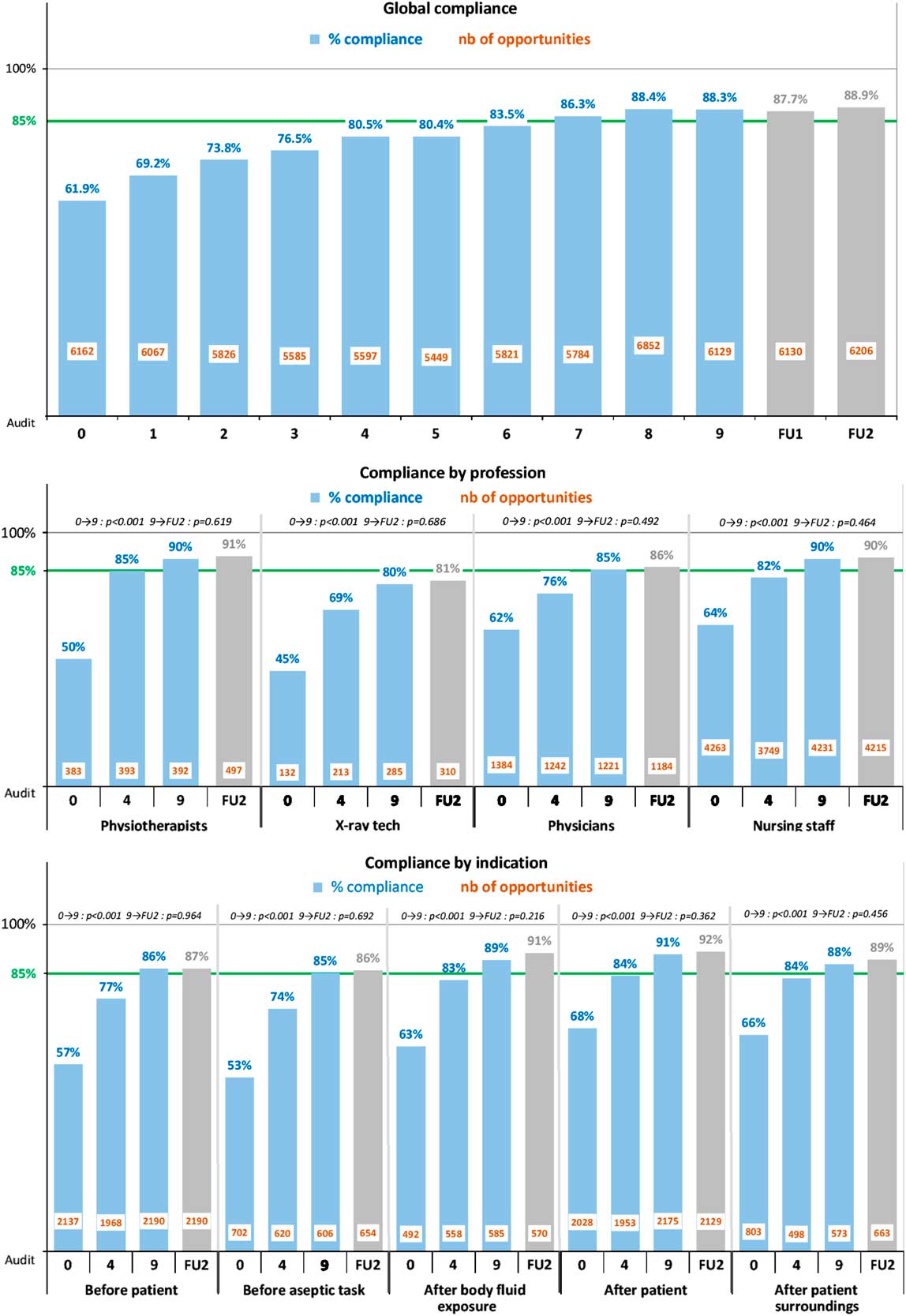
During the collaborative, including baseline, a total 59,272 opportunities for hand hygiene were recorded (mean per observation audit, 5,921; range, 5,449–6,852). Observed compliance increased from 61.9% at baseline (March 2014) to 88.3% upon Collaborative completion (September 2015; P≤.001) (Figure 1).
Trends in hand hygiene compliance (global, by profession and by indication) at baseline audit 0, during intervention (audits 1–9) and at postintervention follow-up (audits FU1–FU2).

Improvements in compliance were maintained after the Collaborative, as demonstrated in the 2 postcollaborative observation sessions conducted 6 and 12 months after intervention completion, respectively. Compliance remained stable from 88.3% to 88.9%, 12 months after the Collaborative concluded (P=.248).
For all professions, compliance improved (all P<.001), and this improvement was sustained during the postproject assessment (all P>.464) (Figure 1). Improved compliance was also observed across all indications for hand hygiene (all P<.001) and was sustained after the project ended (all P>.216) (Figure 1).
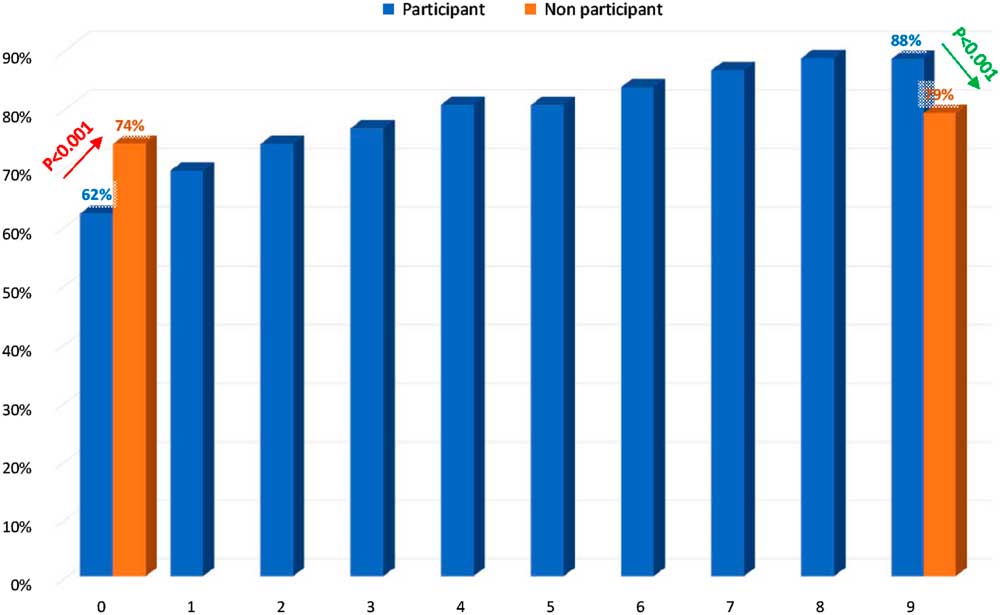
Hand hygiene compliance improved across all participating hospitals during the Collaborative (all P<.001) and was sustained after 12 months in 4 hospitals (all P>.111) and improved further in 1 hospital (P<.001) (Figure 1). The additional hospital that was a Collaborative nonparticipant agreed to carry out baseline and final compliance observations. It showed a modest increase in compliance, from 74% to 79%. This hospital demonstrated a significantly (P<.001) higher compliance level before intervention than all other hospitals participating in the Collaborative during the same period. However, after the intervention, this hospital performed significantly less well (P<.001) than the Collaborative hospitals (Figure 2).
Trends in hand hygiene compliance in participating hospitals compared with compliance levels in a nonparticipating hospital.

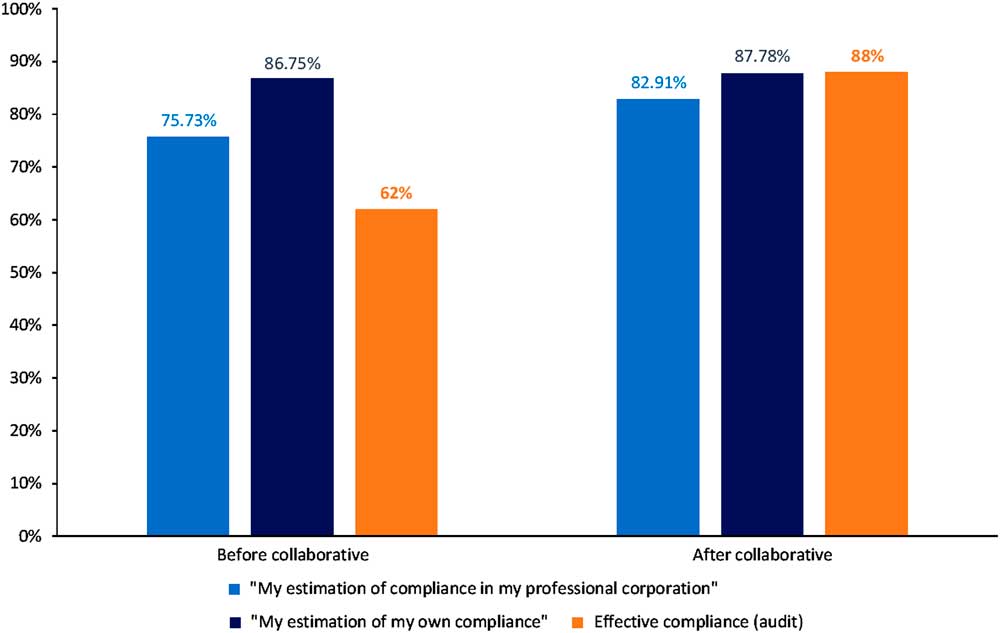
On average, respondents to the first hand hygiene perception survey believed their own compliance to be 86.75% and that of their colleagues to be 75.73%. The average actual compliance assessed through direct observation was 62% (Figure 3). After the intervention, respondents’ estimates of their own compliance increased to 87.78%, while that of colleagues’ compliance increased to 82.91%, and that of directly measured compliance totaled 88% (Figure 3).
Self-estimated and estimates of colleagues compared with directly monitored compliance with hand hygiene before and after intervention.

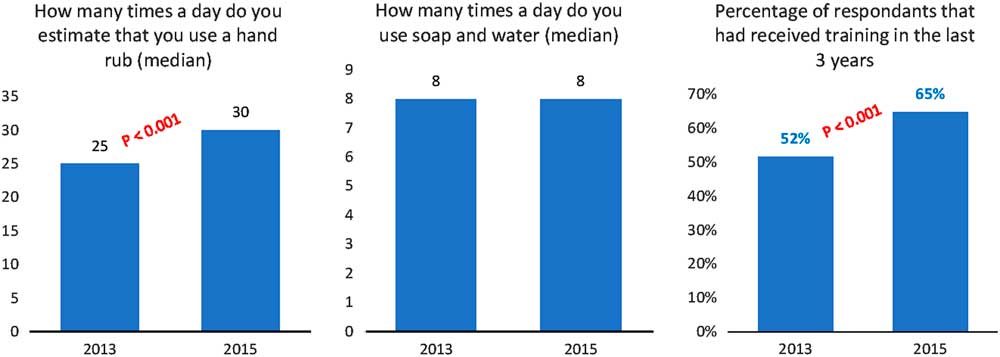
The survey also revealed that the median number of times each day that staff members estimated they carried out hand hygiene increased significantly during the Collaborative. However, their estimate of the number of times they actually washed their hands with soap and water remained stable (Figure 4).
Estimates of the frequency of use of alcohol-based hand rub and soap and water handwashing, as well as percentage of respondents who received hand hygiene training before (2013) and after (2015) intervention.

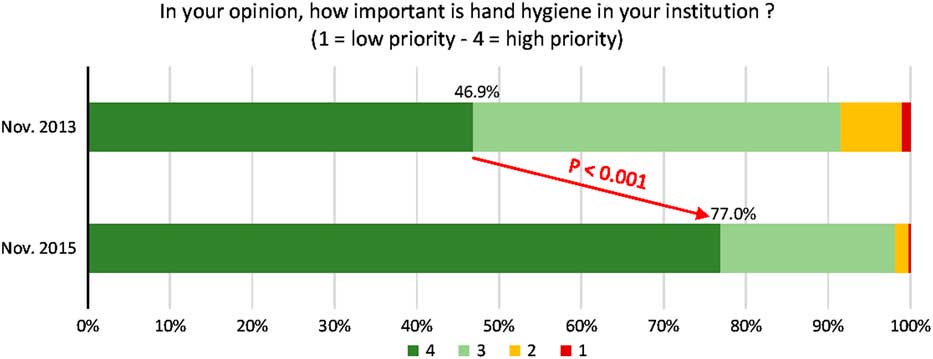
The proportion of respondents who stated that they had received hand hygiene training within the past 3 years increased from 52% to 65% before and after the Collaborative, respectively (P<.001). The percentage of respondents who rated the importance of hand hygiene at their institution as a high priority increased significantly following the intervention (Figure 5).
Respondent ratings of hand hygiene as institutional priority before (2013) and after (2015) intervention.

The proportion of ABHR dispensers that were accessible (ie, within reach at points of care) increased from 45.4% before the Collaborative (November 2013) to 67.7% during the Collaborative (November 2014; P<.001). This ratio increased further (73.8%) after the Collaborative (November 2015; P=.005 between November 2014 and November 2015).
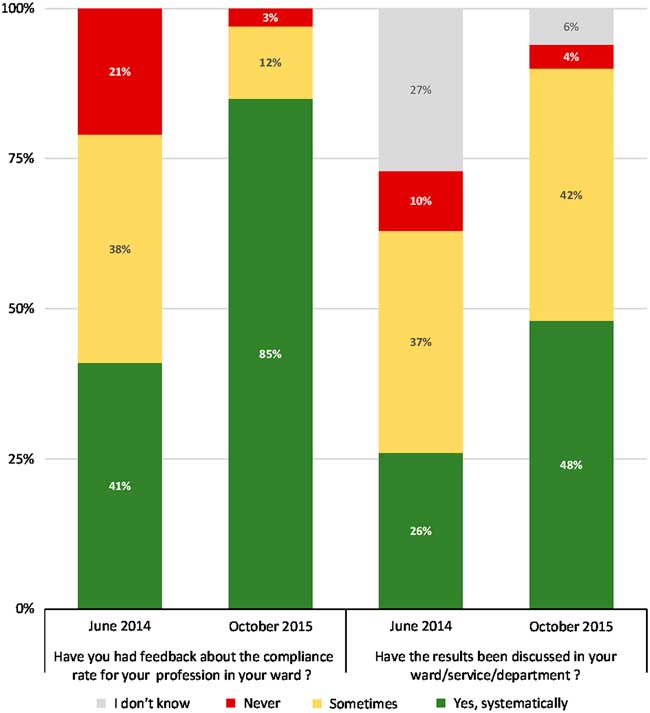
In the survey about the perception of the interventions, at the beginning of the Collaborative, 41% of staff members reported having systematically received feedback about the compliance rate for their profession at the ward level. This statistic increased to 85% upon completion of the Collaborative (P<.001). Similarly, the proportion of staff who stated that these results had been systematically discussed in their ward rose from 26% at the beginning to 48% upon completion of the Collaborative (P<.001) (Figure 6).
Hand hygiene feedback at the ward level as a result of intervention. Participant perception survey.

DISCUSSION
The Collaborative relied on intense feedback to staff. Hence, frequent observations were conducted in every ward over an extended period of 18 months. This duration was selected because it was hypothesized to be the minimum time needed for staff to believe that change would be maintained and would not disappear, as had occurred in many previous campaigns. Overall, more than 59,000 opportunities were observed and allowed high statistical power in detecting improvements in compliance. The initial increases in compliance after baseline were the highest and easiest to obtain. However, subsequent percentage increases became more difficult to obtain. The overall objective of 85% compliance was reached 14 months into the project.
Being aware that sustainability is a key challenge in quality improvement,Reference Wiltsey Stirman, Kimberly, Cook, Calloway, Castro and Charns 28 the organizers of the Collaborative heavily promoted engineering sustainability and designated it as an explicit reinforcement of the multimodal strategy. This emphasis may explain the stability of the compliance during postproject observations. Sustainability may also be explained by the fact that compliance improvement was observed across all hospitals, all professions, and all indications for hand hygiene. Thus, compliance was not dependent on a single leading profession or hospital.
The Collaborative reached its goal of 85% compliance 4 months before its completion. The final compliance measurement was 88.3%. At that time, the organizers anticipated that sustaining this measurement might not be achievable. However, this anticipation was unfounded, with results reaching 89.1% compliance 12 months later. Sustainability, reported only infrequently in the literature,Reference Allegranzi, Gayet-Ageron and Damani 18 , Reference Pittet, Sax, Hugonnet and Harbarth 29 remains a challenge in hand hygiene promotion. 13 Recently, hospitals and the WHO have proposed creative IPC activities to combat “campaign fatigue,”Reference Seto, Cowling and Cheung 30 which proved to be efficacious in several instances.Reference Tartari, Pires and Bellissimo-Rodrigues 31 The results from this Breakthrough Collaborative are promising, and long-term compliance monitoring will provide further information about the success of this strategy.
The hospital that was a Collaborative nonparticipant showed significantly higher compliance than the Collaborative hospitals at baseline. During the Collaborative, this hospital confirmed that it applied only its usual routine and introduced no intervention. Despite this, its average compliance improved significantly (P<.001) but to a much smaller extent than that in hospitals participating in the Collaborative. This resulted in significantly lower compliance than the other hospitals participating in the Collaborative after the intervention. While this hospital does not constitute a formal control group, these observations are nevertheless interesting.
The first hand hygiene perception survey showed that staff substantially overestimated their hand hygiene compliance. This finding served as a helpful insight for the members of the Collaborative. It helped chief executive officers (CEOs) and other senior executives understand that low compliance was not due to ill intentions but to a lack of knowledge and understanding of the indications for hand hygiene, which in turn was due to a lack of feedback on compliance. Thus, hand hygiene was clearly demonstrated to be a systems issue to be solved by management. The improvement interventions were adjusted, taking this performance feedback problem into account by emphasizing feedback on compliance. Interestingly, the gap between self-estimated compliance and actual observed compliance disappeared upon Collaborative completion, suggesting that regular feedback may have contributed to aligning the perception of compliance with reality.
The finding that only 45% of the respondents reported finding an ABHR dispenser within reach at points of care raised another systems issue: providing the optimal infrastructure. This problem helped convince management to invest in supplying 1 dispenser per bed rather than 1 per room. However, great variability between hospitals was evident considering the time it took for the whole process of dispenser installation to be completed, including deciding to invest in dispensers, choosing the dispensers, ordering, receiving, and installing them. Some hospitals managed this process within 6 months, whereas one did not manage to implement the same process by Collaborative completion. The increase in the number of dispensers installed was reflected in the inventory, with the rate of dispensers per bed increasing from 45% to 74%.
Alcohol-based hand rub (ABHR) was promoted, both through mural and individual pocket-sized dispensers. The median estimated number of daily uses of ABHR increased from 25 to 30 during the Collaborative. However, this increase is likely underestimated because staff members were informed that they could omit instances where they performed unnecessary hand hygiene. Hand washing using soap and water, which was not the target of the Collaborative, remained at an estimated frequency of 8 per day before and after the Collaborative.
The percentage of respondents who stated that they had received training within the last 3 years increased by 13%. This result possibly reflects the deployment of the e-learning modules as well as education on the topic.
We hypothesize that intervention aimed at engaging leadership is key to explaining the substantial increase in the rate of respondents who stated that hand hygiene is highly important at their institution. We observed variability across hospitals regarding intensity of leadership engagement, but in most hospitals, the intensity was substantial. The enhanced perception regarding importance of hand hygiene also provided the foundation for the sustainability of improved compliance. The overall perception of the usefulness of the Collaborative appeared to reflect that that its meaning became understood among staff.
The Collaborative insisted on reporting and discussing compliance results as performance feedback to the wards. This process was assessed through the intervention perception surveys conducted every 4 months. Comparing the results of the first and the final surveys, the rate of responders who perceived systematic feedback more than doubled from 41% to 85%. Furthermore, the rate of responders who perceived that the results were being systematically discussed almost doubled from 26% to 48%. This performance feedback is likely an important contributing factor to compliance improvement.
Study Strengths and Limitations
Key strengths of this study are the large number of opportunities observed and post-project compliance measurements. The limitations of this study include the absence of both a measured impact on HAIs and of a formal control group. We do not know whether the informal control group was representative of what may have occurred in the absence of a Collaborative. However, we can only speculate that, if that control group was representative, the Collaborative considerably accelerated and consolidated improvement. Other limitations are linked to the open and direct observation methodology: the visible presence of the observer might generate a change in staff behavior. This, however, could play a role at baseline as well as later during the project; it may explain not only higher compliance but also the observed sustained improvement in compliance. Furthermore, observations were conducted during standard office hours, excluding nights and weekends. We therefore cannot draw conclusions about the staff compliance after hours.
This study assesses the implementation of a rigorously conducted multi-center project combining the Breakthrough Collaborative method for its organization and the WHO multimodal strategy for improvement package content as well as for measurement. It shows that this combination can be associated with significant and substantial improvement in compliance across all participating hospitals, all professional categories and all indications for hand hygiene.
ACKNOWLEDGMENTS
Financial support. No financial support was sought or received for this study.
Potential conflicts of interest. A.S. and I.A. are employed by the Hospital Federation of Vaud. All other authors report no conflicts of interest relevant to this article.
SUPPLEMENTARY MATERIAL
To view supplementary material for this article, please visit https://doi.org/10.1017/ice.2017.180.