Introduction
An earthquake can suddenly strike a region and potentially cause mass injury and death, requiring a readiness to respond by health care workers. Earthquakes are an acknowledged science-based risk for many geographic regions of the world. Seismic events require an extraordinary response from a multitude of agencies and the general public. Therefore, public health efforts focus on preventing and minimizing injuries. Disaster preparedness involves (1) practicing behavioral responses taken at the onset of shaking, (2) establishing emergency response plans and storage of supplies, and (3) mitigating buildings to enhance structural integrity. Reference Jones, Bernknopf and Cox1 Leading these efforts since 2008 are the Great ShakeOut Earthquake Drills being held annually in regions across North America and spreading worldwide. 2 Although earthquake-prone areas of the Western United States and Alaska conducted drills in public schools for decades, the new ShakeOut campaign provides a novel opportunity to build resilience across communities. Using repeated and consistent messaging, the campaign reminds the public of preparedness and the essential behavioral response to drop, cover, and hold on. 2
Registered nurses are essential and reliable responders to disasters with an ethical commitment to caring for patients while also protecting their own right to self-preservation. 3 Numerous studies demonstrate the need for adequate training of nurses for post-disaster response and recovery from earthquakes with an assumption that nurses would not be casualties. Reference Kalanlar4-Reference Shapira, Aharonson-Daniel and Bar-Dayan6
The American Association of Colleges of Nursing (AACN) Essentials of Baccalaureate Education recommends curriculum content on emergency preparedness and disaster response, which includes self-protection. 7 To date, there is a paucity of research on nurses’ own disaster preparedness and their knowledge of recommended behavioral responses and safety measures for seismic activity. Undoubtedly, an uninjured and well-trained nursing workforce is needed for an effective disaster response.
This study aimed to assess emergency preparedness and the preexisting level of knowledge of self-protective behavioral responses to an earthquake in baccalaureate nursing students. The results of the study could be used to enhance educational curricula to ensure a viable workforce for response and recovery to an earthquake disaster.
Methods
Study Design and Sample
This descriptive study employed a cross-sectional survey administered to students enrolled in an accredited baccalaureate nursing program located in a seismically active region of the Western United States. During fall semesters 2014–2016, a voluntary survey was administered to assess preexisting knowledge in the nursing students regarding earthquake safety. The survey was collected before the start of an optional classroom activity to prevent interactions between students. Small groups of nursing students who were educated by the state’s ShakeOut Drill director, taught their peers about regional earthquake risk, the importance of emergency preparedness, myths vs facts, and the recommended self-protective actions during an earthquake. Templates of family emergency plans (FEP) were also distributed. The classroom activity ended with a simulation (ShakeOut Drill), which prompted the attendees to demonstrate appropriate behavioral responses to an earthquake scenario. Therefore, a post-educational survey was omitted.
Surveys were offered to groups of junior and senior nursing students with control to prevent any group from being resurveyed as they progressed through the program. Survey responses were anonymous without demographic profiles to protect the identity of individual students.
Survey Development
The Earthquake Safety Survey was developed in 2014 by the researcher, based on ShakeOut Drill recommendations endorsed by the US Federal Emergency Management Agency. 2 Preexisting surveys regarding recommended self-protective responses during earthquakes were not available in the literature or from federal agencies at the time of survey development. The survey consisted of 10 independent questions: 3 dichotomous yes/no, 6 behavioral response-based dichotomous questions, and 1 multiple choice. The questions addressed the participants’ perception of being prepared, actions toward preparedness, and knowledge of responsive self-protective actions to be undertaken during an earthquake. The survey’s readability was a Flesch–Kincaid Grade Level of 2.6 in the English language. The paper-and-pencil survey was pretested by 7 nursing students and > 50 senior citizens during an educational event to ensure that all questions were clearly written, readable, and the response options were comprehensive, mutually exclusive, and could be easily marked. No demographic variables of respondents were included.
Data Analysis
Descriptive statistics for the survey responses were presented as frequencies (n) and proportions (%). To determine similarities and differences between subgroups of respondents, the chi-square analysis was used with P values < 0.05 considered as significant, or the odds ratio (OR) was employed for dichotomous variables using a 95% confidence interval (CI) for significance testing. Data were analyzed using the Statistical Package for the Social Sciences (SPSS), version 24, for Windows (IBM Corp, Armonk, NY).
Results
A total of 274 nursing students participated in the survey. The participation rate was 93% of the eligible nursing program’s student body, which included 295 adults with a mean age of 29.95 (±2.1) years. Most students self-identified as female gender (84%) and, for race, as white non-Hispanic (83%), white Hispanic (9%), Asian (5%), and black (3%).
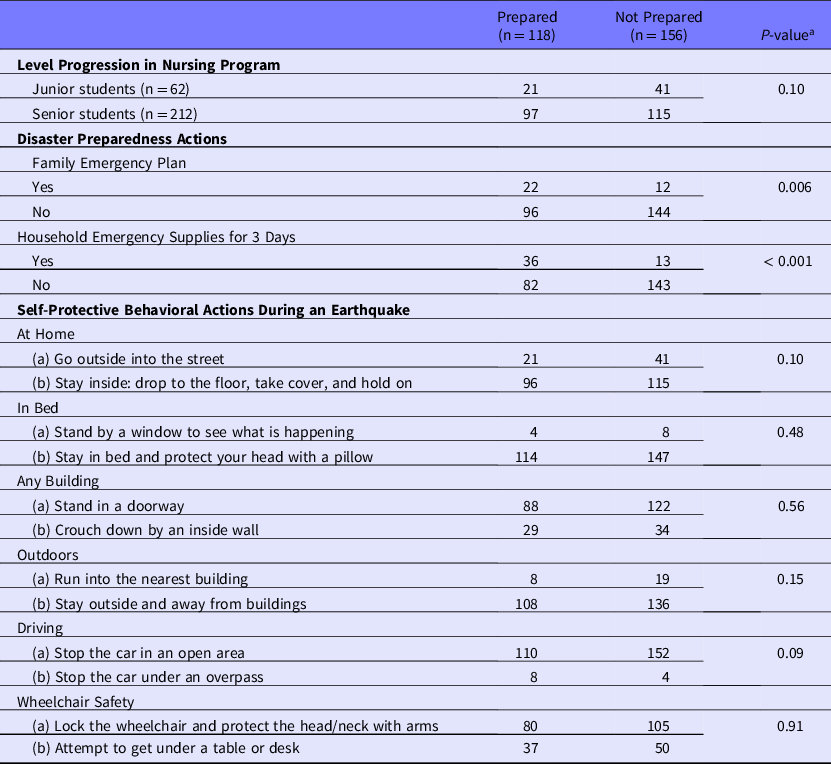
Most nursing student respondents did not feel prepared for an earthquake event and did not have an existing FEP or emergency supplies (Table 1). Among those respondents who felt prepared (Table 2), there was over a doubling of odds for having an FEP (OR = 2.75; 95% CI: 1.30–5.82; P = 0.006), and prepared students were nearly 5 times as likely to have emergency supplies (OR = 4.83; 95% CI: 2.42–9.63; P < 0.001) than unprepared students. However, no significant differences related to preparedness were found for self-protective actions or for between educational levels of students (see Table 2) nor for between the years of data collection (P = 0.64).
Baccalaureate nursing students’ responses to the earthquake safety survey (N = 274) a

a Percentages were calculated based on N.
Comparison of nursing students self-identified as prepared verses unprepared for an earthquake

a Chi-square P-value comparing observed and expected frequencies.
The recommended ShakeOut self-protective actions were correctly identified by most students (see Table 1), including (1) staying inside – drop to the floor, take cover, and hold on; (2) staying in bed; and (3) staying outside and away from buildings. Non-recommended behavioral response actions considered hazardous were chosen by some students, most notably standing in a doorway and going outside of the home into the street. Fewer proportions of students selected other hazardous actions, including (1) running into a building, (2) standing by a window, and (3) stopping a car under an overpass.
Regarding safety for persons in wheelchairs, two-thirds of the nursing students correctly selected locking the wheelchair and protecting the head and neck. There was a significant difference between educational level regarding wheelchair safety. Senior nursing students were twice as likely to lock the wheelchair than junior students (OR = 2.11; 95% CI: 1.18–3.78; P = 0.011). Those nursing students who knew to stay inside; drop, cover, and hold on were also more likely to lock a wheelchair (P = 0.012) than students who would go outside into the street. Still, 73% of these students selected the unsafe action of stand in a doorway instead of crouch down by an inside wall, and 12% thought to run inside the nearest building for safety instead of stay outside and away from buildings.
Discussion
It is imperative for nurses to not sustain injuries and be able to fully respond when an earthquake disaster occurs. This initial study indicates a lack of personal emergency preparedness in a sample of baccalaureate nursing students living in a seismically active region of the United States. The findings also suggest the lack of knowledge of current recommended self-protective responses as indicated by several hazardous actions the respondents would perform during seismic activity. Therefore, nursing students need to be educated for not only the nursing care provider’s role during a disaster response, but also for disaster preparedness and recommended actions for self-preservation.
Less than half of the nursing students in the current study felt prepared for an earthquake. This finding is consistent with studies on perception of self-preparedness for a disaster in both nursing students Reference Kalanlar4,Reference Schmidt, Davis and Sanders5 and the general public. 8 An interventional study to improve disaster knowledge and preparedness with Turkish undergraduate nursing students found a substantial majority (88% to 97.2%) reported not feeling prepared for a disaster prior to training. Reference Kalanlar4 In addition, a cross-sectional survey of 1348 respondents (3% response rate) from the United States National Student Nurses Association explored students’ level of disaster preparedness. Reference Schmidt, Davis and Sanders5 Their findings also indicated a general lack of overall preparedness, although 42.5% reported having a personal disaster plan and 20.3% had a 3-day emergency supply bag. Reference Schmidt, Davis and Sanders5 These results nearly match the findings of the current study of 43% and 18%, respectively. Moreover, the preparedness findings of both of these studies with nursing students in the United States are nearly equal to the 2017 Federal Emergency Management Agency’s National Household Survey results on preparedness in America, which found that 42% of the general population perceived being prepared for a disaster. 8
The general assumption is that health care professionals know how to safely react during an earthquake. The current study’s results support this assumption and provide a unique insight into nurses’ preexisting knowledge of personal safety actions taken during an earthquake. Most nursing students (77%) appropriately selected drop, cover, and hold on as an immediate response to seismic shaking. This finding is consistent with a study of hospital trauma nurses’ response to work and knowledge of self-protective actions during an earthquake. Reference Shapira, Aharonson-Daniel and Bar-Dayan6 The researchers found that 75% of Canadian nurses, compared to 25% of Israeli nurses, would take cover underneath a table/furniture or sit close to an internal wall and protect the head. Reference Shapira, Aharonson-Daniel and Bar-Dayan6
An outdated, long-standing belief held by the public is that standing in a door is the safe and preferred action during an earthquake. Reference McBride, Becker and Johnston9 Prior to current recommendations, standing in a doorway was advised. Reference McBride, Becker and Johnston9 The current study indicates that this outdated recommendation was still believed by three-fourths of the nursing students, similar to findings from a 2004 study that found most Southern California college students would seek shelter in a doorway. Reference Whitney, Lindell and Nguyen10 Therefore, increased awareness is needed for the recommended response – drop, cover, and hold on – instead of stand in a doorway.
The current study provides new findings not yet described in the literature, including knowledge of wheelchair safety and actions while driving. Nurses routinely lock wheelchairs when not transporting patients, and self-locking is routine for persons who use wheelchairs. Attempts to extract oneself or pulling a patient out of a wheelchair during an earthquake could result in injuries. 2,Reference McBride, Becker and Johnston9 The novel finding in the current study of a higher level of nursing education associated with appropriate actions is plausible. Senior nursing students received more didactic education and clinical experiences than junior-level students, therefore they would be more likely to practice wheelchair safety. Regarding seismic activity while driving, ShakeOut recommendations include pulling over and stopping a car in an open area. 2,Reference McBride, Becker and Johnston9 Some nursing students believed it safer to stop the car under an overpass. However, seismic ground motion and shaking could result in a bridge collapse. Reference Jones, Bernknopf and Cox1,2
The study has implications for enhanced nursing curriculum along with continued efforts for the public at large. Most nursing students were from a seismically active region and had likely participated in earthquake drills during K-12 education. Therefore, their level of emergency preparedness and beliefs of self-protective actions would be reflective of the public and general university students, unless influenced by nursing curricula. Yet, these data indicate unpreparedness, inaccurate beliefs about safe actions, and suggest a need for enhanced knowledge in the nursing workforce. Accordingly, nursing schools have an opportunity to integrate content that promotes personal emergency preparedness and self-preservation. Education on regional-specific environmental risks should be incorporated into a school’s disaster curricula supported by the AACN Essentials of Baccalaureate Education for Professional Nursing Practice. 7 Schools of nursing, along with hospitals and clinics, should participate in ShakeOut Drills to reinforce safety and build resilience in health care communities. Ongoing efforts that prepare the public for disasters will enhance preparedness in the nursing workforce.
Strengths of this study included the 93% participation rate and multiple year time frame, which limits the potential for participation bias within the sample. Study limitations include the descriptive cross-sectional design and the single sample site, which reduces the external validity of these findings and may not reflect the students and curricula of other baccalaureate nursing schools. This study also involved self-reported survey data and is thus subject to the limitations associated with survey research.
Conclusion
A readiness to respond by the nursing workforce is critical to disaster response and improved population health outcomes. These findings imply that nursing students are no more prepared than the general public. Enhanced efforts by nursing schools are needed to increase nurses’ preparedness and knowledge of recommended actions for self-preservation during earthquakes.
Conflict(s) of Interest
The authors declared no potential conflicts of interest with respect to the research, authorship, and/or publication of this paper.
Ethical Standards
This study was approved by the University of Nevada, Reno, Institutional Review Board.