




No CrossRef data available.
Article contents
Normative data for the Animal, Profession and Letter M Naming verbal fluency tests for Dutch speaking participants and the effects of age, education, and sex
Published online by Cambridge University Press: 23 January 2006
Abstract
Previous research has indicated that performance on verbal fluency tests (VFTs) is influenced by language and/or culture. Consequently, normative VFT data for English-speaking people cannot be used for people for whom English is not their first language. The aim of the present study was to provide normative data for the Animal Naming, Profession Naming, and Letter M Naming (four-letter words beginning with the letter M) VFTs for Dutch-speaking populations, based on a large sample (N = 1856) of healthy men and women aged 24–81 years of different educational levels. The results showed that age affected the performance of all VFTs profoundly, but the age effect was not uniform: in the Profession and Letter M Naming VFTs, performance was stable in young adulthood but declined strongly after age 50. In contrast, in the Animal Naming VFT, performance appeared to decline linearly, starting early in life. Furthermore, males had higher scores than females on the Profession Naming VFT, and higher educated participants outperformed their lower educated counterparts on all three VFTs. Regression-based normative data were prepared for the 3 VFTs, and the advantages of using a regression-based normative approach instead of a traditional normative approach are discussed. (JINS, 2006, 12, 80–89.)
Information
- Type
- Research Article
- Information
- Journal of the International Neuropsychological Society , Volume 12 , Issue 1 , January 2006 , pp. 80 - 89
- Copyright
- © 2006 The International Neuropsychological Society
INTRODUCTION
In Verbal Fluency Tests (VFTs), testees are required to generate, typically within 60 s, as many words as possible that belong to a certain category (Lezak et al., 2004). Two types of VFTs are usually distinguished, namely phonemic VFTs (in which the participants are asked to generate words beginning with a given letter) and semantic VFTs (in which an individual is asked to recite examples of a given category, e.g., animals). From a psychometric viewpoint, VFTs have been used to investigate a variety of cognitive processes, for example, word knowledge, access to semantic memory, long-term verbal memory, attention (Crowe, 1998; Ruff et al., 1997), speed of information processing, vocabulary size, working memory, inhibition of irrelevant words (Sergeant et al., 2002), and, executive functioning (Henry & Crawford, 2004; Mitrushina et al., 1999). A diminished VFT performance has been associated with a variety of pathological conditions including Alzheimer's disease (Pachana et al., 1996), schizophrenia (Crawford et al., 1993), Parkinson's disease (Flowers et al., 1995), depression (Videbech et al., 2003), traumatic brain injury (Raskin & Rearick, 1996), and HIV-associated dementia (Woods et al., 2004). In fact, VFT performance has been used in the differential diagnosis of Alzheimer disease and ischemic vascular dementia (Tierney et al., 2001).
To be used in a meaningful way, it is important that appropriate normative data are available for these tests. Different studies have provided normative data for VFTs for English-speaking people (for an overview, the reader is referred to Mitrushina et al., 1999), but these norms cannot be used for people who speak a different language because linguistic factors affect VFT performance. With respect to semantic VFTs, Kempler et al. (1998) found that Spanish speakers generated the smallest number of animal names in comparison to Chinese and English speakers, and Vietnamese speakers generated the most animal names. The researchers related these differences to differences in the length of words for animal names in these languages, with animal names being longest in Spanish and shortest in Vietnamese. Studies with phonemic VFTs on the other hand suggested that the difference in the number of generated words was related to the frequency of words beginning with the given letter in a language: Spanish speakers generate fewer words beginning with the letters F, A, and S in comparison to English speakers because these letters are less common in Spanish than in English (Loewenstein et al., 1994; Loewenstein & Rubert, 1992; Lopez & Taussig, 1991). In addition to these linguistic factors, culture-specific factors, such as the degree of familiarity of testing (Ardila, 1995), may also affect semantic and phonemic VFT performance.
The aim of the present study was to provide normative data for the Animal Naming, Profession Naming, and Letter M (four-letter words beginning with the letter M) naming VFTs for Dutch-speaking participants, using a large sample (N = 1,856) of cognitively intact participants aged 24–81 years. In normative studies, it is important to identify which variables influence test performance (Lezak et al., 2004). Previous research suggested that phonemic fluency tends to be relatively resistant to the effects of aging (Harrison et al., 2000; Ivnik et al., 1996; Mathuranath et al., 2003; Tomer & Levin, 1993; but see Auriacombe et al., 2001), whilst semantic fluency is suggested to decline with age (Auriacombe et al., 2001; Benito-Cuadrado et al., 2002; Crossley et al., 1997; Harrison et al., 2000; Kosmidis et al., 2004; Lee et al., 2004; Mathuranath et al., 2003; Tomer & Levin, 1993). Results regarding the influence of education on VFT performance are less clear-cut, with some studies reporting little impact of education on either semantic or phonemic VFTs (Harrison et al., 2000) and others reporting effects of education on both types of VFTs (Kosmidis et al., 2004; Mathuranath et al., 2003; Ratcliff et al., 1998). Sex differences in VFT performance are generally not observed (Benito-Cuadrado et al., 2002; Harrison et al., 2000; Lee et al., 2004; Mathuranath et al., 2003), but some studies reported a modest effect of sex on the performance of semantic VFTs (Auriacombe et al., 2001; Kosmidis et al., 2004) or semantic and phonemic VFTs (Tombaugh et al., 1999). Ruff and colleagues (1996) suggested that sex might moderate the effect of education.
Thus, in the present study, we first established to what extent age, sex, and/or education influences performance on the different VFTs in our Dutch-speaking sample, in order to correct normative data for these variables.
METHODS
Research Participants
The data used for this study were derived from the Maastricht Aging Study, a prospective study of the determinants of usual cognitive aging (Jolles et al., 1995). Participants were recruited from the Registration Network Family Practices (RegistratieNet Huisartspraktijken, RNH), which contains the demographic and health characteristics of 80,000 people who live in the province of Limburg in the Netherlands. A total of 10,396 individuals aged between 24 and 81 years were randomly drawn from the register and were screened for medical pathology known to interfere with cognition (cerebrovascular pathology, all tumors of the nervous system, multiple sclerosis, all types of epilepsy, parkinsonism, dementia, organic psychosis, schizophrenia, affective psychosis, and, mental retardation). These people were told about the study by their general practitioner (which was expected to improve compliance) and were asked to return a prepaid postcard indicating their willingness (or not) to participate in the study. A total of 4,490 people agreed to participate in the study (3,531 individuals refused to participate and 2,375 individuals did not return the postcard). These people were screened in a semi-structured interview to check for additional exclusion criteria that were not coded in the RNH (i.e. a history of transient ischemic attacks, brain surgery, hemodialysis for renal failure, electroconvulsive therapy, and, chronic psychotropic drug use), which led to the exclusion of a further 301 participants. Of the remaining 4,189 participants, 1,856 were randomly selected from 12 age categories (25 ± 1 years, 30 ± 1 years … 80 ± 1 years) for participation in the study.
Not all data for the 1,856 participants were analyzed: a score below 24 on the Mini-Mental State Examination (Folstein et al., 1975), the occurrence of technical problems during test assessment, and the occurrence of more than five errors or repetitions in at least one VFT resulted in exclusion. In this way, unreliable data or data from participants who could not be regarded as cognitively intact were not used. After these corrections—which excluded an additional 31 participants—the data of 1,825 participants were available for the analysis. Basic descriptive data for the sample are provided in Table 1. Level of education (LE) was assessed by classifying formal schooling according to a system often used in the Netherlands (De Bie, 1987) and which is comparable with the International Standard Classification of Education (UNESCO, Paris, 1976). The participants were grouped as follows: those with at most primary education (LE low), those with junior vocational training (LE average), and those with senior vocational or academic training (LE high). These three levels of education corresponded with an average (± SD) of 8.59 ± 1.92, 11.39 ± 2.50, and 15.23 ± 3.31 years of full-time education, respectively. Using LE as a measurement of education instead of years of education has the advantage that qualitative considerations are taken into account in addition to quantitative considerations (Houx et al., 1993). All participants were native Dutch speakers and all were of White ethnicity.
Descriptive characteristics of the sample (N = 1825)

Procedure and Outcome Measures
All participants were individually tested at the neuropsychological test laboratory of the University Hospital Maastricht. In all cases, the participants were asked to name as many words as possible belonging to a restricted category in 60 s. Three VFTs were administered in a fixed order, one after the other, namely the Animal Naming, Profession Naming, and Letter M Naming (four-letter words beginning with the letter M) VFTs. The total number of correct, nonrepeated words was scored for each VFT.
The Animal, Profession, and Letter M Naming VFTs were used in the present study because these VFTs are frequently administered in the Netherlands (see, e.g., Hurks et al., 2004; Luteijn & Van der Ploeg, 1983; Schmitt et al., 2000). In the Letter M Naming VFT, we added an extra search criterion (four-letter words; see also Thurstone, 1938) to the one that is usually evoked in standard phonemic VFTs (words beginning with a certain letter). This was done because the focus of the Maastricht Aging Study is primarily on age-related changes in cognition (Jolles et al., 1995), and previous research with standard phonemic VFTs showed that performance was relatively resistant to the effects of aging (see above). As was observed with many neuropsychological tests, age differences in performance increase as the complexity of the task increases (Salthouse, 1992, 1996). Thus, in order to increase the probability of observing age-related differences in Letter M naming performance, we increased the task complexity by adding the four-letter search criterion.
The tests were administered by five test assistants who had been intensively trained in test administration by the neuropsychologists and physician of the project staff. Members of the project staff visited the test assistants at least once a week to ensure uniform test administration and data collection.
Data Analysis
Multiple linear regression models were fitted for the VFT scores using a step-down hierarchical procedure with as predictors age, age2, sex, LE (dummy coded with two dummies and LE average as the reference category), including all possible two-way interactions. Age was centered (age = calendar age − 50) before computing the quadratic terms and interactions to avoid multicollinearity (Marquardt, 1980). The dummies LE low and LE high were always either both included, or both excluded from, the model, since they belong together and represent the effect of the categorical predictor level of education. Similarly, their interactions with another predictor were always either both included or excluded from the model. Non-significant predictors (p > .005) were excluded from the model, but no predictor was removed from the model as long as it was also included in a higher-order term in the model. In particular, age was never removed if age2 or any interaction involving age or age2 was still in the model. The reason for this is that the p-value of any predictor is arbitrary (depending on the coding used for the predictors) if that predictor is part of any higher-order predictor in the model (Aiken & West, 1991). Note that a lower alpha level (p = .005) was chosen in these analyses to avoid Type I errors due to multiple testing. The assumptions of regression analysis were tested for each model: homoscedasticity (by visual inspection of the scatter plots of the residuals on the predicted values), normal distribution of the residuals (by visual inspection of the normal probability plots), multicollinearity (by calculating the Variance Inflation Factors, which should not exceed 10; Belsley et al., 1980), and influential cases (by calculating Cook's distances).
The normative data can be obtained by calculating the residuals for each VFT score (ei = observed score − predicted score): after standardization of the residuals [Zi = ei/SD(residual)], the performance of the participant can be evaluated via a Z-distribution table with cumulative probabilities. More details regarding the regression-based normative method can be found elsewhere (Van Breukelen & Vlaeyen, in press).
All analyses were performed using the SPSS 10.0 for Macintosh software package.
RESULTS
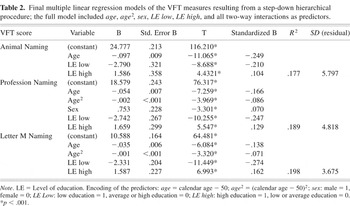
Table 2 presents the regression models for the Animal, Profession, and Letter M Naming VFTs. The assumptions of regression analysis were fulfilled for each model (no heteroscedasticity, normally distributed residuals, maximum VIF = 1.301, and maximum Cook's distance = .012). Age negatively influenced performance on all three VFTs, with an additional significant quadratic age effect on the Profession and Letter M Naming VFTs. Sex differences were only found in the Profession Naming VFT, with males performing better than females. Higher educated participants outperformed their lower educated counterparts on all VFTs. The negative impact of a low education as compared with an average education was larger than the positive effect of a high education for all VFT scores (see standardized B values, Table 2). None of the interaction terms were significant.
Final multiple linear regression models of the VFT measures resulting from a step-down hierarchical procedure; the full model included age, age2, sex, LE low, LE high, and all two-way interactions as predictors.

The regression models, combined with the standard deviations of the residuals [see Table 2, SD (residual)], provide normative data. First, the participant's predicted VFT scores are calculated. Then the residuals of these scores are computed (ei = observed score − predicted score) and standardized [Zi = ei/SD (residual)], so that the individual's performance can be evaluated using a standard Z distribution table with corresponding cumulative probabilities. For example, in the Profession Naming VFT, a 60-year-old woman with a high LE generated 15 profession names in 1 min. Her predicted Profession naming score would be 19.498 [= 18.579 − (.054 * 10) − (.002 * 100) + (.753 * 0) − (2.742 * 0) + (1.659 * 1)], with a residual of −4.498 (= 15 − 19.498). The standardized residual equals −.934 (= −4.498/4.818), which corresponds to a p value of .175.
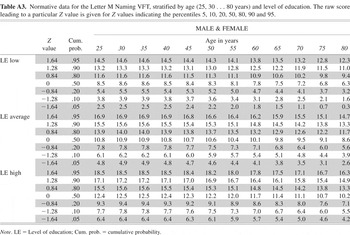
Tables A1, A2, and A3 (in Appendix) provide normative data for the VFTs based on the regression models, stratified by their statistically relevant predictors (see Table 2). If an individual is not exactly 25, 30 … 80 years old, then the person's age should be rounded up to the closest age given. If the performance of such an individual is borderline–normal according to Tables A1, A2, and A3 (e.g. Z value ≈ −1.28), the regression models presented in Table 2 can be used to determine the exact Z values.
DISCUSSION
In the present study, we first investigated the influence of Age, Sex, and LE on VFT performance. Although previous research has shown that semantic fluency declines with age whereas phonemic fluency remains quite stable, our study suggests that age affects performance on both types of VFTs profoundly. The age-related differences in phonemic VFT performance found in the present study may be because we added a second searching criterion—namely four-letter words—to the one that is usually employed in phonemic VFTs (words beginning with a certain letter). Indeed, many empirical studies comparing the performance of younger versus older adults on cognitive tasks have shown that increasing task complexity leads to greater age differences in performance, a phenomenon that is known as the complexity effect (Salthouse, 1992, 1996). As mentioned by Salthouse (1992), understanding the complexity effect is important because it may contribute to the understanding of the causes of adult age differences in cognition. Thus, phonemic VFTs with a restriction in the length of the words to be generated may be a valuable addition to the assortment of neuropsychological tests that are commonly used in aging research. An alternative explanation for the finding of age effects on the Letter M Naming VFT, whereas age effects are usually not observed in phonemic VFTs may be the higher statistical power of the present study (large sample) in comparison to most other VFT studies. More research is needed to determine which explanation is correct, for example by using a counterbalanced design in which phonemic VFTs with and without the four-letter search criterion are administered. However, the age effects found in the present study were substantial (i.e., the predicted Letter M Naming score for an 80-year-old person is about 25.8%, 20.3%, and 17.7% lower than the predicted performance of a 25-year-old person for low-, average-, and high-educated people, respectively; see Appendix, Table A3), which suggest that these age effects should also be detected in smaller samples with sufficient age variability and are not primarily power-related.
In contrast to most of the other VFT studies, we used multiple regression models with both linear and quadratic age effects as predictors of VFT performance. An advantage of using such a method is that linear age effects can be distinguished from quadratic age effects: only a linear age effect was found in the Animal Naming VFT, whereas significant quadratic age effects in addition to the linear age effect were observed in the Profession Naming and Letter M naming VFTs. As an example, Figure 1 shows the predicted VFT scores at ages 30, 35 … 80 relative to the predicted VFT scores at age 25 for average educated females1
Figure 1 shows the relative predicted VFT scores (based on Table 2) rather than the raw predicted scores for reasons of clarity and comparability, because the raw predicted scores (number of generated words) differ per VFT (more animal names are generated than profession names, and more profession names than letter M words). Figure 1 presents these values for average educated females only, but the shape of these curves is very similar for people with different demographical characteristics.

Predicted VFT scores at ages 30, 35 … and 80 years relative to the predicted VFT scores at age 25 years, for average educated females.
In agreement with most other studies, we found that the effect of sex on VFT performance was relatively small: males generated on average .753 profession names more than females did, but there were no sex differences in the Animal or Letter M Naming VFTs. Sex did not appear to modulate the effect of education, as was suggested by Ruff and colleagues (1996). Performance on both semantic and phonemic VFTs was profoundly affected by educational attainment, with there being a greater difference in VFT performance between low- and average-educated people than between average- and high-educated individuals. For the Letter M Naming and Profession Naming VFTs, a low LE was the most important predictor of test performance (compare the standardized B's, Table 2). For the Animal naming VFT, age was the most important predictor, but LE also influenced performance profoundly, that is, low-educated participants generated on average 2.790 fewer words than average-educated participants and 4.376 fewer words than high-educated participants (see Table 2), an effect that corresponds with the effect of about 28.8 (= 2.790/.097) and 45.1 (= 4.376/.097) years of aging, respectively. As indicated by Mitrushina and colleagues (1999), nearly every normative VFT study with English-speaking people is confined to participants with a high level of educational attainment. Our finding that especially a low LE adversely influenced VFT performance is of importance in this respect because it suggests that the available normative data for English-speaking participants may seriously bias the evaluation of the VFT performance of lower educated people. This is especially problematic because a significant proportion of the people who are tested neuropsychologically are older persons, and many older people are relatively poorly educated (before the 1960s most people did not go on to higher education, often because of socio-economical rather than intellectual reasons; Jolles et al., 1995). This decrease in educational attainment as a function of increasing age was also seen in our sample (see Table 1). An advantage of using a regression-based normative approach is that such unbalanced data can be analyzed without biasing the estimation or testing of the regression weights, and with only a minor loss of statistical power (because the standard error of a regression weight is proportional to the

of the predictor at hand; see e.g. Kleinbaum et al., 1998). Indeed, regression-based norms provide accurate estimates of the population statistics because they are based on equations that are derived using the data for all demographic groups (Van Breukelen & Vlaeyen, in press; Zachary & Gorsuch, 1985). This is not the case with a traditional normative approach, which provides means and standard deviations of the test scores of the normative sample, so that a tested person's raw score can be evaluated by converting it into a Z score. A problem that is intrinsically related to the traditional method is that—even when the overall size of the normative sample (N) is reasonably large—the sample size of the actual reference group (n) is small after the sample is broken down by the relevant demographic variables (Crawford & Howell, 1998). For example, splitting a sample by age group (12 levels), sex (2 levels), and LE (3 levels) reduces the sample size per subgroup to 1/72 of the total sample size. As a result, the population statistics (M, SD) can be much less accurately estimated within subgroups than for the total sample, which yields unreliable normative data (Van Breukelen & Vlaeyen, in press).
Age, sex, and LE are important factors that are related to VFT performance (Mitrushina et al., 1999), but previous studies showed that other factors such as verbal intelligence also affect VFT performance (Bolla et al., 1998). In fact, Bolla et al. (1998) found that verbal intelligence has a stronger association with VFT performance than education has. Nevertheless, we used LE as a proxy of general ability rather than verbal IQ for a number of reasons. First, it is important that an independent variable can be measured in a straightforward manner in normative studies. Using verbal intelligence as a predictor of VFT performance would imply that a person would have to complete a verbal intelligence test before the normative VFT data could be used, which is a time-consuming and expensive process (Van der Elst et al., 2005). Secondly, it is important that independent variables used in a regression model are measured reliably. Although an independent variable such as LE is somehow imperfectly measured because it is usually based on self-report (which was also the case in the present study), the measurement error associated with a measure such as IQ is substantially larger. A large measurement error makes the independent variable an imperfect statistical control and can invalidate a regression model (Fox, 1997), and thus the derived normative data. Thirdly, in normative studies, education is the preferred operationalization of general ability. Using a measure such as LE instead of verbal intelligence has the advantage of a better comparability with previous normative research. Fourthly, when IQ is used as a stratification variable, certain specific problems, such as the Flynn effect (the gain of IQ over time; Flynn, 1999), are encountered. As a result, researchers or clinicians using the VFT normative data would have to use the same IQ norms as the ones used in the specific normative study, even though more up-to-date IQ norms are available.
It should be noted that we used a cross-sectional design in the present study, which has certain limitations. For example, with such a study design it cannot be determined to what extent the effects of age on VFT performance are confounded by cohort effects. However, this was not a major problem in our study because we were primarily interested in normative trends in VFT performance, and a cross-sectional study design is appropriate for such purposes (Hayslip & Panek, 1989). An advantage of the present study is the very large number of healthy, cognitively intact participants from whom normative data were derived using a regression-based approach. The normative data can be used to evaluate the Animal, Profession, and Letter M Naming VFT performance of Dutch-speaking participants aged 24–81 years old, with appropriate correction for demographic influences.
ACKNOWLEDGMENTS
The research reported here was supported by the University of Maastricht and the PMS Vijverdal (The Netherlands). We thank all the participants for their cooperation and the test assistants for help with data collection.
APPENDIX
Normative data for the Animal Naming VFT, stratified by age (25, 30 … 80 years) and level of education. The raw score leading to a particular Z value is given for Z values indicating the percentiles 5, 10, 20, 50, 80, 90 and 95.

Normative data for the Profession Naming VFT, stratified by age (25, 30 … 80 years), sex, and level of education. The raw score leading to a particular Z value is given for Z values indicating the percentiles 5, 10, 20, 50, 80, 90 and 95.

Normative data for the Letter M Naming VFT, stratified by age (25, 30 … 80 years) and level of education. The raw score leading to a particular Z value is given for Z values indicating the percentiles 5, 10, 20, 50, 80, 90 and 95.

References
REFERENCES
Aiken, L.S. &
West, S.G.
(1991).
Multiple regression: Testing and interpreting interactions.
Newbury Park, CA:
Sage.
Ardila, A.
(1995).
Directions of research in cross-cultural neuropsychology.
Journal of Clinical and Experimental Neuropsychology,
17,
143–150.Google Scholar
Auriacombe, S.,
Fabrigoule, C.,
Lafont, S.,
Amieva, H.,
Jacqmin-Gadda, H., &
Dartigues, J.
(2001).
Letter and category fluency in normal elderly participants: A
population based study.
Aging Neuropsychology and Cognition,
2,
98–108.Google Scholar
Belsley, D.A.,
Kuh, E., &
Welsch, R.E.
(1980).
Regression diagnostics: identifying influential data and sources of
collinearity.
New York:
Wiley.
Benito-Cuadrado, M.M.,
Esteba-Castillo, S.,
Böhm, P.,
Cejundo-Bolívar, J., &
Pena-Casanova, J.
(2002).
Semantic verbal fluency in animals: A normative and predictive study
in a Spanish population.
Journal of Clinical and Experimental Neuropsychology,
24,
1117–1122.Google Scholar
Bolla, K.I.,
Gray, S.,
Resnick, S.M.,
Galante, R., &
Kawas, C.
(1998).
Category and letter fluency in highly educated older adults.
Clinical Neuropsychologist,
12,
330–338.Google Scholar
Crawford, J.R. &
Howell, D.C.
(1998).
Comparing an individual's test score against norms derived from
small samples.
Clinical Neuropsychologist,
12,
482–486.Google Scholar
Crawford, J.R.,
Obonsawin, M.C., &
Bremner, M.
(1993).
Frontal lobe impairment in schizophrenia: Relationship to
intellectual functioning.
Psychological Medicine,
23,
787–790.Google Scholar
Crossley, M.,
D'Arcy, C., &
Rawson, N.S.B.
(1997).
Letter and category fluency in community-dwelling Canadian seniors:
A comparison of normal participants to those with dementia of the
Alzheimer or vascular type.
Journal of Experimental and Clinical Neuropsychology,
19,
52–62.Google Scholar
Crowe, S.F.
(1998).
Decrease in performance on the Verbal Fluency Test as a function of
time: Evaluation in a young healthy sample.
Journal of Clinical and Experimental Neuropsychology,
20,
391–401.Google Scholar
De Bie, S.E.
(1987).
Standaardvragen 1987: Voorstellen voor uniformering van
vraagstellingen naar achtergrondkenmerken en interviews [Standard
questions 1987: Proposal for uniformization of questions regarding
background variables and interviews].
Leiden, The Netherlands:
Leiden University Press.
Flowers, K.A.,
Robertson, C., &
Sheridan, M.R.
(1995).
Some characteristics of word fluency in Parkinson's
disease.
Journal of Neurolinguistics,
9,
33–46.Google Scholar
Flynn, J.R.
(1999).
Searching for justice: The discovery of IQ gains over time.
American Psychologist,
54,
5–20.Google Scholar
Folstein, M.F.,
Folstein, S.E., &
McHugh, P.R.
(1975).
Mini-Mental State: A practical method for grading the cognitive
state of patients for the clinician.
Journal of Psychiatric Research,
12,
189–198.Google Scholar
Fox, J.
(1997).
Applied regression analysis, linear models, and related
methods.
Thousand Oaks, CA:
Sage.
Gleissner, U. &
Elger, C.
(2001).
The hippocampal contribution to verbal fluency in patients with
temporal lobe epilepsy.
Cortex,
37,
55–63.Google Scholar
Harrison, J.E.,
Buxton, P.,
Husain, M., &
Wise, R.
(2000).
Short test of semantic and phonological fluency: Normal performance,
validity and test–retest reliability.
British Journal of Clinical Psychology,
39,
181–191.Google Scholar
Hayslip, B. &
Panek, P.E.
(1989).
Adult development and aging.
New York:
Harper & Row.
Henry, J.D. &
Crawford, J.R.
(2004).
A meta-analytic review of verbal fluency performance following focal
cortical lesions.
Neuropsychology,
18,
284–295.Google Scholar
Houx, P.J.,
Jolles, J., &
Vreeling, F.W.
(1993).
Stroop Interference: Aging effects assessed with the Stroop
Color-Word Test.
Experimental Aging Research,
19,
209–224.Google Scholar
Hurks, P.P.M.,
Vles, J.S.H.,
Hendriksen, J.G.M.,
Kalff, A.C.,
Feron, F.J.M.,
Kroes, M.,
Van Zeben, T.M.C.,
Steyaert, J., &
Jolles, J.
(2004).
Semantic category fluency versus initial letter fluency over time as
a measure of automatic and controlled processing in healthy school-aged
children.
Brain and Cognition,
55,
535–544.Google Scholar
Ivnik, R.J.,
Malec, J.F.,
Smith, G.E.,
Tangalos, E.G., &
Petersen, R.C.
(1996).
Neuropsychological tests' norms above age 55: COWAT, BNT, MAE
Token, WRAT–R Reading, AMNART, Stroop, TMT, and JLO.
Clinical Neuropsychologist,
10,
262–278.Google Scholar
Jolles, J.,
Houx, P.J.,
Van Boxtel, M.P.J., &
Ponds, R.W.H.M.
(1995).
Maastricht Aging Study: Determinants of cognitive aging.
Maastricht, The Netherlands:
Neuropsych Publishers.
Kempler, D.,
Teng, E.L.,
Dick, M.,
Taussig, M.,
Davis, D.S.
(1998).
The effects of age, education, and ethnicity on verbal
fluency.
Journal of the International Neuropsychological Society,
4,
531–538.Google Scholar
Kleinbaum, D.G.,
Kupper, L.L.,
Muller, K.E., &
Nizam, A.
(1998).
Applied regression analysis and other multivariate methods
(3rd ed.).
Belmont, CA:
Brooks/Cole Publishing Company.
Kosmidis, M.H.,
Vlahou, C.H.,
Panagiotaki, P., &
Kiosseoglou, G.
(2004).
The verbal fluency task in the Greek population: Normative data, and
clustering and switching strategies.
Journal of the International Neuropsychological Society,
10,
164–172.Google Scholar
Lee, D.Y.,
Lee, K.U.,
Lee, J.H.,
Kim, K.W.,
Jhoo, J.H.,
Kim, S.Y.,
Yoon, J.C.,
Woo, S.I.,
Ha, J., &
Woo, J.I.
(2004).
A normative study of the CERAD neuropsychological assessment battery
in Korean elderly.
Journal of the International Neuropsychological Society,
10,
72–81.Google Scholar
Lezak, M.D.,
Howieson, D.B., &
Loring, D.W.
(2004).
Neuropsychological assessment
(4th ed.).
New York:
Oxford University Press.
Loewenstein, D.A.,
Arguelles, T.,
Arguelles, S., &
Linn-Fuentes, P.
(1994).
Potential cultural bias in the neuropsychological assessment of the
older adult.
Journal of Clinical and Experimental Neuropsychology,
16,
623–629.Google Scholar
Loewenstein, D.A. &
Rubert, M.P.
(1992).
The NINCDS-ADRDA neuropsychological criteria for the assessment of
dementia: Limitations of current diagnostic guidelines.
Behavior, Health and Aging,
2,
113–121.Google Scholar
Lopez, S.R. &
Taussig, F.M.
(1991).
Cognitive-intellectual functioning of Spanish-speaking impaired and
nonimpaired elderly: Implications for culturally sensitive
assessment.
Psychological Assessment,
3,
448–454.Google Scholar
Luteijn, F. &
Van der Ploeg, F.A.E.
(1983).
Handleiding Groninger Intelligentietest (GIT) [Manual Groningen
Intelligence Test].
Lisse, The Netherlands:
Swets and Zeitlinger.
Marquardt, D.W.
(1980).
You should standardize the predictor variables in your regression
models.
Journal of the American Statistical Association,
75,
87–91.Google Scholar
Mathuranath, P.S.,
George, A.,
Cherian, P.J.,
Alexander, A.,
Sarma, S.G., &
Sarma, P.S.
(2003).
Effects of age, education and gender of verbal fluency.
Journal of Clinical and Experimental Neuropsychology,
25,
1057–1064.Google Scholar
Mitrushina, M.N.,
Boon, K.B., &
D'Elia, L.F.
(1999).
Handbook of normative data for neuropsychological assessment.
New York:
Oxford University Press.
Pachana, N.A.,
Boone, K.B.,
Miller, B.L.,
Cummings, J.L., &
Berman, N.
(1996).
Comparison of neuropsychological functioning in Alzheimer's
disease and frontotemporal dementia.
Journal of the International Neuropsychological Society,
2,
505–510.Google Scholar
Raskin, S.A. &
Rearick, E.
(1996).
Verbal fluency in individuals with mild traumatic brain
injury.
Neuropsychology,
10,
416–422.Google Scholar
Ratcliff, G.,
Ganguli, M.,
Chandra, V.,
Sharma, S.,
Belle, S.,
Seaberg, E., &
Pandav, R.
(1998).
Effects of literacy on measures of word fluency.
Brain and Language,
61,
115–122.CrossRefGoogle Scholar
Ruff, R.M.,
Light, R.H.,
Parker, S.B., &
Levin, H.S.
(1996).
Benton Controlled Oral Word Association Test: Reliability and
updated norms.
Archives of Clinical Neuropsychology,
11,
329–338.Google Scholar
Ruff, R.M.,
Light, R.H.,
Parker, S.B., &
Levin, H.S.
(1997).
The psychological construct of word fluency.
Brain and Language,
57,
394–405.Google Scholar
Salthouse, T.A.
(1992).
Why do adult age differences increase with task complexity?
Developmental Psychology,
28,
905–918.Google Scholar
Salthouse, T.A.
(1996).
The processing-speed theory of adult age differences in
cognition.
Psychological Review,
103,
403–428.Google Scholar
Sergeant, J.A.,
Geurts, H., &
Oosterlaan, J.
(2002).
How specific is a deficit of executive functioning for
Attention-Deficit/Hyperactivity Disorder?
Behavioural Brain Research,
130,
3–28.Google Scholar
Schmitt, J.A.J.,
Jorissen, B.L.,
Sobczak, S.,
Van Boxtel, M.P.J.,
Hogervorst, E.,
Deutz, N.E.P., &
Riedel, W.J.
(2000).
Tryptophan depletion impairs memory consolidation but improves
focused attention in healthy young volunteers.
Journal of Psychopharmacology,
14,
21–29.Google Scholar
Thurstone, L.L.
(1938).
Primary mental abilities.
Chicago:
University of Chicago Press.
Tierney, M.C.,
Blach, S.E.,
Szalai, J.P.,
Snow, G.,
Fisher, R.H.,
Nadon, G., &
Chui, H.C.
(2001).
Recognition memory and verbal fluency differentiate probable
Alzheimer disease from subcortical ischemic vascular dementia.
Archives of Neurology,
58,
1654–1659.Google Scholar
Tombaugh, T.N.,
Kozak, J., &
Rees, L.
(1999).
Normative data stratified by age and education for two measures of
verbal fluency: FAS and animal naming.
Archives of Clinical Neuropsychology,
14,
167–177.Google Scholar
Tomer, R. &
Levin, B.E.
(1993).
Differential effects of aging on two verbal fluency tasks.
Perceptual and Motor Skills,
76,
465–466.Google Scholar
United Nations Educational, Scientific and Cultural Organisation
(UNESCO).
(1976).
International Standard Classification of Education (ISCED).
Paris:
Author.
Van Breukelen, G.J.P. &
Vlaeyen, J.W.S.,
(in press).
Norming clinical questionnaires with multiple regression: The pain
cognition list.
Psychological Assessment.
Van der Elst, W.,
Van Boxtel, M.P.J.,
Van Breukelen, G.P.J., &
Jolles, J.
(2005).
Rey's verbal learning test: Normative data for 1855 healthy
participants aged 24–81 years and the influence of sex, education,
and model of presentation.
Journal of the International Neuropsychological Society,
11,
290–302.Google Scholar
Videbech, P.,
Ravnkilde, B.,
Kristensen, S.,
Egander, A.,
Clemmensen, K.,
Rasmussen, N.A.,
Gjedde, A., &
Rosenberg, R.
(2003).
The Danish PET/depression project: Poor verbal fluency
performance despite normal prefrontal activation in patients with major
depression.
Psychiatry Research: Neuroimaging,
123,
49–63.Google Scholar
Woods, S.P.,
Conover, E.,
Rippeth, J.D.,
Carey, C.L.,
Gonzalez, R.,
Marcotte, T.D.,
Heaton, R.K., &
Grant, I.
(2004).
Qualitative aspects of verbal fluency in HIV-associated dementia: A
deficit in rule-guided lexical-semantic search processes?
Neuropsychologia,
42,
801–809.Google Scholar
Zachary, R.A. &
Gorsuch, R.L.
(1985).
Continuous norming: Implications for the WAIS–R.
Journal of Clinical Psychology,
41,
86–97.Google Scholar

Descriptive characteristics of the sample (N = 1825)
Final multiple linear regression models of the VFT measures resulting from a step-down hierarchical procedure; the full model included age, age2, sex, LE low, LE high, and all two-way interactions as predictors.

Predicted VFT scores at ages 30, 35 … and 80 years relative to the predicted VFT scores at age 25 years, for average educated females.

Normative data for the Animal Naming VFT, stratified by age (25, 30 … 80 years) and level of education. The raw score leading to a particular Z value is given for Z values indicating the percentiles 5, 10, 20, 50, 80, 90 and 95.

Normative data for the Profession Naming VFT, stratified by age (25, 30 … 80 years), sex, and level of education. The raw score leading to a particular Z value is given for Z values indicating the percentiles 5, 10, 20, 50, 80, 90 and 95.
Normative data for the Letter M Naming VFT, stratified by age (25, 30 … 80 years) and level of education. The raw score leading to a particular Z value is given for Z values indicating the percentiles 5, 10, 20, 50, 80, 90 and 95.
 You have
Access
- 266
- Cited by