Introduction
Trauma exposure in childhood is one of the most well-established and robust risk factors for the development of a range of psychiatric disorders, including increased risk for depression and suicidality (Carr, Martins, Stingel, Lemgruber, & Juruena, Reference Bounoua, Miglin, Spielberg and Sadeh2013; Pine & Cohen, Reference Phillips, Ladouceur and Drevets2002; Pompili et al., Reference Pine and Cohen2014). Given its transdiagnostic relevance, it is likely that early exposure to traumatic events disrupts the typical development of brain regions supporting affective systems, including the orbitofrontal cortex (OFC)–amygdala circuit. OFC is frequently implicated in the top-down processing of emotions (Garcia, Vouimba, Baudry, & Thompson, Reference First2014; Ghashghaei, Hilgetag, & Barbas, Reference Gee and Casey2007; Wright et al., Reference Wright, Williams, Feczko, Barrett, Dickerson, Schwartz and Wedig2008), such as recognizing and perceiving emotional responses (Adolphs, Reference Adolphs2002), modulating fear responses (Phan et al., Reference Paquola, Wael, Wagstyl, Bethlehem, Hong, Seidlitz and Bernhardt2005), and reinforcement learning (Groman et al., Reference Goodman and Yehuda2019). Critical to these processes is OFC's reciprocal communication with amygdala, a subcortical structure that supports the acquisition and expression of emotions, including fear expression (Öhman, Reference Ochsner, Ray, Cooper, Robertson, Chopra, Gabrieli and Gross2005) and memory consolidation of emotional experiences (McGaugh, Reference Lupien, McEwen, Gunnar and Heim2002). OFC is thought to play a critical regulatory role over amygdala, with the most replicated findings showing inverse correlations between prefrontal and OFC activity during tasks eliciting emotional responses (Ochsner et al., Reference Morey, Haswell, Hooper and De Bellis2004; Stein et al., 2007) and at rest (Kim, Gee, Loucks, Davis, & Whalen, Reference Kerr, Avery, Barcalow, Moseman, Bodurka, Bellgowan and Simmons2011; Roy et al., Reference Ray and Zald2009) in healthy samples.
The OFC and amygdala are both highly susceptible to the effects of early life stress (Shonkoff et al., Reference Saygin, Kliemann, Iglesias, van der Kouwe, Boyd, Reuter and Augustinack2012) and essential to key regulatory processes (Bechara, Damasio, & Damasio, Reference Banks, Eddy, Angstadt, Nathan and Phan2000; Phillips, Ladouceur, & Drevets, Reference Phan, Fitzgerald, Nathan, Moore, Uhde and Tancer2008), which is why we focused on these regions in this study. For example, extant research has identified alterations in the structural integrity of OFC and amygdala following exposure to early, repeated childhood stress, typically in the form of maltreatment exposure (Hanson et al., Reference Hahn, Dresler, Ehlis, Plichta, Heinzel, Polak and Fallgatter2010; Hart & Rubia, Reference Hanson, Chung, Avants, Shirtcliff, Gee, Davidson and Pollak2012; Lim, Radua, & Rubia, Reference Lim, Hart, Howells, Mehta, Simmons, Mirza and Rubia2014; Lupien, McEwen, Gunnar, & Heim, Reference Linehan1993; Moreno-López et al., Reference Mincic2020; Tottenham & Galván, Reference Tebartz van Elst, Hesslinger, Thiel, Geiger, Haegele, Lemieux and Ebert2016). Specifically, empirical studies have shown that childhood maltreatment is associated with reduced volume in cortical and subcortical regions, including in the OFC and amygdala (Cassiers et al., Reference Carr, Martins, Stingel, Lemgruber and Juruena2018; Edmiston & Blackford, Reference DeYoung, Hirsh, Shane, Papademetris, Rajeevan and Gray2013; Lim et al., Reference Krueger, Derringer, Markon, Watson and Skodol2019; Morey, Haswell, Hooper, & De Bellis, Reference Moreno-López, Ioannidis, Askelund, Smith, Schueler and van Harmelen2016) and alterations in amygdala–prefrontal circuitry (McLaughlin & Lambert, Reference McGaugh2017; Paquola et al., 2019). While mounting evidence suggests that childhood trauma has detrimental effects on the functioning of OFC–amygdala interactions (Hart & Rubia, Reference Hanson, Chung, Avants, Shirtcliff, Gee, Davidson and Pollak2012), the extent to which alterations in OFC–amygdala circuitry related to early traumatic stress can be observed at a purely structural level has been relatively understudied. Based on recent arguments that examining structural covariation between brain regions is necessary to further understanding of brain networks initially established at a functional level (Gong, He, Chen, & Evans, Reference Ghashghaei, Hilgetag and Barbas2012; He, Chen, & Evans, Reference Heim and Nemeroff2007; Zielinski, Gennatas, Zhou, & Seeley, Reference Yang and Raine2010), the primary aim of this study was to address this gap in relation to OFC–amygdala connectivity.
To our knowledge, only two studies have investigated structural associations between amygdala and cortex. In a healthy youth sample, Albaugh et al. (Reference Albaugh, Ducharme, Collins, Botteron, Althoff, Evans and Hudziak2013) found that amygdala volume was inversely related to cortical thickness in several regions of PFC, including bilateral OFC. Blackmon et al. (Reference Berenz, Amstadter, Aggen, Knudsen, Reichborn-Kjennerud, Gardner and Kendler2011) reported a similar inverse association between amygdala volume and thickness in the left lateral OFC (lOFC) in a sample of healthy adults. These studies provide a starting point for understanding morphometric associations between amygdala and OFC in healthy adult samples by providing preliminary evidence of inverse structural associations that mirror functional connectivity findings. Given research suggesting that early trauma exposure detrimentally impacts functional OFC–amygdala circuitry, it is likely that the structural associations between these regions may also be impacted by chronic childhood stress exposure. However, to our knowledge, this question has not yet been investigated.
Implications for the development of pathological personality
A large body of literature has implicated both trauma exposure early in life (e.g. Ball & Links, 2009; Goodman & Yehuda, Reference Gong, He, Chen and Evans2002) and reductions in OFC cortical volume in the development of personality disorders (PDs), particularly those marked by emotional and behavioral dysregulation (e.g. borderline, antisocial PDs) (Chanen et al., Reference Cassiers, Sabbe, Schmaal, Veltman, Penninx and Van Den Eede2018; Raine, Reference Raine2018; Tebartz van Elst et al., Reference Tarullo and Gunnar2003; Yang & Raine, Reference Yang and Raine2009). Further, results from a prospective twin study showed that personality pathology is best understood in the context of both environmental (i.e. childhood maltreatment) and biological factors (Berenz et al., Reference Bechara, Damasio and Damasio2013). Research on the neurobiology of personality has consistently implicated alterations in OFC–amygdala circuitry that account for variation in trait-level personality dimensions central to PDs, including disinhibition, antagonism, and negative affectivity (Ameis et al., Reference Ameis, Ducharme, Albaugh, Hudziak, Botteron, Lepage and Karama2014; Banks, Eddy, Angstadt, Nathan, & Phan, Reference Ball and Links2007; Blair, Tinkelman, Moita, & LeDoux, Reference Blackmon, Barr, Carlson, Devinsky, DuBois, Pogash and Thesen2003; Coccaro, Lee, McCloskey, Csernansky, & Wang, Reference Coccaro, Keedy, Gorka, King, Fanning, Lee and Phan2015; Saxbe et al., Reference Salat, Buckner, Snyder, Greve, Desikan, Busa and Fischl2018; Tebartz van Elst et al., Reference Tarullo and Gunnar2003). For example, Coccaro et al. (Reference Coccaro, Keedy, Gorka, King, Fanning, Lee and Phan2015) found that individuals with elevated impulsivity and aggression exhibited exaggerated amygdala reactivity and diminished OFC activation during a social threat task. Similarly, disruption in neural networks involving the amygdala and OFC has been implicated in emotion dysregulation among individuals with BPD (Soloff, Abraham, Ramaseshan, Burgess, & Diwadkar, Reference Shonkoff, Garner, Siegel, Dobbins, Earls, Garner and Wood2017). Taken together, it appears that the OFC–amygdala relationship is critical to understanding links between trauma exposure and trait levels of emotional and behavioral dysregulation. However, the majority of this research has focused on either structural alterations in specific neural regions (e.g. OFC and/or amygdala individually) or in the functioning of OFC–amygdala circuitry. Research to date has yet to examine the clinical implications of early trauma exposure for OFC–amygdala morphometric associations and the manifestation of pathological personality traits in adulthood.
Current study
A gap in this line of work is knowledge of how structural covariation between the amygdala and OFC may be affected by developmental experiences that are known to impact emotion regulation, and in turn, confer risk for psychopathology. The primary objective of the current study was to investigate the extent to which morphometric associations between the amygdala and regions of the OFC vary as a function of childhood trauma exposure. We also explored the clinical relevance of these associations for pathological personality traits by examining the interactive effects of trauma exposure and OFC volume in regions found to covary with amygdala. We focused on assaultive trauma experiences, because these forms of childhood trauma have been robustly linked to chronic activation of the HPA-axis (Cross, Fani, Powers, & Bradley, Reference Coccaro, Lee, McCloskey, Csernansky and Wang2017; Tarullo & Gunnar, Reference Taki and Kawashima2006), which is posited to have long-term deleterious effects on the developing cortex (Gee & Casey, Reference Garcia, Vouimba, Baudry and Thompson2015; Tottenham & Galván, Reference Tebartz van Elst, Hesslinger, Thiel, Geiger, Haegele, Lemieux and Ebert2016). Consistent with past work in samples of healthy adults without trauma exposure (Albaugh et al., Reference Albaugh, Ducharme, Collins, Botteron, Althoff, Evans and Hudziak2013; Blackmon et al., Reference Berenz, Amstadter, Aggen, Knudsen, Reichborn-Kjennerud, Gardner and Kendler2011), we hypothesized that there would be an inverse association between OFC and amygdala volume in those without a trauma history in our sample. Conversely, we hypothesized that this relationship would be absent or even positive in those with a trauma history.
Methods and materials
Participants
Participants were 137 ethnically diverse adults recruited from the community using flyers and online postings. Inclusion criteria: between ages 18 and 55, fluency in English. Exclusion criteria were current psychosis or a current diagnosis of a psychotic disorder, estimated IQ in the Intellectual Disability range, serious medical/neurological condition, history of head injuries with lasting effects, MRI contraindications, and imminent suicide risk. No other psychiatric conditions were considered exclusionary conditions. All participants with complete interview, self-report, and MRI data were included in the analysis. Two participants who reported more than one previous head injury were removed from analysis to reduce the potential impact of these events.
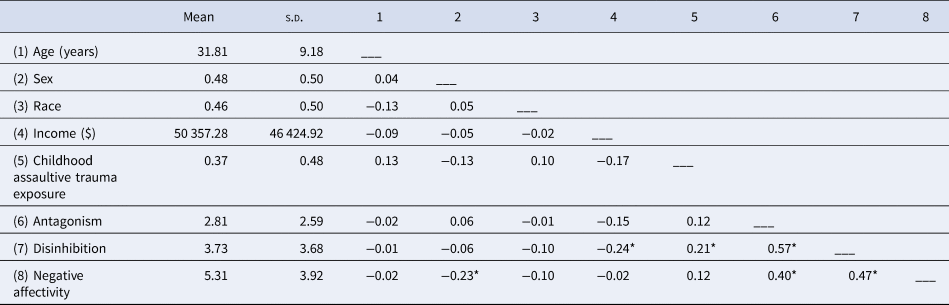
The final sample consisted of 135 participants [M(s.d.)age = 31.81(9.18); 48.1% men]. Sample characteristics are presented in Table 1. Approximately half of the sample self-identified as Caucasian/White (53.0%), followed by Black (35.1%), Asian (7.5%), or Biracial/Other (4.3%). Past year income for the sample ranged from $0 to $300 000 [M(s.d.) = $50 357.028 ($46 424.92)]. The majority of participants came from communities with high violent crime rates (www.neighborhoodscout.com/de/wilmington/crime on 06/07/2020), suggesting the sample is at relatively higher risk for exposure to assaultive trauma than other community samples.
Sample characteristics and zero-order correlations (N = 135) among study variables

Note. Sex was coded as 0-female; 1-male; Race was dummy-coded as 0-White, 1-Non-White; Trauma Exposure was coded as 0-absent, 1-present. *p < 0.05.
Procedures
Written and oral consent was obtained from all individuals before participation. Participants completed a battery of assessments, including a structured clinical interview and a neuroimaging protocol across two study visits. The University Institutional Review Board approved all protocols and procedures (Protocol #'s: 1073423-17, 1361164-1).
Measures
Childhood assaultive trauma exposure
The Detailed Trauma Screen from the SCID-5-RV Stressor Related Disorders module (First, Reference Edmiston and Blackford2014) was used to assess the history of exposure to traumatic events. Participants completed this measure via a clinical interview conducted by, or under the supervision of a licensed clinical psychologist (n = 72), or via a self-report survey (n = 63). Assessment method was not uniquely associated with any study variables of interest (p's > 0.05); thus, the samples were combined in all analyses.
Consistent with previous research quantifying childhood trauma exposure (e.g. Bounoua, Miglin, Spielberg, & Sadeh, Reference Blair2020), we compared adults with chronic exposure to childhood assaultive trauma, defined as experiencing multiple assaultive traumas prior to the age 13, to those individuals who either did not experience any assaultive trauma, only reported a single exposure in childhood, or reported assaultive trauma that only occurred later in life. Assaultive trauma was operationalized as direct exposure to threatened or actual physical violence (e.g. assault, domestic violence, or physical or sexual abuse). Non-assaultive events included exposure to life-threatening danger that did not involve threatened or actual physical violence (e.g. natural disasters) (Cisler et al., Reference Cho, Pellecchia, Aminian, Ray, Segura, Obeso and Strafella2012; Sadeh, Miller, Wolf, & Harkness, Reference Roy, Shehzad, Margulies, Kelly, Uddin, Gotimer and Milham2015).
The sample reported a range of lifetime trauma exposure (Min/Max = 0/6 events), with a little over a third of the sample (37.0%, n = 50) meeting criteria for inclusion in the repeated childhood assaultive trauma group. Among individuals with repeated childhood assault exposure, the most common forms were physical abuse (82.0%), sexual abuse (20.0%), and witnessing violence perpetrated against others (14.0%).
Pathological personality traits
Three dimensions of pathological personality that have been associated with OFC–amygdala circuitry in prior work were assessed using the Personality Inventory for DSM-5-Brief Form (PID-5-BF; Krueger, Derringer, Markon, Watson, & Skodol, Reference Kim, Gee, Loucks, Davis and Whalen2013). Participants rated the extent to which each item best described them from 0 (Very False/Often False) to 3 (Very True/Often True). An Antagonism score was created by summing five items measuring the degree to which individuals are self-focused and disregard the needs of others (e.g. ‘I use people to get what I want.’) [M/s.d. = 2.81/2.59]. A Disinhibition score was created by summing five items that measure the tendency to engage in risky and impulsive behaviors (e.g. ‘I feel like I act totally on impulse.’) [M/s.d. = 3.74/3.68]. A Negative Affectivity score was created by summing five items measuring the tendency to experience negative emotions (e.g. ‘I get emotional easily, often for very little reason.’) [M/s.d. = 5.31/3.92]. Average scores on these disordered personality traits in the current sample fell between means reported for clinical and non-clinical samples in previous work (Bach, Sellbom, & Simonsen, Reference Baas, Aleman and Kahn2018). Previous work has demonstrated that the PID-5-BF shows excellent reliability and construct validity across a range of samples (Anderson, Sellbom, & Salekin, Reference Anderson, Sellbom and Salekin2018).
MRI acquisition
Data were collected using a Siemens 3 T Magnetom Prisma scanner with a 64-channel head coil. A T1-weighted multi-echo MPRAGE anatomical scan (resolution = 1 mm3, TR = 2530 ms, TEs = 1.69, 3.55, 5.41,7.27 ms) was collected, which has the advantage of less distortion and higher contrast than standard MPRAGE sequences, resulting in more reliable cortical models (van der Kouwe, Benner, Salat, & Fischl, Reference Tottenham and Galván2008). A T2-weighted variable flip-angle turbo spin-echo scan (resolution = 1 mm3, TR = 3200 ms, TE = 564 ms) was collected, which is used in FreeSurfer to better differentiate the gray-matter-dura boundary.
Amygdala volume
We used FreeSurfer's (v6) probabilistic atlas tool to segment amygdala (Saygin et al., Reference Saxbe, Lyden, Gimbel, Sachs, Piero, Margolin and Kaplan2017). The tool is based on a generative model, where the registered atlas is combined with a subject-specific likelihood model to produce a segmentation specific to that individual's brain.
OFC cortical volume
The cortical volume of each OFC vertex was estimated using FreeSurfer's (v6) standard morphometric pipeline (Salat et al., Reference Sadeh, Miller, Wolf and Harkness2004). Data were spatially smoothed using a Gaussian kernel of 15 mm full-width at half-maximum.
Data analytic plan
Age, biological sex, body mass index (BMI), and estimated intracranial volume (eTIV) were entered as covariates of no interest in all analyses, given associations between these variables, trauma exposure, and neural morphology in previous research (e.g. Chen, Sachdev, Wen, & Anstey, Reference Chanen, Velakoulis, Carison, Gaunson, Wood, Yuen and Pantelis2007; Taki & Kawashima, Reference Stein, Wiedholz, Bassett, Weinberger, Zink, Mattay and Meyer-Lindenberg2012). All analyses were conducted within each hemisphere separately, given evidence of lateralization of amygdala function (Baas, Aleman, & Kahn, Reference Antonucci, Gansler, Tan, Bhadelia, Patz and Fulwiler2004).
FreeSurfer's QDEC application was used to examine associations between childhood trauma, amygdala volume, and OFC cortical volume using general linear models. We created an OFC mask by merging the lateral and medial orbitofrontal parcellations of the Desikan-Killiany Atlas. Main effects between amygdala and OFC cortical volume were examined. Next, OFC cortical volume was regressed on the interaction of childhood trauma and amygdala volume, with the main effects of childhood trauma and amygdala volume included in the model as well as the covariates (age, sex, BMI, and eTIV). To correct for multiple comparisons within OFC, we applied a standard correction procedure using the FreeSurfer analysis software. Volumetric results were corrected for the number tests conducted using pre-cached Gaussian Monte Carlo simulation (10 000 iterations, cluster-wise threshold: p < 0.05, sign: absolute) that was created based on the size of the ROI examined (Hagler, Saygin, & Sereno, Reference Groman, Keistler, Keip, Hammarlund, DiLeone, Pittenger and Taylor2006). Bonferroni correction was also applied to take into account the number of comparisons conducted across both hemispheres.
Follow-up linear regression analyses were conducted to test associations between OFC cortical volume in the identified clusters and disordered personality traits. Finally, to examine the clinical relevance of trauma-related differences in OFC–amygdala volumetric associations, we conducted moderation analyses to test whether cortical volume in OFC regions linked to amygdala volume was also related to pathological personality traits. Specifically, we modeled the interactive effect of childhood trauma and OFC cortical volume (in the regions associated with amygdala volume in the QDEC analysis) on disordered personality traits. Moderation analyses were conducted using PROCESS Macro v3.3 (Hayes, Reference Hart and Rubia2018) in SPSS v26 (IBM Corp, Reference Soloff, Abraham, Ramaseshan, Burgess and Diwadkar2013). One participant had missing data on the PID-5-BF and was excluded from this analysis.
Results
Impact of childhood trauma on OFC–amygdala volumetric associations
We first examined whether the inverse association between amygdala volume and OFC structure reported in previous work (e.g. Albaugh et al., Reference Albaugh, Ducharme, Collins, Botteron, Althoff, Evans and Hudziak2013) was present across our sample. Results revealed that no main effects of amygdala volume on OFC volume survived following correction for multiple comparisons.
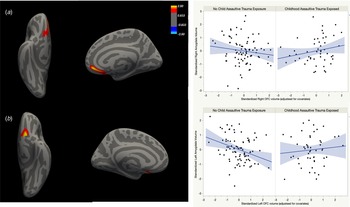
Next, we examined whether associations between amygdala and OFC cortical volume differed between adults with and without assaultive trauma in childhood. Significant interaction effects emerged for both hemispheres (see Table 2 and Fig. 1), indicating that the relationship of amygdala with OFC cortical volume varied as a function of childhood trauma exposure.
Chronic childhood trauma exposure moderates the volumetric association between amygdala and regions of the OFC, after controlling for age, sex, BMI, and eTIV. (a) Right medial OFC. (b) Left medial and lateral OFC.

Childhood trauma exposure moderates the volumetric associations between amygdala and clusters within the orbitofrontal cortex

OFC, orbitofrontal cortex.
In the right hemisphere, childhood trauma moderated the association between amygdala and cortical volume in a cluster that peaked in medial OFC (mOFC). Consistent with prior work, amygdala volume showed a trending inverse relationship with mOFC volume (t = −1.41; 95% CI −0.46 to 0.08) in individuals without a history of assaultive childhood trauma. Conversely, a significant positive association between amygdala and cortical volume in this cluster was observed in adults with chronic assaultive trauma exposure in childhood (t = 1.99; 95% CI 0.002–0.62).
A similar pattern of findings was evident in the left hemisphere. Childhood trauma moderated the association between amygdala and cortical volume in a cluster that peaked in mOFC and included lOFC. Follow-up analyses revealed a significant negative association between left amygdala and OFC cortical volume in the non-trauma exposed group (t = −2.93; 95% CI −0.31 to −0.06). Among adults with childhood assaultive trauma exposure, this relationship between amygdala and OFC cortical volume showed a trend in the positive direction (t = 0.65; 95% CI −0.10 to 0.19).
Exploratory examination of sex differences
Given extant research suggesting that biological sex moderates the effect of trauma exposure on neurobiological systems (e.g. van voorhees & Scarpa, Reference van der Werff, Pannekoek, Veer, van Tol, Aleman, Veltman and van der Wee2004), we ran exploratory three-way interaction analyses to test whether sex moderated the observed associations. No significant results emerged [i.e. sex did not moderate the interactive effect of childhood trauma and amygdala volume on cortical volume in the left (t = 1.47, 95% CI −0.09 to 0.63) or right (t = −0.29, 95% CI −0.89 to 0.67) OFC clusters]. We also tested for, and did not find, any new cortical clusters where sex moderated the childhood trauma × amygdala association when we ran whole cortex analyses in QDEC.
Links with pathological personality
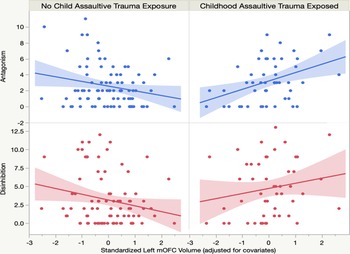
We investigated the translational relevance of trauma-related alterations in OFC–amygdala volumetric associations for understanding disordered personality traits. More specifically, we tested whether the OFC clusters identified above explained variance in disordered personality traits as a function of childhood trauma exposure. Interaction findings are depicted in Fig. 2.
Childhood trauma exposure moderates associations between left OFC volume and disordered personality traits.

Antagonism
No main effects emerged for the left or right OFC clusters and antagonistic personality traits. However, childhood trauma exposure moderated the association between the left OFC cluster and antagonism (ΔR 2 = 0.07, p = 0.003). In the trauma-exposed group, left OFC cortical volume was significantly and positively associated with trait antagonism (t = 2.03, 95% CI 0.0002 to 0.01), indicating that callous, manipulative, and grandiose traits increased as OFC cortical volume increased in this group. In contrast, in the non-trauma exposed group, left OFC cortical volume showed a negative trend with antagonistic personality traits (t = −1.25; 95% CI −0.01 to 0.001). No significant interaction emerged in the right hemisphere.
Disinhibition
No main effects emerged between cortical volume in the left or right amygdala-related OFC clusters and trait disinhibition. However, a significant interaction emerged between childhood trauma and OFC cortical volume for disinhibition (ΔR 2 = 0.06, p = 0.004). Among individuals with childhood trauma, disinhibition showed a trending positive association with left OFC cortical volume (t = 1.21; 95% CI −0.003 to 0.01), indicating that more cortical volume in left OFC was associated with a greater tendency to act impulsively. In the non-trauma exposed group, left OFC cortical volume was significantly and inversely associated with disinhibition (t = −2.22; 95% CI −0.02 to −0.001), such that impulsivity increased as OFC cortical volume decreased in this group. No significant interaction emerged in the right hemisphere.
Negative affectivity
No significant main or moderation effects emerged for the left or right amygdala-related OFC clusters and negative affectivity.
Specificity of childhood assaultive trauma exposure
We conducted supplementary analyses to ensure the interactive effect of childhood trauma and amygdala volume on OFC volume could not be accounted for by assaultive trauma exposure in adulthood. These analyses revealed that childhood trauma remained a significant moderator of the association between amygdala and OFC volume when adult trauma exposure was entered into the model for both the left (p = 0.002) and right (p = 0.002) hemispheres. Similar analyses were conducted to test whether the moderating effect of childhood trauma on the association between left OFC volume and personality traits persisted after accounting for adult assaultive trauma exposure. Results indicated that childhood assaultive trauma remained a significant moderator of the effect of left OFC volume on antagonism (ΔR 2 = 0.07, p = 0.003) and disinhibition (ΔR 2 = 0.06, p = 0.004).
Discussion
Childhood trauma has been consistently implicated in a range of clinical disorders, particularly through its effect on underlying neurobiological processes (Heim & Nemeroff, Reference Hayes2001; Tottenham & Galván, Reference Tebartz van Elst, Hesslinger, Thiel, Geiger, Haegele, Lemieux and Ebert2016). The OFC–amygdala circuit is heavily involved in emotion regulatory processes (Bechara et al., Reference Banks, Eddy, Angstadt, Nathan and Phan2000; Phillips et al., Reference Phan, Fitzgerald, Nathan, Moore, Uhde and Tancer2008) and is particularly vulnerable to early life stress (Tottenham & Galván, Reference Tebartz van Elst, Hesslinger, Thiel, Geiger, Haegele, Lemieux and Ebert2016). The present study revealed that trauma exposure moderates the anatomical associations between amygdala and OFC volume (see Fig. 1). Notably, volume in the identified clusters was also related to pathological personality traits in adulthood, such that disinhibition and antagonism exhibited different relationships with OFC volume in trauma-exposed v. non-exposed adults. Results provide new insights into the long-term neuroanatomical correlates of childhood trauma exposure and advance our understanding of the etiopathogenesis of pathological personality.
Importantly, supplementary analyses indicated that our findings appear to be relatively specific to childhood assaultive trauma. We found the effect of childhood trauma exposure on OFC–amygdala volumetric associations remained significant after accounting for assaultive trauma first experienced after the age of 18. This finding is consistent with existing work that underscores the vulnerability of amygdala–prefrontal circuitry to chronic stress early in development (Tottenham & Galván, Reference Tebartz van Elst, Hesslinger, Thiel, Geiger, Haegele, Lemieux and Ebert2016). Similarly, the moderating effect of childhood trauma on the association between left OFC volume and trait levels of antagonism and disinhibition remained significant after accounting for adult-only trauma exposure. Previous work has demonstrated that early trauma may lead to pathological personality traits via changes on neurobiological systems that support emotional and behavioral regulatory processes, including the amygdala and OFC (e.g. Raine, Reference Porter, Palmier-Claus, Branitsky, Mansell, Warwick and Varese2008). Taken together, these findings point to the impact of chronic childhood trauma exposure, in particular, on OFC–amygdala morphometric associations and associated links with inhibition and antagonism.
Impact of childhood trauma on OFC–amygdala morphology
We found that trauma exposure impacted the volumetric association between amygdala and bilateral mOFC, extending into lOFC/ACC in the right hemisphere. Specifically, amygdala and OFC volumes were positively correlated in adults with a history of childhood assaultive trauma, whereas this relationship was reversed in non-exposed individuals (Fig. 1). The inverse association in those without trauma is consistent with previous anatomical studies (Albaugh et al., Reference Albaugh, Ducharme, Collins, Botteron, Althoff, Evans and Hudziak2013; Blackmon et al., Reference Berenz, Amstadter, Aggen, Knudsen, Reichborn-Kjennerud, Gardner and Kendler2011), and parallels the inverse frontolimbic connectivity patterns observed at rest among healthy adults (Roy et al., Reference Ray and Zald2009). Thus, previous findings appear to reflect structural relationships only in those without childhood trauma.
To our knowledge, our findings provide the first evidence of the role of childhood trauma exposure on morphometric relations between amygdala and OFC. In particular, the positive volumetric association between OFC and amygdala among individuals with childhood trauma suggests a mechanism through which chronic stress may impact neurobiological development. Given that the OFC regions that we identified have previously been linked to impulsivity/decision making (Antonucci et al., Reference Anderson, Sellbom and Salekin2006; Wang et al., Reference van voorhees and Scarpa2016; Wilbertz et al., Reference Wang, Chen, Cai, Li, Zhao, Zheng and Xue2012) and reward anticipation (Hahn et al., Reference Hagler, Saygin and Sereno2009), a positive OFC–amygdala association may reflect the weakened or disturbed top-down regulation circuit that is well-documented in the trauma literature (van der Werff et al., Reference van der Kouwe, Benner, Salat and Fischl2013). This association may also reflect a mechanism by which repeated HPA-axis hyperactivation following chronic stress leads to amygdala hyperexcitability and concurrent structural atrophy in amygdala and OFC (Albaugh et al., Reference Albaugh, Ducharme, Collins, Botteron, Althoff, Evans and Hudziak2013; Dedovic, Duchesne, Andrews, Engert, & Pruessner, Reference Cross, Fani, Powers and Bradley2009). Thus, the findings from this study underscore childhood trauma exposure as an important environmental factor that may impact critical frontolimbic circuitry.
Implications for etiological models of personality pathology
Present findings also have important implications for understanding heterogeneity in the etiology of PDs. In particular, we found that childhood trauma exposure modulated the relationship between volume in amygdala-linked OFC regions and pathological disinhibition and antagonism. As seen in Fig. 2, among non-exposed individuals, OFC volume was inversely associated with pathological personality, such that less OFC volume was associated with more trait impulsivity and antagonistic personality traits, a pattern that is consistent with much of the existing research (Antonucci et al., Reference Anderson, Sellbom and Salekin2006; Blair, Reference Blair, Tinkelman, Moita and LeDoux2004; Coccaro et al., Reference Cisler, Begle, Amstadter, Resnick, Danielson, Saunders and Kilpatrick2016; Johnson, Elliott, & Carver, Reference Jackson, Balota and Head2020; Yang & Raine, Reference Yang and Raine2007). In contrast, among trauma-exposed individuals, OFC volume was positively associated with impulsive and antagonistic personality traits. Interestingly, in a study of healthy adults, Cho et al. (Reference Chen, Sachdev, Wen and Anstey2013) also found that mOFC volume was positively correlated with impulsivity, and authors speculated that this may be indicative of more engagement in OFC systems among impulsive individuals. Based on the findings of this study, it may be the case that trauma exposure is a critical moderating factor in the complex association between OFC morphometry and impulsivity in adulthood.
Furthermore, the divergent associations between OFC volume and impulsive/antagonistic personality traits in the exposed and non-exposed groups are intriguing in that they follow the pattern of findings for amygdalar volume. That is, among individuals with a history of assaultive childhood trauma, greater OFC volume was linked to both greater amygdalar volume and higher levels of pathological personality traits, whereas among individuals without this history, less OFC volume was associated with both greater amygdala volume and higher levels of pathological personality traits. Given the cross-sectional nature of the data, it is impossible to infer directionality in the relations among these variables. However, future research examining the joint influence of trauma exposure on the OFC–amygdala circuit and clinical phenotypes over time could clarify these interactive effects over the lifespan.
Although personality traits have a strong genetic basis and tend to remain stable over time (DeYoung, Reference DeLisi, Drury and Elbert2010; DeYoung et al., Reference DeYoung2010), few studies have examined the neuroanatomical correlates of personality pathology. As research has already demonstrated personality pathology-related differences in functional coupling between amygdala and PFC (Kerr et al., Reference Kalin, Shelton and Davidson2015), examination of structural associations between amygdala and OFC provides sorely needed insights into the neural substrates of pathological personality. Indeed, prominent theories of personality development highlight the dynamic interplay between biology and environmental factors (Heim & Nemeroff, Reference Hayes2001; Linehan, Reference Lim, Radua and Rubia1993; Raine, Reference Porter, Palmier-Claus, Branitsky, Mansell, Warwick and Varese2008). Given the overwhelming evidence that many PDs are characterized by exposure to childhood adversity (DeLisi, Drury, & Elbert, Reference Dedovic, Duchesne, Andrews, Engert and Pruessner2019; Porter et al., Reference Pompili, Innamorati, Lamis, Erbuto, Venturini, Ricci and Girardi2020; Raine, Reference Porter, Palmier-Claus, Branitsky, Mansell, Warwick and Varese2008), the present findings shed light on potential divergent etiological pathways to PD development.
Strengths and limitations
The study had several strengths, including a vertex-wise analytic approach (v. treating OFC as a single entity), which is consistent with recommendations to examine amygdala connections with specific OFC locations (Ray & Zald, Reference Raine2012), and recruitment of an ethnically diverse sample of adults with elevated rates of childhood trauma exposure. Nonetheless, results should be considered in light of some study limitations. First, in this study, we took a theory-driven approach and, consequently, focused specifically on the relations between OFC and amygdala. To comprehensively understand how childhood trauma impacts connections between subcortical regions and prefrontal regulatory processes, additional research is needed. For example, future examinations of whether childhood trauma exposure moderates structural and functional associations between amygdala (and other subcortical regions) with the whole cortex will be necessary to extend the current findings. Second, we used a conservative approach in our multiple comparison correction (i.e. we did not look at associations with the volume of the entire OFC), which may explain why we did not find significant associations between OFC cortical volume and trait levels of negative affectivity previously reported in the literature (Jackson, Balota, & Head, Reference He, Chen and Evans2011; Kalin, Shelton, & Davidson, Reference Johnson, Elliott and Carver2007; Mincic, Reference McLaughlin and Lambert2015; Wright et al., 2006). Given research suggesting that biological sex moderates the effect of trauma exposure and neurobiological systems (e.g. van voorhees and Scarpa, Reference van der Werff, Pannekoek, Veer, van Tol, Aleman, Veltman and van der Wee2004), future research should further explore potential sex differences in the impact of childhood trauma exposure on OFC–amygdala morphometry.
Conclusions
Taken together, these findings provide novel insights into the impacts of childhood trauma on OFC–amygdala morphometric relations, extending previous research primarily focused on functional alterations. Specifically, results indicate that the widely-cited impact of early life stress exposure on OFC–amygdala circuitry can be observed at a purely structural level. These findings may provide important insight in the examination of structurally-based networks of neural regions involved in key transdiagnostic regulatory processes by underscoring the importance of considering early environmental factors that may fundamentally alter morphometric associations apparent in adulthood. Further, present findings provide novel empirical evidence for an environment × neurobiology effect on pathological personality traits. While previous work has focused on direct associations between OFC volume and pathological personality presentations, these findings point to divergent neuroanatomical associations with disordered personality that depend on childhood trauma exposure. This knowledge has the potential to inform etiological models of personality development that may eventually have implications for the treatment of pathological personality traits.
Acknowledgements
This research was supported in part by the National Institutes of General Medical Sciences [NS, 2P20GM103653-06-6527] and Mental Health [NB, 1F31MH120936-01A1], [NS, 1R01MH116228-01A1, L30MH117623], [JMS, L30MH117662].
Conflict of interest
None.