Introduction
The Kingdom of Makuria was one of three medieval Christian territories located between the First and Sixth Nile Cataracts during the sixth to fourteenth centuries AD (Welsby Reference Welsby2002; Ruffini Reference Ruffini2012; Werner Reference Werner2013). This was the only period in the history of the Middle Nile Valley when the domestic pig was bred and consumed, despite several millennia of Egyptian political and economic influence (where pigs were and still are, among Coptic populations, a popular animal; Brewer et al. Reference Brewer, Redford and Redford1994; Blench Reference Blench, Blench and MacDonald2000). In fact, no pig was raised to the south of the Third Nile Cataract outside this period (Chaix Reference Chaix and Welsby1998; Blench Reference Blench, Blench and MacDonald2000; Osypińska Reference Osypińska, Łajtar, Obłuski and Zych2016a).
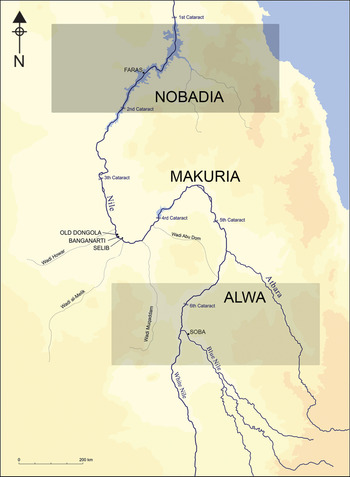
Banganarti is a medieval site in Makuria, in modern northern Sudan (Figure 1), renowned for the exceptionally high quantity of its pig remains. Here, we investigate the genesis and development of pig breeding in Christian Makuria and at Banganarti in particular. The extensive eleventh- to thirteenth-century archaeozoological evidence from Banganarti illustrates the specifics of pig breeding and pork consumption in Makuria. We also address the problem of identifying preferences in pork consumption at the socio-topographic level (defined here as the distribution by social category), by assessing the potential of the archaeozoological data to reveal areas occupied by local and non-local populations (e.g. pilgrims).
General map of medieval Nubian kingdoms (zones of influences) and the main locations mentioned in the text (figure: M. Osypińska).

Archaeology
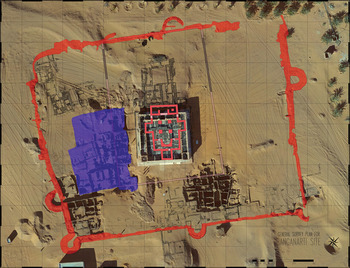
Banganarti is located on a dried-up canal that separates the Island of Tanqasi from the right bank of the Nile (Figure 1). Situated 7km upriver from Old Dongola, the capital of the medieval kingdom of Makuria, Banganarti's fortified settlement and church (the Raphaelion, dedicated to Archangel Raphael) were discovered during archaeological reconnaissance conducted between Old Dongola and Ez-Zuma in 1998–2001 (Żurawski Reference Żurawski2003). Excavations in 2001 confirmed the local oral tradition concerning the location of a ruined church said to be concealed by a hill covered with fragments of red bricks, lime mortar fragments and pottery, known locally as kom el-kenissa (Arabic for ‘church mound’) or jebel en-nassara (Arabic for ‘hill of the Christians’) (Żurawski Reference Żurawski2014). Ongoing fieldwork has revealed a large settlement complex (Figure 2) within the defensive walls, which functioned from the late sixth or early seventh century to the sixteenth century or later. Its central feature was the Raphaelion, a multiphase sanctuary for pilgrimage and healing that attracted visitors from the Middle Nile and beyond (Żurawski Reference Żurawski, Godlewski and Łajtar2008, Reference Żurawski2014).
Aerial photograph of Banganarti: the fortified settlement with the church phases dedicated to St Raphael the Archangel is in the centre; the fortifications and church are marked in red, the eastern district is in blue (figure: B.T. Żurawski).

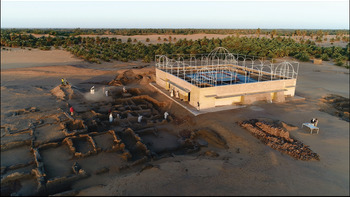
The period between the mid eleventh and late thirteenth centuries is of particular interest in terms of the site's population, animal economy and socio-topographic diversification. This phase began with the construction of the Upper Church, dedicated to the Archangel Raphael, on the ruin of its predecessor, the Lower Church (Figure 3).
The so-called Philadelphian reconstruction of the Raphaelion at Banganarti, as seen from a drone in March 2018. Excavations of the eastern district are in the foreground (figure: B.T. Żurawski).

Following construction of Banganarti's enormous church, which was intended to service crowds of pilgrims, the site was transformed from a fortified provincial settlement into the foremost pilgrimage centre in the Middle Nile region. In the context of increasing political stability across the region, new residential buildings and shelters for pilgrims spread beyond the defensive walls, and the military function of Banganarti lapsed.
Excavations have so far covered an area of 1ha. These investigations have unearthed the full length of the defensive walls together with adjacent areas, uncovering one-third of the entire site and reaching 8m below ground surface (Figure 3). Remains of temporary shelters have been exposed both inside and outside the walls. Organic waste derived from the primary stages of animal carcass processing (e.g. fragments of skulls, horn cores and phalanges) have been recovered from refuse dumps in the extramural areas. In the southern part of the site, remains of kitchens established inside and possibly also outside the enclosure have been recorded. The surviving, functionally diverse buildings contemporaneous with the Raphaelion, such as the houses in the eastern district (the so-called Eastern Living Quarter) and in the domestic area along the eastern fortification belt, have provided rich faunal assemblages. The animal bones discussed below come from eleventh- to thirteenth-century contexts dated by ceramic and stratigraphic analyses. With its two distinct populations—a resident community engaged in agriculture, animal husbandry, trade and hospitality and a transient group of pilgrims, Banganarti is a particularly useful case study for understanding the economy, demography and socio-topographic differentiation of medieval Nubia.
Materials and methods
Faunal data were acquired predominantly from remains excavated from habitation strata within buildings of the eastern district, and from excavations along the defensive wall. The strata inside the buildings consist mainly of Nile silt, organic matter, ashes and aeolian sand. The composition of the layers along the defences is similar. The uppermost levels and extramural strata comprise largely aeolian sand.
The material recovered is well preserved, as attested by the percentage of faunal remains attributable to taxon and anatomical element (Figure 4). The largest influence on preservation relates to the processing stages of the remains, such as intentional fragmentation, cutting or exposure to high temperatures and fire, all of which are indicative of slaughtering and cooking. Standard analytical procedures are used for identifying animal taxon, skeletal element, age, sex, pathological changes, measurements and post-mortem damage (for the comprehensive archaeozoological analysis of the site, see Osypińska Reference Osypińska2016b).
Preservation of the faunal remains from the eleventh- to thirteenth-century AD contexts at Banganarti (figure: M. Osypińska).

The number of identified specimens is used for quantification. Unified zoological nomenclature is applied for both domesticated (Gentry et al. Reference Gentry, Clutton-Brock and Groves2004; Cichocki et al. Reference Cichocki, Ważna, Cichocki, Rajska-Jurgiel, Jasiński and Bogdanowicz2015) and wild animals (Stuart & Stuart Reference Stuart and Stuart2006; Kingdon et al. Reference Kingdon, Happold, Butynski, Hoffmann, Happold and Kalin2013; Cichocki et al. Reference Cichocki, Ważna, Cichocki, Rajska-Jurgiel, Jasiński and Bogdanowicz2015). The species distribution is analysed taking into account the frequency of the bones of individual species and their percentage representation in the assemblages from different locations.
Results
In total, 3107 animal bones or fragments were recovered from Banganarti contexts dated to AD 1000–1200. In the residential buildings in the eastern quarter, 1050 bones or fragments exhibiting diagnostic features were recovered, while excavations of the defences and adjacent structures yielded a further 2057 (see Table S1 in the online supplementary material (OSM)). Although remains of molluscs and fish were also found, mammalian species dominate the assemblages. Almost all the animal bones recovered from the residential buildings and near the defensive circuit come from domesticated animals, while the wild animal bones, representing less than one per cent of the faunal remains, were found in both locations (Table S1).
Cattle (Bos taurus/Bos primigenius f. domestica) remains dominate (47.1 per cent) the Banganarti faunal material. The percentage of cattle was higher (49.5 per cent) in the eastern district than in the enclosing wall zone (46.1 per cent). Sheep (Ovis aries) and goat (Capra hircus) constitute 32 per cent of the material, with pig (Sus scrofa f. domestica) comprising the third most prominent species (17.4 per cent (Table S1)). The percentages of small ruminants and pig bones differ between zones. Within the buildings located to the east of the sanctuary, the percentage of ovicaprid bones is higher (35.6 per cent) than in areas containing shelters by the wall circuit (30.1 per cent). Conversely, a higher percentage of pig remains (20.1 per cent) is recorded in the contexts near the defences than in those excavated in the eastern part of the site (12.2 per cent).
The high percentage of pig remains in the Banganarti assemblage sets the site apart from other medieval Makurian settlements, including the capital at Old Dongola and the refuge site at Selib (see Osypińska Reference Osypińska2018 and references therein). It also contrasts strongly with evidence from the capital of the Kingdom of Alwa, to the south of the Sixth Cataract, at Soba East (Figure 5). Osteometric data from the Banganarti pig remains demonstrate their morphological similarity with ancient Egyptian pigs (Bertini & Cruz-Rivera Reference Bertini and Cruz-Rivera2014), although there are no such comparative data from medieval Egypt. Makurian pigs had a relatively ‘primitive’ morphology, with elongated faces (due to rectangular lacrimal bones), straight profile, small bodies and a height at the withers ranging from 0.50–0.75m (Osypińska Reference Osypińska2016b).
Percentage variation of the economically most important animal remains from medieval sites in the Middle Nile Valley (figure: M. Osypińska).

Meat-consumption models
The AD 1000–1200 faunal assemblage from Banganarti shows that meat came mainly from domesticated animals, as was also the case in its earlier period (seventh–ninth centuries AD; cf. Osypińska Reference Osypińska2016b). Neither hunting nor fishing provided a significant element of the subsistence strategy. This trend is observable in the faunal assemblages from both the houses in the eastern district and from the buildings adjoining the fortifications. Proportional analysis of meat-bearing elements from the three main species, however, allows us to observe certain differences in dietary preferences (Figure 6).
Dietary preferences, as illustrated by the proportions of consumed parts of the carcass: H = head (cranium, mandible, dentition, horn cores); T = torso (vertebrae, ribs, sternum); PPAL = proximal part of the anterior limb (scapula, humerus, radius, ulna); DPAL = distal part of anterior limb (carpals, metacarpals); PPPL = proximal part of posterior limb (pelvis, femur, tibia, patella); DPPL = distal part of posterior limb (talus, calcaneus, tarsals, metatarsals); PH = phalanges (first, second and third phalanx) (figure: M. Osypińska).

In the eastern district of Banganarti, beef was clearly the most popular meat in the inhabitants’ diet, a pattern typically seen in larger Nubian settlements from as early as the Kushite period (c. 785 BC–AD 350; Chaix Reference Chaix, Jousse and Lesur2011). Beef was also preferred in other medieval urban settlements, such as Soba (sixth to tenth centuries) and Old Dongola (twelfth to fourteenth centuries) (Chaix Reference Chaix, Jousse and Lesur2011; Osypińska Reference Osypińska, Łajtar, Obłuski and Zych2016a). It was only in rural settlements, such as Selib 1 (twelfth to thirteenth centuries; Osypińska Reference Osypińska2018), that goat and sheep meat were more frequently consumed (Figure 5). There are no archaeozoological data concerning diet from the kingdom of Nobadia to the north of Makuria, and no pig remains have been found in Soba, the capital of the southern kingdom of Alwa (Chaix Reference Chaix and Welsby1998). The Makurian diet therefore stands out within the context of Nubia for the obvious importance of pork consumption (Osypińska Reference Osypińska, Łajtar, Obłuski and Zych2016a).
At Banganarti, pig carcasses were divided in a manner similar to that of the ruminant species and display a diversified distribution across the site. Proximal limb and skull fragments, for example, dominate the assemblages from both the houses of the eastern district and the contexts adjacent to the fortifications (Figure 7 & Table S2). Although the high frequency of skull remains (H) in the eastern district is clear (Figure 7), skull fragments are less frequently encountered in the area of the walls, a pattern also observed for the trunk bones (T). The distribution of the most desirable parts of the carcass—the proximal limbs (PPAL and PPPL)—also varies by zone (Figure 7). It is therefore probable that pork, along with mutton, was subject to distribution with a specified target—consumers with higher demands—in mind.
Carcass division of the most important species (the colour is marked by parts recorded in large surpluses, subjected to careful division) (figure: M. Osypińska).

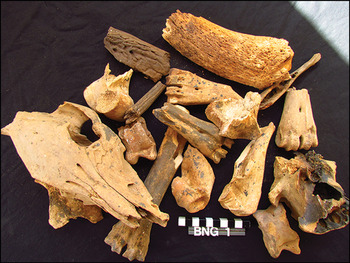
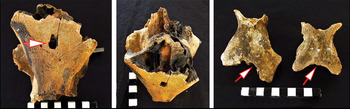
The meatiest parts of the carcasses (the shoulders and the haunch) are the most heavily fragmented. Traces of preparation for cooking also suggest that the meat from pigs’ heads was considered edible; more than a dozen pig skull fragments recovered near the defences, for example, have a hole in the frontal bone and evidence of scorching, suggesting that the heads were roasted on an open fire (Figure 8).
Fragments of the frontal bones (os frontale) of pigs, exhibiting holes and scorching made during preparation and cooking of the meat (figure: M. Osypińska).

It is notable that in the temporary utility structures (kitchens; Żurawski Reference Żurawski2014), located next to the defences, pork constituted a particularly popular element of the diet. Reasons for the varied distribution of faunal remains across the site might lie in the waste-disposal practices or the different locations used for slaughtering pigs and ruminants. The most probable explanation, however, may be the differences in diet between the inhabitants of the Eastern Living Quarter and that of the people using the kitchens and shelters on the periphery—differences grounded in the socio-topographic diversity of Banganarti and the site's function as an important pilgrimage centre with a large catchment area.
The residential buildings located near the eastern side of the sanctuary comprise high-quality houses, probably inhabited by members of the elite: priests, monks, clerks and perhaps merchants. In accordance with the traditional Nubian model, beef predominated in the diet of the upper echelon of local society. Conversely, the area close to the defences—both inside and outside—comprised mainly shelters for the pilgrims, makeshift houses, huts and outdoor kitchens. Less affluent travellers and pilgrims could probably obtain food and lodging in this area. While the refuse found next to the defences probably comprises the remains left by the guards stationed near the walls, the spatial data also suggest that pilgrims, non-Nubian travellers and perhaps the poorer residents of Banganarti ate predominantly pork.
Discussion
Animal husbandry strategies and the environment
The economic factors influencing the functioning of the settlement at Banganarti have yet to be fully established, but they were undoubtedly complex. The settlement was probably economically self-sufficient, supported by locally run agriculture and animal breeding. As a state-level pilgrimage centre, it could also have received donations from the royal court, the church hierarchy and affluent visitors. Such a mixed economic model is highly plausible. A strip of rural settlements close to Banganarti along the Nile, recorded during archaeological survey (Żurawski Reference Żurawski2003), served as an economic hinterland for the church, monastery and wider settlement.
The archaeozoological data provide essential information on the production, distribution and consumption of meat at Banganarti during both its time as a fortified settlement and following the loss of its defensive capabilities due to increasing political stability in the region and its transformation into the most important pilgrimage centre in the Middle Nile.
The social changes and increase in Banganarti's prosperity and prestige undoubtedly drove a change in the demand for meat and, consequently, in animal breeding (Osypińska Reference Osypińska2016b). This hypothesis is supported by the archaeozoological data, which show changes over time, comprising a shift from easy-to-breed small ruminants to cattle. The latter are far more demanding, requiring large quantities of good quality fodder and access to pasture and water, while having much lower fertility rates (i.e. producing only one calf per year). Breeding cattle required considerable economic expenditure, particularly in the Upper Nubian environmental conditions. There was also a notable increase in the rearing of pigs. These animals, the easiest of the meat-providing livestock species to breed, especially among urban populations, have high fertility rates and can be kept in small pens.
The ages of the cattle and pigs, slaughtered as immature animals more frequently than sheep or goats, and the predominantly male sex of the animals, indicate that animal husbandry was intended to provide meat for consumption. In the case of cattle, such a model contrasts with an agriculture-based economy, in which such animals were kept mainly for draught labour, fertiliser and milk.
The environmental conditions of Makuria, narrow strips of fields on both banks of the Nile and no pastures, combined with the growing demand for beef (Figure 5) and evidence for morphological changes in cattle from the mid ninth century onwards (Osypińska Reference Osypińska2018), suggest that large herds were brought in from external areas to support the local economy. Banganarti and Dongola are located at the outlet of Wadi el-Malik, which ran from Kordofan—still the most important cattle-breeding centre in Sudan today—some 600km to the south. It therefore seems highly likely that the cattle were imported from here (Osypińska Reference Osypińska2018: 191–95, 246, 315).
For such a small settlement as Banganarti, the animal husbandry appears more typical of an urban rather than a rural model. The most important element is the dominant practice of breeding cattle for meat. Traditionally characteristic of third- to first-century BC Meroitic political and religious centres, it was also a feature of the thirteenth- to fourteenth-century citadel at Old Dongola, inhabited by social elites. The archaeozoological data from Banganarti may indicate that, at the time the church and fortifications (and a possible monastery) were established, the settlement also had a stock of breeding animals to guarantee a supply of meat. The founding herd in this early period may have comprised both local and imported animals.
Local residents and visitors
The community living at Banganarti generally had a diet that can be considered traditional for the Middle Nile region, characterised by a large proportion of ruminant meat. The archaeozoological analyses at Banganarti allow us to identify the socio-topographic diversification of the settlement. Although the diet of both the permanent and temporary inhabitants was based on the traditional model, we can identify a few differences. It seems, for example, that the Eastern Living Quarter was inhabited by people of high social status who consumed primarily beef and—quite frequently—veal. Here, the proportion of pork was relatively low, with only the most desirable cuts consumed, if any. The distribution of the different faunal remains does not provide clear evidence for a waste-disposal model. The archaeozoological and archaeological data suggest that the diversity in consumption resulted from the cultural and/or economic differences of the inhabitants of the two areas studied at Banganarti.
As mentioned above, the Banganarti population is notable for having the highest rate of pork consumption in medieval Makuria. We favour the hypothesis that pig breeding was introduced to the Middle Nile in the formative period of the Christian state, as part of a more complex cultural pattern. On the one hand, pig breeding was popular in Egypt in the sixth to seventh centuries AD; on the other, the Nubian population flowing into the Middle Nile from Kordofan from the fourth century AD could have introduced their own dietary practices and behaviours, among which pig breeding and pork consumption were important.
The custom of pilgrims bringing pigs to pilgrimage sanctuaries is well documented in written sources from outside Nubia (see the OSM), and could have contributed significantly to the substantial consumption of pork at Banganarti. This hypothesis is partly corroborated by the diversity of the areas in Banganarti where pork was eaten. Particularly large quantities of pork were consumed in the peripheral households, extramural structures and external kitchens along the defensive walls—areas of the settlement probably inhabited by pilgrims, migrants from the south and non-locals in general. Pilgrims may have stayed here while they awaited their turn to enter Archangel Raphael's sanctuary to undergo incubation (experiencing a divinely inspired dream) or other faith-healing rituals. Others were probably strangers who were not allowed to enter the fortified area. The wealthier pilgrims, however, probably stayed in xenodocheia (guesthouses) and rented rooms in the Eastern Living Quarter. The hypothesis concerning the sociological diversity of Banganarti's temporary or permanent populations is supported by the archaeological and archaeozoological data.
The evidence for a particular method of preparing pigs’ heads for consumption at Banganarti deserves further attention. While the method, which involved roasting the entire head on a spiked grill over a fire has many modern analogies, no such practice is known in the Meroitic medieval Middle Nile. At Banganarti, this method of roasting the head is only evident in the faunal material found near the defences and in the kitchen areas datable to the eleventh to thirteenth centuries (Figure 6). Roasting meat over a fire is the dominant cooking method in these locations, and is unique among the other Makurian sites that we have investigated to date. In both the Old Dongola area (in the citadel and suburban monastery) and the small settlement in Selib, only small fragments of meat were cooked on the bone, most probably in sauces (Osypińska Reference Osypińska2018).
Banganarti's animal economy
At the outset of our research into the economy of Banganarti, we expected to find evidence that would resemble that obtained from the nearby contemporaneous site of Old Dongola. The results, however, indicate that Banganarti was a settlement with a unique economic signature more closely linked to elite complexes in large centres of power. Animal husbandry encompassing cattle, sheep, goats and pigs played a prominent role at Banganarti from its foundation in the late sixth or early seventh century onwards (Osypińska Reference Osypińska2016b).
The importance of the site as an eleventh- to sixteenth-century Middle Nile pilgrimage centre clearly distinguishes Banganarti from other settlements in the region, in which pig remains were either absent or present in only small quantities. In terms of the quality and quantity of pig breeding, Banganarti shares many similarities with the Egyptian pilgrimage sites of Abu Mina in the Mareotis district (Delehaye Reference Delehaye1910; Grossmann Reference Grossmann and Frankfurter1998) and Menouthis close to Alexandria (Sansterre Reference Sansterre and Dierkens1991; see the OSM). At Mareotis, a large pilgrimage centre devoted to Saint Menas was active between the fourth and tenth centuries AD. Descriptions of Menas’ miracles contain ample references to the ubiquitous presence of pigs within the walls of the settlement that developed around the Saint Menas pilgrimage complex (see the OSM). Furthermore, early archaeological investigation at Abu Mena yielded a large quantity of pig skulls within the faunal assemblage associated with the slaughterhouse next to the monastery (Kaufmann Reference Kaufmann1918).
Pigs, pilgrims and texts
Literary sources documenting the Nubian past make a single reference to pig breeding: in the narrative of the capture of Qasr Ibrim by the Egyptian army in 1173. Abū al-Makārim writes that the Muslims left the town in ruins, took the Nubian inhabitants as prisoners and slaughtered 700 pigs (Evetts & Butler Reference Evetts and Butler1895: 266–67, folio 96b). The dearth of literary sources referring to pig breeding in Nubia is balanced by the sizeable collection of texts on daily life and the miracles of patron saints in Egyptian pilgrimage centres. Pig breeding features prominently in these narratives. The posthumous miracles of Saint Menas, for example, provide valuable, although indirect, information on the topic (Frankfurter Reference Frankfurter1998; see the OSM). The animals were brought to Mareotis by the pilgrims as votive offerings. One such ‘animal farm’, located close to the Saint Thecla sanctuary in Meriamlik in southern Turkey, is described by Basil of Seleucia (Kötting Reference Kötting1950: 156). What is surprising in these narratives is the ease with which pigs were allowed to move around the pilgrimage centres. In a description of a miracle of Saint Cosmas and Saint Damian, for example, a sow—apparently offered to the sanctuary by one of the pilgrims—confidently ran between the sick waiting for miraculous healing (Rupprecht Reference Rupprecht1935: 18–20). In lieu of a pig offering, which was quite expensive, a terracotta model of a swine could be brought to the sanctuary and sacrificed to the saint (cf. Żurawski Reference Żurawski2014: 245). While the saint's attendants were probably not happy with such a substitution, the quantity of animal figurines, including pigs, found generally in the loca sancta is remarkable. Finally, pig breeding was also practised on a large scale in Byzantine monastic establishments (Thomas & Constantinides-Hero Reference Thomas and Constantinides-Hero2000: 1190).
Conclusions
Only in one case in the history of the Middle Nile Valley was pork an important dietary constituent: in the sixth- to fourteenth-century AD Christian kingdom of Makuria. This predilection for pork and pig breeding is especially apparent at Banganarti, and is attributable to the settlement's specific function as a prominent pilgrimage centre attracting visitors from far afield.
The ubiquitous presence of pig bones at Banganarti suggests the extensive breeding of the animals for a number of reasons. The most important of these was probably the Christianisation of Upper Nubia, along with elements of Coptic-Egyptian worship. An equally important factor was the adaptation of cultural modes from elsewhere. In Makuria, however, less obvious factors should also be considered, such as a possible inflow of people from the Central African Sahel, particularly from Kordofan. The location of rural Banganarti and urban Old Dongola, at the mouth of a natural corridor between Kordofan and the Nile, should be emphasised. The hypothesis on the great influx of Kordofanians into the Middle Nile is supported by the discovery in Nubian archaeological assemblages of ruminants typical for the Niger Great Bend, Central Africa and Fulbe societies (Osypińska Reference Osypińska2018). Our research at Banganarti suggests that pork was a popular food for pilgrims, visitors and poorer inhabitants. The diet of the higher social classes was dominated by beef, which had been a traditional and typical element of Nubian cuisine since the Kushite period (Chaix Reference Chaix, Jousse and Lesur2011; Osypińska Reference Osypińska2018).
The complex history of Banganarti is reflected in its animal husbandry, which can be reconstructed through archaeozoological analyses. The pilgrimage centre, one of the most important in the entire Middle Nile Valley, must have been extremely diverse, both culturally and demographically. Some pilgrims remained in the settlement for longer periods and others stayed permanently, thus contributing to a greater diversification of the local population. The foreigners intermixed with the local residents, including an educated elite (e.g. scribes attached to the church) and members of lower social groups who maintained the logistical and economic functions of the centre, such as servicing the xenodocheia and private quarters. The pilgrims themselves constituted a group that was socially, culturally, ethnically and even religiously diverse. This is attested by, for example, the ‘portrait’ of a Muslim pilgrim named Ali, with an accompanying inscription in Arabic, found on the wall of the church's western portico (Żurawski Reference Żurawski2003; Łajtar Reference Łajtar and Żurawski2014: 273).
Pork was willingly eaten by communities for which it traditionally constituted a permanent element of the diet. At Banganarti, they could have been either pilgrims from the north (Egypt) or communities from the south, such as from the central Sahel. The easy availability of pork was also important. The pig is the most productive animal among domestic species, and easy to keep due to its omnivorous habits and limited need for pasture. The archaeozoological analyses, carried out concurrently with archaeological investigations, have revealed the special importance of pigs in medieval Banganarti and have contributed to a better understanding of the coexistence between diverse groups in multi-cultural communities.
Acknowledgements
Research at Banganarti was funded by the National Science Centre of Poland to the project ‘Angels and Locusts: Everyday Life in Banganarti, the Pilgrimage Centre on the Middle Nile between the Sixth and Sixteenth Century’ (grant 2016/21/B/HS3/03724).
Supplementary material
To view supplementary material for this article, please visit https://doi.org/10.15184/aqy.2019.235