Introduction
Stroke is the second leading cause of death and burden of disease in developed countries (Lopez et al. Reference Lopez, Mathers, Ezzati, Jamison and Murray2006). Depression is the most frequent affective disorder that takes place after a stroke (Gordon & Hibbard, Reference Gordon and Hibbard1997), with about 33% of patients with stroke developing depression (Hackett et al. Reference Hackett, Yapa, Parag and Anderson2005). The recognition and diagnosis of depression in stroke patients is important because the presence of depression has been associated with both poor outcome (Schulz et al. Reference Schulz, Beach, Ives, Martire, Ariyo and Kop2000; Pohjasvaara et al. Reference Pohjasvaara, Vataja, Leppavuori, Kaste and Erkinjuntti2001) and higher mortality (House et al. Reference House, Knapp, Bamford and Vail2001; Linden et al. Reference Linden, Blomstrand and Skoog2007). Depressive symptoms have also been reported as being an independent risk factor for incident stroke and transient ischemic attack in people aged <65 years (Salaycik et al. Reference Salaycik, Kelly-Hayes, Beiser, Nguyen, Brady, Kase and Wolf2007).
Chronic inflammation has been suggested as an important mechanism related to depression. An increase in serum levels of some inflammatory cytokines, such as interleukin (IL)-1β, IL-2 and IL-6 (Maes et al. Reference Maes, Scharpe, Bosmans, Vandewoude, Suy, Uyttenbroeck, Cooreman, Vandervorst and Raus1992, Reference Maes, Meltzer, Bosmans, Bergmans, Vandoolaeghe, Ranjan and Desnyder1995a, Reference Maes, Vandoolaeghe, Ranjan, Bosmans, Bergmans and Desnyderb; Connor & Leonard, Reference Connor and Leonard1998; Dentino et al. Reference Dentino, Pieper, Rao, Currie, Harris, Blazer and Cohen1999; Tiemeier et al. Reference Tiemeier, Hofman, van Tuijl, Kiliaan, Meijer and Breteler2003) and C-reactive protein (CRP) (Berk et al. Reference Berk, Wadee, Kuschke and O'Neill-Kerr1997; Kop et al. Reference Kop, Gottdiener, Tangen, Fried, McBurnie, Walston, Newman, Hirsch and Tracy2002; Penninx et al. Reference Penninx, Kritchevsky, Yaffe, Newman, Simonsick, Rubin, Ferrucci, Harris and Pahor2003; Ford & Erlinger, Reference Ford and Erlinger2004; Panagiotakos et al. Reference Panagiotakos, Pitsavos, Chrysohoou, Tsetsekou, Papageorgiou, Christodoulou and Stefanadis2004), has been associated with the presence of depression. However, some authors have not found this association (Kuo et al. Reference Kuo, Yen, Chang, Kuo, Chen and Sorond2005) and others found it only in males (Danner et al. Reference Danner, Kasl, Abramson and Vaccarino2003). A relationship between depression and inflammation has also been found in patients with coronary heart disease. Higher serum levels of intracellular adhesion molecule 1 (ICAM-1) and CRP have been detected in patients with major depression (Appels et al. Reference Appels, Bar, Bar, Bruggeman and de Baets2000; Miller et al. Reference Miller, Stetler, Carney, Freedland and Banks2002; Lesperance et al. Reference Lesperance, Frasure-Smith, Theroux and Irwin2004). In post-stroke depression, inflammation has been proposed as a related factor because it could result from an increase in pro-inflammatory cytokine production in mood-related areas due to brain ischemia (Spalletta et al. Reference Spalletta, Bossu, Ciaramella, Bria, Caltagirone and Robinson2006).
Other molecular markers, such as brain-derived neurotrophic factor (BDNF) (Duman et al. Reference Duman, Heninger and Nestler1997; Altar, Reference Altar1999; Karege et al. Reference Karege, Perret, Bondolfi, Schwald, Bertschy and Aubry2002; Nestler et al. Reference Nestler, Barrot, DiLeone, Eisch, Gold and Monteggia2002; Saarelainen et al. Reference Saarelainen, Hendolin, Lucas, Koponen, Sairanen, MacDonald, Agerman, Haapasalo, Nawa, Aloyz, Ernfors and Castrén2003; Castren, Reference Castren2004; Sairanen et al. Reference Sairanen, Lucas, Ernfors, Castren and Castren2005) and leptin (Lu et al. Reference Lu, Kim, Frazer and Zhang2006), have been associated with the development of depression in clinical and experimental studies.
Leptin is an adipocyte hormone encoded by the obese (ob) gene. It circulates as a 16-kDa protein and is transported across the blood–brain barrier by a saturable system to exert its central effects (Banks, Reference Banks2004). Its main function is appetite behavior and energy balance control, although in recent years it has been studied on account of its participation in synaptic plasticity (Shanley et al. Reference Shanley, Irving and Harvey2001), neuroprotection (Zhang et al. Reference Zhang, Wang, Signore and Chen2007; Signore et al. Reference Signore, Zhang, Weng, Gao and Chen2008) and as a vascular risk factor for myocardial infarct and stroke (Söderberg et al. Reference Söderberg, Ahrén, Jansson, Johnson, Hallmans, Asplund and Olsson1999; Sierra-Johnson et al. Reference Sierra-Johnson, Romero-Corral, Lopez-Jimenez, Gami, Sert Kuniyoshi, Wolk and Somers2007).
However, the role of leptin in patients with depression remains unclear. Whereas some authors have found higher leptin levels in patients with depression (Rubin et al. Reference Rubin, Rhodes and Czambel2002; Esel et al. Reference Esel, Ozsoy, Tutus, Sofuoglu, Kartalci, Bayram, Kokbudak and Kula2005; Gecici et al. Reference Gecici, Kuloglu, Atmaca, Tezcan, Tunckol, Emul and Ustundag2005), others have reported lower leptin levels (Atmaca et al. Reference Atmaca, Kuloglu, Tezcan, Ustundag, Gecici and Firidin2002; Westling et al. Reference Westling, Ahren, Traskman-Bendz and Westrin2004; Jow et al. Reference Jow, Yang and Chen2006); however, there have been no studies on leptin in patients with post-stroke depression.
Our aim in this study was therefore to evaluate the possible association between inflammatory molecular markers [IL-1β, TNF-α, IL-6, ICAM-1 and high sensitivity CRP (hs-CRP)], neurotrophic markers (BDNF) and leptin, and the development of post-stroke depression.
Method
Study population
One hundred and thirty-four patients with a first episode of ischemic stroke admitted to the Stroke Unit of our hospital within the first 24 h of stroke onset were prospectively included in the study. All patients were treated in accordance with the Guidelines of the Cerebrovascular Diseases Study Group of the Spanish Society of Neurology (GEECV-SEN, 2004). Patients with severe stroke at discharge [National Institutes of Health Stroke Scale (NIHSS) score >20], speech disturbances that precluded us from performing the evaluation, a previous history of depression (clinical diagnosis or previous treatment), hepatic, renal, hematological or immunological diseases, thyroid hormone disorders, uncontrolled diabetes, infectious or inflammatory diseases, and life expectancy <1 month were excluded. Ninety out of 134 patients (67.2%) were male, with a mean age of 70.4±10.9 years. Thirty patients were not evaluated at 1 month (nine patients refused to attend the follow-up, five patients were bedridden or had difficulty in being transported to hospital, four patients were hospitalized, and 12 patients were lost to follow-up); the remaining 104 patients were valid for analysis. None of the patients had received antidepressant drugs during the acute phase of stroke because of the short duration of symptoms and the possible interference of somatic symptoms related to hospitalization. However, seven patients had received antidepressant drugs (selective serotonin reuptake inhibitors) at discharge for severe depressive symptoms.
The protocol was approved by the ethics committee and informed consent was given by patients or their relatives.
Clinical variables
Stroke severity was evaluated by trained neurologists using the NIHSS at admission, at discharge and after 1 month. A score <8 was considered as being a mild deficit, 8–20 as moderate and >20 as severe (Brott et al. Reference Brott, Adams, Olinger, Marler, Barsan, Biller, Spilker, Holleran, Eberle and Hertzberg1989). Functional outcome was evaluated by the modified Rankin Scale (mRS) [0–2, independent; 3–4, need help for activities of daily living (ADL); 5, severe disability; 6, death] and the Barthel Index (BI) (0, highest disability for ADL; 100, independent for ADL) at discharge and at 1 month.
We recorded previous medical history including vascular risk factors, and we performed hematological and coagulation determinations, cranial computed tomography (CT), electrocardiography, chest radiography and carotid ultrasound at admission. Stroke subtype was classified according to TOAST (Trial of ORG 10172 in Acute Stroke Treatment) criteria (Adams et al. Reference Adams, Bendixen, Kappelle, Biller, Love, Gordon and Marsh1993).
Cerebral CT was performed between days 4 and 7 to evaluate infarct volume, using the formula 0.5×a×b×c (a and b=greatest perpendicular diameters, c=number of 10-mm sections where the cerebral infarct was apparent).
Psychological evaluation
Psychological evaluation was performed by the same trained psychologist at discharge and 1 month. Previous history of depression and psychiatric disease, civil state, educational level and people living with the patient were recorded at admission. Depression was evaluated at discharge and at 1 month using DSM-IV criteria for the diagnosis, with the exception of time criteria, which were considered as 1 week in the first evaluation and 1 month in the second evaluation. Major depression was considered when at least five of nine symptoms in accordance with DSM-IV criteria were present, and minor depression when three or four symptoms were present. The presence of anhedonia and depressive mood was essential for the diagnosis as patients without these symptoms are not considered to have depression. To evaluate the severity of depressive symptoms we used the Yesavage Geriatric Depression Scale (GDS).
Laboratory tests
Blood samples were obtained at discharge, before starting possible antidepressant treatment, and at day 30±7. Samples were centrifuged at 3000 g for 10 min and immediately frozen and stored at −80°C for further determination of molecular markers. Serum IL-6 and ICAM-1 levels were measured with a commercially available quantitative enzyme-linked immunosorbent assay (ELISA) kit (BenderMedSystems Diagnostics GmbH, Austria). BDNF and leptin levels were measured with ELISA kits (ChemiKine™, Chemicon® International Inc. and R&D Systems, Inc., USA, respectively). IL-1β, TNF-α and hs-CRP levels were determined using the IMMULITE 1000 System [Diagnostic Products Corporation (DPC), USA]. Biomarker concentrations were measured in a central laboratory by investigators blinded to the clinical outcome and neuroimaging findings. Clinical investigators were unaware of the laboratory results until the study had ended.
Statistical analyses
The presence of major depression at discharge and at 1 month and also the development of major depression within the 1-month follow-up period in patients who were not depressed at discharge were considered as the main variables of the study. The results are expressed as percentages for categorical variables and as mean (standard deviation, s.d.) or median (interquartile range, IQR) for the continuous variables depending on their normal distribution. Proportions were compared using the χ2 test, and the Student's t test or the Mann–Whitney test was used to compare continuous variables between groups as appropriate. Because of a lack of linearity, molecular markers were categorized by receiver operating characteristic (ROC) analysis.
Logistic regression modelling was performed to determine the influence of the different clinical or molecular factors on the development of the main variables. Those factors found to be related to the main variables in the univariate analysis were entered in the model (enter approach and probability of entry p<0.05). The results are expressed as adjusted odds ratios (ORs) with the corresponding 95% confidence intervals (CIs).
Values of p<0.05 were considered to be statistically significant in all tests. The statistical analysis was conducted using SPSS version 14.0 for Windows XP (SPSS Inc., Chicago, IL, USA).
Results
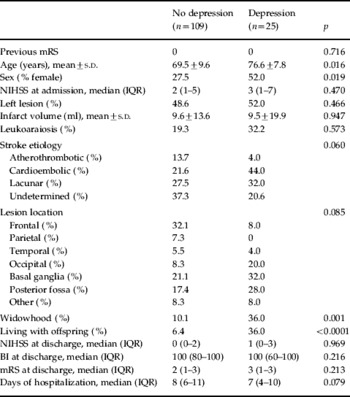
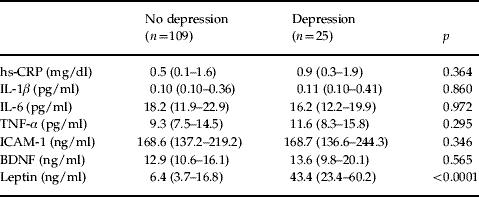
Fifty-four patients (40.3%) showed depression at discharge and in 25 patients (18.7%) this depression was classified as major. The clinical variables associated with the presence of major depression at discharge are shown in Table 1. Table 2 shows the molecular marker values for patients who presented with major depression at discharge. The serum level of leptin determined at discharge was the only molecular marker associated with the presence of major depression at discharge (OR 1.02, 95% CI 1.0–1.03, p=0.001). After adjusting for all clinical variables associated with major depression at discharge, leptin remained the only variable related to the presence of major depression at discharge (OR 1.01, 95% CI 1.0–1.03, p=0.011).
Baseline clinical characteristics, stroke subtype, neuroimaging and psychological findings in patients with and without post-stroke major depression at discharge

mRS, Modified Rankin Scale; NIHSS, National Institutes of Health Stroke Scale; BI, Barthel Index; s.d., standard deviation; IQR, interquartile range.
Serum levels of molecular markers on day 7±2 in patients with and without major depression at discharge

Values given as median (interquartile range).
hs-CRP, High-sensitivity C-reactive protein; IL-1β, interleukin-1 beta; IL-6, interleukin-6; TNF-α, tumor necrosis factor alpha; ICAM-1, intercellular adhesion molecule 1; BDNF, brain-derived neurotrophic factor.
At discharge, 36 patients (26.9%) received treatment with statins (atorvastatin between 20 and 80 mg/day) and 99 patients (73.9%) received anti-platelet drugs (52 patients aspirin 100 mg/day, and 47 patients clopidogrel 75 mg/day). Inflammatory molecular markers and leptin determinations were independent of treatment with statins and anti-platelet drugs.
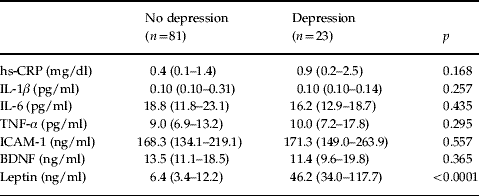
At 1 month, the percentage of patients with depression (48.1%) and major depression (22.1%) was higher than at discharge (p=0.002 and p<0.001 respectively). Variables relating to the presence of major depression at 1 month were: sex (female 60.9% v. 21.0%, p<0.0001), depression at discharge (47.8% v. 9.9%, p<0.0001), and living with offspring (26.1% v. 7.2%, p=0.012). Patients with major depression at 1 month had similar stroke severity [NIHSS: 0 (0–1) v. 0 (0–1), p=0.259] but they showed higher functional disability [BI: 70 (90–100) v. 100 (95–100), p=0.001; mRS: 2 (1–3) v. 1 (0–2), p=0.031]. Molecular marker levels in patients with and without depression at 30±7 days are shown in Table 3. The only molecular marker associated with the presence of major depression at 1 month was serum leptin levels (OR 1.1, 95% CI 1.0–1.2, p=0.002). After adjusting the model for all the significant variables in the bivariate analysis, only the presence of major depression at 1 month (OR 13.1, 95% CI 2.9–57.5, p=0.001) and high leptin serum levels at day 30±7 (OR 1.0, 95% CI 1.0–1.1, p=0.002) independently predicted the development of major depression at discharge. Using ROC curves, leptin levels >20.7 ng/ml at day 7±2 predicted the development of depression at 1 month with the highest sensitivity and specificity [86% and 84% respectively; area under the curve (AUC)=0.897, p<0.001].
Serum levels of molecular markers on day 30±7 in patients with and without major depression at 1 month

Values given as median (interquartile range).
hs-CRP, High-sensitivity C-reactive protein; IL-1β, interleukin-1 beta; IL-6, interleukin-6; TNF-α, tumor necrosis factor alpha; ICAM-1, intercellular adhesion molecule 1; BDNF, brain-derived neurotrophic factor.
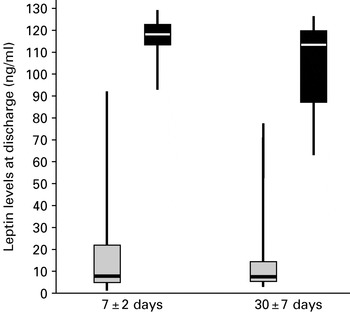
Eight patients (7.7%) without depression at discharge developed depression during the first month. These patients showed higher stroke severity at 1 month [NIHSS: 1 (0–3) v. 0 (0–1), p=0.031] and worse functional outcome [BI: 55 (30–60) v. 100 (95–100), p<0.0001; mRS: 3 (2–4) v. 1 (1–3), p=0.001]. Leptin serum levels at discharge and at 1 month were higher in patients who developed depression during the first month after stroke (Fig. 1). Leptin serum levels at discharge (OR 1.1, 95% CI 1.0–1.2, p=0.010) and at 1 month (OR 1.0, 95% CI 1.0–1.1, p=0.026) were the only variables associated with the development of major depression during the first month of evolution. In these patients, leptin levels >85 ng/ml at discharge predict the development of major depression within the first month with a sensitivity of 100% and a specificity of 99% (AUC=0.998, p<0.001).
Serum leptin levels on days 7 and 30 for patients with (▪) and without ( ) post-stroke depression within the 1 month follow-up period. Boxplots show median values (horizontal line inside the box), quartiles (box boundaries), and the largest and smallest observed values (lines drawn above and below the box) of leptin.

Discussion
Our results suggest that leptin is a powerful biological marker of risk of developing post-stroke major depression. Therefore, it may be used as a future therapeutic target in patients with ischemic stroke because depression has been associated with poorer outcome (Schulz et al. Reference Schulz, Beach, Ives, Martire, Ariyo and Kop2000; Pohjasvaara et al. Reference Pohjasvaara, Vataja, Leppavuori, Kaste and Erkinjuntti2001) and also with increased mortality (House et al. Reference House, Knapp, Bamford and Vail2001; Linden et al. Reference Linden, Blomstrand and Skoog2007).
In our study we found that 40.3% of patients who suffered an ischemic stroke present with depression at discharge (19% major depression), and this percentage is even higher at 1 month. These results broadly agree with the findings of previous studies (Hackett et al. Reference Hackett, Yapa, Parag and Anderson2005; Caeiro et al. Reference Caeiro, Ferro, Santos and Figueira2006). No association was found between etiological subtype or lesion location and the presence of depression. As in the general population (Alexopoulos, Reference Alexopoulos2005), post-stroke depression was more frequent in women (Carod-Artal, Reference Carod-Artal2007), a finding that is not supported by some other studies (Berg et al. Reference Berg, Palomaki, Lehtihalmes, Lonnqvist and Kaste2003; Naess et al. Reference Naess, Nyland, Thomassen, Aarseth and Myhr2005).
We found that patients with depression more frequently live with their offspring, although other factors, such as widowhood, spouse disease or disability, that led the patient to live with their offspring may have contributed to the development of depression. Patient relocation, particularly when it is forced, can alter mood negatively (Armer, Reference Armer1993). In our study, living with offspring often implied a change of residence, which might also be related to the presence of depression.
Our results also show that patients with major depression at 1 month have worse functional outcome in comparison with those without it, independently of stroke severity. These data suggest that the presence of depression itself conditions poor outcome, although earlier studies have reached different conclusions on this point (Herrmann et al. Reference Herrmann, Bartels, Schumacher and Wallesch1995; Hackett & Anderson, Reference Hackett and Anderson2005).
We did not find any association between molecular markers of inflammation and neurotrophic factors and the development of depression. Although this conclusion is at variance with studies conducted in the general population (Maes et al. Reference Maes, Scharpe, Bosmans, Vandewoude, Suy, Uyttenbroeck, Cooreman, Vandervorst and Raus1992, Reference Maes, Meltzer, Bosmans, Bergmans, Vandoolaeghe, Ranjan and Desnyder1995a, Reference Maes, Vandoolaeghe, Ranjan, Bosmans, Bergmans and Desnyderb; Berk et al. Reference Berk, Wadee, Kuschke and O'Neill-Kerr1997; Duman et al. Reference Duman, Heninger and Nestler1997; Connor & Leonard, Reference Connor and Leonard1998; Altar, Reference Altar1999; Dentino et al. Reference Dentino, Pieper, Rao, Currie, Harris, Blazer and Cohen1999; Karege et al. Reference Karege, Perret, Bondolfi, Schwald, Bertschy and Aubry2002; Kop et al. Reference Kop, Gottdiener, Tangen, Fried, McBurnie, Walston, Newman, Hirsch and Tracy2002; Nestler et al. Reference Nestler, Barrot, DiLeone, Eisch, Gold and Monteggia2002; Penninx et al. Reference Penninx, Kritchevsky, Yaffe, Newman, Simonsick, Rubin, Ferrucci, Harris and Pahor2003; Saarelainen et al. Reference Saarelainen, Hendolin, Lucas, Koponen, Sairanen, MacDonald, Agerman, Haapasalo, Nawa, Aloyz, Ernfors and Castrén2003; Tiemeier et al. Reference Tiemeier, Hofman, van Tuijl, Kiliaan, Meijer and Breteler2003; Castren, Reference Castren2004; Ford & Erlinger, Reference Ford and Erlinger2004; Panagiotakos et al. Reference Panagiotakos, Pitsavos, Chrysohoou, Tsetsekou, Papageorgiou, Christodoulou and Stefanadis2004; Sairanen et al. Reference Sairanen, Lucas, Ernfors, Castren and Castren2005), it does coincide with data from other studies including patients with coronary disease (Schins et al. Reference Schins, Tulner, Lousberg, Kenis, Delanghe, Crijns, Grauls, Stassen, Maes and Honig2005).
We found an association between high leptin levels and the presence of depression after stroke. As mentioned earlier, the role of leptin in the development of depression remains controversial. Whereas some authors have found higher leptin levels in patients with depression (Rubin et al. Reference Rubin, Rhodes and Czambel2002; Esel et al. Reference Esel, Ozsoy, Tutus, Sofuoglu, Kartalci, Bayram, Kokbudak and Kula2005; Gecici et al. Reference Gecici, Kuloglu, Atmaca, Tezcan, Tunckol, Emul and Ustundag2005), others have reported lower leptin levels in patients with depression (Atmaca et al. Reference Atmaca, Kuloglu, Tezcan, Ustundag, Gecici and Firidin2002) and in attempted suicides (Westling et al. Reference Westling, Ahren, Traskman-Bendz and Westrin2004; Jow et al. Reference Jow, Yang and Chen2006). A recently proposed theory is that both insufficient leptin levels and leptin resistance (as found in obese people) are associated with mood disturbances (Lu, Reference Lu2007). Similarly, high leptin levels are associated with neuroprotective effects in animal models of cerebral ischemia (Zhang et al. Reference Zhang, Wang, Signore and Chen2007; Signore et al. Reference Signore, Zhang, Weng, Gao and Chen2008). The fact that patients with higher levels of leptin showed worse outcome in our study may support the idea that it is consequence of a condition of leptin resistance. Several mechanisms have been implicated in leptin resistance, such as a failure in the transport of leptin in blood, a decrease in its receptor function and transduction defects (Munzberg & Myers, Reference Munzberg and Myers2005).
Leptin plays an important role in energy homeostasis, and also in the inflammatory response (Rios et al. Reference Rios, Fan, Fekete, Kelly, Bates, Kuehn, Lechan and Jaenisch2001; Otero et al. Reference Otero, Lago, Gomez, Lago, Gomez-Reino and Gualillo2006; Steiner & Romanovsky, Reference Steiner and Romanovsky2007). Furthermore, leptin reduces food intake by regulating orexigenic and anorexigenic factors in the hypothalamus. Although the exact role of leptin in the development of depression is unknown, it is known to be involved in the activity of the hypothalamus–pituitary–adrenal (HPA) axis and its relationship with glucocorticoids. In depressive patients, glucocorticoid receptor resistance is thought to cause overstimulation of the HPA system. Glucocorticoids themselves increases leptin synthesis and secretion in humans in adipose tissue (Antonijevic et al. Reference Antonijevic, Murck, Frieboes, Horn, Brabant and Steiger1998). Changes in the HPA system during antidepressant treatment have been correlated with leptin levels (Himmerich et al. Reference Himmerich, Zimmermann, Ising, Kloiber, Lucae, Kunzel, Binder, Holsboer and Uhr2007). BDNF also has an important anorexigenic effect in the hypothalamus and is essential in the maintenance of regulation of anxiety-related behavior and in food intake through central mediators, such as leptin, insulin, glucose and cholesterol (Bariohay et al. Reference Bariohay, Lebrun, Moyse and Jean2005; Komori et al. Reference Komori, Morikawa, Nanjo and Senba2006). However, our study found no relationship between leptin and BDNF or molecular markers of inflammation, which may suggest that leptin has an independent role in the development of post-stroke depression.
We found that patients with high leptin levels have a higher risk of developing major depression. A recently published study including 510 women showed that women with a history of depression or dysthymic disorder showed higher levels of leptin, independently of body mass index, age, treatment, alcohol and tobacco consumption or physical activity, and in those who developed depression during 5 years of follow-up, leptin levels were useful in predicting this development of depression in female non-smokers (Pasco et al. Reference Pasco, Jacka, Williams, Henry, Nicholson, Kotowicz and Berk2008).
The main limitation of our study is that patients with severe speech disturbances, alteration of consciousness level and severe strokes were excluded, which could have resulted in an underestimation of the prevalence of post-stroke depression. Another limitation is the short follow-up period, which did not allow us to observe the effects of lengthy institutionalization on post-stroke depression.
In conclusion, the present study demonstrates a strong relationship between leptin serum levels at discharge and the development of post-stroke major depression within the first month. Further studies are necessary to confirm this association, which may open the way to the proposal of new therapeutic options.
Acknowledgments
This project was partially supported by grants from the Spanish Ministry of Science and Innovation SAF2008-00737; Xunta de Galicia (Consellería de Innovación, Industria e Comercio: PGIDIT06BTF91801PR; Consellería de Sanidade: PS07/14; and the Consellería de Educación e Ordenación Universitaria: Axudas para a Consolidación e Estruturación de Unidades de Investigación Competitivas. Expediente: 80/2006); and the Spanish Ministry of Health (Instituto de Salud Carlos III) RETICS-RD06/0026.
Declaration of Interest
None.