Implications
Knowing the quality of suckling lamb carcasses and meat from different breeds is useful for sheep farmers (e.g. to improve genetics and protect diversity) and markets (e.g. orientation, authentication, etc.), especially in regions where the meat is traditionally produced and consumed. There is significant demand among different stakeholders for studies that compare the quality of suckling lamb meat from local and non-native sheep breeds, such as the Churra and Assaf breeds, respectively. The most relevant breed-related differences found in this study were in carcass conformation and colour stability.
Introduction
Suckling lamb meat is traditionally produced in Mediterranean Europe. Its quality is characterised by a tender, juicy and smooth texture, a pearly white to pale pink colour, and a distinctive mild flavour (Gorraiz et al., Reference Gorraiz, Beriain, Chasco and Iraizoz2000). Breed seems to be a key premortem factor affecting the quality characteristics of suckling lamb carcasses, meat colour, cooking losses and fatty acid (FA) profile (Sañudo et al., Reference Sañudo, Campo, Sierra, María, Olleta and Santolaria1997; Beriain et al., Reference Beriain, Horcada, Purroy, Lizaso, Chasco and Mendizábal2000; Miguélez et al., Reference Miguélez, Zumalacárregui, Osorio, Beteta and Mateo2006 and Reference Miguélez, Zumalacárregui, Osorio, Figueira, Fonseca and Mateo2008). The distinctive quality of suckling lamb from several European Union regions has been protected by the corresponding Protected Geographical Indication (PGI) quality labels (Data Base of Origin and Registration (DOOR), Reference D’Alessandro, Maiorano, Kowaliszyinc, Loiudiced and Martemuccia2017). PGI meat is normally required to be derived from local breeds or their crossbreeds. However, in the case of the Spanish PGI ‘Lechazo de Castilla y León’, breeders of the non-native breed Assaf, which was introduced in Spain over 25 years ago (De la Fuente et al., 2006), have asked to add this breed to the PGI-allowed local breeds: Churra (the most abundant), Castellana and Ojalada. This claim, based on the financial relevance of the Assaf breed and the alleged length of time that has elapsed since the breed was introduced to the region, has caused controversy among producers, sellers and consumers and rejection from farmers of local breeds.
In Castilla y León (Northwest Spain), the populations of the Churra and Assaf dairy breeds are each over 500 000 sheep (Ministerio de Agricultura, Pesca y Alimentación (MAPA), 2010). Assaf is a semi-fat-tailed breed developed from a cross between the fat-tailed Awassi and the non-fat-tailed Friesian breeds. Compared to Churra, Assaf ewes produce more milk (359 l v. 127 l per lactation period) and have better adaptation to intensive systems. Furthermore, birth weight and growth rate are higher (De la Fuente et al., 2006) for Assaf lambs, which could account for differences in the carcass and meat quality between these two breeds.
A few studies exist on the quality of suckling lamb carcass and meat from Churra and Assaf sheep (Landa et al., Reference Landa, Lavín, Frutos, Mantecón and Giráldez2004; Miguélez et al., Reference Miguélez, Zumalacárregui, Osorio, Beteta and Mateo2006 and Reference Miguélez, Zumalacárregui, Osorio, Figueira, Fonseca and Mateo2008; De la Fuente et al., Reference De la Fuente, Gabiña, Carolino and Ugarte2010). The only comparative studies that can be found between these two breeds are the studies by Revilla et al. (2005Reference Revilla, García-Martín and Vivar-Quintanaa, Reference Revilla, Rodríguez-López and Vivar-Quintana2005b and Reference Revilla, Vivar-Quintana, Lurueña-Martínez and Palacios2007). The present study, as a case study approach, was aimed at comparing detailed quality characteristics of the Churra and Assaf suckling lamb carcasses and meat; some of these qualities had scarcely or not at all been studied previously, for example, carcass joints and tissue composition, volatile compounds and colour stability. Hence, this work may pave the way for future studies to analyse a larger number of animals in order to confirm the significant differences identified herein.
Material and methods
Animals and meat sampling
The Churra and Assaf lambs (12 per breed) used for this study were males born and reared on the experimental farm of the Faculty of Veterinary Sciences of the University of León (León, Spain) in the spring of 2016. After birth, the lambs were kept with their dams to suckle the first colostrum from 4 to 8 h. They were then ear-tagged and weighed. Their mean weights (standard deviation) were 3.8 kg (±0.5) and 4.9 kg (±0.5) for Churra and Assaf, respectively. Lambs of the same breed were kept in a 52 m2 pen where they were fed ad libitum a milk substitute (Ovilac 60 Calfvet, Lleida, Spain) to minimise maternal influence. The substitute contained skimmed milk, whey, palm, copra and rape oils, gluten, wheat flour and yeast extract (24% fat, 24.5% protein and 6.5% ashes) and was reconstituted to 12% solids.
The animals were handled following the principles stated in the Directive 2010/63/EU of the European Parliament and of the Council. For each breed, eight of the 12 lambs showing a continuous growth with an average daily weight gain higher than 0.2 kg/day and weighing between 9 and 12 kg (considered market weight range by the PGI ‘Lechazo de Castilla y León’) were chosen; lambs were slaughtered at a local slaughterhouse on 3 different days. Mean (±standard deviation) weight gains (kg/day), BWs (kg) and ages (day) at slaughter for Churra and Assaf, respectively, were 0.24 kg/day (±0.04) and 0.26 kg/day (±0.04); 10.2 kg (±1.2) and 10.3 kg (±0.6); and 26.0 days (±5.0) and 21.0 days (±2.3). The BWs during the rearing period of the lambs used in the experiment are given in Supplementary Table S1.
Assessment of carcass quality
At 2 days postmortem, the lamb carcasses were weighed, and the buttocks and breast perimeters were determined on a horizontal plane, while the carcass was hanging, by passing a flexible tape measure around the base of the tail and the xiphoid, respectively. Carcasses were then split in two halves and the right halves were weighed. Afterward, the half-carcass internal length (L), pelvic limb length (F) and chest depth (Th) were determined (Miguélez et al., Reference Miguélez, Zumalacárregui, Osorio, Beteta and Mateo2006). Thymus, kidney, perirenal fat, testicles, epiploic fat and tail were then removed, and the prepared half carcasses were weighed and jointed (Colomer-Rocher et al., Reference Colomer-Rocher, Morand-Fehr, Kirton, Delfa and Sierra1988). The leg was then dissected into muscle, fat, bone and remainders (Miguélez et al., Reference Miguélez, Zumalacárregui, Osorio, Beteta and Mateo2006), and the tissues were weighed and expressed as a percentage of leg weight. Carcass fatness was evaluated by weighing the perirenal, pelvic (channel) and epiploic fats, the subcutaneous and intermuscular leg fat and the subcutaneous fat covering the loin in the lumbar region. Bone conformation was assessed by measuring the length and weight of the femur and 12th rib bone, the maximum width of the tarsus–metatarsus joint (Os1), and the distance between the medial malleolus and the base of the calcaneus (Os2). During jointing and dissection, the Longissimus dorsi (L. thoracis and L. lumborum), Biceps and Quadriceps femoris muscles and the perirenal fat were collected for further analysis.
Sample preparation for meat quality analysis
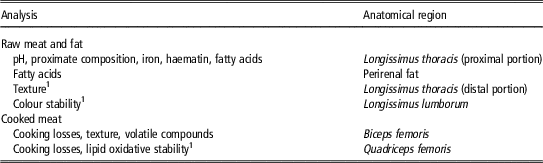
The L. dorsi muscle and perirenal fat were analysed raw, while the Biceps femoris and Q. femoris muscles were analysed after being cooked (Table 1). The L. dorsi muscle was divided into proximal L. thoracis (from 1st to 6th thoracic vertebrae), distal L. thoracis and L. lumborum. The first part, after pH measurement, was homogenised with a domestic food processor, vacuum packaged and frozen (−18°C) before being used for meat composition analysis. The second and third portions were split into two halves perpendicular to their long axis. Then, one half from each portion (randomly chosen) was analysed for texture (L. thoracis) and colour (L. lumborum) on the same day that the portions were split, and the other half was wrapped with polyvinyl chloride cling film and stored for 5 days at 3°C before analysis. Perirenal fat was homogenised, wrapped in aluminium foil and frozen until the FA analysis.
List of the meat quality analyses performed in raw or cooked meat and the sample anatomical region

1 Analysis were performed before and after an aerobic refrigeration storage period.
The B. and Q. femoris muscles were weighed, vacuum packaged, frozen at −18°C and stored for up to 2 months. Before analysis, muscles were thawed inside the vacuum bags overnight at 3°C, cooked in a water bath at 80°C until reaching a core temperature of 70°C, cooled with tap water and finally weighed in order to calculate the water losses. Biceps femoris muscles were subjected to Warner–Bratzler shear force (WBSF) and volatile composition analyses. Quadriceps femoris muscles were divided into two portions that were parallel to the muscle’s long axis; one portion (randomly chosen) was immediately analysed for thiobarbituric acid-reactive substances (TBARS), and the other portion was wrapped in cling film and stored for 2 days at 3°C before TBARS analysis.
Analysis of raw meat and fat
The pH was determined in duplicate with a puncture electrode (CRISON GLP22, Alella, Barcelona, Spain). Moisture, fat, protein and ash content were determined following the Association of Official Analytical Chemists (AOAC, 1999) guidelines. For Fe analysis, 10 ml of concentrated HNO3 was added to the ashes, and the mixture was sonicated (Bransonic 221; Branson, Danbury, CT, USA) for 15 min at 60°C and then filtered through an ash-less filter paper. Then, 3 ml of the filtrate was diluted into 6 ml of Milli-Q water and analysed as described by Osorio et al. (Reference Osorio, Zumalacárregui, Figueira and Mateo2007) with the only modification that the 10 ppm-Fe standard was prepared in nitric acid/water (1:3). Haematin determination was carried out following the method by Turhan et al. (Reference Turhan, Sule Ustun and Bogachan Altunkaynak2004). Fatty acid percentages were analysed in duplicate from 500 mg aliquots of previously lyophilised muscle homogenate or 50 mg of homogenised perirenal fat according to Manso et al. (Reference Manso, Bodas, Vieira, Mantecón and Castro2011) with two modifications: internal standards were not used, and the split ratio was 10 : 1.
Texture profile analysis was performed using a TA-XT2i analyser (Godalming, Surrey, UK) with a 25 kg cell load and a cylindrical 10 mm probe diameter (set to run at 1 mm/s). Three 1.0-cm thick cubes were cut from the corresponding sample with a scalpel, tempered at 21°C for 1 h and then compressed twice (80% of their thickness), parallel to the fibre direction, with a 5-s elapse period.
For the determination of colour, two 1.5-cm wide slices were cut from L. thoracis muscle samples and then placed into a 1.5-cm deep Petri dish. After blooming at room temperature for 1 h, the Petri dish was opened and the colour was determined in duplicate on the cut surface of each slice (measurement at day 0). Afterward, the slice dishes were closed, wrapped in cling film, and stored in darkness at 3°C for further colour measurement at days 3, 6 and 10. Colour was determined using a CM-700d spectrophotometer (Konica Minolta Sensing Inc., Osaka, Japan) with a D65 illuminant in SCI mode, an 11-mm aperture for illumination and 8-mm for measurement, and 10° visual angle. The results were expressed as lightness (L*), redness (a*) and yellowness (b*) according to the CIE L*a*b* system (Comission Internationale de l’Eclairage (CIE), 1976). Three wavelength ratios of reflectance were calculated: 630 and 580 nm (R630/R580) and 610 and 525 nm (R610/R525), both used for detecting colour changes in meat during storage (the higher the value, the higher the proportion of Fe2+-myoglobin); and 572 nm and 525 nm (R572/R525), used for estimating the metmyoglobin proportion (American Meat Science Association (AMSA), 2012).
Analysis of cooked meat
Weight losses due to cooking were reported as the percentage of raw meat. Texture was determined from two 1×1×3-cm cooked meat cubes with fibres directed parallel to the major side using a TA.XT2i analyser (Stable Micro Systems) fitted with a WBSF blade. The operating conditions used were a 25-kg load cell, 0.5 mm/s test speed, and cut in the centre of the cubes perpendicular to the muscle fibres. The part of the cooked B. femoris muscle not used for texture analysis was homogenised and used for volatile analysis. The volatile compounds were determined in duplicate by GC-MS following the protocol of Villalobos-Delgado et al. (Reference Villalobos-Delgado, Caro, Blanco, Morán, Prieto, Bodas, Giráldez and Mateo2014) with few modifications: the sample weight was 2.5 g, and the solid-phase microextraction fibre (preconditioned at 300°C for 30 min) was exposed to the headspace of the vials for 40 min at 40°C. Finally, lipid stability was determined in duplicate by determining the TBARS at day 0 and 2 of refrigerated storage (Nam and Ahn, Reference Nam and Ahn2003).
Statistical analysis
Carcass quality characteristics, pH, proximate composition, Fe, volatile content and WBSF data were analysed using an analysis of covariance (ANCOVA). Breed was the fixed factor, and carcass weight was the quantitative covariate. Fatty acid percentages and cooking loss were also analysed using ANCOVA; breed and anatomical location and their interaction were included in an initial model as fixed factors and weight as the covariate. However, since no significant interactions between the fixed factors were detected, the interactions were excluded in the final model. Texture profile, colour stability and TBARS analysis data were analysed by repeated measures (storage time) ANOVA with breed as fixed factor. Furthermore, Pearson correlations between the carcass weight and the meat quality variables were also carried out. Analyses were performed using the SPSS Statistics software (version 23; IBM, Somers, NY, USA).
Results
Carcass characteristics
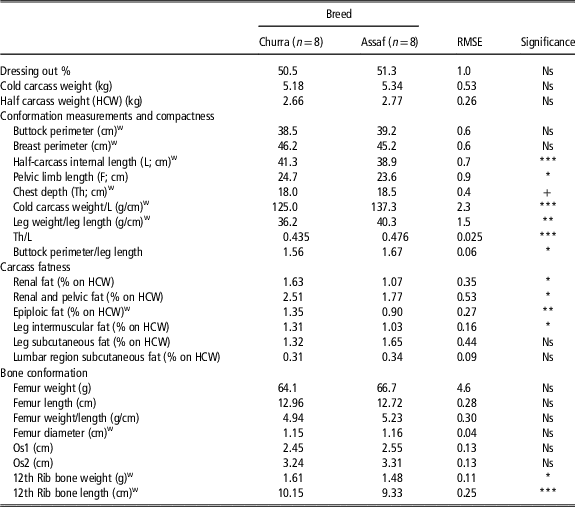
Table 2 shows the carcass characteristics for the Churra and Assaf breeds. For brevity, pH, carcass joint and leg tissue percentages are given in Supplementary Table S2 because these were not significantly affected by breed. Breed affected L (P<0.001) and F (P<0.05), with both longer in the Churra. On the other hand, compactness indexes were higher in the Assaf carcasses. The effect of carcass weight (covariate) on carcass conformation was significant (P<0.05) for buttock and breast perimeters and L. The Pearson coefficients (r) between carcass weight and both perimeters were >0.9.
Carcass weight, conformation measurements, fatness and bone conformation in relation to breed: Churra v. Assaf

RMSE=root mean square error; Ns=not significant.
Dressing out %=(cold carcass weight/live weight at slaughter)×100.
wThe effect of carcass weight used as the covariate in the model was significant (P<0.05).
+ P<0.1, *P<0.05, **P<0.01, ***P<0.001.
Renal, pelvic, epiploic and leg intermuscular fat proportions were significantly higher for Churra than for Assaf. However, the percentages of subcutaneous fat in the leg and lumbar region (expressed as half-carcass weight basis) were not different, and neither were the percentages of total leg fat. No differences were found between the breeds in bone characteristics except for in the 12th rib bone length and weight, which were significantly higher in Churra sheep. The effect of carcass weight was significant (P<0.05) for epiploic fat percentage, leg weight, 12th rib bone weight and length, femur diameter, percentage of femur weight on total leg weight. Positive r coefficients were found for all characteristics except the latter, which was negative (data not shown).
Meat and fat composition
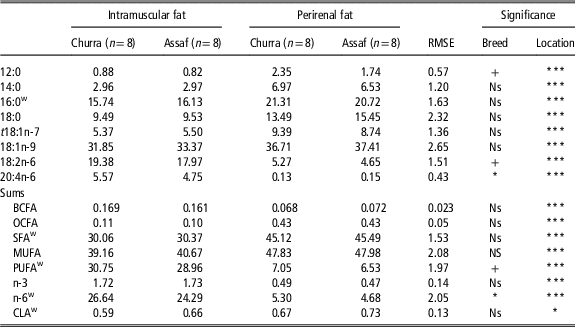
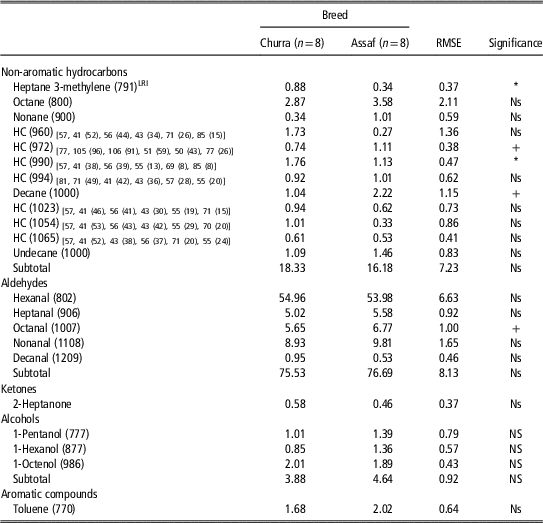
No significant differences were found in pH, proximate composition, Fe or haematin content in L. dorsi M. The mean values (root mean square error) of the results for both breeds were as follows: pH, 5.8 (0.05); moisture, 74.5% (0.7); protein, 19.9% (0.6); fat 1.5% (0.2); ashes, 1.4% (0.1); iron, 1.2 mg/100 g (0.2); and haematin, 240 μg/g (42). Fatty acid percentages of intramuscular and perirenal fats are shown in Table 3. For brevity, only the FAs showing percentages higher than 1% in any one fat deposit were included. Breed mainly affected the percentage of n-6 FA. Significant differences were found in the total n-6 abundance and specifically in the percentage of arachidonic acid, which were both higher (P<0.05) in Churra. Furthermore, the fat depot showed a significant effect on most FA percentages, with intramuscular fat having less saturated and higher polyunsaturated FA (PUFA) than perirenal fat. The only significant correlation between carcass weight and FA percentage was found for conjugated linoleic acid (r=0.454, P<0.01). Table 4 shows the most abundant volatiles in the headspace of cooked meat for each breed, with the volatiles classified into five chemical families. Breed comparison revealed a significantly higher amount of 3-methylene-heptane and an unidentified hydrocarbon in Churra.
Fatty acids and summations (expressed as % of total fatty acids) in suckling lamb fat in relation to fat depot and breed

Ns=not significant; BCFA=branched-chain fatty acids; OCFA=odd-chain fatty acids; SFA=saturated fatty acids; MUFA=monounsaturated fatty acids; PUFA=polyunsaturated fatty acids; CLA=conjugated linoleic acid; RMSE=root mean square error.
wThe effect of carcass weight used as covariate in the model on the variables with the superscript was significant (P<0.05).
+ P<0.1, *P<0.05, ***P<0.001.
Volatile compound profile (peak area %) of suckling lamb meat in relation to breed

RMSE=root mean square error; Ns=not significant; HC=non-positively identified hydrocarbon.
LRIExperimental linear retention index, in brackets after each compound.
+ P<0.1, *P<0.05.
Technological meat quality traits
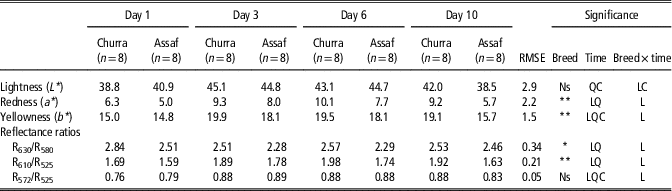
The colour values of Churra and Assaf meat during 10 days of refrigerated aerobic storage are shown in Table 5. Both breed and storage time affected meat colour, and significant interactions between breed and time (P<0.05) were also observed. Churra showed higher a* and b* values than Assaf throughout the storage period. Accordingly, the R630/R580 and R610/R525 (related to Fe2+-myoglobin) were higher in Churra than in Assaf, whereas the reflectance ratio R570/R525 (related to metmyoglobin) was similar in both breeds.
Colour stability of suckling lamb raw meat at different days postmortem in relation to breed

RMSE=root mean square error; Ns=not significant; R630/R580=reflectance at 630 nm/580 nm; R610/R525=reflectance at 610 nm/525 nm; R572/R525=reflectance at 572 nm/525 nm (American Meat Science Association (AMSA), 2012).
L, Q and C indicate respectively linear, quadratic and cubic significant effect (P<0.05).
*P<0.05, **P<0.01.
Storage from day 1 to 3 resulted in increases of L*, a* and b* values in both breeds, with the L* and b* increments being greater in Churra than in Assaf. In turn, R610/R525 and R572/R525 increased, whereas R630/R580 decreased, suggesting increases in oxymyoglobin and metmyoglobin and a decrease in reduced myoglobin proportions, respectively. After the third day of storage, L*, a* and b* of Churra meat remained constant until day 10, whereas in Assaf meat they remained stable from day 3 to 6 and then decreased, reaching levels similar to those of day 1. These changes were accompanied by a decrease in R610/R525 (oxymyoglobin) from day 6 to 10. Furthermore, throughout storage and for each of the breeds, R630/R580 (reduced myoglobin plus oxymyoglobin) was inversely related to R572/R525 (metmyoglobin), as expected.
Breed had no significant effect on raw meat texture (Supplementary Table S3). With regard to cooking losses, breed showed a nearly significant effect (Table 6), with slightly higher values being found for Churra, and significant differences were observed between muscles (lower in Q. femoris muscle). However, breed did not affect WBSF. Finally, Table 7 shows the TBARS values for recently cooked meat and cooked meat stored for 2 days: breed and time exerted significant effects, with the TBARS values being higher for Churra.
Cooking losses and Warner–Bratzler shear force of cooked meat in relation to muscle type and breed

RMSE=root mean square error; Ns=not significant.
+ P<0.1, ***P<0.001.
Thiobarbituric acid-reactive substances (TBARS; expressed as mg of malondialdehyde per kg of meat) in suckling lamb meat at day 0 and 2 after cooking in relation to breed

RMSE=root mean square error.
*P<0.05, ***P<0.001.
Discussion
Carcass characteristics
The age (days) of lambs at slaughter differed between breeds (P<0.01) despite having non-significantly different carcass weight (Table 2). This agrees with the greater birth weight and higher growth rate of Assaf lambs compared to Churra lambs (De la Fuente et al., 2006). The results indicated better carcass conformation in the Assaf than in the Churra breed. In a previous study, Revilla et al. (Reference Revilla, García-Martín and Vivar-Quintana2005a) also found more compact and short carcasses for the Assaf than for the Churra.
The higher amount of fat in the cavity and intermuscular fat depots of the Churra suggest that this breed is more precocious than the Assaf, and from the market point of view, the higher amount of renal fat would be an advantage for the Churra. On the other hand, the lack of significant differences in the subcutaneous and total leg fat could be explained by the fact that Assaf is a semi-fat-tail breed. Thus, in Assaf lambs, more fat would have been deposited as subcutaneous fat not only in the tail but also in the surrounding regions of the leg. The finding that subcutaneous leg fat, on average, accounted for 60% of the total leg fat in Assaf, while it was 49% in Churra (P<0.05; data not shown in tables), supports this view. More subcutaneous fat around the tail and in the perineal region could be the reason why a previous study (Revilla et al., Reference Revilla, García-Martín and Vivar-Quintana2005a) found that Assaf carcasses had higher fatness scores than Churra, as assessed by the degree of fat cover on the dorsal surface of the carcass, including the rump.
Meat and fat composition
The absence of significant breed effect on meat proximate composition and pH agrees with the study by Miguélez et al. (Reference Miguélez, Zumalacárregui, Osorio, Figueira, Fonseca and Mateo2008). The FA profile of intramuscular fat in this study showed a higher PUFA proportion (twice) than that previously found in the meat of Churra suckling lambs also fed with a milk substitute (Osorio et al., Reference Osorio, Zumalacárregui, Figueira and Mateo2007). This could be attributed to differences in the fat composition of the milk substitutes used in both experiments. When comparing the intramuscular fat FA profile of this study with that of Leccese or Churra, where suckling lambs were fed the ewe’s milk (Osorio et al., Reference Osorio, Zumalacárregui, Figueira and Mateo2007; D’Alessandro et al., Reference De la Fuente, Sánchez, Pérez, Lauzurica, Vieira, González de Chávarri and Díaz2012), the former shows lower levels of saturated FA (30% v. 40% to 50%), similar MUFA and higher PUFA (30% v. 10% to 20%). However, the ratio n-6/n-3 was higher (15% v. 2% to 5%) and less favourable considering an ideal ratio of 2 (Simopoulos et al., Reference Simopoulos, Leaf and Salem1999). These observations highlight the great influence that diet has on the FA content of suckling lamb carcasses.
The FA differences found between breeds in this study contradict those reported by Revilla et al. (Reference Revilla, Vivar-Quintana, Lurueña-Martínez and Palacios2007), where Assaf subcutaneous fat showed a higher proportion of n-6 and PUFA than Churra. This discrepancy could be partially attributed to differences in the feeding system, since maternal milk was used in the previous study. The differences in the saturation degree between fat depots is due to the higher amount of phospholipids in intramuscular fat whereas perirenal fat has a higher proportion of neutral lipids (Juárez et al., Reference Juárez, Horcada, Alcalde, Valera, Mullen and Molina2008). Previous studies have also found an effect of breed and fat depot on the FA profile of light lambs (Osorio et al., Reference Osorio, Zumalacárregui, Figueira and Mateo2007; Juárez et al. Reference Juárez, Horcada, Alcalde, Valera, Mullen and Molina2008). However, in contrast to what was found by Juárez et al. (Reference Juárez, Horcada, Alcalde, Valera, Mullen and Molina2008), there was no interaction between breed and depot in this study. The volatiles detected (Table 4), which are in general agreement with those of a previous study (Vieira et al., Reference Vieira, Fernández-Diez, Mateo, Bodas, Soto and Manso2012), are thought to arise from the lipid degradation that occurs during cooking. The importance of the differences found between the breeds (two hydrocarbons) is low, presumably because hydrocarbons have low odour thresholds (Drumm and Spanier, Reference Drumm and Spanier1991).
Technological meat quality traits
Differences in suckling lamb meat colour between breeds, including Churra, were also found by Sañudo et al. (Reference Sañudo, Campo, Sierra, María, Olleta and Santolaria1997) and are in partial agreement with this study (Table 5) where Churra meat showed a comparatively higher b* value. The colour differences found in this study cannot be explained by differences in Fe or haematin content (no differences). Therefore, factors affecting light scattering on the meat surface, that is, protein matrix microstructure, the chemical states of myoglobin, or oxygen diffusion (Sañudo et al., Reference Sañudo, Campo, Sierra, María, Olleta and Santolaria1997; Swatland, Reference Swatland2012), might be responsible for the colour differences found. The results suggest a lower light scattering and/or a higher oxygen diffusion in the meat from Churra. The study also indicates that redness should be less stable in Assaf, which decreased in redness after 6 days of aerobic storage.
The increases in a* and b* during the first 3 days of aerobic storage in this study has been observed in previous studies of lamb meat and was attributed to an increase in oxymyoglobin concentration on the meat surface due to both weight loss and increased oxygen penetration (Callejas-Cárdenas et al., Reference Callejas-Cárdenas, Caro, Blanco, Villalobos-Delgado, Prieto, Bodas, Giráldez and Mateo2014). The increase showed by L*, reaching levels of 45, however, contrasts with the meat from weaned lambs, which were heavier than the lambs in this study (Kim et al., Reference Kim, Stuart, Black and Rosenvold2012; Callejas-Cárdenas et al., Reference Callejas-Cárdenas, Caro, Blanco, Villalobos-Delgado, Prieto, Bodas, Giráldez and Mateo2014). L* tended to decrease in the meat weaned lambs. A minimum L* value in aerobically stored lamb meat has even been suggested as a determinant between consumer acceptance and rejection, that is, 34 to 35 for the meat of Australian lambs (Khliji et al., Reference Khliji, van de Ven, Lamb, Lanza and Hopkins2010) or 42 for the meat of 27 kg Spanish fattened lambs (Callejas-Cárdenas et al., Reference Callejas-Cárdenas, Caro, Blanco, Villalobos-Delgado, Prieto, Bodas, Giráldez and Mateo2014). The discrepancy between this and the other studies (opposite change in L* during a short aerobic storage), could be explained by age-related differences in lamb muscle composition or structure that affect light scattering, oxygen diffusion and/or myoglobin changes. As observed for suckling lamb meat, increments in L*, as well as in a* and b*, during short aerobic storage periods, especially the first day, have also been reported for pork (Lindahl et al., Reference Lindahl, Karlsson, Lundström and Andersen2006). These authors suggested that the increases could be due to the prolonged and continuous formation of oxymyoglobin during and even after 1 day of storage at low temperature. Therefore, suckling lamb meat could have a prolonged period of oxymyoglobin formation compared with the meat of older lambs, resulting in an increased oxymyoglobin proportion during the first days of storage.
The WBSF of the cooked lamb was not different between breeds (Table 6). However, in partial disagreement, in a previous study that used a sensory panel, Churra meat was found to be more tender than Assaf (Revilla et al., Reference Revilla, Rodríguez-López and Vivar-Quintana2005b). These authors also found that meat from Churra was juicer and had more liver-flavour intensity than meat from Assaf. These differences cannot be confirmed or refuted with this study since sensory analysis was not performed. The differences in lipid oxidative stability (Table 7) suggest a technological advantage to Assaf regarding the storage life of cooked lamb. These differences could be attributed to the concentration of muscle compounds that affect lipid oxidation, that is, released Fe from myoglobin, PUFA or tocopherols (Min and Ahn, Reference Min and Ahn2005). The higher amounts of PUFA n-6 found in Churra meat could explain, at least partially, the lower lipid stability of this breed meat. Thiobarbituric acid-reactive substances levels in cooked meat stored for 2 days were near the threshold of 2 mg of malondialdehyde per kg of meat, considered as the acceptable oxidation level of raw beef just before cooking (Campo et al., Reference Campo, Nute, Hughes, Enser, Wood and Richarson2006). However, that value might not apply for cooked suckling lamb meat, for which no threshold has been found in the literature.
Conclusions
This study is presented as a comparison of a wide range of characteristics of interest in suckling lamb meat quality from the native Churra and non-native Assaf breeds with a similar mean carcass weight. The study confirms that Churra carcasses are longer than Assaf carcasses. Moreover, fatness appear to be higher in Churra, although differences were not evidenced for subcutaneous fat on the leg and lumbar region. Regarding meat quality, differences between breeds were found in intramuscular FA profile, raw meat redness throughout aerobic storage (higher for Churra) and cooked meat lipid stability (higher for Assaf). It was also found that, contrarily from that observed for weaned lambs in other studies, lightness of suckling lamb meat tends to increase during a few-day aerobic storage. Further studies including larger populations should be designed in order to confirm some of the significant results reported herein whereas research based on the analysis of genetic markers or differential expression analyses could help to reveal the genetic basis of the described differences.
Acknowledgements
This work was funded by the ‘Ramón y Cajal’ Programme from the Spanish Ministry of Economy and Competitiveness (MINECO; State Secretariat for Research, Development and Innovation) through the RYC-2012-10230 contract. BGG is funded by the “Ramón y Cajal” Programme from MINECO (RYC-2012-10230). The authors thank the staff from the farm of the Faculty of Veterinary Sciences (Universidad de León) for the management of lambs and to the collaborating slaughterhouse.
Supplementary material
To view supplementary material for this article, please visit http://dx.doi.org/10.1017/S1751731117002270