At first glance, the outcome of the 2008 presidential election would appear to be very difficult to predict. For the first time in over 50 years, there will be no incumbent president or vice president in the race. Instead, the Republican Party, which has seen its popularity and electoral fortunes plummet since 2004, is pinning its hopes of retaining control of the White House on Arizona Senator John McCain—an individual who has frequently clashed with his own party's leadership. And McCain's Democratic opponent will be Illinois Senator Barack Obama, the first African American ever to receive a major-party presidential nomination.
The absence of an incumbent president or vice president in the race and the unusual characteristics of the two major-party candidates have led to considerable uncertainty among political observers about the outlook for the November election. While President George W. Bush's low approval ratings and the public's overwhelmingly negative perceptions of the economy indicate a very difficult political climate for Republicans, McCain's reputation as a maverick and Obama's problems uniting Democratic voters behind his candidacy have led some analysts to suggest that a Democratic victory in November is far from certain. Polling data seem to support the argument that despite the unpopularity of his party, McCain has a realistic chance of keeping the White House in Republican hands. McCain has been running very close to Obama in most national polls since the conclusion of the presidential primaries.
The Time-for-Change Model
Despite uncertainty among political observers due to the unusual characteristics of the candidates and the tightness of the polls, research on U.S. presidential elections indicates that how voters will cast their ballots in November can be predicted accurately based on conditions that are known long before Election Day (Fair Reference Fair1978; Brody and Sigelman Reference Brody and Sigelman1983; Lewis-Beck and Rice Reference Lewis-Beck and Rice1992; Holbrook Reference Holbrook1996; Wlezien and Erikson Reference Wlezien and Erikson1996; Norpoth Reference Norpoth1996; Campbell and Garand Reference Campbell and Garand2000; Campbell Reference Campbell, Campbell and Garand2000; Hibbs Reference Hibbs2000). According to the time-for-change model, these conditions include the popularity of the incumbent president, the state of the economy, and the length of time that the president's party has controlled the White House (Abramowitz Reference Abramowitz1988; Reference Abramowitz1996).
The assumption underlying the time-for-change model is that a presidential election is a referendum on the performance of the incumbent president. If this is true, then regardless of whether there is an incumbent in the race, how voters cast their ballots should be strongly influenced by their evaluation of the incumbent president's performance. The evidence displayed in Figure 1 provides strong support for this hypothesis. This figure shows the trend in support for the candidate of the president's party among voters who approved or disapproved of the incumbent president's performance since 1972 when the American National Election Studies (NES) began asking the presidential approval question.
Percentage Voting for Candidate of President's Party by Approval of President's Job Performance, 1972–2004
Source: American National Election Studies.

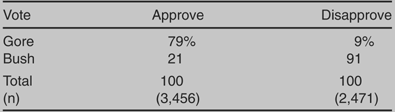
The data displayed in Figure 1 show that in these nine elections between 80 and 90% of those who approved of the incumbent president's performance voted for the candidate of the president's party while between 80% and 90% of those who disapproved of the incumbent president's performance voted for the candidate of the opposing party. Even when the incumbent president was not on the ballot, in 1988 and 2000, the results were very similar. For example, the data displayed in Table 1 show that in the 2000 presidential election there was a very strong relationship between how voters cast their ballot in the presidential contest between Al Gore and George W. Bush and their evaluation of President Bill Clinton's job performance: almost 80% of those who approved of Clinton's performance voted for the Democrat, Gore, while over 90% of those who disapproved of Clinton's performance voted for the Republican, Bush.
2000 Presidential Vote by Clinton Job Approval

Source: 2000 National Exit Poll.
Clearly some of the correlation between presidential approval and presidential vote is a byproduct of party identification. Both approval and vote choice are strongly influenced by party identification. However, even after controlling for party identification, there is a strong relationship between approval and vote choice. For the nine elections since the NES began asking the presidential job approval question, the partial correlation between approval and vote choice, controlling for party identification, has ranged from 0.29 to 0.58 withan average of 0.49. These results indicate that even though President Bush will not be on the ballot in 2008, how voters cast their ballots in November will be strongly influenced by their evaluation of his performance.
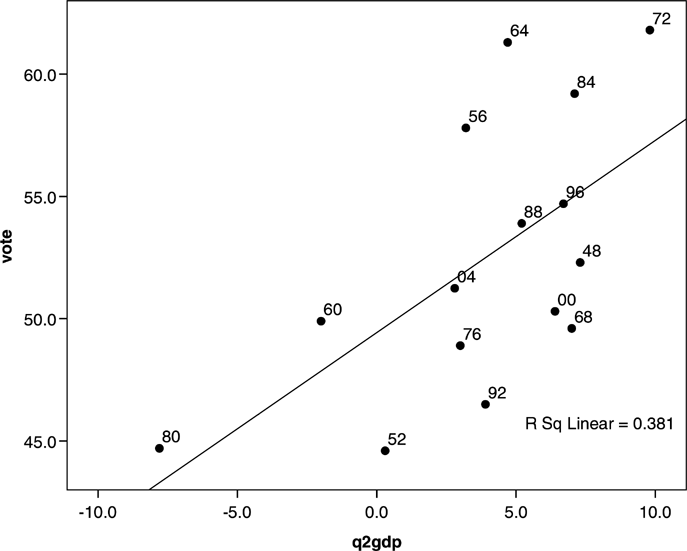
The time-for-change model is based on three leading indicators of presidential vote choice: the growth rate of the economy during the second quarter of the election year, the incumbent president's approval rating at mid-year, and the length of time the incumbent president's party has controlled the White House—the time-for-change factor. The first of these indicators, the growth rate of the economy during the second quarter of the election year, as measured by real annualized GDP growth, provides a measure of national economic conditions. It is widely assumed that economic conditions have a strong influence on voting behavior in a democracy. Rational voters are expected to reward the party in power for good economic conditions and punish the party in power for bad economic conditions. However, the data displayed in Figure 2 indicate that the relationship between economic conditions and the outcomes of U.S. presidential elections since World War II is not very strong.
Vote for Incumbent Party by Annual GDP Growth Rate during Second Quarter of Election Year, 1948–2004
Source: Bureau of Economic Analysis and data compiled by author.

By itself, the growth rate of the economy explains less than 40% of the variance in the outcomes of U.S. presidential elections. Moreover, other economic indicators such as unemployment, change in real disposable income, and job creation do no better. Since World War II there have been several elections in which the candidate of the incumbent party has done much better than one would expect based on economic conditions. In 1956, for example, Republican incumbent Dwight Eisenhower was reelected in a landslide despite anemic economic growth. On the other hand, there have been several elections in which the incumbent party has done much worse than one would expect based on economic conditions. In 1968, for example, Democrat Hubert Humphrey, seeking to succeed Lyndon Johnson who chose not to run for reelection, lost a close contest to Republican Richard Nixon despite a booming economy.
The lesson one should draw from Figure 2 is not that economic conditions don't matter, of course, but that economic conditions are only one of the factors that influence voters' evaluations of the incumbent president's performance. Presidents are also judged on the basis of their conduct of foreign affairs, their personal style and communication skills, their honesty and integrity, and their domestic policy agenda. In order to capture some of the other factors that go into the public's evaluation of the president, the time-for-change model includes the incumbent president's approval rating in the Gallup Poll at mid-year as another predictor of voter decision making.
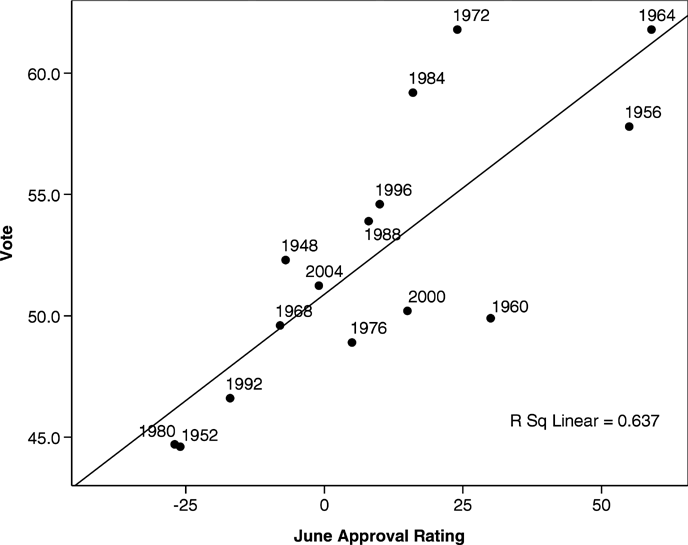
The data displayed in Figure 3 show that there is a fairly strong relationship between the incumbent president's approval rating at mid-year and the outcome of the presidential election.Footnote 1 Presidential approval, by itself, explains almost two-thirds of the variance in the incumbent party's share of the major-party vote. Nevertheless, the fit between presidential approval and election results is far from perfect. In some years, such as 1972 and 1984, the candidate of the incumbent party does much better than one would have expected based on the president's approval rating at mid-year. In other years, such as 1960 and 2000, the candidate of the incumbent party does much worse than one would have expected based on the president's approval rating at mid-year. Clearly there were other factors influencing voter decision making in these elections.
Vote for Incumbent Party by Incumbent President's Approval Rating at Mid-Year, 1948–2004
Source: Gallup Poll and data compiled by author.

The third predictor used in the time-for-change model is a dummy variable that measures the difference between elections in which a party has controlled the White House for one term and those in which a party has controlled the White House for two or more terms. This variable is intended to capture the strength of time-for-change sentiment in the electorate. It is based on the hypothesis that voters attach a positive value to periodic alternation in power by the two major parties and that regardless of the state of the economy and the popularity of the current president, when a party has held the White House for two or more terms, voters will be more likely to feel that it is time to give the opposing party an opportunity to govern than when a party has held the White House for only one term.
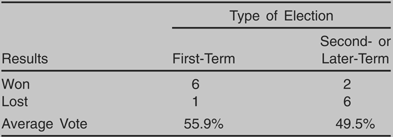
The evidence presented in Table 2 provides empirical support for the time-for-change hypothesis. Since the end of World War II, there have been seven presidential elections in which a party has controlled the White House for one term and the president's party has won six of these elections. In fact, since 1900 the president's party has won 10 out of 11 first-term elections. Jimmy Carter in 1980 was the only first-term incumbent in the past century to lose a presidential election. In contrast, the president's party has lost six of the eight postwar presidential elections in which his party had controlled the White House for two or more terms, although most of these elections were very close and, in the case of Al Gore in 2000, the candidate of the incumbent party won the national popular vote while losing the electoral vote. Since 1900, the president's party has lost seven out of 13 elections in which his party had controlled the White House for two or more terms.
Success of Incumbent Party Candidate in Presidential Elections by Type of Election, 1948–2004

Note: Vote share based on major-party vote.
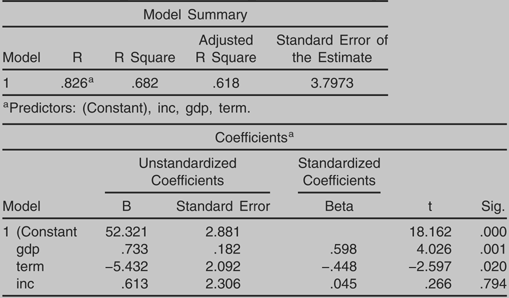
The time-for-change variable is not equivalent to incumbency. When a dummy variable measuring the presence of absence of an incumbent is substituted for the time-for-change dummy variable, it does not perform nearly as well. When an incumbency dummy variable is included in the model along with the time-for-change dummy variable, its impact is negligible and the explanatory power of the model is unchanged. However, only two of the nine second- or later-term elections since World War II have involved an incumbent running for reelection: 1948 and 1992. I therefore conducted an additional test of the time-for-change hypothesis using data on 18 presidential elections between 1932 and 2004. This allows us to distinguish more clearly between the effects of the time-for-change and incumbency variables since five of the 12 second- or later-term elections in this series have involved an incumbent running for reelection: 1932, 1940, 1944, 1948, and 1992.
For the four elections prior to 1948, no presidential approval data and only annual GDP data are available. However, the results displayed in Table 3 show that a model including three independent variables—annual GDP change, incumbency, and the time-for-change dummy variable—performs fairly well, explaining over 60% of the variance in the popular vote. More importantly, the results show that while the time-for-change dummy variable (−5.4) has a strong and statistically significant effect, the estimated coefficient for the incumbency dummy variable (0.6) is very small and statistically insignificant.
Results of Regression Analysis of Presidential Election Results, 1932–2004

a Dependent Variable: vote.
Source: Bureau of Economic Analysis and data compiled by author.
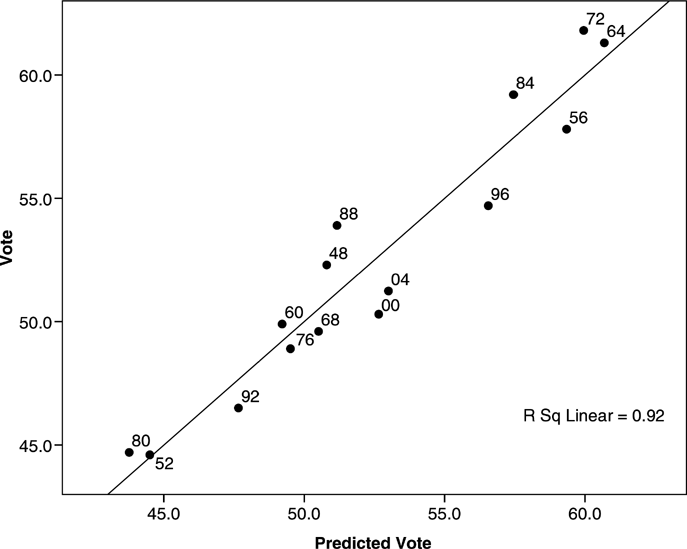
Combining our three predictors into a single model allows us to explain a much larger proportion of the variance in the outcomes of postwar presidential elections than we can with a model based on any one or two of these variables. The data displayed in Figure 4 show that our three-variable time-for-change model explains 92% of the variance in the incumbent party's share of the major-party vote. Almost all of the predicted results are very close to the regression line. Moreover, the model is almost as accurate at predicting the outcomes of elections without a running incumbent as it is at predicting the outcomes of elections with a running incumbent. For the 10 postwar elections with a running incumbent (1948, 1956, 1964, 1972, 1976, 1980, 1984, 1992, 1996, and 2004), the average absolute error of the model's predictions is 1.2%. For the five postwar elections with no running incumbent (1952, 1960, 1968, 1988, and 2000), the average absolute error of the model's predictions is 1.6%.
Incumbent Party Vote by Predicted Incumbent Party Vote, 1948–2004
Source: Data compiled by author.

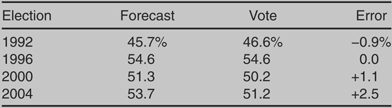
In addition to explaining a large proportion of the variance in the outcomes of postwar presidential elections, the evidence displayed in Table 4 shows that the time-for-change model also produces very accurate forecasts of the outcomes of the last four presidential elections based on data available prior to those elections. These forecasts were generated by re-estimating the model for each election based on data from earlier elections and using the preliminary estimate of real GDP growth released by the Bureau of Economic Analysis in August. The re-estimated models predicted the winner of the popular vote in each of these elections with an average absolute error of only 1.1 percentage points. Thus, the time-for-change model, based on information available several months before Election Day, was more accurate than public opinion polls conducted in the final week before each of these elections. The average absolute error of such pre-election polls is about 2–3 percentage points.
Accuracy of Time-for-Change Model Forecasts Based on Prior Elections, 1992–2004

Source: Data compiled by author.
Note: Forecast and vote represent incumbent party's share of major-party popular vote.
Estimation of 2008 Time-for-Change Model
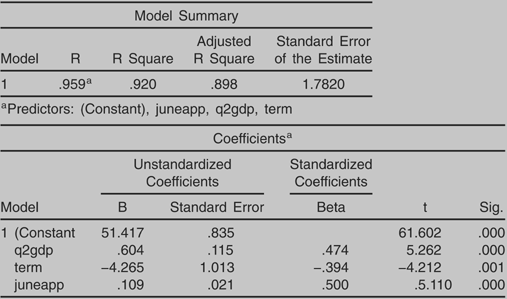
Table 5 shows the estimated coefficients for the 2008 time-for-change model, based on data for presidential elections between 1948 and 2004. According to these results, for every 1 percentage point increase in the president's net approval rating, the candidate of the president's party can expect an increase of just over 0.1% of the major-party vote. While this may seem like a fairly small effect, the difference between havinga popular and having an unpopular president in the White House is substantial. For example, the difference between having a president with a net approval rating of +20 and having a president with a net approval rating of −20 would be 4% of the vote.
2008 Forecasting Model

a Dependent Variable: vote.
Source: Data compiled by author.
The results in Table 5 indicate that economic conditions have a substantial impact on the outcomes of presidential elections. For every additional 1 percentage point of real annual GDP growth during the second quarter, the candidate of the president's party can expect to receive an additional 0.6% of the vote. Thus, the difference between running with a stagnant economy and running with a booming economy is substantial. A candidate from the president's party running in a year when real GDP grows at an annual rate of 5 percentage points during the second quarter can expect to receive an additional 3% of the vote compared with a candidate from the president's party running in a year when there is no growth in real GDP during the second quarter.
Perhaps the most interesting finding in Table 5 involves the impact of the time-for-change variable. According to these results, even after controlling for the popularity of the incumbent president and the state of the economy, there is a dramatic difference between first-term and later-term elections. A candidate from the president's party running in a second- or later-term election suffers a penalty of more than 4 percentage points compared with a candidate running in a first-term election. Thus, the impact of the time-for-change variable is equivalent to a difference of about 40 points in net approval and about 7 points in real GDP growth. Regardless of the popularity of the president or the state of the economy, it is simply much more difficult for the president's party to retain its hold on the White House after two or more terms in office.
The 2008 Forecast
Given these results, then, what is the outlook for the 2008 presidential election? According to the August estimate from the Bureau of Economic Analysis, real GDP grew at an annual rate of 3.3% during the second quarter of 2008; according to the Gallup Poll conducted closest to mid-year (July 10–13), President Bush's net approval rating stood at a lowly −30% (31% approval vs. 61% disapproval); and, of course, 2008 is a second-term election. Based on these results, the time-for-change model predicts that Barack Obama will receive 54.3% of the major-party vote in November vs. 45.7% for John McCain.
With no incumbent president or vice president in the race, a party maverick leading the Republican ticket, and the first African American presidential candidate in American history, 2008 appears to be the most unpredictable presidential election in more than 50 years. Nevertheless, experience indicates that the outcome of the 2008 presidential election can be predicted with a high degree of accuracy based on the same fundamental forces that affect the outcomes of all presidential elections: the popularity of the incumbent president, the condition of the economy, and the length of time that the president's party has controlled the White House. While factors outside of the model such as rising partisan polarization and resistance to an African American candidate by some white voters may result in a somewhat smaller popular vote margin for the Democratic nominee, the combination of an unpopular Republican incumbent in the White House, a weak economy, and a second-term election make a Democratic victory in November all but certain.