Introduction
The COVID-19 pandemic profoundly disrupted health care systems worldwide, reducing utilization of essential health services and contributing to increased non-COVID morbidity and mortality.Reference Silverio-Murillo, Hoehn-Velasco and Balmori de la Miyar 1 –Reference Lu, Dhanoa and Cheema 3 Beyond its direct infectious burden, the pandemic created prolonged operational strain across health systems, including redistribution of personnel, interruption of routine care, increased demand for infection-control resources, pressure on hospital capacity, and depletion of organizational reserves.Reference Silverio-Murillo, Hoehn-Velasco and Balmori de la Miyar 1 –Reference Jordan-Rios, Nuzzi and Bromage 4 Health care workers (HCWs) were particularly affected by this prolonged emergency environment. Many faced increased workloads, staff shortages, repeated exposure to infection risk, moral and psychological stress, work-life strain, burnout, and concerns about preparedness and institutional support.Reference Jordan-Rios, Nuzzi and Bromage 4 –Reference Kaye, Okeagu and Pham 8
Against this background of pandemic fatigue and strained health-system capacity, Mpox, formerly referred to as monkeypox, emerged as another international public health threat. The first case linked to the 2022 outbreak was reported in the United Kingdom on May 7, 2022,Reference Khamees, Awadi and Al-Shami 9 and the World Health Organization has since documented more than 109,000 confirmed cases across over 120 countries. 10 Although Mpox differed from COVID-19 in transmission dynamics, clinical presentation, and population-level spread, its emergence required renewed attention to surveillance, risk communication, infection prevention, and vaccination preparedness. For HCWs, this meant that attitudes toward Mpox vaccination developed in a context already shaped by the operational and psychological consequences of the COVID-19 pandemic. Thus, Mpox vaccination attitudes among HCWs should be understood not in isolation, but as part of a broader post-COVID-19 preparedness environment in which prior emergency experience, fatigue, and perceived institutional capacity may shape responses to new infectious threats.
Vaccination remains one of the most effective tools for controlling infectious disease outbreaks. During the COVID-19 pandemic, vaccination substantially reduced severe outcomes,Reference Santoli, Nurchis and Calabrò 11 and similar preventive strategies are essential for emerging threats such as Mpox. In this context, HCWs are a priority group not only because of their occupational exposure, but also because they are trusted sources of health information whose attitudes may influence public confidence in vaccination.Reference Vasilevska, Ku and Fisman 12 , Reference Friehs, Kotzur and Kraus 13
Previous studies have shown that willingness to receive Mpox vaccination varies substantially across settings and populations. For example, acceptance among HCWs was reported to be relatively high in China but substantially lower in Jordan, indicating that Mpox vaccine attitudes are not determined by occupational risk alone but are also shaped by national context, prior vaccination culture, perceived disease relevance, and trust in health information.Reference Hong, Pan and Jiang 14 , Reference Mahameed, Al-Mahzoum and AlRaie 15 These differences suggest that HCWs should not be treated as a uniform group when evaluating readiness for vaccination against emerging infectious threats. More broadly, vaccine acceptance is influenced by anxiety, stress, perceived risk, and confidence in preventive measures.Reference Martinelli and Veltri 16 , Reference Bendau, Plag and Petzold 17 In the post-COVID-19 period, these psychological factors may be particularly important because prior pandemic experience could either increase perceived vulnerability and readiness to vaccinate or contribute to fatigue, distress, and reduced engagement with new public health recommendations.
The Health Belief Model provides a useful framework for understanding these relationships. According to this model, preventive health behavior is influenced by perceived susceptibility, perceived severity, perceived benefits and barriers, and cues to action.Reference Zampetakis and Melas 18 In the context of emerging infectious diseases, prior outbreak experience may act as a cue that reshapes perceived threat and alters the perceived value of vaccination. For HCWs, direct exposure to COVID-19-related stress, patient suffering, occupational risk, and institutional pressure may therefore influence how subsequent infectious threats, such as Mpox, are interpreted and whether vaccination is viewed as necessary. Within this framework, COVID-19 frontline experience and living with high-risk individuals may be interpreted as cues to action and markers of perceived susceptibility, because they increase the personal and occupational salience of infectious disease risk. Fear of COVID-19 and fear of Mpox correspond to perceived threat, reflecting perceived susceptibility and severity, whereas occupational burnout may function as a psychological barrier that reduces motivation or capacity to engage in additional preventive behavior. These Health Belief Model constructs therefore provide a theoretical basis for examining whether pandemic-related experiences and psychological responses are associated with willingness to receive Mpox vaccination.
Despite growing international evidence on Mpox vaccine acceptance, several gaps remain. First, most available studies have been conducted outside Central Asia, leaving limited evidence from Kazakhstan, Kyrgyzstan, and Uzbekistan. Second, previous studies have generally examined demographic and attitudinal predictors of Mpox vaccination willingness, but less is known about whether COVID-19 frontline experience and living with high-risk individuals are associated with acceptance of a new post-pandemic vaccine. Third, the psychological pathways linking pandemic experience to Mpox vaccine acceptance, including fear of COVID-19, fear of Mpox, distress, and burnout, remain insufficiently understood among HCWs in this region. Addressing these gaps is important because HCWs’ vaccine attitudes may influence both occupational preparedness and public confidence in vaccination.Reference Vasilevska, Ku and Fisman 12
Against this background, the present study examined how experiences during the COVID-19 pandemic were associated with willingness to receive Mpox vaccination among HCWs in Central Asia. Conducted between July and November 2022, during the early phase of the Mpox outbreak and the continuing aftermath of COVID-19, the study aimed to clarify the role of pandemic-related exposure and psychological factors in shaping HCWs’ vaccination attitudes. Based on the Health Belief Model and previous evidence linking outbreak experience, perceived risk, psychological distress, and vaccine acceptance, the study tested 3 hypotheses. First, HCWs with direct or proximate COVID-19-related experience, including frontline work and living with high-risk individuals, would report higher willingness to receive Mpox vaccination. Second, fear of Mpox and fear of COVID-19 would be positively associated with Mpox vaccine acceptance and would partially mediate the association between COVID-19-related experience and vaccine acceptance. Third, psychological distress and occupational burnout would show distinct associations with vaccine acceptance, with distress reflecting heightened perceived threat and burnout potentially reducing willingness to engage in preventive vaccination behavior.
Methods
Study Design and Setting
This cross-sectional study was conducted from July to November 2022, during a period when documented Mpox cases were emerging, and the global community was still dealing with the ongoing effects of the COVID-19 pandemic. The research involved HCWs from 3 Central Asian countries: Kazakhstan, Kyrgyzstan, and Uzbekistan.
Study Population and Data Collection
A total of 3,054 HCWs from Kazakhstan, Kyrgyzstan, and Uzbekistan were included in this cross-sectional study. Recruitment was conducted between July and November 2022 using a multichannel non-probability convenience sampling strategy. Convenience sampling is a non-probability recruitment approach in which participants are enrolled based on accessibility, availability, and willingness to participate rather than random selection from a complete sampling frame. This approach was chosen because the study was conducted during an outbreak-related period, when rapid recruitment of HCWs across three countries was needed, and no complete, accessible, cross-national registry of eligible HCWs was available for probability-based sampling. In addition, HCWs were geographically dispersed across institutions and regions, making random sampling logistically difficult within the available study period. Therefore, a multichannel convenience approach was used to maximize reach across professional groups and institutions while acknowledging that the resulting sample should not be interpreted as nationally representative. Official invitation letters outlining the aims and procedures of the study were sent to Regional Departments of Public Health and Health care in the participating countries, which were asked to facilitate dissemination of the survey among HCWs. To broaden coverage across professional groups and institutions, the survey link was also distributed through professional social media and messaging platforms commonly used by HCWs, including Facebook and WhatsApp groups. Eligible participants were HCWs currently working in health care-related settings in the participating countries during the study period.
Because recruitment was based on a non-probability convenience sampling strategy, the number of participants differed across countries. The final sample was therefore unbalanced by country, with a larger proportion of respondents from Kazakhstan than from Kyrgyzstan or Uzbekistan. Country was included as a categorical variable in comparative and multivariable analyses to account for between-country differences; however, estimates of country effects should be interpreted cautiously because they may reflect both true contextual differences and differences related to recruitment coverage, sample composition, and self-selection within each country.
Data were collected using a structured, anonymous online questionnaire administered via the 1ka.si survey platform. Before accessing the questionnaire, participants were provided with information about the study and asked to provide online informed consent. To reduce information bias, the survey was anonymous, and the platform was configured to prevent repeated submissions from the same IP address. The questionnaire included items on socio-demographic and occupational characteristics, previous COVID-19 exposure and vaccination history, and willingness to receive Mpox vaccination. In addition, psychological factors potentially relevant to vaccine acceptance, including fear of COVID-19, fear of Mpox, psychological distress, and occupational burnout, were assessed using validated instruments.
According to survey platform records, 14,472 individuals entered the survey introduction page, 7,599 proceeded to the first page, 4,372 started the questionnaire, and 3,083 completed it. This corresponded to a completion rate of 70.5% among those who started responding and 40.6% among those who entered the first survey page. Incomplete questionnaires were excluded during data screening; analyses were conducted on the final analytical sample of 3,054 participants.
No formal a priori sample size calculation was performed because the study was designed as a time-limited online survey aiming to recruit as many eligible HCWs as feasible during the study period. Although no a priori sample size calculation was conducted, the achieved analytical sample of 3,054 participants was considered adequate for the planned multivariable regression and exploratory mediation analyses. This assessment was based on commonly used rules of thumb requiring at least 10-20 observations per estimated predictor or model parameter. However, this statistical adequacy should be interpreted independently from population-level generalizability, which remains limited by the non-probability convenience sampling design.
Variables and Measures
Participants provided information on various socio-demographic characteristics, including: age, gender, occupation (reported primary role in the health care system, categorized into groups such as nurses, doctors/physicians, residency students, administrative staff, junior HCWs, non-medical laboratory staff, and mentoring HCWs), family status, and information on whether participants had children (yes/no).
Fear of COVID-19 and Mpox was assessed using a 3-item adapted version of Snell’s questionnaire originally developed to assess fear of AIDS.Reference Snell, Finney, Davis, Yarber and Bauserman 19 The fear items were adapted by replacing the original disease-specific reference with COVID-19 and Mpox, respectively. The questionnaire was administered in Russian. The adapted items were translated into Russian and reviewed by bilingual researchers with expertise in medical and public health terminology to ensure semantic equivalence, conceptual consistency, and comprehensibility for Russian-speaking HCWs in Kazakhstan, Kyrgyzstan, and Uzbekistan. The items were also assessed for contextual relevance to emerging infectious disease risk and HCWs’ experience during and after the COVID-19 pandemic. The questionnaire included the following parallel items for COVID-19 and Mpox: “Thinking about COVID-19/Mpox makes me feel anxious”; “I feel tense when I think about the threat of COVID-19/Mpox”; and “I feel quite anxious about the possibility of another outbreak of COVID-19/Mpox.” Each item was rated on a 5-point Likert-type scale from 1 (“Not at all”) to 5 (“Very”), with higher scores indicating greater fear. Because the scale was adapted for the present study context, additional psychometric evaluation was conducted. A 2-factor confirmatory factor analysis model was tested, with the three COVID-19 fear items loading on a fear of COVID-19 factor and the three Mpox fear items loading on a fear of Mpox factor. This two-factor model was selected instead of conducting two separate one-factor models because each fear scale included only three items; separate three-item one-factor models would be just-identified and therefore would not provide informative global model-fit indices. The combined 2-factor model allowed evaluation of the expected structure of the 6 fear items and provided evidence for construct validity. The model showed good fit to the data: CFI = 0.992, TLI = 0.984, RMSEA = 0.068, 90% CI 0.058-0.080. Standardized factor loadings ranged from 0.797 to 0.915 for fear of COVID-19 and from 0.862 to 0.928 for fear of Mpox. The fear of COVID-19 and fear of Mpox scales also showed high internal consistency, with Cronbach’s α values of 0.881 and 0.926, respectively.Reference Taber 20
The Depression, Anxiety, and Stress Scale-21 (DASS-21) was employed to evaluate psychological distress among HCWs.Reference Lovibond and Lovibond 21 This validated instrument comprises 21 items, divided equally into 3 subscales. Each of the three subscales contains 7 items scored on a Likert scale from 0 to 3 (0: Did not apply to me at all, 1: Applied to me to some degree or some of the time, 2: Applied to me to a considerable degree or a good part of the time, 3: Applied to me very much or most of the time). Scores for depression, anxiety, and stress are calculated by summing the scores for the relevant items. DASS-21 showed reliable to the strong levels of internal consistency: depression (Cronbach’s α 0.892), anxiety (Cronbach’s α 0.897), and stress (Cronbach’s α 0.913).
Occupational burnout was assessed using the Copenhagen Burnout Inventory (CBI).Reference Kristensen, Borritz and Villadsen 22 The CBI consists of 19 items representing three dimensions: personal burnout, work-related burnout, and client-related burnout. Response options range from 0 (“Never” or “To a very low degree”) to 100 (“Always” or “To a very high degree”). For each scale, an average score was calculated, with higher scores indicating higher burnout. The Russian-language version of the CBI was used for all participants in Kazakhstan, Kyrgyzstan, and Uzbekistan, because the survey was administered in Russian across all participating countries. This version had previously been validated among nurses in Kazakhstan and Kyrgyzstan and demonstrated satisfactory reliability and validity.Reference Seisembekov, Brimkulov and Taalaikanova 23 In the present study, the same version was applied to the broader HCW sample, including physicians, nurses, residency students, administrative personnel, junior HCWs, laboratory staff, and mentoring HCWs. Internal consistency was acceptable to high in the current sample: personal burnout, Cronbach’s α = 0.899; work-related burnout, Cronbach’s α = 0.850; and client-related burnout, Cronbach’s α = 0.842.
To assess willingness to receive Mpox vaccination, participants responded to the original survey item, reported verbatim here: “I am willing to receive a monkeypox vaccine,” which was presented within the broader survey prompt, “How characteristic are the following statements for you?” Because the survey was conducted in 2022, the questionnaire used the term “monkeypox,” which was the standard terminology at that time. Throughout the remainder of this manuscript, the disease is referred to as Mpox in accordance with current World Health Organization terminology. Participants rated the statement on a 5-point Likert-type scale ranging from 1 (“Not at all”) to 5 (“Very”). Higher scores indicated greater willingness to receive Mpox vaccination. For descriptive reporting, response option 1 was interpreted as no willingness to receive Mpox vaccination, whereas response options 2-5 were interpreted as indicating at least some degree of willingness. For regression, correlation, ANOVA, and mediation analyses, the 5-point score was analyzed as an approximately continuous outcome to preserve information across ordered response categories and to facilitate interpretation of mean-level associations. This approach is commonly used in applied health and behavioral research when Likert-type variables have ordered response categories and the analytical aim is to estimate associations across the full response range. To account for the ordinal nature of the outcome and evaluate the robustness of this modeling decision, an ordinal logistic regression sensitivity analysis was also conducted using the original 5-point response as an ordered dependent variable. A single-item measure was used because the study focused on vaccination willingness as a direct behavioral intention rather than a multidimensional vaccine hesitancy construct, and because the survey was conducted during an outbreak-related period when questionnaire length needed to be limited to support completion. As this was a single-item outcome, internal consistency reliability and factor-analytic validity could not be estimated.
Statistical Analysis
Descriptive statistics were calculated for demographic, occupational, COVID-19-related, and psychological characteristics. Continuous variables were summarized using means and standard deviations, while categorical variables were summarized using frequencies and percentages. The dependent variable was willingness to receive Mpox vaccination, assessed using a 5-point Likert-type item and analyzed as a continuous outcome.
The distribution of continuous and Likert-type variables was assessed using normality tests where appropriate. A paired-samples t-test was used to compare fear of COVID-19 and fear of Mpox scores within the same participants. For comparisons between two independent groups, the Mann-Whitney U test was used when the dependent variable was ordinal or not normally distributed. For comparisons involving more than 2 groups, one-way ANOVA was used to compare mean levels of fear of Mpox and Mpox vaccine acceptance across demographic, occupational, and COVID-19-related categories. When omnibus group differences were statistically significant, post-hoc comparisons were conducted using Tukey’s test when homogeneity of variance was assumed and Games–Howell tests when homogeneity of variance was not assumed. Chi-square tests were used for comparisons of categorical variables where applicable.
Correlation analysis was performed to examine associations between psychological factors and Mpox vaccine acceptance. Spearman’s rank correlation coefficients were used for ordinal or non-normally distributed variables. Given the high intercorrelations among depression, anxiety, and stress subscales, these variables were summarized into an overall DASS-21 score for further analysis.
Multivariable linear regression was used as the primary regression model to identify independent predictors of Mpox vaccine acceptance. This model was chosen because the dependent variable was the 5-point Mpox vaccine acceptance item, which was treated as an approximately continuous outcome to preserve information across ordered response categories and to facilitate interpretation of adjusted mean-level associations. The regression model included covariates selected a priori based on theoretical relevance, previous vaccine-acceptance literature, and variables available in the survey. Categorical covariates included country, gender, occupation, family status, having children, COVID-19 frontline work, COVID-19 infection history, COVID-19 vaccination history, and living with high-risk individuals. Continuous covariates included burnout, DASS-21 score, fear of COVID-19, and fear of Mpox. For occupational role, administrative staff were used as the reference category because this group had the lowest mean Mpox vaccine acceptance in bivariate analysis and represented a less directly patient-facing occupational group, allowing comparison of clinical and training-related roles against a lower-acceptance administrative reference group. Multicollinearity among predictors in the multivariable linear regression model was assessed using variance inflation factors (VIF) and tolerance values. VIF values below 5 and tolerance values above 0.20 were considered to indicate no problematic multicollinearity. ANOVA and Bayesian ANOVA were additionally conducted to examine the effects of country, COVID-19 frontline work, and their interaction on Mpox vaccine acceptance, providing both frequentist and probabilistic model support.
Because Mpox vaccine acceptance was measured using a single 5-point Likert-type item, the primary regression analysis treated the outcome as approximately continuous to preserve information across response categories and to facilitate interpretation of adjusted mean-level associations. To evaluate the robustness of this modeling decision, an ordinal logistic regression sensitivity analysis was conducted using the original 5-point response as an ordered dependent variable and the same set of predictors as in the multivariable linear regression model.
Mediation analysis was conducted to explore whether fear of Mpox, fear of COVID-19, psychological distress, or burnout mediated the relationship between COVID-19 pandemic-related experiences and Mpox vaccine acceptance. The exposure variables in these models were COVID-19 frontline work and living with high-risk individuals during the COVID-19 pandemic. The mediators were fear of COVID-19, fear of Mpox, psychological distress measured by the DASS-21 score, and occupational burnout. Mpox vaccine acceptance was the outcome variable. These mediation models were included because the Health Belief Model and previous vaccine-acceptance literature suggest that outbreak-related experience may influence vaccination willingness partly through perceived threat, emotional distress, and occupational strain. Separate mediation models were estimated to examine fear-related pathways, distress-related pathways, and combined burnout/distress pathways. All regression and mediation models were exploratory and cross-sectional. Therefore, the mediation analyses were used to examine indirect statistical associations between COVID-19-related experiences, psychological factors, and Mpox vaccine acceptance, rather than to establish temporal or causal pathways. The terms “direct,” “indirect,” and “mediated” effects are used in a statistical sense and should not be interpreted as evidence of causality. Statistical significance was set at P < 0.05. All analyses were performed using Jamovi version 2.2.5 statistical software.
Ethics Approval and Consent to Participate
The study was approved by the Local Ethics Committee of “University Medical Center” Corporate Fund (extract from protocol No. 11 of December 30, 2021) and by the Local Ethics Committee of I.K. Akhunbaev Kyrgyz State Medical Academy (extract from protocol No. 13 of December 08, 2021). All methods were performed in accordance with the relevant guidelines and regulations. All participants provided informed consent online before the survey.
Results
The study included a total of 3,054 HCWs from three Central Asian countries. The sample distribution was unbalanced by country, with most participants recruited from Kazakhstan (67.3%), followed by Kyrgyzstan (19.7%) and Uzbekistan (13.0%). The majority of participants were female (79.5%). Occupation categories varied, with the largest group being nurses (53.2%), followed by doctors/physicians (30.0%) and other roles, including administrative and non-medical staff. Most participants were married (58.8%) and had children (70.7%). A significant portion of HCWs had worked frontline during COVID-19 (40.6%) and reported a history of COVID-19 infection (56.0%). Additionally, 90.4% of participants had received a COVID-19 vaccine, and 26.5% were living with high-risk individuals during the COVID-19 pandemic (Table 1).
Baseline characteristics of the study population (N = 3,054)

Table 1. Long description
Table 1 summarizes the baseline characteristics of the study population (N = 3,054). Variables include country, gender, occupation, family status, children, COVID-19 frontline work, COVID-19 history, COVID-19 vaccination, and living with high-risk individuals. Results are presented as frequencies and percentages for each category.
Fear of Mpox
The average level of fear of Mpox was 2.33 ± 1.19, which was significantly higher than the fear of COVID-19 (2.26 ± 1.07; tpaired = 8.07, P < 0.001, Cohen’s d = 0.146). Fear of Mpox varied significantly across different demographics and work-related factors among HCWs (Table 2). By country, HCWs in Kyrgyzstan reported the highest fear levels, followed by Uzbekistan and Kazakhstan, with significant differences (P < 0.001). Female HCWs had higher fear levels compared to males (P < 0.001). Regarding family status, widowed HCWs reported the highest fear levels compared to single, married, or divorced individuals. HCWs with children exhibited slightly lower fear levels compared to those without children (not statistically significant).
Fear of Mpox and Mpox vaccine acceptance by participant characteristics

Table 2. Long description
Table 2 compares fear of Mpox and Mpox vaccine acceptance across demographic, occupational, and COVID-19-related characteristics. Means, standard deviations, statistical test results, and significant post-hoc comparisons are presented. Fear of Mpox and vaccine acceptance differed significantly according to country, occupation, COVID-19 frontline work, and several other participant characteristics.
Note: M, mean; SD, standard deviation; HCW, health care worker. Mann–Whitney U tests were used for 2-group comparisons, and one-way ANOVA was used for comparisons involving more than 2 groups. Post-hoc comparisons are reported only when the omnibus test was statistically significant. “All pairwise comparisons significant” indicates that all country pairs differed significantly from each other. “Kazakhstan vs Kyrgyzstan and Uzbekistan” indicates that HCWs from Kazakhstan had significantly lower Mpox vaccine acceptance than HCWs from Kyrgyzstan and Uzbekistan. “Nurses vs physicians,” “residency students vs administrative staff,” and “widowed vs single and married participants” indicate significant pairwise post-hoc comparisons. Statistical significance was set at P < 0.05.
Occupation also influenced fear, with nurses showing higher fear levels than doctors (P < 0.001). Fear levels were elevated among those who had worked on the frontline during the COVID-19 Pandemic compared to those who had not, and were higher among HCWs with a history of COVID-19 infection versus those without (P < 0.001). Interestingly, COVID-19 unvaccinated HCWs reported greater fear compared to vaccinated individuals (P < 0.001). HCWs living with high-risk individuals also exhibited higher fear levels than those who did not (P < 0.001).
Mpox Vaccine Acceptance Level
Overall, 1,868 HCWs (61.2%) reported at least some degree of willingness to receive Mpox vaccination, whereas 1,186 participants (38.8%) selected “Not at all,” indicating no willingness to receive Mpox vaccination. When analyzed on the original 5-point Likert-type scale, Mpox vaccine acceptance among HCWs showed significant variation based on demographic and work-related factors (Table 2). By country, acceptance was highest in Kyrgyzstan, followed by Uzbekistan and Kazakhstan, with significant differences observed (P < 0.001), with significantly lower vaccine acceptance among Kazakhstani HCWs compared with HCWs from Kyrgyzstan and Uzbekistan on post-hoc tests. Interestingly, these results are similar to the distribution of fear levels. To explore these differences, ANOVA and Bayesian ANOVA analyses were conducted, showing that country and COVID-19 frontline work were significantly associated with vaccine acceptance levels (ANOVA: F = 17.56 and 19.19, respectively, P < 0.001). The interaction between country and COVID-19 frontline work was also significant (ANOVA: F = 8.23, P < 0.001), indicating that the association between frontline work and vaccine acceptance differed across countries. The Bayesian ANOVA analysis supported these findings, showing the strongest model fit for the interaction between country and COVID-19 frontline work (BF10 = 1.16*109), highlighting the potential influence of both contextual and experiential factors on vaccine acceptance among HCWs. Post-hoc comparisons indicated that HCWs in Uzbekistan who had worked on the frontline showed particularly high acceptance rates, suggesting that national context and frontline experience may be jointly associated with attitudes toward the Mpox vaccine (Suppl. Tables 1-4). Moreover, Uzbekistani HCWs had the highest DASS-21 scores (F = 201, P < 0.001).
Gender did not significantly influence vaccine acceptance, although males showed slightly higher acceptance than females. Family status did not significantly impact acceptance levels, while having children was associated with slightly lower acceptance compared to those without children (P < 0.05).
Occupation played a role, with residency students showing the highest acceptance, whereas administrative staff showed the lowest. HCWs who worked on the frontline during COVID-19 reported higher vaccine acceptance compared to those who did not (P < 0.001). Although there was no significant difference based on COVID-19 infection history, living with high-risk individuals was associated with higher acceptance compared to those who did not live with high-risk individuals (P < 0.05). In bivariate analysis, COVID-19 vaccination status was not significantly associated with Mpox vaccine acceptance (P = 0.637).
Predictors of Mpox Vaccine Acceptance
Correlates of Mpox vaccine acceptance were analyzed using both correlation and regression analyses. The correlation analysis showed that Mpox vaccine acceptance, analyzed on the original 1-5 Likert-type scale, was significantly associated with several psychological variables (Table 3). Among them, fear of Mpox had the strongest positive correlation with vaccine acceptance (rho = 0.547), followed by fear of COVID-19 (rho = 0.327), and smaller positive correlations with anxiety (rho = 0.115) and depression (r = 0.105, P < 0.001); whereas occupational burnout did not show significant correlation with Mpox vaccine acceptance level. Given the high collinearity among depression, anxiety, and stress scores (rho>0.8), these variables were combined (summarized) into the DASS-21 score for further analysis.
Correlation analysis

Table 3. Long description
Table 3 presents Spearman correlation coefficients among burnout, depression, anxiety, stress, fear of COVID-19, fear of Mpox, and Mpox vaccine acceptance. The strongest positive correlation with vaccine acceptance was observed for fear of Mpox, followed by fear of COVID-19. Depression, anxiety, and stress were highly intercorrelated.
Note: **P < 0.001
In the regression analysis (R2 = 0.302, Table 4), key predictors of Mpox vaccine acceptance included country and gender. HCWs in Kyrgyzstan and Uzbekistan were more likely to accept the Mpox vaccine compared to those in Kazakhstan (P < 0.05). Male HCWs showed higher acceptance than females (P < 0.001). Among occupational roles, residency students demonstrated significantly higher acceptance compared to administrative staff (P < 0.05), while other roles were not significantly different. Because administrative staff represented a relatively small subgroup, occupational comparisons using this reference category should be interpreted cautiously.
Predictors of Mpox vaccine acceptance on regression analysis (R2 = 0.302, F = 59.6, P < 0.001)

Table 4. Long description
Table 4 presents the multivariable linear regression model for Mpox vaccine acceptance. Regression coefficients, 95% confidence intervals, and p-values are reported. Fear of Mpox was the strongest positive independent predictor, whereas burnout showed a significant negative association. Male sex, prior COVID-19 vaccination, and country were also significant predictors after adjustment.
Abbreviations: β, Regression coefficient; CI, confidence interval; HCW, health care worker; Admin. Staff, administrative staff; DASS-21, Depression, Anxiety, and Stress Scale-21.
Multicollinearity diagnostics indicated no evidence of problematic collinearity among predictors in the multivariable linear regression model. VIF values ranged from 1.03 to 1.41, and tolerance values ranged from 0.710 to 0.975, which were well within acceptable limits (Suppl. Table 5). The Durbin-Watson statistic was 1.97 (P = 0.336), indicating no evidence of residual autocorrelation. Because the primary regression model treated the 5-point Mpox vaccine acceptance item as an approximately continuous outcome, an ordinal logistic regression sensitivity analysis was conducted using the original ordered response categories. The model was statistically significant (McFadden’s R2 = 0.133, P < 0.001) and produced findings broadly consistent with the primary multivariable linear regression model (Suppl. Table 6). In both models, fear of Mpox remained the strongest positive correlate of vaccine acceptance, while burnout remained inversely associated with acceptance. In the ordinal model, fear of Mpox was associated with higher vaccine acceptance (OR = 3.007, 95% CI 2.770–3.266, P < 0.001), whereas burnout was inversely associated with acceptance (OR = 0.993, 95% CI 0.989–0.998, P = 0.007). Male sex (OR = 1.349, 95% CI 1.128–1.612, P = 0.001), prior COVID-19 vaccination history (OR = 1.609, 95% CI 1.246–2.083, P < 0.001), and residency-student status compared with administrative staff (OR = 2.187, 95% CI 1.156–4.158, P = 0.016) were also associated with greater Mpox vaccine acceptance in the ordinal model. These findings support the robustness of the main results despite the ordinal structure of the outcome variable.
Although COVID-19 frontline work and living with high-risk individuals were associated with higher Mpox vaccine acceptance in bivariate analyses, these variables were not independently associated with acceptance in the multivariable linear regression model after adjustment for demographic, occupational, COVID-19-related, and psychological factors.
Family status, having children, working frontline, and COVID-19 history did not significantly predict vaccine acceptance. In contrast to the bivariate comparison, prior COVID-19 vaccination was positively associated with Mpox vaccine acceptance in the multivariable linear regression model after adjustment for demographic, occupational, COVID-19-related, and psychological factors (β = 0.199, P < 0.001). This difference suggests that the association between prior COVID-19 vaccination and Mpox vaccine acceptance became evident after accounting for country, occupation, psychological factors, and other COVID-19-related variables. Burnout showed a small but significant negative relationship with acceptance (β = −0.055, P = 0.005). In contrast, the DASS-21 score, fear of COVID-19, and living with high-risk individuals were not significant predictors in the regression model. Fear of Mpox remained the strongest correlate of acceptance (β = 0.536, P < 0.001), highlighting its strong association with vaccine decision-making (Table 4).
Exploratory Mediation Analysis of COVID-19 Experience and Mpox Vaccine Acceptance
Exploratory cross-sectional mediation analyses were conducted to examine whether fear of COVID-19, fear of Mpox, psychological distress, and burnout statistically accounted for associations between COVID-19-related experiences and Mpox vaccine acceptance. These models were interpreted as indirect statistical associations and not as evidence of temporal or causal pathways.
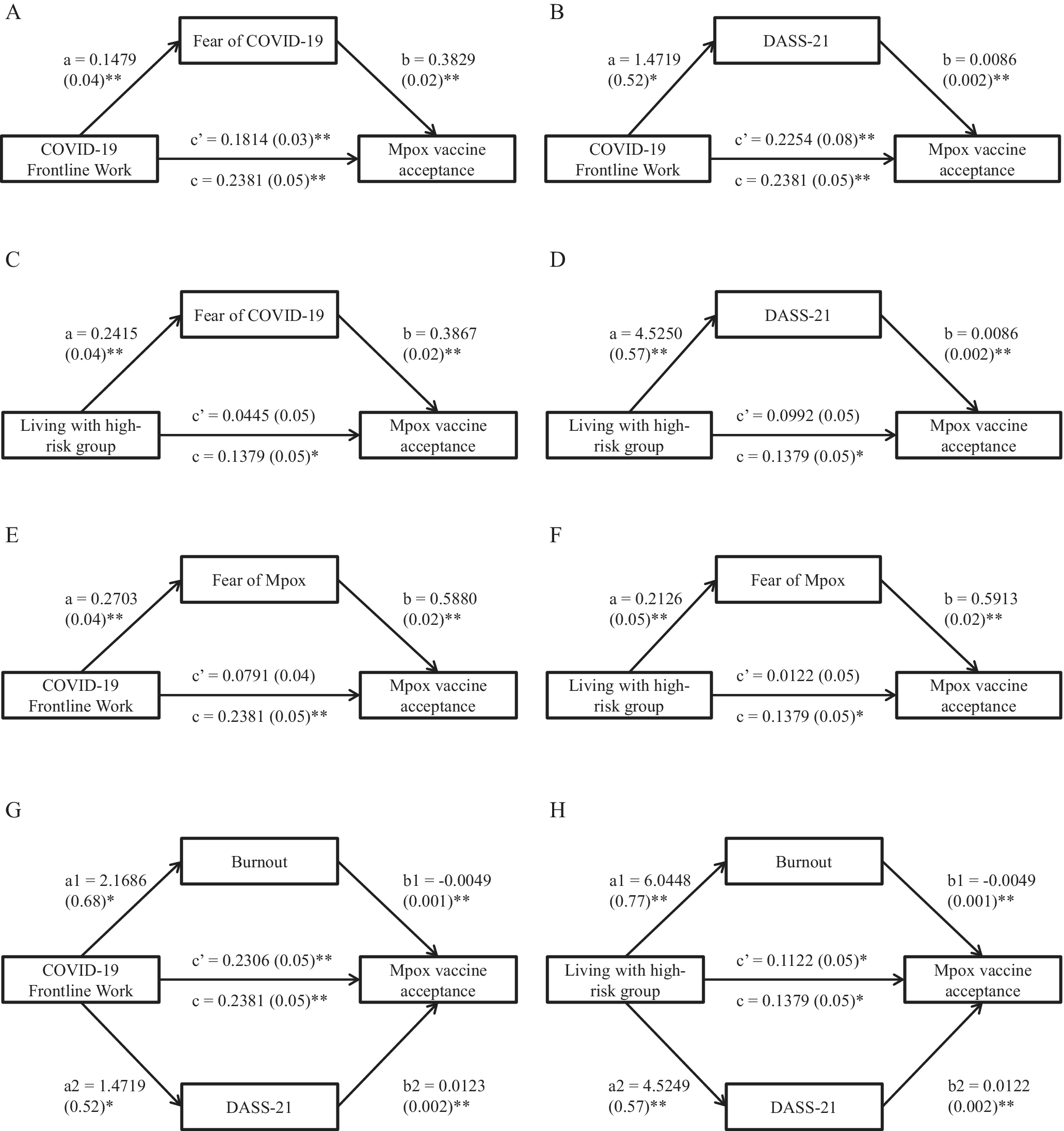
Mediation analysis identified several significant indirect statistical associations with Mpox vaccine acceptance (Table 5 and Figure 1). In Model A, fear of COVID-19 statistically accounted for part of the association between COVID-19 frontline work and vaccine acceptance, with an indirect effect estimate of 0.0566 (SE = 0.0154, P < 0.001). The direct association remained significant (0.1814, SE = 0.0460, P < 0.001), indicating both direct and indirect statistical associations. Similarly, in Model B, DASS-21 scores partially mediated this relationship, with a smaller but significant indirect effect (0.0126, SE = 0.0051, P = 0.013), and the direct effect remained significant (0.2254, SE = 0.0481, P < 0.001).
Mediation analysis of factors influencing Mpox vaccine acceptance among HCWs

Table 5. Long description
Table 5 summarizes eight mediation models evaluating whether fear of COVID-19, fear of Mpox, DASS-21 psychological distress, and burnout statistically account for associations between COVID-19-related experiences and Mpox vaccine acceptance. Estimates, standard errors, direct, indirect, and total effects are reported. Several significant indirect effects were identified, particularly through fear of Mpox and fear of COVID-19.
Note. Component a represents the association between the exposure and the mediator, and Component b represents the association between the mediator and Mpox vaccine acceptance after adjustment for the exposure. In Models G and H, a1 and b1 refer to the burnout pathway, whereas a2 and b2 refer to the DASS-21 pathway. Indirect, direct, and total effects are presented as unstandardized regression coefficients. Statistical significance was defined as P < 0.05.
Abbreviations: SE, standard error; DASS-21, Depression, Anxiety, and Stress Scale-21.
Path diagrams of mediation models for Mpox vaccine acceptance. (A) Mediation model illustrating the indirect effect of COVID-19 frontline work on Mpox vaccine acceptance through fear of COVID-19. (B) Mediation model showing the indirect effect of COVID-19 frontline work on Mpox vaccine acceptance via psychological distress (measured using DASS-21). (C) Mediation model examining the influence of living with high-risk groups on Mpox vaccine acceptance through fear of COVID-19. (D) Mediation model demonstrating the pathway from living with high-risk groups to Mpox vaccine acceptance mediated by psychological distress (DASS-21). (E) Indirect effect of COVID-19 frontline work on Mpox vaccine acceptance via fear of Mpox. (F) Indirect effect of living with high-risk groups on Mpox vaccine acceptance via fear of Mpox. (G) Combined mediation model exploring the effects of burnout and psychological distress (DASS-21) as mediators of the relationship between COVID-19 frontline work and Mpox vaccine acceptance. (H) Combined mediation model showing the roles of burnout and psychological distress (DASS-21) in the relationship between living with high-risk groups and Mpox vaccine acceptance. Path coefficients (a, b, c′, c) are presented with standard errors in parentheses. Significance levels: *P < 0.05, **P < 0.001.

Figure 1. Long description
A multi-panel figure containing eight mediation models. Each model features an independent variable on the left, a mediator in the center top or bottom, and the dependent variable Mpox vaccine acceptance on the right. Arrows indicate path coefficients with standard errors in parentheses and asterisks for significance.
* Panel A: COVID 19 Frontline Work to Mpox vaccine acceptance via Fear of COVID 19. Path a = 0.1479, b = 0.3829, c prime = 0.1814, c = 0.2381.
* Panel B: COVID 19 Frontline Work to Mpox vaccine acceptance via D A S S 21. Path a = 1.4719, b = 0.0086, c prime = 0.2254, c = 0.2381.
* Panel C: Living with high risk group to Mpox vaccine acceptance via Fear of COVID 19. Path a = 0.2415, b = 0.3867, c prime = 0.0445, c = 0.1379.
* Panel D: Living with high risk group to Mpox vaccine acceptance via D A S S 21. Path a = 4.5250, b = 0.0086, c prime = 0.0992, c = 0.1379.
* Panel E: COVID 19 Frontline Work to Mpox vaccine acceptance via Fear of Mpox. Path a = 0.2703, b = 0.5880, c prime = 0.0791, c = 0.2381.
* Panel F: Living with high risk group to Mpox vaccine acceptance via Fear of Mpox. Path a = 0.2126, b = 0.5913, c prime = 0.0122, c = 0.1379.
* Panel G: COVID 19 Frontline Work to Mpox vaccine acceptance via two mediators, Burnout (top) and D A S S 21 (bottom). Path a 1 = 2.1686, b 1 = minus 0.0049, a 2 = 1.4719, b 2 = 0.0123, c prime = 0.2306, c = 0.2381.
* Panel H: Living with high risk group to Mpox vaccine acceptance via Burnout (top) and D A S S 21 (bottom). Path a 1 = 6.0448, b 1 = minus 0.0049, a 2 = 4.5249, b 2 = 0.0122, c prime = 0.1122, c = 0.1379.
Model C showed that fear of COVID-19 significantly mediated the effect of living with high-risk individuals during the COVID-19 pandemic on Mpox vaccine acceptance, with an indirect effect of 0.0934 (SE = 0.0177, P < 0.001), while the direct effect was not significant (P = 0.387). In Model D, DASS-21 also mediated this relationship, with an indirect effect of 0.0387 (SE = 0.0091, P < 0.001), but the direct effect was marginally non-significant (P = 0.067).
Model E showed that fear of Mpox statistically accounted for a substantial indirect association between COVID-19 frontline work and vaccine acceptance, with an indirect effect of 0.1589 (SE = 0.0260, P < 0.001), while the direct effect was not significant (P = 0.055). In Model F, fear of Mpox also mediated the relationship between living with high-risk individuals and vaccine acceptance, with an indirect effect of 0.1257 (SE = 0.0290, P < 0.001), and the direct effect was non-significant (P = 0.790). These findings underscore the strong association of fear-related factors with HCWs’ acceptance of the Mpox vaccine. Although the estimated indirect effects were modest in absolute size, they are interpretable on the original 1-5 Mpox vaccine acceptance scale. For example, the indirect effect of COVID-19 frontline work through fear of Mpox was 0.1589, indicating an estimated increase of approximately 0.16 points in vaccine acceptance associated with this pathway. Similarly, the indirect effect of living with high-risk individuals through fear of Mpox was 0.1257, corresponding to an estimated increase of approximately 0.13 points. These effect sizes should not be interpreted as large individual-level changes, but they may be meaningful at the workforce level because even modest shifts in vaccination willingness can affect preparedness when applied across large groups of HCWs.
The exploratory mediation analysis further examined whether burnout and DASS-21 statistically accounted for indirect associations in the relationship between living with high-risk individuals or COVID-19 frontline work and Mpox vaccine acceptance. Model G indicated that burnout and DASS-21 had different mediating effects between COVID-19 frontline work and Mpox vaccine acceptance. The indirect effect through burnout was negative at −0.0106 (P = 0.014), with significant component paths. At the same time, the indirect effect through DASS-21 was positive at 0.0181 (P = 0.008), with significant components. The direct effect was also significant (P < 0.001).
Model H showed that burnout and DASS-21 also mediated the relationship between living with high-risk individuals and Mpox vaccine acceptance. The indirect effect through burnout was negative at −0.0295 (P < 0.001), with significant paths. The indirect effect through DASS-21 was positive at 0.0552 (P < 0.001), with significant components. The direct effect was also significant (P = 0.040).
Discussion
This multi-country study examined Mpox vaccine acceptance among HCWs in Central Asia during the early Mpox outbreak and the continuing aftermath of the COVID-19 pandemic. Several findings deserve emphasis. First, Mpox vaccine acceptance differed significantly across countries, with higher acceptance observed in Kyrgyzstan and Uzbekistan than in Kazakhstan. Second, pandemic-related exposure remained relevant: HCWs with COVID-19 frontline experience and those living with high-risk individuals showed greater willingness to receive Mpox vaccination. Third, psychological factors were central to vaccine acceptance, with fear of Mpox emerging as the strongest correlate, whereas burnout showed a small but significant negative association.Reference Martinelli and Veltri 16 , Reference Zampetakis and Melas 18 , Reference Domnich, Grassi and Fallani 24 –Reference Sharif Nia, She and Kaur 30 Together, these findings suggest that acceptance of a new vaccine among HCWs is shaped not only by occupational role and national context, but also by the psychological imprint of prior pandemic experience.
The observed between-country differences likely reflect a combination of contextual influences rather than a single explanatory factor. Variations in health-system organization, communication strategies, institutional trust, prior vaccination culture, and local experience during the COVID-19 period may all have contributed to these differences. Importantly, the significant interaction between country and COVID-19 frontline work suggests that prior pandemic exposure did not operate uniformly across settings. In particular, HCWs in Uzbekistan with frontline experience demonstrated especially high acceptance, indicating that contextual and experiential factors may reinforce one another. Because the present design does not directly measure policy environment, institutional trust, or media exposure, these interpretations should remain cautious; nevertheless, the findings support the view that vaccine attitudes among HCWs are embedded within broader health care and social contexts rather than determined solely at the individual level.Reference Vasilevska, Ku and Fisman 12 , Reference Hong, Pan and Jiang 14 , Reference Mahameed, Al-Mahzoum and AlRaie 15 , Reference Brauer, Choi and Chang 25 , Reference Khatiwada, Nugraha and Dochez 26
Occupational differences were also notable. Residency students showed the highest levels of acceptance, whereas administrative personnel showed the lowest. This pattern is consistent with previous work suggesting that willingness to vaccinate may be greater among groups with more direct clinical exposure, stronger identification with preventive medicine, or more recent training in evidence-based practice.Reference Vasilevska, Ku and Fisman 12 , Reference Koh, Liow and Loh 31 At the same time, the occupational pattern observed here should not be overgeneralized. Professional category may capture not only patient contact, but also differences in age, recent educational exposure, institutional expectations, and perceived personal risk. Even so, the findings suggest that vaccination campaigns targeting HCWs may need to be differentiated by professional subgroup rather than treating the health care workforce as a homogeneous population.
The most consistent finding in the present study was the role of fear of Mpox. Across analyses, fear of Mpox was the strongest predictor of willingness to receive vaccination, exceeding the contribution of demographic and most occupational variables. This finding is consistent with the Health Belief Model and previous literature showing that perceived threat and risk perception are central drivers of vaccination behavior.Reference Martinelli and Veltri 16 , Reference Bendau, Plag and Petzold 17 , Reference Zampetakis and Melas 18 , Reference Cipolletta, Andreghetti and Mioni 32 –Reference Limbu, Gautam and Pham 36 However, rather than simply repeating the general Health Belief Model pathway, the present findings suggest that, among HCWs in a post-COVID-19 context, fear of Mpox may reflect a broader process of pandemic-shaped risk appraisal. HCWs who perceived Mpox as a more salient or personally relevant infectious threat were more likely to endorse vaccination, indicating that acceptance of a novel vaccine may depend partly on how new outbreaks are interpreted through prior pandemic experience.
Prior COVID-19 experience appeared to be associated with Mpox vaccine acceptance mainly through psychological pathways rather than as a simple direct exposure effect. HCWs with frontline COVID-19 experience and those living with high-risk individuals reported greater willingness to receive Mpox vaccination, and these associations were statistically linked to fear of COVID-19, fear of Mpox, and psychological distress. These findings suggest that prior outbreak experience may shape how HCWs appraise subsequent infectious threats, although the cross-sectional design does not allow causal interpretation.Reference Zampetakis and Melas 18 , Reference Domnich, Grassi and Fallani 24
At the same time, not all psychological responses appeared to operate in the same direction. Whereas fear-related constructs and general distress were positively associated with vaccine acceptance, occupational burnout was inversely associated with willingness to vaccinate. This distinction is important because fear and distress may heighten perceived urgency and need for self-protection, whereas burnout reflects emotional exhaustion, depleted energy, and reduced professional engagement. In this context, burnout may reduce vaccine acceptance not because HCWs perceive lower infectious risk, but because prolonged occupational strain can weaken motivation, trust, attention to new recommendations, and readiness to engage in additional preventive behaviors. This finding extends prior literature on HCW psychological burden during and after COVID-19 by suggesting that burnout may affect not only well-being and work performance, but also preparedness-related behaviors such as willingness to accept vaccination against emerging infectious threats.Reference Bolatov, Brimkulov and Jarylkasynova 6 , Reference Zeng, Peng and Hao 7 , Reference Moyo, Bhappu and Bhebhe 29 , Reference Sharif Nia, She and Kaur 30
The cross-sectional and exploratory mediation analyses further illustrate this psychological complexity, but these results should be interpreted carefully. Because all variables were measured at the same time point, the mediation models do not establish temporal or causal pathways. Rather, they identify indirect statistical associations consistent with the possibility that fear and distress help explain the relationship between pandemic-related experience and vaccine acceptance. From an interpretive standpoint, these models are useful because they suggest that pandemic exposure may be associated with later vaccine attitudes not only directly, but also through altered emotional and cognitive responses to infectious threats. However, longitudinal studies are needed before stronger causal inferences can be made.
From a practical perspective, the observed effect sizes suggest that psychological pathways were statistically robust but modest in magnitude on the 1-5 vaccine acceptance scale. For example, the indirect association between COVID-19 frontline work and vaccine acceptance through fear of Mpox corresponded to an estimated difference of approximately 0.16 scale points. Such effects should not be overinterpreted as large individual-level changes. However, in public health preparedness, modest shifts in vaccine willingness across a large health care workforce may still be operationally relevant, particularly during early outbreak response when rapid uptake among HCWs can influence institutional readiness and public confidence. The findings therefore suggest that vaccination strategies should not rely only on increasing perceived threat, but should also address burnout, trust, and organizational support.
These findings have practical implications for vaccine promotion among HCWs. First, communication strategies for emerging infectious disease vaccination should recognize that HCWs’ decisions are shaped by prior outbreak experience and by their current psychological state. Second, while threat awareness may increase short-term vaccine willingness, fear-based messaging should not be relied upon as a primary strategy because it may contribute to fatigue, resistance, and declining trust over time. Third, the negative association between burnout and vaccine acceptance suggests that occupational well-being is not only a workforce issue but also a vaccination-readiness issue. Therefore, interventions that aim to improve vaccine uptake among HCWs should not focus only on correcting knowledge deficits or increasing perceived risk, but also on reducing the occupational exhaustion that may undermine engagement with new vaccination recommendations. By sustaining HCWs’ psychological well-being, workforce engagement, and trust in institutional guidance, such support measures may also contribute to health care system resilience and improve readiness for future outbreak response. Practical interventions could include confidential psychological counselling, peer-support groups, brief stress-management or resilience sessions, supervisor-led check-ins, team debriefings, and accessible occupational mental health services. These measures should be combined with transparent risk communication and vaccine information sessions that increase preparedness without amplifying anxiety.Reference Bolatov, Brimkulov and Jarylkasynova 6 , Reference Brauer, Choi and Chang 25 , Reference Al Zahrani 28 –Reference Sharif Nia, She and Kaur 30
The study also contributes to the literature by extending evidence on Mpox vaccine acceptance to Central Asia, a region that remains underrepresented in the international vaccine-behavior literature. Most previous studies on Mpox vaccine acceptance among HCWs have been conducted in other regions and have reported substantial heterogeneity in acceptance levels and determinants.Reference Hong, Pan and Jiang 14 , Reference Mahameed, Al-Mahzoum and AlRaie 15 By showing that vaccine attitudes in Central Asia were associated with national context, occupational role, prior pandemic exposure, fear, distress, and burnout, the present study broadens current understanding of how acceptance of vaccines against emerging infectious threats may develop in post-pandemic health care environments.
Study Limitations and Future Perspectives
Several limitations should be acknowledged. First, the cross-sectional design precludes temporal and causal inference. The associations observed in this study, including the mediation models, should therefore be interpreted as correlational rather than causal. Although several associations and indirect effects were statistically significant, some effect sizes were modest on the 1-5 vaccine acceptance scale and should be interpreted with caution regarding individual-level practical significance. Second, all measures were self-reported and may be influenced by social desirability or differential interpretation of questionnaire items. Although the Russian-language CBI version used in this study had previously been validated among nurses in Kazakhstan and Kyrgyzstan, its prior validation did not include all occupational groups and countries represented in the present sample. Therefore, future studies should further evaluate the measurement properties and measurement invariance of the CBI across professional subgroups and Central Asian settings. Third, willingness to receive Mpox vaccination was assessed as an attitudinal outcome rather than verified vaccination behavior; intention does not always translate into uptake. The survey was conducted between July and November 2022, during the early phase of the Mpox outbreak and the post-COVID-19 period. Therefore, the findings reflect HCWs’ vaccine willingness during this specific time window. Vaccine attitudes and actual uptake rates may vary at later time points, particularly after changes in Mpox epidemiological status, public awareness, vaccine availability, or vaccination policies. In addition, Mpox vaccine acceptance was assessed using a single-item measure of willingness. This approach captured a direct behavioral intention and reduced respondent burden during an outbreak-related survey; however, it did not allow assessment of internal consistency reliability or construct validity, and it may not capture broader dimensions of vaccine hesitancy such as confidence, complacency, perceived safety, perceived effectiveness, or institutional trust. Fourth, the study used a non-probability convenience sampling strategy through health departments and professional social media/messaging platforms. Although the final sample size was statistically adequate for the planned regression and mediation analyses, the absence of an a priori sample size calculation remains a methodological limitation and should be distinguished from population-level generalizability. Therefore, the sample may overrepresent HCWs who were more engaged with institutional or online professional networks and may not be nationally representative of all HCWs within each country. Because the survey was administered online and participation was voluntary, self-selection bias cannot be excluded. HCWs with greater health literacy, stronger engagement with professional networks, greater interest in emerging infectious diseases, or more favorable attitudes toward vaccination may have been more likely to participate. In addition, the country distribution was unbalanced, with a larger proportion of participants from Kazakhstan than from Kyrgyzstan or Uzbekistan; therefore, estimated country effects should be interpreted cautiously and should not be considered nationally representative comparisons between countries. As a result, the findings should be interpreted primarily as associations within the study sample rather than as generalizable prevalence estimates for the health care workforce of Kazakhstan, Kyrgyzstan, or Uzbekistan. Several procedures were used to reduce potential bias where possible: the survey was anonymous to reduce social desirability pressure, online informed consent was obtained before participation, repeated submissions from the same IP address were restricted, incomplete questionnaires were excluded during data screening, validated or previously adapted instruments were used where available, and multivariable models adjusted for demographic, occupational, COVID-19-related, and psychological covariates. Nevertheless, these procedures could reduce but not eliminate selection bias, self-report bias, residual confounding, or the limitations of cross-sectional inference. Fifth, unmeasured contextual factors, including institutional trust, access to reliable vaccine information, local policy environment, prior experience with vaccination campaigns, and perceived availability of Mpox vaccines, may also have influenced acceptance. Moreover, the three countries may have differed in the stage of public awareness, perceived local relevance of Mpox, public health communication, and vaccine-related information programs during the sampling period. These contextual differences were not directly measured and may have contributed to between-country differences in Mpox vaccine acceptance.
Future studies should address these limitations through longitudinal or repeated-measures designs that can clarify how outbreak experience shapes vaccine attitudes over time. Research that integrates contextual variables, such as institutional trust, perceived organizational support, exposure to vaccine-related information, stage of outbreak awareness, public health messaging, and country-specific information environments, would be especially valuable for explaining between-country differences. In addition, further work should examine whether the psychological mechanisms observed here differ across professional subgroups, care settings, and levels of direct patient contact. Finally, studies linking vaccine attitudes to actual uptake would provide a more complete understanding of how psychological and contextual factors translate into real-world vaccination behavior.
Conclusion
This study showed that willingness to receive Mpox vaccination among HCWs in Central Asia was associated with both prior pandemic-related experience and psychological responses to emerging infectious disease threats. Greater willingness to vaccinate was observed among HCWs with COVID-19 frontline experience and those living with high-risk individuals, while fear of Mpox emerged as the strongest positive correlate of vaccine acceptance, and burnout was independently associated with lower willingness to vaccinate.
These findings have important implications for pandemic preparedness and vaccination policy. Health care institutions and public health authorities should integrate psychological and occupational considerations into vaccination preparedness strategies by combining evidence-based risk communication with interventions that monitor and mitigate burnout, support HCWs’ mental well-being, and strengthen trust in institutional guidance. Preparedness efforts should extend beyond informational campaigns or fear-based messaging to include organizational measures that promote workforce resilience, psychological support, and sustained engagement with vaccination programs. Such integrated approaches may enhance vaccine readiness among HCWs, strengthen institutional preparedness for emerging infectious disease threats, and improve the resilience of health care systems during future public health emergencies.
Supplementary material
The supplementary material for this article can be found at http://doi.org/10.1017/dmp.2026.10447.
Data availability statement
All data are available upon request to the corresponding author.
Acknowledgments
The author would like to thank Prof. Telman Z. Seisembekov, Prof. Nurlan Brimkulov, Prof. Gaukhar Jarylkasynova, Dr. Ainura Taalaikanova, Dr. Rano Yuldashova, Dr. Shakhlo Kodirova, and Dr. Dariga S. Smailova for their invaluable assistance with data collection. Their support and collaboration were greatly appreciated and contributed significantly to this research. The author thanks the administration of the following institutions and organizations for their support in conducting the study: Astana Medical University, University Medical Center Corporate Fund (Astana, Kazakhstan), Asfendiyarov Kazakh National Medical University, Kazakhstan’s Medical University «Kazakhstan School of Public Health» (Almaty, Kazakhstan), Kazakhstani Regional Departments of Public Health and Healthcare (Kazakhstan), I.K. Akhunbaev Kyrgyz State Medical Academy (Bishkek, Kyrgyzstan), and Bukhara State Medical Institute (Bukhara, Uzbekistan).
Author contribution
Not applicable.
Funding statement
The author received no specific funding for this article.
Competing interests
None.
Ethics approval
All procedures performed in studies involving human participants were in accordance with the ethical standards of the institutional and/or national research committee and with the 1964 Helsinki declaration and its later amendments or comparable ethical standards. The study was approved by the Local Ethics Committees of “University Medical Center” Corporate Fund (extract from protocol No. 11 of December 30, 2021) and I.K. Akhunbaev Kyrgyz State Medical Academy (extract from protocol No. 13 of December 08, 2021).
Informed consent
Online informed consent was obtained from all individual participants included in the study.
Consent for publication
Not applicable.