INTRODUCTION
Strongyloidiasis is a widespread infection that afflicts 30–100 million people in 70 countries, mainly in tropical and subtropical regions of the world (Genta, Reference Genta1989; Siddiqui and Berk, Reference Siddiqui and Berk2001). The parasite Strongyloides stercoralis causes chronic asymptomatic infections in immunocompetent human hosts and systemic invasion in immunocompromised patients, developing into a fatal hyperinfection syndrome (Marcos et al. Reference Marcos, Terashima, Canales and Gotuzzo2011; Paula and Costa-Cruz, Reference Paula and Costa-Cruz2011).
Immunological methods such as enzyme-linked immunosorbent assay (ELISA) have been widely used in the diagnosis of human strongyloidiasis due to their applicability, safety, availability of reagents and high sensitivity, being considered the best test for serological screening (Schaffel et al. Reference Schaffel, Nucci, Carvalho, Braga, Almeida, Portugal and Pulcheri2001; Gonzaga et al. Reference Gonzaga, Ribeiro, Feliciano, Manhani, Silva, Ueta and Costa-Cruz2011b; Koosha et al. Reference Koosha, Fesharaki and Rokni2004).
Currently, the immunodiagnosis of human strongyloidiasis has been performed using antigen extracts from larvae of several species of Strongyloides. However, recent research shows that fractions of total extract of Strongyloides venezuelensis filariform larvae can be used to detect IgG in S. stercoralis infection (Rigo et al. Reference Rigo, Lescano, Marchi and Amato-Neto2008; Feliciano et al. Reference Feliciano, Gonzaga, Gonçalves-Pires, Gonçalves, Rodrigues, Ueta and Costa-Cruz2010; Gonzaga et al. Reference Gonzaga, Ribeiro, Cunha-Júnior, Ueta and Costa-Cruz2011a), demonstrating that different antigenic preparations can also be used in strongyloidiasis diagnosis.
Other life stages of the parasite such as parasitic females and eggs may also have potential as sources of diagnostic antigens. Strongyloides venezuelensis infects wild rats and its life cycle in rodents is similar to S. stercoralis in humans. Filariform larvae reach the lungs, migrate to the small intestine where they develop into adult worms (Ferreira et al. Reference Ferreira, Pereira, Souza, Cassali, Souza, Lemos, Teixeira and Negrão-Corrêa2007; Schilter et al. Reference Schilter, Pereira, Eschnazi, Fernandes, Shim, Sousa, Teixeira and Negrão-Corrêa2010). Humans infected with S. stercoralis normally eliminate larvae in the feces, while in rodents infected with S. venezuelensis, eggs are eliminated. Eggs are shed in the feces of experimentally infected rodents, and can be readily recovered and thus are an available antigen for use in immunodiagnostic tests (Baek et al. Reference Baek, Islam and Matsuda1998; Gonçalves et al. Reference Gonçalves, Silva, Ueta and Costa-Cruz2010). A major reason to investigate parasitic female worm and egg extracts in immunodiagnosis is because they are found in the human intestinal mucosa, and thus host systems have contact and could potentially develop an immune response to them. Therefore, this indicates that antigenic extracts produced from the parasitic female and egg could be of great relevance in diagnosis of strongyloidiasis, especially in cases of hyperinfection and dissemination when parasitic load increases in host lungs and intestine or in severe diarrhoea cases with elimination of eggs in the feces (Ferreira et al. Reference Ferreira, Pereira, Souza, Cassali, Souza, Lemos, Teixeira and Negrão-Corrêa2007; Gonçalves et al. Reference Gonçalves, Rocha, Gonzaga, Gonçalves-Pires, Ueta and Costa-Cruz2012). The aim of this study was to use larval, parasitic female and egg antigens from S. venezuelensis to detect parasite-specific IgG and immune complexes in human serum samples by ELISA.
MATERIALS AND METHODS
Serum samples
A panel of parasitologically well-characterized serum samples from immunocompetent individuals was used. A total of 95 serum samples, obtained from an established bank of biological specimens consisted of 30 patients harbouring S. stercoralis larvae (copro-positive), 30 healthy subjects based on their clinical observation, without evidence of contact with S. stercoralis infection or previous history of strongyloidiasis and copro-negative and 30 patients with other parasites including Ascaris lumbricoides (n=7), Enterobius vermicularis (n=5), Giardia lamblia (n=5), hookworms (n=8), Taenia spp. (n=5), Schistosoma mansoni (n=5). Individuals of the 3 groups were subjected to 3 rounds of fecal sampling by the methods of Lutz (Reference Lutz1919) and Baermann (Reference Baermann1917). The study received approval from the Research Ethics Committee of the Universidade Federal de Uberlândia, State of Minas Gerais, Brazil, under protocol number 465/10.
Parasites
Strongyloides venezuelensis third-stage infective larvae (L3) were obtained from charcoal fecal cultures of experimentally infected Rattus norvegicus (Wistar). The cultures were stored at 28°C for 48 h, and infective larvae were collected and concentrated using the Rugai method (Rugai et al. Reference Rugai, Matton and Brisola1954). The recovered larvae were washed 5 times in phosphate-buffered saline (PBS), 0·01 M, pH 7·2, and stored at – 20°C in PBS until use.
To recover parasitic females, Wistar rats experimentally infected with S. venezuelensis were sacrificed after anaesthesia (ketamine 60 mg/kg and xylazine 7 mg/kg) on day 8 post-infection (p.i.), then the small intestine was removed, placed in Petri dishes containing saline solution, longitudinally sectioned and incubated at 37°C for 2 h. After that period, females were counted using the Sato and Toma (Reference Sato and Toma1990) method.
To obtain eggs, 3 R. norvegicus (Wistar) experimentally infected with S. venezuelensis were placed on clean, moist absorbent paper and allowed to defecate on day 8 p.i. The number of eggs/g of feces was estimated using Cornell-McMaster method (Gordon and Whitlock, Reference Gordon and Whitlock1939).
Alkaline extract from Strongyloides venezuelensis
Alkaline extracts were prepared, as previously described (Machado et al. Reference Machado, Ueta, Gonçalves-Pires, Oliveira, Faccioli and Costa-Cruz2003). Briefly, 1 ml of 0·15 M NaOH was added to 300 000 S. venezuelensis larvae or 500 S. venezuelensis parasitic females or 300 000 eggs and kept under gentle shaking for 6 h at 4°C. Subsequently, 0·3 M HCl was added until a pH of 7·0 was reached. These preparations were then centrifuged at 12 400 g for 30 min at 4°C. Supernatant fractions (alkaline extracts) were analysed for protein content according to the method of Lowry et al. (Reference Lowry, Rosebrough, Farr and Randall1951), subdivided into aliquots and stored at −20°C until use.
Production of immune serum in rabbits
Rabbits were immunized against S. venezuelensis larval, parasitic female or egg antigens for production of immune sera, and parasite-specific IgGs were purified as described previously (Gonçalves et al. Reference Gonçalves, Silva, Ueta and Costa-Cruz2010).
Immune complex measurement in serum samples by ELISA
Preliminary experiments were carried out in order to determine the optimal conditions for ELISA through serial dilution of the reagents (antibody, control serum, and conjugate). Briefly, low-affinity polystyrene microplates (BioAgency Laboratories, São Paulo, Brazil) were coated for 18 h at 4°C with 50 μl/well of anti-larval IgG, anti-parasitic female IgG or anti-egg IgG (40 μg/ml) in 0·06 M carbonate-bicarbonate buffer (pH 9·6). After 3 washes with PBS-T, 50 μl/well of serum samples (1:80) were added and incubated for 45 min at 37°C. Serum samples positive and negative for immune complexes were used as control. The positive serum samples consisted of a positive sample for IgG anti-S. venezuelensis. After incubation for 45 min at 37°C and another 3 washes, peroxidase-labelled goat anti-human IgG (Sigma) was added (50 μl/well) at the ideal dilution of 1:2000 for 45 min at 37°C. The reaction was revealed by adding the enzyme substrate (0·03% H2O2 and o-phenylenediamine (OPD) in 0·1 M citrate-phosphate buffer, pH 5·0) followed by incubation for 15 min at room temperature, and the addition of 25 μl of 2N H2SO4/well to stop the reaction. Optical density (OD) was determined at 492 nm in a plate reader (Titertek Multiskan, Flow Laboratories, McLean, VA, USA). Results were expressed as reactivity index (RI), as follows: RI=absorbance of tested sample/cut-off, where cut-off is the mean absorbance of 3 negative sera plus 3 standard deviations. Values of RI>1·0 were considered positive.
IgG-specific measurement in serum samples by ELISA
ELISA, using extracts of larvae, parasitic females and eggs from S. venezuelensis was carried out according to the protocol of Gonçalves et al. (Reference Gonçalves, Rocha, Gonzaga, Gonçalves-Pires, Ueta and Costa-Cruz2012). Briefly, low-affinity polystyrene microplates (BioAgency Laboratories, São Paulo, Brazil) were coated overnight at 4°C with 5 μg/ml of S. venezuelensis larvae (L3), parasitic females or egg alkaline extracts in 0·06 M carbonate-bicarbonate buffer (pH 9·6). Plates were washed 3 times with PBS containing 0·05% Tween 20 (PBS-T). After washing, plates were incubated with sera (50 μl/well) diluted 1:80 for plates with larval or egg alkaline extract and 1:320 for plates with parasitic female alkaline extract, for 45 min at 37°C. The secondary antibody consisting of peroxidase-labelled goat anti-human IgG conjugate (Sigma, St Louis, MO, USA) at the optimal dilution of 1:2000 was added and incubated for 45 min at 37°C. Reagents were used for a final assay volume of 50 μl/well. The reaction was revealed as described above. Sera with RI>1·0 were considered positive.
Data analysis
Statistical analysis was performed using the software GraphPad Prism version 5.0 (Graph Pad Software, Inc). Statistical variations were analysed using ANOVA, followed by t- test. Statistical significance was set at P<0·05. Sensitivity, specificity and diagnostic efficiency (DE) were calculated in accordance with the methods of Mineo et al. (Reference Mineo, Silva, Sopelete, Leal, Vidigal, Tápia and Bacchin2005). DE indicates the accuracy of a test, and is calculated according to the formula (true positive+true negative results)/true positive+false positive+false negative+true negative results) and expressed as a percentage.
RESULTS
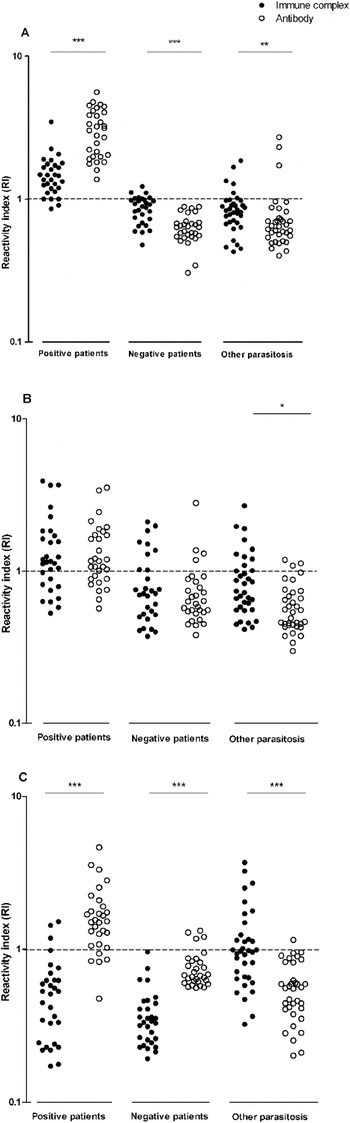
Figure 1 shows the levels of immune complex and specific anti-S. stercoralis IgG expressed as a reactivity index (RI) for serum samples from patients harbouring S. stercoralis larvae, healthy subjects and patients with other parasites when the 3 antigens were used. In patients harbouring S. stercoralis larvae, there was a significant statistical difference in the detection of immune complex and IgG between the use of larval and egg antigens, with higher positivity rates for larval antigen.
Levels of immune complexes and specific anti-Strongyloides stercoralis IgG expressed as Reactivity Index (RI) for serum samples from patients harbouring S. stercoralis larvae (n=30), healthy subjects (n=30) and patients with other parasites (n=35) as measured by ELISA, using an alkaline extract of (A) larvae, (B) parasitic females and (C) eggs as heterologous antigens. The dashed lines represent the positivity threshold (RI >1·0). * P<0·05, ** P<0·01, *** P<0·001.

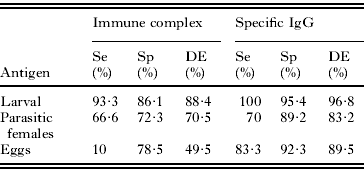
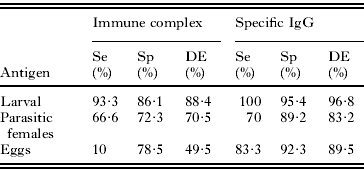
The diagnostic parameters: sensitivity, specificity and diagnostic efficiency of ELISA in the detection of immune complex and specific IgG are shown in Table 1.
Diagnostic parameters of immune complexes and specific IgG to Strongyloides using three different antigenic extracts (larval, parasitic females and eggs) of Strongyloides venezuelensis
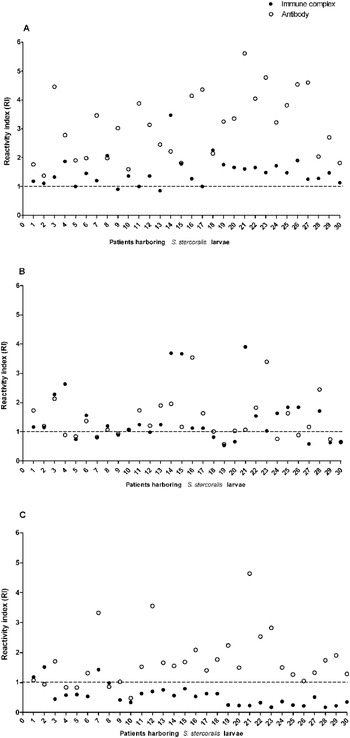
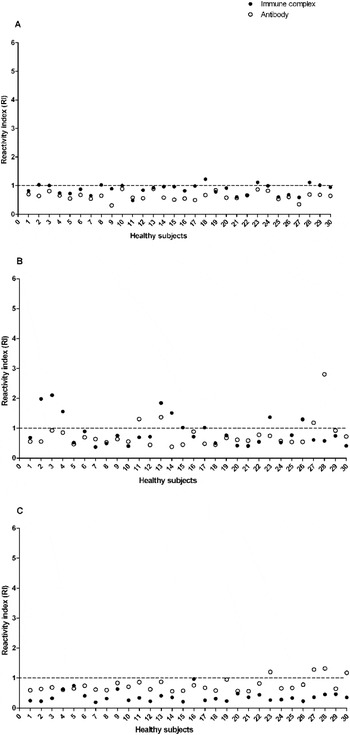
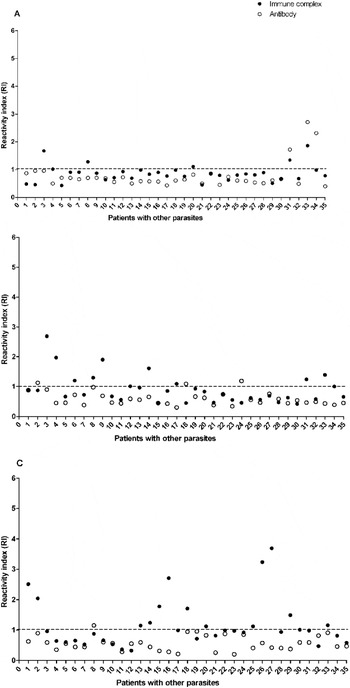
Figures 2, 3 and 4 show a detection panel from immune complex and specific IgG using larvae, parasitic females and eggs for each of 95 individuals tested. In patients harbouring S. stercoralis, detection of immune complexes was higher than detection of antibody using antigens from larvae (10%), parasitic females (23·33%) and eggs (6·66%). For healthy subjects, parasitic female extract was not adequate for immune complex detection. In patients with other parasites, larval extract demonstrated better results.
Detection panel from immune complex anti-Strongyloides stercoralis IgG expressed as Reactivity Index (RI) for serum samples from patients harbouring S. stercoralis larvae (n=30) as measured by ELISA using an alkaline extract of (A) larvae, (B) parasitic females and (C) eggs as heterologous antigens. The dashed lines represent the positivity threshold (RI>1·0).

Detection panel from immune complex anti-Strongyloides stercoralis IgG expressed as Reactivity Index (RI) for serum samples from healthy subjects (n=30) as measured by ELISA using an alkaline extract of (A) larvae, (B) parasitic females and (C) eggs as heterologous antigens. The dashed lines represent the positivity threshold (RI>1·0).

Detection panel from immune complex anti-Strongyloides stercoralis IgG expressed as Reactivity Index (RI) for serum sample from patients with other parasites (n=35) as measured by ELISA using an alkaline extract of (A) larvae, (B) parasitic females and (C) eggs as heterologous antigens. The dashed lines represent the positivity threshold (RI>1·0).

In patients with other parasites, there was cross-reactivity for immune complex detection with the following parasites: A. lumbricoides (1), E. vermicularis (2), hookworms (1) and S. mansoni (2) when larval extract was used. For parasitic female extract, cross-reactivity was observed with E. vermicularis (2), A. lumbricoides (4), G. lamblia (2) and S. mansoni (3). When egg extract was used, it shown that E. vermicularis (2), G. lamblia (4), hookworms (3), Taenia sp. (4) and S. mansoni (1) presented cross-reactivity.
For specific IgG, cross-reactivity was observed in patients with other parasites: S. mansoni (3) when larval extract was used; E. vermicularis (1), hookworms (2) when parasitic female extract was used. When egg extract was used, cross-reaction only with A. lumbricoides (1) was observed.
DISCUSSION
Although several diagnostic methods exist to detect the presence of S. stercoralis there is no gold standard. Current parasitological methods for the detection of parasites are of insufficient sensitivity for accurate detection of infection in the immunocompromised host (Devi et al. Reference Devi, Borkakoty and Mahanta2011).
Regarding the difficulty of parasitological diagnosis in fecal samples for human strongyloidiasis, experiments and new immunological tests are essential for the development of a highly specific test to evaluate S. stercoralis infection. Novel diagnostic methods are expected to improve epidemiological studies and control efforts for the prevention and treatment of strongyloidiasis. Based on this concept, we present here a novel approach that could be used for the diagnosis of human strongyloidiasis. The method of immune complex detection seems to be an alternative strategy for human strongyloidiasis diagnosis.
Heterologous antigen has been widely used for diagnosis of human strongyloidiasis with good and promising results, especially in epidemiological surveys (Feliciano et al. Reference Feliciano, Gonzaga, Gonçalves-Pires, Gonçalves, Rodrigues, Ueta and Costa-Cruz2010; Gonçalves et al. Reference Gonçalves, Rocha, Gonzaga, Gonçalves-Pires, Ueta and Costa-Cruz2012). S. venezuelensis has potential use for this diagnosis, and immune complex detection can improve this potential.
Other developing forms of the parasite such as parasitic females and eggs may also have potential to be used as antigens. In human strongyloidiasis diagnosis, in addition to an antigenic extract of larvae, it would be prudent to use an antigenic extract produced from parasitic females, since it is this form that is established in the intestinal mucosa. In experimental models the elimination of eggs occurs in the feces, and in human infection eggs can be eliminated when the patient suffers severe diarrhoea. Moreover, the eggs are transiently present in patients without diarrhoea but simply hatch in the intestine resulting in first-stage larvae being passed in the feces, indicating the relevance of the use of antigenic extracts based on eggs (Gonçalves et al. Reference Gonçalves, Rocha, Gonzaga, Gonçalves-Pires, Ueta and Costa-Cruz2012). In the present study, anti-larval, anti-parasitic female or anti-egg IgGs raised in rabbits against the different S. venezuelensis stages were used for the first time to detect S. stercoralis-specific immune complexes in human sera.
In patients with other parasites, the detection of immune complexes was higher using the parasitic females and eggs as antigen than when larval antigen was used. In the present study, the rates of sensitivity, specificity and diagnostic efficiency of ELISA to detect immune complex and specific IgG were significantly higher when using antigen from the larvae of S. venezuelensis than when antigens from parasitic females or eggs were used. This demonstrates that the diagnosis of strongyloidiasis by ELISA is most effective when larval extract is used. Immune complex detection is innovative and this is the first attempt to use this method for strongyloidiasis diagnosis.
This present study represents important research in an attempt to use alternative parasitic females and eggs of S. venezuelensis as heterologous antigens in immune complex detection of human strongyloidiasis. The results show that parasitic females and eggs have some potential in detecting antibodies against S. stercoralis; however, larval extract remains the best antigen for use in ELISA. In this study, we demonstrated that immune complex detection is an alternative strategy for the diagnosis of strongyloidiasis. Detection of immune complexes in serum samples by immunological assay may contribute to diagnosis, which is an important consideration particularly for immunocompromised patients potentially at risk of strongyloidiasis. Although of great importance for immunological diagnosis, antibody detection may be an indication of cured disease with the presence of residual antibody because the detection of antigen and immune complexes might indicate disease activity.
The current results concerning immune complex detection in serum samples, particularly using anti-larval IgG, appear to be very promising.
FINANCIAL SUPPORT
This research was supported by the Fundação Coordenação de Aperfeiçoamento de Pessoal de Nível Superior (CAPES), Fundação de Amparo à Pesquisa do Estado de Minas Gerais (FAPEMIG), Conselho Nacional de Desenvolvimento Científico e Tecnológico (CNPq) and by the Federal University of Uberlândia (UFU), Brazil.