INTRODUCTION
Rocky shores are ecosystems that support a wide variety of marine animals, such as crustaceans and juvenile fish of great ecological and economic importance (Henriques & Almada, Reference Henriques and Almada1998; Thompson et al., Reference Thompson, Crowe and Hawkins2002). These shores can be widely covered by algae forming a phytal environment that has a characteristic composition and distribution of flora and fauna (Giere, Reference Giere2009).
On rocky shores, environmental gradients of nutrients and productivity have major effects on the type and strength of interactions in communities by establishing strong correlations between species distribution and physical factors, such as temperature, wave exposure, degree of sedimentation and upwelling (Schiel, Reference Schiel2004). Most rocky shores are strongly influenced by adjacent coastal basins hydrography, especially in areas where upwelling occurs. The occurrence of upwelling, defined as the rise of the richest deep, cold water to the surface, affects the community structure on rocky shores, as interactions between organisms on all trophic levels are strongly influenced by the primary production of the ecosystem (Menge, Reference Menge2000).
Biodiversity and density distribution patterns for marine benthic communities in areas under the influence of upwelling have been reported in various locations around the world, mainly for macrobenthos. For the macrofauna of the Atlantic coast of tropical Africa, Le Loeuff & Cosel (Reference Le Loeuff and Cosel1998) report that species richness is greater in regions of upwelling when compared to typical tropical regions. On the north-western coast of the Iberian Peninsula, Lastra et al. (Reference Lastra, La Huz, Sanchez-Mata, Rodil, Aerts, Beloso and Lopez2006) also report that the number of macrofauna species increases significantly on beaches near the coastal upwelling zones. On the western coast of southern Africa, Bosman et al. (Reference Bosman, Hockey and Siegfried1987) report that intertidal communities cannot be separated clearly into two groups based on presence or absence of upwelling.
Considering temporal variations Witman & Smith (Reference Witman and Smith2003) report that the turnover of the community of epifaunal invertebrates at Gordon Rocks in the Galapagos Marine Reserve is extremely fast for a tropical sublittoral community of a natural hard substrate. A twofold increase in the number of species and density in the space of a year in this location of upwelling in the Galapagos is among the most rapid increases in diversity among any sublittoral epifaunal community. For a community of marine algae, Ormond & Banaimoon (Reference Ormond and Banaimoon1994) confirm that there is a very marked seasonal pattern of seaweed growth, with periods of maximal growth occurring in summer/autumn, when there are high amounts of nutrients due to the seasonal upwelling that occurs along the southern Arabian coast. Temporary episodes of downwelling/upwelling are also known to significantly affect the supply and settlement of invertebrate larval stages (Almeida & Queiroga, Reference Almeida and Queiroga2003; Ma, Reference Ma2005).
The meiofauna community is represented by benthic metazoans that are trapped between meshes of 0.044 mm (or 0.062 mm) and 0.5 mm (or 1 mm) (Giere, Reference Giere2009). This community plays an important role in the transfer of energy in benthic systems, serving as food for macrobenthos, fish and other organisms (Coull, Reference Coull, Higgins and Thiel1988). Its distribution pattern associated with sediment or algal substrate is very complex due to the influence of geological, chemical, hydrodynamic and various biological processes (Giere, Reference Giere2009). Among the groups of meiofauna, Copepoda Harpacticoida is regularly the most abundant taxon in the phytal environment (Hicks, Reference Hicks1977a; Coull et al., Reference Coull, Creed, Eskin, Montagna, Palmer and Wells1983; Hall & Bell, Reference Hall and Bell1993), with high diversity values (Hicks, Reference Hicks, Moore and Seed1985). According to Wells (Reference Wells2007), there are about 4300 species in 589 genera and 56 families described for this important taxon.
Studies on the meiofauna community in areas that undergo periodic upwelling are rare and include only one study on major taxonomic groups (Soltwedel, Reference Soltwedel1997) and a few for selected taxa. In one of the few studies on meiofauna (using meshes of 0.250 and 0.177 mm and thus addressing partially only the meiofauna organisms) in upwelling areas at Cabo Frio, Brazil, Machado et al. (Reference Machado, Coimbra and Carreño2005) suggest that both Ostracoda species composition and community structure are probably controlled by the presence of cold water associated with intense upwelling. The authors further state that the Ostracoda fauna may be characterized as a cold water assemblage. Nearly in the same area (Arraial do Cabo, Brazil), Fonsêca-Genevois et al. (Reference Fonsêca-Genevois, Santos, Castro, Botelho, Almeida and Coutinho2004) studied Nematoda, concluding that the considerable genus richness is related to upwelling, which determines significant temporal variations in the assemblage structure of this group. To our knowledge, there are no studies evaluating the composition or structure of the Copepoda Harpacticoida assemblage on the species level in phytal communities in areas of upwelling.
Arraial do Cabo in southeastern Brazil is the extreme point of inflection of the Brazilian coast and experiences seasonal coastal upwelling, which is a well-known phenomenon associated with east-northeast winds. This phenomenon is more frequent during the spring and summer and its high primary production supports important local fishing activities (Valentin, Reference Valentin1984).
The aim of the present study was to describe, for the first time, the specific composition of the community of meiofaunal Harpacticoida copepods in a phytal environment situated in a region under the influence of seasonal coastal upwelling. Spatial variations between two shores with different levels of exposure to the upwelling and temporal variations between two main seasons of the year are also described. The data were used to test the hypothesis that temporal differences in the community of the Harpacticoida fauna would be greater on the shore more affected by upwelling.
MATERIALS AND METHODS
Study area and coastal upwelling
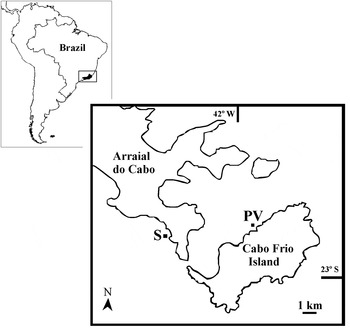
The study area is located in Arraial do Cabo (Rio de Janeiro, southeastern Brazil) between 22°58′ and 23°00′50″S and 41°57′40″ and 42°03′W (Figure 1). The local hydrology at Arraial do Cabo depends directly on meteorological conditions. The wind pattern is responsible for the distribution of water masses, which consist of the Brazil Current, the Coastal Water and the deep cold South Atlantic Central Water (SACW). Under the influence of prevailing east-northeast winds, the surface water flows to the open sea, allowing the deep water (approximately 300 m) to ascend. Upon entering the euphotic layer, this cold, deep water (SACW), with temperatures below 18°C and nitrate concentrations about 10 µg-at l−1, influences the structure of the tropical coastal ecosystem. This common pattern is inverted during the passage of cold fronts from the south. There are two main austral seasons: spring–summer, with prevailing winds favourable to upwelling, and autumn–winter, with the frequent passage of cold polar fronts and rapid changes in wind patterns unfavourable to upwelling. Despite its primarily seasonal nature, with higher frequency of occurrence in spring–summer, upwelling events are not restricted to this period and occur sporadically when the winds are favourable (Valentin, Reference Valentin1984; Valentin et al., Reference Valentin, André and Jacob1987).
Map of study area showing sample station ‘S’ at Sonar (located in Pontal do Atalaia) and ‘PV’ at Pedra Vermelha (located on Cabo Frio Island) in Arraial do Cabo, southeastern Brazil.

In this region, upwelling is characterized by the occurrence of a local phytoplankton bloom near the coast (above 6 µg Chl-a l−1) with a duration of less than 24 hours. Although the amount of chlorophyll produced is small in comparison to other regions, it is considered high for a tropical region and supports the local food chain as well as important fishery activities (Valentin & Coutinho, Reference Valentin and Coutinho1990).
For the present study, two rocky shore sampling stations in Arraial do Cabo were chosen: Sonar and Pedra Vermelha (Figure 1). Sonar is located in the main area of upwelling occurrence in the outer portion of the Pontal do Atalaia. It has a high degree of declivity, with about 10 m in length from surface to bottom (maximal depth of 8 m), and high exposure to waves and winds. Pedra Vermelha is located in the inner portion of Cabo Frio Island and is a sheltered location, with a lower impact from the upwelling. This shore has a rocky slope about 25 m long from top to bottom and its maximal depth is also 8 m. At both shores the composition of epilithic algae turfs in depths extending to 2 m are dominated by Jania spp. and Amphiroa sp. with other species such as Centroceras clavulatum, Ceramium spp., Polysiphonia spp. and Cladophora spp. occurring with lower frequency.
Sampling and sample processing
Weekly data of surface water temperature and nitrate collected at Pedra Vermelha rocky shore over a two-month period prior to the meiofauna sampling (data provided by the Instituto de Estudos do Mar Almirante Paulo Moreira) were used to characterize upwelling seasonality in the area.
At Pedra Vermelha, samples were taken in March (spring–summer, season with greater frequency of upwelling events) and September 2002 (autumn–winter season, when upwelling rarely occurs). At Sonar, samples were taken in January (spring–summer season) and June 2004 (autumn–winter season). At both rocky shores, samples were collected at high tide in depths extending to 2 m. Four replicates were performed for each rocky shore and season by SCUBA diving. The collection method consisted of scraping the substrate with the aid of acrylic bottles, gathering the epilithic algae and trapped sediment.
Meiofauna samples were washed with filtered tap water through geological sieves with mesh sizes of 0.5 mm and 0.044 mm. The meiofauna retained between sieves was fixed in 4% formalin. Under stereomicroscope, fifty individuals of Copepoda Harpacticoida were selected from each replicate, when available, and placed in Eppendorf tubes with 70% alcohol. The identification of Copepoda Harpacticoida was performed under optical microscope following the taxonomic keys of Lang (Reference Lang1948, Reference Lang1965), Huys et al. (Reference Huys, Gee, More, Hammond, Barnes and Crothers1996) and Wells (Reference Wells2007) as well as publications with specific descriptions.
Statistical analysis
Statistical analysis was based on the methods proposed by Clarke & Warwick (Reference Clarke and Warwick1994) using the Primer® 5 program (Plymouth Routines in Multivariate Ecological Research). The Shannon–Wiener (H′, using log2), Pielou's evenness (J′), rarefaction ES(50) and species richness indices were calculated. Two-way analysis of variance (ANOVA) was used to determine significant differences for calculated ES(50) values both between shores and seasons. Bartlett's test was used to determine the homogeneity of variances. The Bray–Curtis measure was applied to standardized data to assess the similarity between replicates, since the samples were semi-quantitative. Multi-dimensional scaling (MDS) was used to represent the similarity matrix. Two-way analysis of similarity (ANOSIM) was used to determine significant differences in the structure of the Copepoda Harpacticoida assemblage between the two rocky shores and sampling seasons. Similarity percentage (SIMPER) analysis was applied to determine which species were responsible for the similarities within rocky shores/seasons and dissimilarities between rocky shores/seasons. The t-test was used to determine whether dissimilarities between seasons are more important at Pedra Vermelha or Sonar. This test was also used to determine whether the heterogeneity between replicates of the same rocky shore is more pronounced in spring–summer (upwelling season) or autumn–winter (sporadic upwelling events). The Mann–Whitney test was used to determine differences in nitrate values between seasons. Considering that the upwelling effect over surface temperature variable affected mainly its variance, an F test was used to determine differences between seasons. The level of significance was set at P < 0.05 for all analyses.
RESULTS
Coastal upwelling characterization
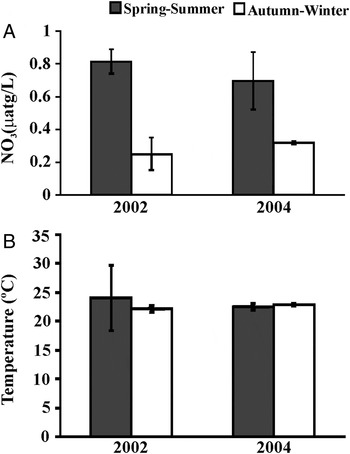
Upwelling events were characterized by an increased concentration of nitrate in the surface water two months prior to sampling in March 2002 and January 2004 (spring and summer, respectively). There were significantly higher mean nitrate values in the periods preceding the samplings in March 2002 than those obtained in the periods preceding the samplings in September 2002 (U = 2.75, P < 0.01). The same pattern was observed in 2004, with significantly higher mean nitrate values in the periods preceding the samplings in January 2004 than those obtained in the periods preceding the samplings in June 2004 (U = 2.59, P < 0.01) (Figure 2A). Mean surface water temperature obtained from weekly measurements two months prior to the samplings demonstrated no apparent difference between spring–summer and autumn–winter averages (Figure 2B). However, the variance in temperature (s2 = 5.6) in the period with a higher incidence of upwelling was higher than the variance (s2 = 0.6) in the period with sporadic upwelling in 2002 (F7,8 = 9.33, P < 0.01); no significant difference was found among variances in 2004. These data clearly indicate that the upwelling events were stronger during 2002 compared to 2004.
Weekly nitrate (A) and surface water temperature (B) measurements (mean ± variance) of two months prior to meiofauna samplings in 2002 and 2004 in Arraial do Cabo, southeastern Brazil.

Copepoda Harpacticoida composition
A total of 700 individuals of Harpacticoida copepods were analysed, 80% of which were identified at species level. The remaining 20% were copepodites, malformed or broken animals, for which the determination of species was not possible.
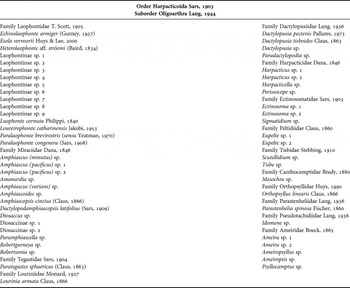
Fourteen families, thirty-six genera and fifty-six different species were recorded for Arraial do Cabo (Table 1). A review of the literature (Reid, Reference Reid and Young1998; Kihara, Reference Kihara2003; Vasconcelos, Reference Vasconcelos2008; Wandeness, Reference Wandeness2009) indicates that nine of the 36 genera found in this study and the Amphiascus species group pacificus are reported for the first time for Brazil: Ameiropsyllus Bodin, 1979, Amphiascopsis Gurney, 1927, Psyllocamptus T. Scott, 1899, Ameiropsis Sars, 1907, Dactylopodamphiascopsis Lang, 1944, Idomene Philippi, 1843, Harpacticella Sars, 1908, Eupelte Claus, 1860 and Perissocope Brady, 1910.
List of Copepoda Harpacticoida species identified in the phytal environment of Arraial do Cabo, southeastern Brazil.

The dominant families in the study area were Miraciidae (21%), Parastenheliidae (15%), Ameiridae (13%) and Laophontidae (13%). Laophontidae had the highest number of species. The species of highest relative abundance were Parastenhelia spinosa (15.2%), Orthopsyllus linearis (10.3%), Ameira sp. 2 (9.8%), Amonardia sp. (5.8%), Paralaophonte congenera (5.6%) and Ectinosoma sp.1 (5.5%).
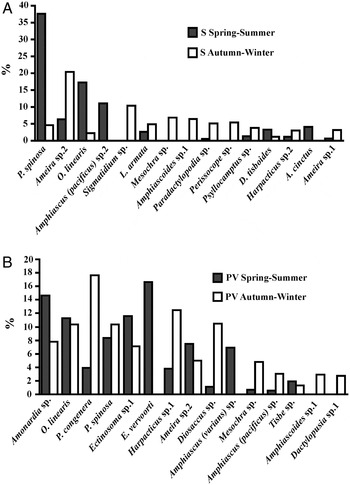
Considering the rocky shores separately, the species with the highest relative abundance at Pedra Vermelha were Amonardia sp., Orthopsyllus linearis, Paralaophonte congenera, Parastenhelia spinosa, Ectinosoma sp. 1, Esola vervoorti and Harpacticus sp. 1. At Sonar, three species dominated the assemblage: Parastenhelia spinosa, Ameira sp. 2 and Orthopsyllus linearis (Figure 3).
Relative abundance (%) of dominant species of Harpacticoida at (A) Sonar (S) and (B) Pedra Vermelha (PV) according to sampling season (spring–summer and autumn–winter) in Arraial do Cabo, southeastern Brazil.

Harpacticoida community structure variation
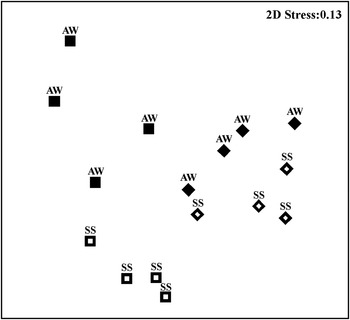
The Copepoda Harpacticoida assemblage for both rocky shores of Arraial do Cabo had high values of species richness (32 species at Pedra Vermelha, 39 at Sonar; total of 56 for the region), evenness (0.78 for Sonar, 0.81 for Pedra Vermelha; overall equitability = 0.79) and diversity (4.04 for Pedra Vermelha, 4.15 for Sonar; overall diversity = 4.56). ANOVA found no significant differences in ES(50) values between rocky shores (mean values being 11.88 for both shores), seasons or the interaction between these factors (P > 0.05). The mean ES(50) value was 11.9 considering all replicates. The MDS ordination analysis (Figure 4) of the Copepoda Harpacticoida fauna revealed a clear separation between the rocky shores and sampling seasons.
Multidimensional scaling ordination between Pedra Vermelha (diamonds) and Sonar (squares) samples in spring–summer (SS) and autumn–winter (AW) in Arraial do Cabo, southeastern Brazil.

The pattern observed in the MDS ordination was confirmed by ANOSIM. Significant differences in the Copepoda Harpacticoida community structure were detected between rocky shores (Rglobal = 0.818, P < 0.001, number of permutations = 1225) and between seasons (Rglobal = 0.734, P < 0.001, number of permutations = 1225). The separation between spring–summer and autumn–winter was more evident at Sonar, with an average similarity of 18.5% between replicates from the two seasons, compared to an average of 35% for Pedra Vermelha (t = 5.06, P < 0.01). Although the separation between rocky shores in the MDS is clear for each season, the Bray–Curtis similarity values between replicates from the same rocky shore in the same sampling season indicate lower heterogeneity in spring–summer (average similarity = 51%) when compared to autumn–winter (36%) (t = 3.58, P = 0.002).
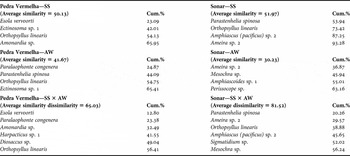
Table 2 displays the results of the SIMPER analysis, revealing Esola vervoorti (23.09%), Ectinosoma sp. 1 (18.92%) and Orthopsyllus linearis (12.11%) to be the species that most contributed to the similarity among replicates at Pedra Vermelha in spring–summer. On this same rocky shore during the season when upwelling is rare (autumn–winter), the species with the greatest contribution were Paralaophonte congenera (24.87%), Parastenhelia spinosa (19.22%) and Orthopsyllus linearis (10.66%). At Sonar, P. spinosa stood alone, contributing 53.94% of the average similarity among the replicates in spring–summer. In autumn–winter, Ameira sp. 2 (36.87%), Mesochra sp. (9.07%) and Amphiascoides sp. 1 (9.07%) were the most important species contributing to the similarity among replicates at Sonar.
Cumulative percentage (Cum.%) of species contribution to average similarity for Pedra Vermelha and Sonar rocky shores in spring–summer (SS) and autumn–winter (AW) in Arraial do Cabo, southeastern Brazil.

At Pedra Vermelha, Esola vervoorti (12.8%), Paralaophonte congenera (10.57%), Amonardia sp. (9.11%), Harpacticus sp. 1 (9.06%), Diosaccus sp. (7.49%) and Orthopsyllus linearis (7.38%) were the species that most contributed to the dissimilarity in the spring–summer versus autumn–winter replicates. At Sonar, the species that contributed most to the dissimilarity among replicates between seasons were Parastenhelia spinosa (20.26%), Ameira sp. 2 (9.32%), Orthopsyllus linearis (9.31%), Amphiascus (pacificus) sp. 2 (6.77%), Sigmatidium sp. (6.37%) and Mesochra sp. (4.22%) (Table 2).
DISCUSSION
Although Copepoda Harpacticoida is a very diverse group, it has not been the subject for detailed studies on the Brazilian coast until recently. Only 68 genera had been recorded by 1998 (Reid, Reference Reid and Young1998). While the number of monographic studies, mostly not published, on the taxonomy of this group has increased in recent years (Kihara, Reference Kihara2003; Vasconcelos, Reference Vasconcelos2008; Wandeness, Reference Wandeness2009), 25% of the total number of genera identified in the present study are new records for the Brazilian coast.
Although this paper is the first to address the Copepoda Harpacticoida assemblage on the species level in a phytal environment in Brazil, previous authors have cited the occurrence of this taxon on the genus level in a few phytal environments. Studying the meiofauna associated with the algae Sargassum cymosum on the Lázaro shore of the State of São Paulo, Curvêlo (Reference Curvêlo1998) reports the genera Harpacticus, Scutellidium, Amphiascus and Ectinosoma as the main representatives of the order Harpacticoida. Jakobi (Reference Jakobi1953) found numerous individuals of the genera Harpacticus, Parastenhelia and Paralaophonte in seaweed on the Itapocorói and Porto Belo beaches in the State of Santa Catarina. The Harpacticoida fauna found in the phytal environment of Arraial do Cabo was also similar in terms of genera to that reported by other authors in different parts of the world, such as Ria Deseado, Argentina (Pallares, Reference Pallares1968), Ashtamudi in India (Arunachalam & Nair, Reference Arunachalam and Nair1988), Cook Strait (Hicks, Reference Hicks1977b), Wellington (Hicks, Reference Hicks1986) and Island Bay (Coull & Wells, Reference Coull and Wells1983) in New Zealand, Robin Hood's Bay and St Abbs in England (Hicks, Reference Hicks1980), South Carolina (Coull et al., Reference Coull, Creed, Eskin, Montagna, Palmer and Wells1983) and Florida (Walters & Bell, Reference Walters and Bell1994) in the USA, British Columbia in Canada (Webb & Parsons, Reference Webb and Parsons1992) and Port Phillip Bay in Australia (Jenkins et al., Reference Jenkins, Walker-Smith and Hamer2002).
The term ‘isocommunity’ was first proposed by Thorson (1957 cited in Por, Reference Por1964) for macrofauna. The concept of isocommunity or parallel ecological communities suggests that similar substrates, although geographically separated, are inhabited or colonized by the same set of dominant genera, although the species composition may vary between sites. Por (Reference Por1964) concluded that this hypothesis was even more pronounced on the meiofauna level although Gheskiere et al. (Reference Gheskiere, Vincx, Urban-Malinga, Rossano, Scapini and Degraer2005) studying the Nematoda community of sandy beaches suggested that the concept of parallel ecological communities is only supported for the upper beach zones. This concept was suggested by Hicks (Reference Hicks1977b, Reference Hicks1980) as being applicable to Copepoda Harpacticoida communities in the phytal environment. Thus, the Harpacticoida community in Arraial do Cabo, compared to that of other locations in Brazil and regions of the world, reinforces the hypothesis of geographical parallelism or isocommunities for the phytal environment. The presence of a large number of cosmopolitan species with high relative abundance (38% of total individuals) in this study should be stressed, with Orthopsyllus linearis, Dactylopusia tisboides, Laophonte cornuta, Parategastes sphaericus, Paralaophonte brevirostris and Paralaophonte congenera standing out. These species have been cited as having considerable morphological variation or likely to belong to a complex of species with as yet unresolved taxonomy (see Wells (Reference Wells2007) for comments on the taxonomy of these species).
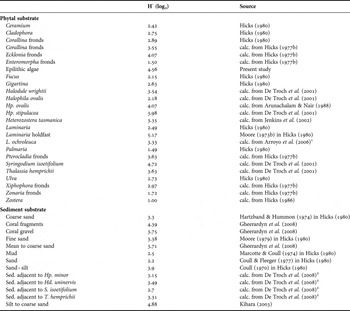
The high degree of species richness and evenness for Copepoda Harpacticoida in Arraial do Cabo is reflected in the diversity value (H′ = 4.56 bits), which is higher than most diversity values reported for the phytal environment (Hicks, Reference Hicks1980 and values calculated from Hicks, Reference Hicks1977b) as well as most of those found in sediments in other coastal environments (Hicks, Reference Hicks1980; Kihara, Reference Kihara2003; Gheerardyn et al., Reference Gheerardyn, De Troch, Ndaro, Raes, Vincx and Vanreusel2008). Table 3 displays the maximal diversity values (H′ log2) calculated for Copepoda Harpacticoida species in different phytal and sedimentary substrates available in the literature.
Maximal diversity values (H′ log2) calculated for Copepoda Harpacticoida assemblages on phytal and sedimentary substrates available in the literature (Sed., sediment; calc., calculated).

1, values calculated for species of Thalestridae, 2, value calculated for identification to the genus level.
The results displayed in Table 3 reveal that phytal environments have diversity indices similar to those of other coastal environments. As suggested by Huys et al. (Reference Huys, Gee, More, Hammond, Barnes and Crothers1996), some of the highest diversity values were obtained from phytal samples including the associated sediment (Laminaria holdfast and epilithic algae). However, the other two highest values were obtained in infralittoral sediment (sandy sediments and coral fragments). The value from Kihara (Reference Kihara2003) was obtained at a number of stations with a large variation of sediment texture (stations with the dominant sediment class ranging from silt to coarse sand), which may explain the high diversity. Gheerardyn et al. (Reference Gheerardyn, De Troch, Ndaro, Raes, Vincx and Vanreusel2008) classified the Harpacticoida fauna associated with coral fragments as mainly composed of genera typically found in phytal assemblages. Similarly to what occurs with the fauna on holdfasts of macroalgae, ‘the sediment trapped by coral fragments may provide a microhabitat for sediment-dwellers, while the complex microtopography of the coral branches may be a suitable substratum for true epibenthic or even “phytal” harpacticoids’.
The composition of the epilithic algae tufts at the two rocky shores of Arraial do Cabo has a great abundance of Jania sp. and Amphiroa sp., both of which are calcareous articulated algae, with erect, well-branched stems that can hold the sediment and provide a structurally complex habitat for Harpacticoida fauna. According to Hicks (Reference Hicks, Moore and Seed1985), areas in which algal cover is performed by different species and large amounts of filamentous epiphytes have much greater spatial heterogeneity when compared with most homogeneous and monospecific areas. In these complex environments, the different microhabitats favour the establishment of animals with different habits and/or morphological adaptations, which can thus coexist, foraging different niches in the seaweed. This, in turn, allows a greater distribution of food sources and a loss of competitive interactions, with the consequent establishment of rich, diverse Copepoda Harpacticoida fauna (Hicks, Reference Hicks1977b; Arroyo et al., Reference Arroyo, Maldonado and Walters2006). In Arraial do Cabo, the high diversity values were due to the strong spatial heterogeneity and structural complexity of epilithic algae that cover the Sonar and Pedra Vermelha rocky shores.
Although the rocky shores sampled in this study differ in wave exposure and slope, the indices of diversity, richness and evenness calculated separately for each shore were similar and the ANOVA was unable to detect significant differences between rocky shores or seasons for ES(50) values. These results indicate that univariate indices were not sensitive enough to detect differences between the shores or seasons. This result contrasts with that reported by Toefy et al. (Reference Toefy, McMillan and Gibbons2003) studying Foraminifera associated with Gelidium pristoides in False Bay, South Africa, who found greater species abundance and diversity in the exposed area, where the algae had a larger size and more trapped sediment in comparison to the fauna at the sheltered beach. However, it should be stressed that the more exposed shore in the present study had a higher total number of species than the sheltered shore.
Unlike the univariate indices, the ANOSIM revealed significant differences in the Harpacticoida assemblage between the two rocky shores of Arraial do Cabo. This result contrasts with the finding described by Somerfield & Jeal (Reference Somerfield and Jeal1995), who studied Halacaridae on rocky shores in Ireland and noted that, although the alga and barnacle community available as substrate was different between exposed and sheltered beaches, the association of Halacaridae was similar.
The difference between the rocky shores in Arraial do Cabo may be related to physical differences, such as slope and wave exposure, or to the fact that the rocky shores are located in areas with different degrees of exposure to upwelling events. While the entire region of Arraial do Cabo is influenced by coastal upwelling, the effect of this phenomenon is significantly stronger at Sonar than Pedra Vermelha (Guimaraens & Coutinho, Reference Guimaraens and Coutinho1996). This may be explained by the fact that Sonar is located in the outer portion of the Pontal do Atalaia, which is the main area of upwelling, whereas Pedra Vermelha is located on Cabo Frio Island and is sheltered, thereby it experiences less intense effects of upwelling. In Arraial do Cabo, Guimaraens & Coutinho (Reference Guimaraens and Coutinho1996) found distinct phytal communities during upwelling events, with a correlation between the gradient of upwelling intensity (areas with greater or lesser exposure to this phenomenon) and flora distribution. The benthic flora survey recorded elements with warm temperate affinities predominant in the summer at Sonar and algae with tropical affinities in more sheltered areas (such as Pedra Vermelha). Changes of the benthic flora affect the meiobenthic harpacticoids composition since there is a close relationship among both associations (Hicks, Reference Hicks1977b). Moreover, exposure differences between both rocky shores may also affect both the phytal substrate and the meiofaunal association as was earlier observed by Dommasnes (Reference Dommasnes1968) and Gibbons (Reference Gibbons1988). Among the species with the highest relative abundance in the present Harpacticoida assemblage, Esola vervoorti and Diosaccus sp. occur only at Pedra Vermelha, while Amphiascus (pacificus) sp. 2, Sigmatidium sp. and Lourinia armata were unique to Sonar. Among these species, Esola vervoorti and Amphiascus (pacificus) sp. 2 occurred only in spring–summer and Sigmatidium sp. and Amphiascoides sp. 1 occurred only in samples collected in autumn–winter.
On both rocky shores, there was a significant change in species composition from autumn–winter (period of sporadic upwelling) to spring–summer (period of intense upwelling). This pattern was especially pronounced on Sonar, the rocky shore more exposed to upwelling although samplings on this shore occurred during 2004, a year with weaker upwelling events according to both the surface water temperature and nitrate data that denote stronger upwelling in 2002 (Pedra Vermelha samplings). At Sonar in autumn–winter, the species Ameira sp. 2, Mesochra sp. and Amphiascoides sp. 1 together accounted for 55% of the average similarity between replicates. This percentage changed strongly in spring–summer, with Parastenhelia spinosa alone accounting for approximately 54% of average similarity. The association between upwelling enrichment with benthic communities dominated by opportunistic species has been suggested. Studying the macrofauna community on the Galician coast of northwestern Spain, Lopez-Jamar et al. (Reference López-Jamar, Cal, González, Hanson, Rey, Santiago and Tenore1992) found that enrichment from upwelling production reaches the seabed in pulses and, thus, benthic organisms (mainly small surface detritus-feeding polychaetes) are specialized in exploiting such irregular events. Studying the benthos in southeastern Brazil, De Léo & Pires-Vanin (Reference De Léo and Pires-Vanin2006) suggest that megabenthic community distribution in this region is closely linked to the seasonality of the SACW thermal front, with abrupt changes in species composition and the dominance of key species. This was found to be especially true for Cabo Frio, where a high dominance of top carnivore species, such as the crustacean Portunus spinicarpus and the sea-star Astropecten brasiliensis occurs during upwelling events (spring–summer 2002). In a study carried out on the sediment of the inner part of Cabo Frio Island, Fonsêca-Genevois et al. (Reference Fonsêca-Genevois, Santos, Castro, Botelho, Almeida and Coutinho2004) found differences in the dominance of Nematoda genera among samples from winter (September–October), dominated by Pseudosteineria, and summer (March), dominated by Viscosia. Unlike the present study and the above examples indicating a strong effect from periodicity or upwelling intensity on faunal changes, Kelaher & Castilla (Reference Kelaher and Castilla2005) studied macrofaunal assemblages in coralline algal turf on seven rocky shores in northern Chile and found that there were no patterns to suggest that mesoscale variation in upwelling intensity affects either faunal assemblages or local habitat characteristics. Nevertheless, the assemblages varied significantly between shores due to differences in the complexity and heterogeneity of the habitat structure, which have greater influence on faunal assemblages in mat-like habitats on rocky shores than environmental variables associated with mesoscale coastal upwelling.
The considerable variation in physicochemical conditions associated with upwelling (temperature reduction and increase in the concentration of nutrients) and the resulting unidirectional modification in phytal communities (Guimaraens & Coutinho, Reference Guimaraens and Coutinho1996) may favour the dominance of species adapted to such conditions, as seems be the case with Parastenhelia spinosa. Upwelling is suggested as the main factor contributing to the stronger temporal dissimilarity at Sonar, thereby confirming the initial hypothesis that the Harpacticoida assemblage at the rocky shore more affected by upwelling exhibits greater variation between spring–summer and autumn–winter samples.
The peculiar hydrological characteristics of upwelling sites determine important ecological changes in benthic communities (Guimaraens & Coutinho, Reference Guimaraens and Coutinho1996; De Léo & Pires-Vanin, Reference De Léo and Pires-Vanin2006; Lastra et al., Reference Lastra, La Huz, Sanchez-Mata, Rodil, Aerts, Beloso and Lopez2006) and allow the occurrence of a more diverse fauna in comparison to that of areas in which this phenomenon does not occur (Le Loeuff & Cosel, Reference Le Loeuff and Cosel1998; Machado et al., Reference Machado, Coimbra and Carreño2005). As suggested by Witman & Smith (Reference Witman and Smith2003), due to these characteristics, upwelling areas warrant special attention in the planning of marine reserves to ensure the conservation of biodiversity.
ACKNOWLEDGEMENTS
The authors thank IEAPM for supplying the abiotic data. P.J.P. Santos acknowledges a research fellowship (305609/2004-1) and V.C. Sarmento an MSc scholarship from CNPq. L.M. Lage acknowledges an MSc scholarship from CAPES. Thanks are also due to Mr Richard Boike for the English revision. Thanks are also due to anonymous referees for providing comments that improved the manuscript.