The timing of flowering and fruiting plays a critical role in plant ecology, influencing community structure and plant–animal interactions (Rathcke & Lacey Reference RATHCKE and LACEY1985). Phenological analyses are important tools to predict plant community response to climate change and consequences for ecosystem processes (Singh & Kushwaha Reference SINGH and KUSHWAHA2005). However, studies examining the link between flowering and inter-annual climatic variation tend to focus on temperate species (Ågren Reference ÅGREN1988, Inouye Reference INOUYE2008, Kudo & Hirao Reference KUDO and HIRAO2006). While not a strict dichotomy, water availability triggers flowering in many tropical species (Borchert Reference BORCHERT1994, Bullock & Solis-Magallanes Reference BULLOCK and SOLIS-MAGALLANES1990), and temperate plants often flower in response to photoperiod and temperature (Hülber et al. Reference HÜLBER, WINKLER and GRABHERR2010).
Habitat can also affect phenological strategies of plants (Croat Reference CROAT1975). Temporal patterns in phenology have been shown to differ between savanna ecotone and forest habitats (Wallace & Painter Reference WALLACE and PAINTER2002). Soil moisture in open and closed habitats can differ, influencing reproductive patterns of plants (Bazzaz Reference BAZZAZ1979). Thus, understanding phenology of broadly distributed species in savanna and forest can help explain distribution patterns of these species, as well as structure of the entire community.
The dioecious palm, Mauritia flexuosa L.f. (Arecaceae) is the most widespread palm in South America (Goulding & Smith Reference GOULDING and SMITH2007), occurring in savanna, forest and ecotone habitats. This keystone species provides critical food and habitat for vertebrates (Brightsmith Reference BRIGHTSMITH2005, Tobler et al. Reference TOBLER, JANOVEC and CORNEJO2010). Despite its ecological importance, little is known about the relationship between phenology, habitat and seasonality of M. flexuosa. To understand, and perhaps predict, regeneration patterns of this ubiquitous palm, we must determine the relationships between habitat, precipitation and phenological events.
We studied the phenology of M. flexuosa in two native habitats of Roraima, northern Brazilian Amazonia: undisturbed, lowland savanna/forest ecotone (hereafter referred to as savanna) and undisturbed, lowland semi-deciduous forest (hereafter referred to as forest). Three hypotheses were tested: (1) male to female sex ratios are equal in each habitat; (2) the onset and termination of flowering differ between habitats; and (3) flowering and fruiting are seasonal, and correlated with precipitation.
Fieldwork was conducted from March 2009 to March 2011 in Maracá Ecological Reserve (1035 km2) (3°21.21′N, 61°25.47′W). This tropical wet-dry region, Aw (Köppen Reference KÖPPEN, Köppen and Geiger1936), has an average annual rainfall of 1614 mm, with a rainy season (May–September) and a dry season (December–March). Field observations and experiments were conducted in two sites per habitat.
Mauritia flexuosa (Arecaceae) is a solitary, dioecious palm reaching heights of 40 m. Staminate flowers of this anemophilous palm offer copious amounts of dry pollen, but pistillate flowers offer no reward. Both staminate and pistillate flowers open continuously, with individual flowers lasting a maximum of 5 d, and an inflorescence less than 1 wk. Fruits of M. flexuosa are globose and scaly, measuring 4–6 cm by 3–5 cm, and usually one-seeded (Khorsand Rosa & Koptur Reference KHORSAND ROSA and KOPTUR2013).
At each of the four sites, all M. flexuosa individuals were tagged for sampling within a 200 × 20-m transect. Sample size varied between habitats, representative of the natural variability of plant distribution within sites and habitats (undisturbed forest sites: N = 45, N = 57; undisturbed savanna sites: N = 64, N = 80).
Sex was determined, and 20 monthly phenological observations were made on marked individuals in each of the four sites. We recorded the number of inflorescences/infructescences on each individual, categorizing the developmental stages of flowers and fruits. Percentages of flowering individuals and fruiting females in each habitat were calculated for each month.
A test of independence was employed to determine if a relationship existed between sex and habitat type. Chi-square goodness-of-fit tests were used to compare the male-to-female ratio in each habitat with the expected 1 : 1.
To obtain the monthly proportion of flowering or fruiting individuals in each habitat, we divided the number of individuals in that phenophase by the total sample size (non-flowering individuals were excluded). Flowering and fruiting curves were created, representing the monthly proportion of flowering and fruiting individuals (%) in each habitat. To determine the relationship between yearly flowering (or fruiting) and precipitation, Spearman's Rank correlations were conducted on the monthly proportion of flowering (or fruiting) individuals and mean monthly precipitation. Precipitation means for 2009–2011 were acquired from the National Institute for Spatial Research (INPE).
The relationship between flowering (or fruiting) and previous precipitation events was quantified by conducting Spearman's Rank correlations between the monthly proportion of flowering (or fruiting) individuals and the following time lags in mean precipitation: 7 d, 15 d, 1 mo, 2 mo, 3 mo and 6 mo prior to the flowering event. Correlations were separated by year.
Kruskal–Wallis tests were performed to determine if the onset and termination of flowering (defined as the earliest/latest DOY on which we observed any degree of flowering in at least 5% of the population) in males and females differed significantly between habitats. Kruskal–Wallis tests were also used to determine if the mean number of inflorescences differed significantly between sexes, habitats and years.
Non-parametric tests were performed after unsuccessful attempts to transform the non-normally distributed data, and Holm's Sequential Bonferroni correction was applied to all pair-wise comparisons to control for type I error. All statistical analyses were performed in IBM SPSS Statistics version 19 (SPSS, Chicago, Illinois, USA).
We found a female bias in both habitats (81 males : 119 females), deviating significantly from the expected 1 : 1 (χ21 = 7.22, P = 0.007). However, when habitats were considered separately, the ratio of males to females was significantly different from equality only in the savanna sites (χ21 = 7.91, P = 0.005), and we found no relationship between habitat and sex (χ21 = 1.40, P > 0. 05). Nearly all (> 98%) of the 119 flowering females set fruit.
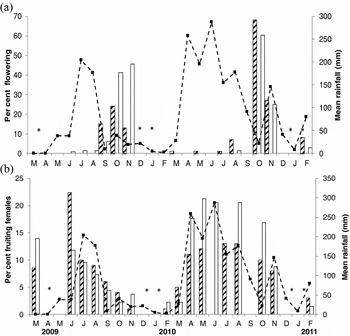
In both habitats, flowering occurred at the wet/dry season interface, from August to November (Figure 1a). Inflorescence development took 1.7–3.7 mo (mean ± SE = 2.06 ± 0.49). Neither the onset nor termination of flowering differed significantly between habitats in either year (Onset Yr. 1: χ21 = 2.40, P > 0. 05; Yr.2: χ21 = 2.67, P > 0. 05; Termination Yr. 1: χ21 = 2.40, P > 0. 05; Yr. 2: χ21 = 0.17, P > 0. 05). Precipitation and flowering were not correlated the first year (rs = 0.37, P > 0.05), but negatively correlated the second year (rs = −0.71, P = 0.03). A positive correlation was detected between flowering and a time-lag in precipitation of 3 mo during both years (Yr. 1: rs = 0.82, P = 0.01; Yr. 2: rs = 0.66, P = 0.05). No correlation was found between flowering and each of the other time lags, however (7 d, 15 d, 1 mo, 2 mo, 6 mo).
Flowering and fruiting of Mauritia flexuosa from March 2009 to February 2011, in Roraima, Brazil. Percentage of all individuals flowering (a); percentage of females with ripe fruit (b). Hatched bars represent savanna and white bars represent forest; dotted line represents mean precipitation (mm); asterisks indicate no data.

Fruits were initiated at the beginning of the dry season, and fruit maturation occurred during the wet season, the whole process lasting 8–12 mo. We counted most ripe fruits during the rainy season. In both habitats, the peak dry season (November–February) had high numbers of unripe fruits and low numbers of ripe fruits (Figure 1b). Precipitation and ripe fruits were positively correlated, although significant only during the second year (rs = 0.83, P < 0.01). We found no significant relationship between ripe fruits and any of the time lags (7 d, 15 d, 1 mo, 2 mo, 3 mo, 6 mo) during either study year.
Flowering was synchronized between sexes, and there was no difference in the date of flowering between sexes (Yr. 1: χ21 = 0.77, P > 0.05; Yr. 2: χ21 = 0.54, P > 0.05). One-fifth of females flowered in both years of the study. Males did not produce significantly more inflorescences than females (Yr. 1: χ21 = 0.003, P > 0.05; Yr. 2: χ21 = 1.53, P > 0.05). The mean number of inflorescences was significantly greater in the savanna than in the forest during the second year only (χ21 = 6.85, P = 0.009). Inflorescence production significantly increased during the second year in the savanna habitat (χ21 = 9.55, P = 0.002), but not in the forest habitat.
Dioecy is associated with obligate outcrossing and variation in spatial distribution of resources, so we expected sex ratios in dioecious species to be equal, or favouring the longer-dispersing sex, males (Bawa Reference BAWA1980). Earlier studies of Mauritia flexuosa have suggested male-biased (Horn et al. Reference HORN, GILMORE and ENDRESS2012) or equal sex ratios (Urrego Giraldo Reference URREGO GIRALDO1987). Selective felling of females for fruit may cause male-biased ratios. Female-biased sex ratios that we observed in the savanna habitat differ from previous reports and our initial hypothesis. Neither harvesting of fruits nor felling of trees had occurred in the four sites we sampled.
Spatial segregation of the sexes (SSS) has been reported in dioecious, wind-pollinated species (Doust et al. Reference DOUST, EL-KEBLAWY, FREEMAN, MCARTHUR and MIGLIA1997). Females generally have higher resource requirements, so SSS and female-biased ratios should occur in resource-rich micro-habitats (Bertiller et al. Reference BERTILLER, SAIN, BISIGATO, CORONATO, ARES and GRAFF2002). Wind-pollinated Mauritia flexuosa may demonstrate SSS, potentially explained by patchy resource distribution. In the forest habitat, where seedlings face competition for space and light, females may not have a selective advantage over males. In the savanna habitat, light and space are less limiting, permitting female dominance. We found a significant deviation from equality only in the savanna habitat, where 26% of the population's sex remained undetermined. This topic warrants further investigation.
In a dioecious species, such as Mauritia flexuosa, some degree of overlap in flowering between sexes is necessary to ensure that males can secure mates (Bateman Reference BATEMAN1948); our data support this hypothesis. Synchronous flowering in dioecious, wind-pollinated species may be a strategy to maximize reproductive assurance (Friedman & Barrett Reference FRIEDMAN and BARRETT2009). Contrary to previous reports (Storti Reference STORTI1993) and anecdotal data, females can flower every year, also maximizing reproductive assurance. In addition, 98% of females set fruit, suggesting an absence of pollen limitation (Khorsand Rosa & Koptur Reference KHORSAND ROSA and KOPTUR2013).
El Niño Southern Oscillation (ENSO) events play a pivotal role in inter-annual climatic variation in northern Amazonia, causing temperature increase and decreased rainfall (Li et al. Reference LI, ZHANG, YE, LI and BAKER2011); ecotonal habitats are especially responsive to seasonal variation (Mayle et al. Reference MAYLE, LANGSTROTH, FISHER and MEIR2007). The abnormally wet rainy season following the ENSO year may have provided the seasonally dry, ecotonal savanna populations with resources necessary to increase reproductive growth, whereas forest soil moisture remained relatively constant (Hoffmann & Franco Reference HOFFMANN and FRANCO2003).
In contrast to many species which flower during the dry or wet season (Bawa et al. Reference BAWA, KANG and GRAYUM2003), flowering of Mauritia flexuosa peaks at the wet/dry interface, when floodwaters recede. The extremely wet conditions of the rainy season and extremely dry conditions of the dry season may stress this species. The juncture between these two extremes, when floodwaters recede and oxygen is restored to the roots, may be the optimal time for reproductive investment. Flowering may not just be explained by present abiotic conditions, however; flowering may also be a delayed response to rainfall. The passage of the rainy season, 3 mo prior to the flowering season, appears to be a major determinant of flowering in M. flexuosa. In tropical dry forest trees, McLaren & McDonald (Reference MCLAREN and MCDONALD2005) also observed a significant increase in flowering 3 mo after the peak rainy season, suggesting that the passage of the rainy season, not just rainfall, determined flowering.
Irradiance and flowering are positively correlated (Hamann Reference HAMANN2004). Roraima lies just north of the equator, with a peak dry season associated with low cloud cover and the highest number of irradiance hours (Barbosa et al. Reference BARBOSA, MOURÃO, CASADIO and SILVA2012). Insufficient resources during the peak dry season may prevent flowering, but the wet/dry season transition, when M. flexuosa still has access to resource reserves from the wet season and increasing hours of cloudless days of the dry season, may be the ideal time for flowering. Decreased rainfall and increased wind associated with the wet/dry transition may also improve the likelihood of successful wind pollination.
Fruit availability peaks during the wet season in other Amazonian flooded-forest species, aiding in seed dispersal and germination (Haugaasen & Peres Reference HAUGAASEN and PERES2005). Fruit development should occur during the dry season, when cloudiness is at its lowest, and fruit maturation should occur during the wet season, when seed germination conditions are optimal. Temperature may also play a role in germination of M. flexuosa seeds; Spera et al. (Reference SPERA, CUNHA and TEIXEIRA2001) found seed viability decreased when exposed to temperatures of 30 °C or higher. Increased humidity and lower temperatures, brought on by the rainy season, may provide the optimal conditions for seed germination in this species.
Our results show that sex ratios in M. flexuosa are female-biased, and flowering is seasonal, occurring during the transition from wet to dry season, with fruit maturation occurring during the wet season. Males and females flower synchronously, and the onset and termination of flowering do not differ between habitats. Flowering is negatively associated with present precipitation and positively correlated with prior precipitation. Fruiting is positively associated with present precipitation and unrelated to prior precipitation. Contrary to expectation, habitat does not significantly affect phenology of this species in northern Amazonia. Our data suggest that short-term climatic variation, however, may influence flowering and fruiting patterns. Phenological response to climate variation will have implications for distribution patterns and conservation of this keystone species.
ACKNOWLEDGEMENTS
Access was granted by the Brazilian Ministry of the Environment (MMA). Funding was from National Science Foundation (0906083), Fulbright-Hayes Commission, and Florida International University. We thank F. Guedes, I. S. Firmino, S. Pedro, N. M. Rosa, E. F. da Silva and R. P. de Souza for field assistance; Chico Mendes Biodiversity Institute (ICMBio) and National Institute for Research in Amazonia (INPA) for logistical support; B. Barrios and P. Johnson for statistical assistance; and S. Zona for manuscript improvement. This is contribution number 249 to the Florida International University Program in Tropical Biology.