Military conflicts that expand are far deadlier than those that do not. While only 27 per cent of the wars between 1816 and 2007 expanded to include at least one additional state (that is, third party) after the war began; those wars were among the deadliest, accounting for 87 per cent of the fatalities across all of the wars during this time period. Given the extraordinary destruction that conflict expansion augurs, understanding third parties’ decisions to join ongoing conflicts is important. More specifically, it is crucial to understand when during a conflict third parties join and what side they join, since these decisions can dramatically affect the conflict's evolution and outcome. For example, the US decision to join the Allied Powers in World War I dramatically influenced the outcome of the war, as did the UK decision to join the conflict that became World War II. More recent conflicts, such as those in Afghanistan, Congo and Iraq, have also expanded to include additional states on one or both sides at different points in time. We argue that in order to explain the expansion of interstate disputes, it is necessary to understand when third parties join and what side they join – otherwise our understanding of conflict expansion will be limited, since our theories and analyses will lack information about key components of the conflict process. Moreover, understanding these decisions will improve our knowledge of the dynamic processes of conflicts more generally.
While extant research has identified several factors that influence third parties’ decisions to join ongoing disputes, few studies have examined how these factors influence the timing of third-party joining or how they might differ for joining the initiator of a dispute compared to joining the target. Most existing research examining the timing of third-party joining ignores which side a third party joined, and research that has examined the side of third-party joining has typically ignored the timing of that joining.Footnote 1 In this article we examine how these factors influence both the timing of third-party joining and the side they join during ongoing disputes.Footnote 2
We build on the opportunity and willingness framework, which has received considerable attention in the study of interstate conflict diffusion and in international relations (IR) research more broadly.Footnote 3 Although other perspectives could be used to study third-party intervention, such as bargaining or spatial diffusion models,Footnote 4 the opportunity and willingness framework seems appropriate as a first cut to examine the timing and side of third-party joining during ongoing disputes.Footnote 5 We expand this framework, originally presented in terms of alliances and contiguity, to include several additional factors that influence a third party's opportunity or willingness to join an ongoing dispute.
In addition to extending the opportunity and willingness framework, we build on existing conflict expansion research in two ways. First, we examine the timing of third-party joining. Militarized conflict is a dynamic process, and third-party joining has an important effect on the evolution of a conflict. In particular, a third party has the ability to influence the eventual outcome of a dispute by changing the probability that each initial belligerent will win. Additionally, the timing of third-party joining is important because it can influence the length of a dispute. For example, the entry of the United States into World Wars I and II decisively influenced their evolution – in particular their length and final outcome. In World War I, the United States joined after Germany had improved its military position and just prior to Russia's exit. In World War II, the United States joined after France exited and both the UK and the USSR were suffering on the battlefield.
The importance of timing has been recognized for quite some time in conflict expansion research. For example, Siverson and Starr note: ‘There is another related aspect of war diffusion that is of significance…What accounts for the variation in the length of time it took nations to join ongoing wars?’Footnote 6 However, very little research examines when and what side third parties join in ongoing disputes.Footnote 7
Secondly, we examine how the factors that purport to explain the timing of third-party joining might differ between joining the initiator of a dispute and joining the target. A third party's decisions about whether to join an ongoing conflict and what side it would join are not independent decisions. For example, after Germany invaded Poland in 1939, it is unlikely that the UK first decided whether to join the conflict and then decided whether it would align with Germany or Poland. The UK decision to join was not independent of its decision about which side to join. Extant conflict expansion research has also differentiated between joining the two sides in a dispute, but most existing research does not examine side selection alongside timing (an exception is Melin and Koch).Footnote 8
Our focus on side selection contributes to the growing body of political science research that focuses on context.Footnote 9 The initiators and targets of disputes provide the context that influences third parties’ decisions to join.Footnote 10 Our results show that without incorporating this context, the results obtained from statistical models can be misleading. Additionally, rather than separating third parties’ timing and side selection decisions, our empirical analysis models these interdependent decisions using a competing risks event history model.
Our theoretical arguments and empirical findings are directly relevant to several debates in IR: whether states respond to more powerful states by balancing against or bandwagoning with them, whether states fulfill their alliance obligations or not, whether states of the same regime type behave differently towards one another than states of different regime types (by aligning with states that have similar regimes), whether states respond to perceived threats by aligning against rivals, and whether geographically proximate states align with or against neighbours. There is extensive theoretical interest in each of these topics in IR, and conflict research in particular. We attempt to reconcile disparate findings in the conflict expansion literature that speak to these debates.
The article proceeds as follows. First, we discuss the opportunity and willingness framework. Secondly, we present our extensions to this framework and our hypotheses about how each factor influences the time until a third party joins the initiator or the target. Thirdly, we present our research design. Fourthly, we report the results of our analysis, which demonstrate the importance of distinguishing between joining the initiator and joining the target, and show that conflating these choices can lead to incorrect inferences. Finally, we discuss our contributions to the research on conflict expansion and IR more broadly, and point out specific avenues for future research.
Opportunity and willingness framework
The opportunity and willingness framework, developed by Starr and Most, who built on the research of Boulding as well as Sprout and Sprout, has been extensively used in international and civil conflict research.Footnote 11 For example, it has been used to examine a variety of topics including democratic peace theory and shared rivers and water scarcity.Footnote 12 One of the main approaches to the study of civil wars also uses this approach by focusing on feasibility and motivation. For example, Collier, Hoeffler and Rohner maintain that their ‘approach is to find proxies for each of the major perspectives: feasibility, and the two main variants of motivation, greed and grievance’.Footnote 13
Siverson and Starr conceptualize opportunity as the ‘degree of interaction’ or ‘interaction opportunity’, meaning that ‘some activity must at base be physically, technologically, or intellectually possible’.Footnote 14 In essence, ‘opportunity consists both of the possibilities that exist in the international system at any point in history (for example, technology, ideology, religion, social inventions such as new forms of government), and how those possibilities are distributed in the system’.Footnote 15
While opportunity concerns the possibility of militarized conflict, ‘willingness deals with the motivations and goals of policy makers, and the decision making processes that lead them to choose the “war” alternative rather than “no war”’.Footnote 16 Siverson and Starr elaborate on the concept to include ‘a decision maker's calculations of advantage and disadvantage, cost and benefit, considered on both conscious and unconscious levels. It is through willingness that decision makers recognize opportunities and then translate those opportunities into alternatives that are weighed in some manner’.Footnote 17
Two particularly relevant articles that use the opportunity and willingness framework to examine conflict expansion are Siverson and Starr and Werner and Lemke.Footnote 18 Siverson and Starr used this framework to examine the timing of joining ongoing interstate wars without considering which side is joined. They hypothesized that ‘the greater a nation's opportunities and willingness, the less time it will take that nation to become involved in the war’.Footnote 19 Furthermore, among the opportunity variables, they expected states with direct contiguity to join sooner than those with cross-water and colonial borders. Among the willingness variables, they expected states with defence pacts to join earliest, followed by those with neutrality pacts and ententes, as they ‘view these types of alliance commitments as forming a rough ordinal index of willingness’.Footnote 20 While their expectations for contiguity were supported, those for alliances were not. States that had defence pacts with the initial belligerents did not join earliest, which was unexpected because defence pacts are seen as the strongest form of alliance commitment. We believe this result illustrates the need to take both side selection and timing into consideration, since it is likely that some of the factors that would motivate states to join the initiator would not necessarily influence (or would influence differently) the decision to join the target.
Werner and Lemke build upon Siverson and Starr by incorporating side selection and including a larger number of variables, particularly for capturing willingness.Footnote 21 However, they did not consider the timing of third-party joining and excluded contiguity from their analysis. In addition, the research designs of both studies only included states that actually joined a conflict, and excluded states that could have joined a conflict, which we argue below is a problem that affects their statistical results and therefore their conclusions.
While Siverson and Starr found less support for willingness, Werner and Lemke found that willingness plays a considerable role. Werner and Lemke found that ‘differences in domestic institutions and, under some conditions, power and alliance commitments, have a significant impact on foreign policy decisions’.Footnote 22 The differences in the results might be due to the different research designs, but this requires further exploration given the central position of willingness in the framework. In fact, Siverson and Starr's lack of support for willingness is surprising, given that factors associated with willingness have been found to play a bigger role than those associated with opportunity.Footnote 23 We extend the framework in order to address this discrepancy.
Extending the opportunity and willingness framework
Opportunity concerns whether a state can join a conflict, while willingness concerns why states join. Kinsella and Russett argue that at the beginning of a conflict, ‘states must rely more on contextual factors like geographic proximity and state capabilities when making decisions’.Footnote 24 These contextual factors are the opportunity variables. As a conflict persists, more information becomes available to potential joiners because there is more militarized interaction between the initial belligerents and any other states that have joined. Kinsella and Russett state:
As more information is exchanged through signaling, the impact of contextual factors on state behavior is likely to recede. Then, influences identified with liberal theory – democratic governance, economic interdependence, and membership in international organizations, all of which are indicative of dyadic interactions that communicate private information – should become relatively more important than they were at earlier stages.Footnote 25
The additional factors referred to by Kinsella and Russett are the willingness variables. This argument does not take into account which side initiated the conflict and which side was targeted. The identity of the initial belligerents is important because it provides information that third parties will find pertinent when deciding whether or not to join, and on which side. Indeed, expectations of third-party joining affect the behaviour of initial belligerents, which may adjust their demands to dissuade a third party from joining.Footnote 26
While there have been instances when an initiator took the first militarized action because future and alternative prospects looked bleak, it has been shown that initiators are more likely to challenge weak targets that they believe will not receive outside assistance, so the distribution of military capability is likely to favour the initiator.Footnote 27 Thus potential joiners might assume that the initiator has private information on how the process of conflict will unfold in its favour, and has an incentive to misrepresent its resolve or military capabilities during bargaining. However, strategically keeping the opposing side uncertain about military capabilities increases the chance of war and is also likely to make third parties increasingly concerned.Footnote 28
The initiator's advantage is likely to influence both when and which side third parties decide to join. In particular, as the discrepancy in military capability between the initial belligerents increases, the duration of the dispute is likely to be shorter, which in turn decreases the window within which third parties can join. If third parties expect the initiator to win and to do so quickly, they may be more inclined to join the dispute sooner on the side of the initiator than on the side of the target, perhaps because they expect the initiator to win quickly or because their expected costs are lower due to the anticipated shortened duration of the conflict.
The initiator's advantage may cause third parties to decide that joining the target may be more costly. However, there may also be costs of not joining the target, and in some situations these costs may be higher than joining. For example, if the security of a potential joiner is jeopardized by not joining the target, it is more likely to join. Thus, while the initial information may indicate that the initiator has an advantage, the strength of the initiator may have implications for the security of the potential joiner.
As discussed above, willingness refers to the motivations and goals of decision makers that influence their decision to join a conflict or remain neutral. If potential joiners believe the initiator has an advantage at the outset of a dispute, the willingness variables should increase the probability of joining the initiator rather than the target. If the initial information suggests that the initiator has an advantage, there is little reason to delay joining the initiator; in general, states are more likely to join the initiator more quickly than the target.
Below we discuss several variables within the opportunity and willingness framework that influence a third party's decision to join an ongoing conflict. While some of these factors (such as geographic proximity and democracy) have been considered in extant research in terms of timing and side selection, other factors (such as autocracy, rivalry and previous major power joining) have not been considered in relation to how they influence the timing of third-party joining and which side they join.Footnote 29 We discuss the influence of each factor on the risk (that is, timing) of third-party joining and how the risk of joining differs between a decision to join the initiator and a decision to join the target. Since we use an event history model to conduct our empirical analysis, we present our hypotheses in terms of how each factor affects the risk of joining. If a factor increases (decreases) the risk of joining it decreases (increases) the time until joining is expected to occur.
Opportunity
Since opportunity is linked to whether a state is able to get involved in a conflict, we focus on capability and geographic proximity. These factors have been put forward as ‘the most physically apparent determinants of opportunity’.Footnote 30
Capability
After a conflict begins, a potential joiner is likely to consider how its capability contribution will influence the conflict's eventual outcome and how long it will take the initial belligerent it joins to reach that outcome, preferably a victory. The realist tradition is particularly concerned about capability because it is central to the balance of power in the international system.Footnote 31 According to balance of power theory, states are concerned with the acquisition of power by other states because it threatens their own security and survival. Military conflict provides states with an opportunity to gain additional power that, in turn, could lead to a change in the distribution of power in the international or regional system. As a result, a third party is likely to consider the threat that an ongoing militarized conflict poses to its external security when making its joining decision.Footnote 32 Stoll asserts that ‘findings across a variety of studies are consistent with the premise that states are motivated by basic realpolitik considerations when they decide to join or abstain from a war’.Footnote 33
Regardless of the distribution of capabilities between the initial belligerents, third-party joining increases the probability of winning for the initial belligerent it joins, thus changing the dynamics of the dispute. For example, if there is an approximate balance of capabilities between the initial belligerents, then joining by even a relatively weak state can shift the balance to one initial belligerent, potentially leading to a (quicker) victory for the joined side. Indeed, in some conflicts, such as World War I, third parties were actively solicited by both initial belligerents.
Of particular importance are instances when a third party joins the weaker side in an imbalanced conflict. Most realists and neorealists anticipate that third parties would join the weaker side in this instance, since failure to do so can result in the more powerful conquering the weaker.Footnote 34 When a third party joins the weaker side, it balances against the stronger side and increases the weaker side's chances of victory. In this case, the third party's motives are at least partially interpreted as preventing the stronger side from becoming even more dominant. Some realists have argued that states might bandwagon with (instead of balancing against) the stronger side. For example, Walt argues that weaker states are more likely to join the stronger side (that is, bandwagon) while stronger states are more likely to join the weaker side (balance).Footnote 35 States might choose to bandwagon in order to appease the stronger side or to achieve certain goals.Footnote 36
While Siverson and Starr exclude capability, Werner and Lemke find that as the initiator of a dispute becomes more powerful, third parties are more likely to join on its side, but as the target becomes more powerful, third parties are less likely to join on its side.Footnote 37 Werner and Lemke argue that these findings lend support to the revisionist realists (for example, Schweller).Footnote 38 Similarly, Reiter and Stam find no support for a weaker target receiving third-party assistance, and Corbetta reports limited support for balancing in militarized conflicts.Footnote 39 In contrast, Melin and Koch find that a third party's capability itself or relative to the initial belligerents, does not influence whether to join the initiator but does influence joining quickly on the side of the target. In short, there appears to be no consistent empirical support for whether balancing or bandwagoning is more prevalent.Footnote 40
Although joining by relatively weak third parties can affect the dynamics of an ongoing conflict, the more powerful a third party is relative to the initial belligerents, the greater its ability to influence the conflict's outcome. As a third party's capability increases, its opportunity for joining also increases. We expect that third parties with higher levels of material capability (relative to the initial belligerents) are more likely to join an ongoing dispute, and will do so sooner, than less capable third parties.Footnote 41 If a potential joiner with sufficient capability to significantly alter the chances of victory for one side delays joining, other third parties could join, or its favoured side could become significantly weaker as the dispute persists. In either case, a third party's ability to influence the outcome of the dispute decreases.
Delaying entry is particularly relevant for third parties that would join the target, as initiators are more likely to challenge weak states, potentially reducing the length of the conflict and the time in which a third party must make its decision.Footnote 42 Since initiators are more likely to challenge weak states, their victory might be seen as particularly threatening to the global or regional distribution of power. By joining the target, a third party can help ensure the survival of the target and prevent the initiator from increasing its power – or at least from acquiring enough power to alter the status quo, all of which are vital concerns to states, according to realists. Walt argues that ‘states that are viewed as aggressive are likely to provoke others to balance against them’.Footnote 43 While relatively more capable third parties may also join the initiator, we expect there to be less urgency compared to joining the target. In sum, while we expect that relatively more capable third parties have a higher risk of joining an ongoing dispute than relatively less capable third parties, we expect the risk of joining to be higher for joining the target than the initiator.
Hypothesis 1: As the capability contribution of a third party increases, the risk of joining the target is higher than the risk of joining the initiator.
Geographic proximity
A third party's geographic proximity to an ongoing conflict is likely to influence its assessment of how threatening the conflict is to its external security. Third parties in close proximity to the conflict, especially contiguous ones, are more likely to be sensitive to local events than those farther away. Moreover, local conflict is naturally more threatening to these proximate states. While Regan finds that contiguity does not affect the decision to join in civil wars, the situation in interstate conflict appears to be different.Footnote 44 A third party's geographic proximity to the initial belligerents has been shown to increase the likelihood that a conflict will expand.Footnote 45 One likely reason is that geographic proximity provides third parties with an opportunity to preserve their external security.
This finding was illustrated in both of the Balkan Wars, where many nearby states rushed to gain land first from the Ottoman Empire and then from Bulgaria. More recently, the breakup of Yugoslavia generated fears that other nearby states would be pulled into the conflicts. Additionally, transportation costs make participation in long-distance conflicts more difficult due to the loss-of-strength gradient; thus proximate potential joiners are more likely to influence a conflict than non-proximate third parties.Footnote 46 In fact, it is hard to imagine Greece and Ethiopia making the trip to fight on the Korean Peninsula during the Korean War if it had not been for the transportation assistance that these states received from the United States. In the case of a contiguous third party, its participation can open up an additional front that the side it aligns against will now need to defend, in turn increasing the probability of victory for the side joined. Proximity could also present a third party with an opportunity to acquire additional territory by joining the conflict.
Siverson and Starr found that geographically contiguous states would take less time to join a war, which led them to conclude that opportunity had a greater effect on the timing of joining than willingness.Footnote 47 In other analyses, Siverson and Starr differentiated between the initiator and target, but they did not do so in their analysis of timing.Footnote 48 Also, while Werner and Lemke build upon Siverson and Starr in many ways, they do not examine the role of geographic proximity.Footnote 49 However, Melin and Koch find that as the distance between a potential joiner and an initial belligerent increases, the time until joining the initiator or the target increases.Footnote 50
We expect a third party's geographic proximity to the ongoing dispute to increase the risk of participation. We also expect third parties that are contiguous to the initiator to be more likely to join the target, and third parties that are contiguous to the target to be more likely to join the initiator. Furthermore, we expect the risk to be higher for joining the target. This expectation follows from our earlier argument that third parties may conclude that it will be more costly if they do not join the target, since a third party contiguous to the initiator that does not join the target may be at a disadvantage in the long run. If the initiator wins, the third party may end up facing a stronger neighbour in the future – a situation that will reduce its security and raise the level of threat it may face from its neighbour.
Hypothesis 2: A third party contiguous to the initiator has a higher risk of joining the target compared to the risk that a third party contiguous to the target will join the initiator.
Willingness
Siverson and Starr found that willingness, in the form of alliances, played less of a role than opportunity in the timing of third-party joining in ongoing conflicts.Footnote 51 In contrast, Werner and Lemke found more support for factors associated with willingness, such as regime similarity, but did not consider timing in their analyses.Footnote 52 Since willingness refers to what motivates states to join an ongoing conflict, we consider how regime type, alliances, rivalry and previous major power joining influence the timing and what side a third party joins.
Regime type
States with similar domestic political institutions are likely to be more familiar with each other's decision-making processes, thus decreasing the uncertainty between them and making it easier for them to build mutual ties. Past research shows that institutional similarity influences whether states engage in violent conflict with each other. Findings on the existence of both a democratic peace, and possibly a dictatorial peace, are relevant with respect to which side a third party will join.Footnote 53 Previous research demonstrates that third parties are more likely to join states with similar domestic political regimes.Footnote 54 Werner and Lemke find that institutional similarities are important in a state's decision to join and that there is little merit to the argument that ‘opposites attract’.Footnote 55 In 1938, US President Franklin Roosevelt assured British Prime Minister Neville Chamberlain that Great Britain would have ‘the industrial resources of the American nation behind him in the event of war with the dictatorships’.Footnote 56
The primary focus of past research has been on explaining the behaviour of democracies. Democracies do not shy away from joining, and tend to join ongoing conflicts more frequently than autocracies.Footnote 57 The two world wars and the Gulf War are examples of democracies joining a coalition against a small number of autocracies. This pattern fits with Lake's argument that democracies should be adept at balancing against other regimes by forming democratic countercoalitions.Footnote 58 Similarly, Choi maintains that democracies are more likely to win as the number of democracies they have on their side increases.Footnote 59
We expect regime similarity to differ for the timing of third parties’ decisions to join the initiator or the target. Melin and Koch did not find much support for democracy contributing to joining on the initiator side.Footnote 60 Gartzke and Gleditsch concluded that democracies are less reliable allies.Footnote 61 Reiter and Stam found no evidence that democracies are more likely to join democratic targets.Footnote 62 In part these findings indicate that leaders of democratic states want to avoid situations of risk that could lead to national (and potentially electoral) defeat. As initiators are more likely to target weak states, and since democracies are more likely to initiate conflicts that they expect to win, democracies might resist joining a democratic target but may not have the same reservations about joining a democratic initiator.Footnote 63 Third parties are likely to perceive the chance of joining the losing side as being low in the case of joining a democratic initiator and high in the case of a democratic target. Thus we expect the time until democracies join democratic initiators to be shorter than the time until joining democratic targets.
The extent to which autocratic third parties behave similarly to democratic third parties in their propensity to join has been less explored. It is debatable whether autocracies have the same set of attachments to each other as democracies, partly because many different regime types can be labelled autocratic. However, examples such as the Holy Alliance, Axis powers, Three Emperors League and Triple Alliance demonstrate that non-democratic regime types also join together. Werner and Lemke show that autocracies also consider regime similarities and differences in their alignment decisions, and found that autocracies are more prone to honour their alliance commitments, perhaps because democratic allies were less likely to be targeted in the first place.Footnote 64 Raknerud and Hegre found that autocracies join fellow autocracies, but to a lesser extent than democracies join with other democracies.Footnote 65 Corbetta also found that autocracies join other autocracies.Footnote 66 In terms of autocratic third parties, we expect the risk of joining an autocratic initiator to be higher than the risk of joining an autocratic target. While autocratic regimes might be less sensitive to some types of costs (such as electoral costs) associated with joining one of the initial belligerents and ending up on the losing side, they also face costs such as regime survival.
Hypothesis 3: A democratic (autocratic) third party has a higher risk of joining a democratic (autocratic) initiator than a democratic (autocratic) target.
Alliance
The importance of alliances as a primary reason for conflict expansion has been widely examined.Footnote 67 Siverson and Starr find that alliances increase the willingness of third parties to join ongoing conflicts.Footnote 68
While alliances might increase the willingness of third parties to join ongoing disputes, the central question is whether third parties will honour their alliance commitments. Potential joiners are likely to consider the costs of maintaining their alliance commitments during an ongoing conflict. Third parties that fail to do so face potential reputation costs, the potential loss of an ally and a potential victory by a non-ally. This is similar to Altfeld and Bueno de Mesquita's argument that alliances influence a third party's utility for having a particular belligerent win.Footnote 69 There is some evidence that states tend to honour their alliance commitments.Footnote 70 Leeds found that 80 per cent of allied states fulfilled their alliance obligations when the conditions of the alliance were invoked by war.Footnote 71 An interesting exception to this finding is that Gartzke and Gleditsch concluded that democracies were less likely to come to their allies’ assistance than non-democracies.Footnote 72
If a challenger knows that a target has an alliance and is still willing to take militarized action, this suggests that it does not believe the alliance is reliable. A state is more likely to issue a challenge if it believes that the target's ally will not come to its assistance or if it is not concerned by the assistance that the ally will provide, perhaps because it estimates that the assistance will be too little or too late.Footnote 73 Thus while many states might honour their commitments, there is little support that alliances result in extended deterrence success.Footnote 74
Past research has primarily distinguished between three types of alliances: defence pacts, ententes and non-aggression pacts. Defence pacts are argued to have the greatest effect on third parties’ decisions, since they require members to militarily aid each other in the event of a conflict. Non-aggression pacts, which require members to remain neutral or at least not use force against other members in the event of a dispute, have been found to slow the expansion process, though with conflicting levels of support.Footnote 75 Ententes are argued to have less effect than defence pacts, as they only require members to consult with each other if a dispute occurs.
While alliances are argued to be a crucial element of the expansion process, most existing research has not considered how the type of alliance influences the timing of third-party joining the initiator compared to the target. We consider three types of alliance obligations: defence, offence and neutrality. Leeds, Ritter, Mitchell and Long demonstrate some of the advantages of relying on this classification rather than defence, ententes and non-aggression pacts.Footnote 76
A potential joiner that has a defence, offence or neutrality pact with an initial belligerent is likely to share common views on foreign policy. When an ally initiates a conflict, we expect states that share a defence or offence pact with the initiator to join the initiator. If a potential joiner does not join, it can lead to reputation costs, which are likely to have implications beyond the current conflict and may weaken the allies’ mission. These costs also exist for potential joiners that have defence or offence pacts with the target; thus we also expect them to increase the risk of joining the target. The costs of not fulfilling a defence or offence pact with a state that is targeted will also be high, but the costs of joining the target are likely to be higher and may deter some states from joining. Neutrality pacts require an explicit promise to not join a conflict against a fellow signatory. While much weaker than defence pacts, we also expect them to increase the risk of joining. If a potential joiner has a neutrality pact with an initiator that should increase the risk of joining the initiator. If a potential joiner has a neutrality pact with the target that should increase the risk of joining the target, although we expect it to be less costly to join the initiator.
Hypothesis 4 : A third party with a defence (or offence or neutrality) pact has a higher risk of joining the initiator than the target.
Rivalry
The presence of an entrenched hostility (that is, rivalry) between a potential joiner and one of the initial belligerents is likely to influence a third party's assessment of how threatening the ongoing conflict is to its external security and therefore its willingness to join. States involved in rivalries are likely to perceive each other as aggressive.Footnote 77 Thus when the rival of a third party is involved in a conflict with another state, its willingness to become involved increases since it can inflict costs on its rival and/or prevent it from acquiring additional power by joining the conflict on the opposing side. By joining a rival's adversary, a potential joiner can improve its external security. Several important wars of the last two centuries include countries joining on the side opposite their rival, such as the Korean War and World Wars I and II.
Kim examined alliance commitments and found that third parties are more likely to join an ongoing conflict to aid friends than to oppose foes.Footnote 78 This finding suggests that rivalries might have less of an influence than alliances. Melin and Koch report that a shared enemy between either side and the third party will increase the risk of joining, although they do not consider whether the states involved were rivals.Footnote 79 The ‘enemy of my enemy is my friend’ rationale leads us to believe that third parties will take the chance to capitalize on the possibility of dealing a decisive blow to an adversary even if there is not a good relationship between the potential joiner and the other initial belligerent. In this case, a third party does not need to feel any particular fondness for the side it joins, but joins anyway because of a strong dislike for the opposing side, its rival. In their research on third-party joining in civil wars, Findley and Teo find that the risk of joining the opposition increases by about 11 times when a rival joins the government.Footnote 80 They also report that when a rival joins the opposition, the risk of joining the government increases by about 4 times.
We expect a rivalry to increase the risk of a third party joining a conflict, and that the risk is higher for joining the side opposite its rival. If the rival of a potential joiner is the initiator (target), the potential joiner is more likely to join the target (initiator). We also expect that rivals with the initiator will join the target sooner than rivals with the target will join the initiator. If a stronger state attacks a rival, a potential joiner may remain neutral in the hopes that the initiator will win without its involvement, in which case a rival would reap the benefits of victory without the costs. In contrast, if the initiator is the rival, we expect the rival to intervene on the side of the target in order to prevent its enemy from scoring a victory.
Hypothesis 5: A third party that has a rivalry with the initiator has a higher risk of joining the target than a third party that has a rivalry with the target has of joining the initiator.
Previous major power joining
When making their decisions about whether or not to join an ongoing conflict, third parties are likely to consider the participation of other third parties, especially if those other parties are influential states in the international system and have the potential to dramatically influence the outcome of the conflict. We focus on how the prior joining by major powers influences the willingness of other third parties to join. When a major power joins an ongoing conflict, it is likely to lead other third parties to reevaluate their decision to join.Footnote 81 Thus when deciding whether or not to join, potential joiners will not only consider the initial belligerents of the conflict but also whether a major power has previously joined.
While this argument has not received much empirical attention, Yamamoto and Bremer examined how major power joining influences other major powers’ decisions to join an ongoing conflict.Footnote 82 They found that a major power's decision to join was highly dependent on the participation of other major powers.Footnote 83 However, the decision of a major power to join influences the decisions not only of other major powers, but of all other potential joiners as well, and has implications for the balancing and bandwagoning debate discussed above. For example, in the Korean War many states joined after the United States did so. Once a major power joins, other states might conclude that the side the major power joined is much more likely to win. In fact, it is noteworthy that minor powers were unwilling to join opposite the United States, as China alone fought on the side of North Korea. In this case, less capable states might have believed that they could gain by joining on the side that the major power (the United States) joined. In return for joining the side the major power joined in an ongoing conflict, a minor power may increase the likelihood of obtaining benefits such as support from that same major power in any future conflicts in which the minor power becomes involved, increased trade, financial aid or inclusion in an international organization such as NATO. Thus, participation by a major power should increase the probability that other potential joiners will enter on the same side. And since joining by a major power will likely reduce the length of the dispute and the time in which additional third parties may obtain any benefits from joining, the risk of joining either side is higher when major power third parties have previously joined.
Hypothesis 6: The risk of a third party joining the initiator (target) if a major power has previously joined the initiator (target) is higher than if a major power has not previously joined the initiator (target).
Research design
We use the Militarized Interstate Dispute (MID) dataset to identify a sample of disputes, the timing of third-party joining (if any) in those disputes and the side on which that joining (if any) occurred.Footnote 84 Our sample only includes MIDs that had a dispute hostility level of 4 or 5 (that is, ‘use of force’ or ‘interstate war’) and that lasted for more than one day between 1816 and 2001. We use these MIDs because they indicate that military force has been used by at least one state. These are the most serious disputes, and we expect third-party decisions to be important during these disputes.
We follow the MID codings in identifying the initiator, target and third-party joiners. The initiator is defined as the side that took the first codeable militarized action, while the target is defined as the recipient of that action.Footnote 85 We acknowledge that the label ‘initiator’ may not truly reflect which state initiated the dispute in the broader sense of ‘instigator’, but we believe that regardless of how the initial belligerents are labelled (initiator and target, aggressor and victim), the factors that influence when and which side third parties join should differ by side. Additionally, this way of determining initiators and targets, while limited, is standard in most research using the MID dataset, including the conflict expansion literature.Footnote 86 A state is coded as having joined a MID if it participated in the MID for at least one day after the first day of the MID.
We use a triadic approach to examine third-party joining in ongoing MIDs.Footnote 87 Some extant research only includes third parties that actually joined a MID in their sample, which is problematic because it excludes important information about third parties that could have joined a MID but chose not to.Footnote 88 Since a third party is continually updating its decision about whether to join or remain neutral as a dispute persists, a decision not to join at one point in time does not preclude joining in the future. Our dataset includes all third parties that could potentially join a MID, which we define as all states in the international system (except the initial belligerents) during the MID according to the Correlates of War (COW) State System Membership List.Footnote 89
We restrict our attention to politically relevant triads. A triad is defined as being politically relevant if: (1) the potential joiner is contiguous to at least one of the initial belligerents or (2) the potential joiner or one of the initial belligerents is a major power.Footnote 90 For each year in each MID we include the initiator, the target and all potential joiners that meet the two conditions that define a politically relevant triad.Footnote 91 For example, consider World War I, in which Austria-Hungary was the initiator and Serbia was the target. For each year of the MID (1914–1918), Greece is a potential joiner until 29 June 1917, when it joined Serbia, and Switzerland is a potential joiner until the end of the war because it did not join either side by the end of the war. Our sample includes 1,274 politically relevant MIDs and 88,916 politically relevant triad years (observations).
We distinguish between joining the initiator and joining the target. As the labeling of the two initial belligerents highlights, different processes are likely to be at work for a third party's decision to join the initiator compared to the target. To the extent that a decision to join the initiator is different from a decision to join the target, our covariates should have a different effect on the risk of joining the initiator compared to the risk of joining the target. For example, a covariate may have a negative effect on the hazard (that is, the risk of joining at a particular time point given that the third party has not already joined) of joining the initiator, but a positive effect on the hazard of joining the target. Since our covariates can potentially have different effects on the risk of joining one side or the other, not distinguishing between joining in general and joining a particular side constrains the covariate effect (that is, it is the same for joining either side). Our politically relevant sample includes 511 cases of joining: 294 on the side of the initiator and 217 on the side of the target.Footnote 92
While each observation in our dataset represents a year in a MID, each third party is at risk of joining on each day of a MID. Most research on conflict expansion uses the year as the temporal unit of observation. However, since approximately 83 per cent of the MIDs in our dataset lasted less than a year, we believe a more fine-grained temporal unit is more appropriate to examine the timing of joining decisions and will provide more nuanced results.Footnote 93 The shortest MID in our dataset lasts for two days, the longest for 4,779 days, and the mean and median duration of MIDs is 235 and 120 days, respectively. In addition, approximately 88 per cent of joining occurs within the first year of a MID, and the mean and median time until joining are 155 and fifty-two days, respectively.
Since we are interested in both the timing and side of third-party joining, we use a competing risks event history model.Footnote 94 For each day in a MID, each third party that is not already participating can choose either to join the initiator or join the target. In the competing risks framework, each of these choices is treated as part of the set of possible decisions available to third parties during a MID. These choices (risks) ‘compete’ to be the first outcome that is observed in the historical record, such that each third party is at risk of making a transition to one of these two choices, given our set of covariates, for each day during a MID. For example, if a third party joins the initiator, then that joining decision is the first outcome that is observed in the historical record. However, there existed some probability that the third party would join the target up until the point in time at which it joined the initiator. Although the probability that this alternative decision will occur at any point in time might be small, it remains a possibility for which we should account.
To implement the competing risks model, we estimate two separate Cox proportional hazard models: one for the risk of joining the initiator and one for the risk of joining the target.Footnote 95 For each model, we treat failure due to the other risk as randomly censored. For example, we estimate a model for the risk of joining the initiator in which we treat failures due to joining the target as randomly censored. The competing risks model makes the assumption that the risks, conditional on our covariates, are independent: if an observation fails due to one risk, it could have failed due to the other if the MID had lasted long enough. Thus the decision to join the initiator is independent of the decision to join the target. In this way, there is a potential failure time associated with each of the risks.Footnote 96
Once an observation fails due to one risk, it exits the sample and is no longer at risk of experiencing failure due to the other risk. In other words, we only observe the first joining instance. For example, in the model we use to estimate the risk of joining the target, if a third party joins the target, then it is no longer at risk of joining the initiator. Thus when Greece joined the Allied Powers in World War I it was no longer at risk of joining the Central Powers. If, by the end of a MID, a third party has not joined one of the sides then it is coded as right-censored (for example, Switzerland in World War I).Footnote 97
We tested for violations of the proportional hazards assumption in each of our Cox models using the scaled Schoenfeld residuals and corrected for non-proportionality by interacting the offending covariates with the natural log of time.Footnote 98 Finally, we cluster by each initiator-target-potential joiner triad within each MID. Thus we assume that there is not independence across triads within the same MID, which is important when there are multiple initiators and/or targets in a MID.
Independent Variables
Below we present the operationalization for each of our opportunity and willingness variables. Since we estimate two Cox models, one for the risk of joining the initiator and one for the risk of joining the target, each variable is operationalized differently between the models to reflect our theoretical arguments. We also estimate a model in which we do not differentiate between the two sides and present the operationalization of each variable for this model.
Opportunity Variables
Capability
We use the COW Composite Index of National Capability (CINC) to measure the capability of the initiator, target and each potential joiner.Footnote 99 We adjust a potential joiner's capability contribution to account for distance (in miles) to the initial belligerents using the loss-of-strength gradient.Footnote 100 Since a potential joiner can either join the initiator or the target, we followed Bueno de Mesquita and discounted a potential joiner's capability contribution to the location where it is stronger.Footnote 101 We accounted for the fact that some MIDs have multiple initial belligerents by finding the shortest distance between a potential joiner and all of the initial belligerents. We followed the procedures used in Bueno de Mesquita, whose indicator ‘depends on the number of days it takes to transport a major military operation’.Footnote 102 Bueno de Mesquita defines the transportation range as 250 miles per day from 1816–1918, 375 miles per day from 1919–1945 and 500 miles per day after 1945.Footnote 103 We then adjusted a potential joiner's CINC score using the formula from Bueno de Mesquita:Footnote 104
 $${\rm{Adjusted}}\,{\rm{CINC}} = {\rm{CIN}}{{{\rm{C}}}^{{\rm{lo}}{{{\rm{g}}}_{10}}\left[ {({\rm{miles}}/{\rm{miles}}\,\,{\rm{per}}\,\,{\rm{day}}) + (10{\rm{ - }}e)} \right]}} $$
Our measure accounts for the difference in the probability that an initial belligerent wins if the potential joiner joins that initial belligerent and the probability that the initial belligerent wins if the potential joiner does not join (that is, remains neutral). The capability contribution a potential joiner can make to the initiator is calculated as the capabilities of the initiator and potential joiner relative to the combined capabilities of the initiator, target and potential joiner minus the capabilities of the initiator relative to the initial belligerents:
 $$\frac{{{{C}_I} + {{C}_{PJ}}}}{{{{C}_I} + {{C}_T} + {{C}_{PJ}}}}{\rm{ - }}\frac{{{{C}_I}}}{{{{C}_I} + {{C}_T}}},$$
where CI, CT and CPJ represent the capabilities of the initiator, target and potential joiner, respectively. The term on the left represents the probability that the initiator wins if the potential joiner joins the initiator, and the term on the right represents the probability that the initiator wins if the potential joiner does not join (remains neutral).Footnote 105 We use this variable in the Join Initiator model. The capability contribution a potential joiner can make to the target is calculated similarly, except that the term on the left now represents the probability that the target wins if the potential joiner joins the target, and the term on the right represents the probability that the target wins if the potential joiner does not join (remains neutral):
 $$\frac{{{{C}_T} + {{C}_{PJ}}}}{{{{C}_I} + {{C}_T} + {{C}_{PJ}}}}{\rm{ - }}\frac{{{{C}_T}}}{{{{C}_I} + {{C}_T}}}.$$
We use this variable in the Join Target model. In the Join Either Initiator or Target model (which combines the two risks), we measure the maximum capability contribution a potential joiner could make to either initial belligerent:
 $$ max\left( {\frac{{{{C}_I} + {{C}_{PJ}}}}{{{{C}_I} + {{C}_T} + {{C}_{PJ}}}}{\rm{ - }}\frac{{{{C}_I}}}{{{{C}_I} + {{C}_T}}},\frac{{{{C}_T} + {{C}_{PJ}}}}{{{{C}_I} + {{C}_T} + {{C}_{PJ}}}}{\rm{ - }}\frac{{{{C}_T}}}{{{{C}_I} + {{C}_T}}}} \right). $$
Thus if a potential joiner's capability contribution to the initiator (target) is greater than its capability contribution to the target (initiator), then we use that value to represent the capability contribution a potential joiner could make to either initial belligerent.Footnote 106
Geographic proximity
Geographic proximity is measured by determining whether the potential joiner shares a common land border or is separated by 150 miles or less of water from the initiator or target (that is, contiguous) as determined by the COW Direct Contiguity dataset.Footnote 107 We created a binary variable that equals 1 if the potential joiner and an initial belligerent are contiguous and 0 otherwise. In the Join Either Initiator or Target model we include a variable that measures whether a potential joiner is contiguous to either the initiator or target. In the Join Initiator model we include a variable that measures whether a potential joiner is contiguous to the target, and in the Join Target model we include a variable that measures whether a potential joiner is contiguous to the initiator.
Willingness Variables
Regime type
We measured regime similarity between a potential joiner and the initial belligerents using the Polity IV data set.Footnote 108 We computed regime similarity by calculating the difference between a state's democracy and autocracy scores, which range from −10 to +10, to which we add 10, so that the scores range from 0 to 20 (higher values indicate more democratic). States with scores between 16 and 20 (inclusive) are coded as democracies, and states with scores between 0 and 4 (inclusive) are coded as autocracies. We create two binary variables, one that equals 1 if a potential joiner and an initial belligerent are democracies and 0 otherwise, and one that equals 1 if a potential joiner and an initial belligerent are both autocracies and 0 otherwise. In the Join Either Initiator or Target model we include two variables: whether a potential joiner and the initiator or target are democratic, and whether a potential joiner and the initiator or target are autocratic. In the Join Initiator model we include two variables: whether a potential joiner and the initiator are both democratic, and whether a potential joiner and the initiator are both autocratic. In the Join Target model we include two variables: whether a potential joiner and the target are both democratic, and whether a potential joiner and the target are both autocratic.
Alliance
We measured whether a potential joiner had an alliance obligation with an initial belligerent using the Alliance Treaty Obligations and Provisions (ATOP) dataset.Footnote 109 The ATOP dataset provides the precise obligations undertaken by each member of an alliance. We examined three types of alliance obligations: defence, offence and neutrality. Defence and offence pacts obligate a member of an alliance to provide military assistance in the event of military conflict involving another member of the alliance, and neutrality pacts involve an explicit promise not to join a conflict against an ally and not to facilitate an adversary's success in the event of a conflict with the ally.
Since two states that are part of the same alliance do not necessarily undertake symmetric obligations, we coded the obligation of the potential joiner to the initiator or target of a MID and not vice-versa. In order for a potential joiner and an initial belligerent to be coded as having an alliance obligation, the alliance had to be in effect for the full duration of a MID. If an alliance between a potential joiner and an initial belligerent was signed or terminated during a MID, then the obligation is not coded as being in effect. If an initial belligerent and a potential joiner were involved in multiple alliances, we coded the presence of an alliance obligation if at least one of the obligations was in effect for the full duration of a MID.
We included three binary variables for defensive, offensive and neutrality obligations. Each binary variable equals 1 if a potential joiner and an initial belligerent had a defensive, offensive or neutrality obligation, respectively, and 0 otherwise. In the Join Either Initiator or Target model we include three variables: (1) whether a potential joiner had a defence pact with the initiator or target, (2) whether a potential joiner had an offence pact with the initiator or target and (3) whether a potential joiner had a neutrality pact with the initiator or target. In the Join Initiator model we include three variables: (1) whether a potential joiner had a defence pact with the initiator, (2) whether a potential joiner had an offence pact with the initiator and (3) whether a potential joiner had a neutrality pact with the initiator. In the Join Target model we include three variables: (1) whether a potential joiner had a defence pact with the target, (2) whether a potential joiner had an offence pact with the target and (3) whether a potential joiner had a neutrality pact with the target.
Rivalry
We measured whether a potential joiner had a rivalry with an initial belligerent using Thompson's operationalization of rivalry.Footnote 110 We created a binary variable that equals 1 if a potential joiner and an initial belligerent are strategic rivals, and 0 otherwise. In the Join Either Initiator or Target model we included a variable that measures whether a potential joiner is a strategic rival of the initiator or target. In the Join Initiator model we include a variable that measures whether a potential joiner is a strategic rival of the target. In the Join Target model we included a variable that measures whether a potential joiner is a strategic rival of the initiator.
Previous major power joining
We measured the joining of a major power using a binary variable that recorded whether or not a major power joined a MID. Major powers are determined using the COW State System Membership List.Footnote 111 Since each observation in our dataset represents a year in a MID, we coded the first major power that joined a MID as not being affected by the joining of a previous major power. However, all other potential joiners’ decisions were coded as being affected by the prior joining of a major power. If a non-major power joined a MID, then all other potential joiners’ decisions are coded as not being affected by the prior joining of a major power. In the Join Either Initiator or Target model we included a variable that measures whether or not a major power joined the initiator or target. In the Join Initiator model we included a variable that measures whether or not a major power joined the initiator. In the Join Target model we included a variable that measures whether or not a major power joined the target.
Results
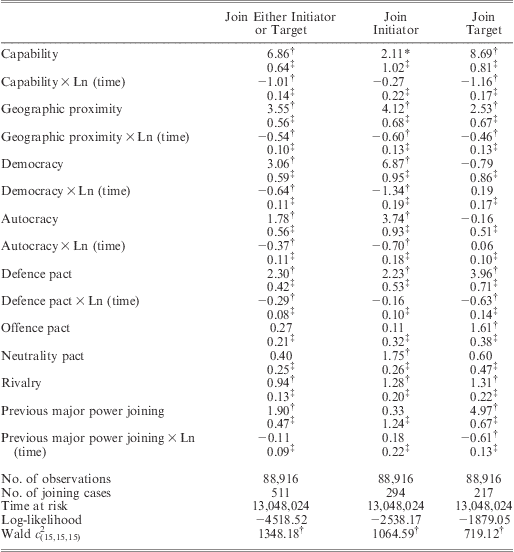
In order to demonstrate the importance of differentiating between joining in general and joining the initiator or the target, we estimated a model in which we pooled the risks. The results are in the first column of Table 1. The results for the pooled model represent the ‘average’ effect of a covariate on the risk of joining either the initiator or the target. In columns two and three of Table 1, we present the results from the competing risks model. The second column presents the results for joining the initiator and the third presents the results for joining the target. A positive (negative) coefficient indicates that the covariate increases (decreases) the risk of joining and that the time until joining occurs decreases (increases).Footnote 112
Competing Risks Model of Third-Party Joining, 1816–2001: Politically Relevant Triads

Significance levels (two-tailed): †5%; ‡1%.
Coefficients with robust standard errors below.
Across all three models, as a third party's capability contribution to an initial belligerent increases the risk that a third party will join an ongoing MID increases, although this effect differs between joining the initiator and joining the target. This initially positive effect subsequently decreases. In Figure 1, we plot the effect of capability on the risk of a third party joining during an ongoing MID. In this figure, the y-axis represents the percentage change in the hazard ratio (the difference in the risk of joining for different values of capability) and the x-axis represents time measured in days.Footnote 113 Panel A shows the median percentage change in the hazard of joining when a third party's capability increases from the first to the second quartile, while Panel B illustrates the median percentage change when a third party's capability increases from the second to the third quartile.Footnote 114
Effect of capability on the risk of a third party joining during an ongoing MID
Note: The dashed line displays the median percentage change in the hazard of joining when a third party's capability increases from the first to the second quartile (Panel A) and from the second to the third quartile (Panel B), while the solid lines correspond to the 95 per cent confidence interval. An area that is shaded grey indicates that the variable's effect is statistically significant, while an area that is white indicates that the variable's effect is not statistically significant. Y-axis scales differ across panels.
In the Join Either Initiator or Target model, an increase in a third party's capability from the first to the second quartile produces an initial 5 per cent increase in the risk of joining. However, this initial increase subsequently decreases and is not statistically significant between days 487 and 2,507 of a MID. While this effect becomes negative and significant after day 2,507, there are no joining cases after this point in time. In the Join Initiator model an increase in a third party's capability from the first to the second quartile produces a very small (less than 1 per cent) increase in the risk of joining. This small effect is only significant until day 89 of a MID. While this effect is only statistically significant for a short period of time, approximately 60 per cent of joining cases on the initiator side occur while the effect is positive and significant. There is a larger increase in the risk of a third party joining the target as its capability increases from the first to the second quartile, but this effect is still quite small (only about 3 per cent). The initial increase in the risk of joining the target subsequently decreases and is statistically significant for a much longer time period: the first 820 days of a MID. In contrast to joining the initiator, the effect for joining the target is positive and significant for 98 per cent of the cases in which a third party joined the target.
When a third party's capability contribution increases from the second to the third quartile, the statistical significance follows the same pattern of results. However the substantive effect of this increase is much larger, as indicated by the different y-axis scale. In the Join Either Initiator or Target model, an increase from the second to the third quartile produces a 40 per cent (as opposed to 5 per cent) increase in the risk of joining. The increase in the risk of joining the initiator is small compared to joining the target, where the increase in the risk of joining is nearly 30 per cent (as opposed to 3 per cent).Footnote 115
These results are consistent with our expectations. As the capability contribution a third party can make to an initial belligerent increases, the likelihood of joining also increases. This result is similar to the findings in the extant literature.Footnote 116 Additionally, if initiators target weak states, then our results lend support to the notion that third parties join the target in an attempt to balance against a more powerful initiator. This finding supports Walt's notion that ‘states that are viewed as aggressive are likely to provoke others to balance against them’.Footnote 117 These results are also consistent with the arguments of Waltz and previous empirical research that finds balancing to be more prevalent than bandwagoning.Footnote 118
Across all three models, geographic proximity to an initial belligerent initially increases the risk that a third party will join an ongoing MID relative to non-proximate third parties. However, this initially positive effect quickly becomes negative, and thus decreases the risk that a geographically proximate third party will join an ongoing MID. However, the point in time when this effect changes from positive to negative differs across the models. When we do not differentiate between joining the initiator and joining the target, the effect changes from positive to negative after day 737 of a MID. However for joining the initiator this effect changes on day 930, and for joining the target the effect changes on day 253. Thus geographic proximity to the target increases the risk that a third party will join the initiator for a longer period of time than geographic proximity to the initiator does for joining the target. Interestingly, the effect is not significant between days 441 and 4,170 for joining the initiator and days 102 to 1,242 for joining the target. Thus for approximately 92 per cent of the joining cases on the initiator side, the effect of geographic proximity is positive and significant, while 0 per cent had a negative and significant effect. For joining the target, 69 per cent of the cases have a positive and significant effect while 1 per cent have a negative and significant effect.Footnote 119
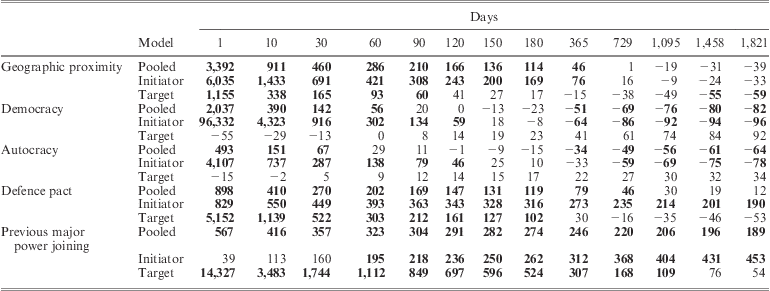
Overall, these results suggest that geographic proximity strongly increases the risk that a third party will join early in a MID, and that a third party geographically proximate to the target is more likely to join the initiator sooner than a third party geographically proximate to the initiator will join the target. In Table 2 we present the percentage change in the hazard ratio for each binary independent variable that violated the proportional hazards assumption at different points in time during a MID.Footnote 120 The risk that a third party that is geographically close to the target will join the initiator initially increases by 6,035 per cent relative to a non-proximate third party and decreases to 308 per cent within the first three months of a MID. In contrast, the risk that a third party that is geographically close to the initiator will join the target decreases from 1,155 per cent to 60 per cent over the same time period. While the results for geographic proximity are consistent with those of Siverson and Starr and others who have shown that contiguity influences joining decisions, our results add to the existing research by showing how contiguity influences when third parties join.Footnote 121
Percentage Change in Hazard Ratio for Binary Independent Variables that Violated the Proportional Hazards Assumption at Different Time Points During a MID
Note: Numbers in bold indicate that the percentage change in the hazard ratio is statistically significant at the 95 per cent level.
Of particular interest are the findings for democracy, since there is much written about its influence on joining in the extant literature. In Figure 2 (Panel A), we plot the effect of democracy on the risk of a third party joining an ongoing MID. In this figure, the y-axis represents the combined coefficient, which ‘describes the direction and magnitude of the variable's effect on the hazard rate over time’, and the x-axis represents time measured in days.Footnote 122 These results highlight the importance of distinguishing between joining the initiator and joining the target. In the Join Either Initiator or Target model, democratic similarity with at least one initial belligerent initially increases the risk of a third party joining; however, this effect becomes negative after day 120. A similar pattern is observed in the Join Initiator model, in which the initially positive effect becomes negative after day 170. Approximately 65 per cent of cases in which a third party joined the initiator occurred when the effect was positive and significant, compared to 18 per cent when the effect was negative and significant. In contrast, in the Join Target model, after day 61 the initially negative effect on the risk of joining becomes positive. However, in neither case does democratic similarity significantly influence the risk of a third party joining the target.
Effect of democracy (Panel A) and autocracy (Panel B) on the risk of a third party joining during an ongoing MID
Note: The dashed line displays the combined coefficient, while the solid lines correspond to the 95 per cent confidence interval. An area that is shaded grey indicates that the variable's effect is statistically significant, while an area that is white indicates that the variable's effect is not statistically significant.
Overall, these results suggest that if a third party and an initiator are both democratic, the risk of joining the initiator increases early in a dispute (within the first six months). This finding is consistent with our expectations and the results of Raknerud and Hegre and Werner and Lemke.Footnote 123 However, the risk of a democratic third party joining a democratic initiator decreases as a dispute persists. The initial risk of a democratic third party joining a democratic initiator initially increases by 96,332 per cent, but decreases to 59 per cent in the first four months of a MID. However, the risk of a democratic third party joining a democratic initiator decreases by 64 per cent after the first year of a MID and continues to decrease as a MID persists. The results for joining the target suggest a very different dynamic. If a third party and a target are both democratic, there is no statistically significant chance that the third party will join the target at any point during a MID. While this result is consistent with the findings of Mousseau and Reiter and Stam, it is inconsistent with the arguments and findings in Lake and Choi.Footnote 124 By distinguishing between the initial belligerents, these results demonstrate the influence of democracy on when and which side third parties join to an extent that previous research could not.
Figure 2 (Panel B) plots the effect of autocracy on the risk of a third party joining an ongoing MID. As with the results for democracy, these results highlight the importance of distinguishing between joining the initiator and joining the target. In the Join Either Initiator or Target model, autocratic similarity with at least one initial belligerent initially increases the risk of a third party joining; however, this effect becomes negative after day 118. A similar pattern is observed in the Join Initiator model, in which the initially positive effect becomes negative after day 207. Approximately 65 per cent of joining cases have a positive and significant effect of joining the initiator, while 9 per cent have a negative and significant effect. In contrast, in the Join Target model, after day 14 the initially negative effect on the risk of joining becomes positive. However, in neither case does autocratic similarity significantly influence the risk of joining the target.Footnote 125
Overall, these results suggest that if a third party and an initiator are both autocratic, the risk that a third party will join the initiator increases early in a dispute but decreases as a dispute persists. The initial risk of an autocratic third party joining an autocratic initiator initially increases by 4,107 per cent, but decreases to 46 per cent in the first four months of a MID. However, the risk of an autocratic third party joining an autocratic initiator decreases by 59 per cent after the second year of a MID and continues to decrease the longer the MID lasts. In contrast, if a third party and a target are both autocratic, there is no statistically significant chance that the third party will join the target at any point during a MID. These results are consistent with our expectations as well as the findings of Raknerud and Hegre and Corbetta, but question the extent to which autocracies behave differently from democracies.Footnote 126 Interestingly, the results for autocracy are similar to the results for democracy, suggesting that if initiators target weak states then both democratic and autocratic third parties are not likely to come to the aid of targets that share regime similarity. While this result raises doubts about the extent to which any regime type will aid the target of a MID, the risk of a democratic third party joining a democratic initiator is always higher than an autocratic third party joining an autocratic initiator within the first four months of a MID, although the differences between the two regime types decrease over this time period.
Across all three models, having a defence pact with an initial belligerent initially increases the risk that a third party will join an ongoing MID. However, this initially positive effect becomes negative, and thus decreases the risk that a third party will join. When this effect changes differs across the models. In the Join Either Initiator or Target model, the effect changes from positive to negative on day 2,662 of a MID; however, for joining the target this effect changes on day 553. In contrast, the effect is always positive for joining the initiator. Thus all of the cases of joining the initiator occur when the effect of the defence pact is positive and significant. The effect of a defence pact is not significant for joining the target between days 246 and 2,900 of a MID. Approximately 83 per cent of joining cases occur when the effect is positive and significant, while 0 per cent occur when the effect is negative and significant.
Overall, these results suggest that a defence pact between a third party and the initiator strongly increases the risk that a third party will join the initiator at any point during a MID. While defence pacts are generally designed to aid the target of aggression, a third party that has a defence pact with a target is only significantly likely to aid the target relatively early in a MID (within eight months). Indeed, the risk of joining the target is initially 5,152 per cent higher for a third party with a defence pact with the target than a third party without one. Comparatively, the initial risk that a third party will join the initiator is 829 per cent higher for a third party that has a defence pact with the initiator. While the percentage increase in the risk of joining the target decreases to 522 per cent by the end of the first month of a MID, the percentage increase in the risk of joining for a third party that has a defence pact with the target is still higher than the percentage increase in the risk of joining for a third party that has a defence pact with the initiator. After the first month of a MID, the percentage increase in the risk of joining for a third party with a defence pact with the initiator is higher than the risk of joining for a third party with a defence pact with the target.
The results for offensive alliance obligations suggest that third parties that have an offence pact with a target are likely to honour their alliance commitment. One possibility is that the initiator starts a conflict because it fears an attack is pending. Another possibility is that since offensive pacts suggest a similarity of foreign policy, a third party might decide to join a target in order to maintain its support. Moreover, the exact differences between defence and offence pacts can be ‘blurry’.Footnote 127 In contrast, third parties that have an offence pact with an initiator are not likely to honour their alliance commitment, which is contrary to our expectation.
Third parties that have a neutrality pact with an initiator are likely to join the initiator, but third parties that have a neutrality pact with the target are not likely to join the target. Existing conflict expansion research has primarily examined non-aggression pacts, which were found to increase the time until joining, decrease the time until joining the initiator and not influence the time until joining the target.Footnote 128 The ATOP dataset treats non-aggression pacts as distinct from neutrality pacts.Footnote 129
While the results for defence pacts are consistent with existing research, we can provide some additional insight, namely that if a dispute lasts longer than eight months then third parties that have a defence pact with the target are not likely to honour their alliance commitment.Footnote 130 Moreover, our results show that of the three alliance types, defence pacts have the greatest influence, which supports the argument made by Siverson and Starr but for which they had not found empirical support.Footnote 131 At the same time, arguments that allies do not honour their commitments also receive some support, as we find that if a third party with a defence pact does not join the target early in a dispute, it is unlikely to join later. These results help reconcile past discrepant findings by showing that allies do honour their defence pacts with initiators, but only honour their defence pacts with targets relatively early in a dispute. While offence and neutrality pacts are relatively rare compared to defence pacts, the findings for offence and neutrality pacts suggest that the reliability of alliance commitments varies by alliance type.
There has been increasing attention to the effects of rivalry on conflict behaviour in the conflict literature, but little attention has been paid to the role of rivalries in conflict expansion. This is surprising, since the perception of a serious threat has been previously discussed as a central element of joining decisions. Our findings demonstrate that a dispute is particularly likely to draw in additional states if a third party has a rivalry with one of the initial belligerents. Third parties that have a rivalry with the target are more likely to join the initiator, while third parties that have a rivalry with the initiator are more likely to join the target. Thus a third party that has a rivalry with an initial belligerent is at risk of joining the side opposite its rival. These results suggest that third parties that have a rivalry with one of the initial belligerents may use the dispute to inflict additional damage on a rival by joining the rival's opponent. This finding is consistent with what would be expected from the rivalry literature.Footnote 132 These findings also contribute to the balancing and bandwagoning debate, since rivals join the side opposite their rival, which suggests that third parties are concerned about their rivals improving their position.Footnote 133
The results for previous major power joining also highlight the importance of distinguishing between joining the initiator and joining the target. In the Join Either Initiator or Target model, a major power joining with the initiator or target always significantly increases the risk of a third party joining an ongoing MID, although this positive effect decreases over time. In the Join Initiator model, the effect of a major power joining on the initiator side also always increases the risk of joining, although the positive effect increases after day 6 of a MID. However, the effect is positive and significant only after day 30. Approximately 55 per cent of joining cases occur when the effect is positive and significant, while 45 per cent occur when the effect is still positive but not significant (between days 1 and 30). Note that while the constitutive term coefficient is not statistically significant, this only provides the effect of a major power joining on day 1 of a MID. In contrast, in the Join Target model, the effect of a major power joining on the target side changes from positive to negative after day 3,712. Approximately 99 per cent of the joining cases occur when the effect of a major power joining is positive and significant, while 0 per cent of the cases occur when the effect is negative and significant.Footnote 134
Overall, these results suggest that a major power joining on the initiator side during an ongoing dispute strongly increases the risk that a third party will join the initiator at any point during a dispute, but this effect is only significant after one month into a dispute. However, a major power joining on the target side significantly increases the risk that a third party will join the target only relatively early in the dispute. The risk of a third party joining the target after a major power has joined the target is quite substantial, starting at 14,327 per cent and decreasing to 524 per cent compared to the risk of a third party joining the target without a major power joining the target within the first six months of a MID. Additionally, within the first six months of a MID, the percentage increase in the risk of joining the target after a major power joined the target is always higher than the percentage increase in the risk of a third party joining the initiator after a major power joined the initiator. However, the percentage increase in the risk of joining the initiator following the joining by a major power is always higher than the risk of a third party joining the target following a major power joining the target after the first year of a MID, and increases as the MID persists.
In sum, we find evidence of both balancing and bandwagoning. These results suggest that previous major power participation on the side of the initiator significantly increases the risk of joining the initiator (bandwagoning) and previous major power participation on the side of the target increases the risk of joining the target (balancing). Moreover, these results suggest that we should observe balancing only relatively early during a MID, since third parties are less likely to balance as the MID persists, and that we should observe bandwagoning after the first month of a MID, since third parties are more likely to bandwagon as the MID persists. These results are consistent with our expectations and the empirical findings of Yamamoto and Bremer.Footnote 135
Conclusion
While conflict expansion is a relatively rare event, conflicts that do expand tend to be deadlier than those that do not. A substantial amount of research has tried to identify the factors that influence a third party's decision to join an ongoing dispute. One frequently used approach to studying conflict expansion is the opportunity and willingness framework. In this article, we built upon this framework to examine how opportunity and willingness influence when third parties join ongoing disputes and which side they join in those disputes. This article makes three contributions to the existing research on conflict expansion.
First, our results provide new insight into the effect of variables highlighted in the conflict expansion literature that are important for third parties’ decisions to join ongoing disputes. Specifically, our results show how these variables influence when and which side third parties join in ongoing disputes. Additionally, we have examined variables that have not been analysed in extant research (for example, rivalry) and variables that are often mentioned as being important but are not frequently analysed (for example, previous major power joining).
Secondly, our results contribute to some of the key debates in conflict research. In terms of the balancing versus bandwagoning debate, we find evidence for both sides, although which one is more likely depends on the length of a dispute and the mechanism that influences third parties’ decisions. As a third party's capability contribution increases, there is a small chance that it will bandwagon within the first three months of a dispute – but almost no chance afterwards. In contrast, there is a large chance that a third party will balance within the first two years of a dispute, but almost no chance afterwards. Thus in terms of a third party's capability contribution we found more evidence for balancing than bandwagoning, although both are less likely the longer a dispute lasts. The results for the previous major power joining variable suggest that we should observe balancing only relatively early in a dispute, since it is less likely to occur as a dispute persists. In contrast, we should only observe bandwagoning after the first month of a dispute, since it is more likely to occur as a dispute persists.
We found that alliance reliability varies by alliance type. Third parties that have a defence pact with the initiator are likely to join the initiator at any point during a dispute. In contrast, third parties that have a defence pact with the target are only likely to join the target in the first eight months of a dispute. However, within the first month of a dispute a third party that has a defence pact with the target is more likely to join the target than a third party that has a defence pact with the initiator is likely to join the initiator. Third parties that have an offence pact with a target are likely to fulfill their alliance commitments, but third parties that have an offence pact with the initiator are not. Finally, third parties that have a neutrality pact with an initiator are likely to join the initiator, but third parties that have a neutrality pact with a target are not likely to join the target.
In terms of regime type, we found that both democratic and autocratic third parties will join democratic and autocratic initiators, respectively, but not democratic and autocratic targets. If a third party and an initiator are both democratic, the risk of joining the initiator increases within the first six months of a dispute – after which it decreases. In contrast, if a third party and a target are both democratic, there is no statistically significant chance that the third party will join the target at any point during a dispute. Interestingly, we observed a similar pattern for autocratic third parties, which are likely to join an autocratic initiator early in a dispute but are not likely to join an autocratic target at any point during a dispute. These findings suggest that democratic and autocratic third parties behave similarly in terms of when and which side they join during ongoing disputes.
Thirdly, our results demonstrate the importance of distinguishing between the decision to join the initiator of a dispute and the decision to join the target – and that doing so provides new insights into conflict expansion. There were substantial differences in variables’ effects on the risk of joining between the pooled model and the risk-specific models. For some variables, the risk of joining is higher in one of the risk-specific models than the pooled model. For example, the effect of capability on the risk of joining is higher in the joining target model than in the pooled model. In other cases, the effect a variable has on the risk of joining in one of the risk-specific models is statistically significant but the effect is not statistically significant in the pooled model. For example, the effect of offence pacts on the risk of joining is statistically significant for joining the target, but is not statistically significant when we pool the risks. In addition, by distinguishing between joining the initiator and joining the target we uncovered several interesting results. As mentioned above, the risk of joining increases when a third party and an initiator are both democracies, but there is no significant relationship for the risk of joining when a third party and the target are both democracies. If we relied upon the results from the pooled model, we would not be able to distinguish these effects.
There are a number of additional avenues for future research. First, we have only considered military intervention by third parties. Since third-party participation can take many forms, ranging from arbitration and mediation to uses of military force, future research might consider when a third party decides to mediate, arbitrate or use military force – and on which side. Along these lines, future research might also consider the timing and side of other forms of intervention, such as diplomatic or economic.Footnote 136 Secondly, we found evidence that the prior participation of a major power influences other third parties’ decisions to join. Future research might consider how other characteristics of previous intervenors influences other third parties’ decisions. For example, does the prior participation of a democracy influence the future participation of other democracies? Finally, we believe that more theoretical research is needed to account for the interdependent nature of third parties’ decisions. If states that are considering starting a conflict base their decisions, in part, on whether or not third parties are expected to join (and on which side), third parties’ decisions to join ongoing disputes are also likely based on whether or not other third parties will join in the future, when those third parties will join and on which side.