The 1996 legislative reform, which replaced the Aid to Families with Dependent Children programme (AFDC) with the programme of Temporary Assistance for Needy Families, marked a significant shift in US welfare policy. From one perspective, this development can be seen as following a continuous path of step-by-step changes from temporary welfare to temporary work-conditioned welfare, starting from the passage of Title IV of the Social Security Act of 1935. This Act created what was originally called the Aid to Dependent Children (ADC) programme: the means-tested scheme of income support for women who were single parents. In 1935, the New Deal architects of ADC believed that they were designing a temporary measure, since the programme was expected to wither away in several decades as widows with children became eligible for survivors' insurance that was soon to come under the social security system (Witte, Reference Witte1962).
By the 1960s, however, it became increasingly evident that welfare was not as temporary as had been expected. The welfare rights movement aroused expectations that social assistance was a right rather than a provisional benefit. In 1966, mass welfare rights demonstrations were held in 16 cities across the country. A year later, the National Welfare Right Organization (NWRO) was formed, giving voice to a movement that sought to empower poor people, to increase access to assistance among eligible families, and to ensure respect for the legal rights of those on public aid. Welfare recipients were vulnerable to particularly onerous treatment under the ‘man in the house’ rule that mandated the termination of AFDC benefits to any woman with an able-bodied man in the house, and the investigative procedures such as ‘midnight raids’, which were sometimes conducted to check on who might be living with recipients. In 1968, the legal arm of the welfare rights movement was successful in getting the US Supreme Court to strike down the ‘man in the house’ rule (Trattner, Reference Trattner1999; Piven and Cloward, Reference Piven and Cloward1977).
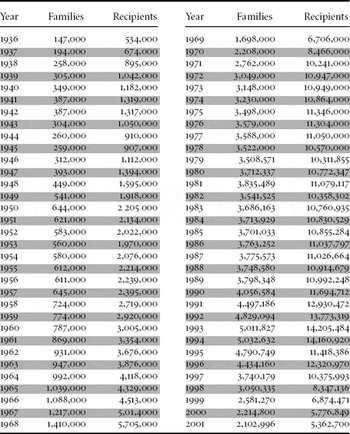
Instead of shrinking, as the New Deal architects imagined, the ADC programme, renamed Aid to Families with Dependent Children (AFDC) in 1962, grew rapidly even in a strong economy with a relatively low rate of unemployment. Table 1 shows that between 1960 and 1971 the number of welfare recipients tripled, from 3 million to 10 million people (in 2.8 million families). By 1993, the number of recipients peaked at 14.2 million in over 5 million families. The 42 per cent increase between 1971 and 1993 was significantly greater than the 25 per cent increase in the US population over that period.
Average monthly families and recipients of ADC, calendar years 1936–2001

Note: Prior to enactment of the Personal Responsibility and Work Opportunity Reconciliation Act of 1998 (PL104–193), cash assistance for needy families was provided through Aid to Dependent Children (1936–1962), later called Aid to Families with Dependent Children (1962–1997).
Source: Administration for Children and Families (2002).
As the growth of the AFDC caseload accelerated after 1960, a series of welfare reforms was enacted over the next four decades, which placed increasing emphasis on the recipients' responsibility to become self-supporting. The most significant of these welfare reforms include (Gilbert, Reference Gilbert, Gilbert and Parent2004):
• the 1962 ‘service amendments’, which aimed to reduce the welfare caseload through intensive social casework services to rehabilitate the poor, changing their behaviour in ways that would facilitate economic independence (it did not work, as 1 million new recipients were added to the rolls between 1962 and 1966, at a time when unemployment rates were relatively low);
• the 1967 amendments, which provided services and financial benefits under the work incentive programme (WIN) to encourage voluntary participation in work training and employment (the number of recipients continued to increase, more than doubling, from 5 million to 11 million, by 1988);
• the 1988 Family Support Act, which required AFDC recipients with children over three years of age to participate in work training programmes (the number of recipients kept climbing to over 14 million in 1993).
Following these measures, the Temporary Assistance for Needy Families (TANF) programme of 1996 may be seen as one more step, perhaps more decisive than the other reforms, in the journey to workfare. Taken as a step-by-step progression, the history of welfare reform conforms to the theoretical view that social policy changes are ‘path dependent’, which means that where they go is largely determined by the strength and momentum already created by their core constituencies: wherever it is headed, the direction is usually difficult to reverse.
It is hard to imagine that poor people – the core beneficiaries of welfare programmes – wielded much in the way of political influence on welfare reform, or were staunchly behind the progression to workfare. But since welfare grants flow through state governments and result in an infusion of cash into the states' economies, governors and state representatives can also be seen as an important constituency of these programmes. In capping the federal contribution to welfare programmes, the TANF legislation fixed the level of federal funding based on the amount states spent on AFDC in 1994. Between 1994 and 1966, the number of welfare recipients had declined by almost 2 million and was still falling. Thus, the federal allocation under TANF gave the states a considerable surplus, which encouraged their political support.
From another perspective, however, rather than one more step along the pathway of reform, it has been argued that TANF constitutes a transformative measure, one that jumps the track, so to speak, and sets welfare on an alternative path.Footnote 1 It might be noted that for a brief period under the Nixon administration between 1969 and the early 1970s, policy-makers proposed another kind of transformative measure that would have taken welfare reform in a very different direction. Nixon's Family Assistance Plan (FAP) called for a guaranteed annual income implemented through a negative income tax. Despite the fact that the minimum guaranteed level of support for families with no income was quite low ($1,600 for a family of four), this proposal got bogged down in committee, where it died (Trattner, Reference Trattner1999). In contrast to the FAP, which would have dramatically extended the AFDC entitlement to cash assistance, TANF was a historical reversal of AFDC's entitlement to cash assistance (Haskins, Reference Haskins2006). As such, it breached the clause of the social contract under which the state provided a safety net for families struggling to survive outside the labour force.
Policy transformations under TANF
TANF policy revised the essential character of the social safety net provided by US public welfare through the 1990s. Under the six decades of AFDC (and ADC), poor families could rely on public aid that provided a modest cash benefit as a social right to which they were entitled for as long as it was needed without the requirement to work or behave in any particular manner. All this changed with the passage of the TANF legislation, which cut four core strands of the safety net by making benefits conditional on work, time-limited, linked to responsible personal behaviour, and by ending the federal guarantee of support.
Social responsibility
The long-standing acceptance of welfare as a social right was replaced by a new emphasis on the recipients' social responsibilities. From the 1960s to the mid-1980s, the political discourse on welfare was animated by efforts to extend the range of benefits available to the poor. The new benefits included medical care, food stamps, day care, legal aid and work training. With memories of the Great Depression still in mind, the poor were perceived by many people as innocent victims of capitalism and as such entitled to be compensated for the system's failures: welfare was seen as among the ‘social rights of citizenship’. William Ryan's (Reference Ryan1971) admonitions against ‘blaming the victim’ struck a prominent chord in the Zeitgeist of the 1960s and early 1970s. Ryan described the 1967 welfare amendments, which provided financial incentives to encourage voluntary participation in work training and employment, as ‘coercive and repressive’. (As coercion goes, the 1967 amendments were very mild compared to the measures initiated under the 1996 legislation.)
By the late 1980s, concerns about the nature of welfare entitlement shifted away from elaborating social rights to delineating the social obligations of citizenship. Although T. H. Marshall is strongly identified as elaborating and supporting the idea of welfare as social rights of citizenship, he was well aware that these rights had to be balanced by the duties of citizenship. Social rights are marked by a variety of tangible benefits to which citizens are legally entitled, whereas the duties of citizenship are somewhat vague. Marshall was clear, however, that ‘of paramount importance is the duty to work’ (1950: 129). Marshall did not, however, explain how the right to tangible benefits might be modified if citizens did not discharge their duties.Footnote 2 Following Marshall's concern about balancing rights and responsibilities, Lawrence Mead's influential book Beyond Entitlement: The Social Obligations of Citizenship (Reference Mead1986) takes this line of analysis a step further by stipulating tangible responsibilities of citizens. He identified several duties that constituted the core of expected behaviour for US citizens. At the very least, according to Mead, able-bodied adults are expected to work in available jobs, to contribute to the support of their families, to acquire fluency in English, to learn enough in school to be employable and to respect the law as well as the rights of others.
The public discourse on social responsibilities that began to take hold in the late 1980s was reflected in the welfare reforms under the 1998 Family Support Act, which included efforts to have teenage mothers with children under three complete their high school education; to make single mothers applying for aid responsible for helping to establish paternity so that absent fathers could be held accountable for child-support payments; and to have unwed teenage mothers live with a parent, other adult relatives or in some other adult-supervised living arrangement.
It was not until the TANF legislation in 1996, however, that a significant agenda of personal responsibility was firmly incorporated into welfare policy, with serious consequences for those who failed to meet the standards. TANF prohibited federal assistance to teenage mothers living separately from their parents or not attending school, as well as to individuals convicted of significant drug offences. It also provided special financial payments – ‘illegitimacy bonuses’ – to the five states that decrease out-of-wedlock births the most, without increasing abortions. The law also encourages fathers to make child-support payments, and the development of ‘abstinence-only’ sex education programmes in schools.
Although framed by a number of federal rules, the TANF legislation permits states unprecedented leeway in organising their welfare programmes and initiating behavioural requirements. States have, for example, imposed ‘family caps’ on their aid formula, denying mothers additional benefits if they have children while on welfare;Footnote 3 linked benefits to the school attendance records and performance of recipients' children; required that parents have their children receive proper immunisation and periodic health screening; and tied benefits to establishing paternity within six months of birth (Preston, Reference Preston1998; Rowe, Reference Rowe2000). With regard to personal behaviour, one could say that TANF conditions made welfare morally more demanding.
Work-conditioned benefits
The most compelling condition stipulated by TANF is the recipient's duty to work. In sharp contrast to earlier reforms, which involved voluntary activities, incentives and work-training requirements, the 1996 welfare reform legislation incorporates firm ‘work first’ requirements, emphasising full-time jobs rather than job preparation. States are required to meet strict timetables with respect to employment. According to the federal mandate, welfare recipients must be engaged in some kind of work-related activity to continue to receive benefits under TANF after their first two years of support. At their discretion, states can require that recipients go to work before the first 24 months. (However, the initial rules failed to specify how the work requirements must be satisfied. It was not clear, for example, whether self-employment, work for family members, volunteer or other unpaid work would count as a job (Smolensky et al., Reference Smolensky, Evenhouse and Reilly1997).) Each state has to ensure that a rising proportion of aid recipients work each year. If states fail to transition clients from welfare to work, stiff financial penalties are imposed. And if clients refuse to comply with the work requirements, they are subject to sanctions that involve reductions of their benefit ranging from 10 per cent to loss of the entire benefit for varying periods of time (Rowe, Reference Rowe2000).
Time limits
Arguably, the most stringent federal regulation involves the 60-month limit on assistance, which bars states from providing federally funded cash benefits to families for more than a total of five years during their lifetime. States may exempt up to 20 per cent of TANF recipients from the federal five-year limit due to family hardship. Policy-makers confront a challenge to define the nature and severity of ‘family hardship’ that should qualify for the 20 per cent exemption, as advocates for needy groups, such as victims of AIDS/HIV and other chronic disabilities, battered women, and grandparents providing kinship foster care, mobilise to protect their constituencies (Swarms, Reference Swarms1997).
Ending the federal entitlement
TANF effectively put an end to the federal pledge to contribute to the financial support of all eligible parents and children in poverty, which was guaranteed by federal open-ended matching grants to the states. Under the open-ended grants, no upper limits were placed on the size of the federal matching welfare allotments, states determined how much of their own money to spend on welfare assistance and the federal government automatically contributed its matching share. The portion paid by Washington varied. In AFDC's last year – fiscal year 1996 – it ranged from 50 per cent for the highest per capita income states to 78 per cent for Mississippi, the poorest state. The guarantee of open-ended federal matching made AFDC a federal entitlement: all families meeting the state's eligibility criteria had a statutory right to cash assistance. Unlike the entitlement to social security, which rests on a statutory guarantee as well as the normative acceptance of the right to old age pensions, by the 1960s the legal and budgetary entitlement to AFDC was no longer reinforced by the popular sentiments of the 1930s, which allowed that mothers who did not work deserved public aid. Although modest and controversial, the AFDC entitlement was still important. It never covered all the poor, only those deemed income-eligible by the states. And it never carried with it sufficient standards for benefit levels: cash assistance was typically below the level to remove recipients from poverty. The matching arrangement, nevertheless, ensured a minimal level of material support. Families stranded by the economy, a lack of ability, or just bad luck had a right to aid. Matching grants also powerfully encouraged state spending because the more the state put in, the more the federal government contributed. The open-ended character of the federal grant, furthermore, was responsive to changing situations of need. In prosperous times, caseloads were reduced and AFDC funding (federal and state) was reduced. In recessionary periods, caseloads increased and AFDC funding increased.
In ending the federal entitlement, TANF has subordinated assistance to the availability of funds. Rather than matching state spending, the federal government provides a fixed annual sum. Unconnected to state spending – and unconnected to changing levels of need – this allotment can result in benefit rationing in hard times. When more families meet the state need standard than are budgeted for, assistance can be reduced or denied. The end of the cash entitlement for dependent families removes the assurance of a reliable public aid safety net. State policy-makers, given unprecedented authority to design their own anti-poverty programmes, may well devise effective and humane welfare interventions. Without federal standards and without a right to assistance, however, they will come under pressure to cut benefit levels and narrow eligibility when economic downtowns reduce available state revenues.
Forces of change
What accounts for this fundamental change in US welfare policy? There are no pat answers. Some have suggested that the change was driven by racial politics. Welfare could be seen as a veiled but obvious reference to race. Those who opposed welfare ‘handouts’ were attacking the right to cash assistance that was particularly helpful to people of colour (Edelman, Reference Edelman2007). This is not entirely persuasive. Although African-Americans were disproportionately represented on the welfare rolls, they were never a majority of recipients. In 2001, 39 per cent of welfare recipients were African-Americans (Karger and Stoesz, Reference Karger and Stoesz2008). While cash assistance from AFDC was no doubt helpful to people of colour, the majority of people to whom it was helpful were Caucasian women and children.
It was indeed the case that for decades racial stereotypes contributed to negative views of welfare. In the late 1950s and early 1960s, as Charles Murray notes, ‘the statistics might show that whites have always been the largest single group of welfare recipients, but the stereotypes that enraged the critics was the family of four, five, six, and more children reared at government expense, and somehow the stories about such families always seemed to talk about black families’ (Reference Murray1984: 18). And in the late 1970s and early 1980s, Ronald Reagan often repeated the story of a ‘welfare queen’, apparently an African-American woman, ‘who supposedly drove a Cadillac, bought thick steaks with food stamps, and vacationed in resorts on taxpayer funds’ (Wilson et al., Reference Wilson, Schram, Soos and Fording2003: 194). Although the facts were difficult to pin down, this well-known anecdote imparted a virulent stereotype.
Thus, welfare-related racial politics had been around for almost half a century before the arrival of TANF. While they may have influenced some policy-makers when voting for TANF in 1996, the racial explanation of this fundamental policy shift ignores several more compelling reasons for the transformation of welfare policy. In trying to understand how and why this came about, it is important to appreciate that welfare policy in the US was built upon legislative foundations informed by political ideas, norms and scientific knowledge, which prevailed more than half a century ago. When Harry Hopkins, Frances Perkins, Rexford Tugwell and other New Deal architects devised the blueprints for social protection in the 1930s, public assistance under Aid to Dependent Children was initially designed mainly for the dependent children of widows. The New Deal policy-makers fully anticipated that ADC would fade away as soon as the ‘deserving’ widows with children could qualify for survivors' insurance to which their working husbands had contributed under the newly emerging social security system. In those days, mothers were expected to stay at home and care for their young children; divorce was relatively rare, as was child-bearing outside of marriage. Much has changed since then, and these changes help account for the transformation of welfare policy.
Structure of family life
The rates of birth to unmarried women climbed more than six-fold from 7.1 per cent in 1940 to 44.8 per cent in 1996. The rates of divorce and annulment more than doubled from two per 1,000 in 1940 to 4.7 per 1,000 in 1990. Initially, when ADC was implemented, 85 per cent of recipients qualified for benefits based on the death of a parent. By 1992, enrolment in AFDC due to a parent's death accounted for only 2 per cent of the caseload (Rudolph and O'Hara, Reference Rudolph and O'Hara2002). Thus, in stark contrast to clients for whom the ADC programme was originally designed in 1935, by 1996 most AFDC recipients were unwed or divorced mothers, not quite as deserving as young widows. Some critics of welfare saw AFDC as a programme that undermined morality and facilitated irresponsible behaviour.
Gender norms
Since the 1960s, social norms regarding the role of motherhood and labour force participation of women have changed dramatically. The labour force participation of women with children under six years old multiplied threefold, from less than 20 per cent in 1960 to 62 per cent in 1996. By 1996, 77 per cent of women with children between the ages of six and 17 were in the labour force, as were 55 per cent of mothers with children under one year of age. As women with young children joined the labour force in almost unprecedented numbers, there was a normative shift in the role of motherhood that dulled public sympathy for welfare programmes that pay women to stay home and care for their children. Why shouldn't welfare mothers be expected to work if most women with young children were already employed outside the home? (There are some tentative signs that an increasing proportion of mothers with young children are opting out of the labour force, at least in the pre-school years, but it is too early to tell whether this trend will gain momentum (Gilbert, Reference Gilbert2008).)
Welfare benefits and ideas about social equity/fairness
Not only did it seem unfair that the state paid some mothers to stay at home while the majority of others were rushing to drop their children off at day care centres on the way to work, but as new benefits were made available in the 1960s and 1970s, the level of support available to welfare recipients was sometimes higher than the salary of low-income workers. Although the basic welfare grants were lower than the minimum wage, when the value of food stamps, public housing subsidies and Medicaid were added on, the package of welfare benefits often exceeded the minimum wage. Moreover, it was well established that a significant proportion of welfare recipients supplemented their benefits by working for pay that was not reported.Footnote 4
Knowledge about the consequences of welfare policy
Policy-makers learned much about the consequences of their efforts from the experiences accumulated during the decades of welfare reform. As previously noted, the ‘soft’ legislative reforms of 1962, 1967 and 1988 – which focused on therapy, voluntary participation and incentives – did little to stem the continuous increase in welfare caseloads. These experiences lent credible support to the charge that welfare benefits inadvertently dampen the incentive to engage in full-time work and that welfare reform required a more rigorous approach to work than was promoted under previous legislation. It is a conclusion frequently drawn not only in the United States but also throughout Europe. Thus, for example, an OECD report on the Netherlands in the 1990s finds ‘clear indications that the generosity of social benefits and high effective marginal tax rates implicit in income-dependent subsidies create strong disincentives to work and underlie the exceptionally high dependency ratio in the Netherlands, where one employed person supports almost one person on social benefits’ (OECD, 1991b).
Over the last decade, socio-political deliberations in the industrialised welfare states have produced numerous legislative reforms to ‘activate’ the beneficiaries of disability insurance, unemployment insurance and social assistance (Collins, Reference Collins1990; Eardley et al., Reference Eardley, Bradshaw, Ditch, Gough and Whiteford1996; Kalish, Reference Kalish1991). These reforms have injected programmes that offered ‘passive’ income supports with an array of sanctions and incentives designed to promote labour force participation and other active contributions to the community. This approach to social policy comes largely in response to an increasing acceptance of the idea that social welfare provisions produce ‘poverty traps’ or ‘enforced dependency’, phrases prudently crafted not to blame the victims (Bradshaw and Millar, Reference Bradshaw and Millar1990; Euzeby, Reference Euzeby1988). One report goes so far as to say that ‘dependency traps are an unintended outcome of most social security systems’ (OECD, 1991a).Footnote 5
This combination of social forces – structural changes in family life, a normative shift regarding the role of motherhood, and knowledge and experience gained about the consequences of welfare – help account for the fundamental change in the character of welfare under the TANF legislation. What gave these pressures for change particular weight is that they all pushed in the same direction, away from a system of welfare entitlements for deserving widows and towards the responsibility to work.
The 2005 reforms: adjusting course
The 1996 TANF reforms settled the big political issues of work requirements, personal responsibility, length of benefit and federal entitlement, which had reached a level of critical concern by the 1990s. As David Ellwood (Reference Ellwood1996) pointed out, the settlement of these issues represented a compromise among four distinct strands of conservatism: work-oriented reformers, who emphasised the critical importance of jobs and training; ideological critics, who emphasised the importance of incentives to encourage moral behaviour; budget-cutters, who viewed the welfare problem as one of excessively generous support; and devolvers, who saw the welfare problem in terms of excessive federal ‘command and control’, with red tape and regulations impairing the ability of the states to create welfare solutions crafted to their own circumstances.
Although when the time came to re-authorise TANF in 2002 there was considerable political haggling about the rules, this was more a matter of adjusting the course than fundamental reform. The fundamental issues of reform had already been resolved in 1996. By 2005, the political debate was concentrated mainly around how much to tighten the work requirements. Under TANF, 50 per cent of all adults receiving assistance and 90 per cent of two-parent households must participate in a set of work activities. However, the states were allowed to adjust these work-rates downward by one percentage point for each percentage-point decline in their TANF caseload since 1995. The Deficit Reduction Act of 2005 modified this ‘caseload reduction credit’ so that adjustments to the work participation rates are now based on a state's caseload decline after 2005. Failure to meet these rates can result in financial penalties of up 5 per cent of the federal family assistance grant to states, which can grow by two percentage points for each subsequent year of non-compliance up to 21 per cent of the federal grant (Baider et al., Reference Baider, Ganzglass, Greenberg, Minoff, Parrott, Schott, Sweeney and Turetsky2007).Footnote 6 Since the state caseloads declined substantially over the last decade, leaving some of the least qualified recipients still on the rolls, this modification of the work participation formula places considerable pressure on the states. These pressures are magnified by a significant new set of bureaucratic requirements for state monitoring and documentation of work participation. For example, unpaid work activities must be supervised daily, and homework time for those in vocational educational programmes must be monitored. Finally, the DRA sharpened and narrowed the federal definition of activities that counted toward the work participation rates. These activities included vocational education for 12 months, unsubsidised employment, subsidised employment, community service programmes, child care to enable another TANF recipient to participate in a community service programme, and up to six weeks of job readiness and job search assistance.
In all, the main implications of the most current reforms are to confirm and intensify the work requirements of TANF. These new more stringent measures come at a time when the states' caseloads have already shrunk, leaving them to deal with a pool of hard-to-place recipients in a faltering economy.
Conditionality and entitlement: vying for the new social contract
TANF and the DRA of 2005 have reinforced conditionality and restricted entitlement to welfare. After the last round of reforms, there does not appear to be much further room for tightening the federal conditions linked to public assistance under TANF, nor does there appear to be any political leverage for reversing the conditions currently imposed. Yet there is still room for progressive and conservative policy-makers to manoeuvre as they seek to redefine and rebalance the rights and responsibilities of a new social contract for public assistance. In the course of vying to rewrite this contract, there are at least four avenues along which issues of conditionality and entitlement are likely to be played out.
First, advocates of conditionality may invoke the relative success of TANF work requirements in lowering caseloads and increasing employment to justify extending conditionality to related means-tested programmes of public assistance. If it works in one programme, why not make eligibility for food stamps and public housing subsidies, for example, conditional on work requirements for able-bodied adults?
This question raises the issue, of course, of whom to include among the able-bodied and what conditions might be strengthened for people who are disabled. The political salience of TANF has declined significantly as the number of welfare recipients plummeted from 14 million (or about 5.4 per cent of the total population) in 1995 to 5 million (1.7 per cent of the total population) in 2005 (Crouse et al., Reference Crouse, Douglas and Hauan2007). TANF is one of two national means-tested programmes that offer cash assistance to the poor. The other programme, SSI, serves blind, elderly (not covered by Social Security) and disabled people. In 1995, TANF had 8 million more recipients than SSI. By 2005, the SSI recipients had climbed to surpass TANF by 2 million. Over the decade from 1995 to 2005, the number of SSI recipients has increased relatively from 43 per cent to 140 per cent of the number of TANF recipients. Most of this increase in due to the rising number disability recipients in the SSI programme. Several studies suggests that as many as 30 per cent of the people in the remaining pool of TANF recipients would be eligible for SSI under the administrative category of ‘mental retardation’ (Ramey and Keltner, Reference Ramey and Keltner2002). As the TANF regulations stiffen, states have initiated efforts to assist TANF recipients in applying for SSI, which is still an entitlement programme.Footnote 7 As progressives who support expanding social entitlements seek to boost SSI enrolment, advocates of conditionality may focus great attention on the ways to tighten the screen on claimants' ability to work and to introduce TANF-style work requirements into some portion of the SSI programme.
Second, as the social obligation to work has been intensified, advocates for social entitlements are moving to shift the emphasis on policy reforms from the responsibility to work to the social rights to earn a living wage for low-income workers, whose ranks have expanded as welfare recipients move off the rolls and into the labour force. The right to a living wage attracts a broader spectrum of political support than a guarantee of cash assistance for people who do not work. It is easier to mobilise public opinion in support of government intervention that helps people who work hard and play by the rules to provide their families with a decent standard of living, than programmes that pay poor people to stay home and care for their children.
There are several approaches to expanding income supplements for working families. One way is to increase the level of income disregard – the amount of pay for their jobs that recipients are allowed to retain without having their welfare allotment reduced – set by the states. Over a dozen states currently permit recipients to make up to $1,000 in earnings before losing TANF payments (Gilbert and Terrell, Reference Gilbert and Terrell2005). The Center on Income and Budget Priorities suggests that it is to the states' advantage to increase the earned income disregard because it not only provides a powerful incentive to accept low-income jobs, but it extends the period that working families qualify as TANF recipients, which helps the state achieve the federally mandated work participation rate. (Of course, the longer the low-income workers remain on TANF, the more months they accrue toward their 60-month time limit on federal support.)
Beyond using TANF and state funds to supplement low-income working families, progressive advocates argue for the right to a living wage. They propose lifting the federal minimum wage to 50 per cent of the average wage, its level relative to the average wage in the 1950s. This would have brought the federal minimum wage to $8.40 an hour in 2008 (the 2008 minimum wage was $5.85 per hour and is set to rise to $7.25 by July 2009). In addition, several federal tax reforms are seen as also advancing the right to a living wage. These involve expanding the Earned Income Tax Credit (currently over $4,000 a year to a minimum-wage worker with two children) and making the current federal child-care tax credit a refundable credit so that low-income workers who do not owe federal taxes can benefit. These proposals are made bearing in mind the need to balance the minimum wage paid by employers and income supplementation through government assistance (Greenberg et al., Reference Greenberg, Dutta-Gupta and Minoff2007).
The third issue concerns care work and the extent to which it meets the demands of conditionality. Under the DRA regulations of 2005, the core activities that count as work include providing child care which enables another recipient to participate in a community service programme, but not providing child care for their own children. A movement is afoot to recognise care work as equivalent to other work, advanced by a new strand of feminist thought in the US – sometimes referred to as ‘care feminism’ or relational feminism – which is on the rise.Footnote 8 This strand of feminist discourse emphasises the value of care work and the need for women to have meaningful opportunities to choose how much of their lives to invest in paid work and childrearing. Supporting this position, Alstott (Reference Alstott2004) proposes the development of caretaker resource accounts that would pay an annual grant of $5,000 to assist individuals who provide continuity of care for a child, and who sacrifice their own opportunities in doing so.
The debate about care work goes well beyond the US. In Germany, Leipert and Opielka (Reference Leipert and Opielka1999) have argued for a new social contract based on the understanding that parental child-care work is functionally equivalent to gainful employment. Calculating the monetary value of child care, they propose a monthly salary of approximately $1,360 for the first child and $680 for additional children up to age seven. Although this proposal stirred some debate in the late 1990s, it did not carry the day. Many countries provide a cash allowance for home care for elderly people, which can be used to pay relatives. And cash payments for home care of children are already offered in several European countries, including Norway and Finland (Gilbert, Reference Gilbert2008).
Finally, at the same time that TANF imposed federal requirements regarding work and time limits, it also allowed states great discretion to organise their welfare programmes in their own fashion and to adjust the balance between conditionality and entitlement in light of local priorities. TANF, for example, permits the states to limit assistance to particular categories of poor families. States, if they wish, can prohibit cash payments to otherwise eligible legal immigrants, or to two-parent families, or to families failing to meet certain procedural or programmatic rules and regulations. Cash, indeed, does not have to be provided at all: the states can structure ‘assistance’ in the form of vouchers, services or other benefits that meet ongoing basic needs.Footnote 9
The states have responded to this flexibility in a variety of ways. Some have developed requirements that are more stringent than those in the federal regulations. Idaho, for example, has established a lifetime eligibility limit of two years and refuses to offer exemptions to special need groups, such as victims of domestic violence. Mississippi requires welfare recipients to accept any job offered or else lose all benefits. Employers hiring welfare recipients are provided a TANF subsidy of $3.50 an hour to which they must add $1.00 an hour. In this fashion, public assistance is turned into a wage subsidy programme.
Other states have adopted more lenient rules, in some cases guaranteeing public support over the five-year federal limit with state funds. New York State, for example, provides a constitutional guarantee that obligates local governments to help all the needy, irrespective of how long they have been on welfare. Vermont, which also refuses to impose a life-time limit on welfare support, describes its approach as a ‘kinder, gentler’ form of welfare reform. While requiring single parents to work, the state provides a generous cash supplement to poor workers; it has also created its own nearly universal health care programme for children. Most recipients must do community service after receiving benefits for two and a half years. If a recipient is unable to secure a private sector job, the state provides ten months of employment in a public or non-profit organisation.
In sum, a new social contract is being forged about the right to public assistance, which seeks to change the balance between entitlements and conditionality. Politically, this contract is driven by two agendas. The responsibility agenda emphasises the obligation to work and socially acceptable personal behaviour; the entitlement agenda emphasises the right to work training, employment opportunities and a living wage. Although the federal framework has been codified, the states are still experimenting with various measures – not all of the clauses of this contract are entirely worked out yet. It is quite possible that between federal and state initiatives the political balance that is achieved will vary in different localities, reflecting the spectrum of political constituencies ranging across the 50 states. Whatever balances emerge, the federal role in the welfare arena has fundamentally changed from that of providing direct income maintenance to the poor to that of creating public support to promote private responsibility.