1. INTRODUCTION: SPACES OF INTIMACY
In March 2020 the world witnessed a big turn towards destabilisation, change and the unknown in its search for a new ‘normality’. The simple act of walking has been challenged by the limitations of confinement and the rules of risk-avoidance. The world had turned quiet, still and a deadly virus had driven humanity into an acceleration of technologies and connectivities of the remote kind. In a very comprehensive article about the void of the network, Donatella Della Ratta appraises the strengths of the sound dimension in endless Zoom-like meetings and ‘its potential for a freeing-up from the anxiety of the hyperconscious self-gaze, [which] might help create an opening for spaces of intimacy and in defiance of connectivity’(Della Ratta Reference Della Ratta2021). This can be considered as valuable learning for networked sound art and sound-based work that explores sound’s ability to enable and support intimate listening. While we rekindle with the idea of intimate listening in the void of the network, we also need to adjust our understanding of what is transmitted, from where and from whom, to whom. In reference to the polyphonic and multifaceted perspectives that can emerge through listening, Communication Studies professor and soundwalking artist Andra McCartney borrows Donna Haraway’s term ‘partial knowledge’ to address the ‘partiality’ of such experiences only to be completed by relying ‘on connections with others for objectivity and the creation of knowledge … that provide the possibility to listen together’ (McCartney Reference McCartney, Fischer and Muhlen2014: 120). Even though this act of ‘listening together’ is constantly challenged by the network’s multifaceted and erroneous materiality, it is important to acknowledge, to refer back to Della Ratta, that through these intimate spaces created within networked soundworks, we can unlock particular exchanges and sensitivities that connect our inner listening and internal ‘seep through’ with that of others. Borrowing Gaston Bachelard’s notion of the ‘seep through’ (Bachelard Reference Bachelard and Jolas1994: 106), I focus it on the internal ‘seep through’, by which I imply our ongoing internal processes, individual backgrounds and ‘building materials’ that emerge or seep through in our exchanges within our environment and affect and shape the way we perceive it. The internal ‘seep through’ is not a pure and unaffected body but a living entity that is in continuous change, not unlike the network itself.
2. ECOLOGIES AND THE TELEMATIC MESHWORK
In the Introduction to Guattari’s Three Ecologies, Pindar and Sutton write that Guattari’s approach to social ecology ‘requires the collective production of unpredictable and untamed ‘dissident subjectivities’ rather than a mass movement of like-minded people’ (Guattari Reference Guattari2000: 14). The idea of dissident subjectivity echoes here Della Ratta’s gesture of ‘freeing-up’ and the liberation from the monarchy of the gaze. Networked sound art ‘plays’ the void as a space where different kinds of ecologies emerge that defy the singularised connectivity often procured by mass-teleconferencing platforms and applications. It gradually forms a telematic meshwork of ecologies that enacts the potential of subjectivities as ‘antidotes to mass-media and telematic standardisation’ (Guattari Reference Guattari2000: 35).
Ingold (Reference Ingold2011), in his definition of the line, refers to the idea of interaction, of a line that is in continual growth and part of what he calls a meshwork, a world of becoming and of interwoven lines of interaction. Ingold applies the same concept to listening by emphasising the importance of positioning sound in this meshwork of interactions that escape the exclusive grip of the aural and become part of a wider scheme of materials and senses present in the environment. In fact, for Ingold, sound is an omnipresent phenomenon of experience similar to that of light whereby any systematic categorisation, or ‘scaping’ as he calls it, is nothing but a deceitful undertaking, hence his stance against the use of the term ‘soundscape’. For him, sound exists along with other registers of experience, the wind, the light and other ‘fluxes’ (Ingold Reference Ingold2011: 136–9). Similarly, the telematic meshwork develops into an environment where the aesthetic particularities of a remote channel become native to the character, atmosphere of the onsite one and vice-versa. The pandemic has allowed for these kinds of contractions to happen in order for our networked selves to become alive and to be born. In the time since March 2020, we live with our ‘cool’ technologies at hand, we work, study and communicate in a process of perceiving and filling the gaps in between (McLuhan Reference McLuhan1964) along with other registers of experience and other fluxes within and beyond our embodied and networked selves.
3. CREATING A FRAMEWORK TO WALK WITHIN FROM AFAR
Going back to pre-COVID pandemic times, a major part of my work had been dedicated to exploring the boundaries and possibilities of remote and onsite listening. I was in my late adolescence, early adult-hood when the network had invaded my home as a form of slow but magical ability to connect to the rest of the world from the comfort of my sofa, restrained but also freed-up (to recall Della Ratta again). This kind of fascination was ingrained in many of my experiments with telematic soundwalking back in 2007–8. The aesthetics of the telematic receiver and the idea of a seated yet open listener who gradually becomes a transceiver (who receives and transmits) created a framework and a method that was also conceptually supported by my interest and engagement with experimental radio practice. To Martin Spinelli, ‘[a] radio experiment is fundamentally interactive’ (Spinelli 2005: 10) This type of interactivity was central to developing my telematic soundwalking practice, as in my ongoing project titled A Certain Geography, and to falling into the void of the network, open, partial but with intent. In sound we can anticipate the emergence of partial knowledge composed by a plurality of dissident subjectivities and internal ‘seep throughs’, to refer back to McCartney, Bachelard and Guattari. As a telematic soundwalker, I prompt my remote listeners for interactions. My disembodied footsteps become the restrained listeners’ own footsteps. They prompt the enactment of bodily memory and remembering. The remote listeners, in exchange, have the ability to affect my trajectory, to prompt me to take actions, to answer questions, to stay silent, still, and to anticipate, feel, fear and laugh.
In order to navigate this complex meshwork of the network, I wish to devise a work-in-progress framework that follows on from previous research I did on Sonic Perceptual Ecologies.Footnote 1 This framework is my guiding light towards unpacking the different layers of my transient telematic work. This framework to walk from afar and within a listener’s intimate space supports the creation of relationships to isolation and operates in three interconnected levels. It first considers the physical plane, the space where the soundwalker is located and the space(s) of the listener(s), each one with its own aesthetics and characteristics; the former transient, the latter (often) fixed. In The Image of the City, Kevin Lynch discusses the notion of the node (Lynch Reference Lynch1960: 70), as a junction of strategic importance for both the urban designer and the city dweller. These spaces invoke great meaning to inhabitants and to passers-by as they usually act as springboards for associations. The nodes become meeting points of paths that are important for people in order to remember, make choices or change direction. According to Lynch, although a node’s position is designated on a map, its directionality remains a blurred and undefined territory until a traveler projects their intentions onto it. In that sense, its borders are constantly negotiated as well as its centre of gravity. A node maintains a certain amount of order only to be saturated by the effect of the movements of the fragmented everyday life. The design of a node therefore resides in facilitating the generation of trajectories and to a certain extent allow the travelers to take control of their own shifts. In the context of a telematic soundwalk, a node becomes a plural space, and through the intimacy of sound, the borders of remote and onsite spaces are constantly blurred and negotiated. The physical plane of the roamer is expanded by the listeners’ anticipations, reactions and listenings and the listening space of the seated audience, its acoustic properties are infiltrated by the sounds of the remote soundwalker. This relationship is prone to failures, multiple beginnings, disruptions and interferences (Papadomanolaki Reference Papadomanolaki2019: 35) but it is within its frailty that Della Ratta’s intimacy is born.
Then the process moves on to the second level of the framework-in-progress: that of subjectivities and the internal ‘seep through’ of the roamer and the listeners. This is the space where sound acts as a trigger that unlocks possibilities and prompts interactions. It is the space where finitudes and certitudes are challenged and destabilised and where a kind of ‘counter-atmosphere’ within the telematic meshwork becomes delineated. Gernot Boehme has developed the notion of the atmosphere as the gluing matter between senses and materialities while emphasising its aspect as a means to aestheticise our environments (Boehme Reference Boehme1993: 123). In that sense, a ‘counter-atmosphere’ uses the preceding notion to suggest a way of opening-up and questioning existing narratives and aesthetics within the nodes engaged, as described previously. We listen but as we do so the spaces are changing as we change ourselves. Networked sound, as frail as it might be, becomes enmeshed through us with our spaces and the atmosphere that radiates within our space is expanded and hybridised with that of the telematic sound. We become plural in our restrained conditions. Ian Baucom in reference to Frantz Fanon’s writings on Radio Solidarity cites that ‘Fanon insists, the conditions of the transmission’s failure were precisely the conditions of the auditor’s success. Hearing is not only an acoustic experience; it is the expression of a desire. Listening is not simply an act of consumption; it is also a productive activity’ (Baucom Reference Baucom2001: 22). This kind of desire, or anticipation, is the starting point for unlocking our internal ‘seep throughs’, of setting our dissident subjectivities in motion and of countering the narrative of assumed networked hierarchy, also transposed to our homes in the form of confinement and isolation.
The third level of this incomplete framework considers the network itself and the meshwork of interactions that is being created. In 2009, Pauline Oliveros in the concluding remarks in her paper on Tele-Musical Performances wrote that ‘[m]usicians are leading the way to global development with a conscious way of connecting non-violently’ (Oliveros Reference Oliveros2009: 4) In defiance of the violence and acts of racial discrimination that networked cultures and social media have been assisting to surface in the recent years, networked sound art creates a much needed response. The networked meshwork in the context of my telematic soundwalks is a way to connect non-violently and allow different kinds of interaction to be manifested and affect what is being heard and done. Mark Dresser in his paper on Tele-social music-making emphasises that telematic sound has ‘the potential of artistic intimacy’ (Dresser Reference Dresser2009: 16). Again the word ‘intimacy’ becomes a prominent descriptor of sonic networked exchanges. This intimacy becomes articulated within the network of interactions that are both intimately felt and difficult to express and pin-down. Not unlike an onsite soundwalk, where listeners meditate on what is being heard. Hildegard Westerkamp writes in her influential essay on the practice ‘[a] soundwalk is any excursion whose main purpose is listening to the environment … The focus on listening can make this a meditative activity, sometimes shared in silence with others’ (Westerkamp Reference Westerkamp and Carlyle2007: 49). In my telematic soundwalks, this silence is replaced by a series of exchanges that might happen in silence but are influenced by the meshwork itself. Listeners send messages to the walker via their mobile phones or via Twitter and when the messages reach the other end of the signal chain, they are then enacted, the roamer reacts, moves, uses their voice to read the messages, and responds to each listener individually or performs the message. The messages are looped in the telematic sound and become an important part of the process. They are part of the roamers’ ‘polyphonic’ telematic voice, establishing a form of commons where a non-violent communication is gradually formed intimately.
I would like to borrow and expand here Mikhail Bakhtin’s notion of the utterance and his idea about the polyphonic nature of communication and the fact that our voices, our utterances, are a polyphonic composition of other voices, other utterances. We become who we are through others (Bakhtin Reference Bakhtin, Emerson and Holquist1986: 78, 98). Our speech and thought is inhabited by other people’s words, but also other listenings, sounds and voices, and what we consider as ours does not necessarily belong to us. The networked meshwork is akin to Bakhtin’s utterances. Authorship is a flaky concept here. The interactions are a meshwork of interwoven actions and reactions through networked sound. All three levels of the framework are at work to create a transient, frail yet intimate exchange. Going back to Fanon’s Radio listening, Baucom writes that ‘[l]istening and hence solidarity are not about “being alike” or even “hearing alike,” but about differentially “hearing the like” or, indeed, mishearing the like (Baucom Reference Baucom2001: 29). It is in the plurality of mishearing that dissident subjectivities become relevant within the networked meshwork of interactions, or utterances to refer back to Bakhtin. The Pandemic has allowed us to become more resilient and in defiance of top-down narratives of stable and solid connectivity towards a new normality. The preceding framework in-progress is both a provocation to such a perspective and a very personal testament that the telematic body of a soundwalker is a frailty plural mechanism for the generation of intimate meshworks of interactions.
4. A CERTAIN GEOGRAPHY: EMBRACING THE NETWORKED GEOGRAPHY OF UNCERTAINTY
A Certain Geography is an ongoing site-specific networked performance, initiated and developed as part of my PhD research (2012–15) across London’s transient spaces.Footnote 2 The project is a continuation of a series of projects, most notably Trajectory (2007–08),Footnote 3 which I have been creating since 2007 and deals with soundwalking, collective listening and the use of live mobile sound transmission. This article follows a long lineage of projects dealing with telematic art, radio art and transmission, a field which I have been researching between 2007 and 2011 as part of the published project Transmission Arts: Artists & Airwaves (PAJ Publications 2011).Footnote 4 The project finds inspiration in Hildegard Westerkamp’s 1978–79 Soundwalking series at Vancouver Co-operative Radio and socially engaged locative projects such as Peter Cusack’s Favourite Sounds, which deals with the nuances of sound, voice, listening, locality and technology.
For A Certain Geography, I was interested, as explained earlier in this article, in experimenting and exploring the dynamics between remote and onsite listening by introducing key ideas based around collective listening and interwoven ecologies of subjectivities (Guattari Reference Guattari2000: 14). For Trajectory, I have developed a custom system of mobile transmission where a roamer outside a gallery space streams back a live soundwalk from the environs of the space while the listeners from inside can send her/him text messages to prompt actions. In A Certain Geography, I expanded this method by performing soundwalks across remote sites and making links across different countries, alone or within an ensemble of distributed and co-located performers as in my collaborative work with the Female Laptop Orchestra.Footnote 5
The expanded method also includes repetitive field visits for a short period of time within the environs of a specific site in order to choose the path for a soundwalk that also leads to the creation of a locative text-score to be used in the performance. In these visits I engage with as many perspectives of a site as possible, constantly destabilising my focus. During the drifts in the field, I interact with the site, instigate conversations with people, and take notes on sounds, thoughts and events, fragments of which are incorporated in the text-score. The performance consists of myself transmitting my soundwalk live back to the chosen site where the audience is located, listening. Depending on the setting, the text-score can be projected so the audience can read it. The transmission loop closes with the audience participating in the exploration by listening, interacting with me via text messages, in a process, as mentioned earlier, of gradual and intimate non-violent communication.
A Certain Geography is a project whose site is a hybrid one as it resides in the porosities, overlaps and disruptions between local and remote, embodied and disembodied, textural or temporal, anticipated and technologically mediated spaces and listening positions. Its iterative and interwoven layers lead to the creation of a transient and delicate meshwork, to refer back to Ingold, where the individual and the collective exist contingently and intimately. Mobility becomes the plateau for the instigation of exchanges and utterances. The geography of the nodes at play with all their underlying intricacies and ambiguities are reciprocally contested, opened up and invented (de Certeau Reference de Certeau and Rendall1984: 93, 97, 99) through the perpetual creation of a networked walking trajectory. Words, gestures and sounds are repeated, countered, disjointed and destabilised by silences, delays and disruptions of signals. In the following section I will revisit and discuss one case study of the project that has been presented while I was still based in London and a more recent iteration of A Certain Geography where the preceding method had to change due to the nature of the site of presentation.
5. CASE STUDY: PARASOL UNIT: A CERTAIN GEOGRAPHY
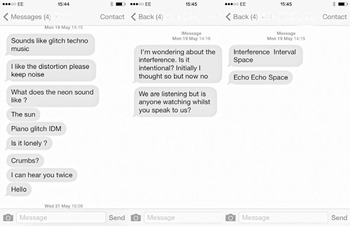
On 19 May 2014, I performed a 15-minute live telematic soundwalk inside the Parasol Unit gallery in Old Street, London as part of the sensingsite event themed as ‘Transcribing Site’.Footnote 6 The piece involved the audience seated in the main conference room listening to my live streamed soundwalk while I used my voice and body to narrate and interact with the spaces’ acoustics, the sounds from the exhibits and the accidental activities taking place. The members of the audience also interacted with me throughout the event by sending text messages (Figure 1), sharing their thoughts, asking questions and instigating me to take actions. These text messages played a pivotal role in ‘freeing-up’ the transmission chain as they prompted my immediate response either by reading the message out loud, responding or performing actions.
Samples of screenshots of the messages received on the performance.

During the performance, the gallery’s different spaces and their acoustics merged with my own passing through them, the past iterations of myself in the same spaces and the audience’s anticipations, altogether amplifying and resounding the gallery’s environment. This networked meshwork of interactions – despite its briefness – engaged and instigated people to reflect on and interact with what was being streamed. My initial plan was to do my soundwalk outside the gallery and my first field visits had taken place in the environs of the gallery which at that time were significantly impacted by major construction work that made my task of finding a meaningful route extremely difficult since for most of the time access to certain paths was denied. Hence the decision to focus my research inside the gallery which, within its microcosm, was another type of transient space with pre-programmed narratives embedded in it (Minton Reference Minton2012).
In preparation for the piece, I spent a week revisiting the gallery, walking around the different rooms, interacting with the exhibition on display, the visitors and taking notes on thoughts and sounds and gradually allowing my internal ‘seep through’ to break into the environment. These fragmentary scribbles were then used for the creation of a text-score video (Video Example 1) that was projected in the event room while I was streaming my soundwalk. Positioned discreetly at the bottom of the screen, the text-score existed as a supportive sounding layer, a sort of unorthodox subtitling that conversed with the incoming sound that at times overlapped and at times not. Elliptical phrases such as ‘Theatre as the eclipse of reality, Sound as the eclipse of reality’ or ‘I am coming up the stairs loudly, decisive steps’ served as remains of my past interactions with the spaces of the gallery as in the second example and my reflections on the conceptual content of some of the pieces on display as in the first example provided. Subtitles, often associated with the notion of foreignness and a discourse around social and cultural politics and policies (Sinha Reference Sinha, Egoyan and Balfour2004: 172–3), are rarely used in ways that negate their ‘translational’ role. The projected text-score, similarly perhaps to Derek Jarman’s Blue (Jarman Reference Jarman1993), offered a silent atmosphere, cleansed by the ‘cacophony of images’, a gateway to the ‘admirable austerity of the void’ (Esch Reference Esch, Egoyan and Balfour2004: 509) where the audience can listen and immerse themselves into the work’s ‘potent distillation of autobiography, historiography, subjective memory and documentary reality’ (Esch Reference Esch, Egoyan and Balfour2004: 510).
Inspired by the idea of overlapping temporalities (past, present and future), one of the themes in Shezad Dawood’s exhibitionFootnote 7 on display during that week, the text-score provided a glimpse into the past, the sounds of exploring the space and the sounds of my thoughts in response to the exhibits while the streamed sound was the link to a (latent) present. The audience’s interactions represented the future in the form of anticipated actions and sounds. Similar to Westerkamp’s soundwalking radio show, these different temporal layers provided a suitable context for the listeners as they made them more aware of the experienced sound environments inside the gallery not only during the time of the performance but also of their experiences before and after.
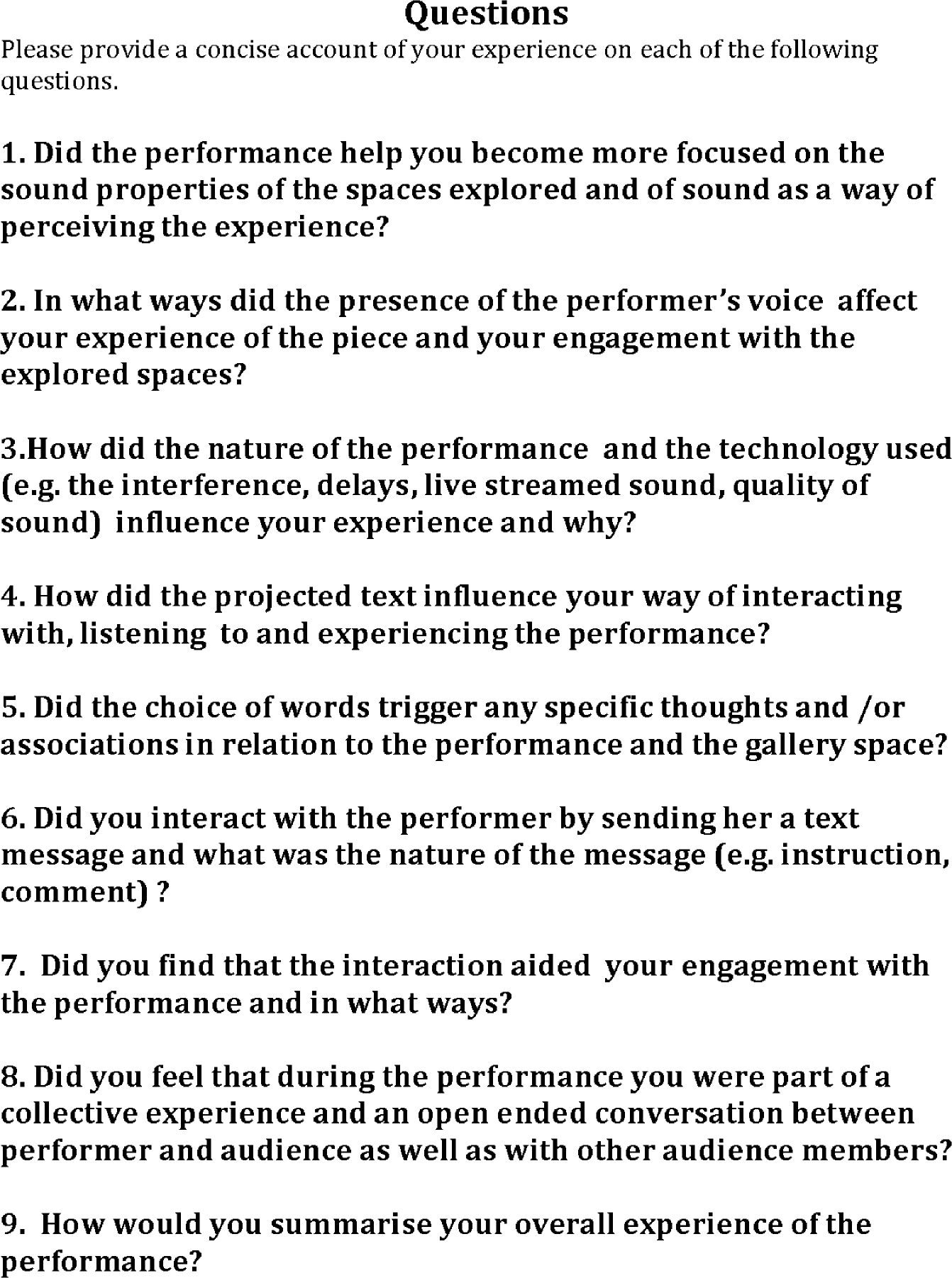
The collective and convivial experience that was formed on the day of the performance managed to balance all these different lines of interactions. On the one hand, the selective use of the voice and the way it coexisted with the other sounds and layers facilitated the emergence of associations and tensions. These were also significantly affected by the particular technology used and more specifically by the occurrence of interference and latency. After the completion of the performance, I circulated via email an assessment of the experience questionnaire (Figure 2) to a total of five audience members, of which two managed to fill it in. In one of the two questionnaires, a member of the audience, when asked about the use of the voice as well as the nature of the technology and how it affected the experience of the performance, replied that: ‘[t]he voice created tension – the distortion and varying quality of transmission made me a more active listener … [t]he technology used highly enhanced the experience. If the transmission was immediate and of perfect, clear quality I would not have engaged as strongly’.
Excerpt from the questionnaire.

On the other hand, the audience’s text messages constantly destabilised my prescribed trajectory and activated a more instinctive mode of conversation with them. Within this context, the text-score provided an ongoing supportive bridge across my transmitted sounds and the acoustic rigidity of the listening room. The internal ‘seep through’ of my listeners emerged in the form of questions about the sound itself, poetic expressions in response to the text-score and the sound, humorous comments and questions about my state of being, how am I feeling or whether it is lonely (see Figure 1). The interplay between the proximity and the distance of the soundstream captured many of the listeners’ imaginations and made them more aware of the possibilities of sound as a catalyst for perception. In the discussion that followed the performance, one member of the audience stated:
what’s so interesting with your piece was the porosity of the building and questions of spatiality of proximity and distance, because you were both very close and yet you were very far away, at the same time … knowing that we were all within the same building.
The projected text-score was in and out of synch with the sound and both created a synergic ‘counter-atmosphere’ in the room that inspired some people to anticipate sounds, to reflect on the incoming sounds or to write text messages in response to it. A member of the audience claimed during our post-performance discussion that the text-score created this space of ambiguity between the recorded sound (text) and the live sound, a sort of anticipation of what to hear. She said, by illustration, in relation to the footsteps on the text-score ‘with the footsteps I was thinking, now she’s going to come in at some point, you know “oh she is coming, oh no she’s not” and the kind of playing with the different senses’.
In the same discussion, another audience member found it very engaging that she could see people sending text messages and then hear the message being read on the stream; hearing other people’s thoughts made them listen differently. The audience’s messages complemented each other and played a significant role in generating not only multidirectionality and a sense of conviviality but also a form of telematic embodiment, where the listener’s own body and voice are augmented through the telematic sound body of the roamer (Manovich Reference Manovich2006). As an audience member expressed in a later performance of A Certain Geography at the University of Hull’s campus, ‘listening to your steps made me think of my own steps, the sound they make or could make in these same environments’.Footnote 8 The emergence of the internal ‘seep through’ of the members of the audience manifested as messages became, through my telematic sound body, a ‘polyphony of utterances’ and a shared loop of communication where my position as a controller of the process was constantly negated by the audience’s interactions.
In a similar manner, the text functioned ‘as a unique monad that in itself reflects all texts … [t]he interconnection of all ideas (since all are realised in utterances)’ (Bakhtin Reference Bakhtin, Emerson and Holquist1986: 105). Going back to Ingold’s idea of the meshwork and Boehme’s gradual formation of meaning, mentioned earlier, we could argue that the interaction and conversation between the audience and myself was an exploration of the different angles and dissident subjectivities that can be perceived through sound and its combination with other senses, the materials of the environment, the materiality of technologies and the sensibilities of those involved in the transmission chain.
The voice – as in works involving soundwalking and taking, for example, Thibaud’s Commented City Walks Footnote 9 – was not merely commenting but integrally activating this meshwork. A member of the audience, during the post-performance discussion, made an interesting comparison to Saskia Olde Wolbers’s installation Yes, These Eyes Are the Windows Footnote 10 by pointing out the common way with which the two pieces through the use of sound, voice and movement amplify the aural porosities of the space and appropriate them to make a new and refreshed angle of perception. With that in mind, one could argue that the performed soundwalk was both a mental and a physical dérive through which the space of the gallery was creatively and playfully rediscovered and created a shared, intimate and tense experience between the audience and myself that felt like a ‘suspenseful ping-ponging between a populated mystery box and another lost and musingly narrative pingpong ball’ as an audience member wrote in the evaluation questionnaire.
In her writing, Amacher discussed how in her notion of perceptual geography a space’s own sounding and the sensations produced internally ‘originating from within human anatomy’ (Amacher Reference Amacher, Cox and Warner2017: 119) are in a constant dialogue, affecting and altering how her music is perceived and composed synergically and intimately through a listener’s body and brain. In a similar way the networked sound in A Certain Geography, as in the preceding case study, creates a bridge across the nodes of the roamer and the listeners, the acoustics of the spaces and in conjunction with the text-score, triggers listeners’ internal and intimate soundings, their ‘seep through’ and consequently a ‘counter-atmosphere’ to the gallery’s staged aesthetics, acoustics and functionality, an opening to new interpretations, the exchange of messages and Guattari’s ‘dissident subjectivities’. The networked meshwork of sound and the telematic body exist not only onscreen in past iterations and onsite through the speakers but also intimately in each listener’s brain, body and memory as the audience responses reveal. Going back to the start of this article, telematic sound, with all its frailty and interference, helped the audience to be ‘[freed-up] from the anxiety of the hyperconscious self-gaze, [and helped] create an opening for spaces of intimacy and in defiance of connectivity’ (Della Ratta Reference Della Ratta2021).
6. CASE STUDY: A CERTAIN GEOGRAPHY – ANCIENT MESSENE
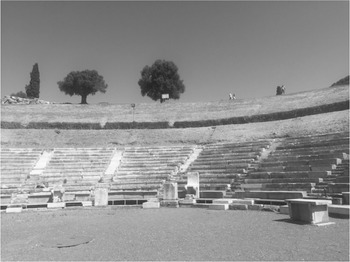
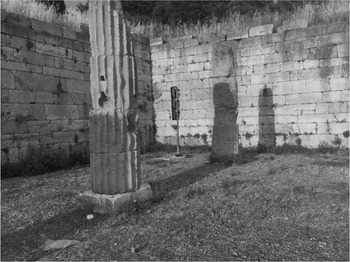
Four years later, in the sunburned and rocky terrain of Ancient Messene in Peloponnese, I searched for the path of water that ran from the northern to the southern part of the ancient city and created a trajectory that follows the flow of civilisation (Sound Example 1) and the possible places where women’s voices existed (Sound Example 2). My performance of A Certain Geography as part of Tuned City – Ancient MesseneFootnote 11 was a unique and challenging iteration of the project in that the site itself required a logistically simpler approach that focused solely on sound. Owing to limitations in signal reception, the option for direct audience participation via text messages/tweets was left out. I also did not have the possibility to project my text-score due to the listening space being an (open air) ancient theatre (Figure 3) and the time of my performance being in the early afternoon, making it therefore impossible to use a projector.
The theatre where the performance of ACG was transmitted to.

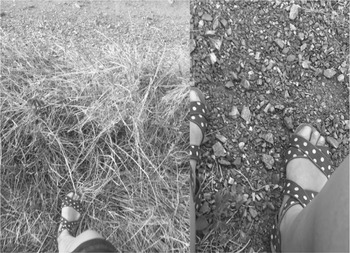
Working with difficulties and the frail nature of the technology, as explained earlier, is an important aspect of the project as it allows for more intimate experiences in defiance of connectivity to emerge. For the purposes of this performance, I chose to focus on creating a text-score with different points of action across the designated trajectory, each point emphasising various characteristics of the soundscape such as its acoustics and reflections, the sound of water, performing footsteps on different terrains (Figure 4), the sound of cicadas, the materiality of the ruins found onsite such as stones, marbles (Figure 5) and the sounds of sound installations happening across the site. Professor Eric Lewis (McGill University) was accompanying me on my soundwalk, performing, from a distance, improvised short interventions with his trumpet, at different points in order to activate the specific acoustic properties of these points.
Footsteps on different terrains.

The penultimate point of action near the Stoa north the Agora.

Each point of action was complemented by a short textual interference referring to relevant historical details, fictionalised through the muted voice of an imagined woman, an inhabitant of the ancient city. These interferences were recorded on a dictaphone using my own voice (Sound Examples 1 and 2) and matched the different points of action marked on the trajectory. Each time I reached an action point I would playback the accompanying interference by placing the dictaphone within the soundscape so it co-existed with other sounds happening at the time and of course my own performative actions. Sound Example 1, for instance, was played at the starting point of the trajectory, near the stadium where the audible flowing stream of the water running through the city culminates.
Sound Example 2 was played at the penultimate point of action, near the Stoa north of the Agora where Raviv Ganchrow’s Agora Circuit (Figure 5) was also installed. The dictaphone was placed in position so that the disembodied voice became enmeshed in the soundscapes of both the installation and the Stoa. As the Stoa was located close to the theatre, the audience could listen the installation directly, too. A member of the audience described the experience of listening to the same sound telematically and site-specifically at the same time as quite intense, making them want to come and look for me. The final action point, happening with me returning/entering the theatre, involved the participation of a member of the audience who performed/read part of the text-score live.
As with all the iterations of A Certain Geography Footnote 12 past the completion of my PhD, feedback from audience members for this performance was received informally through conversations and without the scrutiny associated with it being part of a doctoral research project. The performance was received positively, with members of the audience describing it as meditative and brave due to it being an uphill trajectory and surprising, as many people were not aware that it was performed in real-time. A Certain Geography is a project that experiments, as explained, with the properties of onsite and remote listening of the nodes at play and people felt a strong connection of the piece to acousmatic listening and acousmatic music. The way the transient soundwalk coexisted and unveiled different permanent or semi-permanent sounds of the site resembled, for some listeners, an electroacoustic composition, with different sections and movements. The transmitted soundscapes for some people were very detailed and the way they were infiltrated by the onsite sounds of the theatre created a sense of opacity between the acousmatic and the onsite sounds. The presence of the live and the pre-recorded and disembodied voice added a very strong dramatic effect that some people anticipated hearing in the performance. In fact, A Certain Geography is attuned to the long genealogy of electroacoustic works that use field recordings to engage critically with an environment ‘in order that the listener’s recognition of and associations with these sounds may be invoked’ and ‘[people are] entranced with the experience of a journey’ (Truax Reference Truax2002).
This iteration of A Certain Geography provides further evidence of how telematic sound, stripped off any visual prompts, can trigger Della Ratta’s ‘freeing-up’ while establishing a transient meshwork of responses and interactions. The transposition of fixed and moving nodes in this performance allowed for a complex yet very personal engagement of the audience with the site and the points of action with their complementing textual interferences acted as triggers for the emergence of the listeners’ internal ‘seep through’ and the gradual formation of a meshwork of interactions (in solitude and intimacy). Recalling Fanon’s idea of listening as ‘a productive activity’, A Certain Geography: Ancient Messene, despite the lack of messages, prompted imaginary listenings, mishearings, empathy and anticipation. The telematic sound body became a carrier of polyphonic utterances in the form of pre-recorded, live, onsite and remote sounds. It is in the plurality of mishearing, as mentioned earlier, that dissident subjectivities become relevant within the networked meshwork of interactions, or utterances.
7. CONCLUSION
Hildegard Westerkamp in her lecture titled Radio that Listens refers to radiophonic listening as a process that encourages ‘the listener to turn off the radio and “go out there” to experience the environment in a new, embodied, lived sense’ (Westerkamp Reference Westerkamp2015: 5). In a similar way, A Certain Geography proposes a process of exploration and discovery, of listening and experiencing together by offering a canvas where the streamer’s telematic sound body becomes augmented and extended to the listeners through sounding remote yet close. Both listeners and streamer are in a vulnerable position negotiating their perceptual boundaries, affinities and internal ‘seep throughs’ through a delicate transmission loop prone to interference. The footsteps, voice and silences of the streamer trigger a state of ongoing attention countered and anticipated by the listener. This relational dynamic can be supported by the use of site-specific text-scores. The work-in-progress framework presented in this article scrutinises the use of the network in telematic soundwalking in an effort to appraise the value of networked sound art in the past, as it is reflected through our current trying times. Moving away from singularised teleconferencing platforms that favour the authority of the gaze, projects such as A Certain Geography, through the interpreting lens of the proposed framework-in-progress (never to be completed, never to be singular) offer a bottom-up alternative that augments our present confined selves, through sound, to opacity and porosity and invites us to engage with and reflect on mediated listening, listening-in, to an-other, as a way of listening together, as dissident subjectivities intimately in a process of defiance that infiltrates the actual world and challenges ‘how we might listen to it’ (Voegelin Reference Voegelin2014: 51).
Supplementary material
To view supplementary material for this article, please visit https://doi.org/10.1017/S1355771821000406