INTRODUCTION
The Balearic Islands are located off the coast of the Iberian Peninsula in the Western Mediterranean and occupied a strategic position along the ancient maritime routes that connected Italy with Hispania and Africa with Galia. In the 4th century AD, the Balearics became an independent province within the Roman Empire, and the vast period of transformation into the Medieval Ages was marked by successive Vandal (AD 455), Byzantine (AD 534), and Muslim (AD 902/903) conquests of the islands (Amengual 1991–1992). Until relatively recently Late Antiquity was one of the lesser known periods in the history of the Balearics, but over the last few decades growing interest in Late Antiquity has allowed major advances in the knowledge of this period, which was marked by significant transformations of old Roman structures and the spread of Christianity. While it is true that significant progress has been made in the study of the early Christian churches (e.g. Ulbert Reference Ulbert2003; Cau et al. Reference Cau, Mas Florit, Ripoll, Tuset, Valls, Pons and Rivas2012, Reference Cau, Riera Rullan and Salas2013), pottery assemblages (e.g. Cau Reference Cau2003; Cau et al. Reference Cau, Mas Florit, Reynolds, Riutort, Poulou-Papadimitriou, Nodarou and Kilikoglou2014) and settlement patterns (e.g. Mas Florit and Cau Reference Mas Florit and Cau2011, Reference Mas Florit and Cau2013; Mas Florit and Cau Ontiveros Reference Mas Florit, Cau Ontiveros, Cau Ontiveros and Mas Florit2019), the excavation and analysis of rural necropolises is lacking. Study of early Christian necropolises is largely focused on the cemeteries linked to rural early Christian churches (e.g. Navarro Reference Navarro and Palol1988; Riera Reference Riera Rullan2009). Currently, as it relates to the island of Mallorca, there are no studies of necropolises at rural sites, although it is worth noting that this could be influenced by the fact that only a few rural sites have been partially excavated (e.g. Orfila Reference Orfila2009; Palomar et al. Reference Palomar, Cardona and Munar2013; Mas Florit et al. Reference Mas Florit, Vallori Márquez, Murrieta Flores, Rivas Antequera and Cau2015). Field survey, occasionally combined with geophysical prospection, however, has helped identify other potential rural sites (Mas Florit et al. Reference Mas Florit, Cau, Goossens, Meyer, Sala and Ortiz.2018).
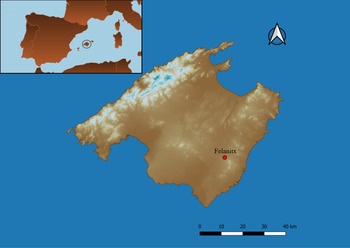
The village of Felanitx lies in a rural area in the eastern part of the island of Mallorca and is home to approximately 17,000 inhabitants (Figure 1). There is evidence of prehistoric and Roman occupation, including one of the few examples of Roman rural villae—called Can Maiol—partially excavated only a few miles away from the current village (Orfila Reference Orfila and Padró1993). The centre of the village has also revealed evidence of Roman activity, although the nature and extent of the Roman settlement is still difficult to establish due to a lack of systematic investigation.
Location of Felanitx in Mallorca in the Balearic Islands (Spain) in the Western Mediterranean.

A rescue excavation brought about by major renovations of one of the buildings in the village (in the 4th of 31 de març street) documented a stratigraphical sequence with several phases, which included evidence of the Roman past. Notably, the ceramic materials recovered from different pits included large quantities of common and cooking wares, some of which presented clear signs of over-firing. This suggests the nearby presence of a ceramic workshop dated to the Early Roman period which was possibly connected to a Roman villa or some other form of rural settlement. In this excavation, the remains of 17 different graves were also identified. The typology of the graves and a revision of the stratigraphical sequence suggests a Roman or late antique chronology for the graves. The inhumations did not provide grave goods except for a bronze belt buckle for which the typological study undoubtedly suggests a late antique chronology.
The stratigraphical sequence suggests the possibility that the space evolved over time since some graves were cut by others. Additionally, the use of a single grave with several inhumations was investigated. In order to obtain an absolute dating for the necropolis and to verify if there are chronological differences among the graves, a total of six human bone samples have been radiocarbon dated by AMS. Given that late antique rural necropolises in Mallorca are understudied (Navarro Reference Navarro and Palol1988; Riera Reference Riera Rullan2009) and that very few examples have been radiocarbon dated (Cau et al. Reference Cau, Mas Florit, Reynolds, Riutort, Poulou-Papadimitriou, Nodarou and Kilikoglou2014), this investigation filled crucial gaps in our knowledge of this topic.
The necropolis
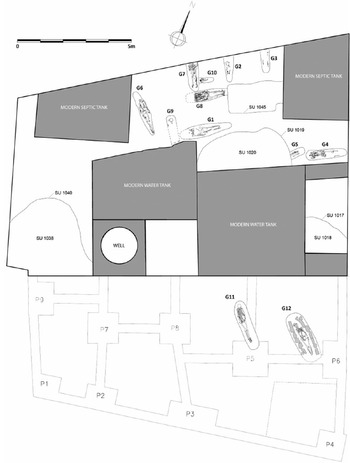
The excavation revealed that much of the plot was altered due to construction linked to modern features such as cisterns, septic tanks and sewers, although underneath a necropolis of inhumation burials (Figure 2) was uncovered which cut the natural terrain and layers from the Roman period. The stratigraphical sequence outlines four main different phases. Phase 4 is represented by contemporary construction dated to 1945 with different renovations throughout the 20th century. A second phase (Phase 3) was probably linked to a leveling of the area and its use as a cultivation field between the 16th and the 18th centuries. Phase 2 corresponds to the necropolis of inhumation burials presumably related to the late antique period. Finally, Phase 1 is the Roman occupation with important ceramic deposits mostly dated to the 2nd century AD, including, as we have already mentioned, common and cooking ware wasters from a pottery workshop that was presumably located in the vicinity, likely belonging to a Roman villa.
Plan of the excavations of the building with the necropolis in the center of Felanitx.

Phase 2, the necropolis containing a total of 17 graves, is the focus of this article, of which 12 graves were excavated (Figure 2). Of these, number 13 and 14 were documented in the stratigraphic profile of a cesspool, number 15 in the stratigraphic profile of the elevator hole and number 16 and 17 at the boundaries of the excavation area of the site. In the case of graves 16 and 17 a full excavation was not possible; however, during the cleaning of the profiles of tombs number 14 and 15, some skeletal remains were recovered that have been included in the anthropological study.
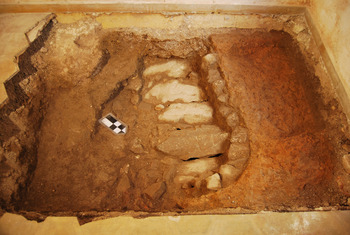
The graves consist of long pits in the ground with the head normally wider than the foot, and probably covered with flagstones suspended in a lateral step, as it can be clearly seen in Grave 1 for instance (Figure 3). In this particular case, the perimeter was also delimited with an alignment of small stones. It is possible that the flagstones of many graves were destroyed when this area of the village was used as a cultivation field in the past. The graves located towards the northeast were also poorly preserved due to the construction of the contemporary building. In general, the skeletons appeared in a poor state of preservation. Graves 2, 3, and 7 were not completely excavated as they continued underneath the limits of the building. Other graves were damaged by recent structures and layers (Graves 4, 5, 8, and 9).
Grave covered with flagstones.

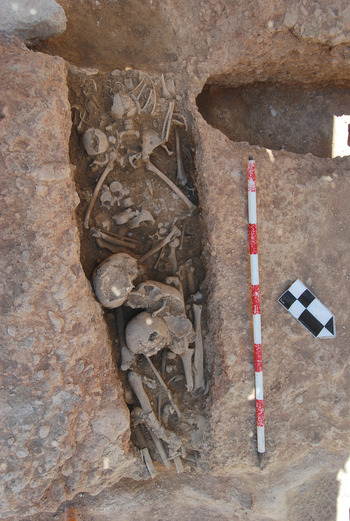
The orientations of the graves were predominantly NW to SE (Graves 2, 3, 6, 7, 8, 11, 12) and SW to NE (Graves 1, 4, 5, 10). Individuals all appear buried in supine decubitus position with the lower limbs extended. The upper limbs appear mostly extended along the body, although there are also cases in which one or both hands rest on the pelvis. As far as the type of burial is concerned, these are individual tombs with the exception of tombs 7 and 8, which are multiple burials containing 2 and 8 individuals, respectively. In Grave 6, the skeleton was relatively well-preserved, and it seems to belong to an infant (SU 1016). Grave 7 is a collective grave with a minimum of two individuals consisting of a juvenile individual buried in supine position (SU 1024) and deposited at the bottom of the grave, and an infant inhumation (SU 1023) with the head over the pelvis of the first individual and the limbs extended towards the lower part of the grave. The bones appeared in a good state of preservation. Grave 8 was also a collective burial with a minimum number of 8 individuals (Figure 4). Located in the upper part of the grave was a perinatal semi-articulated but incomplete individual (SU 1041). Below there was an infant/juvenile individual articulated but again incomplete (SU 1027). Next the skeleton of an adult individual, probably a male, was found in good condition (SU 1042). Finally, lying at the bottom of the grave was another individual partially articulated (SU 1043). The rest of the individuals, up to eight in number, were identified after the excavation following an anthropological study, and were represented by only a few bones. During the excavation of the fill of Grave 4 a white tessera from a mosaic was recovered. In general, there were no grave goods except for a belt buckle found in Grave 8 that was relatively well-preserved.
Detail of Grave 8 collective.

Physical anthropology reveals that of the 17 documented tombs remains have been recovered in 14 of them, and a total of 22 individuals have been studied. By sex, 6 female individuals, 5 male, and 11 indeterminate have been documented, most of them being sub-adult individuals. The morphology of the skull and postcranial skeletons correspond to a Mediterranean-type population. The most abundant pathologies are those related to age (degenerative), some arthropathies and dental diseases, as well as some traumas. The number of individuals from the Felanitx necropolis is low, so it is not sufficient enough to provide conclusive data on some aspects of this population.
MATERIALS AND METHODS
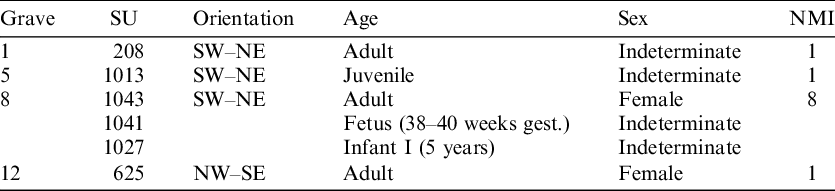
A total of six human bone samples from six different individuals coming from four different graves were selected for radiocarbon dating. The archaeological information of the samples under examination is provided in Table 1. All samples come from inhumation burials. The selection of the samples was made following the stratigraphical sequence of the site to verify whether or not these were synchronous burials, and considering also the state of preservation of the inhumations. In this way, we selected three individuals (SU 208, 625, and 1013) from three different graves (Grave 1, 5, and 12 respectively). In addition, with the specific aim of investigating if there were meaningful differences in the date of the inhumations found in the multiple burial (Grave 8), we sampled three bones from three different individuals buried in the same grave, considering its relative physical position inside the grave and the state of preservation.
Main archaeological information of the necropolis, indicating those that have been radiocarbon dated. Sample characteristics.

The samples were 14C dated by AMS at the Dating Laboratory of the Royal Institute for Cultural Heritage, KIK-IRPA (RICH) in Brussels, Belgium (Boudin et al. Reference Boudin, Van den Brande, Synal, Wacker and Van Strydonck2015). They were subjected to a pretreatment to eliminate all exogenous contaminants like chemical compounds of different age or contamination due to handling after the exhumation of the material and to retrieve the pure collagen of the bones used for dating. The superficial adhesions and the patina covering the surface of the bone fragments were removed with a metal brush and the remains of adhesive were removed by abrasion. Then the bones were fragmented in a longitudinal axis to remove soil and other impurities from the inner part. Finally, the material was ground to a granulometry of less than 250 μm.
The bone material was treated with hydrochloric acid 1% to eliminate the bone mineral fraction and potential carbonates from groundwater. An additional wash with 1% NaOH to remove humic acids was carried out. The hydrolysis was applied at 90°C for 10 hours at pH3 (Longin Reference Longin1971). The samples were dried by freeze-drying and the C:N ratio was measured.
Hereafter, samples were transferred into quartz tubes with CuO and Ag and combusted to CO2. Graphitization of CO2 was carried out using H2 over a Fe catalyst. Targets were prepared at the Royal Institute for Cultural Heritage in Brussels (Belgium) following Van Strydonck and Van der Borg (Reference Van Strydonck and Van der Borg1990–1991) and dated by AMS using a MICADAS (Boudin et al. Reference Boudin, Van den Brande, Synal, Wacker and Van Strydonck2015). A small part of the collagen sample was used for C:N ratio using a Thermo-Flash EA/HT elemental analyzer (Thermo Fisher Scientific, Bremen, Germany). Standards used were IAEA-N1, IAEA-C6, and internally calibrated acetanilide. The analytical precision was smaller than 0.25‰ for both δ13C and δ15N values, based on multiple measurements.
RESULTS OF THE 14C DATING
Although bone collagen is not susceptible to carbon exchange with the environment, sometimes the formation of humic-protein compounds is possible. Due to the fact that the humic acids from soils normally exhibit a different age with respect to the bone, this could result in a rejuvenation or ageing of the results and, consequently, a corruption of the radiocarbon result. In addition, as it is well-known, the probability of a humic acid protein complexation increases with the degree of decay of the bone, which is evident with a low content of collagen (Boudin et al. Reference Boudin, Bonafini, Van den Brande and Vanden Berghe2017).
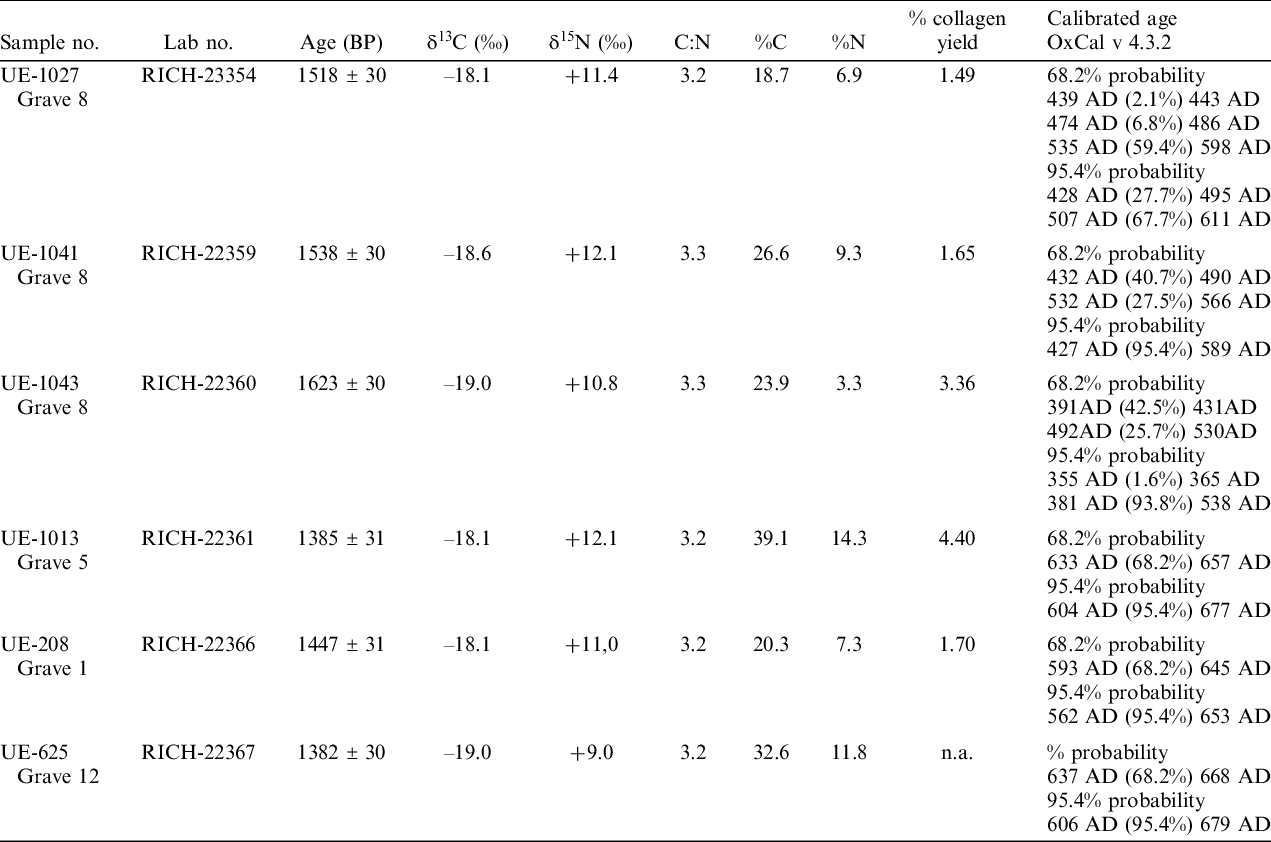
Since the collagen content in the dated bones is low (Table 2) (well preserved bones have a collagen content above 2%), it was necessary to test the bone quality by measuring the C:N ratio (Van Klinken Reference Van Klinken1999). For well-preserved fossil bones the collagen C:N ratio must be between 2.9 and 3.6 (de Niro Reference de Niro1985), while fresh bone collagen has a C:N ratio of 3.1:3.2. The table shows that the experimental value and the C:N ratio referring to material does not exceed the critical interval (Table 2), which demonstrates the absence of humic-protein compounds in the collagen used for dating and provides greater confidence in the accuracy of the data for the radiocarbon dates obtained. It has to be noted, however, that De Niro’s criterion holds for the C:N ratio in the case of stable isotope studies, but radiocarbon analyses are much more sensitive to contamination. RICH-22367 yielded very few collagen (< 0.1%, out of 3 g bones). The collagen was white and fluffy and indicates good quality.
Calibration of the radiocarbon dates.

n.a; = not anlayzed. Note: %collagen yield of RICH-22367 could not be analyzed. There was little collagen and in order to radiocarbon date, the collagen was dissolved in water and transferred as a liquid into the combustion tube, dried in a desiccator and combusted for graphitization.
The stable isotope data are represented in Table 2. The average δ13C and δ15N values for this dataset are respectively –18.5 ± 0.4 and +11.1 ± 1.1. This result is comparable with the average values (δ13C –19.2 ± 0.5 and δ15N 11.1 ± 1.1) for late prehistory (the last 5 centuries BC) (Van Strydonck et al. Reference Van Strydonck, Boudin, Ervynck, Orvay and Borms2005). The results are also comparable with the Medieval Christian sites (Van Strydonck et al. Reference Van Strydonck, Boudin and Ramis2018) although the δ15N value is somewhat higher (δ13C –19.0 ± 0.7 and δ15N 10.3 ± 1.2). In no way the data suggest any reservoir effect due to consumption of marine food that could have altered the radiocarbon results (Cau et al. Reference Cau, Van Strydonck, Boudin, Mas Florit, Mestres, Cardona, Chávez and Orfila2017).
The radiocarbon dates are also represented in Table 2. In addition, the calibrated dates are shown in Figure 5. Calendar ages were determined using OxCal v 4.3.2 program (Bronk Reference Bronk Ramsey1995, Reference Bronk Ramsey2001) with the terrestrial calibration curve IntCal13 (Reimer et al. Reference Reimer, Bard, Bayliss, Beck, Blackwell, Bronk Ramsey, Grootes, Guilderson, Haflidason, Hajdas, Hatte, Heaton, Hoffmann, Hogg, Hughen, Kaiser, Kromer, Manning, Niu, Reimer, Richards, Scott, Southon, Staff, Turney and van der Plicht2013).
Radiocarbon dates calibrated AD.

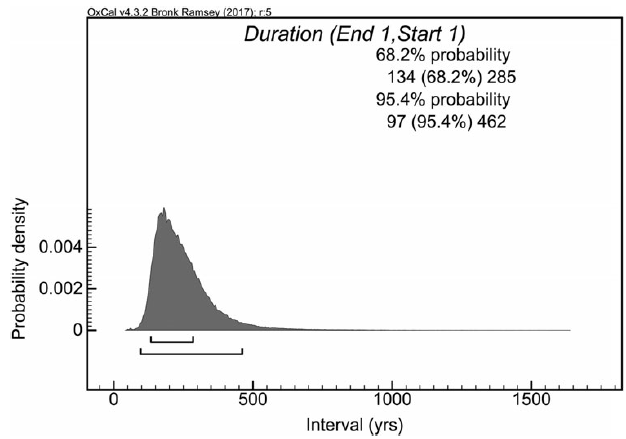
The six dates form a continuous series with overlapping probability distributions. Due to some small wiggles in the calibration curve the oldest calibrated dates cover a wide time range of about two centuries which makes these dates less precise. In order to estimate the duration of the necropolis usage the 14C data were put in a sequence to estimate the boundaries using OxCal v 4.3.2 (Figure 6). Hereby, the difference of the boundaries was calculated showing an occupation of 365 cal years with 95.4% probability (Figure 7).
The radiocarbon dates of the necropolis of Felanitx in a sequence using OxCal v 4.3.2.

An estimation of the duration the necropolis of Felanitx using OxCal v 4.3.2.

DISCUSSION AND CONCLUDING REMARKS
The results of the radiocarbon dating on the six bone samples provide an absolute chronology for different inhumations of the necropolis found in the village of Felanitx in Eastern Mallorca in what probably was a rural necropolis. As we have seen, studies of late antique necropolises on the island of Mallorca are scarce and to date only a few examples have been radiocarbon dated. Knowledge about rural necropolises comes mainly from those related to early Christian rural churches (Riera Reference Riera Rullan2009; Cau et al. Reference Cau, Mas Florit, Reynolds, Riutort, Poulou-Papadimitriou, Nodarou and Kilikoglou2014), with the exception of a radiocarbon date obtained from a burial found at the Roman villa of Sa Mesquida (still unpublished). This is the first set of samples from a necropolis probably related to a Roman rural site with evidence of occupation during Late Antiquity that we are aware of in Mallorca. In the western Mediterranean, the presence of burials in different parts of a villa is a well attested phenomenon (Chavarría Reference Chavarría2007) during Late Antiquity and this could well be the case of these graves found in Felanitx.
The necropolis was built over an area of a Roman site that during early Roman times was used as a pottery workshop that produced cooking and common ware pottery. According to the 14C dating results, the samples form a continuous series and are dated between the 4th to the 7th century AD. This wide chronology coincides with the archaeological material, but unfortunately is not very useful in historical terms. The presence of a Byzantine bronze belt buckle inside of Grave 8 points towards a late antique dating for the grave. This piece can be classified as a Bologna E7/E8 type buckle dated to the first half of the 7th century or possibly to the second half of the same century (Schülze-Dörrlamm Reference Schülze-Dörrlamm2002, Reference Schülze-Dörrlamm2009). Although the belt buckle cannot be related in particular to any of the individuals analyzed in the collective grave, the dating is within the timeframe proposed for all the samples which have been radiocarbon dated.
Samples RICH-22366 (SU 208) from grave 1, RICH-22361 (SU 1013) from grave 5, and RICH-22367 (SU 625) from grave 12, reveal a more precise dating into the seventh century, but it is difficult to propose different phases as the radiocarbon dates form a continuous series. It is important to highlight that three individuals with a poorer chronology (US1043, US1041, and US1027) were buried in the collective grave (G8) and their deposition seems contemporary to one another. Could this collective deposition have been related to a disease or another traumatic event?
All the aspects of funeral ritual at this necropolis correspond to the established Christian canons of the era. Further work is still needed: by increasing the number of samples from other rural necropolises around the island we will be able to obtain an integrated and more precise dating of the rural necropolises and better understand the evolution of the rural sites during Late Antiquity.
ACKNOWLEDGMENTS
This contribution is part of the results of the project Archaeology, Remote Sensing, and Archaeometry: A multidisciplinary approach to landscape and ceramics from the Roman to the Medieval period in Mallorca (Balearic Islands) (ARCHREMOTELANDS) (HAR2017-83335-P), PI: Miguel Ángel Cau Ontiveros, funded by the Ministerio de Ciencia, Innovación y Universidades, with contribution from the European Regional Development Fund from the European Commission. This is also part of the activities of the Equip de Recerca Arqueològica i Arqueomètrica de la Universitat de Barcelona (ERAAUB), Consolidated Group (2017 SGR 1043), thanks to the support of the Comissionat per a Universitats i Recerca del DIUE de la Generalitat de Catalunya. The work of C. Mas Florit was possible thanks to a Juan de la Cierva Incorporación grant from the Ministerio de Ciencia, Innovación y Universidades from the Spanish Goverment, and a Beatriu de Pinós postdoctoral fellowship from the AGAUR, with the support from the Secretaria d’Universitats i Recerca of the Departament d’Economia i Coneixement of the Generalitat de Catalunya. We are indebted to Gisela Ripoll for her help with the classification of the belt buckle. We would like to thank the editors and the anonymous reviewer whose suggestions helped to improve this paper.