1. Introduction
Trust can be defined as having faith in something or someone. It is, thus, an important component of all successful commercial exchanges. Trust facilitates trade by reducing transaction costs and its absence can make transacting costly or even impossible. If sellers do not trust that buyers will actually pay them, they will be reluctant to deliver the goods and services that they have for sale. Similarly, if buyers do not trust that sellers will actually deliver the desired goods or services, they will be reluctant to pay for those goods and services. If trading partners do not trust one another, they must take steps, potentially very costly steps, to mitigate the potential of betrayal, fraud and malfeasance. Not surprisingly, numerous studies have concluded that trust is positively related to economic growth and development (e.g. Algan and Cahuc, Reference Algan and Cahuc2010, Reference Algan, Cahuc, Aghion and Durlauf2013; Chamlee-Wright, Reference Chamlee-Wright1997; Choi and Storr, Reference Choi and Storr2018, Reference Choi and Storr2020; Fukuyama, Reference Fukuyama1995; Guiso et al., Reference Guiso, Sapienza and Zingales2009; Ingram and Roberts, Reference Ingram and Roberts2000; La Porta et al., Reference La Porta, Lopez-de-Silanes, Shleifer and Vishny1997; Tabellini, Reference Tabellini2008; Torsvik, Reference Torsvik2000; Zak and Knack, Reference Zak and Knack2001).
Indeed, there is now a considerable literature on the economic importance of trust as well as the relationship between trust and institutions. For instance, using macro-economic data, Zak and Knack (Reference Zak and Knack2001) demonstrated a positive correlation between trust, GDP growth and investment levels. Similarly, La Porta et al. (Reference La Porta, Lopez-de-Silanes, Shleifer and Vishny1997) found evidence of a positive correlation between the proportion of trusting people and GDP growth across countries. Similarly, Guiso et al. (Reference Guiso, Sapienza and Zingales2009) found that higher levels of bilateral trust (between citizens of two countries) led to larger volumes of trade between said countries. Guiso et al. (Reference Guiso, Sapienza and Zingales2004) also found that households from high-trust regions were less likely to hold cash or use informal credit and more likely to use checks, invest in securities and use formal credit. And Guiso et al. (Reference Guiso, Sapienza and Zingales2008) found that less trusting individuals were less likely to invest in stocks. Keefer and Knack (Reference Keefer and Knack1997) found evidence of a positive correlation between trust and economic performance. Trust, they found, was stronger in countries with well-established formal institutions that protect property rights, enforce contracts and restrict governments from acting arbitrarily. Furthermore, societies with higher levels of trust seem to also have more efficient judicial systems (Berggren and Jordahl, Reference Berggren and Jordahl2006), higher-quality government bureaucracies (Putnam, Reference Putnam1993), less government intervention (Aghion et al., Reference Aghion, Algan, Cahuc and Shleifer2010), less corruption and better financial markets (Guiso et al., Reference Guiso, Sapienza and Zingales2004; La Porta et al., Reference La Porta, Lopez-de-Silanes, Shleifer and Vishny1997). Using data from US states, Dincer and Uslaner (Reference Dincer and Uslaner2010) reported that a 10 percentage point increase in trust improved the GDP growth rate by 0.5 percentage points and the manufacturing employment growth rate by 1.3 percentage points over a 5-year period. Brown et al. (Reference Brown, Gray, McHardy and Taylor2015) also found that the magnitude of employees' trust in their managers was positively associated with firm-level financial performance, labor productivity and the quality of the firm's product. Similarly, Gennaioli et al. (Reference Gennaioli, Shleifer and Vishny2015) argued that when investors trusted their portfolio managers, they were willing to pay higher fees and viewed investments as less risky. And Goergen et al. (Reference Goergen, Chahine, Brewster and Wood2013) showed that trust shared by managers and employees positively affected reported measures of relative performance of the firm in its industry.
Although there is now a sizeable empirical literature on the economic importance of trust and on the institutions that are associated with higher levels of trust, this literature remains relatively silent on, more generally, the potential of markets to generate trust and, more specifically, how market actors discover whom to trust and, perhaps more importantly, whom not to trust. It is relatively silent on how people identify trustworthy and untrustworthy individuals in market settings and on how market institutions help market actors discover whom to trust and to not trust. In this paper, we build on research that understands the market as a discovery process (Hayek [1945] Reference Hayek and Caldwell2014, Reference Hayek1976; Kirzner [1973] Reference Kirzner2013; Lavoie, Reference Lavoie1986). The market process, we contend, is not merely an entrepreneurial process through which previously unexploited profit opportunities are uncovered. It is not merely a competitive process in which prices and other economic information are revealed and through which resources are allocated to their most highly valued use. We argue that the market is also a discovery process through which market participants acquire first-hand knowledge about their trading partners' dispositions, moral priorities and personalities. The market facilitates the identification of trustworthy and untrustworthy individuals and is, thus, a process for the discovery of whom to trust and whom not to trust. We focus on the market as a process for the discovery of whom not to trust because of the importance of avoiding the downside risks associated with trading with an untrustworthy or unscrupulous trading partner.
The remainder of the paper is structured as follows. Section 2 reviews how Hayek and Kirzner understood the market as a discovery process. It is important to review this literature both to highlight the critical role that discovery plays in the market, particularly for market process theorists, and also to note the limited way in which they discussed discovery. For Hayek and Kirzner, market participants discover market conditions, their own tastes and the tastes of others, resource availability and existing technological possibilities. In section 3, we argue that market participants can also discover whom not to trust, i.e. which participants are unlikely to follow through on their promises. Indeed, market institutions facilitate the discovery of untrustworthy actors. This, of course, leaves open the question of how this process works in market settings. Section 4, then, presents experimental evidence that suggests that although market participants are trusting of strangers (at least in our experimental setting), they are less trusting of trading partners who have proven to be untrustworthy in past dealings. In particular, our subjects seemed to offer strangers the benefit of the doubt, i.e. they treated subjects that they had not interacted with before the same as they treated subjects that they had positive interactions with in previous dealings. But our subjects treated those that they had negative interactions with in previous dealings worse than both positive relations and strangers. Our experimental evidence is consistent with subjects discovering whom not to trust (i.e. when they learned that someone was untrustworthy, they trusted them less). Our intent in presenting this experiment is not to provide a smoking gun or to experimentally test the proposition that markets facilitate the discovery of whom not to trust. Instead, we hope our discussion of the experiment will highlight the possibility that the market can function as a procedure for the discovery of whom to trust and to not trust, the market institutions that facilitate this kind of discovery, and the mechanisms through which it occurs. Absent an opportunity to conduct fieldwork, it is our view that an experiment of this sort is the best way to illustrate this phenomenon.Footnote 1 Section 5 offers concluding remarks.
2. The market as a discovery procedure
In his famous ‘The Use of Knowledge in Society’, Hayek ([1945] Reference Hayek and Caldwell2014) explored how a society could efficiently and effectively coordinate its economic activities even though the knowledge that is required to do so is held by numerous individuals, many of whom may not even be aware of the knowledge they possess. This knowledge of ‘time and place’ is the knowledge of local conditions, of our own particular desires and constraints, of available resources, of opportunities, of the challenges we must overcome, and of the particular processes and know-hows involved in making the products we produce or in offering the services we provide. ‘The economic problem of society’, wrote Hayek (ibid.: 93–94; emphasis added), ‘is … a problem of how to secure the best use of the resources known to any of the members of society, for ends whose relative importance only these individuals know. Or, to put it briefly, it is a problem of the utilization of knowledge which is not given to anyone in its totality’. In other words, for Hayek, the coordination of economic decisions and actions by individuals with diffuse, local knowledge, who are pursuing their plans, is the economic problem that every advanced society must solve.
Hayek recognized that, by its very nature, this type of knowledge did not lend itself to being easily captured and shared with a central authority. As such, he argued, a centrally planned economic system simply cannot ensure that this diffuse and local knowledge is effectively put to use. Instead, a society must adopt a decentralized economic system if it wants to ensure that the knowledge of time and place is first discovered by relevant actors and then effectively utilized (ibid.: 98). As Hayek ([1968] Reference Hayek and Caldwell2014: 306) explained, ‘which goods are scarce goods, or which things are goods, and how scarce or valuable they are – these are precisely the things which competition has to discover’. For Hayek, it was only through a competitive system that efficient coordination of economic activities could be achieved.
Interestingly, for Hayek, the discovery that takes place in a market does not involve scenarios where individuals deliberately search for information that they knew they lacked. Instead, discovery in the market more resembles scenarios of surprise, where individuals unexpectedly have an epiphany, learn something previously unknown about the state of the world, or gain some insight about something that was made available to them that they nonetheless previously overlooked. Therefore, the market reveals profitable information or insights (i.e. some nuggets of intuitive wisdom or useful information that are not immediately and readily apparent). In addition, according to Hayek, individuals acting on their own volition, according to their own plans, in the market generate and receive market signals (in the form of prices) that communicate information about what goods and services are desired and not desired, how intensely they are desired (relative to other goods and services), and more. Individuals then incorporate the information they discover in their subsequent economic decisions and respond to market signals to the best of their ability using their particular knowledge. The market, yet again, will provide feedback on their actions and experimentations by satisfying or disappointing their expectations through profits and losses. This repeated iteration in the market is what Lavoie (Reference Lavoie1986: 8) also referred to as the ‘dialog’ of the market.
Market process theorists have stressed that this dialog has a central figure. Kirzner viewed the entrepreneur as the agent of discovery within the market. For Kirzner (Reference Kirzner[1973] 2013: 55), the market is constantly in a state ‘characterized by widespread ignorance’ where market participants are unaware of the available and real opportunities for mutually beneficial market exchange. This ignorance, he thought, arose out of the sheer fact that individuals are merely human and can make errors. For example, not knowing an even more willing buyer was around the corner, a seller may have sold her wares at a price lower than what she could have reaped. Similarly, a buyer may have bought products at a price higher than what she might have paid because she did not know that a seller was selling the same good for less just next door. In another instance, an individual may have formulated a business strategy built on an expectation about others' plans and decisions that, for one reason or another, just do not come to fruition. For Kirzner, the entrepreneur served as a coordinating force. As Kirzner (ibid.: 12) described,
The pattern of decisions in any period differs from the pattern in the preceding period as market participants become aware of new opportunities. As they exploit these opportunities, their competition pushes prices in directions which gradually squeeze out opportunities for further profit-making. The entrepreneurial element in the economic behavior of market participants consists … in their alertness to previously unnoticed changes in circumstances which may make it possible to get far more in exchange for whatever they have to offer than was hitherto possible.
The entrepreneur is alert to and so discovers arbitrage or profit opportunities, i.e. opportunities to buy at a lower price and sell at a higher price, which already exist and are waiting to be noticed. Upon discovering a profit opportunity, the entrepreneur will attempt to exploit it (ibid.: 30n). And, once she exploits the opportunity, she will either gain profits or experience losses. In this way, the entrepreneur ‘brings into mutual adjustment those discordant elements which resulted from prior market ignorance’ (ibid.: 58). For Kirzner (Reference Kirzner1997: 62), the entrepreneurial market process is a discovery process because the entrepreneur within that setting is ‘gradually but systematically pushing back the boundaries of sheer ignorance, in this way increasing mutual awareness among market participants’.
3. What do actors discover in a market?
Market process theorists have emphasized that the market is a place where market actors discover a great deal of market-relevant information such as prices and profit opportunities. Hayek also believed, however, that market participants were capable of learning about their environment and the people with whom they trade. ‘The function of competition’, expanded Hayek ([1948] Reference Hayek2014: 109; emphasis in original text),
is here precisely to teach us who will serve us well: which grocer or travel agency, which department store or hotel, which doctor or solicitor, we can expect to provide the most satisfactory solution for whatever particular personal problem we may have to face. Evidently in all these fields competition may be very intense, just because the services of the different persons or firms will never be exactly alike, and it will be owing to his competition that we are in a position to be served as well as we are.
Kirzner also discussed what we discover in market settings beyond prices and profit opportunities. In order for entrepreneurs to be agents of discovery and respond to newly acquired information and changing market conditions, learning across a range of domains must be taking place. Individuals, Kirzner (Reference Kirzner[1973] 2013: 56–57; emphasis in original text) wrote,
learn from their experiences in the market. It is necessary to postulate that out of the mistakes which led market participants to choose less-than-optimal course of action yesterday, there can be expected to develop systematic changes in expectations concerning ends and means that can generate corresponding alterations in plans. Men entered the market yesterday attempting to carry out plans based on their beliefs concerning the ends worth pursuing and the mean available. These beliefs reflected expectations concerning the decision other men would be making. The prices a market participant would sell and the prices he expected to have to pay for the resources or products he would buy all went to determine the optimum course of market action for him. The discovery, during the course of yesterday's market experiences, that the other market participants were not making these expected decisions can be seen as generating changes in the corresponding price expectations with which market participants enter the market today.
In essence, market participants can and do learn about continually changing market conditions, tastes, resource availability and existing technological possibilities. Additionally, as Kirzner (ibid.: 8) seemed to suggest, individuals also learn something about other people by merely observing their behavior and decisions as they navigate the market.
Often what individuals discover and communicate in the market is knowledge that is readily observable and easily articulable. Lavoie (Reference Lavoie1986), however, added that much of the knowledge that is discovered in the market is inarticulate knowledge. As Lavoie (ibid.: 1) explained,
the ‘inarticulate’ nature of much of the knowledge is meant the knowledge of how to do something successfully (e.g. ride a bicycle) without the further knowledge of how to explicitly say how the thing is actually accomplished such as that in order to keep one's balance on a bicycle it is necessary to compensate for a given angle of imbalance, by steering the bike so as to make a curve of which the radius r should be proportionate to the square of the velocity over the angle of imbalance.
Conveying and discovering inarticulate knowledge of this kind is critical for success within markets.
Lavoie (ibid.: 2) emphasized that this inarticulate knowledge is the ‘“know how” to operate their business relatively efficiently’, not the ‘know that’ producers are employing a certain production technique that complies with the efficiency standards of neoclassical economics. As Lavoie (ibid.: 9; emphasis added) explained,
the essence of the ‘knowledge problem’ argument is not simply that plant managers know things that the CPB [or Central Planning Board] does not, or that communication of this knowledge by the former to the latter would … entail the losing some data or accuracy. The problem is rather that the relevant knowledge is inarticulate. The producers know more than they can explicitly communicate to others. While the market marshals this dispersed knowledge without requiring its articulation all these market-socialist models necessarily require the full articulation of the localized knowledge to the CPB during the ‘dialogue’. The plant manager must be able to say which production technique, including specific quantities of all the inputs needed, he will use for any of the configurations of tentative pries suggested to him at each iteration of the dialogue.
Stated another way, only the market renders this otherwise unusable, inarticulate knowledge into usable information discoverable by the market actors who can best put it to use.
Furthermore, much of the articulate information conveyed by prices is only made intelligible against the backdrop of the particular market context, or ‘a wide background of inarticulate knowledge gleaned from a vast experience of habitual productive activity’ (ibid.: 16). Prices as numbers, Lavoie reminded us, are not the only pieces of information that the market transmits. ‘On the contrary’, Lavoie (ibid.) explained, ‘it is only because of the underlying inarticulate meaning attached to the priced goods and services that prices themselves communicate any knowledge at all’. Although the possessor of inarticulate knowledge may not be able to articulate it to anyone, she can recognize its relevance and usefulness, given the particular context of the market, and can adjust her plans to it and from it in the market.
Combined, the insights from Hayek, Kirzner, and Lavoie suggest the market is a discovery process for articulate and inarticulate knowledge including but certainly not limited to prices and profit opportunities. The market is ever-changing. Over time, consumer tastes grow more sophisticated, our technological capabilities improve with research and development, resources that were once available becomes unavailable (and those that were once unavailable becomes available), and more. The market teaches participants about changing conditions through the price system. And, from the sheer act of buying, selling, and pursuing their own plans in the market, we learn new information about goods, services, and the trading partners with whom we interact. In addition, we also learn something about the market environment by observing others' actions and behaviors. Some of this information we learn may be articulable, easily shared with a third party such as a central planner if asked. However, some of this information can also be tacit and not articulable. This kind of knowledge tends to be exclusive to the particular time and place and we often do not know that we possess such knowledge, nor do we immediately realize its relevance.
Some of this knowledge that the market reveals is about people. For instance, the market teaches us who can provide a particular resource, good, or service and who can produce said good or service the cheapest without sacrificing the quality. Additionally, we also form impressions about the people with whom we interact and observe in the market. That so and so pays attention to details, or is unscrupulous, or failed to deliver what she promised, or always works diligently, or tends to overcharge for services, or is trustworthy, can often be readily observed and conveyed to others. We also learn something about our trading partners that we cannot easily and succinctly explain. Colloquially, people often comment about a business acquaintance who seems ‘shady’ or gives off ‘bad vibes’.
The (articulable and inarticulate) knowledge about others that we gain through our interactions in the market is incorporated into our decision to continue or discontinue trading with them. Furthermore, we share this information with friends when we are asked about the acquaintance. Although much of economics has downplayed (if not dismissed) the value of this kind of information when making decisions on whom to trade with, such information can be the determining factor at the margin. Stated differently, when we are determining who we can expect ‘to provide the most satisfactory solution for whatever particular personal problem we may have to face’ (Hayek [1948] Reference Hayek2014: 109), we will utilize the impressions we have formed about our trading partners beyond their capabilities narrowly defined. We will also concern ourselves with, among other things, who is trustworthy and who is not trustworthy.
In short, the market can also be a discovery process for whom to trust and, importantly, whom not to trust. That people can discover whom to trust and whom not to trust in the market is an important insight, given how important trust is to the functioning of markets. Recall that trust facilitates trade by reducing transaction costs. Moreover, the absence of trust can make transacting costly or even impossible. Although recognizing that the market can be a process for the discovery of whom to trust and whom not to trust is important, especially since it has not been stressed by even market process theorists, noting that market actors learn who is trustworthy does not speak to how market institutions facilitate this learning. It also does not offer any evidence that what seems possible (i.e. the discovery of whom to trust and to not trust) does in fact occur in markets, nor does it speak to whether learning whom to trust or learning whom not to trust is more important.
We believe that the institutions that facilitate exchange in the market (such as private property, freedom to contract, and rule of law, along with many others), also create an environment where people learn whom to trust and whom not to trust.
First, there is an opportunity for opportunism with every market exchange. As such, exchange is an institution that allows market participants to learn about the trustworthiness of others (Arrow, Reference Arrow1972). For example, in every exchange, the buyer typically commits to paying a certain amount for a particular good or service on a specified date or timeline. Similarly, a seller often commits to delivering the good or performing the service of a certain quality before payment occurs. This simplified depiction of the act of purchasing and selling reveals multiple opportunities for opportunism or bad behavior to varying degrees. The buyer could receive the good or service and refuse to pay as agreed. The seller could accept the payment and refuse to deliver or deliver a shoddy product. Since the choice to engage in opportunism is a deliberate decision, every exchange (whether they are successful or failed) reveals some information about the trustworthiness or untrustworthiness of trading partners. As such, exchanges can demonstrate whether the parties involved are reliable partners. With each exchange, market participants can glean important information about their trading partners' characters and personalities by personally observing (or hearing about), say, their negotiating strategies, the tone of their communication, and their behavior within and outside the negotiations.
Furthermore, the potential of repeated interactions in a market setting means that market actors may have multiple opportunities to observe the behavior of others and thus incentivize them to behave better than they might if they knew there would be no future market interactions. As such, acting as if they are trustworthy may not mean that an actor is genuinely trustworthy and might instead reflect a desire to earn profits in the future. Stated differently, in the context of our discussion, market actors could be confident that they have learned that their trading partners should not be trusted if they behaved untrustworthily despite the underlying incentives to be trustworthy. Another way to think about this is that if market actors appear to be trustworthy when there is the potential of repeated dealings, their trading partners would still have learned something important.
Second, the profit-and-loss mechanism is an institution that allows market participants to reward trustworthiness and punish untrustworthiness, and that also rewards market participants who correctly assess the trustworthiness of potential trading partners. And so, market actors are not only incentivized to be trustworthy but also to develop mechanisms to learn about the trustworthiness and untrustworthiness of potential trading partners.
Institutions and occupations that maintain and ensure trustworthy behavior evolve within the market. Davidson et al. (Reference Davidson, Novak and Potts2018), for instance, argued that over of third of the US labor force is employed in roles that enforce trustworthiness, such as managers, judges, and auditors. Institutions that communicate trustworthiness also often evolve within the market. Businesspeople frequently inquire about potential trading partners and offer referrals based on what they have discovered through their market interactions. As the saying goes, reputation matters. Referrals can generate significant profits, as does having a strong, positive reputation. For instance, results from a study on eBay indicate that buyers demonstrate more willingness to purchase from sellers with strong reputations than from new sellers (Resnick et al., Reference Resnick, Zeckhauser, Swanson and Lockwood2006). Many employers find and hire candidates for open positions based on the recommendations of their friends and business partners (e.g. Caers and Castelyns, Reference Caers and Castelyns2010; Granovetter, Reference Granovetter1973, Reference Granovetter1983). Those workers who have strong reputations and proven records of successes get head-hunted frequently. With the development of rating websites such as Angie's List and Yelp and with the addition of reviews on platforms such as eBay, Amazon, Google, and Uber, market participants can more easily share and obtain information about past, current, and potential trading partners. The development of these sorts of institutions within markets raises the stakes for market participants. For those who are untrustworthy, these sorts of institutions raise the likelihood of being caught or known for their unscrupulous behavior. It is a long-term and non-trivial investment, even for those who are naturally trustworthy, to build a strong reputation or public image of being trustworthy, which could easily crumble with one unfortunate or bad incident.Footnote 2 Firms have also found other ways to communicate their reputations or to encourage market participants to risk trading with them when their reputations are unknown. For instance, many firms implement money-back, or satisfaction, guarantees where they promise to make full refunds if buyers are not completely satisfied with their product or service. Since it would be costly to make such promises if their product or service's quality was subpar, such guarantees convey information about the trustworthiness of the supplier and the quality of the products or services.
The market process reveals information about market participants to their peers. The same market mechanisms that reveal information about consumer preferences, technological possibilities, and other market conditions also reveal social information about the people who populate market spaces (see Elsner and Schwardt, Reference Elsner and Schwardt2019). By merely navigating markets as buyers, sellers, producers, and consumers, market participants learn – discover information – about each other's trustworthiness. Although they are complementary components and difficult to disentangle from one another, market participants' ability to learn from profits and losses, to reward good/desired behavior and punish bad/undesired behavior are uniquely distinct. In the next section, we use an economic experiment as a case study to discuss if and how the market can serve as a discovery process for whom to trust and whom not to trust. And, as a way to discuss whether learning whom to trust or learning whom not to trust is more important.
4. An experiment that illustrates the market as a discovery process for whom not to trust
Our claim here is that economic agents are able to learn about the trustworthiness of others in market settings. If our argument is correct, it must be the case that people are acquiring some information (whether it be articulate or inarticulate, and received consciously or unconsciously) about the others with whom they are engaging in market exchange, which is then incorporated into their decision-making and expressed through subsequent decisions. In what follows, we present results from an economic experiment we conducted in the laboratory that supports our claim.
In order to assess our claim, we implemented a treatment where subjects first played a market game followed by the trust game (Berg et al., Reference Berg, Dickhaut and McCabe1995). In order to evaluate whether our subjects learned something about each other, we compare trust game results from this treatment against those from a baseline. In the baseline, our subjects performed what is popularly called the slider task in experimental economics (Gill and Prowse, Reference Gill and Prowse2012, Reference Gill and Prowse2019) followed by the trust game. The slider task serves as an ideal juxtaposition for the market, as it is an individual task that did not permit our subjects to interact with one another and where our subjects had no opportunity to learn about one another. Hence, the baseline represents the trust and trustworthiness our subjects in the treatment might have showed if they knew nothing specific about those with whom they were playing the trust game and, more broadly, the typical person who resides in a particular market space. An alternative interpretation of the trust game results from the baseline is the amount of trust and trustworthiness our subjects themselves might have shown strangers in real life.
Before we describe our experimental design and present our results, permit us to clarify a few things. First, this paper is intended to identify a gap in the market process literature on the discovery that takes place within the market by identifying the possibility that market actors can learn about the trustworthiness of others. Additionally, we use the results from this experiment to inform our discussions of whether and how people discover the trustworthiness of others in a market setting. This result is important because it not only points to the possibility that relationships characterized by trust can form in markets, but also suggests what market participants learn about the trustworthiness of each other through their interactions.
Second, each of our subjects was identifiable by a unique experimental alias throughout the experiment and knew that they were identifiable by other subjects by their assigned alias throughout the experiment. This meant that subjects were able to directly connect their experiences in the experimental market to specific market actors. Our experimental environment, however, stripped out a number of personal details that might be the source of distrust based on biases. For instance, our subjects did not know the gender, race, and physical appearance of their trading partners with certainty.Footnote 3 This suggests that our experiment did not offer an environment where subjects confronted or had to overcome their biases. That said, if people can discover whom to trust and to not trust in our experimental environment, it does suggest that exchange might be a mechanism through which they can learn about the actual trustworthiness of others, thus testing their biases.
In the next section, we briefly describe the treatment first, followed by the baseline.Footnote 4 Again, the only difference between the treatment and the baseline is the game that the subjects played before the trust game.
Brief description of the experiment
In the treatment, our subjects first played the market game, which was divided into a negotiation stage and a defection stage. In the negotiation stage, as either buyers or sellers, our subjects freely, repeatedly, and simultaneously sent and received offers to purchase or sell an experimental good to anyone in the opposite market role. This feature of our market game was critical; by allowing our subjects to freely choose with whom to negotiate, they could freely decide whether to re-engage a particular trading partner in exchange or to avoid trading with them in the future. When a subject received an offer, she had the option to accept, reject, or send a counteroffer. To be clear, an offer constituted a proposed trading price in this game. The buyers and sellers were allotted 2.5 minutes for the negotiation stage.
Once the negotiation stage ended, those whose offer was accepted or who accepted an offer moved onto the defection stage.Footnote 5 In this stage, the subject who sent the accepted offer had the option to follow through on the trade or to embezzle her trading partner by refusing to pay for or to deliver the good. If she decided to follow through on the trade, she and her trading partner exchanged the good and the cash (i.e. agreed trading price). The profits from a successful trade were calculated in a standard manner: the buyer earned the difference between her endowed budget and the agreed trading price, and the seller earned the difference between the agreed trading price and the production cost of the good. On the contrary, if the subject who sent the offer decided to defect and so default on her agreement, she kept both the good and the cash while her trading partner earned nothing for that particular trade. Note that we purposefully designed the payoffs in this market game in a way that not only made cheating profitable but also heightened the sense of betrayal that our subjects may have felt when they were cheated on, thereby making dealing with a cheater costly. Our subjects retained the same market roles throughout the market game and interacted and negotiated with one another for 10 trading rounds. The market game ended with the closing of the tenth trading round.
Once the market game ended, our subjects played a trust game. The trust game as conceived by Berg et al. (Reference Berg, Dickhaut and McCabe1995) involved two subjects – a trustor and a trustee – who made decisions sequentially and who were both endowed with 10 tokens at the beginning of the game. First, the trustor made a decision on how to divide her endowment with the trustee; she could have sent as little as zero tokens and as many as all 10 tokens. Whatever the amount she decided to send to the trustee, it was tripled before the trustee received her transfer. Second, the trustee made a decision on how to divide this tripled amount between herself and the trustor. The trust game ended with the trustee's decision. At the end of the trust game, the trustor's profit (in tokens) was calculated as the portion of her endowment that she kept for herself plus the amount she received from the trustee. The trustee's profit was calculated as the portion of the trustor's tripled amount that she kept for herself plus her entire endowment of 10 tokens. Again, our subjects were identifiable by their experimental aliases throughout the experiment and therefore knew whom they were playing the trust games with at all times. Our subjects played a trust game with everyone in the opposite market role in the market game. The trust game ended here. And, with the conclusion of the trust game, the experiment for the treatment ended here.
In experimental economics, the trustor's transfer is popularly interpreted as measuring trust; the size of her transfer represents her willingness to take a risk (i.e. willingness to trust) that the other person would reciprocate her trust, a decision that is made at a cost to herself. The trustee's transfer is popularly interpreted as measuring trustworthiness or reciprocity; the size of her transfer quantifies the degree to which she is willing to repay the trust she was shown by the trustor, a decision that is made at a cost to her as well.
In the baseline, our subjects performed the slider task instead of the market game and we exactly replicated the slider task as designed by Gill and Prowse (Reference Gill and Prowse2012, Reference Gill and Prowse2019). In the original design of the slider task, the subjects are shown a screen on the computer containing 48 sliders, which are all initially positioned at zero. Using the mouse, the subject could position each slider at any integer between 0 and 100. Each slider could be adjusted and readjusted as many times as the subject wanted, with the current position of each slider displayed to the right of each slider. The subject's task is to adjust as many of the sliders to precisely 50 within an allotted amount of time. The subject scores a point for each slider positioned at 50 and the subject's total score for a round determines her earnings for that round. In the slider task, the subject's total score is interpreted as measuring effort. In our experiment, our subjects had 2.5 minutes per round to adjust as many sliders as they would have liked and played the slider task for 10 rounds. Once the slider task concluded, the subjects in the baseline also played the trust game with four other subjects. At the conclusion of the trust game, the experiment ended here for the baseline.
Experimental results
In the treatment, the relationships that our subjects shared with one another could be categorized as one of three relationship types at the end of the market game. A buyer and a seller were said to share a positive relationship if the proportion of successful/executed trades between them exceeded half of their total number of trades. A buyer and a seller were said to share a negative relationship if the proportion of successful/executed trades between them was less than or equal to half of their total number of trades. There were instances where a particular buyer and a particular seller never once entered the defection stage together; in other words, this particular pair of buyer and seller shared no market relationship. We described these buyers and sellers as strangers.Footnote 6 Obviously, by design, subjects in our baseline were strangers to one another.
In the context of our experiment, if our argument about the market serving as a discovery process for whom to trust holds some credence, two things will be true. First, we should observe differential levels of trust and trustworthiness between negative relationships and positive relationships in the treatment. If a market participant defects on her trades with a particular trading partner most of the time, her trading partner learns that she tends to be a promise breaker and will likely not show her trust or act trustworthily toward her. Similarly, if a market participant is defected upon by her trading partner most of the time, she learns that her trading partner tends to be a promise breaker and will likely not show her trust or act trustworthily toward her. Similar logic can be applied to those who follow through on their trades most of the time.
Second, if market exchanges are indeed revealing information about market participants who are, in turn, using this information to make subsequent decisions, it must also be true that market participants treat their trading partners with whom they share negative relationships and/or positive relationships differently from how they would otherwise treat people about whom they have learnt nothing specific. In other words, comparing our trust game results from positive and negative relationships in the treatment against those from the baseline (where there was absolutely no opportunity for our subjects to learn about one another prior to the trust game) will allow us to more cleanly assess whether any learning in a market setting took place than comparing them against trust game results from strangers in the treatment. As such, for our analysis below, we disregard all relationships categorized as strangers from the treatment. Instead, we compare the trust and trustworthiness that arise in positive and negative relationships in the treatment against the trust and trustworthiness that arise between strangers in the baseline.
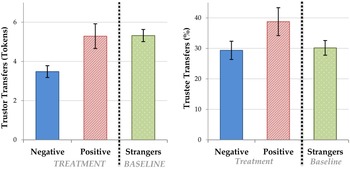
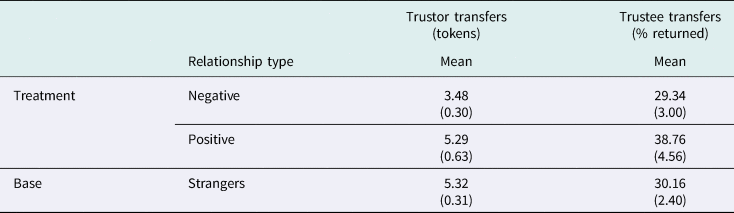
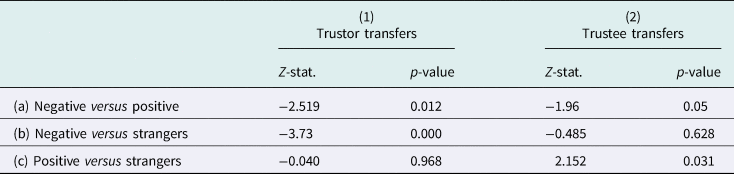
We conducted two-sided Mann–Whitney tests to make pairwise comparisons throughout this section. Following the convention in experimental economics, we converted trustee transfers from tokens to proportions of the respective trustor's tripled transfer; in other words, we calculated percentage returned by trustee as trustee's token transfer divided by the respective trustor's tripled token transfer. Table 1 presents our summary statistics on trust and trustworthiness by relationship type (see also Figure 1).
Player 1 transfers in the treatment and the baseline by relationship type. The error bars represent standard errors. Percentage returned by trustee is calculated as trustee's token transfer divided by the respective trustor's tripled token transfer. The negative and positive relationships are from the treatment and the strangers are from the baseline. Graph presents trustor and trustee transfers by different relationship types and indicates the treatment from which the relationship type is derived below the bars. The first set of bars represent trustor transfers and the second set of bars represent trustee transfers. Within each set of bars, from left to right, the bars represent negative relationships, positive relationships, and strangers.

Summary of trust game transfers by relationship type

Standard errors are reported in parentheses.
Percentage returned by trustee is calculated as trustee's token transfer divided by the respective trustor's tripled token transfer.
The negative and positive relationships are from the treatment and the strangers are from the baseline.
Results (learning in the market). Differential levels of trust and trustworthiness between relationships in the treatment and strangers in the baseline are observable. Trustor transfers to negative relationships in the treatment are smaller than trustor transfers to strangers in the baseline. Trustee transfers to positive relationships in the treatment are larger than trustee transfers to strangers in the baseline.
Note how our main argument did not speculate on whether market participants will only reward trustworthy behavior, only punish untrustworthy behavior, or perform some combination of rewarding and punishing behavior. Thus, for our purposes here, it is enough if our subjects display only rewarding behavior or only punishing behavior.
Support for results. Row (b) in Table 2 presents results from pairwise comparisons of trustor and trustee transfers to negative relationships in the treatment and strangers in the baseline. Trustor transfers to negative relationships were less than those to strangers (3.48 versus 5.32, p = 0.000) but trustee transfers to negative relationships were statistically no different to those transfers to strangers (29.34 versus 30.16%, p = 0.628).
Pairwise comparison of trust game transfers

The table presents results from two-sided Mann–Whitney tests.
Column (1) compares trustor transfers between two relationship types. Column (2) compares trustee transfers between two relationship types.
The negative and positive relationships are from the treatment and the strangers from the baseline.
Row (a) compares trust game transfers to negative relationships and positive relationships in the treatment. Row (b) compares trust game transfers to negative relationships from the treatment against those to strangers in the baseline. Row (c) compares trust game transfers to positive relationships from the treatment against those to strangers in the baseline.
Row (c) in Table 2 presents results from pairwise comparisons of trustor and trustee transfers to positive relationships in the treatment and strangers in the baseline. Although trustor transfers to positive relationships were statistically no different to those to strangers (5.29 versus 5.32, p = 0.968), trustee transfers to positive relationships were greater than those transfers to strangers (38.76% versus 30.16%, p = 0.031).
Taken together, these results suggest that people not only tend to be trusting but also expect others, including strangers, to be trustworthy unless and until they learn otherwise. Trustors treated strangers the same as they did individuals with whom they had built a relationship in the market game in our experiment. Trustors, however, transferred less to trustees whom they had learned were untrustworthy in the market game. Our findings corroborate with other laboratory studies such as Koscik and Tranel (Reference Koscik and Tranel2011) and Aimone and Houser (Reference Aimone and Houser2013), which suggested that people are naturally trusting. If people are naturally trusting, market institutions that allow them to differentiate between trustworthy and untrustworthy individuals would seem to be critical. Our results also suggest that, when market institutions allow for people to discover whom not to trust, this knowledge influences their subsequent behavior. Trustees rewarded trustors who had proven to be trustworthy in our market game.
As noted earlier, we purposefully designed the payoffs in our market game in a way that not only made cheating profitable but also heightened the sense of betrayal that our subjects may have felt when they were cheated on, thereby making dealing with a cheater costly. In the context of our experiment, this meant that our subjects were incentivized to discover whom not to trust. As Aimone and Houser (Reference Aimone and Houser2011) suggested, some real-world markets have evolved institutions that reduce the costs of betrayal aversion (e.g. insurance against fraud). This means that some real-world markets may dull some of the benefits of betrayal aversion and make it both less likely and less important that market actors discover whom to trust and to not trust. In Choi and Storr (Reference Choi and Storr2018), we found that no learning about the trustworthiness of market actors occurred when market institutions prevented betrayal from occurring. However, even if market institutions that mitigate the costs associated with betrayal can evolve, it is unlikely that they can completely eliminate betrayal or its associated costs.
5. Conclusion
Some degree of trust is necessary for all exchanges. However, in the current economic literature on trust and markets, the focus has tended to be on how trust facilitates market interactions and little to no attention has been given to the social economy of trust. Stated another way, little attention is paid to how market activities, interactions and outcomes shape and are shaped by trust and trustworthiness. In fact, neoclassical economics historically has advanced a rational, calculative approach to trust (Williamson, Reference Williamson1975).Footnote 7 In that framework, trust is understood as something akin to predictability of economic agents' behavior. Because economic agents are myopically opportunistic, constantly tempted by even trivially larger gains and willing to readily exploit others' vulnerabilities for larger gains, they can only expect or trust each other to behave cooperatively when their incentives are aligned. Even if an economic environment is peopled with agents who display high trust and have good intentions, opportunists can enter and take advantage of the system. As a result, even trustworthy people with good intentions are forced to defend themselves from exploitation and might behave in untrusting and untrustworthy ways.
Indeed, the neoclassical concept of trust depicts a very fragile picture of an economy. Fortunately, we do not need to look far to see that this concept of trust does not meaningfully capture what it means to be trusting and trustworthy in real life. Moreover, unlike what neoclassical economics would predict, there is an abundance of trust in the world (e.g. Inglehart et al., Reference Inglehart, Haerpfer, Moreno, Welzel, Kizilova, Diez-Medrano, Lagos, Norris, Ponarin and Puranen2014), even in market settings (e.g. Choi and Storr, Reference Choi and Storr2018, Reference Choi and Storr2020; Storr and Choi, Reference Storr and Choi2019). It, therefore, seems important to comprehend how trust may be promoted, regulated, and, more crucially, discovered in the market.
Here, we argued how markets can serve as a social space where people can learn about others' trustworthiness through market interactions. To make our case, we relied on the existing Austrian economic notions of the market as a discovery process (Hayek, [1945] Reference Hayek and Caldwell2014, Reference Hayek1976; Kirzner, Reference Kirzner[1973] 2013; Lavoie, Reference Lavoie1986). In the pursuit of self-interest, we contended, market participants reveal crucial, sometimes inarticulate, social information about themselves in face-to-face market interactions that their partners observe and take into account when forming assessments of them. This information is only realized from market interactions and exchanges. Whether someone is worthy of our trust and whether we should trust cannot be answered from self-introspection and social isolation. In this manner, just like how the market can self-regulate prices, quantity and quality and through the same mechanism, the market can also self-regulate trust and trustworthiness.
This paper obviously connects to the literature on trust within experimental economics (see Johnson and Mislin, Reference Johnson and Mislin2011 for a meta-analysis of trust games) and in particular the studies that explored the link between an individual's exposure to markets and their performance in laboratory experiments that measure trust (e.g. Fehr and List, Reference Fehr and List2004; Henrich et al., Reference Henrich, Boyd, Bowles, Camerer, Fehr and Gintis2004; McCannon et al., Reference McCannon, Asaad and Wilson2018). There is also a literature on the relationship between trust as measured in surveys such as the World Values Survey and trust as measured in experimental trust games (e.g. Bellemare and Kroeger, Reference Bellemare and Kroeger2007; Glaeser et al., Reference Glaeser, Laibson, Scheinkman and Soutter2000). However, to the best of our knowledge, with the exception of our present study and our other experimental studies (Choi and Storr, Reference Choi and Storr2018, Reference Choi and Storr2020; Storr and Choi, Reference Storr and Choi2019), the experimental literature is silent on the underlying mechanism that facilitates the discovery of whom to trust and not to trust. There are some notable exceptions. For instance, a series of economic experiments conducted in various small-scale societies showed that the degree to which a community has integrated and has had exposure to markets are positively correlated with individual economic behavior such as trust, trustworthiness, cooperation, and altruism (e.g. Ensminger, Reference Ensminger, Henrich, Boyd, Bowles, Camerer, Fehr and Gintis2004; Henrich et al., Reference Henrich, Boyd, Bowles, Camerer, Fehr and Gintis2004, Reference Henrich, Boyd, Bowles, Camerer, Fehr, Gintis, McElreath, Alvard, Barr, Ensminger, Smith Henrich, Hill, Gil-White, Gurven, Marlowe, Patton and Tracer2005, Reference Henrich, Ensminger, McElreath, Barr, Barrett, Bolyanatz, Cardenas, Gurven, Gwako, Henrich, Lesorogol, Marlowe, Tracer and Ziker2010; Tracer, Reference Tracer, Henrich, Boyd, Bowles, Camerer, Fehr and Gintis2004; Tu and Bulte, Reference Tu and Bulte2010). More narrowly on market interactions, Herz and Taubinsky (Reference Herz and Taubinsky2018) reported that (at least within the context of their experiment) an individual's market history can affect her subsequent fairness preferences, and Brandts and Riedl (Reference Brandts and Riedl2020) reported a causal effect of market experience on subsequent cooperation. Although the experimental studies we cite here are undoubtedly important for the advancement of scholarship in our overall understanding of markets and trust/prosocial attitudes, they speak to the existence (whether it be causation or correlation) of a positive impact of markets on prosociality and do not explicitly study the underlying mechanisms through which markets may positively impact prosociality. Hence, although these literature studies speak to the possibility that markets might engender trust, they continue to be silent on the mechanisms through which markets engender trust.Footnote 8 Our study bridges this gap between the experimental literature on markets and trust, and market process theory. We must emphasize that we view our current paper to be one of extending the Austrian conception of the market as a discovery procedure to discuss how markets give participants an opportunity to learn about the trustworthiness of others that uses an economic experiment as an illustration to suggest that learning takes place in real markets.
As such, our study points to a gap within the Austrian literature on the market and suggests a strategy for filling it. Following Hayek and Kirzner, market process theorists have discussed the market as a process where participants discover knowledge about changing market conditions, their own tastes and those of others, resource availability, existing technological possibilities, and profit opportunities. As Lavoie explained, much of this knowledge that is discovered is tacit. Market process theorists have not previously extended their notion of discovery within the market to discuss what market participants discover about one another. Because market transactions give others an opportunity to engage in opportunism, market actors learn about the characters of others (including but obviously not limited to their trustworthiness). There are several implications of this extension of market process theory. Most importantly, it offers a potential path for Austrian economists to talk about the role of trust within markets and gives them a way to discuss the potential of markets to incentivize, create, and sustain the institutions that it needs to function.
Finally, our study offers an insight into how trust works within markets. Markets, as noted frequently above, cannot function without trust. This might suggest that figuring out how to engender trust or facilitate and sustain trust might be key to promoting functioning markets. Hayek described market exchange as a way to change strangers into friends. In our experiment, however, market participants seemed to treat strangers as honorary friends. Our study suggests that, in some contexts at least, trust is the default position (i.e. market participants give each other the benefit of the doubt). The problem then is not one of generating trust but of market participants having opportunities to discover who should not be trusted.