PD is a chronic, neurodegenerative movement disorder, currently without a cure (Jenkinson et al., Reference Jenkinson, Dummett, Kelly, Peters, Dawson, Morley and Fitzpatrick2012). As the PwP becomes progressively disabled, they become more dependent on others for their care, resulting in HPPs needing to engage increasingly with the informal care giver(s). Both the emotional and the practical support needed by the PwP is mostly provided by the spouse or partner of the PwP (D'Amelio et al., Reference D'Amelio, Terruso, Palmeri, Di Benedetto, Famoso, Cottone and Savettieri2009; Martinez-Martin et al., Reference Martinez-Martin, Forjaz, Frades-Payo, Rusinol, Fernandez-Garcia, Benito-Leon and Catalan2007), as the partner has first-hand knowledge of their progress and wellbeing. McLaughlin et al. (Reference McLaughlin, Hasson, Kernohan, Waldron, McLaughlin, Cochrane and Chambers2011) reported that many HPPs acknowledge the invaluable input provided by spousal care givers and, therefore, the necessity to establish a strong interpersonal relationship with them. They argued that it is vital that HPPs provide an opportunity for spousal care givers to discuss the progress of the PwP, as well as the changing roles, needs and entitlements of the spouse or partner themselves.
While the Alzheimer's literature has explored the engagement processes between formal and informal care-providers (Carpentier & Grenier, Reference Carpentier and Grenier2012), no studies could be found investigating HPPs’ perspective on their engagement with spousal care givers of PwP. According to Carpentier and Grenier (Reference Carpentier and Grenier2012), research on the engagement between health practitioners and families indicates an important change in philosophy and practice now happening in many health systems. They suggest that adapting care for chronic illness means providing support for both the patient and the care giver.
In reviewing the broader PD literature, there is evidence of some aspects of what care givers find meaningful in their engagement with health professionals (Birgersson & Edberg, Reference Birgersson and Edberg2004; Jenkinson et al., Reference Jenkinson, Dummett, Kelly, Peters, Dawson, Morley and Fitzpatrick2012; McLaughlin et al., Reference McLaughlin, Hasson, Kernohan, Waldron, McLaughlin, Cochrane and Chambers2011). In particular, Bolland, Bucks, & Guilfoyle (Reference Bolland, Guilfoyle and Bucks2015) investigated partners’ engagement experiences with HPPs and revealed that partners experienced a lack of entitlement for their own needs to be met, and would find it helpful if HPPs would act as agents of support. The current paper explores the subtleties of engagement experiences from the perspective of the HPP. Understanding these processes may contribute to an improved sense of wellbeing for spousal care givers and facilitate enhanced care and management of the PwP.
A qualitative enquiry is the ideal research methodology for revealing the meaning of lived experiences of a phenomenon (Liamputtong & Ezzy, Reference Liamputtong and Ezzy2007). Given the dearth of research investigating the engagement experiences between HPPs and spousal care givers, from the perspective of the HPPs, Smith's (Reference Smith, Smith, Harré and Van Langenhove1995) IPA was used to explore how HPPs interpret their experiences of engagement with spousal care givers of PwP. This study asked, ‘What are the key factors influencing the engagement experiences for HPPs, and how do they experience these factors?’
Methods
Participants
Using criterion sampling (Liamputtong & Ezzy, Reference Liamputtong and Ezzy2007), 12 HPPs involved in the care and management of PwP and their spousal care givers were purposively recruited through the local Parkinson's association, a press release, and by snowballing contacts. The cross-section of HPPs recruited included medical specialists, a Parkinson's nurse specialist, occupational therapists, a social worker, a speech therapist, a dietitian and a clinical neuropsychologist. For confidentiality, each participant was identified only as an HPP.
Procedure
With University Ethics Committee approval, semi-structured interviews were conducted by the first author between June, 2013 and August, 2014. Eight of the 12 participants lived in Perth, Western Australia. Seven of these HPPs were interviewed face-to-face, and one Perth participant by telephone. The remaining four participants lived inter-state and were interviewed by telephone. Participants provided written, informed consent. Interviews were digitally recorded, transcribed verbatim and analysed for emerging meanings. Saturation of recurring patterns in their speech guided the number of partners interviewed (Fossey, Harvey, McDermott, & Davidson Reference Fossey, Harvey, McDermott and Davidson2002). This occurred after 12 interviews, when continued sampling was unwarranted. Each interview took 25–60 minutes. At the end of each interview, the HPP was given the opportunity to comment on any further issues of relevance, and some brief member checking took place. All were asked if they would participate in a second interview to check data if needs be.
Analysis
All interviews were digitally recorded and transcribed verbatim by the first author. The analysis which followed was based on the principles of Smith's IPA (Smith, Reference Smith, Smith, Harré and Van Langenhove1995; Smith & Osborn, Reference Smith, Osborn and Smith2007). The primary focus of the analysis was on the meaning that the HPPs gave to their experiences of engagement with partners of PwP, and directed formulation of the research question: ‘What are the key factors influencing the engagement experiences for HPPs, and how do they experience these factors?’
One participant, with over 20 years’ experience as an HPP, agreed to be re-interviewed in May, 2014, in a process called member checking or respondent validation. She was given an opportunity to amend her initial comments, and challenge or clarify the researcher's understanding of her experiences and insights. This acted to validate the researchers’ interpretations, thus enhancing procedural and interpretive rigour (Kitto, Chesters, & Grbich, Reference Kitto, Chesters and Grbich2008). This second interview was also transcribed verbatim for analysis. Given the significant challenges of HPP recruitment, subsequently, additional member checking for the last nine participants took place at the end of each interview.
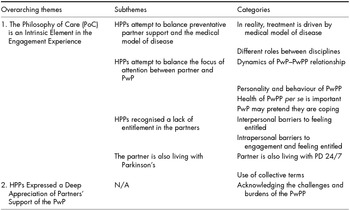
The current study follows guidelines for qualitative research papers by Kitto et al. (Reference Kitto, Chesters and Grbich2008) and Social Science and Medicine (2010). Each transcript was read repeatedly in conjunction with notes from the interviews. This provided a first pass impression of the data, and a general understanding of the HPPs’ perceptions of engagement (Colaizzi, Reference Colaizzi, Valle and King1978; Sanders, Reference Sanders2003). Meaningful passages, sentences or phrases from the transcripts that provided an understanding (Moustakas, Reference Moustakas1994) of the HPPs’ lived experiences of engagement were identified and highlighted. The meanings generated were considered in light of the scant literature of health professionals’ engagement experiences, and subsequently grouped into categories. The extracts from participants’ discourse, and the categories created were presented to co-authors for expert checking, discussion and review (Creswell, Reference Creswell2007) in order to concur on the connections between excerpts and categories (Table 1). The categories were then grouped into significant themes, as an interpretative summary of HPPs’ experiences (Cresswell, Reference Creswell2007). Excerpts that best illustrated recurrent and underlying themes were selected, and subsequently integrated into a comprehensive exposé of the phenomenon of engagement as experienced by the HPPs interviewed.
Categories, Major Themes and Subthemes

Continuous reflexivity and review of the interpretations being formed by the researcher were comprehensively journalled. Reflexivity involves an awareness of the researcher's experiences and preconceptions, and the role they play in interpretation while engaged in the research process. This ensures that the research findings are informed, as far as possible, by the data and not by the researcher's preconceptions, and helps fully to capture the voice of the HPPs, distinct from the researcher (Fossey et al., Reference Fossey, Harvey, McDermott and Davidson2002).
Findings and Interpretations
All participants were English speaking. There were eight female and four male HPPs, with a range of experience in the PD area from 4 to 37 years (15.4 ± 10.0). HPPs articulated rich accounts of their experiences of engaging with care givers of PwP. Two significant themes not considered in previous caregiving literature, and associated subthemes, emerged from their interviews (Table 1). The first and major theme captured the HPPs’ PoC and how this impacted on the engagement process. The second, more minor theme portrayed a pervasive appreciation of partners and the support they provide the PwP. The themes are interconnected, for example, the respect and appreciation that an HPP had for the caregiving role guided the PoC that they adopted.
Theme 1: The Philosophy of Care is an Intrinsic Element in the Engagement Experience
In describing their engagement with spousal care givers of PwP, the HPPs expressed a pervasive philosophical position, a PoC driving their engagement. It has core elements and principles about personal values, care goals and beliefs of the HPPs. They suggested that these informed the ways in which they engaged with partners of PwP. This theme encompassed four subthemes with some overlapping concepts. The first described the challenges of balancing care for a partner, with a medical model of disease focussed on the PwP. The second subtheme portrayed the tensions experienced by HPPs in seeking a balance of focus between the partner and the PwP. In the third subtheme, HPPs described their recognition of partners’ feelings of neglect and isolation, and their lack of entitlement to seek help. The fourth and final subtheme described the HPPs’ recognition that the partner was also living with PD on a daily basis.
HPPs’ Attempt to Balance Preventative Partner Support and the Medical Model of Disease
The medical model of disease created a tension for many HPPs. They expressed a sense of frustration due to limited resources, and the traditional focus on only the person with the medical diagnosis. There was no code or charge for attending to the partner. Yet, they argued that engagement with the partner was often essential for gaining crucial first-hand knowledge of the PwP's care needs. It has been well established that the partner's health impacts their ability to support the PwP. They described a deep-rooted dissonance over wanting to provide some care and attention to partners, while working within the confines of the medical system:
Obviously we cannot give them (partner) everything that they want. There's no such thing as overnight care (at home); so, you know, we have to work within the limitations of what is available. (HP03)
There were complex forces and tensions in play between what was needed for the partner, and how the HPP's role within the medical model defined what they could deliver. Often they wanted to assist the partner directly rather than the patient:
Another part of my role is equipping the partners to dialogue with perhaps other health professionals who may not be as open to the partner. I hear very frequently when . . . couples go to the neurologist appointment that the partner feels excluded, not listened to . . . so part of my role, the second part of my role, I see, is equipping the partners to be heard, even in a non-verbal way. (HP02)
When their role allowed time to focus on the partner, HPPs expressed a different perception of their responsibility and PoC, which was beyond the medical model and focused more broadly on a definition of care which included the partner:
You see different relationships, you know, different ways of communicating, which I think the doctors probably don't have the time, or don't get into, whereas I see people in their home, so it's completely different . . . and I've seen that very much so in my groups for partners, allowing them to verbalise what they're feeling and introducing them to other people. (HP02)
The medical model of care (MoC) was echoed by the perspective of a medical specialist:
You have to remember, we're seeing the person with the disease . . . so they're our main concern . . . I'm always amazed how good most of the partners are at looking after their spouse, but they (PwP) are the focus of attention, from our point of view. (HP01)
The discourse became technically orientated, and the focus on the PwP was couched in the medical metaphor of ‘accepted protocols’:
The focus is so much on the medical . . . our input was guided by the doctor's plan and what was appropriate . . . and the family may not have as much say. There were also clinician time factors. (HP10)
Another HPP suggested that she felt restricted to engaging specifically in what she could do something about, as though there was a concern about venturing into territory that she did not have the resources or time for:
From my training, I ask them (partner) questions about the area I can assist with. For anything else, I would let them know who the person was to talk to about that, and also let the other discipline know what their concerns are. (HP10)
An implicit expression of the medical model of sickness was also revealed in a small subset of HPPs who continually diverted the focus of their discussion to the PwP. This occurred even when the research interviewer reminded the HPP during the interview that the focus of the study was on their engagement with the partners of the PwP. This diversion was revealed in the way they chose to answer questions, for example, when asked about the ways in which they showed attention, care and support for the partner, this HPP missed the focus of the question:
Knowing that the PwP will always have other deficits, I'll always ask what other disciplines they're linked in with, and refer them on if necessary. (HP11)
This inherent focus on the PwP by some HPPs digressed from the general trend. Most HPPs interviewed recognised that focussing on, and supporting, the partner was beneficial to the partner's wellbeing, as well as the PwP, and together, this was a holistic view of care:
The purpose of our service . . . is to make sure that our client (PwP) has got enough support at home, and also my job is also to look after the carers and make sure that their health is well maintained. (HP04)
In support of promoting preventative care, one medical specialist agreed that a standardised brief questionnaire as a prompt would be useful in assessing the partner's wellbeing:
Yes. . . if it's standardised . . . first of all it would remind us to ask the partner because I do agree if it's a difficult patient, you could be more focused on the patient, and you may ignore that bit (partner's well-being) . . . so if you have a questionnaire, it will remind us . . . certainly doable. (HP06)
He also argued the need for being pro-active in preventative support of the partner:
We always talk about psychological counselling for the patient, but I guess sometimes the psychological counselling for the partner would be good, even if they're asymptomatic or even if they don't show any signs of fatigue . . . then we could pick up some things before things fall apart . . . a bit of advocacy . . . so being pro-active and keep looking for things rather than waiting for them to report. (HP06)
There was a spectrum of approaches in dealing with the tension of this balancing act. One HPP, for example, held open the lines of communication in an inclusive manner, and believed that the time spent listening was a good investment and sometimes enough to satisfy partners’ needs:
I can't do anything else, but I can just listen to them (the partners) and their fears. And it's well worth it . . . it's a good investment . . . they (partner) will phone you up in the middle of a very stressful, heated moment and you think, ‘Oh what are we going to do? This is a crisis’, and then, ‘thank you for listening, I feel so much better’, and in my mind, I had them (PwP) going into residential care. (HP02)
HPPs’ Attempt to Balance the Focus of Attention Between Partner and PwP
HPPs subscribing to a non-medical MoC were seeking a balance between attending to the PwP, and to their spousal care givers, and they presented a discourse that revealed how this inner tension played out:
I think the carer-partner dichotomy is always interesting. So often the PwP says, ‘They (HPPs) don't look at me . . . they go directly to the partner,’ so we make a conscious effort initially at least to be addressing the person with the condition. Because of all the communication changes, they sometimes get ignored, or disregarded . . . it's not surprising that the partner might step in and take on some of the responsibility of articulating the PwP's needs . . . it's like a double-edged sword . . . yes they need to do it, but we need to remember that the PwP is still there. So it's very hard to find a balance in talking to the carers . . . it's finding that fine line. (HP02)
The tension described above was further complicated by the HPP continually needing to remain alert for interactions within the engagement experience, and it was often challenging to capture the dynamic of the couple relationship and whether the HPP could involve the partner:
Sometimes the person with Parkinson's wants to remain fiercely independent and doesn't want the partner to speak at the appointments. That can be a little bit of an issue at times. Or the carers are happy just to sit back and let the person with Parkinson's do all the speaking, so then we don't actually know what's going on with the carer. (HP04)
The HPP was often alert to the covert communication cues of the PwP when the partner tried to dominate the interactions:
I actually had to move my chair and block (the partner), and I knew I was doing it but it had to be done because I could see the patient had so much he wanted to say. His eyes were just telling me. (HP02)
At times, the interactive process of the HPP engaging the partner was subtle:
I would carefully or indirectly engage with the carer by telling the patient what I think the carer wants to know. (HP08)
The tension arose because the HPPs acknowledged that the health of the PwP was strongly dependent on maintaining the wellbeing of the spousal care giver. HPPs had to decide whether partner issues could be resolved by providing functional support for the PwP:
Our service would have a positive impact for our clients (PwP) because we're supporting the carer who hopefully can maintain some quality of life and health with enough support and breaks and services and education that could help in the long term, maintain our clients (PwP) at home, and hopefully prevent any crisis. (HP03).
Alternatively, HPPs described personal care and support for the carer in their own right as vital:
It's often about validating their emotions in terms of where they're at and what their needing as well; a lot of the time, they're adjusting and they're grieving; they're coming to terms with a complete and utter change of lifestyle, loss of their partner. He may be physically there, but not emotionally or often there's a loss of communication, so they don't have that person to talk to anymore because they can't communicate . . . so they're lonely . . . and no-one understands that. (HP12).
The tensions described invaded the HPP's space and their engagements. Often the tension between who to help, and how, translated into a discourse of subtle frustration for some HPPs when they made an effort to obtain information about ‘non-medical’ issues:
About the non-medical type of care . . . which also involves the carer . . . people think that we don't want to hear about this other stuff, but . . . it's part of our training that we have to ask about the social history . . . and often I get a look like, ‘why are you asking about my work and who I live with?’ but that's where we get all the hints about how things are at home. (HP06)
Contributing to the HPPs’ tension was an awareness that many care givers pretended that they were coping, and yet they remained silent:
It's almost that they keep everything very bottled up and they try to pretend that everything's okay and that they're coping. (HP04)
They will try to put up a brave face when seeing us in the hospital because they don't want to come across as not coping. (HP06)
HPPs Recognised a Lack of Entitlement in the Partners
A further complication for HPPs in providing care to partners was a clear appreciation of the partner's sense of being alone and neglected, and overlaid on this, was a lack of entitlement to seek help for these feelings.
I don't think there's a lot of recognition of what partners do, so they internalise a lot of feelings. They feel very guilty . . . they don't feel they have a right and that's a huge problem with everything . . . funding, with services, there aren't things made available. You and I could see the basic needs, like the right to sleep, but they're going without. So they're lonely . . . and no-one understands that . . . they could very practically be going to appointments . . . but it's not about them really; what they then do is feel incredibly guilty for complaining; guilty for making it about them at all . . . guilty because they're not the person who's got the problem. (HP12)
HPPs often felt restricted in their ability to help them with these psychological feelings of isolation. These emotions were sometimes thoughtlessly evoked in partners, reinforcing the entrenched sense of a lack of entitlement:
I hear very frequently when . . . couples go to the neurologist appointment that the partner feels excluded, not listened to. I've heard of doctors say, ‘I'm not asking you’. (HP02)
They consequently leave appointments not having their needs met:
There's limitations as far as what services are provided. They (partners) have a higher prevalence of anxiety and depression, in comparison to the rest of the population that is not recognised . . . they're caring and their needs are not being met. They sacrifice a lot of things at the expense of caring for someone else. (HP12)
HPPs suggested that through their discussions and observations of partners, often intrapersonal barriers were at play. Partners rarely felt legitimately entitled to personalised care and support when in the presence of HPPs:
The intrapersonal process, absolutely true . . . they're unwilling to articulate their needs (partners). Some carers of PwP don't know what their needs are . . . all they know is that they're not being met. (HP02)
One HPP portrayed the carers’ unquestioned perception of their role as being programmed to focus only on the PwP's experiences and challenges:
They go into a very articulate . . . they're almost programmed to talk about what their partner (PwP) is going through . . . then they realise there's some refocus on them . . . often they become quite emotive . . . they understand better what's going on with the PwP . . . we have no idea of what they might be experiencing. (HP12)
HPPs vigorously expressed the tensions they felt about caregiving, seeking answers in an attempt to make sense of their engagement experiences and trying to think through possible solutions:
They (partners) feel that they're just meant to deliver . . . but there's no service geared up for their well-being . . . that's why I said that if we have something like a questionnaire or someone talking to them at regular intervals, we would be able to pick up those ones (partners) if they need any care . . . they will not cover up ignorance of their entitlements. (HP06)
A seemingly casual reference to the carer's progress was offered as a prompt to help them reflect on their own participation and entitlement in the process:
Perhaps just an open-ended question: ‘How are you walking with all of this? Well, think about it before your next visit’. (HP02)
The Partner is also Living with Parkinson's
Another complicating factor in the care process for the PwP was expressed by HPPs as, ‘the duality of the disease impact is huge.’ Many HPPs recognised that their clinical contact with the PwP was just a snapshot of the at-home reality, and that the co-resident care giver, who had daily contact, was the one who could provide a more comprehensive picture because they, too, were living with PD. They also recognised the daily burden of living with PD as a spousal care giver:
They're the ones 24/7 with the PwP. With the health professional, it's a once off. They're the ones on the ground, we work with what they are doing. (HP09)
When there was realisation that the partner was also living with PD, a strong discourse was evident in the HPPs’ descriptions about the PwP and partner working as a team. Their accounts were rich in collective terms: team, together, partnership, two heads, couple and both. On one level, this added to the complexity of care provision, because the only context in which needs could be delivered was within a team context. It was difficult for some HPPs to create an opportunity for the partner's needs, per se, to be heard, let alone met. Some HPPs supported the spousal care giver but only for the sake of the PwP:
So my experience with carers, it's a joint partnership, really, in helping to maintain our clients (PwP) at home. (HP03)
We need to look at both sides in order to give the best support; if you're not looking after the main carer that will impact directly on the person with Parkinson's. (HP05)
On another level, the ‘team’ perspective between PwP and partner meant that the HPP wanted to separate out care for the spousal care giver for the care giver's own wellbeing as an individual:
We'll talk about the importance of maintaining activities and your well-being and enjoyment in life, and having time out and things like that . . . also, with respite, they (partners) can recharge their batteries as well, especially if they (PwP) require overnight attention . . . the carer's sleep is affected. (HP03)
There's really two aspects to my role: one is listening to the person with the disease and their partner as a whole, but then listening to the partner in a different way. (HP02)
Theme 2: HPPs Expressed a Deep Appreciation of Partners’ Support of the PwP
A secondary theme, permeating the narratives of the HPPs, portrayed their deep respect and appreciation for spousal care givers, and appeared unrelated to whether they subscribed to the medical model or not. Spousal care givers were seen as ‘unsung heroes’ (HP03) who were crucial to the care and support of the PwP:
If I would have seen the patient without the carer (wife), I would have thought that he would have been suitable for a nursing home with high level care, and I was quite surprised with how the wife was handling things . . . if it hadn't worked out as well, I would have called the hospital and then sorted him out from there. He would have required someone to come in 3 hours in the morning and 3 hours in the evening. He's a hoist transfer as well. . . absolutely acknowledged the partner, she had given up her life, her independence and everything for her husband. If he had been in a nursing home, his wife would have had a completely different life, because she was quite independent and healthy and mobile, but she was giving everything away for her husband. (HP06)
Many of the HPPs also actively acknowledged the dedication and self-sacrifice of the spousal care givers:
When I see that the partner is offering support which I think exceeds the norm, then I always acknowledge that. I think people don't say it enough to the carers . . . they sacrifice a lot of things and I think just acknowledging such a great level of care is so important, and, being a bit cheeky, I also want the patient to realise that, ‘Don't take this for granted’. (HP04)
Discussion
The aim of this inquiry was to achieve an understanding of HPPs’ experiences of their engagement with partners or spousal care givers of PwP. The results have drawn attention to the tensions resulting from the interplay between the HPPs’ lived reality and their PoC. Furthermore, an overall deep respect and appreciation of spousal care givers by HPPs emerged from the analysis.
A Model of the Philosophy of Care Framed within a Lived Reality
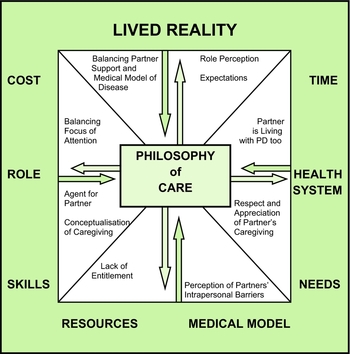
As the study evolved, a graphic model was developed to represent the HPPs’ experiences of engagement with partners of PwP (Figure 1). Its function is to illustrate the tensions created by the HPPs’ internalised PoC, functioning within the limitations of their lived reality, which included observations of the needs of care givers. HPPs found themselves occupying a more contracted space than prescribed by their PoC. The interplay between reality and PoC impacted significantly on meeting partners’ needs.
Philosophy of care functioning within a lived reality.

There is a paucity of research into HPPs’ experiences of engagement with partners of PwP. This was consistent with the findings of Carpentier and Grenier (Reference Carpentier and Grenier2012) in the context of AD caregiving. Despite the importance in health service delivery of ‘interactions between formal and informal care systems’ (p. 1331), they found that the phenomenon has drawn little interest from researchers, and these interactions are discussed in relation to themes found in the broader literature.
It is argued in this study that HPPs conveyed a personal PoC, a philosophical position embracing personal values, beliefs and care goals that drive their engagement experiences. Ambiguity in the literature has led to the terms, MoC, philosophy and framework being used as parallel concepts, despite the terms referring to quite different constructs (Davidson, Halcomb, Hickman, Phillips, & Graham, Reference Davidson, Halcomb, Hickman, Phillips and Graham2006). Tierney (Reference Tierney1998) called it ‘semantic confusion’ (p. 78). The PoC that was found in this study is subtly different to a MoC, which is ‘based on best practice evidence and expert opinion’ (WA Health Networks, 2007; p. 5), for example, the MoC utilised by the PD nurse specialists in Western Australia, which has been presented worldwide as best practice for PD management (Parkinson's Western Australia (PWA), 2014).
HPPs were often limited by the application of their PoC by robust constraints such as a lack of time and resources, which they described as significant barriers in delivering care and support to partners in a manner that honoured their PoC. They felt a major dissonance between the care they wanted to deliver, and what they could actually offer. Some of these factors, such as insufficient resources, have also been described by Hudson, Toye and Kristjanson (Reference Hudson, Toye and Kristjanson2006) as health system barriers, in the context of palliative care, a situation in which many spousal care givers of PwP find themselves.
Furthermore, for many HPPs, a tension existed between adherence to a medical model of disease where the focus was traditionally on the person with the disease, and a more holistic core philosophy. On one hand, the medical model dictated that they focus their attention on the person with the disease, namely the PwP. On the other hand, engagement with the partner was imperative for their valuable first-hand knowledge of the PwP, for the provision of preventative care and support early on in the caregiving trajectory (Carter, Lyons, Stewart, Archbold, & Scobee, Reference Carter, Lyons, Stewart, Archbold and Scobee2010), and for the health and wellness of the care giver of the PwP (Aragon et al., Reference Aragon, Ramaswamy, Ferguson, Jones, Taggart, Lindop and Gay2007; Bogart, Reference Bogart2010).
Despite the emphasis on support for carers, and early intervention in Australia's health model (Australian Government, 2003), it was clear that focusing on the partner for preventative reasons was not a logical rhetoric within the belief systems of some HPPs. They expressed the medical model of sickness by continually redirecting their responses to the PwP, despite constant reminders that the focus of the interviews was on the partner. Fortunately, this tendency to repeatedly divert to the PwP applied only to a minority of HPPs interviewed, and others were caught in the tension between care for the PwP and their care giver, or both.
A subtle balancing act was played out between this focus on the partner and on the PwP. Striving to achieve this balance created a tension which was a powerful driver of the way in which HPPs engaged with partners. For some HPPs, it meant acknowledging that the PwP's health was very much dependent on the partner, as well as recognising that the partner had needs in their own right which required individual assessment and management. This echoes the recognition of the distinct needs of the care giver by the National Service Framework for Long-term (Neurological) Conditions (Aragon et al., Reference Aragon, Ramaswamy, Ferguson, Jones, Taggart, Lindop and Gay2007). For other HPPs, simply providing functional support for the PwP characterised their experience of engaging with partners. This aligns with the assertion by O'Connor, McCabe and Firth (Reference O'Connor, McCabe and Firth2008) that support services often focus on the patient (exemplar of the medical model) with secondary or absent attention being paid to the care giver.
HPPs acknowledged a pervasive lack of entitlement described by Bolland et al. (Reference Bolland, Guilfoyle and Bucks2015), and a sense of being alone and neglected expressed by partners (Aragon et al., Reference Aragon, Ramaswamy, Ferguson, Jones, Taggart, Lindop and Gay2007; Birgersson & Edberg, Reference Birgersson and Edberg2004; Bogart, Reference Bogart2010). The tension here occurred when HPPs discounted these feelings and remained passive in their care of partners, leading to partners’ needs remaining unmet. HPPs observed other intrapersonal obstacles to partners having their needs met, such as not admitting that they were not coping until crisis point. Aoun (Reference Aoun2004) described care givers as often avoiding discussing difficulties because they believe they should be coping. This observation appeared to add another layer of challenge and tension to the engagement experience for some HPPs because they knew if they could encourage care givers to accept help, they could lessen their sense of isolation, increase confidence in their caregiving ability, and help get respite breaks for the care giver.
This cohort of HPPs showed a great capacity to articulate their position with good insight about the challenges and needs of spousal care givers, such as acknowledging that partners were also living daily with PD. Their discourse spoke to a parallel theme arising from partners’ experiences described by Bogart (Reference Bogart2010) and Bolland et al. (Reference Bolland, Guilfoyle and Bucks2015), in which partners shared how they felt about living with PD. They knew that the impact of the disease was ‘felt and lived through by both’ (Bogart, Reference Bogart2010, p. 165). Related to this insight was a strong discourse by HPPs about working as a team, and included collective terms such as team, together, partnership, two heads, couple and both. The critical point was that by observing this, the HPPs experienced tension over whether they could intervene and help the care giver as well as the PwP.
While the HPPs’ expressed their deep appreciation and respect for the partners, who provide support over an extended period of time, they were caught in tension about how to support this. The literature has revealed that care givers find it meaningful to be recognised, valued and respected in their engagement with health professionals (Birgersson & Edberg, Reference Birgersson and Edberg2004; Jenkinson et al., Reference Jenkinson, Dummett, Kelly, Peters, Dawson, Morley and Fitzpatrick2012; Lindahl et al., Reference Lindahl, Liden and Lindblad2011; McLaughlin et al., Reference McLaughlin, Hasson, Kernohan, Waldron, McLaughlin, Cochrane and Chambers2011; Palmer, Reference Palmer2012). Unfortunately, the acknowledgement and admiration expressed by HPPs in the current study did not always align with the experience of spousal care givers in the literature, or in Bolland et al. (Reference Bolland, Guilfoyle and Bucks2015). Consistent with what McLaughlin et al. (Reference McLaughlin, Hasson, Kernohan, Waldron, McLaughlin, Cochrane and Chambers2011) described, it was found in this study that some HPPs did not provide an opportunity for spousal care givers to discuss the progress of the PwP, as well as the changing roles, needs and entitlements of the spouse. This is disappointing given that the literature has revealed that the first-hand knowledge and unique insights of informal care givers and partners of PwP are essential in providing effective care in the management of PD (Birgersson & Edberg, Reference Birgersson and Edberg2004; D'Amelio et al., Reference D'Amelio, Terruso, Palmeri, Di Benedetto, Famoso, Cottone and Savettieri2009; PWA, 2012).
Interpretive Influences
The current study, investigating HPPs’ experiences of engagement with partners of PwP, is part of a broader investigation which included partners’ experiences of engagement with HPPs (Bolland et al., Reference Bolland, Guilfoyle and Bucks2015). Despite starting each study with similar recruitment strategies, the challenges experienced with recruiting HPPs were significant, and strategies had to be expanded due to poor initial response rates. This eventually extended to interstate recruitment and telephone interviews, and the impact of interview format on the quality of interviews needs to be considered. The HPPs who agreed to be interviewed in the current study were those who were prepared to generously volunteer their time and expertise. However, despite these difficulties, a broad range of HPPs was interviewed, presenting a wide range of philosophies and MoCs. Indeed, those HPPs who did not engage partners well were still represented, suggesting that one can have faith in the themes that emerged.
Extensive engagement with the HPPs in their professional world is essential to the interpretation of their subjective experiences. Reflexive reporting involved the awareness and reflections of any preconceptions and opinions of the researcher, enhancing the transparency of the researcher's role, and allowing the reader to distinguish the HPPs’ voices from that of the researcher.
Conclusion
This qualitative paper has explored the subtleties of the HPP-partner engagement and revealed that the key factors influencing the HPP experience included the significant psychological tensions arising from the reality-PoC interface. The graphic model developed during this study illustrates these tensions and provides a basis for both clinical and policy initiatives. Policy makers could ease the problematic tensions experienced by HPPs by addressing barriers to care delivery, such as time constraints and role clarification. Further research is recommended examining the impact of addressing these barriers on factors such as partner health outcomes, and PwP institutionalisation.
Financial Support
This research received no specific grant from any funding agency, commercial or not-for-profit sectors.
Conflict of Interest
None.
Ethical Standards
The authors assert that all procedures contributing to this work comply with the ethical standards of the Human Research Ethics Committee of the University of Western Australia (2013). The investigation was also conducted with reference to the Code of Ethics of the Australian Psychological Society (2007), and the National Statement on Ethical Conduct in Human Research 2007 – Updated 2015 (National Health & Medical Research Council, & Australian Research Council, 2015), and with the Helsinki Declaration of 1975, as revised in 2008 by the World Medical Association.