Introduction
The Canadian Longitudinal Study on Aging (CLSA) is a long-term (20 year) prospective study of adults who at baseline are between the ages of 45 and 85 years. Early in the CLSA planning stages, the research team instituted the stipulation that individuals with conditions such as dementia or cognitive impairment that may preclude the ability to provide informed consent would be excluded at baseline. It was evident, however, that participants who developed cognitive impairment or dementia would remain in the study. Thus, the research team is required to put in place strategies to ensure that data continue to be collected while ensuring the participant’s protection. The inclusion of proxies who respond on behalf of the participant as needed over the course of the study is one such strategy. The more immediate need, however, is to develop a methodology to exclude, as early as possible in the recruitment process, those individuals with cognitive impairment. With a sample size of 50,000, all of whom will be contacted by letter and then by telephone (for a recruitment interview), the most obvious choice would be to introduce a telephone-administered cognitive screen that could be used to screen out individuals who were judged sufficiently impaired in their ability to provide informed consent. While we recognized that falling below a cutoff score on a screening tool does not necessarily indicate the lack of capacity to consent, interview-based screening tools have been used for this purpose (Reference Kim, Caine, Currier, Leibovici and Ryan1,Reference Royall, Cordes and Polk2). In this article, we describe the results of a literature review of telephone-administered cognitive screening tools that we applied to inform the planning of the CLSA.
The Mini-Mental State Exam (MMSE) is one of the most widely used face-to-face tools employed to assess cognitive function (Reference Folstein, Folstein and McHugh3). For population-based research that does not always involve a face-to-face interview, however, the MMSE in its original form is not appropriate. As a result, several telephone-screening tests have been developed. Despite their advantages, telephone-administered screening tests present three key limitations: (a) the lack of in-person contact can limit the number and types of tests administered; (b) the non-standardized interview environment can present distractions and/or cues for the subject responding to assessment questions; and (c) the presence of a hearing impairment can increase the potential for participants to perform poorly as a result of misunderstanding what is being asked. Although no gold standard exists, telephone-administered tools have been identified as one option for assessing competence prior to study enrollment (Reference Brodaty, Clarke, Ganguli, Grek, Jorm and Khachaturian4).
The primary goal of this article is to identify currently existing telephone cognitive screening tools that might be considered to identify eligible study participants for population-based research on aging.
Methods
We conducted a general review of the literature to highlight existing telephone-administered cognitive screening tools. Our review included a search of the journals indexed by Medline (1950–2007) to identify articles published in English or French that included details about cognitive screening tools for adults. Articles were included in this review if they described the development or validation of measures used to screen for cognitive impairment over the telephone. Key search terms included telephone interview, telephone screening, cognitive screening, and cognitive status. We also manually examined the reference lists of the identified articles. The articles were initially screened for relevance by two authors (KR and CW). Each relevant article was subsequently reviewed independently by two authors (KR and JU). A recent review of screening tests for cognitive impairment identified 39 screening tools (37 face-to-face tests and 2 administered by telephone) (Reference Cullen, O’Neill, Evans, Coen and Lawlor5). The focus of the review was to identify brief assessments, to be conducted in a doctor’s office, with a short administration time and which are available in English. In their review, although Cullen et al. (Reference Cullen, O’Neill, Evans, Coen and Lawlor5) identified two telephone-administered tests, these were excluded from further consideration since the focus of the article was to identify the optimal test in a medical setting.
We identified 12 telephone-administered screening tools, one computer-automated telephone tool, and one scale designed to assess the quality of consent subsequent to informed consent being given. The strengths and weaknesses of the tools from the reference articles were also examined and extracted (by KR and JU) according to their relevance for a screening tool in a longitudinal study of aging.
The CLSA is a national study, and the selected screening tool will need to be available in English and French. As part of our review, we were able to take advantage of work already conducted by researchers in the Réseau québecois de recherché sur le vieillissement [Quebec Network for Research on Aging] of the Fonds de la recherche en santé du Québec (FRSQ) who compiled a list of French-language instruments for research on aging (www.rqrv.com). Within this list, six instruments are specifically designed for cognitive screening, four of which were originally developed in English and have been translated and validated in French: (a) Mini-Mental State Exam (MMSE): Échelle du statut mentale; (b) Modified Mini-Mental State (3 MS): Échelle du statut mental modifiée (3 ms); (c) Sandoz Clinical Assessment-Geriatric (S.C.A.G): Échelle d’évaluation clinique des troubles de la sénescence cérébrale “sandoz clinical assessment-geriatric (scag)”; and (d) Blessed Information Memory Concentration Test (BIMC): Test abrégé de Blessed.
These instruments were designed to be administered in person and require modification for telephone use. The MMSE, 3MS, and Blessed IMC have been adapted for telephone use in English – TMMSE/ALFI-MMSE (Reference Roccaforte, Burke, Bayer and Wengel6), T3MS (Reference Norton, Tschanz, Fan, Plassman, Welsh-Bohmer and West7), and Blessed TIMC (Reference Kawas, Karagiozis, Resau, Corrada and Brookmeyer8) respectively. Adapting these telephone screens for use in French would be relatively simple since the in-person versions have already been translated and validated in French, and the French versions would need to be modified only for telephone administration.
Results
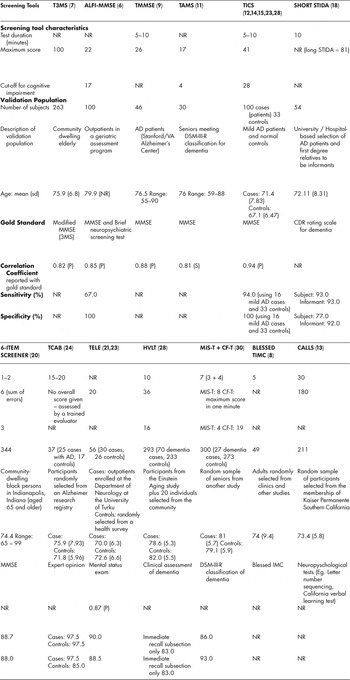
Since the purpose of this article is to provide a general overview of the telephone cognitive screening tools that currently exist, a brief description of each screening tool identified is presented here. Characteristics were extracted and summarized when reported. These included the constructs measured, the length of time for administration, the scoring of the tools/classification scheme, the population in which each was validated, correlations with other tools, and any information regarding the validation (population, number of participants, mean age, gold standard). The results are summarized in Table 1.
Summary of telephone cognitive screening tools

NR = not reported; P = Pearson correlation; S = Spearman correlation.
We identified 12 telephone-administered tools; we first describe the 4 tools developed through modification of the MMSE or its extended form, the 3MS. We then describe the remaining eight tools, derived from a variety of tools administered in person or developed as telephone-administered tools.
Tools Derived from the MMSE
For the four tools described in this section, we report the maximum score attainable. In each case, a higher score indicates higher cognitive functioning.
Telephone Modified Mini-Mental Status Exam (T3MS)
The T3MS is an adaptation of the 3MS, measures the same constructs, and has a maximum attainable score of 100 points (Reference Norton, Tschanz, Fan, Plassman, Welsh-Bohmer and West7). Nine items in the 3MS cannot be administered over the telephone, and these items fall into two categories: (a) five questions in which the participant is asked to name a specified body part (verbal), and (b) four questions that test instrumental abilities (content). For the T3MS, these items are replaced with questions to assess the same constructs. For example, in the 3MS, the interviewer points to his/her forehead and asks the participant: “What is this called?” This question was modified for the telephone version to: “What do you call the part on your face that is above your eyebrows?” To test instrumental abilities, the participant is asked to tap five times on the part of the telephone that they speak into with their finger (telephone version) rather than reading and following written instructions that the interviewer holds up on a piece of paper (face-to-face version).
Overall, the correlation between the T3MS and the in-person 3MS was 0.82 when assessed in a group of 263 community-dwelling elderly residents with an average age of 75.9 years (Reference Norton, Tschanz, Fan, Plassman, Welsh-Bohmer and West7).
Adult Lifestyles Function Interview (ALFI-MMSE) and the 26-point Adaptation (TMMSE)
The ALFI is a 22-point tool originally developed for the National Institute of Mental Health (NIMH) Epidemiologic Catchment Area study in St. Louis, Missouri, U.S.A. (Reference Roccaforte, Burke, Bayer and Wengel6). It was designed as a telephone-administered follow-up interview of participants aged 65 and older. The 26-point TMMSE is an adaptation of the ALFI-MMSE (Reference Newkirk, Kim, Thompson, Tinklenberg, Yesavage and Taylor9) that includes an additional three-step command. Although the 26-point scale is slightly longer, it assesses an important dimension of cognitive status in dementia: the ability to comprehend commands and to act upon them. When tested in a group of outpatients in a geriatric assessment program, the ALFI-MMSE correlated strongly with the MMSE (r = 0.85, p < 0.0001). The TMMSE was validated in a group of patients with possible or probable Alzheimer’s disease (AD). Overall, the correlation with the MMSE was 0.88 (p < 0.001).
The ALFI-MMSE is available in a French translation that has been used in Quebec as a screening tool to exclude seniors with more than mild cognitive impairment in a cohort study of community-dwelling seniors in Montreal (Reference Quail, Addona, Wolfson, Podoba, Lévesque and Dupuis10).
Telephone Assessed Mental State (TAMS)
The TAMS is a compilation of four items from a subset of verbally administered questions in the MMSE (Reference Lanska, Schmitt, Stewart and Howe11). For example, “What is the date?” and “Where are you now?” are the first two TAMS questions. The maximum TAMS score is 17. The sample used to validate this scale consisted of 30 patients with probable AD according to the NINCDS-ADRDA criteria. The correlation between scores on the TAMS and the MMSE was 0.81 (p < 0.001). TAMS scores were also found to be positively correlated with years of education (r = 0.54, p < 0.01) but not with age.
Telephone Interview of Cognitive Status (TICS) and Modified Telephone Interview of Cognitive Status (TICS-m)
The TICS was first introduced by Brandt and colleagues (Reference Brandt, Spencer and Folstein12) to assess cognitive function in patients with AD who were unwilling or unable to be examined in person. The maximum TICS score is 41. The TICS, and an adapted version the TICS-modified (TICS-m), is the most frequently used telephone screening test of cognition (Reference Brandt, Spencer and Folstein12–Reference Welsh, Breitner and Magruder-Habib14). The TICS-m differs from the original TICS by the inclusion of an additional question that tests delayed recall (Reference Welsh, Breitner and Magruder-Habib14). These two screening tests are designed to be administered over the phone in approximately 5 to 10 minutes. They show a high correlation with the MMSE and, for AD (Reference Brandt, Spencer and Folstein12) and dementia (Reference Ferrucci, Del Lungo, Guralnik, Bandinelli, Benvenuti and Salani15), equivalent sensitivity and specificity as cognitive screens. The TICS was found to correctly identify more than 90 per cent of persons who scored below or above comparable MMSE scores in detecting a standard clinical diagnosis of dementia. It has been validated in Italian and in Hebrew, but we were unable to find any literature describing a French translation (Reference Beeri, Werner, Davidson, Schmidler and Silverman16,Reference Dal Forno, Chiovenda, Bressi, Ferreri, Grossi and Brandt17).
Tools Not Derived from the MMSE
Structured Telephone Interview for Dementia Assessment (STIDA)
The STIDA was designed to detect early changes in cognition that could be suggestive of AD (Reference Go, Duke, Harrell, Cody, Bassett and Folstein18). The tool aims to detect mild dementia and to assess accurately the level of dementia in order to generate a score that can be converted to the Washington University Clinical Dementia Rating (CDR) scale, a clinical staging instrument for the severity of dementia (Reference Morris19). The scores range from 0 to 81 with higher scores indicating greater impairment. The tool also has an informant version for situations in which the subjects are unable to respond for themselves. Administration can take 15 to 40 minutes when given in full and 10 minutes if no medical history is collected. The correlation between the informant and subject STIDA was high (r = 0.92, p < 0.0001) when tested in a group of 28 mildly cognitively impaired individuals and 28 informants. In this same study, the short STIDA, a much-abbreviated STIDA that can be administered directly to the subject, was found to have a sensitivity of 93 per cent and a specificity of 77 per cent when compared to the clinical CDR rating for mild dementia.
Six-Item Screener
The Six-Item Screener was designed to identify patients with cognitive impairment either as a one-stage screen to exclude those with moderate to severe impairment or as the first stage of a two-stage screen to identify probable cases of dementia (Reference Callahan, Unverzagt, Hui, Perkins and Hendrie20). Participants are attributed one point if they make an error on an item and no points if they answer correctly; scores range from 0 to 6. For this screener, a higher score was found to be correlated with poorer scores on longer measures of cognitive impairment. The Six-Item Screener is very short and appears quite easy to administer.
TELE
The TELE was first introduced in 1995 by Gatz and colleagues (Reference Gatz, Reynolds, Nikolic, Lowe, Karel and Pedersen21). It is referred to as a self-report interview and is based on the 10-item Mental Status Questionnaire (MSQ) (Reference Gatz, Reynolds, Nikolic, Lowe, Karel and Pedersen21). It supplements the MSQ with additional cognitive elements (including attention, short-term memory, and cognitive abstraction), as well as questions about health and daily functioning. The duration of administration was not reported. The total number of points that can be obtained is 20 if all items are answered correctly. A scoring algorithm was used for practical purposes that incorporated both the TELE cognitive items and the health and daily functioning items (Reference Gatz, Reynolds, John, Johansson, Mortimer and Pedersen22). Correlation between the TELE score and the MMSE score obtained at the clinical workup was 0.54. The sensitivity and specificity of the TELE to differentiate AD patients from healthy controls was 90 per cent and 88.5 per cent respectively (Reference Jarvenpaa, Rinne, Raiha, Koskenvuo, Lopponen and Hinkka23).
Telephone Cognitive Assessment Battery (TCAB)
This 15- to 20-minute telephone interview is designed to assess cognitive impairment using a series of established cognitive tests (Reference Debanne, Patterson, Dick, Riedel, Schnell and Rowland24). It requires a highly trained evaluator to examine the different scales and determine the cognitive status. There is little published information on the sensitivity or specificity of the TCAB in identifying cognitive impairment. For this reason, it is not discussed further.
Hopkins Verbal Learning Test (HVLT)
The HVLT is a memory impairment test that assesses verbal memory (Reference Hogervorst, Combrinck, Lapuerta, Rue, Swales and Budge25). The maximum score for the HVLT total score is 36 and the HVLT recognition score is 12. Six equivalent forms of the HVLT exist, making it appropriate for serial testing as part of longitudinal studies, and alternative forms can be used to avoid practice effects due to item familiarity (Reference Hogervorst, Combrinck, Lapuerta, Rue, Swales and Budge25–Reference Frank and Byrne27). Although designed to be administered in person, all questions can be administered over the telephone in approximately 10 minutes. The HVLT administered over the phone has been shown to be interchangeable with the version administered in person (Intra-class correlation coefficients [ICC] between participants = 0.85, p < 0.001, ICC between modes of administration = 0.06, p > 0.10) when used in a sample of community-dwelling, low-income seniors (Reference Carpenter, Strauss and Ball28). In a different random sample of community-dwelling seniors, the HVLT was shown to have a sensitivity of 83 per cent and a specificity of 83 per cent at its optimal cut-point when comparing HVLT to the clinical assessment of dementia (Reference Kuslansky, Katz, Verghese, Hall, Lapuerta and LaRuffa26). The HVLT has a higher sensitivity compared to the MMSE to detect participants with mild dementia; administration time (10 minutes) and high reliability (Reference Hogervorst, Combrinck, Lapuerta, Rue, Swales and Budge25–Reference Frank and Byrne27,Reference Stewart29). The HVLT has been translated into French.
Memory Impairment Screen by Telephone (MIS-T) and Category Fluency Test (CF-T)
These tests measure episodic and semantic memory respectively, and they were assessed for their ability to screen for dementia in a randomly selected population of seniors who were participating in another study (Reference Lipton, Katz, Kuslansky, Sliwinski, Stewart and Verghese30). The MIS-T takes approximately 4 minutes to administer while the CF-T takes 3 minutes. Scores range from 0 to 8 for the MIS-T whereas CF-T scores are the sum of the new items generated in 1 minute for each category presented. A sensitivity of 86 per cent and a specificity of 93 per cent were found at the optimal cut-point when comparing the MIS-T and CF-T to the DSM-III-R classification of dementia. In this same population, the TICS showed a sensitivity of 64 per cent and a specificity of 86 per cent. The MIS-T outperformed the TICS and the CF-T as a valid and time-efficient telephone screening tool for dementia.
Blessed Telephone Information-Memory-Concentration Test (Blessed TIMC)
The telephone-administered version of the Blessed IMC takes approximately 5 minutes to complete (Reference Kawas, Karagiozis, Resau, Corrada and Brookmeyer8). The tool was tested in a group of participants recruited from neurology clinics, longitudinal studies, and clinical trials at the Johns Hopkins School of Medicine. The correlation between the telephone and face-to-face versions was 0.96 (p < 0.001). However, little other information is available on its psychometric properties.
Cognitive Assessment for Later Life Status (CALLS) instrument
The CALLS is a computer-assisted tool that was modeled after standardized neuropsychological batteries to assess cognitive function in aging (Reference Crooks, Parsons and Buckwalter13). In addition to including cognitive items found in some neuropsychological batteries (e.g., date, month, season, and year), test items also include measures for response time. The maximum score is 180 points and the test takes approximately 30 minutes to administer. The correlation between scores on the CALLS and the MMSE was 0.60 (p < 0.05). Older age was significantly correlated with lower scores (r = 0.35; p < 0.0001), and those with a higher level of education yielded higher CALLS scores than those with lower levels of education.
Discussion
In this review, we identified 12 telephone screening tools, 4 based on the MMSE and 8 based on a variety of other tools. Overall, the telephone screening tools were shown to have adequate sensitivity and specificity when compared to face-to-face tools for the diagnosis of dementia and/or AD. Thus, these tools would be likely to be sufficiently sensitive and specific to screen out cognitive impairment severe enough to compromise the ability to participate in a population-based study of aging. Each identified tool has advantages and disadvantages that need to be weighed in relation to the requirement of the CLSA.
From our review, we found the ALFI-MMSE to be shorter, and simpler to administer than other tools such as the TICS and TCAB. The TICS is longer than the MMSE as a result of its more extensive assessment of language comprehension and repetition ability, more calculation items, and longer recall list. However, it does not include registration of the words to be recalled as is done in the ALFI-MMSE. The TICS and the TMMSE were both created through deletion of items from the 3MS. The T3MS on the other hand does not delete these items but rather substitutes items described in the verbal and content subscales. The Six-Item Screener is shorter than the ALFI-MMSE but does not require the participant to do any mathematical calculations. The advantage of using the ALFI-MMSE, however, is that it has already been used as part of a recruitment strategy and has been shown to be practical (Reference Fischbach, Becker and Giacobini31).
Availability of the screening tool in French is a major advantage for population-based research in aging in Canada. The ALFI-MMSE is the only tool of which we are aware that has been used in a study involving the French population in Quebec (Reference Quail, Addona, Wolfson, Podoba, Lévesque and Dupuis10). While other tools may have been used in French-speaking populations, we found no evidence to support this in the literature. One important limitation of the ALFI-MMSE is that diminished hearing was associated with lower scores (Reference Roccaforte, Burke, Bayer and Wengel6). This is in common, however, with any of the telephone-administered tools.
After we had conducted our review, an early publication (Reference Ball and McLaren32) in which the authors reviewed three of the telephone-administered tools derived from the MMSE (i.e., the TICS and TICS-m; the ALFI and the TAMS) was brought to our attention. The focus of Ball and McLaren’s (Reference Ball and McLaren32) work was consideration of the telephone and/or videoconferencing as the mode of administration for cognitive testing. They concluded that the telephone was a useful method to use to assess cognitive state and that videoconferencing was a promising method but further research is required (Reference Ball and McLaren32). Interestingly, nearly 10 years after this publication, the same tools were identified, suggesting that it would be timely to conduct additional studies targeted toward the utility of these telephone-administered tools in population-based research on aging.
From a practical standpoint, selecting a tool for cognitive impairment in a population-based study depends on many factors that are specific to each study (e.g., time to administer, ease of administration, availability in other languages, constructs measured). For example, if time is an issue, researchers should select the tool with the shortest administration time among a pool of suitable tools. Given that many of the tools reviewed were designed for research in cognitively impaired or AD patients, the need for further validation of scales in a population more closely resembling that of the particular study should be considered. The cognitive screening tools cannot be considered as all-purpose tools. Individuals with moderate to severe cognitive impairment will be detected quite well, but there may be a ceiling effect if used with normal older adults. Moreover, the cognitive screening tool may not be sensitive to mild forms of cognitive impairment, falsely classifying individuals with mild cognitive impairment as “normal”. In a recent study, researchers established population-based norms both cross-sectional and over time on the MMSE (Reference Chatfield, Matthews and Brayne33). Charts that were produced can be used to see how individuals perform in relation to the population of that age and sex, with potential adjustment for education, and whether that relative position remains stable.
In the CLSA, the participants will have a broad range of cognitive function since they will be between the ages of 45 and 85 years and selected from the general population. The Brief Test of Adult Cognition by Telephone (BTACT) is a tool that has recently been developed to test cognitive ability in normal-functioning adults ranging in age from young to older adults (Reference Tun and Lachman34). Testing cognitive ability by telephone has not been widely reported in the literature but merits further investigation, especially for studies with a target population resembling that of the CLSA.
Although the results of cognitive screening tests have been associated with decision-making capacity, there are no cognitive screening tests that can be used to establish decision-making capacity (Reference Resnick, Gruber-Baldini, Pretzer-Aboff, Galik, Buie and Russ35). In particular, the MMSE is a test of general cognitive abilities whereas decision-making instruments, such as the MacArthur Competence Assessment Tools for Clinical Research, focus on context-dependent ability to understand material (Reference Dunn, Nowrangi, Palmer, Jeste and Saks36). Different tools exist for screening for cognitive impairment and capacity to consent, and it seems as though a combination of both types of tools, when appropriate, may represent the ultimate informed-consent process.
In conclusion, the use of telephone-administered cognitive screens would appear to be a reasonable strategy to screen for cognitive impairment on population-based studies of aging. Few, however, would be appropriate without the conduct of further research (validation in a younger age group and/or availability in French) for use in a study such as the CLSA with a broad recruitment age range (45 to 85) and a requirement for validated French language tools. We hope that with the increasing interest in population-based studies of aging in Canada and throughout the world, there will be concurrent increased interest in furthering the research in this area.