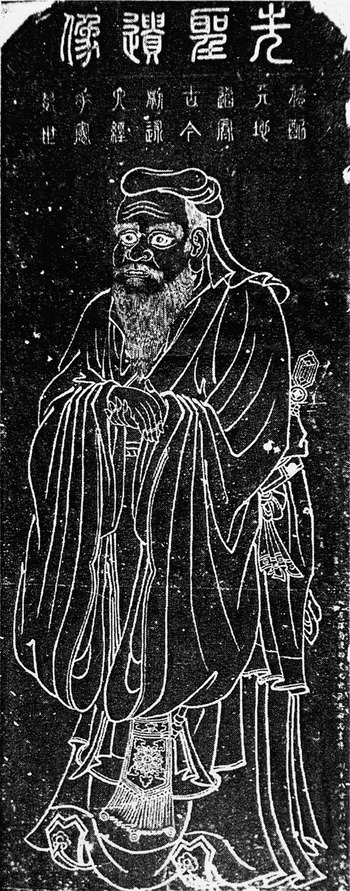
Recent scholarship on religious elements in the ideas, institutions, and practices associated with Confucius (Kongzi 孔子) and his later interpreters has done much to correct long-standing representations of Confucianism as a form of secular humanism (Chen Reference Chen1999; Clart Reference Clart2003; Csikszentmihalyi Reference Csikszentmihalyi, Noel Freedman and McClymond2001; Goossaert Reference Goossaert2006; Jensen Reference Jensen1997; Wilson Reference Wilson and Wilson2002a).Footnote 1 Revisionist inquiry has also brought attention to the recurrent debates over the propriety of using icons in rituals for venerating Confucius (Sommer Reference Sommer1994, Reference Sommer and Wilson2002). However, the significance of the physical and visual qualities of these icons has not been addressed. No matter whether Confucianism is viewed as primarily a moral-ethical system or as a sacrificial cult mandated and supported by the state, it clearly differs from Buddhism, Daoism, and other forms of religious expression in China. Accordingly, a discussion of the materiality, visuality, and efficacy of its icons might seem unnecessary, irrelevant, or perhaps even offensive. Nonetheless, iconic images played a role in sacrifices to Confucius at least as early as the sixth century, and from 630 to 1530, sculptural icons were a standard feature of state-supported temples throughout China (Murray Reference Murray2001; Wilson Reference Wilson1995). When influential opponents of icons finally prevailed and temples in the state cult removed the sculptural figures (Sommer Reference Sommer1994, Reference Sommer and Wilson2002), alternative representations of Confucius rose in significance and took on new functions (Murray Reference Murray2001, Reference Murray and Wilson2002). Recently, one of these has become the “standard image” of Confucius, in effect the icon for our age.
Confucian Religiosity
Various efforts in recent centuries to foreground the moral dimension of Confucius's legacy have obscured practices and beliefs involving icons, along with other religious aspects of Confucianism. During the sixteenth and seventeenth centuries, Jesuit missionaries tried to convince papal authorities in Rome that Confucianism was an ethical philosophy (Jensen Reference Jensen1997, 63–70, 129), so that efforts to spread Christianity in China would not be stymied by requiring converts to give up rituals for worshiping Confucius Similarly, in the nineteenth century, the Protestant missionary-translator James Legge argued that the ancient Confucian classics merely needed to be supplemented with Christianity, just as the Bible's Old Testament was completed by the New Testament (Mungello Reference Mungello2003, 590). Moreover, from the sixteenth century onward, Confucian temples were austere buildings where inscribed tablets were displayed, unlike Buddhist temples and popular-cult shrines with sculptural icons in sensuous profusion.Footnote 2 Although Kang Youwei 康有為 (1858–1927) sought to establish Confucianism as China's official religion (zongjiao 宗 教) at the end of the nineteenth century, on the model of Christianity in Western nations, he made little headway before falling from power in the coup that reversed his 1898 reforms (Chen Reference Chen1999; Goossaert Reference Goossaert and Jean2005, Reference Goossaert2006). Because regular worship of Confucius was on the official Register of Sacrifices (Sidian 祀 典), and thus was closely identified with the imperial system, the collapse of the Qing dynasty (1644–1911) undercut subsequent efforts to create a religion based on Confucianism. In the early decades of the twentieth century, some nationalist modernizers wanted to discard Confucius altogether, while others found it expedient to present him as China's counterpart to the West's great rational philosophers. Suppressing what they considered to be idolatry and superstition, they emphasized a Confucius who did not concern himself with “ghosts and spirits.” And in recent years, global advocates of “New Confucianism” have focused on his ideas about self-cultivation and morality.Footnote 3 To some, Confucian concepts of reciprocal responsibility in a hierarchical society suggest an Asian alternative to Western-style democracy. These different efforts have created a widespread conception of Confucianism that is defined by a set of ancient texts, the civil service examination system based on their mastery, and the promotion of social virtues such as benevolence (ren 仁), filial piety (xiao 孝), propriety (li 禮), and righteousness (yi 義).
In addition to revisiting the arguments in favor of establishing Confucianism as the official religion for modern China (Chen Reference Chen1999; Goossaert Reference Goossaert and Jean2005, Reference Goossaert2006), recent scholarship has begun to examine some of the important religious elements within traditional Confucianism. These include ideas about Confucius himself, as well as the rituals for venerating the man and his legacy. Lionel M. Jensen (Reference Jensen1997, Reference Jensen and Wilson2002), Mark Csikszentmihalyi (Reference Csikszentmihalyi, Noel Freedman and McClymond2001, Reference Csikszentmihalyi and van Norden2002), and Thomas A. Wilson (Reference Wilson and Wilson2002a, Reference Wilson and Wilson2002b) have explored ancient and persistent beliefs in Confucius as a heaven-sent being with superhuman powers. Huang Chin-hsing (Reference Chin-hsing1994) and Wilson (Reference Wilson1995, Reference Wilson1996, Reference Wilson and Wilson2002b, Reference Wilson2002c) have traced the evolution of an official cult for venerating Confucius and Confucian learning within the ritual institutions of the state, which constituted China's “official religion” (Taylor Reference Taylor1997). Ron Guey Chu (Reference Chu, de Bary and Weiming1998) and Huang Chin-hsing (Reference Chin-hsing and Wilson2002) have evaluated recurrent debates over the details of these ritual provisions and the appropriate status to attribute to Confucius, interpreting the disputes as symptoms of an ongoing struggle between emperors and scholar-officials to define and control Confucius and his legacy. Philip Clart (Reference Clart2003) has analyzed popular religious cults that identify themselves as “Confucian” (Ru 儒) and use simplified forms of Confucian sacrificial liturgy. Deborah A. Sommer (Reference Sommer1994, Reference Sommer and Wilson2002) has examined different ways of representing Confucius in ancestral and state sacrifices, focusing particularly on the arguments raised against depicting him in sculptural icons, which were adopted into official policy in the ritual reform of 1530.
In the present article, I describe the process by which sculptural icons became part of the cult of Confucius and examine reasons for their godlike visual features. Exploring the beliefs concerning agency, efficacy, and appropriateness that gradually accrued to these icons, I suggest that the representations shared conceptual premises and interpretative connotations with the potent images associated with Buddhism, Daoism, and popular-deity cults. Finally, I argue that the removal of icons from most state temples in 1530 had unintended effects that demonstrate the limits of official control over image-based practices involving Confucius. One result was that the icon of Confucius uniquely retained by the temple in his hometown of Qufu 曲 阜, Shandong, gained renown through woodblock-printed illustrations that circulated widely, even reaching Europe. The iconography of his seated figure dressed in imperial regalia was eventually appropriated into popular religion, representing Confucius as a deity who could be worshiped by the common people. Another consequence of removing icons from Confucian temples was to bring increased veneration to a radically different depiction, showing Confucius as a dignified standing figure who was merely human. Ultimately based on a small painting owned by his descendants, this conception circulated in hanging scroll paintings, woodblock prints, and rubbings from incised stone tablets. Local gazetteers often recorded versions of the portrayal in government schools and private academies. When the 1970s brought new demands for freestanding representations of Confucius outside mainland China, the image was translated into three-dimensional sculptural form for display at selected sites around the world. In the late twentieth century, such statues also began appearing at mainland temples and schools, prompting the China Confucius Foundation (Zhongguo Kongzi jijinhui 中 國 孔 子 基 金 會) to identify a need for a “standard portrait” (biaozhun xiang 標 準 像). In 2006, the foundation unveiled a large new statue of Confucius in Qufu itself, sparking a new controversy over the validity of visual representations of Confucius and their uses.
Background to the Emergence of Icons
Early Han texts sometimes characterize Confucius as a godlike sage, the heaven-sent “uncrowned king” (Su wang 素 王) (Csikszentmihalyi Reference Csikszentmihalyi, Noel Freedman and McClymond2001, Reference Csikszentmihalyi and van Norden2002; Elman Reference Elman1990, xxvii, 205–13, 240–41; Jensen Reference Jensen1997; Wilson Reference Wilson1995, 29–32).Footnote 4 They describe supernatural elements in his nativity and his extraordinary physical appearance as signs of his destiny to order the world. He was conceived when his mother received a visit from a qilin 麒 麟, a fabulous beast believed to herald the arrival of a sage-king. The creature carried a jade tablet inscribed with a proclamation: “The child of the essence of water will succeed the declining Zhou and become an uncrowned king” (shui jing zi ji shuai Zhou er wei su wang 水 精 子 繼 衰 周 而 為 素 王).Footnote 5 On the night before Confucius was born, two dragons appeared above the roof; deities hovered in the sky and celestial musicians celebrated on the day of his birth. In addition to forty-nine distinguishing marks (biao 表) on the newborn's body, his chest bore five characters that announced, “Talisman of the one created to stabilize the world” (zhi zuo ding shi fu 制 作 定 世 符).Footnote 6 As an adult, Confucius displayed an uncanny expertise in identifying obscure ancient relics and interpreting mysterious portents. His ability to communicate with heaven enabled him to transmit the Way of the Ruler, in coded language, when he composed the Spring and Autumn Annals (Chunqiu 春 秋), a chronicle of events in his home state of Lu 魯.
Other conceptions of Confucius emphasized his roles as a teacher and as an expert on ancient ritual, instead of as a preternaturally insightful and prescient leader who communed with heaven. In some parts of the Analects (Lun yu 論 語), Confucius is portrayed as a human being who endured much travail and disappointment, especially while traveling the ancient states in search of a ruler who would take his advice (Csikszentmihalyi Reference Csikszentmihalyi and van Norden2002).Footnote 7 By the late Eastern Han period, this more mundane Confucius had largely overshadowed the superhuman figure. Nonetheless, the messianic sage was featured in the so-called apocryphal texts (weishu 緯 書) of the late Han and post-Han periods (e.g., Wang Jia Reference Jia1966, 3:4–5). In addition, the “modern text” traditions retained their vitality in South China well into the Period of Disunion (Wilson Reference Wilson1995, 32). Furthermore, the Kong lineage perpetuated and embellished the legends in oral traditions and written genealogies, even down to the present day.Footnote 8 Claiming descent from Confucius, lineage members had a vital interest in preserving a heroic conception of their ancestor and in maintaining their own cohesion (Wilson Reference Wilson1996). Emperors from the Han through the Qing dynasties awarded noble titles, tax exemptions, official positions, and lands to the descendants who maintained sacrifices to Confucius in Qufu.
Although the earliest forms of veneration and sacrifice to Confucius occurred in funerary and memorial contexts, the observances themselves increasingly displayed the features of a deity cult. Confucius continued to receive sacrifices at his grave long past the normal period for commemorative worship (Jensen Reference Jensen and Wilson2002, 180–86; Sima Reference Qian1982, 47:1945). Moreover, persons with no blood relation to him made these offerings, contrary to the customs of familial worship, which prescribed that a son should lead funerary rites—but Confucius's son had predeceased him. After Confucius died in 479 BCE, his disciples carried out the rites of mourning, and the especially devoted Zi Gong 子 貢 kept a six-year vigil in a hut beside the burial mound (Sima Reference Qian1982, 47:1945). Local authorities maintained offerings at this site for generations afterward. The place where Confucius had gathered with his disciples became a memorial hall, and his personal effects were displayed there. The Grand Historian Sima Qian 司 馬 遷 (145–86 BCE) reported seeing the master's clothes, cap, zither (qin 琴), books, sacrificial vessels, and carriage in the memorial hall when he visited Qufu. In 195 BCE, the Han founding emperor Gaozu (r. 206–195 BCE) performed a grand sacrifice (tailao 太 牢) to Confucius in Qufu, offering an ox, sheep, and pig, along with wine and other foodstuffs (Sima Reference Qian1982, 47:1945–46). In 136 BCE, Han Wudi (r. 141–87 BCE) canonized the textual tradition of Confucius and his followers by abolishing the posts of Erudite (boshi 博 士) held by court scholars who were experts in texts belonging to other traditions (Wilson Reference Wilson1995, 29). Other Han emperors awarded posthumous titles of nobility to Confucius and gave material support to his descendants and cult, providing for semiannual sacrifices in Qufu after 169 CE (Wilson Reference Wilson2002c, 261).
By the third century, sacrifices to Confucius were also being performed elsewhere, typically in academic settings. The first sacrifice documented outside Qufu took place in 241 CE at the imperial university (Biyong 辟 雍) in Luoyang, the capital of the kingdom of Wei (220–65), and several more were performed there under the Western Jin dynasty (265–316) (Wilson Reference Wilson and Wilson2002b, 74).Footnote 9 During the centuries of disunion, various northern and southern regimes established state-sponsored temples in their capitals for conducting sacrifices to Confucius and his legacy.Footnote 10 The Sui (581–618) and Tang (618–907) dynasties continued this practice in a reunified empire. The Tang founding emperor Gaozu (r. 618–26) established a temple at the National University (Guozi xue 國 子 學) in Chang'an (modern Xi'an, Shaanxi) and personally sacrificed there in 624 (Ouyang Reference Xiu1975, 1:9, 17). The Tang eastern capital at Luoyang also had an imperially sponsored temple. Initially, it was the Duke of Zhou 周 公, the wise regent to the young heir of the Zhou dynasty founder, who was honored as First Sage (Xian sheng 先 聖), and Confucius received sacrifice as Correlate (Pei 配) and First Teacher (Xian shi 先 師). In 628, a memorial submitted by Fang Xuanling 房 玄 齡 (579–648) convinced the Tang emperor Taizong (r. 626–49) that sacrifices offered in a school should be directed to a teacher. Accordingly, Taizong ended sacrifices to the Duke of Zhou and designated Confucius as First Sage, with the disciple Yan Hui 顏 回 as Correlate and First Teacher (Ouyang Reference Xiu1975, 15:373, 375).Footnote 11 Taizong extended the cult to lower levels of administration in 630 by requiring every prefectural and county school to build a temple to Confucius, thus creating a systematic network of state-sponsored temples (Ouyang Reference Xiu1975, 15:373). Located inside or adjacent to the government schools, these temples carried out regular sacrifices to Confucius twice a year, in spring and autumn.
Tang ritual codes ranked the sacrifice to Confucius as one of several mid-level rites (zhong si 中 祀), prescribing specific implements, offerings, music, and participants.Footnote 12 The liturgy imitated that of another mid-level state cult, the worship of the Gods of Soils and Grains (She ji 社 稷), which had existed in classical antiquity and whose rituals were prescribed in the Record of Rites (Li ji 禮 記). Because the ceremony for sacrifice to Confucius had no fixed classical form of its own, it was susceptible to innovations, and procedural details often changed. Most significantly, portrait icons were introduced into the ceremony, probably inspired by the images of the Buddha and bodhisattvas in Buddhist temples. Starting in the Tang period, the Chan Buddhist practice of using portrait effigies in memorial rituals for deceased abbots and monks (Foulk and Sharf Reference Foulk and Sharf1993–94) provided an additional model that encouraged the use of icons in Confucian temples.
The Earliest Icons of Confucius and Their Visual Features
Sculptural images had appeared in the Qufu temple by the sixth century, if not earlier, when Li Daoyuan 酈 道 元 (d. 527) reported that it displayed statues of Confucius flanked by two unnamed disciples holding scrolls (Li Daoyuan [527] Reference Daoyuan1984, 25:807).Footnote 13 Such a triad shares the conceptual logic of a figure of the Buddha accompanied by bodhisattvas, a familiar composition in sixth-century Buddhist icons, as well as in Daoist imitations.Footnote 14 By 541, the figures of ten disciples attended Confucius in the Qufu temple (Kong Yuancuo [1242] Reference Yuancuo1967, 10:8a–11b).Footnote 15 Again, the tableau suggests a conceptual counterpart in Buddhist iconography, the ten major disciples of Sakyamuni, which may have inspired the increase.
The temple to Confucius in the Tang capital also housed sculptural images, probably from its inception in 619, and certainly by the eighth century. Officials who memorialized the throne on matters of ritual procedure and nomenclature rarely mentioned icons explicitly, but one episode is suggestive. In 720, Li Yuanguan 李 元 瓘 pointed out to Emperor Xuanzong (or Ming Huang, r. 712–56) that the ten disciples (called Ten Savants, Shi zhe 十 哲) who received sacrifices along with Confucius should be represented as seated images (zuo xiang 坐 象), not as standing attendants (li shi 立 侍). Furthermore, Li requested that seventy other disciples and followers of Confucius be portrayed in paintings on the walls of the temple, so that they, too, could receive sacrifices. Accepting Li's arguments, Xuanzong immediately issued a decree adopting these changes (Ouyang Reference Xiu1975, 15:375).
Although no early temple icons of Confucius survive today and documentary sources rarely mention them, some of their attributes can be inferred from his posthumous status. In 1 CE, the Han emperor Pingdi (r. 1 BCE–5 CE) honored Confucius by awarding him the rank of duke (gong 公). From that time onward, various emperors conferred noble ranks and honorific titles on Confucius, his disciples, and the canonized later scholars who were periodically added to the temple (Wilson Reference Wilson1995, 23–71, 254–59).Footnote 16 In 739, Tang Xuanzong elevated Confucius to King of Propagating Culture (Wenxuan wang 文 宣 王) and gave the disciples and later followers various titles, such as duke, marquess (hou 侯), or earl (bo 伯) (Ouyang Reference Xiu1975, 15:375–76). These posthumous ranks had considerable bearing on the visual features of the temple images. Sumptuary regulations specified the kinds of clothing, headgear, and ornamentation appropriate for each rank, as well as the number and kinds of vessels, music, and dancers to be used in sacrifices. As king, Confucius was to be portrayed wearing a robe embroidered with nine emblems and a crown with nine strings of jade beads hanging at the front and back (Kong Zhaoxi [1897] Reference Zhaoxi1990, 8a [623]).
Some later rulers sought to exalt Confucius beyond the rank of king, but ministerial opposition prevented them from doing so. For example, in 1008, the Song emperor Zhenzong (r. 997–1022) wanted to confer the title of emperor (di 帝) on Confucius. Senior officials were able to dissuade him by arguing that no such designation had existed during Confucius's lifetime (Zhang Tingyu et al. [1739] Reference Tingyu1974, 50:1299). Left unstated but surely significant is the fact that scholar-officials would no longer be allowed to worship Confucius if he were promoted to emperor, because he would have to receive the highest level of state sacrifice, which only the ruler could offer (Wilson Reference Wilson2002c, 268). Although Zhenzong was unable to raise Confucius's posthumous rank, he added the words “Dark Sage” (Xuan sheng 玄 聖) to the kingly title. The epithet alludes to apocryphal legends about Confucius's supernatural nature and powers, and in 1013, Zhenzong changed it to Ultimate Sage (Zhi sheng 至 聖).Footnote 17 A black-faced, ferocious-looking sculptural icon preserved in the Confucian temple in Pingyao 平遥, Shanxi, may reflect iconography specific to the “Dark Sage.”Footnote 18
Even without elevating Confucius's rank, some emperors conferred higher honors on him by enhancing his visual representation or aggrandizing his sacrificial ceremony. In 1009, Zhenzong ordered a jade scepter to replace the wooden tablet held by the sculptural effigy in the Qufu temple (Kong Chuan [1134] Reference Chuan1967, shang: 20a). A century later, the Song emperor Huizong (r. 1100–1125) had the nine strings of jade on the crown increased to twelve, and the Jin emperor Shizong (r. 1161–89) augmented the emblems on the robe from nine to twelve (Kong Zhaoxi [1897] Reference Zhaoxi1990, 8b [624]).Footnote 19 These changes in the icon's attributes visually upgraded the “uncrowned king” to an emperor. In the late fifteenth century, two Ming rulers also expanded the number of vessels and dancers in the semiannual sacrificial ceremonies to an imperial level, again without altering Confucius's kingly title.Footnote 20
Convergence with Other Cult Images and Opposition to Icons
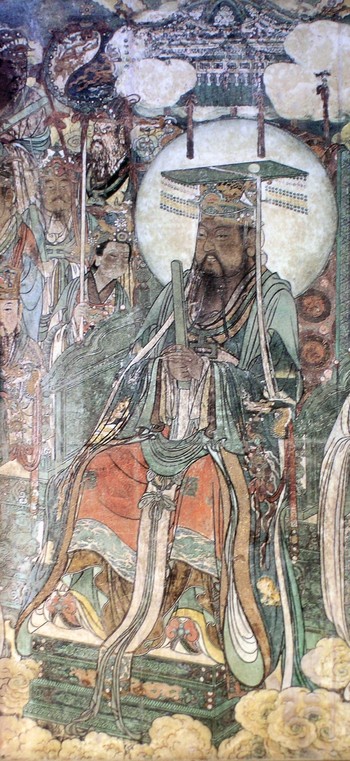
Confucius was by no means the only recipient of imperial recognition. Emperors also bestowed noble ranks and titles on deities in the Daoist and popular-cult pantheons.Footnote 21 Some of these figures gained imperial designations, and many others were kings. Accordingly, the highest-ranking Daoist and cult images were also portrayed with imperial regalia, such as the Jade Emperor depicted in figure 1. Although the icon of Confucius resembled these other emperors and kings, the visual similarities masked great differences in significance and function. Ordinary men and women could worship Daoist, Buddhist, and popular-cult deities, seeking benefits for themselves and their families. By contrast, Confucius and his canonized followers were not efficacious gods who did things for individual supplicants, but conferred benefit to society at large; moreover, only a restricted male elite could perform the sacrifices.Footnote 22 These ceremonies were intended to provide sustenance to the spirits of the men enshrined in the temple, as well as to enable participants to express their reverence for the entire canon of learning and ritual represented by Confucius, his disciples, later scholars, and statesmen. During the sacrifice, icons might help the celebrant visualize the spirits coming and accepting the offerings. A successful performance brought blessings to the entire realm.
The Jade Emperor, detail of painting on the east wall of the Hall of Three Purities (Sanqing dian 三 清 殿), in the Palace of Eternal Joy (Yongle gong 永 樂 宫) Daoist temple, Yuan dynasty, dated 1325. Source: Shanxi siguan bihua 山 西 寺 觀 壁 畫 [Murals in Shanxi temples], comp. Chai Zejun 柴 澤 俊 (Beijing: Wenwu chubanshe, 1997), 198:121.

However, it was hard to prevent Confucian temple icons from triggering beliefs and expectations associated with representational images belonging to other religious contexts. The convergences in visual culture gave rise to beliefs that were not grounded in ancient sources, as well as to embellishments of Confucius's life. One idea undoubtedly inspired by Buddhism is that Confucius was born with forty-nine unusual bodily features, echoing and outdoing the thirty-two marks that distinguished the Buddha Śākyamuni's body from those of ordinary mortals.Footnote 23 Another is that Confucius's spirit was constrained by the physical features of his sculptural icon. Once enlivened by a consecration ritual, a Buddhist image literally became the deity and could wield his powers (Kieschnick Reference Kieschnick2003, 56–63; Sharf Reference Sharf and Lopez1996, 261–67). The gods of popular cults were also believed to inhabit their images (Hansen Reference Hansen1990, 53–54). The infiltration of such concepts and the danger that they would debase the cult of Confucius prompted Song and Ming Neo-Confucian ritualists to formulate objections to the presence of anthropomorphic images in the temple.
The first signs of opposition to icons of Confucius in the state cult emerged as part of a larger argument against using images in sacrifices that had originated in antiquity (Ebrey Reference Ebrey1991; Sommer Reference Sommer1993, Reference Sommer1994, Reference Sommer and Wilson2002). Authoritative classical texts on ritual, most notably the Etiquette and Rites (Yi li 儀 禮) and Record of Rites, did not mention portraits in the procedures for making offerings to ancestral spirits, heavenly forces, or worthy men of ancient times. Major Song thinkers such as Cheng Yi 程 頤 (1033–1107) and Zhu Xi 朱 熹 (1130–1200), as well as ordinary officials, were eager to separate these kinds of rituals from the practices they associated with Buddhism, Daoism, and popular cults (Ebrey Reference Ebrey, de Bary and Chaffee1989, 301–2; Neskar Reference Neskar and Lopez1996, 293–300). Zhu also argued explicitly against sacrificing to images of Confucius (Chan Reference Chan, de Bary and Chaffee1989, 400–401; Sommer Reference Sommer and Wilson2002, 108).
An additional concern was whether sculptures or paintings could ever provide a sufficiently faithful likeness of any deceased person for celebrants to experience the presence of his spirit and enter into communion with him (Sommer Reference Sommer and Wilson2002). Classical texts indicated that in antiquity, a lineal descendant of the deceased played the role of “personator of the dead” (shi 尸) during the ceremony, using his blood connection and physical resemblance to evoke the departed ancestor. In order for a portrait to serve as an effective substitute, it had to be accurate, or else the offering would go astray. As Cheng Yi famously proclaimed, perhaps hyperbolically, a mistake in depicting even a single hair would cause the wrong spirit to come down to receive the sacrifice.Footnote 24 Because images of Confucius were made so long after his lifetime, they could hardly be faithful representations, and no two looked exactly alike. The portrayals were invented by later artisans and not based on direct observation. The visual features of the sculptural icons of Confucius also contradicted the details of his life and displayed elements anachronistic to the material culture of his day. Not only were there no chairs in the late Eastern Zhou period, even the most reliably documented portraits showed him wearing the clothing of the Han and later periods (Queli zhi seventeenth-century ed., 1:6a; Kong Yuqi [1689] Reference Yuqi1983, 7:11a–b [652-81]). And, of course, Confucius had never been a king, much less an emperor. Icons that represented him in the regalia appropriate to the honors that had been posthumously bestowed on him conflicted egregiously with well-known biographical details.
Another line of argument reveals that even very sophisticated men subconsciously equated the sculptural icons in the Confucian temple with the spirits that descended to receive sacrifice during the ceremony. In accord with classical ritual procedures, offerings of food and wine were placed on a mat on the ground. Because the icon of Confucius depicted a figure seated on a chair, both Zhu Xi and Song Na 宋 訥 (1310–90) worried that his spirit would have to crawl to reach the nourishment (Sommer Reference Sommer and Wilson2002, 106–7).Footnote 25 Underlying this fear was their presumption that his spirit took on the properties of its anthropomorphic representation. The notion that Confucius's spirit entered and became the seated figure reflects the influence of Buddhism. Although the sculptural images of Confucius were not supposed to be considered embodiments of the sage, but merely representations to help evoke his spirit, this distinction was blurred by their visual and material similarities to Buddhist icons.
At the most fundamental level, however, Neo-Confucian ritualists were opposed to icons in the Confucian temple simply on principle: Classical texts did not prescribe a role for images in the performance of sacrificial rites. Even the authors of a treatise on the Qufu temple and its rituals acknowledged that icons had been incorporated only in recent centuries: “Setting up images to serve the spirits was not [done in] antiquity. It must postdate the end of the personator ritual” (Queli zhi 1505, 9:50a). Neo-Confucian ritual experts did not necessarily object to representations of Confucius in other contexts; Zhu Xi himself reportedly bowed daily to a sculptural portrait of Confucius, presumably an image kept in his home.Footnote 26 Rather, they believed that the presence of anthropomorphic images altered the character of the formal sacrifice, obstructing its evocation of the grandeur of the Way that Confucius had transmitted from the ancient sages. Indeed, Qiu Jun 邱 濬 (1421–95) argued that the object of the sacrifice was the Way itself, not the flesh-and-blood Confucius (Sommer Reference Sommer1993; Wilson Reference Wilson1996, 566). Figural icons threatened to reduce a profound spiritual encounter to a mundane, sensual experience that would have no transformative power. As Song Na observed, anthropomorphic images profaned the ineffable realm of invisible spirits and could not convey their virtues (Sommer Reference Sommer and Wilson2002, 110–11). Because literati officials repeatedly revived the charge that the use of icons had come to China with Buddhism, the issue continued to rankle. Perhaps finding this view threatening to their special status, Kong writers carefully maintained accounts of the lineage's various images of Confucius. In addition, Kong Yuqi ([1689] Reference Yuqi1983, 7:5a–7b [652-78–652-79]) and Kong Jifen ([1762] Reference Jifen1966, 12:10b–11a [228–229]) presented forceful arguments in defense of icons, citing cases from the late Zhou to early Han in which representational images were created or used in sacrificial rituals, before the purported introduction of Buddhism in the reign of Han Mingdi (57–75).
Stages in the Removal of Icons
In 1382, the Ming founding emperor, Taizu (r. 1368–98), built a new Confucian temple for the imperial university in his capital at Nanjing. At the urging of his advisor, Song Lian 宋 濂 (1310–81), he ordered that the temple be furnished not with portrait icons but only with wooden tablets inscribed with the names and titles of Confucius, his disciples, and later followers and scholars (Sommer Reference Sommer and Wilson2002, 106).Footnote 27 However, Taizu did not require other Confucian temples to get rid of their images, nor did he remove the posthumously conferred noble ranks and honorific designations. By contrast, when he reformed another mid-level state cult, the worship of city gods (Cheng huang 城 隍), Taizu abolished noble titles and anthropomorphic representations from all city-god temples (Taylor Reference Taylor and Liu1990, 109–10). As personifications of natural forces, the city gods did not have well-established individual identities.Footnote 28 But Confucius and his followers had been men who walked the earth in historical times, and the desire for images of them remained strong. When the Yongle emperor (r. 1401–24) refurbished the Nanjing temple in 1410, he abandoned his father's principled aniconism and allowed representational images to be added. After he shifted the Ming capital to Beijing in the 1420s, he permitted the refurbishing of the icons in the imperial university's Confucian temple, which had been built under Mongol rule (Sommer Reference Sommer and Wilson2002, 117–18).
Starting in the middle Ming period, opponents of icons in the Confucian temple began to characterize them explicitly as a Buddhist influence. During the Tianshun era (1457–64), the Suzhou prefect Lin E 林 鶚 (1423–76) refused to repair the dilapidated clay statues in the prefectural school's temple of Confucius, stating,
Clay images are not an ancient practice … They are nothing but earth. How are they the sages and worthies? Confucius was born before Buddhism entered China. Who knew of these so-called images then? (Gu [1658] Reference Yingtai1963, 535; Taylor Reference Taylor and Liu1990, 141).
Following the precedent set by Ming Taizu in the Nanjing Confucian temple, Lin installed inscribed wooden tablets instead.
A few years later, Qiu Jun appealed to anti-Mongol sentiment in his polemic against icons in the Confucian temple at the Beijing imperial university (Sommer Reference Sommer1993; Reference Sommer and Wilson2002, 118–25). He claimed not only that Buddhist influence had interpolated images into classical rituals but also that Mongol patronage during the Yuan dynasty had caused alien religious practices to become entrenched. To Qiu, the presence of icons in the Confucian temple signified a foreign debasement of the native practice, which was to use a tablet to represent the recipient of a sacrifice. However, Qiu did not press to remove images from temples associated with schools at the lower levels of government. His main concern was with the temple in the capital, where the emperor himself sometimes performed the sacrifice (Sommer Reference Sommer and Wilson2002, 123).
As Sommer has pointed out (2002, 123–24), Qiu Jun evidently attributed a form of embodiment and agency to anthropomorphic representations that he did not associate with inscribed tablets. He believed that it violated protocol for the emperor to bow before sculptural images of Confucius and his followers because these men had all been of lower ranks. However, Qiu did not object to the emperor's veneration of tablets inscribed with the names of those same commoners. Although Qiu disparaged sculptural icons as inanimate and worthless objects of clay, arbitrarily fashioned by artisans, he must have sensed that such images made their referents present more effectively than inscribed tablets did. If only at an unconscious level, Qiu equated the icons with the men they represented, which suggests that even an arch foe of Buddhism could not avoid being influenced by the Buddhist idea that the image embodied the deity. Accordingly, Qiu was less concerned about removing icons from prefectural and county temples because only ordinary officials and scholars sacrificed there; the emperor did not.
Although Qiu Jun's arguments went nowhere during his lifetime, they were revived and finally adopted in 1530, when the Jiajing emperor (r. 1522–66) issued a decree requiring that images be removed from all Confucian temples, which henceforth were to display only the inscribed tablets. At the same time, the emperor abolished the noble titles held by Confucius, his disciples, and later followers, replacing them with designations that shifted emphasis to the teaching and transmission of the Way. Confucius was now titled Ultimate Sage and First Teacher (Zhisheng xianshi 至 聖 先師), and the others were variously Correlates, Savants (Zhe哲), Former Worthies (Xian xian 先 賢), and Former Scholars (Xian ru 先 儒). Even if a few state temples dodged the order to destroy their images by constructing a false wall in front of them, the shift to reliance solely on inscribed wooden tablets was remarkably thorough.Footnote 29 At the same time, the number of vessels was reduced from twelve to ten, and the rows of dancers from eight to six (Zhang Tingyu et al. [1739] Reference Tingyu1974, 50:1298). Huang Chin-hsing (Reference Chin-hsing and Wilson2002) has argued that the Jiajing emperor used the issue of appropriate rites for Confucius as an opportunity to consolidate his dominance over capital officials, who had opposed his desire to incorporate his natural parents into the rituals venerating his imperial ancestors.
The Survival and Renewal of the Qufu Temple Icon
Significantly, the imperial order to remove icons made an exception for the temple of Confucius in his hometown of Qufu (Kong Yuqi [1689] Reference Yuqi1983, 7:7b [652-79]). This temple not only participated in the state cult but also was associated with Confucius's flesh-and-blood descendants (Wilson Reference Wilson1996, Reference Wilson and Wilson2002b), and ritualists had come to accept the use of portraits in familial worship (Stuart and Rawski Reference Stuart and Rawski2001, 35–49). Nonetheless, government officials performed semiannual sacrifices at the Qufu temple, which also enshrined more than 150 men unrelated to the Kongs. The main sacrificial hall (Dacheng dian 大 成 殿) displayed sculptural images of Confucius, the Four Correlates, and the Ten Savants, while the Former Worthies and Former Scholars were depicted in paintings in the two long corridors along the east and west sides of the forecourt. The icon of Confucius continued to display imperial attributes, despite the apparent contradiction with his changed title, perhaps to ensure that visually, at least, he outranked his ennobled descendants. Since 739, the most senior Kong in each generation had been a duke, initially titled Duke of Propagating Culture (Wenxuan gong 文 宣 公), and after 1055, Duke of Perpetuating the Sage (Yansheng gong 衍 聖 公) (Wilson Reference Wilson and Wilson2002b, 63, 67). Whatever the reason, the Qufu image preserved the visual similarity between Confucius and the high gods of the Daoist and popular pantheons.
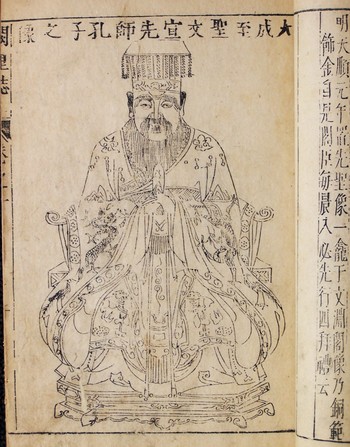
The continued presence of icons after 1530 made the Qufu temple unique, even though the temple at the imperial university in Beijing was ritually more important because the emperor regularly sacrificed there.Footnote 30 Post-1530 editions of the Qufu temple gazetteer, Queli zhi 闕 里 誌, called attention to this new distinction by reproducing a line drawing of the sculptural icon of Confucius at the beginning of the book (figure 2).Footnote 31 Portrayed as a frontal and symmetrical figure with a heavy beard, Confucius sits regally on a curved-back throne with an ornate footrest. Solemn in expression, he holds a pointed tablet in front of his chest. His robe displays imperial emblems, such as the sun, moon, and Big Dipper on the shoulders, and dragons and mountains on the voluminous sleeves. Twelve strings of beads hang from both ends of his mortarboard-shaped crown, which is foreshortened so that the back is not visible. Except for the inscribed title that identifies the figure as Confucius, the image could easily be taken for one of the high gods of religious Daoism (cf. figure 1).
Line drawing of the Qufu temple icon of Confucius, titled “Portrait of the Great-Completion Ultimate Sage and Culture-Propagating First Teacher, Master Kong” (Dacheng zhisheng wenxuan xianshi Kongzi zhi xiang 大 成 至 聖 文 宣 先 師 孔 子 之像), early Qing, c. 1647, woodblock print. Queli zhi 闕 里 誌, expanded edition of Kong Yinzhi 孔 胤 植, juan shou. Source: Regenstein Library, University of Chicago.

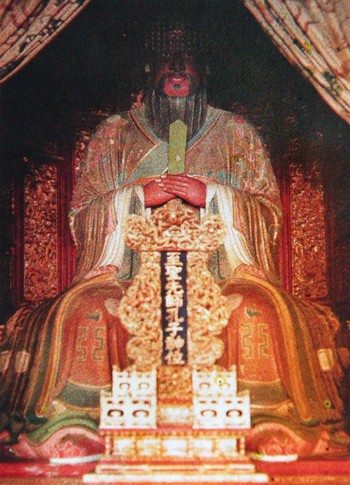
In 1724, a fire in the Qufu temple devastated the main hall and destroyed the sculptural icons. To assist with the repairs, the Yongzheng emperor (r. 1723–35) sent a team of palace artisans to create replacements for the images of Confucius and the Four Correlates, which were completed in 1730 (Kong Jifen [1762] Reference Jifen1966, 12:10a–b [222–228]; Xichao xinyu [1824] 1984, 9:1b [366]). The similarity between figures 2 and 3, as well as a late Ming description (Bi Ziyan Reference Ziyan1983, 3:26a [1293-447]), suggest that the 1730 replacements faithfully preserved iconographic details. The illustration in Queli zhi (i.e., figure 2) probably served as the specific model for the replacement (figure 3). Rather than simply modeling clay figures over a wooden armature, the sculptors used the “unsupported method” (tuo tai fa 脫 胎 法, literally “discarded-embryo technique”), which created a hollow space inside the sculptures.Footnote 32 Silver “organs,” bronze mirrors, and old editions of the Confucian classic books were placed there, suggesting yet another way in which Confucian icons were affected by Buddhist practices. Such deposits were often placed inside an interior cavity of a Buddhist sculptural image to help empower the image or make offerings to the deity (Kieschnick Reference Kieschnick2003, 62–63; Shen Reference Shen2000). Qufu temple documents do not mention the concealed objects, and it is unclear whether the previous set of icons had also contained them. The hidden deposits briefly came to light only in November 1966, during the Cultural Revolution, when Red Guards smashed the Qing sculptures and discovered the objects inside. Unfortunately, the deposited objects were almost immediately destroyed (Wang Liang Reference Liang and Wilson2002, 391; Yazi 1991, 138–39, 168).
Sculptural icon of Confucius (now destroyed) in the main sacrificial hall (Dacheng dian 大 成 殿), Temple of Confucius, Qufu, Shandong. Qing, 1730. Photo by Stéphane Passat, 1913. Source: Chine, 1909–1934, comp. Musée Albert Kahn (Boulogne-Billancourt: Le Musée, 2001), 1:622.

Woodblock Prints and the Popularization of Confucius
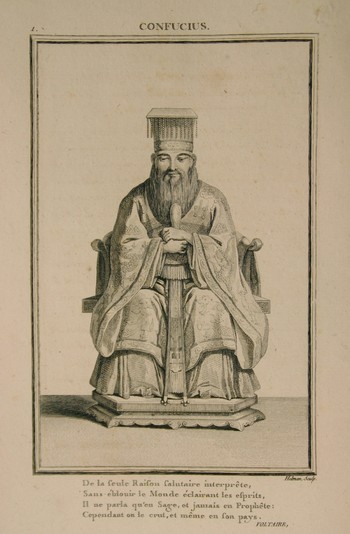
Although the Jiajing emperor intended his 1530 reform to put an end to inappropriately godlike representations of Confucius, the continued existence of the sculptural icon in the Qufu temple prevented this iconography from disappearing. Coinciding with the sixteenth-century boom in woodblock printing and book publishing, the ban on representational images in all other Confucian temples made the Qufu image unique, and thus interesting. Versions of the line-drawn illustration in Queli zhi reproducing the icon's visual features circulated widely during the late Ming and Qing periods, even reaching Europe, where the image was copied and given more naturalistic rendering, shading, and contour to make it look more like a seated human being (figure 4). Pictures in woodblock printed books and on single sheets also spread awareness of the godlike icon to broader segments of Chinese society, facilitating Confucius's incorporation into popular religious practices that differed from the rarified sacrificial rituals enacted in Confucian temples.
Engraving of Confucius inscribed with praise by Voltaire (1694–1778), by Isidore Stanislas Helman (1743–1806), from Abrégé historique des principaux traits de la vie de Confucius, célèbre philosophe chinois; orné de 24 estampes in 4°, gravées par Helman, d'après des dessins originaux de la Chine, envoyés à Paris par M. Amiot, missionaire à Pékin et tirés du cabinet de Mr. Bertin (Paris, 1788). Source: Regenstein Library, University of Chicago.

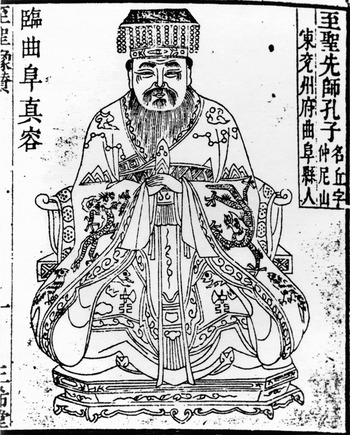
Besides appearing prominently in various reprints and expansions of the Qufu temple gazetteer Queli zhi, the illustration of the sculptural icon also was copied into later editions of another book, Lü Weiqi's 呂 維 祺 (1587–1641) Shengxian xiangzan 聖 賢 像 賛 (Portraits and Encomia for the Sage and Worthies). First published in 1632, the work was a compendium of line-drawn images and eulogies for Confucius, the disciples, and canonized later Confucian scholars. The picture of the temple icon (figure 5) was inserted at the beginning of the 1832 edition and annotated as “copied from the True Visage in Qufu” (lin Qufu zhenrong 臨 曲 阜 真 容), indicating that the book was published elsewhere.Footnote 33 This notation was removed in the 1878 edition, which was published in Qufu by Kong Xianlan 孔 憲 蘭 (juren 1862), a seventy-second-generation member of the Kong lineage.Footnote 34 Perhaps he considered it unnecessary to provide such detailed information about the familiar icon, but he may also have thought it did not represent the “true visage” of his ancestor. As I discuss in the next section, Kong family publications since the twelfth century had recorded a small painting of Confucius and his disciple Yan Hui as the most faithful (zui zhen 最 真) depiction of the master (Kong Chuan [1134] Reference Chuan1967, xia: 3b–4a; Kong Jifen [1762] Reference Jifen1966, 12:3a [213]; Murray, forthcoming).
Line drawing of the Qufu temple icon of Confucius, entitled “Ultimate Sage and First Teacher, Master Kong” (Zhisheng xianshi Kongzi 至 聖 先 師 孔子), Qing period, woodblock print. Lü Weiqi 呂 維 祺, Shengxian xiangzan 聖 賢 像 賛, 1837 edition. Source: National Diet Library, Tokyo.

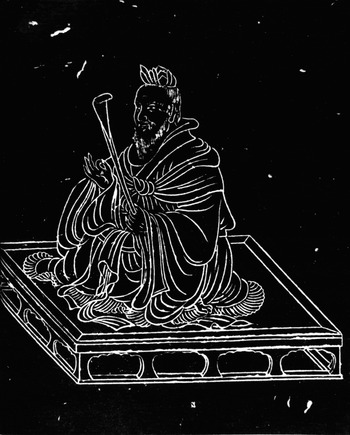
The illustration of the Qufu temple icon differed significantly from the other pictures in Shengxian xiangzan. Lü Weiqi's original compendium reproduced a famous set of stone tablets made in 1156 for the Southern Song imperial university, which later became the Hangzhou prefectural school.Footnote 35 Unlike the Qufu sculpture, the incised tablets portrayed Confucius seated in three-quarter profile on a low dais and dressed in unadorned robes (figure 6). Gesturing with one hand and holding a long, curved scepter with the other, he appears to be addressing the seventy-two disciples, who are arrayed before him in a long line of lively figures.Footnote 36 The Hangzhou tablets were not used in temple sacrifices but were displayed in the school building to inspire the students to cultivate virtue and loyalty, as the preface by the Song emperor Gaozong (r. 1127–62) makes clear. Similarly, Lü Weiqi prefaced his Shengxian xiangzan by stating that scholars of his own day needed images to remind them of fundamental values and prevent them from straying into Buddhism, Daoism, and even Christianity (Lü Reference Weiqi1632, xu: 3b–4b). The animated and engaging figures contrast sharply with the static pose and hieratic frontality of the Qufu temple icon, which suggests a conception of Confucius as remote and eternal, consistent with its ritual function.Footnote 37
Portrait of Confucius, from Portraits and Eulogies of Confucius and Seventy-Two Disciples, Southern Song, 1156, detail of rubbing from an incised stone tablet in the Temple of Confucius, Hangzhou. Source: Huang Yongchuan (1963, 2).

Before photographs of the Qufu temple's sculptural icon of Confucius made it widely known in the twentieth century (e.g., figure 3), woodblock-printed images were the primary means of spreading knowledge of it (e.g., figures 2 and 5). The hieratic frontality and clearly depicted emblems of rank and potency marked Confucius as a god comparable to the Jade Emperor (figure 1), which undoubtedly helped stimulate interest in worshiping him. Moreover, late nineteenth-century efforts to popularize his cult encouraged ordinary people to incorporate Confucius into the heterogeneous pantheon of efficacious deities (Chen Reference Chen1999; Clart Reference Clart2003). Although Confucius never became as important in this respect as Buddhist, Daoist, and popular-cult gods, votive prints from the late nineteenth and early twentieth centuries suggest that people did worship him in homes and village schools (Kongzi baitu 1997, 12). Some of these prints, called “New Year pictures” (nian hua 年 畫), were pasted above altars and on walls at the beginning of each year, providing a focus for veneration and offerings of incense throughout the year. Others, sometimes called “paper horses” (zhi ma 紙 馬), were intended for use in a single worship ritual and were burned immediately afterward, to send them to the spirit world.Footnote 38 Surviving examples show that Confucius was sometimes the primary object of worship, while others include him as just one of many deities in a “pantheon” print.
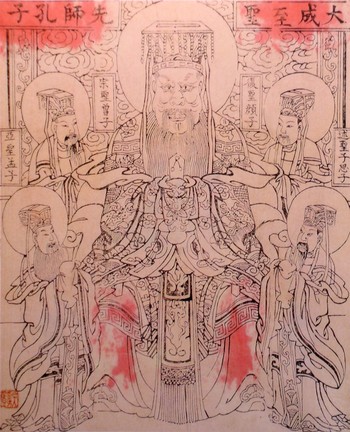
The first of two popular prints reproduced here, made for one-time use, depicts Confucius with imperial attributes (figure 7) and is clearly based on the Qufu temple icon. However, the image has been vernacularized with conventions of the popular-print genre and closely resembles votive images of Daoist and popular gods (see, e.g., Po 1992; Rudova Reference Rudova and Viacheslav1988; Wang Shucun Reference Shucun1992). The powerful features of Confucius's outsize face convey crude vigor, not decorous serenity, rendering him remarkably similar to Lord Guan (Guan di 關 帝) (Po 1992, nos. 21–22; Rudova Reference Rudova and Viacheslav1988, nos. 6, 22) or even to the deified Ox King (Niu wang 牛 王) (Po 1992, no. 28; Wang Shucun Reference Shucun1992, 21 pl. 6). Smaller standing figures of the Four Correlates flank the seated Confucius in the same way that other popular prints portray a god's assistants, visually attesting his importance and power. Although iconic sculptures representing the Four Correlates accompany the statue of Confucius in the Qufu temple, and all are reproduced as line drawings in Shengxian xiangzan, this book presents each figure in isolation. The popular print not only casts the Four Correlates as Confucius's assistants, it also gives each of the five men a halo, a motif originally introduced from Buddhist visual iconography and more recently reinforced by Christian imagery. The swirl pattern that fills the space above is modeled after the auspicious clouds that often surround Buddhist and Daoist deities.
Confucius and Four Correlates, entitled “Great Completion Ultimate Sage and First Teacher, Master Kong” (Dacheng Zhisheng xianshi Kongzi 大 成 至 聖 先 師 孔子), early twentieth century, woodblock print from Yangliuqing 楊 柳 青, Hebei. 42 × 34.5 cm. Source: Kongzi baitu (1997, 18:4).

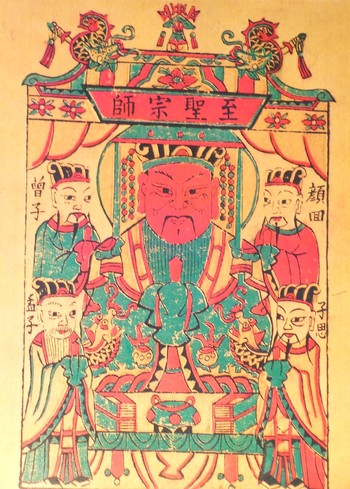
Another popular print depicting Confucius with the Four Correlates frames the group under a temple roof and includes an altar with an incense burner, a setting that visually connotes sacrifice and indicates the ritual function of this image (figure 8).Footnote 39 These elements, and the carefully printed coloring, suggest that this print was intended for veneration and offerings throughout the year. Confucius wears a simplified version of the imperial regalia and has a red face, as other gods sometimes do. The books on the altar refer not to temple rituals but to Confucius's identification with learning. At the center of the roof ridge is a vase sprouting lances and an inverted V-shaped chime, a common rebus for “a lifetime of blessings” (ping sheng ji qing 平 生 吉 慶) (Po 1992, 160). New Year prints typically incorporate such auspicious designs and symbolic decorations as a means of attracting good fortune and worldly success. Taken together, these features suggest that the print was marketed to people who aspired to ascend socially through educational accomplishment and were accustomed to seeking aid from the gods to fulfill their needs. The print visually represents Confucius as an appropriate god to petition for assistance with schooling and examinations. Such expectations are confirmed by the four-character title above his head, “Ultimate Sage and Ancestral Teacher” (Zhisheng zongshi 至 聖宗 師). This designation suggests the reverential conception of Confucius as the progenitor of a lineage of scholars,Footnote 40 and may also allude to his role as the purported founder of a national religion of Confucianism, which Kang Youwei and others were attempting to establish from 1898 through the 1910s (Chen Reference Chen1999; Goossaert Reference Goossaert2006).
Confucius and Four Correlates, entitled “Ultimate Sage and Ancestral Teacher” (Zhisheng zongshi 至 聖 宗 師), early twentieth century, color woodblock print from Beijing; 31×20 cm. Source: Kongzi baitu (1997, 15:1).

An Alternative Icon: The Traveling Pedagogue
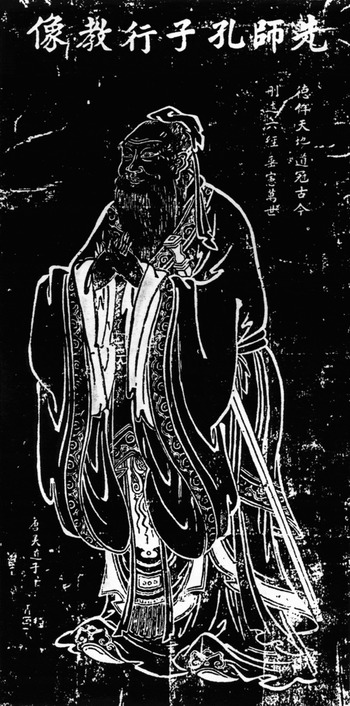
Another effect of the Jiajing emperor's 1530 removal of icons from state temples and change of Confucius's honorific title was to give a more prominent role to depictions that represented Confucius as a man rather than as a god. In addition to more numerous and varied versions of his pictorial biography, often called Shengji tu 聖 蹟 圖 (Murray Reference Murray and Wilson2002, 255–57), the period after 1530 saw a proliferation of portraits of Confucius as a teacher.Footnote 41 These images show him wearing a simple cloth cap and undecorated robes, with a sword tucked under his left arm (figure 9). Slightly stooped, he stands in a dignified posture with hands clasped in front of his chest. Some renditions give his face a distinctly homely appearance, even buck teeth, while others replace the simple cloth headgear with a cap shaped like a lotus bud, or even an official cap. In the late Ming and Qing periods, this image was incised on stone tablets for display in school buildings, and it was also reproduced in woodblock-printed books and hanging scroll paintings.Footnote 42 Differing only slightly from one another, these renditions often include a notation attributing the original depiction to Wu Daozi 吳 道 子 (c. 689–after 755), the most renowned figure painter of the eighth century. However, Wu's early biographies and lists of paintings do not mention any portrait of Confucius. Although the earliest references date only from the late eleventh century (Murray, forthcoming), Wu could conceivably have been inspired to paint an image of Confucius while serving in office in Xiaqiu, Yanzhou 兗 州 瑕 丘, a short distance from Qufu (Zhang Yanyuan [847] Reference Yanyuan1963, vol. 1, 9:108–9).
Portrait of Confucius, rubbing of incised stone tablet, Ming sixteenth-century replacement of Southern Song twelfth-century tablet erected by Kong Duanyou 孔 端 友 and Kong Chuan 孔 傳 in Quzhou 衢 州, Zhejiang. Source: Qufu Kongmiao jianzhu (1988), fig. 1-1-2.

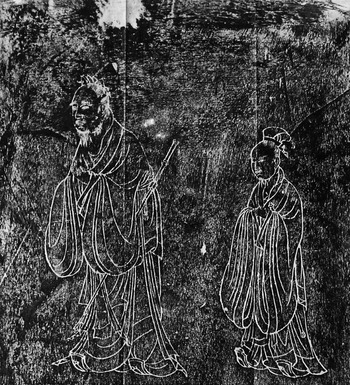
Confucius's three-quarter stance and costume in this portrayal closely resemble those of another picture, in which he is accompanied by his favorite disciple, Yan Hui (figure 10).Footnote 43 First documented in the late eleventh century, the two-man composition reproduced a small painting in the Kong family ancestral temple (jia miao 家 廟), which was adjacent to but separate from the official temple of Confucius in Qufu. Recorded in successive Kong genealogies (e.g., Kong Chuan [1134] Reference Chuan1967, xia: 3b–4a; Kong Yuancuo [1242] Reference Yuancuo1967, 8:4b), the heirloom painting allegedly transmitted Confucius's true likeness more faithfully than other portraits, and it was repeatedly copied in stone stelae and woodblock-printed books from the late eleventh century onward (Murray, forthcoming). The solo portrait was probably created by enlarging the figure of Confucius from this two-man composition. In the early Southern Song period (1127–1279), prominent Kongs from Qufu erected a stele depicting just Confucius in Quzhou 衢 州, Zhejiang, where they settled after fleeing the Jin invasions of the north in 1126–27.Footnote 44 In the following centuries, the solo portrait was repeatedly recarved onto new stones, particularly at government schools and private academies in the South. Several early examples have inscriptions referring to a stone incised with the “Wu Daozi” image of Confucius that was miraculously found in 1322 inside a bridge near Jiangling 江 陵, Hubei, and subsequently put on display there (Kongzi baitu 1997, 107; Zhongguo meishu quanji, huihua bian 1988, 19 no. 70). The apparent preference for the solo portrait in the South and its association with the Southern Kongs contrast with the northern affiliations of the two-man composition, which was reproduced on stelae in the Qufu temple and elsewhere under the Jin dynasty (Murray, forthcoming). Competing with the Southern Song for the allegiance of the Kongs and of learned men in general, the Jin patronized the temple and awarded the ducal title to Kong Duanyou's younger brother, who had remained behind in Qufu (Wilson Reference Wilson1996, 571–72).
Confucius and Yan Hui, rubbing of incised stone tablet erected by Kong Yu 孔 瑀 in the Temple of Confucius, Qufu, Shandong, Northern Song period, dated 1118. Source: E. Chavannes, Mission Archéologique dans la Chine Septentrionale (Paris: Leroux, 1909), CCCXCVIII:871.

Although incised tablets depicting Confucius as a simply dressed standing figure were widespread before 1530, this image gained importance after the Jiajing emperor abolished icons from Confucian temples. The representation accorded well with Confucius's new official designation as Ultimate Sage and First Teacher, and the composition readily circulated in rubbings, from which additional tablets could be carved. Normally displayed in school buildings rather than in sacrificial halls, it played no role in the formal rituals performed twice a year. Instead, the portrayal was commemorative and inspirational, offering latter-day students and teachers visual rapport with their role model and allowing them to imagine themselves as the latest generation of Confucius's disciples. In the Qing period, three stelae carved with versions of the solo portrait of Confucius were added to the Qufu temple's Hall of the Sage's Traces (Shengji dian 聖 蹟 殿), joining a 112-scene pictorial hagiography displayed on stone tablets there since 1592–93 (Murray Reference Murray1996). Modified versions of Confucius's portrayal as a teacher also appeared in European publications of the late seventeenth and eighteenth centuries (Demattè Reference Demattè, Reed and Demattè2007, 37–38; Jensen Reference Jensen1997, 10, 82).
After the Qing dynasty was overthrown and replaced by the Republican government, the basis for the official cult of Confucius became much more tenuous (Wilson Reference Wilson and Wilson2002b, 85–87).Footnote 45 Although some prominent intellectuals advocated making Confucianism a national religion modeled on Christianity, others worked strenuously to redefine it as a nonreligious cultural tradition (Goossaert Reference Goossaert2006, 15). As First Teacher, Confucius became a symbol of respect for learning and an emblem of classical civilization. This conception also found resonance with the Japanese, who increasingly saw themselves as heirs to the ancient cultural legacy (Fogel Reference Fogel1995, chap. 6).Footnote 46 In 1935, a small Ming bronze image of the standing Confucius was installed in the Yushima Seidō 湯 島 聖 堂, the Confucian temple in Tokyo, which had been rebuilt with sturdy modern materials after the 1923 earthquake (Yushima Seidō to Edo jidai 1990, nempō, B1).
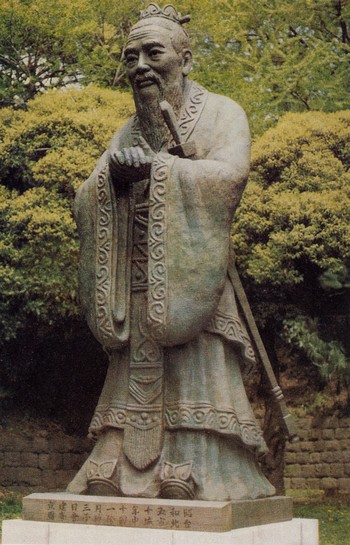
When Confucius was repudiated by Communist authorities in the People's Republic after 1949, the Nationalist government in Taiwan promoted him as an emblem of its commitment to preserve China's ancient heritage. In 1974, at the height of the “Criticize Lin Biao, Criticize Confucius” (pi Lin pi Kong 批 林 批 孔) movement on the mainland, the Taiwan government officially sponsored and disseminated a carefully chosen portrayal of Confucius (Cai Reference Wenyi1976, 115; Murray Reference Murray2001, 17, 26). Deeming his identity as a teacher most significant for Chinese and world culture, the Ministry of Education designated a purported “Wu Daozi” image to serve as the official portrait of Confucius (figure 11). Based on a rubbing from a Qing stele in Qufu, the depiction gave Confucius an appropriately dignified yet humane appearance. Moreover, the choice was validated by Kong Decheng 孔德 成 (1920–2008), the senior Kong in the seventy-seventh generation, who had lived in Qufu before fleeing to Taiwan in 1949. Over-life-size bronze statues using this iconography were cast in Taiwan and presented in 1974–75 to sites of culture and learning around the world, including the Yushima Seidō (figure 12).
Portrait of Confucius, traditionally attributed to Tang master Wu Daozi 吳 道 子 (ca. 689–after 755), rubbing of a Qing-period incised stone tablet in the Temple of Confucius, Qufu, Shandong. Source: Baba (Reference Harukichi1940, 40).

Statue of Confucius on the grounds of the Yushima Seidō 湯 島 聖 堂 (Temple of Confucius), Tokyo, 1975, bronze, cast in Taibei, height 4.58 m.

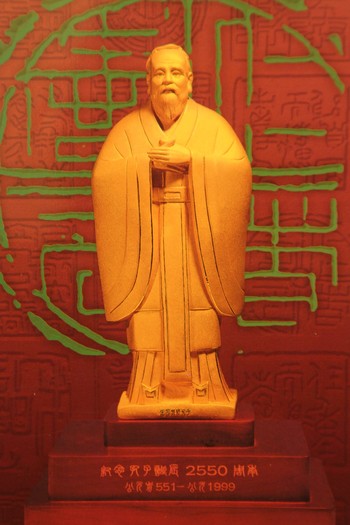
More recently, mainland China has turned away from iconoclasm, and representations of Confucius are proliferating once more. The smashed icons in the Qufu temple were reconstructed in 1984, and Hong Kong and overseas Chinese donors have erected large statues of the ancient teacher at many schools and at former Confucian temples that have been restored as tourist attractions (see cover photo in this issue). In 1999, the government-supported China Confucius Foundation issued a limited edition of 1,000 gold statuettes of Confucius to honor the 2,500th anniversary of his birth (figure 13). Promotional literature claimed that the statue was based on the most faithful traditional portrait, the “Wu Daozi” image, but was even more authentic. Instead of imitating the anachronistic clothing inadvertently depicted by Wu, the robes of the new image reflected archaeological evidence from the Warring States period. This concern for period-appropriate costume perfectly captures the modern demand for a scientific recovery of the past; nonetheless, the removal of Confucius's sword suggests that modern beliefs also influenced the depiction—teacher-philosophers no longer carry weapons.
Statuette of Confucius, 1999, designed for the China Confucius Foundation by Qian Shaowu 錢 紹 武 (b. 1928), 24-carat gold, height 27 cm. Source: China Confucius Foundation publicity pamphlet, 2001.

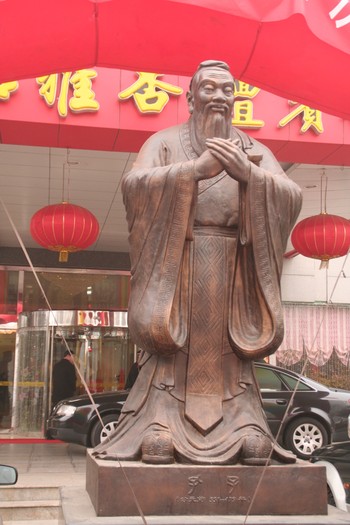
Since 2004, China has used Confucius to promote the study of Chinese language and culture worldwide under the rubric of “Confucius Institutes” and has even contributed funds to establish a “Confucius Literacy Prize” awarded by UNESCO (China View 2006). In order to make Confucius a more recognizable and effective symbol of Chinese civilization, the China Confucius Foundation pushed to standardize his visual representation and put an end to the diverse portrayals, some of which purportedly even “deified and defamed” (shenhua he chouhua 神化 和 丑化) him (Zhongguo xinwen wang 2006). Thus, in January 2006, plans were announced to create a standard portrait, starting with yet another review of existing images in consultation with scholars of Confucianism, historians, sculptors and painters, and descendants of Confucius. Design specifications issued in February called for the new portrait to be based on the purported Wu Daozi image and to depict Confucius as between sixty and seventy years of age, with a facial expression that was at once “genial yet strict, imposing and yet not intimidating, courteous and yet at ease” (wen er li, wei er bu meng, gong er an 温而厲,威而不猛,恭而安) (Dahe xinxiang wang 2006, quoting Analects 7.38, trans. Dawson Reference Dawson1993, 27). A prototype was presented at the Shandong International Cultural Industry Exposition in June 2006, and the final version was unveiled in Qufu on September 23, in time for birthday celebrations (China View 2006) (figure 14). Inevitably, this effort to standardize the portrayal of Confucius prompted criticisms (CRIEnglish.com 2006), some of which recall the kinds of objections raised against his icons in earlier periods. Obviously, it is impossible to know what Confucius “really” looked like so long after his lifetime, and even the so-called Wu Daozi portrait came from the artist's imagination. Moreover, an emphasis on Confucius's outward appearance seems wrong and completely unnecessary to people who focus on his teachings and the values associated with him. The variety of visual representations reflects the ways in which Confucius has been understood and appropriated throughout history. As scholars debated in 2006 whether it was possible or desirable to decree any portrayal as correct, one new argument captured a contemporary concern: that creating a “standard” is the first step toward patenting the image for commercial profit (China Daily 2006). In response, Secretary-General Zhang Shuhua 张 树 骅 of the China Confucius Foundation reiterated that a unified standard was intended only to end the confusion caused by multiple images and to facilitate worldwide recognition of Confucius; in fact, it did not really matter whether the portrait resembled Confucius (CRIEnglish.com 2006). However, Zhang also mentioned that Taiwan had previously issued its own standard image of Confucius, implying that the real “confusion” has to do with which regime controls his legacy. Thus, the 2006 “branding” of Confucius was not primarily for commercial motives but for political ones. Establishing an official portrait of Confucius is an assertion of authority over the heritage of Chinese civilization.
“Standard Portrait” of Confucius, 2006, designed for the China Confucius Foundation by Hu Xijia 胡 希 佳 (b. 1956), bronze, height 255.7 cm. Qufu. Photo by Julia K. Murray.

Acknowledgments
Earlier versions of this paper were presented at the 2003 Annual Meeting of the College Art Association; at the University of Wisconsin's Center for East Asian Studies seminar series; and in the 2007 Confucius Seminar Mellon Workshop in the Center for Humanities. I thank the participants in these sessions for their insightful questions and comments. I am also grateful to Thomas Wilson, Mark Csikszentmihalyi, and the two anonymous JAS reviewers for their detailed suggestions on the submitted manuscript.