Introduction
The immune hypothesis of schizophrenia proposes that schizophrenia is accompanied by the dysregulation of cytokines in both the peripheral and the central nervous systems (CNS), and furthermore, that cytokine dysregulation plays a causative role in the aetiology of the disease. Indeed, studies in rodents have shown that the proinflammatory cytokines have profound effects on the metabolism of brain serotonin, dopamine and noradrenalin Reference Dunn, Wang and Ando(1,Reference Leonard2). Transforming growth factor-beta1 (TGF-β1), which has trophic effects on dopaminergic neurons Reference Krieglstein, Suter-Crazzolara, Fischer and Unsicker(3,Reference Krieglstein and Unsicker4), is essential for the maintenance of immune homeostasisReference Zhang, Yi, Xia and Zhao(5). That is, TGF-β1 strongly inhibits the production of proinflammatory cytokines, such as interferon-gamma, tumour necrosis factor-alpha and interleukin-2 Reference Schmitt, Hoehn and Huels(6,Reference Prud’homme and Piccirillo7), and promotes the differentiation of T helper type 2 (Th2) cells Reference Barral-Netto, Barral and Brownell(8). In addition, TGF-β1 is released from damaged neurons and is thought to play a role in CNS wound healing Reference Lindholm, Castren, Kiefer, Zafra and Thoenen(9,Reference Logan and Berry10). It has been reported that TGF-β1 may play a role in the neuropathogenesis of human disease (Reference Wahl, Allen and Mccartney-Francis11–Reference Morganti-Kossmann, Kossmann and Wahl13).
The human TGF-β1 gene is located on chromosome 19q13.1–13.3 Reference Fujii, Brissenden, Derynck and Francke(14) and population-based linkage analysis of schizophrenia and bipolar case-control cohorts identifies a potential susceptibility locus on 19q13 Reference Francks, Tozzi and Farmer(15). The human TGF-β1 gene has biallelic polymorphisms at codon 10 (position +869) and codon 25 (position +915) of exon 1. The T→C single nucleotide polymorphism (SNP) at +869 of the TGF-β1 signal sequence causes a Leu→Prosubstitution at codon 10 of the amino acid sequence and the G→C at +915 causes an Arg→Prosubstitution at codon 25 Reference Cambien, Ricard and Troesch(16).
There are many pieces of evidence that the polymorphisms at these codons are associated with higher or lower TGF-β1 synthesis in vitro Reference Hutchinson, Turner, Sankaran, Awad and Sinnott(17,Reference Awad, El-Gamel, Hasleton, Turner, Sinnott and Hutchinson18). Many studies have reported that the levels of TGF-β1 are linked to numerous medical Reference Blobe, Schiemann and Lodish(19) and psychiatric diseases (Reference Vawter, Dillon-Carter, Issa, Wyatt and Freed20–Reference Kim, Myint and Lee23).
In our previous studies (Reference Na and Kim24–Reference Kim, Lee and Suh26), cytokines are associated with acute psychotic schizophrenia. Moreover, our previous study Reference Kim, Myint and Lee(27) showed that a high-plasma TGF-β1 level was found in schizophrenia patients, and the level was lower after treatment. Therefore, we tried to investigate the effect of TGF-β1 polymorphisms on the pathophysiology and treatment response in schizophrenia.
Methods
Subjects
Ninety-nine schizophrenia patients diagnosed according to Diagnostic Statistical Manual, Fourth Edition (DSM-IV) criteria were recruited amongst schizophrenic patients who were admitted to Korea University Medical Center, Ansan Hospital between March 2003 and July 2006. Diagnoses were decided by mutual consent of two trained psychiatrists (blind to the genotypes).
The schizophrenia patients comprised 70 of paranoid subtype, 17 of undifferentiated subtype and 12 of other subtypes. Among them, no patient had taken psychotropic medications within the last 2 weeks. During the treatment period of the study, various atypical antipsychotics were used according to patient's symptoms and tolerance including aripiprazole (12 patients, average dosage; 25 mg or 500 chlorpromazine dose equivalent), amisulpride (34 patients, average dosage; 660 mg or 528 chlorpromazine dose equivalent), quetiapine (33 patients, average dosage; 550 mg or 550 chlorpromazine dose equivalent) and risperidone (20 patients, average dosage; 5.4 mg or 540 mg chlorpromazine dose equivalent) Reference Woods(28). Concomitant medications such as benzodiazepine were permitted.
Patients with serious or unstable medical illness were excluded from the study.
The control subjects consisted of 130 randomly selected healthy individuals who visited the Korea University Ansan Hospital for regular health screenings (medical inspection) and agreed to participate in the present study. The control subjects were closely matched with the schizophrenia group in terms of age and sex. Control subjects were excluded if they had any self-reported personal or familial psychiatric history or psychotropic medication history, and also if they had scores of higher than 10 on the Beck Depression Inventory or higher than 40 on the State-Trait Anxiety Inventory.
The study protocol was approved by the Ethics Committee of Korea University, and written informed consent was obtained from all the patients and control subjects. All the patients and control subjects were at least 18 years of age and Korean of Ethnicity.
Clinical evaluation
The evaluations consisted of reviews of psychiatric and medical histories, current and previous medication and alcohol intakes, followed by a semistructured interview for the purpose of establishing DSM-IV criteria diagnosis. The severity of schizophrenia symptoms was evaluated using the Positive and Negative Syndrome Scale (PANSS). A non-responder on PANSS is defined as a patient whose score decreases less than 20% from baseline. A patient who was a non-responder on PANSS scale was regarded as a non-responder in the present study.
TGF-β1 genotyping
Genomic DNA was isolated from buffy coat by a genomic DNA purification kit (Promega, Madison, Wisconsin, USA). Allele frequencies of the TGF-β1 polymorphisms in the signal peptide sequence were determined by PCR and a subsequent restriction analysis with MspA1I endonuclease (Promega) for the L10P polymorphism or BglI endonuclease (Promega) for the R25P polymorphism. Specific primer sequences (5-CGCTTCACCAGCTCCATGT CGATAG-3 and 5-CACACCAGCCCTGTTCGCGC TCT-3) were derived from the original sequence (GenBank Accession No. X05839). The PCR was performed in a final volume of 50 µl containing 100 mM KCl, 20 mM Tris–HCl buffer, pH 8.0, 2 mM MgCl2, 20 pmol of each primer, 0.2 mM each dNTP and 0.1 µg of genomic DNA in the presence of 2.5 U of Taq polymerase (Takara, Tokyo, Japan). After the initial denaturation step (94°C for 5 min), each cycle (of additional 35 ones) consisted of a 94°C denaturation for 30 s, a 60°C annealing for 30 s, a 72°C extension for 30 s, with the final extension lasting 5 min at 72°C. Equal amounts of 10 µl of the PCR product were digested with MspAlI or BglI for 3 h at 37°C. Digestion with MspAlI yields fragments of 40, 46 and 94 bp lengths for the L allele and 12, 40, 46 and 82 bp for the P allele. Digestion with BglI yields fragments of 56, 60 and 64 bp lengths for the R allele and 64 and 116 bp for the P allele. Fragments were separated on 4% QA-agarose gel (Qbiogene, Carlsbad, CA, USA) and visualised by ethidium bromide staining viewed with a UV transilluminator.
Statistical analysis
Pearson chi-squared test was done for testing the categorical variables such as sex or diagnosis and for deviations from Hardy-Weinberg equilibrium. Group mean differences were ascertained by means of Student's t-test or analysis of variance (ANOVA) according to the number of each group. Statistical significance was considered if the two-tailed probability was less than 0.05. All statistical analyses were performed with SPSS version 12.01 for Windows.
Results
Demographic data of the subjects
The male/female distributions are 73/57 in normal controls and 45/54 in schizophrenia, showing no significant difference between the two groups (p = 0.11). The mean ages are not significantly different between the two groups (32.6 ± 10.8 in normal controls and 34.6 ± 11.2 in schizophrenia, p = 0.19). There was no significant difference in body mass index (BMI) between the groups (22.3 ± 3.0 in normal controls and 22.8 ± 3.8 in schizophrenia, p = 0.32).
Clinical characteristics according to the TGF-β1 polymorphism in schizophrenia patients
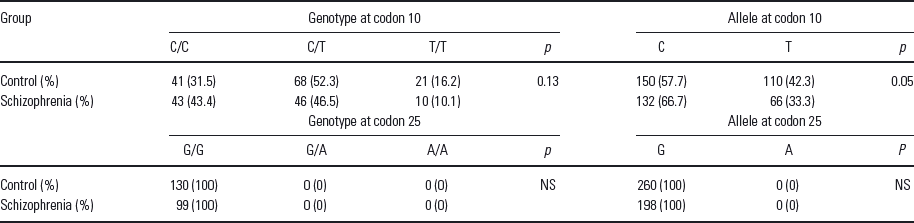
Our study population had no genetic polymorphism at codon 25, but we observed the expected genetic polymorphism at codon 10. The genotype distributions of TGF-β1 at codon 10 were in Hardy-Weinberg equilibrium in both groups (p = 0.41 in control group, 0.65 in schizophrenia group). There was no significant difference in genotype distributions between normal controls and schizophrenia patients (Table 1). Although schizophrenia group showed a higher tendency of allele frequency in the subjects with C allele (p = 0.05), the allelic difference did not reach statistical significance after correction for multiple comparisons (p = 0.1).
Genotype distributions and allelic frequencies of the subjects
NS, not significant.
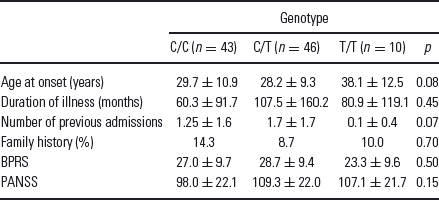
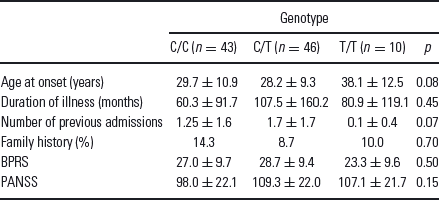
There is no difference in therapeutic response and in symptomatology amongst each group prescribed with a different antipsychotic medication. The PANSS scores were not significantly different according to the genotype in the schizophrenia group (p = 0.50, 0.15, respectively). There was no significant difference in age at onset, duration of illness or number of previous admissions according to the genotype (p = 0.08, 0.45, 0.07, respectively) (Table 2).
Clinical characteristics of schizophrenia subjects divided according to genotype at codon 10
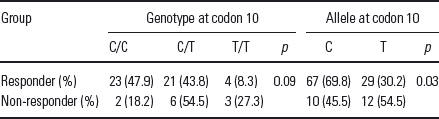
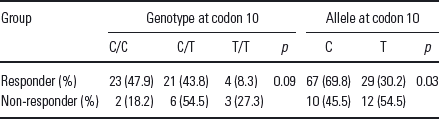
The reasons for the drop-outs included a switch to other drugs because of adverse effects (n = 19) and failure to follow-up (n = 21). The genotype distributions were not significantly different between the responder and non-responder groups of schizophrenia patients. However, the C allele was more frequent in the responder group (Table 3, p = 0.03).
The distribution of genotype and allele frequency in responder and non-responder groups
Discussion
The aim of the present study was to identify the effect of TGF-β1 polymorphism on susceptibility to schizophrenia and treatment response to atypical antipsychotics. We showed that the C allele at position +869 (codon 10) was more frequent in the schizophrenia group than in controls but, the allelic difference did not reach statistical significance after correction for multiple comparisons. Our previous study Reference Kim, Myint and Lee(27) showed that a high-plasma TGF-β1 level was found in schizophrenia patients, and the level was lower after treatment, suggesting that an immune imbalance associated with a high Th1/Th2 ratio stimulated the production of TGF-β1, and that the level of TGF-β1 was corrected after treatment when the imbalance of the immune system was normalised. TGF-β1 polymorphism is known to control protein level Reference Hutchinson, Turner, Sankaran, Awad and Sinnott(17,Reference Grainger, Heathcote and Chiano29). Even though there has been no previous study regarding TGF-β1 polymorphisms in schizophrenia, many studies have done mainly for medical disease. Similar to the present study, there were more C allele African-American hypertension subjects Reference Suthanthiran, Li and Song(30). However, many reports suggest that the C allele is associated with a reduced risk for several medical diseases (Reference Sugiura, Niimi and Sato31–Reference Yokota, Ichihara, Lin, Nakashima and Yamada33). Similarly, the effect of polymorphism on TGF-β1 production gets different according to the kinds of the diseases. Polymorphisms leading to increased TGF-β1 production have been linked to fibrosis and hypertension Reference Awad, El-Gamel, Hasleton, Turner, Sinnott and Hutchinson(18,Reference Li, Khanna, Sharma, Singh, Suthanthiran and August34), and those leading to decreased TGF-β1 production have been linked to osteoporosis Reference Yamada, Miyauchi and Goto(32). Moreover, from a speculation on the inverse relationship between the incidence of schizophrenia and rheumatoid arthritis (Reference Mors, Mortensen and Ewald35–Reference Oken and Schulzer37), the result that T allele is more frequent in rheumatoid arthritis is interesting Reference Sugiura, Niimi and Sato(31), contrary to the present study for schizophrenia. In view of different pathophysiology between schizophrenia and medical disease, it is difficult to compare the results. Moreover, to investigate the role of the functionality of TGF-β1 gene polymorphism on schizophrenia, it is needed to measure the TGF-β1 level.
Considering the therapeutic response, the genotype distributions were not significantly different between responder and non-responder groups in schizophrenia. However, the C allele was more frequent in the responder group. In short, the C allele was possibly associated with better response to antipsychotics. From the result of our previous study Reference Kim, Myint and Lee(27) showing a high-plasma TGF-β1 level in schizophrenia patients and lower level after treatment, and better treatment outcome with C allele in the present study, TGF-β1 seems to be associated with treatment response to atypical antipsychotics directly or indirectly.
Our study had some limitations. Firstly, non-random sampling and a limited sample size should be considered. The possible selection bias that might have been present in the hospital-based, case-control study is a relevant issue. The number of patients and controls used in this case-control study was relatively low and the significances of allele differences were also not high. Secondly, the various subtypes of schizophrenia and various kinds of atypical antipsychotics could be confounding factors. Thirdly, the distribution of TGF-β1 gene polymorphism in Koreans is different from that in Caucasians. In our study, the frequencies of the C/C, C/T and T/T genotypes at position +869 (codon 10) were 31.5, 52.3 and 16.2%, respectively. These frequencies are similar to those found in another study of Korean subjects (25.7, 48.0 and 26.3%) Reference Lee, Kim, Lee, Abdallah, Lympany and Song(38,Reference Kim and Lee39) and in a study of Japanese subjects (25.2, 49.9 and 24.9%) Reference Yokota, Ichihara, Lin, Nakashima and Yamada(33). However, different frequencies of these genotype were found in Caucasians (C/C, 53.0%; C/T, 40.0%; and T/T, 7.0%, respectively) Reference Lympany, Avila, Mullighan, Marshall, Welsh and Du Bois(40). Moreover, while the allelic frequencies of the TGF-β1 gene polymorphism at position +915 (codon 25) for Caucasians were 99.0% G and 1.0% A Reference Lympany, Avila, Mullighan, Marshall, Welsh and Du Bois(40), there was no genetic polymorphism detected for Korean subjects in this study or in a previous study Reference Lee, Kim, Lee, Abdallah, Lympany and Song(38). So, because of these ethnic differences in the distribution of the genotypes, it is difficult to generalise the result of this genetic study. Fourthly, only two SNPs were examined in TGF-β1 gene. There is a possibility that other SNPs in this gene may be associated with schizophrenia and play a major role in schizophrenia.
Notwithstanding with these limitations, this is the first study to examine the effect of TGF-β1 polymorphism in schizophrenia. The C allele at codon 10 was slightly associated with the susceptibility to schizophrenia, and possibly associated with good response to antipsychotic treatment. To evaluate the exact role of TGF-β1 in schizophrenia, further studies with a larger number of subjects and more controlled design with the additional polymorphisms of other cytokines will be needed.
Acknowledgment
This study was supported by a grant from the Korea Health 21 R&D Project, Ministry of Health and Welfare, Republic of Korea (A040042).