Abuse of volatile substances is prevalent in adolescent street children. The substances used are mostly halogenated or unsubstituted hydrocarbons, which may cause changes in mood or consciousness, and in some instances, hallucinations. The most serious acute consequence of abuse is death,Reference Anderson, Macnair and Ramsey1 which is usually reported as secondary to aspiration, accidental trauma, or asphyxia. The other acute causes of death include cardiac arrhythmias, anoxia, vagal inhibition and respiratory depression.Reference Anderson and Loomis2 Our aim was to evaluate the electrocardiographic and echocardiographic findings of street children known to be substance abusers.
Materials and methods
Ethics: The protocols for the intervention trial and follow-up study were approved by Scientific Ethical Committee, Health Minister’s Ethical Committee and Social Security Ministers.
Participants: The study was undertaken in the shelter established for male children known to be addicted to use of volatile substances. These children have been taken from the streets by an official, and kept in the shelter for a short period. Their needs related to medical and social problems are addressed by social workers and psychologists. For dissuading them from returning to the streets, a lot of opportunities are offered, including sports, education, sports and social activities. Participants were examined in the shelter, and written informed consent was obtained from each one.
Before examination, we recorded the reason and duration of living on the streets, and the use of drugs and volatile and illegal substances. For each substance, we ascertained the age at first use, frequency of use as daily, weekly, or monthly, and the date last used. Any known familial heart disease or other diseases were also recorded. In addition, questions were asked about chest pain, palpitations, dizziness, syncope, convulsions, prescribed medications, substances and nutrition.
Control group: The control group was selected from healthy male adolescents of the same age living with their families.
Cardiac investigations: Transthoracic echocardiographic investigation was performed on participants using a Vivid-3 Expert (General Electric, USA) device throughout the study. A complete echocardiographic examination, including m-mode evaluation of left ventricular function on long axis view, was performed on each subject. For electrocardiography, a Hewlett-Packard 4760A cardiograph (Hewlett-Packard Medical Products Group, Andover, MA, USA) was used. The heart rate, and PR, QT and QTc intervals were carried out by 12 lead recordings. Bazett’s formula (QTc=QT√R−R) was used to corrected QT for heart rate.Reference Garson3
Statistical analysis: Student t-test and Pearson correlation test were used in statistical analysis.
Results
We examined 53 street children, and 61 healthy peers. The mean ages of the street children and control group were similar, at 16.24 years, and 16.96 years, respectively. The height and weight centiles of the street children were less than the control group (p less than 0.0001). The median duration of life on the streets was 5.97 years.
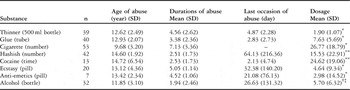
The list of abused drugs is given on Table 1. None of the children in control group were substance abusers. Abuse of thinning agents was common, and generally, the last time thinner used was 2 or 3 days before our examination. In addition to thinner, 40 children had been sniffing glue, the daily mean glue dose being 7.63 tubes. Of the children, 13 had been using morphine or its products, while ecstasy, or methylenedioxymethamphetamine, had been used by 20 street children.
Abused drugs, with duration and dosage of abuse.

*daily, **weekly, †‡monthly.
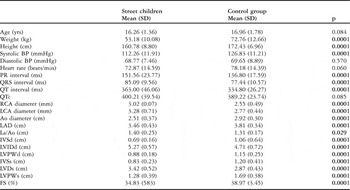
The systolic blood pressure of the abusers was lower than that of their controls (p less than 0.0001). On electrocardiographic examination, 2 of the abusers had ventricular extrasystoles, 5 had first degree atrioventricular block, 2 had sinus tachycardia, and 2 had incomplete right bundle branch block. Only normal findings were encountered in the control group.
The PR, QRS and QT durations of the abusers were longer than the values for their controls (p less than 0.0001). Although the QTc duration was also longer than for the control group, the difference was not statistically significant (Table 2). In 4 abusers, the QTc duration was above 440 ms. These children had abused 3 bottles of thinner and 7 tubes of glue the day before the study, as well as opiate products seven days before the study.
Cardiac findings of control group and street children.

Abbreviations: BP: blood pressure; RCA: right coronary artery; LCA: left coronary artery; Ao: aorta; LAD: left atrial diameter; La/Ao: left atrium/aortic diameter; IVSd: interventricular septum diastolic thickness; LVIDd: left ventricle end-diastolic diameter; LVPWd: left ventricular posterior wall diameter-diastolic; IVSs: interventricular systolic septal thickness; LVDs: left ventricular diameter-systolic; LVPWs: left ventricular posterior wall diameter-systolic; FS: fractional shortening.
On echocardiographic examination, left ventricle end-diastolic diameters for the abusers were dilated compared to their controls (p less than 0.0001), but, left ventricular ejection fractions and left ventricle fractional shortening measurements were in the range normal. The diameters of coronary arteries, aortas and left atriums were also found to be increased as compared to those of the control group (p less than 0.0001) (Table 2).
Discussion
Abuse of inhalants is one of the most common problems in children and adolescents who live on the streets in developing or developed countries.Reference Watson4–Reference Uzun and Kendirli6 They cause euphoria, pleasurable changes in mood, and an altered state of consciousness or hallucinations.Reference Ramsey, Anderson, Bloor and Flanagan7, Reference Esmail, Warburton, Bland, Anderson and Ramsey8 These agents change depending on country, climate and religion. In Brazil, the drugs used include alcohol, tobacco, inhalants, marijuana, and cocaine or crack. Up to nine-tenths report lifetime use of some kind of drug, with almost half reporting recent use within one month of interviewing, and 4% reporting use of injected drugs.Reference de Carvalho, Neiva-Silva and Ramos9 In our study, almost all of the street children were smoking cigarettes and had used or were using thinner, glue, or hashish. Morphine and its products had been abused by one-quarter, ecstasy by one-third, anti-emetics by one-eighth, and alcohol by almost two-thirds. In addition, we found that hashish, thinner and glue abusing were common instead of marijuana and cocaine. These substances lead to addiction at high doses, and/or with chronic use.Reference Lolin10 Volatile substances were abused frequently because of their inexpensive cost.
Death following abuse of volatile substances is due to pulmonary and cerebral edema, encephalopathy syndrome, cerebral damage, optic atrophy, peripheral muscle weakness, gastrointestinal disturbances, hepatic and renal damage, and asphyxia from vomiting and cardiac arrhythmia.Reference Ramsey, Anderson, Bloor and Flanagan7, Reference Esmail, Warburton, Bland, Anderson and Ramsey8 The principal cause of death reported for acute intoxications is arrhythmia due to myocardial sensitivity to catecholamines or a direct arrhythmogenic effect of the solvents, and coronary arterial spasm due to increased levels of catecholamines.Reference Viccellio, Bania, Brent, Hoffman, Kulig, Mofenson, Osborn, Wang and Wax11–Reference Cunningham, Dalzell, McGirr and Khan13 In addition, hypoxia, hypercarbia, hypokalemia and alcohol further predispose to arrhythmias.
The cardiac findings in homeless children known to abuse substances illicit drugs have been reported in previous single cases, but as far as we know, overall cardiac state has not previously been evaluated by echocardiographic and electrocardiographic assessments. After an extensive search of available archives and the literature, we can find no similar studies. We believe that some unrelated information may be available from different sources. but no specific, similar study could be found.
In our study, we found that some children had first degree atrioventricular block, sinus tachycardia, and incomplete right bundle branch block on electrocardiography, and the PR, QRS and QT durations were all longer than for the controls. Although it was not statistically significant, the QTc duration was also longer than for the control group. It is known that prolongation of the QTc interval has been associated with ventricular arrhythmias.Reference Straus, Kors and De Bruin14, Reference Downes, Whyte and Isbister15 In addition, it has also been demonstrated that acute ingestion of alcohol can induce prolongation of PR and QTc intervals.Reference Lorsheyd, de Lange, Hijmering, Cramer and van de Wiel16 Furthermore, the cardiac effects of ecstasy are cardiac stimulant actions, vasoconstriction, tachycardia and hypertension.Reference Fitzgerald and Reid17 In addition, the important effects of these agents have been associated with QT interval prolongation and torsade de pointes.Reference Krantz, Lewkowiez, Hays, Woodroffe, Robertson and Mehler18–Reference Sticherling, Schaer, Ammann, Maeder and Osswald20 Using ecstasy might produce synergistic effects on abuse of thinners and glue on the PR, QT and QTc intervals. It has been claimed that substance abuse can cause idiopathic long QT syndrome.Reference Singh, Singh, Singh and Khan21 In addition, in prolonged QT, ventricular tachyarrhythmias commonly develop during periods of adrenergic stimulation, such as fright or exertion.Reference Zareba, Moss and Schwartz22, Reference Garson, Dick and Fournier23
Those who abuse these substances frequently end their lives in jail, in car accidents, drowning or succumbing to sudden death. Death occurs due to arrhythmia and complications involving the central nervous system. Our study suggests that long PR, QT and QTc intervals are due to such abuse, combined with use of alcohol, smoking, and malnutrition. In addition, broad left ventricle end-diastolic diameter, hypertrophic left ventricle walls, low systolic blood pressure and left ventricle contractility are due to the cardiotoxic effects of these agents, again combined with malnutrition. It remains to be seen whether such abnormalities persist if the circumstances of the children can be improved, or whether these are permanent effects related to their lifestyle. We suggest that, when street children come into contact with those providing healthcare, their cardiovascular state should be reviewed, preferably by being examined by electrocardiography and echocardiography, with particular attention being paid to arrhythmias and ventricular function.
Acknowledgments
We are grateful to Istanbul Governor Muammer Guler, Associate Governor Mehmet Seyman, psychologist Ugur Genc, Abdulmecid Ozluk, from The Istanbul Governor Ayvansaray Volatile Substance Abuser Shelter, for their valuable help with this study.
Grants and other financial support:
This study was supported by the Istanbul Governor, Ministry of Health, and Ministry of Labour and Social Security.