Introduction
Madagascar is a large island situated in the Indian Ocean at a minimum distance of 400 km from the African continent. It is well known for its remarkable biodiversity including many endemic taxa (Goodman & Benstead Reference Goodman and Beanstead2003). Despite the island being one of the most important biodiversity hotspots (Myers et al. Reference Myers, Mittermeier, Mittermeier, da Fonseca and Kent2000), its lichen flora remains very poorly studied with only 157 species included in the only available checklist (Aptroot Reference Aptroot2013). This number contrasts with the 463 lichen taxa reported recently from the neighbouring and much smaller island of Reunion (van den Boom et al. Reference van den Boom, Brand, Ertz, Kalb, Magain, Masson, Schiefelbein, Sipman and Sérusiaux2011). During a field trip in 2008, five of the authors (DE, EF, DK, TR and ES) were able to prospect several biomes, for example montane rainforests, dry forests, semideserts with rock outcrops, and detected numerous new records for the island. Most of these were widespread species not confined to Madagascar. However, the study of our material enabled us to describe the new lichen genus Savoronala Ertz et al., forming stipes producing sporodochia and thriving on Erica stumps and branches in heathlands in coastal sand dunes (Ertz et al. Reference Ertz, Fischer, Killmann, Razafindrahaja and Sérusiaux2013). New lichen species were also discovered such as Syncesia madagascariensis Ertz et al., one of the few species of the genus having ascospores with more than three septa (Ertz et al. Reference Ertz, Killmann, Razafindrahaja, Sérusiaux and Fischer2010), and Dirina madagascariensis Tehler et al., a cryptic species revealed by a detailed phylogenetic study of the genus (Tehler et al. Reference Tehler, Ertz and Irestedt2013a ). Further study of our material revealed a puzzling sorediate crustose member of the Roccellaceae collected in the semidesert landscape of the Isalo Massif. The aim of the present paper is to describe it and assess its phylogenetic position.
Material and Methods
Specimens were studied using an Olympus SZX12 stereomicroscope and an Olympus BX51 microscope. Hand-cut sections were investigated using light microscopy on material mounted in water and 5% KOH. Measurements of ascospores and conidia refer to material examined in water, those of asci to material examined in K/I. Ascospore measurements are indicated as (minimum–)
 $\bar x$
− SD –
$\bar x$
+ SD (–maximum), where
$\bar x$
is the mean value and SD standard deviation, followed by the number of measurements (n). Chemical reactions were tested using KOH (K) and Lugol's reagent either without (I) or with (K/I) pre-treatment with K. Thin-layer chromatography (TLC) of acetone extracts was performed in solvent systems C and G (Orange et al.
Reference Orange, James and White2001).
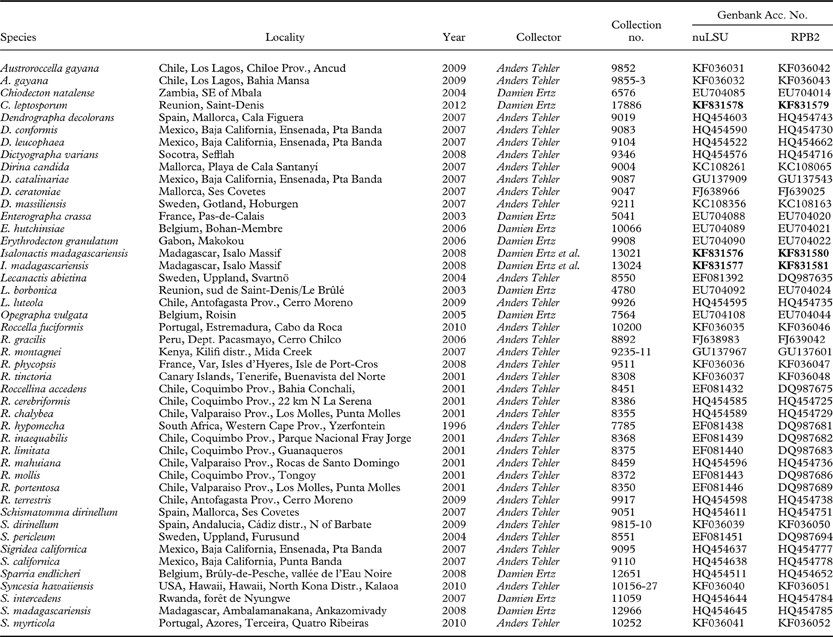
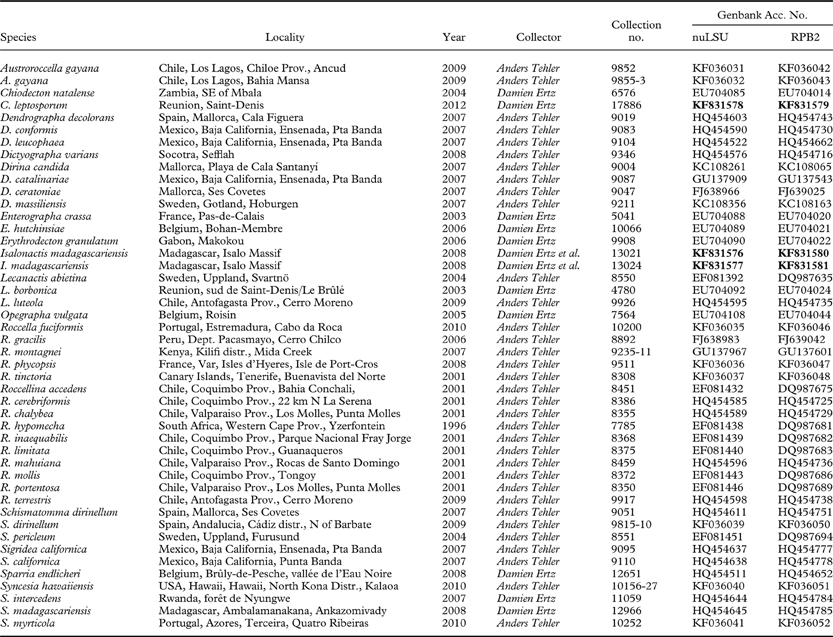
We used DNA sequences from two loci, the nuclear large subunit ribosomal RNA gene (nuLSU), and the second largest RNA polymerase subunit (RPB2), of which six were newly produced for this study (Table 1). Other sequences were mainly sampled from a previously published larger dataset of Arthoniales including the family Roccellaceae (Ertz & Tehler Reference Ertz and Tehler2011), with a few additional sequences from Tehler et al. (Reference Tehler, Irestedt and Ertz2013b ). The two datasets were analyzed both separately and combined. Extractions, amplifications and sequencing procedures generally follow Ertz et al. (Reference Ertz, Miądlikowska, Lutzoni, Dessein, Raspe, Vigneron, Hofstetter and Diederich2009, Reference Ertz, Bungartz, Diederich and Tibell2011). Alignments were carried out with ClustalW (2.1) from within the program Mesquite v.2.75 (http://mesquiteproject.org).
Specimens used in phylogenetic analyses of the Arthoniales. GenBank accession numbers in bold are new sequences from this study.
For the phylogenetic analyses, we used the programs T.N.T. Tree Analysis Using New Technology 1.1 (Goloboff et al. Reference Goloboff, Farris and Nixon2008) and MrBayes 3 (Ronquist & Huelsenbeck Reference Ronquist and Huelsenbeck2003). In all analyses gaps were treated as missing data.
The parsimony analyses used the New Technology search with sectorial search, ratcheting, drifting, tree fusing and driven search options in effect, all using default settings. Resampling tree searches was done with parsimony jackknifing (Farris et al. Reference Farris, Albert, Källersjö, Lipscomb and Kluge1996) under the New Tech search as implemented in T.N.T. (Goloboff et al. Reference Goloboff, Farris and Nixon2008); 1000 replicates submitted to TBR branch swapping were conducted. In parsimony jackknifing, the data are internally resampled with a jackknifing technique to find well-supported groups. Resampling works by calculating a tree for each of a large number of subsamples (pseudoreplicates) of characters from the data, then finding a summary tree, which comprises the groups occurring in the majority of the trees for subsamples. The tree for each pseudoreplicate is found by parsimony analysis, and each pseudoreplicate is formed by randomly selecting characters from the data without replacement, each character having a fixed chance 1/e (about 36%) of being excluded. With this resampling technique, the actual number of characters used may vary from replicate to replicate. Groups found in less than 50% of the trees for pseudoreplicates were discarded, thus eliminating unjustified (poorly supported) resolution caused by ambiguous datasets.
In the Bayesian inference analyses, the best model for nucleotide substitutions was selected for each locus individually by applying the Akaike Information Criterion (AIC; Akaike Reference Akaike, Petrov and Csaki1973) and the program MrModeltest 2.2 (Nylander Reference Nylander2005) in conjunction with PAUP* (Swofford Reference Swofford1998). The selection of substitution models supported the GTR+I+Γ model for both partitions. Posterior probabilities of trees and parameters in the substitution models were approximated with MCMC and Metropolis coupling using the program MrBayes 3.2.1 (Ronquist & Huelsenbeck Reference Ronquist and Huelsenbeck2003). The Bayesian analyses were run for 10 million generations with two independent runs and four chains of Markov chain Monte Carlo (MCMC). The burn-in and convergence diagnostics were estimated using the PSRF (potential scale reduction factor), where values closer to 1 indicated convergence between runs (Gelman & Rubin Reference Gelman and Rubin1992), and TRACER (Rambaut & Drummond Reference Rambaut and Drummond2007), making sure that the ESS values were higher than 200. The final majority-rule tree obtained from the Bayesian analyses is based on 17000 trees from the posterior of the two runs.
Results
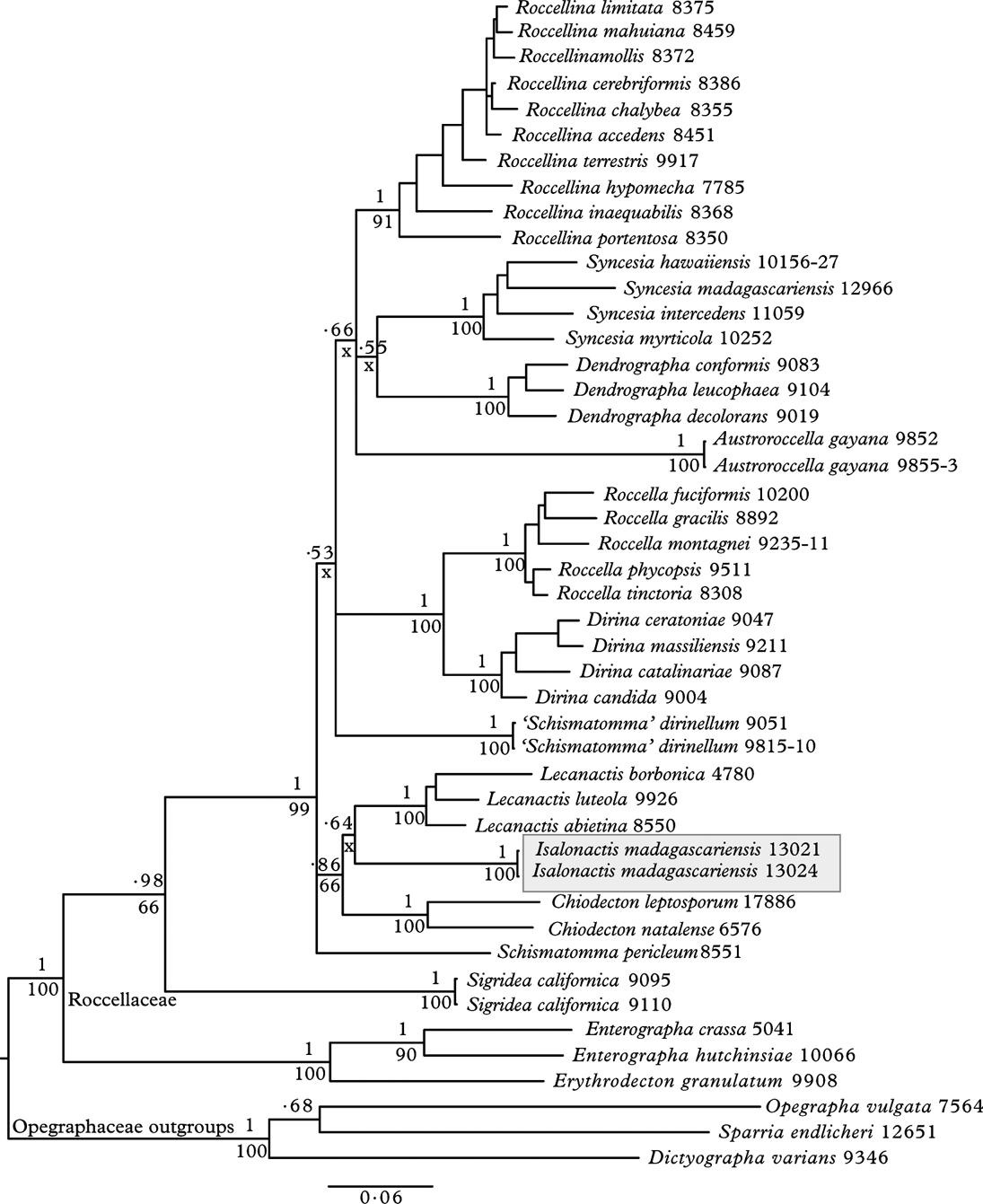
Altogether we analyzed nuLSU rDNA and RPB2 sequences from two newly sequenced samples of Isalonactis madagascariensis (newly described below) and one newly sequenced sample of Chiodecton leptosporum Müll. Arg., together with 43 samples representing 40 other already phylogenetically analyzed species of Roccellaceae. In addition, three outgroup species were chosen among the Opegraphaceae (Ertz & Tehler Reference Ertz and Tehler2011; Tehler et al. Reference Tehler, Irestedt and Ertz2013b ). Parsimony jackknife analysis showed that the individual gene trees were topologically similar, with no conflicts detected, although the nuLSU tree was more poorly resolved.
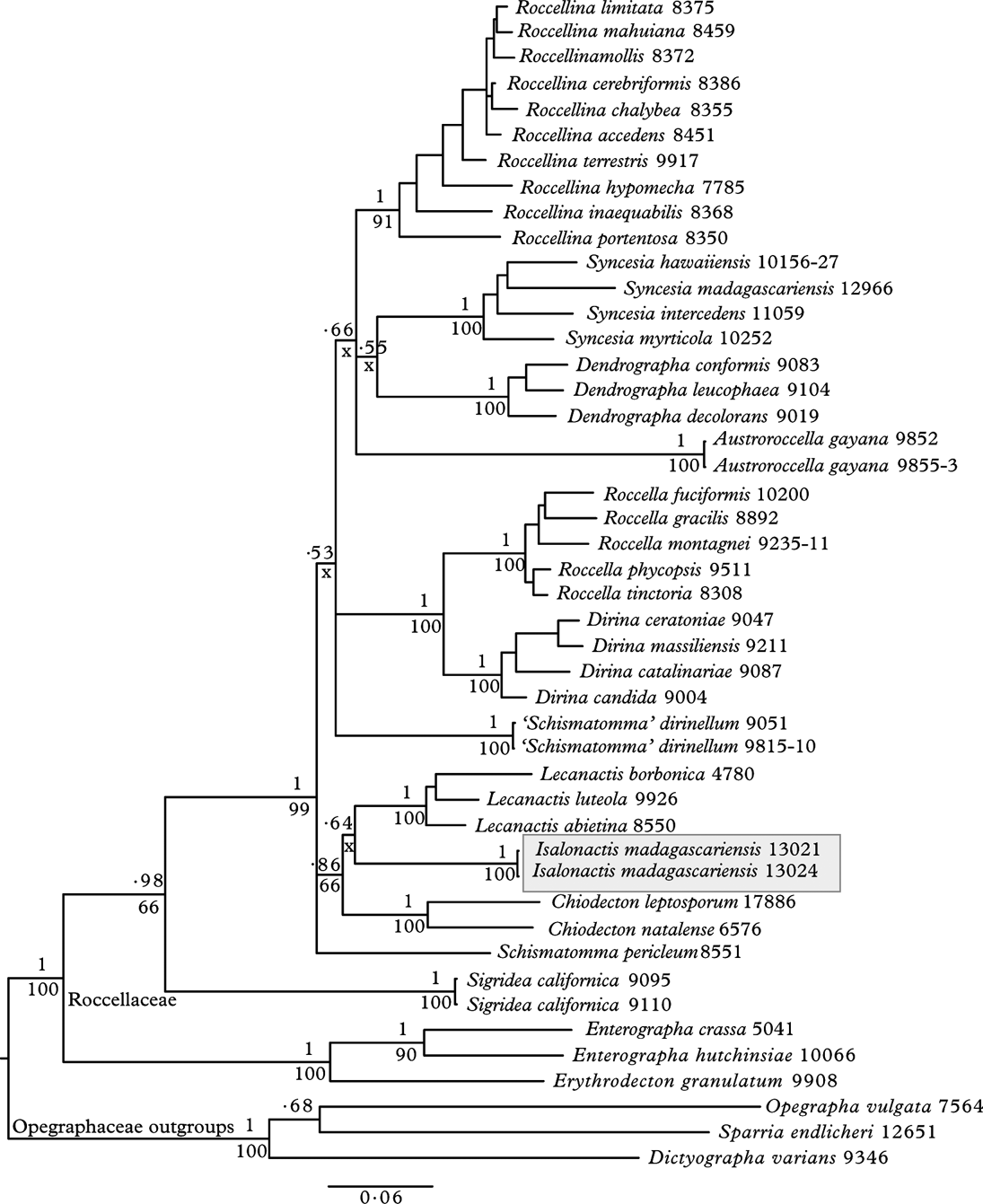
Since there were no conflicts in tree topology between the trees received from the Bayesian inference and the Parsimony jackknife analyses, we chose for the sake of simplicity to plot the Parsimony jackknife frequencies directly onto the Bayesian tree which was more highly resolved (Fig. 1). In the Bayesian tree, Isalonactis (newly described below) appears as a monophyletic group in a sister group relationship with the genus Lecanactis, and the next larger group includes the genus Chiodecton as sister group. In the Parsimony jackknife tree (not shown), these three genera were left unresolved in a trichotomy.
Two-locus (nuLSU + RPB2) majority-rule tree received from Bayesian analysis showing the proposed phylogenetic relationships among 46 specimens representing 37 species of Roccellaceae with three species of Opegraphaceae (Opegrapha vulgata, Dictyographa varians and Sparria endlicheri) chosen as outgroups. Bayesian posterior probability values shown above nodes. Parsimony jackknife frequencies received from parsimony analyses were plotted below nodes (x=frequency below 50%). For readability, values and frequencies are shown for genera and larger groups only. Collecting numbers of the authors following the species names act as specimen and sequence identifiers. Species within single quotes are names for which we regard recombination in a more appropriate genus as premature and thus the old name is retained.
Isalonactis madagascariensis Ertz, Tehler, Eb. Fisch., Killmann, Razafin. & Sérus. gen. et sp. nov.
MycoBank No.: MB807014 (genus) and MB807015 (species)
Taxon belonging to the Roccellaceae and characterized by the combination of the following characters: crustose, non-corticate, cracked to areolate thallus c. 0·2–0·7 mm thick containing psoromic acid, tiny ascomata having a thalline margin, a white pruinose hymenial disc, an inconspicuous excipulum and a pale brown hypothecium, 3-septate hyaline ascospores of (20·0–)22·5–27·0(–29·0)×(4·5–)5·0–5·5(–6·0) µm, and curved to sickle-shaped filiform conidia.
Type: Madagascar, Isalo Massif near ANGAP house and National Park border, 851 m alt., 22°37′8·1″S, 45°21′42·6″E, Mesozoic sandstone cliffs with Coleochloa setifera, Ischnolepis tuberosa and Pachypodium gracilius, on sheltered rock, 7 October 2008, D. Ertz 13024, E. Fischer, D. Killmann, T. Razafindrahaja & E. Sérusiaux (BR—holotype; S—isotype).
(Fig. 2)
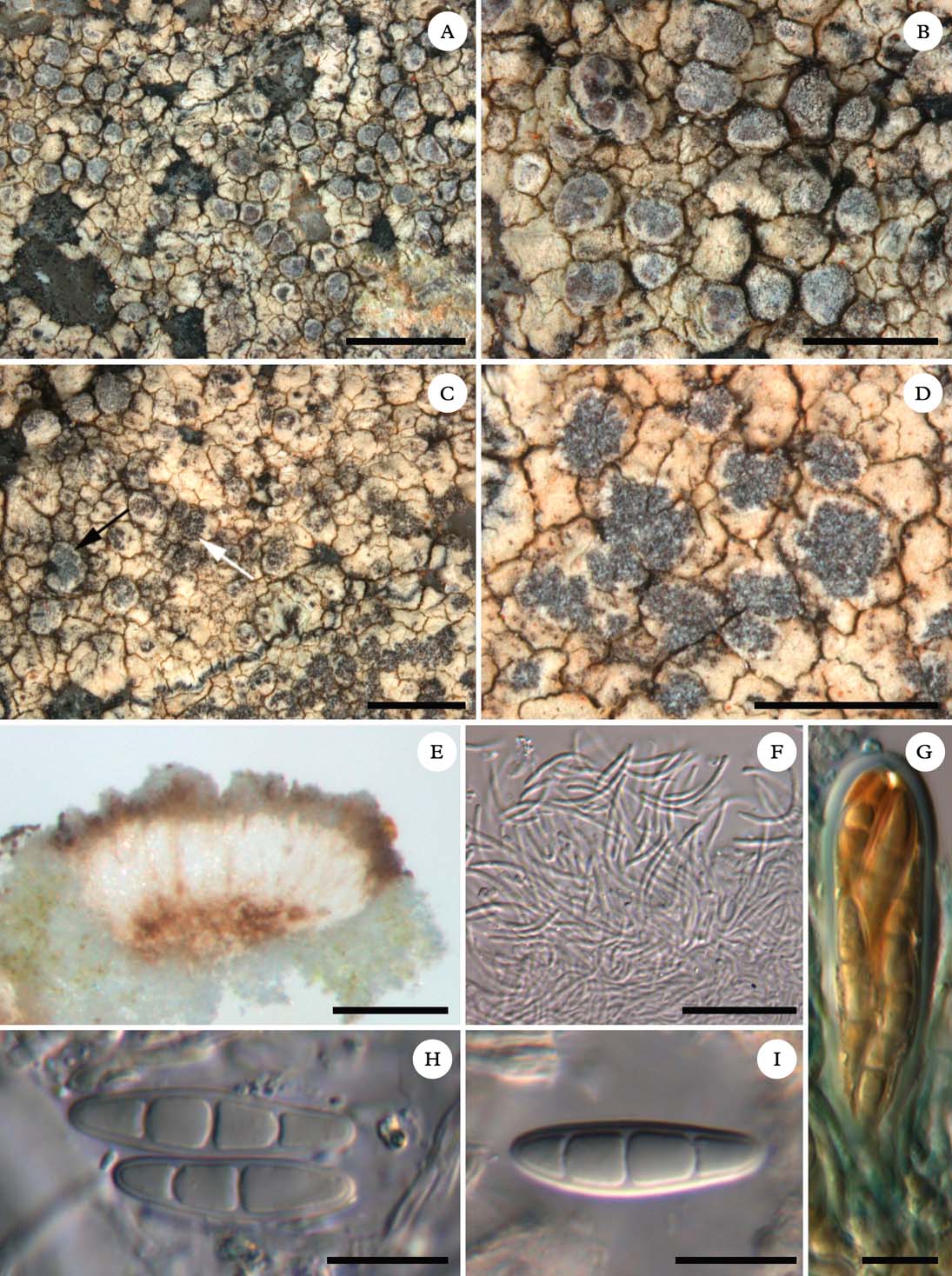
A–I, Isalonactis madagascariensis (A–C, E–I, holotype; D, Ertz 13021). A & B, thallus and apothecia; C, thallus bearing both soredia (white arrow) and apothecia (black arrow), and separated by a black, prothallus borderline from a sorediate thallus at the lower right corner of the photograph; D, thallus and soredia; E, section through an apothecium in water; F, conidia in water; G, ascus in KI; H & I, ascospores in water. Scales: A=2 mm; B–D=1 mm; E=250 µm; F=20 µm; G–I=10 µm. In colour online.
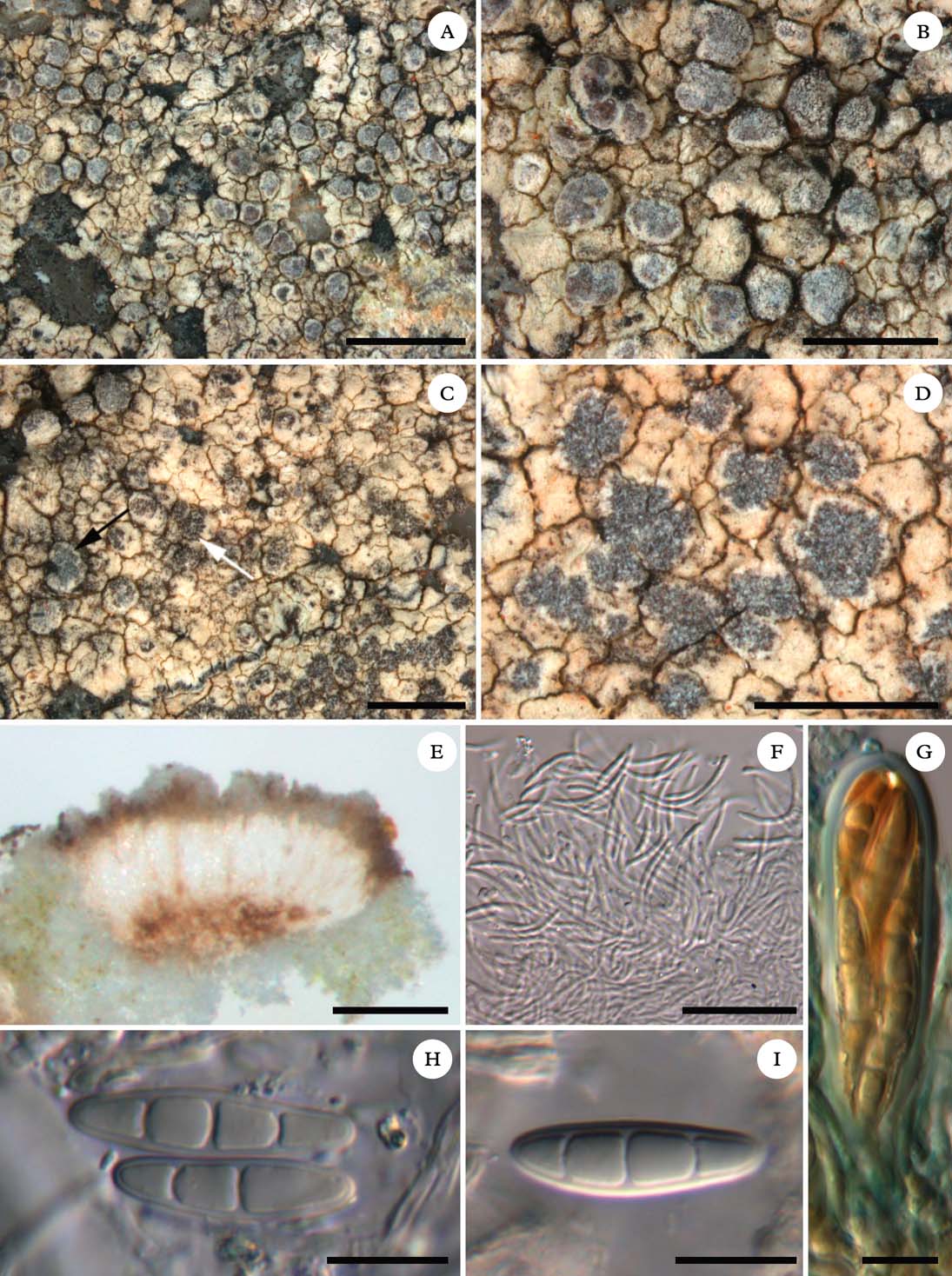
Thallus epilithic, thin, non-corticate, c. 0·2–0·7 mm thick, smooth, finely cracked to areolate, pale cream, matt; presence of numerous hyaline crystals 0·5–3·0 µm diam. covering the hyphae, dissolving in K (polarized light); prothallus absent or dark brown, up to 0·5 mm wide. Photobiont Trentepohlia; cells 11–20×8–12 µm.
Ascomata apothecioid, circular to irregular in outline, sometimes with an undulated or folded margin, scattered, erumpent, semi-immersed to sessile, not or slightly constricted at the base, usually one per areole, (0·2–)0·3–0·5(–0·8) mm diam., with a thin non-corticate thalline margin of 50–70 µm thick, level with the hymenial disc, of the same colour as the thallus; hymenial disc exposed, pale brown, covered by a white pruina. Exciple inconspicuous. Hymenium 85–110 µm tall, hyaline, not inspersed with oil droplets, I+ red, K/I+ blue; epihymenium pale to dark reddish brown, K− (but reddish tinge disappearing); hypothecium 75–150 µm tall, pale to dark brown, I− (orange), K− (but reddish tinge disappearing). Paraphysoids sparsely branched in the hymenium, richly branched in the epihymenium, 2 µm thick, not or only slightly enlarged at apices; apices dark brown, 5–15 µm long. Asci clavate, 55–65×15–16 µm, 8-spored, K/I− except for an amyloid (blue) endoascus layer in the upper part. Ascospores (20·0–)22·5–27·0(–29·0)×(4·5–)5·0–5·5(–6·0) µm (n=23), (2–)3-septate, septation starting with one median septum, not constricted at septa, cells more or less equal in size; gelatinous sheath absent (at ×1000).
Pycnidia immersed in the thallus, visible as pale to dark brown punctiform spots 40–70 µm diam, c. 200×100 µm; pycnidia wall very thin, hyaline to pale brown; conidia filiform, slightly curved to sickle-shaped, 12–23×1 µm.
Chemistry
Thallus K−, C−, P+ yellow, UV− or ± pale cream; TLC (solvents C and G): psoromic acid (specimens tested: holotype and Ertz 13021).
Etymology
Isalonactis refers to the remarkable Isalo Massif (type locality) and the close relationship to the genus Lecanactis.
Ecology and distribution
Isalonactis madagascariensis is known only from the type locality in Madagascar, situated 180 km from the nearest coast. It grows on sheltered siliceous rocks in an arid landscape, with a poorly-developed Roccella montagnei, a fruticose species widely distributed in the Palaeotropics and having a preference for coastal habitats (Tehler et al. Reference Tehler, Irestedt, Wedin and Ertz2010, including two specimens sequenced from the Isalo Massif). Other lichens collected from the same locality are Xanthoparmelia tananarivensis (Gyeln.) Hale, and members of the genera Buellia, Caloplaca, Pertusaria, Pyxine, Parmotrema, Toninia, Usnea and Xanthoparmelia. The type locality is situated just outside Isalo National Park which forms a Jurassic sandstone massif. The rocks have been subjected to erosion and form steep slopes and canyons. Isalo Massif is famous for its endemics. In addition to widespread Malagasy endemics such as Coleochloa setifera (Ridl.) Gilly (Cyperaceae) and Ischnolepis tuberosa Jum. & H. Perrier (Rubiaceae), numerous local endemic plant species are known from this area. Among palms (Dransfield & Beentje Reference Dransfield and Beentje1995), Ravenea rivularis Jum. & H. Perrier, R. glauca Jum. & H. Perrier and Dypsis onilahensis (Jum. & H. Perrier) Beentje & J. Dransf. are almost restricted to Isalo. As members of the endemic families Asteropeiaceae and Sarcolaenaceae, the following shrubs are either endemic to Isalo or found in few other localities: Asteropeia labatii G. E. Schatz et al. Perrierodendron occidentale (Capuron) J. F. Leroy et al. Sarcolaena isaloensis Randrianasolo & J. S. Miller, S. oblongifolia F. Gérard, Schizolaena isaloensis Rabehevitra & Lowry, Xerochlamys undulata Hong-Wa and X. villosa F. Gérard (Ramananjanahary et al. Reference Ramananjanahary, Frasier, Lowry, Rajaonary and Schatz2010). Endemic or near endemic Xerophyta-species (Velloziaceae) are Xerophyta croatii Phillipson & Lowry, X. isaloensis Phillipson & Lowry, X. schatzii Phillipson & Lowry and X. setosa Phillipson & Lowry (Behnke et al. Reference Behnke, Hummel, Hillmer, Sauer-Gürth, Gonzalez and Wink2013). The sandstone rock outcrops are especially famous for numerous endemic succulents such as Pachypodium gracilius (H. Perrier) Rapan., Aloe isaloensis H. Perrier, Ceropegia dimorpha Humbert, C. pseudodimorpha Rauh, Cynanchum macrolobum Jum. & H. Perrier and C. rauhianum Descoings (Rauh Reference Rauh1995, Reference Rauh1998). The Isalo Massif also harbours a large number of endemic species of amphibians and reptiles (Crottini et al. Reference Crottini, Chiari, Mercurio, Meyer, Vences and Andreone2008). It must be noted that the very peculiar Dermatiscum thunbergii (Ach.) Nyl. was found in a similar dry landscape, on a granitic inselberg opposite Anja Nature Reserve [12 km S of Ambalavao, 21°50′45·4″S, 46°50′21·8″E, 972 m, 5 October 2008, Ertz 12987 (BR), Sérusiaux s. n.(LG)]. This member of Physciaceae was only known from the southern part of continental Africa. It is newly recorded here from Madagascar.
Notes
As shown in our phylogenetic tree (Fig. 1), Isalonactis madagascariensis is most closely related to the genera Lecanactis and Chiodecton. It differs from Lecanactis by apothecia having a thalline margin with a pale brown hypothecium, whereas species of Lecanactis have a lecideine exciple with a usually dark brown to carbonized hypothecium. No species of Lecanactis are known to be sorediate. In the holotype specimen of Isalonactis madagascariensis, thalli might have either apothecia or soredia, but one thallus has both (Fig. 2C). In the specimen Ertz 13021, thalli are sorediate but one thallus has both soredia and apothecia, clearly indicating that sterile, sorediate morphs and fertile morphs are conspecific. Psoromic acid is rare in the genus Lecanactis, being known only in two species L. californica and L. dilleniana (Egea & Torrente Reference Egea and Torrente1994), but sequences obtained from the latter suggest that it belongs to another genus (D. Ertz, A. Tehler, M. Irestedt, A. Frisch, G. Thor & P. van den Boom, unpublished data). The ascomata of Isalonactis being sometimes undulated with a strongly folded margin might be reminiscent of the genera Chiodecton or Syncesia. However, Chiodecton species (represented in our phylogenetic tree by the only species for which sequences are currently available, i.e. C. natalense, and by a newly sequenced species, C. leptosporum) differ from our new genus by perithecioid to lirelliform ascomata aggregated into stroma-like structures, obovate or slightly biclavate ascospores and a different chemistry, roccellic acid (Thor Reference Thor1990). The generic type, C. sphaerale Ach., still needs to be sequenced in order to confirm the phylogenetic position of the genus Chiodecton. However, that species has long, narrow (30–37×2–3 µm) and obovate ascospores, and roccellic acid in the thallus (Thor Reference Thor1990). Therefore it is most probably not congeneric with Isalonactis. The genus Syncesia forms a distinct, quite distantly related lineage to our new genus (Fig. 1; the generic type, S. myrticola, being included) and differs usually by curved, longer and slender ascospores in addition to a different chemistry (presence of protocetraric and roccellic acids in nearly all species, including the generic type) (Tehler Reference Tehler1997). The new genus and species might be reminiscent of the genus Sigridea due to the 3-septate ascospores lacking a gelatinous sheath, the thalline margin and the presence of psoromic acid. However, species of the latter genus differ from Isalonactis madagascariensis by a carbonized hypothecium and much shorter, up to 7 µm conidia (Tehler Reference Tehler1993). Moreover, the generic type of Sigridea (S. californica) is phylogenetically not related to our new genus (Fig. 1). The sorediate thalli of our new taxon is similar to Fulvophyton sorediata (Sparrius et al.) van den Boom, but that species has immersed ascomata and very different ascospores, being (4–)6–8-septate, 20–35×5–7 µm with a distinct gelatinous sheath c. 3·5 µm wide (van den Boom & Giralt Reference van den Boom and Giralt2012). We also checked that no older generic names of Arthoniales were available to accommodate our new species.
Additional specimen examined. Madagascar: Isalo Massif near ANGAP house and National Park border, 851 m alt., 22°37′8·1″S, 45°21′42·6″E, Mesozoic sandstone cliffs with Coleochloa setifera, Ischnolepis tuberosa and Pachypodium gracilius, on sheltered rock, 7 October 2008, D. Ertz 13021, E. Fischer, D. Killmann, T. Razafindrahaja & E. Sérusiaux s. n. (BR, LG).
We are indebted to the staff of the Parc Botanique et Zoologique de Tsimbazaza in Antananarivo for logistical support. We would like to thank the Ministère des Eaux et Forêts for collection and export permits for scientific material. Cyrille Gerstmans, Wim Baert and Myriam de Haan are thanked for technical assistance. Finally, the authors acknowledge financial support from the Fonds National de la Recherche Scientifique (FNRS) from Belgium (F.R.F.C. # 2.4515.06).