Increasingly, reports call for developmental surveillance for young children, 1 , 2 , 3 including high-risk groups, 4 – Reference Mossabeb, Wade and Finnegan 6 in order to provide timely, structured early developmental intervention that may improve outcomes.Reference Marino, Lipkin and Newburger 7 – Reference Moharir, Barett and Taras 10 Standardised screening tools using enquiry and observation enhance surveillance 3 , Reference Barre, Morgan and Doyle 5 – Reference Marino, Lipkin and Newburger 7 and lead to multidisciplinary evaluation as needed. 1 , 3 , 4 , Reference Marino, Lipkin and Newburger 7 – Reference Moharir, Barett and Taras 10 Language development, an important indicator of a child’s overall development and cognitive ability, 1 , 3 , 4 , Reference Fricke, Bowyer-Crane and Haley 9 , Reference Moharir, Barett and Taras 10 has been found to be delayed among the increasing number of surviving children undergoing life-saving therapies at young ages.Reference Barre, Morgan and Doyle 5 , Reference Bellinger, Wypij and Rivkin 11 – Reference Acton, Biggs and Creighton 13 Various methods of early screening for language development have been suggested. 1 , 2 , Reference Mossabeb, Wade and Finnegan 6 , Reference Moharir, Barett and Taras 10 , Reference Rescorla 14 – Reference Feldman, Campbell and Kurs-Lasky 16 A promising measure, the language Development Survey,Reference Rescorla 14 part of the Achenbach System of Empirically Based Assessment,Reference Achenbach and Rescorla 17 has shown significant correlation, in previously preterm children, with the communication subtests of the Bayley Scales of Infant and Toddler Development, Third Edition (Bayley-III);Reference Bayley 18 the authors suggest that this language surveyReference Rescorla 14 is an inexpensive screening tool for language delay.Reference Feldman, Campbell and Kurs-Lasky 16 The objective of this study was to determine the accuracy of screening for language delay with the parent-completed Language Developmental SurveyReference Rescorla 14 in young children after complex life-saving therapies using the Bayley-III-assessedReference Bayley 18 language scores as reference standard.Reference Aylward 19
Materials and methods
Design
This prospective inception cohort observational outcomes study determined the rates of language delay as simultaneously measured by a parent-rated screening tool, the Language Developmental Survey,Reference Rescorla 14 and by the individually administered Bayley-IIIReference Bayley 18 among survivors after early life-saving therapies.
Subjects
From July, 2004, to December, 2011, term-born children who received complex life-saving therapies before their first birthday at a tertiary-care children’s hospital serving a wide geographical area were followed-up at 18–29 months of age. We excluded children with sensory disability such as visual impairment or permanent hearing loss or those not assessed using both the Language Developmental SurveyReference Rescorla 14 and the Bayley-III.Reference Bayley 18
Procedures
This cohort is part of a prospective, longitudinal, inter-provincial developmental follow-up programme for children from Western Canada. Referral for follow-up was made by the attending physician at the time of therapy. When survival was deemed likely, a nurse coordinator registered the children and discussed follow-up procedures with the parents as previously reported.Reference Neufeld, Clark and Robertson 12 , Reference Acton, Biggs and Creighton 13 , Reference Robertson, Sauve and Joffe 20 Assessments occurred at developmental follow-up clinics at the tertiary site of referral. The study was approved by site health research ethics boards. Parents/guardians signed the informed consent.
Descriptive variables
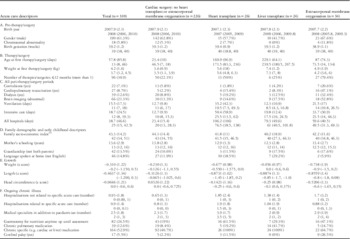
This study focussed on screening for language delay as determined by measures used in this follow-up programme. We report only general descriptive variables applicable for four different therapies completed in the first year of life: complex cardiac surgery needing cardiopulmonary bypass – 142 with biventricular and 84 with single ventricle physiology – without heart transplantation or extracorporeal membrane oxygenation; heart transplantation; liver transplantation; or extracorporeal membrane oxygenation. Acute care variables included the following: age and weight at first intervention; number of life-saving therapies/surgeries per child in the first year of life and at least 6 months before assessment; clinical convulsions; cardiopulmonary resuscitation; dialysis; and total cumulative duration of ventilation, intensive care, and hospitalisation, as reflective of the degree of acute illness (Table 1). Other descriptors included those that may relate to language development: demographics such as gender, birth gestational age, and chromosomal abnormality; family situations such as year of birth, guardianship of the child, language spoken at home, socio-economic status,Reference Blishen, Carroll and Moore 21 and mother’s education; health outcomes such as cerebral palsy, known abnormal brain imaging, and growth; and ongoing illnesses, including usage of gastrostomy feeding tube, number of hospitalisations, medical specialists needed, and medications required, as reflective of chronic illness (Table 1). Use of early developmental intervention was recorded. The socio-economic status was determined by the Blishen Index (range 19–101) (population mean, 43; SD, 13) based upon employment of the main wage earner of each family.Reference Blishen, Carroll and Moore 21
Acute care, family demographics, and early childhood descriptors of children receiving life-saving therapies in infancy.

n=310. Mean (standard deviation), median (inter-quartile range), number (%)
Early childhood assessments
Standardised age-appropriate outcome measures included physical growth, developmental testing, and parent questionnaires. Individual child assessments were carried out by a registered paediatric psychologist, or a psychometrician supervised by a psychologist, an audiologist, a paediatrician, and a nurse.Reference Robertson, Sauve and Joffe 20
Developmental measures and questionnaires used normative data originating in the United States obtained around the same time period. Both tests used national samples, stratifying for gender, socio-economic status, and ethnicity. Differences between the tests, therefore, would not be expected based on normative differences.
-
∙ The Language Developmental SurveyReference Rescorla 14 is a standardised, validated, 10-minute, parent-completed screening tool that correlates well with other measures of early expressive language development.Reference Rescorla and Alley 22 , Reference Rescorla, Ratner, Jusczyk and Jusczyk 23 Vocabulary scores based on verbal utterances meaningful to parents are standardised for children between 18 and 35 months of age. A list of 310 words in 14 semantic categories is provided for parents to indicate words that their child uses spontaneously, either in English or in another language. Vocabulary scores increase across three age brackets – that is, 18–23, 24–29, and 30–35 months. To standardise for these changes, vocabulary scores for each gender and age bracket are transformed into percentiles using a median of the 50th percentile with 5 percentile increments. Scores ⩽15th percentile (corresponding to ⩽1.036 SD) suggest delayed vocabulary development. As the test does not provide percentiles below the 15th percentile, common metrics for delay of >2 SD below the mean cannot be given.
-
∙ The Bayley-III,Reference Bayley 18 an individually administered developmental assessment, gives a language composite score composed of the receptive communication subtest, which measures verbal understanding and verbal concept development, and the expressive communication subtest, which measures ability to communicate through words and gestures. The composite score has a mean (SD) of 100 (15); subtests give scaled scores with a mean (SD) of 10 (3). Language delay was defined as scores falling >1 SD below the mean or <85 for the composite score and <7 for scaled scores in order to correspond as closely as possible with vocabulary delay as determined by the Language Developmental Survey.Reference Rescorla 14 Scores >2 SD below the mean for the composite score are <70 and for the scaled scores <4.
Statistical analysis
Continuous variables are presented as mean (standard deviation) or median (inter-quartile range); categorical variables are presented as counts and percentages. Presence of delays on language outcome measures is expressed as percentages. The expected population proportions of delay are 2.27% for >2 SD below the mean and 15.86% for >1 SD below the mean. Sensitivity, specificity, positive predictive values, and negative predictive values of vocabulary screening from the Language Developmental SurveyReference Rescorla 14 were derived with the Bayley-III language scoresReference Bayley 18 as the reference standard criteria and presented with 95% confidence intervals. To screen for acute care, demographic, and health characteristics of subgroups associated with language delay of <85 and vocabulary delay ⩽15th percentile, we used univariate logistic regressions giving odds ratios and 95% confidence intervals. The final multiple logistic regressions were completed for 276 children after the exclusion of those with a high likelihood of language delay associated with the diagnoses of cerebral palsy and/or chromosomal abnormality, and consisted of variables found significant at a p-value of 0.10 in univariate analyses after screening for multicollinearity. Data analyses were performed using SAS version 9.3.
Results
Between July, 2004, and December, 2011, 502 children ⩾37 completed weeks of gestation at birth underwent life-saving therapies before their first birthday. Of these, the following were excluded: 79 (15.7%) died before the age of 2 years, 24 were tested with an older edition of the Bayley Scales, eight had visual impairment, 15 had permanent hearing impairment, and 41 were assessed outside of the age frame for the Language Developmental Survey.Reference Rescorla 14 Thus, this study included 310 (92.5%) of the eligible 335 children, with 25 (7.5%) lost to follow-up (Table 1).
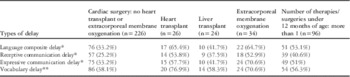
Of the 310 children assessed at a mean (SD) age of 21.5 (2.8) months, vocabulary delay on the Language Developmental Survey was found by screening 144 (46.5%) of 310 survivors, no values for delays of <70 can be provided by this measure; 125 (40.3%) had language composite delay on the Bayley-III of <85 and 54 (17.4%) of <70 (Table 2). Overall, about 6% more children were observed to be delayed by screening than by assessment; for the subgroups, the difference was similar and ranged from 4.9 to 11.5% (Table 2). Subtest scores showed that 98 (31.6%) children had a receptive communication delay of <7 and 21 (6.8%) had <4; and 124 (40%) had expressive communication delay of <7 and 40 (12.9%) of <4. More than half of the children requiring more than one life-saving therapy within the first year had delayed vocabulary and language.
Frequency of language, receptive and expressive communication,Footnote * and vocabularyFootnote ** delay in high-risk children in relation to therapy/surgery in infancy.

n=310
* Language composite and receptive and expressive communication delay as determined by standard scores of <85 and scaled scores of <7 on the Bayley Scales of Infant and Toddler Development-IIIReference Bayley 18
** Vocabulary delay as determined by scores ⩽15th percentile on the vocabulary score of the Language Developmental SurveyReference Rescorla 14 parent questionnaire
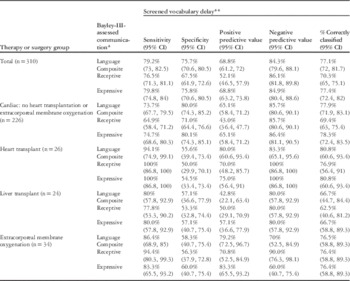
The accuracy for language composite delay determined by vocabulary delayReference Bayley 18 is presented in Table 3. Correct classification of receptive and expressive communication delay ranged from 62.5 to 80.8%. Negative predictive values for language composite delay from vocabulary delay for the total cohort and those after cardiac surgery were in the mid-80s%; a greater range of prediction with wider confidence intervals occurred for the smaller subgroups. Comparison among groups was difficult due to a few children within the Transplantation and Extracorporeal Membrane Oxygenation subgroups. Usefully, sensitivity measures of the Language Developmental Survey for assessed language scores were high, especially for the Heart Transplantation and Extracorporeal Membrane Oxygenation subgroups. Overall, the scores for the Liver Transplantation subgroup show the lowest utility; however, the number of children in this group was the lowest.
Prediction (95% confidence interval (CI) for a proportion) of language composite delay and receptive and expressive communication delayFootnote * by vocabulary delayFootnote **.

n=310
* Language composite and receptive and expressive communication delay as determined by standard scores of <85 and scaled scores of <7 on the Bayley Scales of Infant and Toddler Development-IIIReference Bayley 18
** Vocabulary delay as determined by scores ⩽15th percentile on the vocabulary score of the Language Developmental SurveyReference Rescorla 14 parent questionnaire
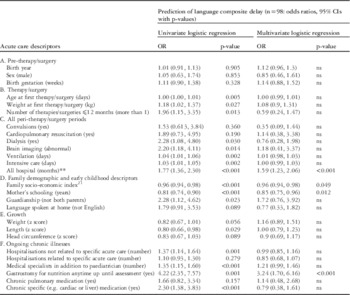
Descriptive variable associations with language delay are shown in Table 4 for 276 children. Owing to a known high proportion of language delay among children with diagnoses of cerebral palsy and/or chromosomal abnormality, these 34 children are excluded from Table 4 and from the prediction of delay from acute care variables among the remaining children. The odds ratio for language delay for children with cerebral palsy was 12.5 (confidence interval=2.9, 55.5), p=0.001; for chromosomal abnormality it was 4.1 (confidence interval=1.4, 12.1), p=0.008. Cerebral palsy was diagnosed in 17 (5.5%) of the 310 children, 15 (88.2%) with language composite delay, and 16 (94.1%) with vocabulary delay. Chromosomal abnormalities diagnosed up to the time of assessment occurred in 18 (5.1%) of the 310 children, including nine with deletion 22q11.2, two with Trisomy 21, one with Trisomy 13, and two with Turner Syndrome; one child with chromosomal abnormality also had cerebral palsy. Of these 18 children, 13 (72.2%) had language composite delay and 14 (77.8%) had vocabulary delay.
Acute care, family demographics, and early childhood predictors of language composite delayFootnote * after complex paediatric therapies in infancy.

ns=variables not selected for the final multivariate logistic regression model
n=276, Logistic regression – odds ratio (OR) and 95% confidence intervals (CIs)
Owing to the high likelihood of language delay, 34 children with cerebral palsy and/or chromosomal abnormality were excluded from this analysis, reducing the number with language composite delay from 125 to 98 and the overall study number from 310 to 276
* Language composite delay determined by standard scores <85, the Bayley Scales of Infant and Toddler Development-IIIReference Bayley 18
** Duration of hospitalisation changed from days to months for the regression to simplify application
Multivariate logistic regression for language composite delay for 98 (35.5%) of the 276 children, excluding those with cerebral palsy or chromosomal abnormality, is shown in Table 4. The odds of language composite delay was 1.59 times higher for each additional month in acute care hospital. The odds of language composite delay for surviving children needing a gastrostomy was 3.24 times higher than those without gastrostomy. The odds of language composite delay was 0.85 smaller for each additional year of mother’s schooling and 0.96 smaller for each unit increase in the Blishen Index.Reference Blishen, Carroll and Moore 21 Of the 276 children, 115 (41.7%) had vocabulary delay. Multivariate logistic regression for vocabulary delay among the 276 children again showed the duration of hospitalisation to be the most significant predictor of delay, odds ratio 1.02 (confidence interval=1.01,1.03), p=0.001, with additional years of mother’s schooling being protective, odds ratio 0.89 (confidence interval=0.82, 0.98), p=0.025.
Only 120 (38.7%) of the 310 children were accessing early developmental intervention at the time of the assessment; this proportion was higher among those after Heart Transplantation and Extracorporeal Membrane Oxygenation. Of all 125 children with language delay, 71 (56.8%) were not receiving any formal developmental intervention. Developmental intervention did not predict delays.
Discussion
Although neurodevelopmental assessments following early life-saving therapies are recommended, 4 , Reference Marino, Lipkin and Newburger 7 , Reference Brosig, Butcher and Ilasdi 8 not all survivors have access to multidisciplinary or specialised assessments. This study of 310 term-born children who survived live-saving therapies in infancy explores screening for language delay. Sensitivity, specificity, positive predictive values, and negative predictive values show that vocabulary screening from the Language Developmental Survey,Reference Rescorla 14 as validated against the Bayley-III language scores,Reference Bayley 18 has potential to screen for language delays in a brief and inexpensive manner. The Language Developmental Survey appears to over-identify language delay relative to the Bayley-III, but may be a useful screening tool for early language development leading to earlier referral for intervention. The community therapist or primary caregiver need only to know that the child has had one of the listed high-risk therapies in infancy and that there has been a prolonged hospitalisation to consider screening for language delay.
The children studied were at high risk for delayed language. Overall, the Bayley-IIIReference Bayley 18 assessed rates of language composite delay of more than 1 SD below the mean in 40% of the cohort or 2.5 times the expected delay; scores >2 SD below the mean exceed the expected by 7.7 times. Rates for specific subgroups of children after Heart or Liver Transplantation or Extracorporeal Membrane Oxygenation exceed values of those with only cardiac surgery. Using the vocabulary screening tool,Reference Rescorla 14 nearly half of the children had delay, almost three times that expected from normative data and almost double the proportion found in preterm infants at the same outcome age.Reference Mossabeb, Wade and Finnegan 6 For those surviving Heart Transplantation or Extracorporeal Membrane Oxygenation, the proportion with vocabulary delay was more than four times than that expected and almost three times that found in previously preterm children.Reference Mossabeb, Wade and Finnegan 6 Concern about all developmental disorders following early life-saving therapies in young children is growing.Reference Mossabeb, Wade and Finnegan 6 , Reference Marino, Lipkin and Newburger 7 , Reference Bellinger, Wypij and Rivkin 11 , Reference Neufeld, Clark and Robertson 12 , Reference Robertson, Sauve and Joffe 20
It is necessary to examine any screening measure in relation to other instruments with known reliability and validity. We classified the children with vocabulary delay obtained by the Language Developmental SurveyReference Rescorla 14 in relation to those with using the Bayley-III.Reference Bayley 18 The Bayley-III has strong psychometric properties and has well-validated utility as a measure to determine delay.Reference Bayley 18 Although there is no gold standard of development, the Bayley Scales are considered a reference standard for developmental evaluation.Reference Bayley 18 , Reference Aylward 19 The Language Developmental SurveyReference Rescorla 14 has potentially poorer reliability and validity due to its weaker construct coverage, proxy-report format, and more limited sampling. The comparison we set out to make cannot be precise due to different scales used for scoring between the Language Developmental SurveyReference Rescorla 14 and the Bayley-IIIReference Bayley 18 and within the Bayley-III.Reference Bayley 18 For the Language Developmental Survey,Reference Rescorla 14 delay is defined as ⩽15th percentile, and for the Bayley-IIIReference Bayley 18 delay is defined as <85 or <16th percentile, or <7, which is a scaled score of 6 or less, or approximately ⩽10th percentile. In this study, there were observed differences in the proportion of survivors identified with delays determined by the screening test and the Bayley-III-assessed measures, especially for the scaled scores of receptive and expressive communication. These differences were in the same direction, suggesting that the Language Developmental SurveyReference Rescorla 14 has the potential to identify more individuals in need of language services than the reference standard to which it was compared, despite performing in a very similar manner. Further studies are needed to see whether the two measures truly identify similar rates of pathology. This is particularly important as there have been concerns about the overestimation of the cognitive test scores of the Bayley-IIIReference Acton, Biggs and Creighton 13 among survivors after early cardiac surgery. In a previous study, ActonReference Acton, Biggs and Creighton 13 did not find differences between the language scores of the Bayley-III and the mental developmental index, which included a language component, of the previous version of the same measure. Future studies may find that the Language Developmental Survey may not over-identify delay depending upon the comparison. The predictive accuracy of the negative predictive value of the Language Developmental SurveyReference Rescorla 14 is in the mid-80s% for the cohort, suggesting that a child scoring ⩾15th percentile is unlikely to experience language delay. This may be important in ruling out the need for multidisciplinary assessment, especially in regions where these are difficult to access, while providing reassurance to families.
Our findings indicate that language delay is common in children after complex therapies in infancy and support the American Heart AssociationReference Marino, Lipkin and Newburger 7 recommendations. To their high-risk categories, our study has shown the need for language testing in children after Liver Transplantation in infancy. Prolonged hospitalisation as a predictor of outcome reflects multiple complications related to individual therapies, which are often not modifiable;Reference Robertson, Sauve and Joffe 20 its association with adverse long-term outcomes has been known for sometime.Reference Newburger, Wypi and Bellinger 24 A higher family socio-economic status and higher maternal education are associated with a lower frequency of language delay.
A strength of this study is the high percentage of cohort follow-up allowing generalisation of results to other children after life-saving therapies in infancy. Variables identified as increasing the odds of language delay were easily recognisable by community healthcare providers without access to details of acute care and will assist in early identification of those most in need of screening. There are limitations to this study as well. Small numbers within the subgroups limits the accuracy and generalisation of subgroup results. Although the Bayley-IIIReference Bayley 18 is a well-accepted standard reference that assesses language development,Reference Aylward 19 a referral to a speech-language pathologist is indicated to better evaluate these and other language delays or disorders. In general, children determined by a screening test to have a developmental concern are quickly evaluated for further testing and intervention as needed; thus, any undue parental stress associated with screening is limited. As life-saving therapies are grouped in this study into one cohort, the identification of modifiable factors from the acute care setting for the subgroups must be deferred to separate studies.
Conclusion
We have shown that the Language Developmental Survey,Reference Rescorla 14 a parent-completed questionnaire for vocabulary development, may be a useful screening tool after life-saving therapies in infancy. As language delay is common within this group, consideration should be given to primary language assessment when possible. Our findings of high proportions of delay imply the need for early language intervention for these children to promote their verbal communication and language development. The long-term consequences of language delay are well known and continued surveillance is needed.
Acknowledgements
The authors deeply thank the children and their parents for their willingness to attend developmental follow-up. This study could not have been completed without the devotion of the research and data coordinators and psychologists who made this research study possible.
Financial Support
Before 2007, this study was supported by a grant from Alberta health and Wellness, Province of Alberta. Subsequently, there has been no external funding. Financial support was provided by each of the hospitals of the Western Canadian Complex Pediatric Therapies Follow-up Group: Stollery Children’s Hospital, Edmonton, Alberta; Glenrose Rehabilitation Hospital, Edmonton, Alberta; Alberta Children’s Hospital, Calgary, Alberta; Winnipeg Children’s Hospital, Winnipeg, Manitoba; Kinsmen Children’s Centre and Royal University Hospital, Saskatoon, Saskatchewan; Regina General Hospital, Regina, Saskatchewan; British Columbia Children’s Hospital, Vancouver, British Columbia.
Conflicts of Interest
None.
Ethical Standards
This was an observational study with no experimental component. Ethics board approvals were obtained at each site with the main study site approval from the Health Ethics Research Board, University of Alberta, Edmonton, Alberta, study ID: Pro00001030. All parents/guardians signed the informed consent.