




No CrossRef data available.
Is the deficit in phonological awareness better explained in terms of task differences or effects of syllable structure?
Published online by Cambridge University Press: 03 May 2005
Abstract
The primary purpose of the study reported here was to explore the effects of the complexity of syllable structure and the effects of task differences in the explanation of deficit in phonological awareness (PA). A sample of 97 subjects was selected and organized into three different groups: 29 reading-disabled (RD) children, 41 normal readers matched in age with the former, and 27 younger normal readers at the same reading level as those with reading disabilities. We administered PA tasks which included items with different complexity of syllable structure. The results showed that the complexity of syllable structure had no particularly marked effect on the dyslexic children. Rather, the isolation task revealed the phonological deficit across all syllable structures.
Information
- Type
- Articles
- Information
- Copyright
- © 2005 Cambridge University Press
Many studies carried out across different languages have found empirical evidence in favor of the deficit model in phonological processing in dyslexia. These studies using the reading level (RL) match design have shown that the problem of individuals with dyslexia lies in their phonological decoding skills, because they have more difficulty in reading nonwords than do nondisabled readers matched in age or in RL (Jiménez & Hernández–Valle, 2000; Jiménez & Ramírez, 2002; Rack, Snowling, & Olson, 1992). The difficulty in grapheme–phoneme recoding seems to be produced by a deficit in those skills involved in phonological processing. One of the skills that is impaired in subjects with reading disabilities is phonological awareness (PA). PA is a form of metalinguistic awareness and refers to the ability to carry out mental operations on units of speech (Morais, 1991; Tunmer & Herriman, 1984; Tunmer & Rohl, 1991).
Deficits in PA have been identified as the critical factor underlying the severe decoding problems displayed by reading disabled (RD) individuals (Goswami & Bryant, 1990). Many studies in English have found PA deficits in dyslexic children compared to both matched group on RL and on chronological age (CA; Olson, 1994). In the Spanish language, Jiménez (1997) provided empirical evidence for a deficit in PA. Also, Landerl, Wimmer, and Frith (1997), using a rather complex PA and manipulation task (i.e., spoonerisms), found support for the original position on PA deficit, as both German and English dyslexic children showed poor performance. However, the spoonerism responses of Landerl et al. (1997) were reanalyzed by Landerl and Wimmer (2000), such that children were given credit for partially correct responses. The effect of this rescoring was that the error rate dropped from 76 to 26% for the English dyslexic children and from 63 to 15% for the German dyslexic children. Thus, they concluded that deficits in phoneme awareness are only evident in the early stages of reading acquisition.
At the same time, one of the critical issues in this field of research has been the operationalization and measure of the PA construct. There are several major determinants of the difficulty of PA tests. These determinants include (a) the complexity of the units on which the operations are performed, (b) the cognitive requirements of the task, and (c) the complexity of syllable structure of items that are presented in each task, for example, consonant–vowel (CV), consonant–vowel–consonant (CVC), consonant–consonant–vowel (CCV), and so forth.
With regard to the first determinant, Treiman (1991, 1992) interpreted PA to mean awareness of certain phonological units, namely, syllables, onsets, rimes, or phonemes. In fact, there is some evidence for separable components of the PA skill. Thus, for instance, using a confirmatory factor analysis, some studies demonstrated the separability of a phoneme factor, a syllable factor, and a rhyme factor (Høien, Lundberg, Stanovich, & Bjaalid, 1995; Lundberg, Frost, & Petersen, 1988). Therefore, one must distinguish between awareness of syllables, awareness of intrasyllabic units, and awareness of phonemes (i.e., phonemic awareness). Children do not access the different linguistic units of speech with the same facility (Liberman & Shankweiler, 1977; Liberman, Shankweiler, Fischer, & Carter, 1974; Treiman & Zukowsky, 1991). The literature reviewed provides evidence for the existence of a deficit in the awareness of phonemes and intrasyllabic units in RD children, but not in awareness of syllables. According to Høien et al. (1995), the unique characteristic of phonemic awareness, and its emergence as a distinct factor within the domain of phonological sensitivity, may be related to the fact that phonemes as basic linguistic units are not explicit control units in speech perception or speech production in the same way that syllables and word units are.
The second determinant is related to the idea that the performance on PA tests can be affected by the cognitive demands of the tasks. For instance, Adams (1990) established five levels of difficulty in PA tasks. The following tasks vary in terms of difficulty from easier to more difficult: (a) recognizing familiar rimes, (b) recognizing and classifying words into onset and rimes, (c) syllables blending or isolating the first consonant from the words, (d) phoneme segmentation tasks, and (e) deletion or phoneme reversal to discover words. Also of interest is the study carried out by Yopp (1988) with the purpose of determining which test or combination of tests of PA should be used in predicting reading acquisition. The results showed that a sound isolation task combined with a phoneme deletion task accounted for the greatest variance (62%), and no other tasks contributed significantly to the regression equation.
A third determinant is the complexity of syllable structure. This is an important source of variability not controlled for in the PA tasks. Investigators have used various tasks in order to tap aspects of PA; however, there has been little standardization within individual PA tasks (McBride–Chang, 1995; Stahl & Murray, 1994). The performance on PA tasks could be affected when syllables with CV structure are shown as items, or when syllables are shown as CVC or CCV structures. Treiman (1992) suggested that syllables seem to break most readily between the onset (any beginning consonants) and the rime (the vowel and any final consonants). The rime may be further divisible into the vowel nucleus and the coda, or any final consonants. She demonstrated that it is more difficult to delete the initial phoneme in syllables with CCV structure than it is in syllables with CV structure. In the case of CV structure the operation that is required is the analysis of syllables into onset and rime. Finally, when CCV structure is presented the operation involved is the analysis of phonemes composing cluster onset. Thus, the access to phonological units of speech can be mediated by the linguistic complexity of the items on which the operations are performed, as has been demonstrated in a number of studies carried out across languages in children (Arnqvist, 1992; Jiménez & Haro, 1995; Schreuder & van Bon, 1989; Treiman & Weatherston, 1992). Treiman and Weatherston (1992), for example, found that children had more difficulty isolating the initial consonant when it belonged to a syllable-initial consonant cluster. Similar results were found by Jiménez and Haro (1995) in Spanish children. These children could segment initial phonemes from a CVC word more easily than they could break up a consonant blend in a CCVC word. More recent research provides evidence on the effects of linguistic manipulations on PA tests (Chafouleas, VanAuken, & Dunham, 2001).
Over the last few years as a result of these studies a number of researchers have become interested in determining the best way to describe the concept of PA. Stahl and Murray (1994) selected a sample of 113 kindergarteners and first graders who completed PA tasks (i.e., isolation, deletion, segmentation, and blending) designed to separate task difficulty from complexity of syllable structure. The results indicated that the measures loaded on a single factor and that PA measured by differences in complexity of syllable structure, rather than by task differences, seemed to be more closely related to that factor.
Nevertheless, Stahl and Murray (1994) recognized some limitations with regard to the instrument and conceptualizations that they used. One of the goals of their study was to describe PA as a function of linguistic complexity units, namely, vowel–coda, onset–rime, cluster–onset, and cluster–coda. To achieve this purpose, the materials across the four PA tasks (blending, segmenting, isolation, deletion) were regrouped. However, in the segmentation task, for example, the item m-o-v-e was grouped under onset–rime and vowel–coda linguistic units, c-r-e-a-m was grouped under cluster–onset unit, and s-e-n-d was grouped under the cluster–coda unit. All of these stimuli involved phoneme manipulations in different parts of the syllable. If the segmentation task was created to only manipulate the unit of interest (e.g., s-ight for onset-rime unit, fl-at for cluster-onset unit) then the classification would have more sense. The same issue is a problem for the blending task. Thus, for instance, they did not use an onset–rime blending task, because their pilot testing indicated that this was at ceiling for participants. The CVC blending task was used to assess both onset–rime blending and rime–coda blending on the basis of the assumption that to blend three phonemes of a word together requires both abilities. For isolation and deletion tasks the target segments were the focus of analysis, but it did not seem that this was necessarily the case for segmentation and blending.
Taking into account some of these considerations, Jiménez and Venegas (2004) redo the linguistic complexity analysis by including only the materials from the two tasks (deletion and isolation) that can be defined unambiguously in terms of linguistic complexity. They followed this analysis strategy with a sample of Spanish illiterate adults. When tasks were used for analysis, a single factor accounted for 78.4% of the common variance. When levels of syllable complexity were used, one factor accounted for 75.3% of the common variance. According to these results, both complexity of syllable structure and task differences account for similar variance in a common factor. Thus, either the complexity of syllable structure or task differences might be used to define PA. Nevertheless, Jiménez and Venegas (2004) suggested that if the complexity of syllable structure does not in fact have an influence across blending and segmentation tasks, then there would not be differences in the performance between different syllable structures within each task. Using paired t tests they examined whether the effects of syllable structure hold under each task, and they found empirical support, although this does not mean that syllabic structure is a more powerful predictor than task characteristics.
Another issue in relation to isolation and deletion tasks is that Stahl and Murray (1994) varied the position of the sound that should be isolated or deleted. This introduces an extra source of variability. Thus, comparisons are confounded by position and by length. Consequently, in the present study we only selected stimuli with CV and CCV syllable structures.
Overall, following the findings obtained by Stahl and Murray (1994), we consider that this issue may be relevant to better understand and assess PA deficits in individuals with reading disabilities. Many of the studies reviewed across languages did not analyze the relative importance of complexity of syllable structure and task differences in assessing the assumption that difficulties in accessing the constituent phonemes of the speech stream are responsible for specific reading difficulties. Therefore, the aim of the present study is twofold: first, to examine the existence of a PA deficit in children with reading disabilities in a consistent orthography when different sources of variability, such as tasks, position of the phoneme, syllable structure of the items, and familiarity of the items, are controlled; second, to determine which factor, task differences versus complexity of syllable structure, contributes to the explanation of individual differences in reading. We addressed these questions by comparing the performance of children with RD with two control groups (age matched and matched on reading level) on different PA tasks (i.e., blending, isolation, segmentation, and deletion) that include items with different syllable structure complexity: CV and CCV.
Our prediction was that a deficit in PA would be found if the scores of RD children in a PA test were lower compared to the scores obtained by the younger normal readers. Confirmation of this hypothesis would lead us, in turn, to investigate whether the PA deficit is better understood in terms of task differences or effects of syllable structure.
METHOD
Subjects
A sample of 97 children was selected (52 male, 45 female) with an age range of 7–10 years (M = 109.9, SD = 12.5). The children were classified into three groups according to reading level: (a) an experimental group of 29 fourth grade RD children (age: M = 117.6, SD = 5.6), (b) a control group of 41 fourth grade normal readers matched in age (CA) with the RD (age: M = 116.4, SD = 5.4), and (c) a control group of 27 younger children of second grade at the same RL as the RD (age: M = 91.6, SD = 4.2). Children with reading difficulties were defined as those who had a percentile score of <25 on the pseudoword test, and read at the same grade-equivalent level of second grade on the word reading test. Both subtests are included in the Standarized Reading Skills Test (PROLEC; Cuetos, Rodríguez, & Ruano, 1996).
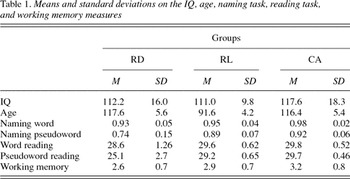
Using a naming task that is included in the SICOLE computer software program (Jiménez, et al., 2002), the RD and RL groups were matched in word naming. In this task there were no significant differences in accuracy measures between RD and RL groups on familiar word reading, F (1, 94) = 1.35, p = .24, but there were significant differences in pseudoword reading, F (1, 94) = 28.7, p < .001. In addition, the RD performed more poorly than CA matched readers on word reading, F (1, 94) = 23.9, p < .001, and pseudoword reading, F (1, 94) = 51.2, p < .001. We only analyzed accuracy measures on the naming task because reaction time (RT) shows a strong maturational trend, contaminating any RL comparison. Older children are strongly advantaged in such comparisons because the baseline components of RT (response preparation, execution, etc.), those components having nothing to do with word recognition, are faster in older subjects (Kail, 1991). There were no significant differences in the distribution of the subjects as a function of gender, χ2 (2) = 3.54, p = .17. Moreover, results showed that there were no differences between groups in IQ, F (2, 94) = 1.79, p = .17, but there were differences in verbal working memory (VWM), F (2, 94) = 5.44, p < .01. A test of simple main effect confirmed that RD children had significantly lower scores on VWM measures than normal readers matched in age, F (1, 95) = 10.9, p < .001, and younger normal readers, F (1, 94) = 8.99, p < .01. The children came from urban areas and middle class backgrounds and were attending various state schools. Children who had sensory, acquired neurological, and other problems traditionally used as exclusionary criteria for learning disabilities were excluded. The means and standard deviations for IQ, age, naming, reading measures, and working memory by group are presented in Table 1.

Design
A three-group reading level design was used in this study. The three groups of children carried out four PA tasks, which came from the PA module of the SICOLE. This test includes CV, CVC, and CCV items, but in the present study we consider only performance on CV versus CCV items. On one hand, two of the tasks (isolation and deletion) can be defined unambiguously in terms of complexity of syllable structure. Therefore, a first analysis included a between participants factor (reading level) and two orthogonal dimensions within participant factors: task differences (isolating vs. deletion) and complexity of syllable structure (CV, CCV). On the other hand, the blending and segmentation tasks were comparable in terms of cognitive demand and therefore we carried out a second analysis, which included a between participants factor (reading level) and two orthogonal dimensions within participant factors: task differences (blending vs. segmentation) and complexity of syllable structure (CV, CCV).
Materials
PROLEC
This test (Cuetos et al., 1996) includes several reading subtests. We administered only the Word Reading and Pseudoword Reading subtests. These subtests require the correct identification of 30 ordinary words and 30 pseudowords with different linguistic structures (CCV, CVV, CVC, CCVC, CVVC, VC). Both subtests measure the accuracy of the responses. The authors reported an alpha coefficient of .92, and used as validity criteria the teacher's ratings of reading ability. Teachers were asked to rate reading ability on a 10-point scale, ranging from low ability (1) to high ability (10). All correlations between reading measures and teacher's ratings were significant statistically (p < .001).
Naming task
The naming task is included in the SICOLE computer software program (Jiménez et al., 2002). This task consisted of reading aloud each of the verbal stimuli that appeared one by one on a computer screen. The child had to read the item as quickly as possible. The RT of each stimulus was registered from the moment when the word or pseudoword appeared on the screen until the subject pronounced the first reading sound. The sound was recorded by the voice key, which stopped the computer's chronometer. The participants were presented either with the block of words followed by the pseudowords, or vice versa, so that they would not use a specific strategy. A reliability analysis was used on the different blocks of stimuli for the sample of RD children. In both the words and the pseudowords, reliability was .97. The program UNICEN was designed and used together with a device that detected the sounds within the broad band of the human voice but was not affected by the fairly high percentage of background noise (Escribano, 1991). The administration of the naming task started with a few practice items to train the participants. During this phase, the RT was not registered. Then, the first stimulus appeared, setting in motion the chronometer, which stopped as soon as the participant emitted any vocal sound; after registering the RT, the second item appeared on the screen. The sequencing in the administration of the stimuli was as follows: blank screen on the computer (200 ms), fixation point in the center of the screen (400 ms), stimulus word or pseudoword. In total, the time between items was 2000 ms. The order of presentation of words and pseudowords was counterbalanced. Items were presented in random order within each set. In total, there were 32 words and 48 pseudowords. High-frequency words used in the naming task were selected on the basis of ratings generated from a normative study conducted by Guzmán and Jiménez (2001). Pseudowords were extracted from research by de Vega, Carreiras, Gutiérrez, and Alonso–Quecuty (1990).
Culture Fair (or Free) Intelligence Test
This test (Scales 1 and 2, Form A; Cattell & Cattell, 1950/1989) allows a measurement of the g factor without interference from cultural bias.
VWM
To assess the children's working memory, we administered the task used by Siegel and Ryan (1989). This task was modeled on the procedure developed by Daneman and Carpenter (1980). The children heard sentences that had the final word missing. The task was to supply the missing word and then to repeat all the missing words from the set. There were three trials at each level or set size (2, 3, 4, and 5 words). For each level or set size, the score was 1 when he or she performed the task successfully and 0 when he or she failed. Task administration was stopped when the child failed all the trials at one level.
Test of PA
We administered the Prueba de Conciencia Fonológica (PCF [Test of Phonological Awareness]; Jiménez, 1995), that is included in SICOLE (Jiménez et al., 2002). A reliability analysis was used and the alpha coefficient was .88. SICOLE comprises different serially connected components. The construction of the first component resulted in an interface displaying a choice-dependent sequence of menus that leads to the selection of a preliminary set of language and reading task situations (e.g., speech perception, syllabic awareness, intrasyllabic awareness, PA, word reading, sentence processing, morpheme and orthographic processing, and reading comprehension). We administered the PA module, which includes four tasks: Blending, Isolation, Segmentation, and Deletion. In the Blending task all the phonemes of each word were presented orally and sequentially by the computer. This task required the child to synthesize segmented phonemes to recognize a word. Phoneme isolation required the child to say the first or last sound of a spoken word. Deletion required the child to remove sounds from the beginning or end of one word and to form another word. Segmentation required pronouncing all phonemes of a word. The tasks are shown in Appendix A. Real-word items were selected for each task. High-frequency words used in the PCF test were selected on the basis of ratings generated from a normative study conducted by Guzmán and Jiménez (2001), who employed a sample of 3,000 words obtained from texts drawn from children's literature. Word familiarity was measured using these authors' procedure of frequency estimation, which involved the separation of the 3,000 words into different sets which were printed. For each set, different groups of 30 children were asked to rate each word on a 5-point scale, ranging from least frequent (1) to most frequent (5). The estimated frequency was calculated for each word by averaging the rating across all 30 judges. On the basis of these ratings, high-frequency words were selected. In each task eight words with different syllable structure were presented. In four of these words, the operation required involved the CV structure. In another four words the syllable structure was CCV. Thus, syllable structure was controlled for each task. In sum, two levels of syllable complexity are represented in each task: analyzing onsets and rimes (CV structure), and analyzing phonemes composing cluster onsets (CCV). The PCF test included 32 items, which represented the four tasks (Phoneme, Blending, Isolation, and Deletion) at two syllable structures (CV, CCV). Similarly to the procedure used by Stahl and Murray (1994), the same set of scores was used once to generate a set of averages across tasks and once to generate a set of averages across syllable structures.
Procedure
Six experienced psychologists administered the reading tests, the naming task, and the phonological awareness assessment using the SICOLE computer software program. The assessment was carried out individually over four sessions per subject in a school room which had the appropriate conditions. The administration of the tasks included in the PCF test was randomly ordered, each being preceded by four examples to ensure that the children understood the instructions.
RESULTS
The comparison between RD children and normal readers matched in age, and younger normal readers was compromised somewhat by the fact that the RD group had a lower VWM mean than the control groups. To control for this difference, it was intended to carry out analyses of covariance taking VWM as the covariate. However, hierarchical regression analyses testing the homogeneity of regression assumption showed that this assumption was not met by the data. We therefore report ANOVAs rather than ANCOVAs below.
An analysis of variance (ANOVA) for one factor (RD vs. normal readers matched in age vs. younger normal readers) was conducted and the total number of correct responses on the PCF Test was calculated separately across participants and items. The analysis of variance on total number of correct responses showed that there were significant differences between all groups, F1 (2, 94) = 42.7, p < .001, mean square error (MSE) = .50, γ2 = .47, F2 (1,31) = 347.7, p < .001. Subsequent tests of simple main effects confirmed that reading disabled children had significantly lower scores on the PCF test than younger normal readers, F1 (1,95) = 20.4, p < .001, and normal readers, F (1,95) = 82.0, p < .001. In addition, younger normal readers had significantly lower scores than normal readers, F (1,95) = 9.80, p < .01. Overall, this means that RD children are characterized by a deficit in PA.
Isolation versus deletion
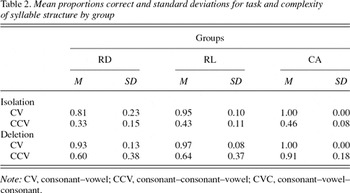
A (3 × 2 × 2) Group (RD vs. normal readers matched in age vs. younger normal readers) × Task Differences (isolation vs. deletion) × Complexity of Syllable Structure (CV vs. CCV) mixed ANOVA was performed on the number of correct responses as a dependent variable and it was calculated separately across participants and items. Table 2 contains means and standard deviations for the three groups in each of the PA tasks and complexity of syllable structure.

This analysis yielded a main effect of group, F1 (2,78) = 25.9, p < .001, MSE = .94, γ2 = .40, F2 (2,11) = 44.7, p < .001. Subsequent tests of simple main effects confirmed that RD children had significantly lower scores than normal readers, F (1,79) = 6.45, p < .05, and younger normal readers, F (1,79) = 6.45, p < .05. In addition, there was a main effect of task differences, F1 (1,78) = 70.6, p < .001, MSE = 2.52, γ2 = .31, but it was not confirmed in the analysis by items, F2 (1,12) = 1.81, p = .20. A main effect of complexity of syllable structure, F1 (1,78) = 374.08, p < .001, MSE = 11.1, γ2 = .82, F2 (1,12) = 9.42, p < .01, demonstrated that individuals had mean scores greater in analyzing onsets and rimes than analyzing cluster onsets.
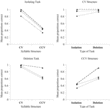
Finally, there was a significant interaction of Group × Task Differences × Complexity of Syllable Structure, F1 (2,78) = 5.14, p < .01, MSE = .18, γ2 = .23, F2 (2,11) = 7.92, p < .01. Tests of simple main effect confirmed that RD children showed larger differences between the different syllable complexity conditions, than normal readers matched in age in the deletion task, such as CV/CCV, F (1,79) = 9.28, p < .01. Younger normal readers also showed larger differences than normal readers matched in age between CV and CCV in the deletion task, F (1,79) = 8.47, p < .01. However, RD children did not show larger differences between CV and CCV than younger normal readers in the deletion task, F (1,79) = .16, p = .69. Conversely, there were no significant differences between all groups for the comparison of CV and CCV in the isolation task (F < 1).
Other subsequent tests of simple main effects confirmed, however, that RD children had significantly lower scores in analyzing onset and rimes in the isolation task than younger normal readers, F (1,79) = 9.48, p < .01, and age-matched controls, F (1,79) = 24.4, p < .01. Moreover, the performance of RD children was more affected when syllables were shown as CCV than younger normal readers in the isolation task, F (1,79) = 7.71, p < .01, and age-matched controls, F (1,79) = 22.6, p < .001. Nevertheless, there were no significant differences between RD children and younger normal readers in the deletion task when syllables with structure CV were shown as items, F (1,79) = 1.44, p = .23, or when syllables were shown as CCV, F (1,79) = .52, p = .47. There were also significant differences in the deletion task between RD children and the age-matched control group on CV items, F (1,79) = 7.70, p < .01, and CCV items, F (1,79) = 15.1, p < .001. Finally, there were no significant differences in the deletion task between younger normal readers and age-matched controls on CV items, F (1,79) = 3.18, p = .07, but the performance of younger normal readers was more affected when syllables were shown as CCV than the age-matched control group, F (1,79) = 11.8, p < .001 (see Figure 1).

The interaction between Group × Task Differences × Complexity of Syllable structure on correct responses; (—[squf ]—) RL, reading age; (–[utrif ]–) CA, chronological age; (--) RD, Reading disabled
Overall, these findings suggest that the performance of RD children on the isolation task was affected not only when syllables with a CV structure were shown as items, but also when syllables were shown as CCV. That is, the access to phonological units of speech was not mediated by the linguistic complexity of the items in the isolating task.
Segmentation versus blending
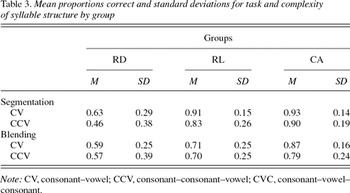
A (3 × 2 × 2) Group (RD vs. normal readers matched in age vs. younger normal readers) × Task Differences (segmentation vs. blending) × Complexity of Syllable Structure (CV vs. CCV) mixed ANOVA was performed on the number of correct responses as a dependent variable and calculated separately across participants and items. Table 3 contains means and standard deviations for the three groups in each of the PA tasks, as well as complexity of syllable structure.

This analysis yielded a main effect of Group, F1 (2, 92) = 31.6, p < .001, MSE = 3.36, γ2 = .40, F2 (2,11) = 31.9, p < .05. Subsequent tests of simple main effects confirmed that RD children had significantly lower scores than normal readers, F (1, 93) = 57.9, p < .001, and younger normal readers, F (1,93) = 21.1, p < .001. The main effect of task differences was also reliable, but only when subjects were treated as a random factor, F1 (1,92) = 6.46, p < .05, MSE = .44, γ2 = .06, F2 (1,12) = 1.82, p = .20. Likewise, a main effect of complexity of syllable structure was also reliable, F1 (1, 92) = 9.81, p < .01, MSE = .44, γ2 = .09, but it was not confirmed in the analysis by items, F2 (1,12) = .36, p = .56. The interaction between all variables was not reliable when subjects were treated as a random factor (F < 1).
DISCUSSION
The primary purpose of the study reported here was to investigate whether children with reading disabilities in a consistent orthography show a deficit in PA. If empirical support for this deficit were found, then a second issue would be to explore the effects of the complexity of syllable structure and the effects of task differences in the explanation of deficit in PA.
The current study demonstrated that the scores obtained by RD children in the PCF Test were inferior to the scores obtained by the younger normal readers when different sources of variability (i.e., task, the position of the phoneme, syllable structure of items, and familiarity of items) were controlled. This means that children with reading disabilities did indeed show a deficit in phonological awareness. Many studies in English have found phonemic deficits in dyslexic children compared to both RL and CA matched children, irrespective of the task used to assess phonemic awareness (Goswami & Bryant, 1990; Olson, 1994). Our finding is particularly significant, as it indicates that RD children learning to read consistent orthographies also exhibit the same difficulties in PA displayed by older English-speaking dyslexic children.
The finding of a dyslexic deficit compared to an age-matched peer group was consistent with that reported in other studies conducted in a consistent orthography (e.g., in Spanish, Jiménez, 1997; Jiménez & Hernández–Valle, 2000; Jiménez & Ramírez, 2002; in German, Landerl & Wimmer, 2000; Landerl et al., 1997).
The second issue in the present study was to determine which of the two factors, task differences or complexity of syllable structure, might better reveal the deficit in PA. Previous research has arrived at a means of conceptualizing PA for the purpose of examining the relation with reading skills (Stahl & Murray, 1994). We considered, therefore, that this would prove to be a fruitful way of looking at the relations between PA and reading disabilities.
The results demonstrated that different reading groups were differentially affected by syllable structure in the deletion task. That means that Spanish children with reading disabilities and younger normal readers did show larger differences between CV and CCV than normal readers matched in age in the deletion task. Nevertheless, both RD children and younger normal readers showed a similar pattern in the deletion task, that is, the RD participants performed equally well as RL matched controls on the deletion task across syllable structures. For the isolation task, however, a deficit is found for the RD group irrespective of syllable structure. The performance of RD children on the isolation task was affected when syllables with the structure CV were shown as items, as well as when syllables were shown as CCV. That means that the access to phonological units of speech was not mediated by the linguistic complexity of the items in the isolating task. Finally, for segmentation and blending tasks, the different reading groups were not differentially affected by syllable structure.
Some English studies provided empirical evidence that complexity of syllable structure has an influence in learning to read, and the controversy has been centered over the role of large versus small phonological units as predictors of children's reading skills (e.g., Bryant, 2002; Goswami, 2002; Hulme et al., 2002; McMillan, 2002). Stahl and Murray (1994) found that the ability to manipulate onsets and rimes within syllables was related more strongly to reading, once an adequate level of letter recognition is achieved. However, studies with Spanish children have demonstrated that in the Spanish language onset and rime units are not involved in the translation of printed letter strings into phonological forms (Jiménez, Alvarez, Estévez, & Hernández–Valle, 2000). In addition, there is evidence in Spanish-speaking children that they are able to classify words on the basis of the rhyme unit in oddity tasks (e.g., bucal–moral–vejez), and they also performed well on oddity tasks that require them to identify the medial vowel phoneme and the same coda (e.g., dosel–senil–viril; Jiménez & Ortiz, 1993). Nevertheless, Jiménez and Ortiz (2000) designed a longitudinal study on a sample of preliterate Spanish children and using path analysis demonstrated that the role of manipulating vowel–coda was not as great as they had assumed in the hypothesized model tested. In addition, this result was consistent with those studies in Spanish that revealed evidence that at 6 years of age, the relationship between rhyme and reading is low (Carrillo, 1994).
Complexity of syllable structure would then play a less important role because Spanish is an orthographically transparent language. Jiménez and Venegas (2004) examined the relationship between PA and reading skills in a sample of Spanish illiterate adults analyzing the contribution of complexity of syllable structure and task differences separately. They reasoned that if adult literacy acquisition is affected by the same factors that govern the acquisition of literacy skills in Spanish children, complexity of syllable structure would play a less important role because Spanish is an orthographically transparent language. They found that phoneme isolating appeared to distinguish adults who could read from adults who could not read words at the primary level. Moreover, the performance on all PA tasks was related to reading measures, a finding that was not coincident with Stahl and Murray's (1994) study. One possible interpretation offered by Jiménez and Venegas (2004) is that performance across tasks, when the linguistic complexity is controlled, is facilitated by the transparency of orthography because all tasks require phoneme manipulation.
The present study has some limitations, recognition of these should contribute to the refinement of future research efforts. On one hand, we found that RD children had significantly lower scores on VWM measures than normal readers matched in age and younger normal readers. The homogeneity of regression assumption was not met; therefore, we do not know if memory had an influence on task performance. On the other hand, it is important to recognize the importance of longitudinal studies in the analysis of developmental changes in the manifestation of a phonological deficit in dyslexic children learning to read a regular orthography. The fact that ours is not a longitudinal study should be borne in mind when designing future investigations. When dyslexic children learning to read consistent orthographies are studied during the later phases of learning to read, evidence for a phonemic deficit in terms of accuracy of performance is difficult to find (Wimmer, Mayringer, & Landerl, 2000). De Jong and van der Leij (2003) studied the development of phonological processing abilities in dyslexics learning to read in Dutch. They also demonstrated that impairments in phonological awareness at the level of phonemes became manifest in first grade and tended to disappear at the end of primary school. Nevertheless, in a second cross-sectional study, it was found that dyslexic children's awareness of phonemes was hampered when task demands increased. Consequently, longitudinal studies are necessary in order to analyze the relative importance of complexity of syllable structure and task differences in assessing the assumption that difficulties in accessing the constituent phonemes of the speech stream are responsible for specific reading difficulties in different orthographic systems.
Despite the above limitations, the research findings demonstrate that the deficit in PA in children with reading disabilities who learn in a consistent orthography is better revealed by the isolation task across all syllable structures. This means that RD children experienced more difficulty in isolating phonemes, irrespective of the complexity of syllable structure.
APPENDIX A TASKS OF PHONOLOGICAL AWARENESS
The numbers under the words are frequency measures.
Isolating
Instructions: This time I want you to listen for just one sound in a word. Tell me the sound you hear at the beginning of each word I say. For example, if I say fila, you say /f/.
Practice words: pila, foto, sota, roto

Deletion
Instructions: I wonder if you could take a sound away from a word and make a whole new word. For example, say rata. Now say it again, but don't say /r/. (For each item, use this form: Say [word]. Now say it again, but don't say [phoneme].)
Practice words: lino, pasa, tarro, fama.

Segmentation
Instructions: Do you remember when I said the words in a secret code and you guessed what word I was saying? This time I want you to say the word in a secret code. I'll say a word, and you spread out all the sounds in the word. For example, if I say rana, you say /r-a-n-a/.
Practice words: pollo, goma, peso, porra.

Blending
Instructions: I'm going to say some words in a secret code, spreading out the sounds until they come out one at a time. Guess what word I'm saying. For example, if I say s-o-f-a, you say sofa (For each item, pronounce the segments with as little additional vowel as possible).
Practice words: queso, broma, puma, niño

ACKNOWLEDGMENTS
This research was supported by a grant from the European Funds for Regional Development (1FD97-1140), and Dirección General de Investigación Científica y Técnica, Ministerio de Ciencia y Tecnología, Spain. Portions of this research were presented at the Bangor Dyslexia Conference sponsored by The British Dyslexia Association and at the International Association for Research on Learning Disabilities, University of Wales, Bangor, July 2003.
References
Adams M.
1990.
Beginning to read: Thinking and learning about print.
Cambridge, MA:
MIT Press.
Arnqvist A.
1992.
The impact of consonant clusters on preschool children's phonemic awareness: A comparison between readers and nonreaders.
Scandinavian Journal of Psychology,
33,
29–
35.Google Scholar
Bryant P.
2002.
It doesn't matter whether onset and rime predicts reading better than phoneme awareness does or vice versa.
Journal of Experimental Child Psychology,
82,
41–
46.Google Scholar
Carrillo M. S.
1994.
Development of phonological awareness and reading acquisition. A study in Spanish language.
Reading and Writing: An Interdisciplinary Journal,
6,
279–
298.Google Scholar
Cattell R. B., &
Cattell A. K. S.
1989.
Test de Factor “g.” Escala 1 and 2
A. Cordero,
M. V. de la Cruz, &
N. Seisdedos, Trans.).
Madrid:
T.E.A. Ediciones.
(Original work published 1950).
Chafouleas S.,
VanAuken T., &
Dunham K.
2001.
Not all phonemes are created equal: The effects of linguistic manipulations on phonological awareness tests.
Journal of Psychoeducational Assessment,
19,
216–
226.Google Scholar
Cuetos F.,
Rodríguez B., &
Ruano E.
1996.
Batería de evaluación de los procesos lectores de los niños de educación primaria
(PROLEC). [Assessment test of reading skills for children].
Madrid:
T.E.A. Ediciones.
Daneman M., &
Carpenter P. A.
1980.
Individual differences in working memory and reading.
Journal of Verbal Learning and Verbal Behavior,
19,
450–
466.Google Scholar
de Jong P. F., &
van der Leij A.
2003.
Developmental changes in the manifestation of a phonological deficit in dyslexic children learning to read a regular orthography.
Journal of Educational Psychology,
95,
22–
40.Google Scholar
de Vega M.,
Carreiras M.,
Gutiérrez M., &
Alonso–Quecuty M. L.
1990.
Lectura y comprensión. Una perspectiva cognitiva
[Reading and comprehension. A cognitive approach].
Madrid:
Alianza Editorial.
Escribano J. L.
1991.
Programa UNICEN
[UNICEN software].
Santa Cruz de Tenerife,
Spain:
Author.
Goswami U.
2002.
In the beginning was the rhyme? A reflection on Hulme, Hatcher, Nation, Brown, Adams, and Stuart (2002).
Journal of Experimental Child Psychology,
82,
47–
57.Google Scholar
Goswami U., &
Bryant P. E.
1990.
Phonological skills and learning to read.
Hillsdale, NJ:
Erlbaum.
Guzmán R., &
Jiménez J. E.
2001.
Estudio normativo sobre parámetros psicolingísticos en niños de 6 a 8 años: La familiaridad subjetiva [Statistical study about psycholinguistic parameters in children from 6 to 8 years old: Word familiarity].
Cognitiva,
13,
153–
191.Google Scholar
Høien T.,
Lundberg I.,
Stanovich K. E., &
Bjaalid I. K.
1995.
Components of phonological awareness.
Reading and Writing: An Interdisciplinary Journal,
7,
171–
188.Google Scholar
Hulme C.,
Hatcher P.,
Nation K.,
Brown A.,
Adams J., &
Stuart G.
2002.
Phoneme awareness is a better predictor of early reading skill than onset-rime awareness.
Journal of Experimental Child Psychology,
82,
2–
28.Google Scholar
Jiménez J. E.
1995.
Evaluación de la conciencia fonológica [Test of phonemic awareness].
In J. E. Jiménez &
M. R. Ortiz (Eds.),
Conciencia fonológica y aprendizaje de la lectura
[Phonological awareness and learning to read]
(pp. 74–
78).
Madrid:
Síntesis.
Jiménez J. E.
1997.
A reading-level match study of phonemic processes underlying reading disabilities in a transparent orthography.
Reading and Writing: An Interdisciplinary Journal,
9,
23–
40.Google Scholar
Jiménez J. E.,
Alvarez C.,
Estévez A., &
Hernández–Valle I.
2000.
Onset-rimes units in visual word recognition in Spanish normal readers and reading disabled children.
Learning Disabilities Research & Practice,
15,
135–
141.Google Scholar
Jiménez J. E.,
Díaz A.,
Ortiz M. R.,
Rodrigo M.,
García E.,
Guzmán R.,
Hernández–Valle I.,
Estévez A., &
Hernández S. G.
2002.
SICOLE: Un sistema de evaluación de procesos cognitivos en la dislexia mediante ayuda asistida a través de ordenador [SICOLE: A system in assessing cognitive processes in dyslexia in the Spanish language] [Computer software].
Universidad La Laguna:
Authors.
Jiménez J. E., &
Haro C.
1995.
Effects of word linguistic properties on phonological awareness in Spanish children.
Journal of Educational Psychology,
87,
193–
201.Google Scholar
Jiménez J. E., &
Hernández–Valle I.
2000.
Word identification and reading disorders in the Spanish language.
Journal of Learning Disabilities,
32,
267–
275.Google Scholar
Jiménez J. E. &
Ortiz M. R.
1993.
Phonological awareness in learning literacy.
Cognitiva,
5,
153–
170.Google Scholar
Jiménez J. E., &
Ortiz M. R.
2000.
Metalinguistic awareness and reading acquisition in the Spanish language.
The Spanish Journal of Psychology,
3,
37–
46.Google Scholar
Jiménez J. E., &
Ramírez G.
2002.
Identifying subtypes of reading disabilities in the Spanish language.
The Spanish Journal of Psychology,
5,
3–
19.Google Scholar
Jiménez J. E., &
Venegas E.
2004.
Defining phonological awareness and its relationship to reading skills in low literacy adults.
Journal of Educational Psychology,
96,
798–
810.Google Scholar
Kail R.
1991.
Developmental changes in speed of processing during childhood and adolescence.
Psychological Bulletin,
109,
490–
501.Google Scholar
Landerl K., &
Wimmer H.
2000.
Deficits in phoneme segmentation are not the core problem of dyslexia: Evidence from German and English children.
Applied Psycholinguistics,
21,
243–
262.Google Scholar
Landerl K.,
Wimmer H., &
Frith U.
1997.
The impact of orthographic consistency on dyslexia: A German–English comparison.
Cognition,
63,
315–
334.Google Scholar
Liberman I., &
Shankweiler D.
1977.
Speech, the alphabet and teaching to read.
In L. B. Resnick &
P. A. Weaver (Eds.),
Theory and practice of early reading
(pp. 105–
129).
Hillsdale, NJ:
Erlbaum.
Liberman I.,
Shankweiler D.,
Fischer F., &
Carter B.
1974.
Explicit syllable and phoneme segmentation in the young child.
Journal of Experimental Child Psychology,
18,
201–
212.Google Scholar
Lundberg I.,
Frost J., &
Petersen O. P.
1988.
Effects of an extensive program for stimulating phonological awareness in preschool children.
Reading Research Quarterly,
23,
263–
284.Google Scholar
McBride–Chang C.
1995.
What is phonological awareness?
Journal of Educational Psychology,
2,
179–
192.Google Scholar
McMillan B. M.
2002.
Rhyme and reading: A critical review of the research methodology.
Journal of Research in Reading,
25,
4–
42.Google Scholar
Morais J.
1991.
Phonological awareness: A bridge between language and literacy.
In D. J. Sawyer &
B. J. Fox (Eds.),
Phonological awareness in reading. The evolution of current perspectives
(pp. 31–
71).
New York:
Springer–Verlag.
Olson R. K.
1994.
Language deficits in specific reading disability.
In M. A. Gernsbacher (Ed.),
Handbook of psycholinguistics
(pp. 895–
916).
New York:
Academic Press.
Rack J. P.,
Snowling M. J., &
Olson R.
1992.
The nonword reading deficit in developmental dyslexia: A review.
Reading Research Quarterly,
27,
29–
53.Google Scholar
Schreuder R., &
van Bon W.
1989.
Phonemic analysis: Effects of word properties.
Journal of Research in Reading,
12,
59–
78.Google Scholar
Siegel L., &
Ryan E. B.
1989.
The development of working memory in normally achieving and subtypes of learning disabled children.
Child Development,
60,
973–
980.Google Scholar
Stahl S. A., &
Murray B. A.
1994.
Defining phonological awareness and its relationship to early reading.
Journal of Educational Psychology,
86,
221–
234.Google Scholar
Treiman R.
1991.
Phonological awareness and its roles in learning to read and spell.
In D. J. Sawyer &
B. J. Fox (Eds.),
Phonological awareness in reading. The evolution of current perspectives
(pp. 159–
189).
New York:
Springer–Verlag.
Treiman R.
1992.
The role of intrasyllabic units in learning to read and spell.
In P. B. Gough,
L. C. Ehri, &
R. Treiman,
Reading acquisition
(pp. 65–
106).
Hillsdale, NJ:
Erlbaum.
Treiman R., &
Weatherston S.
1992.
Effects of linguistic structure on children's ability to isolate initial consonants.
Journal of Educational Psychology,
84,
174–
181.Google Scholar
Treiman R., &
Zukowsky A.
1991.
Levels of phonological awareness.
In S. A. Brady &
D. Shankweiler (Eds.),
Phonological processes in literacy.
A tribute to Isabelle Y. Liberman
(pp. 67–
83).
Hillsdale, NJ:
Erlbaum.
Tunmer W. E., &
Herriman M.
1984.
The development of metalinguistic awareness: A conceptual overview.
In W. E. Tunmer,
C. Pratt, &
M. L. Herriman (Eds.),
Metalinguistic awareness in children
(pp. 12–
35).
Berlin:
Springer–Verlag.
Tunmer W. E., &
Rohl M.
1991.
Phonological awareness and reading acquisition.
In D. J. Sawyer &
B. J. Fox (Eds.),
Phonological awareness in reading. The evolution of current perspectives
(pp. 1–
30).
New York:
Springer–Verlag.
Wimmer H.,
Mayringer H., &
Landerl K.
2000.
The double-deficit hypothesis and difficulties in learning to read a regular orthography.
Journal of Educational Psychology,
92,
668–
680.Google Scholar
Yopp H. K.
1988.
The validity and reliability of phonemic awareness tests.
Reading Research Quarterly,
23,
159–
177.Google Scholar
Means and standard deviations on the IQ, age, naming task, reading task, and working memory measures
Mean proportions correct and standard deviations for task and complexity of syllable structure by group
The interaction between Group × Task Differences × Complexity of Syllable structure on correct responses; (—[squf ]—) RL, reading age; (–[utrif ]–) CA, chronological age; (--) RD, Reading disabled
Mean proportions correct and standard deviations for task and complexity of syllable structure by group
 You have
Access
- 16
- Cited by