Introduction
Giant reed is a tall, perennial herbaceous plant with large bamboo-like culms and robust rhizomes. It has been proposed as a good alternative for reducing the cost of bioenergy crop production due to its high productivity and low agronomic and energy inputs (Corno et al. Reference Corno, Pilu and Adani2014). Giant reed grows in many different ecosystems and soil types, preferentially along lakes, ponds, and rivers (Corno et al. Reference Corno, Pilu and Adani2014; Lewandowski et al. Reference Lewandowski, Clifton-Brown, Scurlock and Huisman2000). A 10-yr field experiment in central Italy indicated that aboveground dry biomass production of giant reed can reach 28.7 tons per hectare per year (Angelini et al. Reference Angelini, Ceccarini, Nasso and Bonari2009). Another study in Italy reported that giant reed cultivation may produce the same amount of biomass at 25% of the cost on 64% of the area compared with traditional bioenergy crops (Corno et al. Reference Corno, Lonati, Riva, Pilu and Adani2016). In order to meet federal and state rules, Portland General Electric (PGE) selected giant reed as one of the alternative fuels for its 585-megawatt coal-fired power plant in Boardman, Oregon (Morgan and Sytsma Reference Morgan and Sytsma2015). PGE contracted 120 ha of production in Morrow County, Oregon, and with plans to convert up to 36,500 irrigated hectares to giant reed production by 2020 (County Court of Morrow 2010; Lies Reference Lies2011). However, weed management in giant reed production has not been well studied, and no herbicides have been registered for use against giant reed as a crop.
Growers and the public have both raised concerns about giant reed’s invasive potential. Giant reed is an invasive weed in many tropical and cool-summer, temperate, Mediterranean-type environments in North America such as Mexico, Texas, California, and other parts of the southwestern United States (ODA 2011). The major concern is the plant’s impact on water supplies and its possibility to change riparian landscapes because it consumes large amounts of water (Anonymous 2012; Oakins Reference Oakins2001). Previous studies have indicated that giant reed consumes three times more water than typical native species (Jackson et al. Reference Jackson, Katagi and Loper2002; Oakins Reference Oakins2001). Other negative impacts of giant reed invasion may include dramatically altered ecological processes in riparian systems, water facility damage, and increased fire hazard (ODA 2011). In coastal California, the appearance of giant reed will increase the risk of wildfire because the large amount of biomass produced by giant reed can reduce the buffering capacity of riparian areas (Anonymous 2012). Giant reed can create large debris piles that threaten the structural integrity of bridges and other in-stream structures, which results in expensive removal and cleanup following flood events (ODA 2011; Seawright et al. Reference Seawright, Rister, Lacewell, Sturdivant, Goolsby and Mccorkle2009).
Previous studies of giant reed have mainly focused on biocontrol efforts, treating the plant as an invasive species in riparian zones over large areas (Jackson et al. Reference Jackson, Katagi and Loper2002; Seawright et al. Reference Seawright, Rister, Lacewell, Sturdivant, Goolsby and Mccorkle2009). However, chemical control could be a more efficient method. Chemical control of giant reed depends on several factors, such as the presence or absence of native plants, the size of the stand, the amount of biomass left after control, the terrain conditions, and the season (Bell Reference Bell, Brock, Wade, Pysek and Green1997; Martin et al. Reference Martin, Gourlie and Barroso2019). Foliar spray, cut-and-spray, and cut-resprout-spray are three common chemical methods used to control giant reed. Imazapyr and glyphosate also have been used to control giant reed (Jackson Reference Jackson1993; Martin et al. Reference Martin, Gourlie and Barroso2019; Morgan and Sytsma Reference Morgan and Sytsma2015; Santín-Montanyá et al. Reference Santín-Montanyá, Jiménez, Ocaña and Sánchez2013). Generally, population expansion of giant reed occurs mainly through vegetative reproduction, either from underground rhizome extension of a colony or from stem fragments carried downstream (Bhanwra Reference Bhanwra1988; Else Reference Else1996; Johnson et al. Reference Johnson, Dudley and Burns2006; Lewandowski et al. Reference Lewandowski, Clifton-Brown, Scurlock and Huisman2000). Thus, the Oregon Department of Agriculture (ODA 2011) recommended killing or removing the root-mass.
To determine potential herbicides for weed management in giant reed grown as a biofuel crop or to control giant reed, greenhouse studies were conducted to evaluate giant reed response to herbicides commonly used in Oregon. Herbicides were applied either as foliar or as cut-and-spray treatments.
Materials and Methods
General Procedures
The giant reed plants used in this study were provided by BOO-Shoot Gardens LLC, 1768 Dunbar Rd., Mount Vernon, WA 98273. Each giant reed plant was individually transplanted in to a 950-ml-square pot filled with potting mix (Sunshine Mix 1 Potting Mix, Sun Gro Horticulture, Bellevue, WA), and placed in the greenhouse. Greenhouse conditions included 25/20 C day/night temperatures with ambient sunlight plus grow lights providing 14 h of overhead light via 25 mW cm−2 per day. Herbicide treatments were applied using an experimental spray chamber equipped with TeeJet TP8004VS nozzles (TeeJet Technologies, Glendale Heights, IL) calibrated to deliver 187 L ha−1 at 276 kPa. Before herbicide application, the healthiest stem was kept on each plant, and other stems were cut at the soil level. A randomized complete block design with four blocks was used in both experiments. The treatments were applied when the mean plant height was between 40 and 50 cm. When treatments were applied, the height range of the plants was 32 to 61 cm. Giant reed plants were grouped into four blocks based on size. The plant height in the four blocks were ≤40 cm, 40–45 cm, 45–50 cm, and ≥50 cm, respectively. The studies were repeated.
Herbicides
Because no herbicides were registered for use against giant reed either as a crop or for control as a volunteer, herbicides were selected that growers in that area were using with rotational crops. The application rates were based on the highest recommended labeled rate for using in the rotational crops and on our field experience.
Experiment 1: Herbicide Screening Assays
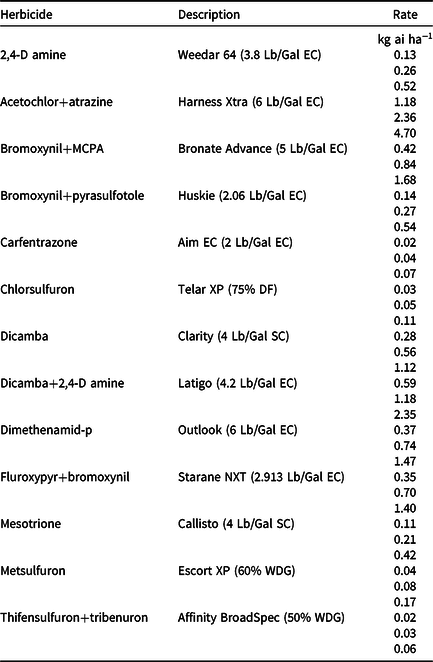
Giant reed plants were sprayed with 13 different foliar applied herbicides (Table 1). Three rates, half of the labeled field rate (0.5×), the labeled field rate (1×), and two times the labeled field rate (2×), were used for each herbicide. A nonionic surfactant was added, if required by the label.
Herbicides used in the herbicide applications screening assay.

a Abbreviations: DF, dry flowable; EC, emulsifiable concentrate; SC, suspension concentrate; WDG, wettable dispersible granules.
Before aboveground biomass harvest, the plant injury was visually rated on a score from 0 (no injury) to 100 (death). Depending on the mode of action of the different herbicides, injury symptoms, including leaf yellowing or purpling, leaf/stem twisting, and short or abnormal plant, were evaluated. At the same time, the number of stems with at least two leaves were counted as an indication of survival. The plant height was measured on the tallest stem of each plant and converted to percentage relative to the untreated controls. Aboveground biomass was harvested about 2.5 cm above the soil surface at 21 and 42 d after herbicide application. The 2.5 cm of stem was retained at the first harvest to ensure that the plant would regrow. A second harvest was conducted to examine the herbicide’s influence on regrowth. At 42 d after herbicide application, belowground biomass was harvested. Roots were separated from soil by rinsing them under tap water. The biomass samples were oven-dried at 65 C for 72 h and weighed. The percent dry weight of the treated plants relative to the untreated control was calculated. The study was repeated.
Experiment 2: Herbicide Screening Assay with the Cut-and-Spray Method
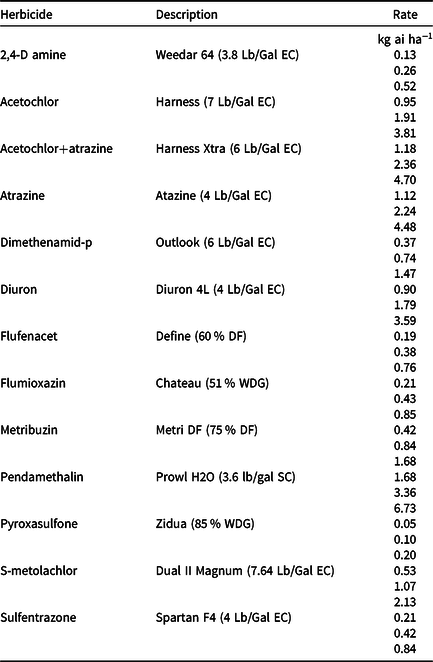
In Experiment 2, herbicides were applied with a cut-and-spray treatment. The purpose of this study was to determine which herbicides could suppress giant reed regrowth after harvest. Giant reed plants were grown under the same conditions as in Experiment 1. When giant reed plant reached the same heights as in Experiment 1, the treatments were applied. Giant reed plants were cut 2.5 cm above the ground, before herbicides were applied. Herbicides at three rates, 0.5×, 1×, and 2×, were applied within 2 d after cutting (Table 2). Herbicide efficacy was estimated at 21 d after herbicide application. Measurements, including plant injury, stem numbers, plant height, and aboveground and root dry biomass, were collected as described in Experiment 1. The study was repeated.
Herbicides used for the cut and spray assay.

a Abbreviations: DF, dry flowable; EC, emulsifiable concentrate; SC, suspension concentrate; WDG, wettable dispersible granules.
Analysis of variance was performed using R software, version 3.5.1. The herbicide effects and possible interaction with rates were tested for each measured parameter. The treatment means were separated using a Student’s t-test at P < 0.05.
Results and Discussion
Normality of residuals and homogeneity of variance of the data were analyzed using R software, version 3.5.1. No significant differences were found among blocks or between replicated studies. Therefore, data for the same treatment were pooled across trials for further analysis.
Experiment 1: Herbicide Screening Assay with Foliar Application
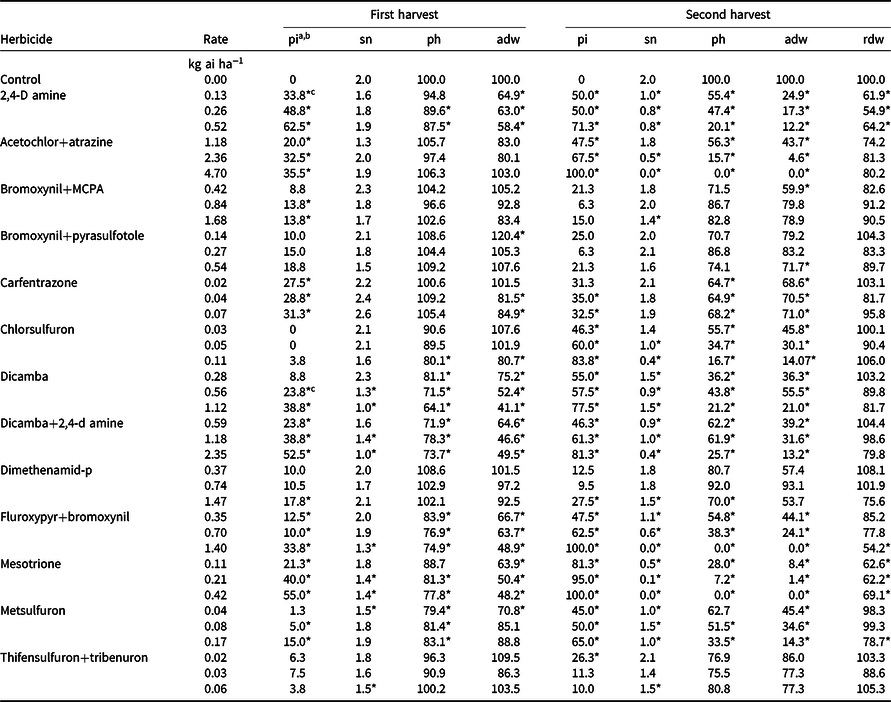
Plant injury caused by herbicide treatment was found at the first harvest with 9 of the 13 herbicides applied at the 1× and 2× labeled rates (Table 3). Except for bromoxynil+MCPA, injury caused by these herbicides was observed on regrowth after the first harvest. Injury caused by dimethenamid-p at both harvests was observed only at the 2× rate. Injury caused by chlorsulfuron was observed at the second harvest.
Plant response to foliar applications.

a Abbreviations: adw, aboveground dry weight; pi, plant injury; ph, plant height; rdw, root dry weight; sn, stem number.
b Data for plant injury, plant height, aboveground dry weight, and root dry weight are presented as a percent of the untreated control plants.
c Asterisks (*) indicate significant difference from the control group using Student’s t-test (P ≤ 0.05).
The number of stems varied from one to five. At the first harvest, dicamba, dicamba+2,4-D-amine, and mesotrione application resulted in reduced stem numbers when applied at the 1× and 2× rates (Table 3). Fluroxypyr+bromoxynil and thifensulfuron-tribenuron application resulted in reduced stem numbers only when applied at the 1× rate. At the second harvest, giant reed plants treated with 1× and 2× rates of all herbicides except bromoxynil+ pyrasulfotole and carfentrazone had fewer stems than control plants. At the second harvest, bromoxynil+MCPA, dimethenamid-p, and thifensulfuron+tribenuron applications resulted in reduced stem numbers only at the 2× rate.
The plant height of treated plants varied from 64% to 109% of that of controls. When applied at 1× and 2× rates, 2,4-D-amine, carfentrazone, chlorsulfuron, dicamba, dicamba+2,4-D-amine, fluroxypyr+bromoxynil, mesotrione, and metsulfuron applications resulted in reduced the plant height at both the first and second harvests, whereas acetochlor+atrazine caused a reduction in the height of regrowth. Dimethenamid-p caused a plant height reduction at both harvests but only at the 2× rate.
When sprayed at 1× or 2× rates, applications of 2,4-D amine, carfentrazone, dicamba, dicamba+2,4-D amine, fluroxypyr+bromoxynil, and mesotrione resulted in reduced the aboveground biomass at both harvests. Acetochlor+atrazine, chlorsulfuron, and metsulfuron applications resulted in reduced aboveground biomass at the second harvest. Bromoxynil+ pyrasulfotole applied at the 2× rate resulted in reduced aboveground biomass of regrowth. However, application of the 2× rate of bromoxynil+ pyrasulfotole did not result in reduced aboveground biomass at the first harvest.
Application of the herbicides 2,4-D amine and mesotrione resulted in reduced root dry biomass when they were sprayed at all three rates. Fluroxypyr+bromoxynil and metsulfuron applications resulted in reduced root dry biomass only when they were sprayed at the 2× rate.
Experiment 2. Herbicide Screening Assay with the Cut-and-Spray Method
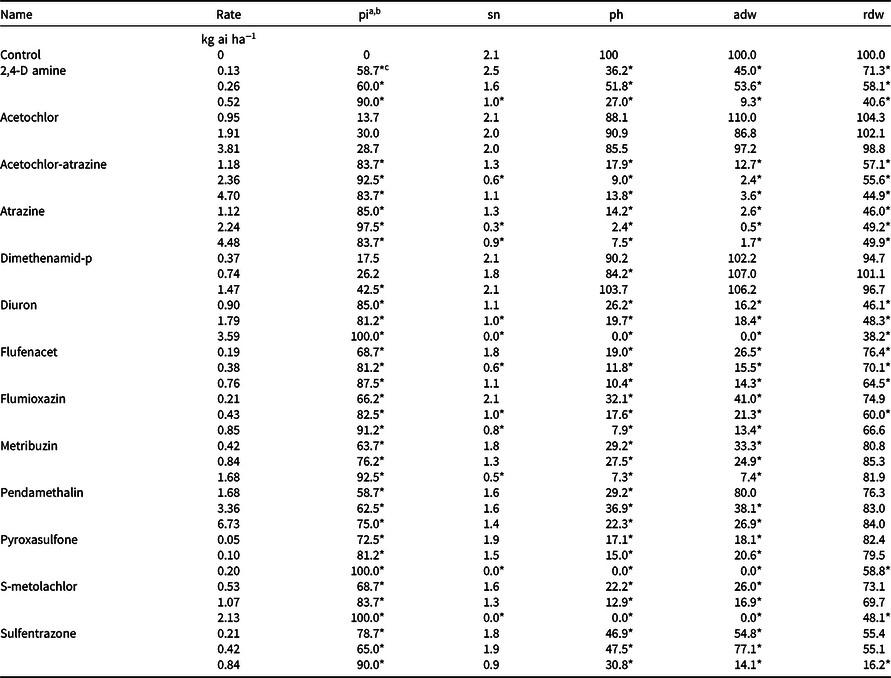
In Experiment 2, all plants were killed when they were treated with diuron, pyroxasulfone, and s-metolachlor at the 2× rate. Plant injury was observed with most herbicide except plants that had been treated with acetochlor and the lower rate of dimethenamid-p (Table 4).
Plant response to cut plus spray application.

a Abbreviations: adw, aboveground dry weight; pi, plant injury; ph, plant height; rdw, root dry weight; sn, stem number.
b Data for plant injury, plant height, aboveground dry weight, and root dry weight are presented as a percent of the untreated control plants.
c Asterisks (*) indicate significant difference from the control group using Student’s t-test (P ≤ 0.05).
Stem number varied from 0 to 2.1. Stem number was the least affected growth parameter in this study. Most herbicides caused injury to the plants but did not reduce the stem numbers, or they reduced the stem number only when used at the highest rate.
Herbicide effects on plant height and aboveground dry weight were similar to the plant injury data. Most injury eventually led to a reduction in plant height or aboveground dry weight. The only exception was plants that were treated with 0.5× pendimethalin, which caused a reduction in plant height but did not reduce aboveground dry weight.
The herbicides 2,4-D amine, acetochlor+atrazine, atrazine, diuron, and flufenacet used at all three rates resulted in reduced plant root growth, whereas pyroxasulfone, s-metolachlor, and sulfentrazone use resulted in reduced root growth only when applied at the highest rate.
In these studies, herbicides that caused less than 10% reduction in aboveground biomass were considered to be acceptable for weed control in giant reed production, and those that caused more than 85% reduction were considered to provide near-total giant reed control. Therefore, when dimethenamid-p was applied to giant reed foliage at the standard rate, plant injury was considered to be acceptable for its use to control weeds in giant reed production fields. Atrazine and mesotrione also provided control of giant reed. When sprayed after cutting, two herbicides, acetochlor and dimethenamid-p, are proposed for use to control weeds in giant reed fields, and atrazine and flufenacet for removing giant reed. Weed control after cutting may be needed because giant reed is grown as a perennial crop.
This study was conducted in a greenhouse, which is very different from field conditions. The pots we used in the greenhouse trials limited the development of the root/rhizomes, which are important to the establishment and spread of giant reed. Furthermore, as indicated in a study conducted by Boose and Holt (Reference Boose and Holt1999), environmental condition and application timing could be important factors in giant reed control. Herbicides used in this study need to be reevaluated under field conditions. However, the results are a starting point for choosing the most likely candidates for further study. The herbicides used in this study are commonly used to control weeds among other crops in the area. In further field trails, other herbicides such as glyphosate, should be included for evaluation preplant or postharvest. Field studies conducted by Martin et. al. (Reference Martin, Gourlie and Barroso2019) indicated that glyphosate applied after stem cutting resulted in less giant reed control compared with multiple glyphosate applications. Further studies should also be conducted to investigate the optimum application timing and doses of these herbicides.
Acknowledgments
This research received no specific grant from any funding agency, commercial or not-for-profit sectors. No conflicts of interest have been declared.