Et l’on voit tout au fond […] un affreux soleil noir d’où rayonne la nuit!
—Victor Hugo, “Les Contemplations” Footnote 1Introduction
In 2015, a Ukrainian fictionist Vasyl Shkliar published a book “The Black Sun” which narrates the events of Euromaidan and the War in Donbas from an Azov fighter’s perspective. A character emits an evocative phrase: “Everything is possible in this country. But don’t worry: we, the Azov guys, we’ll take everyone down a peg” (Shkliar Reference Shkliar2015, 14). Since 2015 much has happened in Ukraine which seems to corroborate the cited promise. Although the far-rightFootnote 2 in terms of regular politicsFootnote 3 is still located on the fringes of Ukrainian politics, Azov,Footnote 4 originally a far-right groupusculeFootnote 5 from eastern Ukraine, has become a notorious movement in this field. Several indicators bear out this initial observation.
Firstly, in terms of numbers the group grew from around 50 members during the first clashes with separatists in March 2014 (Azov Veteran & Mid Rank Party Member 2018), to around 200 people in the moment of the liberation of Mariupol two months later, and up to 20,000 members today. This calculation encompasses members of organizational structures developed under the Azov umbrella and includes: (1) a full-fledged “Azov” regiment (approximately 1500 people, see Avsejushkin 2016); (2) the political party membership (approximately 20,000 members, see Kuzmenko Reference Kuzmenko2018; Lashchenko Reference Lashchenko2018); (3) a uniformed formation “People’s Patrol” allegedly aiming “to ensure law and order in Ukrainian cities” (Natsionalni Druzhyny 2018) approximately 1000 people (Azov Veteran & Mid Rank Party Member 2018). As compared to other far-right organizations in Ukraine, these are significant numbers. For instance, the organizationally mature Freedom party, which enjoyed “significant electoral successes, at the local, regional and national levels between 2009 and 2012” (Mierzejewski-Voznyak Reference Mierzejewski-Voznyak2018, 9), reports a membership of 20,000 people (Svoboda 2019). Sich (alternatively known as C14), infamous for its violent acts, grew from several dozen members in 2013 to several hundred. According to its leader Yevhen Karas, it currently has cells in several Ukrainian cities (Shtohrin Reference Shtohrin2018; Burlakova and Kirtoka Reference Burlakova and Kirtoka2018) and around 100 Sich activists attended Karas’s trial when he was accused of instigating a pogrom on a Roma camp near Kyiv in the spring of 2018 (Ukrainska Pravda Reference Pravda2018b). As for the once famous Right Sector, with its leader Dmytro Yarosh ascending to prominence during Euromaidan and achieving recognition at the highest political echelons (Nayyem 2014), it failed to capitalize on notoriety during the presidential election and attracted only 0.7% of the vote. Today it claims to be able to mobilize around 5000 people (Press Speaker Right Sektor 2018) and still plays a role in street protests. However, Right Sector clearly lacks the diversification in its the political portfolio that the present study of Azov reveals (see below). Therefore, in terms of mobilizational capacity, Azov overperforms typical far-right groupuscules and competes with established parties like Freedom. Boasting to have the most developed grass-root structure in Ukraine (Plachynda Reference Plachynda2018), the organization has evolved from a voluntary fighting squad to a political party with representatives in regional councils and the national parliament.
Secondly, as some researchers conclude, the Euromaidan movement might have initiated the entrance of nationalist groups into mainstream politics (Ishchenko Reference Ishchenko2018b). The far-right especially benefited from stronger media attention (“Samyi ukrainskii plakat” 2018) thus broadening its appeal through a “corresponding structure in social networks, which is playing an increasingly important role in socio-political information strategies” (Likhachev Reference Likhachev2015). Indeed, the appealing self-marketing of Azov as the most outstanding fighting regiment and the least corrupted political force is likely a conscious strategy of translating military achievements into symbolical and political capital. This is directly related to an influx of sympathizers. As an Azov member informed one of the authors: “during [the] summer [of] 2014, 100 people were willing to join us every day; although we were only able to enroll 100 each month” (Azov Veteran & Mid Rank Party Member 2018). The same source also discussed the positive effects of media attention: “[At the moment of the creation of the National Corps], there were 600–700, but after media dragged them through the mire, it grew to 1000” (Azov Veteran & Mid Rank Party Member 2018).
Finally, Azov seems to have sufficient funding allegedly coming from modest membership fees and enjoys support from small and medium businesses which provide free services such as printing leaflets and providing jackets (Azov Veteran & Mid Rank Party Member 2018).Footnote 6 Such a rapid expansion constitutes an empirical puzzle, since the success of Azov was far from expected at the outset of Euromaidan. While the leadership of what later would become Azov was in jail and thus physically unable to partake in the events, Freedom enjoyed higher standing due to several electorally successful years (Shekhovtsov Reference Shekhovtsov, Wodak, Khosravinik and Mral2013; Likhachev Reference Likhachev2013), its encompassing organizational structure (Polyakova Reference Polyakova2014), and its relation to extra-parliamentary groupuscules (Shekhovtsov and Umland Reference Shekhovtsov and Umland2014). At the same time, Right Sector dominated the violent confrontations (Ishchenko Reference Ishchenko2016; Ishchenko 2018 forthcoming). Nowadays these organizations trail behind Azov, which thus represents quite a successful case when compared to other actors from the Ukrainian far-right.
The particular rise of Azov can be explained when one considers it within a broader geographical framework and observes parallels with the trajectory of far-right movements in Western Europe.Footnote 7 As these cases suggest, there are two significant factors which allow for a successful institutionalization of a far-right movement: the willingness of the organization’s leadership to engage in conventional politics and the existence of structural opportunities. We aim to explain the rise of Azov by arguing that Azov’s movement entrepreneurs have particular perceptions of political opportunity structure (hereafter POS), which facilitated the institutionalization of the Azov movement and contributed to its transformation into a successful far-right movement cum-party.
The study contributes to academia in three respects. First, some experts of the Ukrainian far-right are increasingly critical toward the focus on conventional politics, which ignores the rise of extra-parliamentary power of the Ukrainian far-right (Ishchenko Reference Ishchenko2018b). This claim aligns both with the need to focus on incubators for far-right ideas and actions—a type of “uncivil society” (Umland Reference Umland2009; Kotkin Reference Kotkin2010)—as well as the recent call for more attention to the relation between subcultures, social movements, and the regular political field (Acosta Reference Acosta2014; Polyakova Reference Polyakova and Michael2015). Previous studies on Azov describe the movement as a source of xenophobic activities, privatized violence, and nationalist radicalization (Gorbach and Petik Reference Gorbach and Petik2016; Marten and Oliker Reference Marten and Oliker2017; Ishchenko Reference Ishchenko2018b). These interpretations, however, cannot explain why Azov is on its way to occupy a central position in the far-right field in Ukraine. We believe that our analysis can enhance this understanding.
Second, this paper contributes to the often implicitly normative literature on Ukrainian civil society and activism (Way Reference Way2014; Marples and Mills Reference Marples and Mills2015; Burlyuk, Shapovalova, and Zarembo Reference Burlyuk, Shapovalova and Zarembo2017; Udovyk Reference Udovyk2017) in shifting the research focus from revolutions (and the Euromaidan in particular) as events in their own right to a more dynamic approach which perceives revolutions as starting points for a series of processes.
Finally, a certain “Maidan-centrism” holds true for research on social media, which was an important factor for mobilization, organization, and information dissemination during the revolution (Metzger and Tucker Reference Metzger and Tucker2017). In this regard, our research contributes to the understanding of the “interplay between online and offline action” (Metzger and Tucker Reference Metzger and Tucker2017, 190), thus being part of an emerging research agenda (Onuch Reference Onuch2015a; Onuch Reference Onuch2015b; Lokot Reference Lokot2015).
The article is structured as follows. First, we elaborate on POS theory and the dynamics of social movement institutionalization. Second, we discuss our data and methods. Third, we describe how Azov managed to capitalize on the shifts in POS provoked by Euromaidan and engaged in alliance formation processes with the loosely coherent winning coalition of the post-Euromaidan ruling elites, which we consider as a necessary condition for the subsequent institutionalization. Next, we study social profiles of the Azov leadership and show that they represent a particular type of movement entrepreneurs especially keen toward institutionalization. Finally, we analyze the ongoing institutionalization process and conclude on empirical results and theoretical implications.
Theoretical Assumptions and Hypotheses
The POS is the first pillar of our argument. The POS theory has long been established as an instrument to analyze contentious politics. First introduced by Peter Eisinger to describe “elements of the environment [that] impose certain constraints on political activity or open avenues for it” (Reference Eisinger1973, 11–12), the concept of POS became a central element of the so-called political process model. The theory stipulates contention as determined by shifts in political opportunities, with open POS being conducive to initial thrust and positive dynamics of contentious politics. Tarrow pertinently described a POS as open when (1) neither governmental policies nor oppositional alternatives can satisfy social actors; (2) a political system is permissive toward the emergence of non-institutionalized political action; (3) there are some institutional allies sympathizing with the contentious claims; and (4) the elite is unable to react unwaveringly to the contentious politics (Reference Tarrow2011, 164–165). The POS theory was refined and applied to a host of cases (McAdam Reference McAdam1982; Kitschelt Reference Kitschelt1986; Kriesi, Koopmans, Duyvendak, and Giugni Reference Kriesi, Koopmans, Duyvendak and Giugni1992; Boudreau Reference Boudreau1996; Schock Reference Schock1999; Brockett Reference Brockett2005; Tarrow Reference Tarrow2011; Kriesi Reference Kriesi, Snow, Soule and Kriesi2004; Meyer and Minkoff Reference Meyer and Minkoff2004), becoming one of major instruments in a toolkit of a social movement scholar.
Inevitably, as any broadly applied theory, the POS became an object for critique. Some scholars wished for more conceptual clarity and cautioned that unless components of political opportunities were specified, the POS might become “a sponge that soaks up virtually every aspect of the social movement environment” (Gamson and Mayer Reference Gamson, Meyer, McAdam, McCarthy and Zald1996, 275). Others were harsher. Amenta and Halfmann pointed to POS innate contradictions, for “no concept should include both opportunity, which implies something happening in the short term, and structure, which implies aspects of a context that are slow to change” (Reference Amenta, Halfmann, Goodwin and Jasper2012, 229). Pushing scholarly critique to extremes, Goodwin and Jasper accused the POS approach as being both hegemonic and “tautological, trivial, inadequate, or just plain wrong” (Reference Goodwin and Jasper1999, 28).
The academic discussion revolved around the question of whether the POS really affects the trajectories of political contention. As such, it reflected a secular debate in social sciences on the role of structure and agency in human behavior. Challengers to “POS hegemony” view the theory in yet another offshoot of structuralism oblivious to the role of human agency. Lichbach, for instance, deplored that “study of contentious politics since the 1960s may be summarized as a movement from culture to structure” (Reference Lichbach1998, 404). The latter claim discloses another aspect of the dissatisfaction with the POS theory. It has long been taken for granted that social movements are used by citizens to make state officials adopt desired policies (see the influential definition by Tilly Reference Tilly, Giugni, McAdam and Tilly1999, 257). However, it was suggested that “New Social Movements” strive to disseminate expressive aspects of everyday life (Habermas Reference Habermas1975; Melucci Reference Melucci1985). Being cultural in nature, they are relatively immune to POS shifts or, as Ruud Koopmans put it, “because such movements produce their own collective benefits, they will have a greater degree of autonomy from their political environment and thus be less adequately explained by political opportunities” (Reference Koopmans1999, 98). Hence, the POS theory, failing to predict the emergence of identity-based movements, ostensibly reveals its inadequacy.
Both culturalist and agency-driven critiques, however, miss the target, because the elaborated POS model has never pretended to explain contention solely by structuralist and political factors. To the contrary, its proponents seek to combine political opportunities with mobilizing structures and framing processes (McAdam, McCarthy, and Zald Reference Gamson, Meyer, McAdam, McCarthy and Zald1996, 3–6), thus bridging POS with resource mobilization and framing theories and explaining political contention as both politically and culturally determined phenomena. It is revealing that Mark Lichbach himself, despite being a critic of POS theory, built a compelling case for a “consortium” of structure- and agency-focused approaches (Reference Lichbach1998, 415–416).
In our view, the best way to formulate such a synthetic program is to embrace the POS interpretation dubbed by Meyer and Minkoff as “POS signal model” (Reference Meyer and Minkoff2004, 1475). Formulated by Charles Kurzman (Reference Kurzman1996, 164) and Sidney Tarrow (Reference Tarrow, McAdam, McCarthy and Mayer1996, 54), this conception of POS considers it not as an assemblage of exogenous factors hindering or facilitating contention but rather as a collective interpretation of aspects of socio-political and cultural environment deemed auspicious or detrimental to contentious action. POS, in other words, provides individual and collective actors with signals, but the responsibility to interpret those signals and to take advantage of the state of affairs they disclosed falls solely on human agency.
Since signals about political opportunities can be missed and, conversely, well-planned action can expand opportunities, this synthetic approach focuses on strategic choices made by movement entrepreneurs. In line with the logic of bridging various theories of political contention, we borrow the notion from resource mobilization theory (McCarthy and Zald, Reference McCarthy and Zald1977). We define social movement entrepreneurs as actors who put their efforts to maximize the influx of material and symbolic resources into the social movement organizations while providing their perceptions on openness or closeness of POS. Following the logic of Rudiger Schmitt that “it is by the measure of their success in actually mobilizing a powerful social movement that movement entrepreneurs become movement elites” (Schmitt Reference Schmitt1989, 586; additionally, see Staggenborg Reference Staggenborg2013 for distinction between leaders and entrepreneurs), we use the term “movement entrepreneurs” instead of “leaders” due to role shifts within Azov experienced by actors between 2014 and 2018. Some of them (Denys Kotenko and Vladyslav Kirillov) did not occupy any official leadership posts until 2017, but they were active in mobilizing resources and elaborating their visions on POS. The focus on movement entrepreneurs’ perceptions of POS corresponds with the observation by Kriesi, Koopmans, Duyvendak, and Giugni that political opportunities might be more or less favorable according to the issues raised by challenging groups and the policy domains they address (Reference Kriesi, Koopmans, Duyvendak and Giugni1995); as we will show, the Azov’s movement entrepreneurs were more successful in institutionalizing their organization due to realignment of their claims with needs of local authorities. This strategy was made possible by perceptions on POS by the movement entrepreneurs.
After all the discussions about validity of POS theory, one conclusion is indisputable: the model is a relevant instrument solely when well conceptualized: it is essential to avoid considering the POS as everything and anything. The challenge is that, as Marco Giugni has concluded, “each researcher is free to pick the definition she or he prefers, also according to the specific research question” (2011, 280). In this study, we will use the most formalized POS model introduced by Tilly. He describes six indicators of POS: openness of regime, repression, coherence of elite, stability of political alignments, availability of allies, and pace of change (Tilly Reference Tilly2008, 91–93). The chief advantage of Tilly’s model is that the indicators he proposes are empirically measurable. We will use them to describe both the Euromaidan and the ensuing war in Donbas as important openings of the POS for far-right actors in general and enabling the emergence of Azov in particular.
The second theoretical pillar of our study is the interdependence between social movements and institutional politics. Social movement studies have been long plagued with a marking disregard to the strategic interplay between contentious actors and conventional politics. Consequently, social movements were often conceived as opposite to institutional politics. The situation started to change in the 2000s, and now there are well-elaborated conceptualizations on the participation of social movements in conventional politics (Goldstone 2003; McAdam and Tarrow Reference McAdam and Tarrow2010; Pruijt and Roggeband Reference Pruijt and Roggeband2014). Most importantly, scholars have studied overlapping memberships in social movements and political parties facilitated or hindered by discursive opportunities (della Porta Reference della Porta2007), the positive effect of having an allied political party for a social movement’s success in general (Giugni and Passy Reference Giugni and Passy1998), and parties representing a movement’s claims within institutional arenas in particular (Amenta et al. Reference Amenta, Caren, Chiarello and Su2010). They also revealed the dualistic impact of social movements on political parties, for the former could either precipitate a party’s demise (Kitschelt Reference Kitschelt, Dalton and Kuechler1990) or lay the foundation for its durable domination (Schlozman Reference Schlozman2015). Recently, effects by social movements over major political parties’ programs have been disclosed (McAdam and Kloos Reference McAdam and Kloos2014; Cowell-Meyers Reference Cowell-Meyers2014) and some scholars postulated about the advent of party-movements (della Porta et al. Reference Porta, Donatella, Kouki and Mosca2017).
The absence of watertight compartments between contentious and institutional politics is also revealed by the activist tendency to form coherent groups that enjoy disproportionally big influence over conventional politics and even spearhead policies that correspond little to wishes of the public (Bawn Cohen, Karol, Masket, Noel, and Zaller Reference Bawn, Cohen, Karol, Masket, Noel and Zaller2012, 591). These over-inflated players, described as “intense policy demanders,” have three criteria: “They are (1) animated by a demand or set of demands, (2) politically active on behalf of their demands, and (3) numerous enough to be influential” (Cohen, Karol, Noel, and Zaller Reference Cohen, Karol, Noel and Zaller2008, 30). We argue that although Azov kept part of its subcultural nationalist thrust, this did not preclude conversion into a pragmatic movement well integrated into conventional politics.
The last theoretical pillar of our study is the process of social movement institutionalization. We follow Doowon Suh both in his definition of movement institutionalization as a process of “traversing the official terrain of formal politics and engaging with authoritative institutions… to enhance their collective ability to achieve the movement’s goals” (Reference Suh2011, 443) and his seminal idea that institutionalization is a strategic choice of movement entrepreneurs and not a preordained stage of any movement’s development.
We hypothesize that to launch, conduct, and complete movement institutionalization, a particular type of movement entrepreneurs must occupy leadership within any social movement organization. We follow Mohammed Kadivar in his original classification of movement entrepreneurs. Namely, he identifies three dimensions of the POS as perceived by movement entrepreneurs that provoke internal discussions: optimism about state elites, optimism about state institutions, and optimism about contentious mobilization (Kadivar Reference Kadivar2013, 1066). Each of these questions could be answered positively or negatively by individual players. Besides, the answers are analytically independent. Thus, Kadivar suggests there are eight possible profiles, which represent ideal types (Reference Kadivar2013, 1066–1068; see also appendix, Table I). Given the theoretical observations above, we expect two types of movement entrepreneurs to be highly attuned to the POS shifts: political negotiators who “consider incumbent elites receptive toward movement demands and view institutionalized politics as relatively open” (Kadivar Reference Kadivar2013, 1066) and political activists who believe civic mobilization and institutional venues to be beneficial for their goals.
Theoretical foundations of the POS model, social movement institutionalization, and links between contentious and conventional politics allow us to reformulate the initial broad research question as follows: “How do movement entrepreneurs make use of POS to institutionalize their social movement organization?” and yield the following hypotheses with respects to our case:
H-1: the movement entrepreneurs occupying prominent positions within the Azov leadership structure belong to political negotiators and political activist types.
H-2: as political negotiators and political activists, movement entrepreneurs seek to further push Azov’s institutionalization.
In other words, we assume that the current preeminence of the Azov movement within the far-right field in Ukraine hinges on broad and successful institutionalization effectuated in a limited POS opening of post-Euromaidan Ukraine, which in turn was conceived and brought to life by the conscientious political strategy of its leadership.
Design, Data, and Methods
Our first step was to identify the movement entrepreneurs belonging to the leadership core. In addition to the obvious choice of Andrii Biletskyi (both chief of the regiment and leader of the organization), we identified 19 personalities. Fourteen of them are principals of each regional branch, while five others are the members of the Azov Higher Council, which can be considered as the executive body.Footnote 8
Next, we determined the best way to categorize these actors within the movement entrepreneurs’ typology. In the search for data which would enable us to assess individual perceptions on and attitudes toward political elites, state institutions, and contentious politics, we opted for Facebook personal page monitoring.
We consider this approach to be particularly suitable to the Ukrainian context in general and our case in particular. The involvement of digital media in Ukrainian contentious politics reaches as far back as 2000 as a strategy of operation in a semi-authoritarian political environment. Although the Internet penetration rate is rather low and subject to an urban/rural divide,Footnote 9 young cohorts (15–34) are heavy users, and Facebook is the main platform for their political discussions (Metzger and Tucker Reference Metzger and Tucker2017). Apparently, this fact is acknowledged by the Azov movement entrepreneurs, who began to use Facebook when institutionalization commenced. Recognition of Facebook as a tool was also revealed during our research: on several occasions, Azov’s members invited social media experts for internal trainings. This indicates the underlying strategy intended to attract new members; furthermore, desired outreach is a counterargument against objections that the data gathered might by biased, because we were able to view posts which are available to a broad audience.
Accordingly, all 20 identified subjects have Facebook pages. Most are heavy users and tend to post information on their Azov-related activities, political preferences, assessments of political developments, and calls for mobilization and coordination. Moreover, Facebook monitoring contextualizes the proclamations published on the official homepage and allows for inference on individual perceptions.
We elaborated an original approach suited for Facebook monitoring and useful both to assess the subjects’ perceptions of POS and to collect information on institutionalization. Namely, we went through 19 Facebook profiles, each stretching back to 2015—the starting point of Azov institutionalization—and gathered messages related to the respective questions. This was our message “pool.” Next, we coded messages containing information. Processed messages yielded “events,” that is: pieces of information relevant to our hypotheses. To extract “events” from irrelevant information, we created two coding tables.
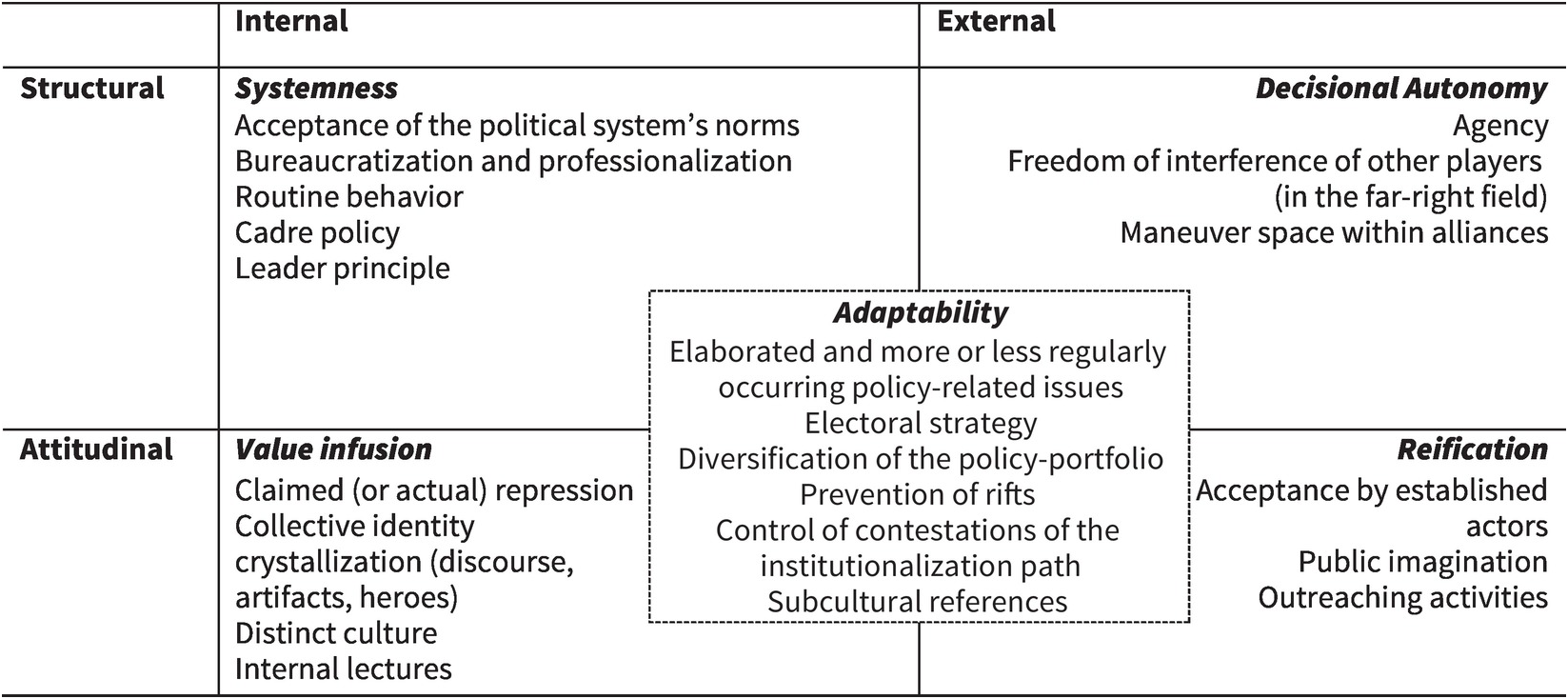
Table I captures attitudes toward political elites, state institutions, and contentious action expressed in Facebook posts and assigns them positive or negative values. The combination of these values on three axes enabled us to code a post as representing a counter-hegemony fighter’s, elite-insider’s, or radical’s mindset.Footnote 10 To tackle Hypothesis 2, we used five indicators of social movement institutionalization introduced by Abby Peterson (Reference Peterson, Bosi, Giugni and Uba2016, 318–319): (1) “systemness”: the increasing scope and regularity of the interactions, which constitute the movement structure; (2) “value infusion”: the movement’s success in creating its own distinctive culture; (3) “decisional autonomy”: freedom of interference of other players from within the field, while shaping the movement’s strategies; (4) “reification”: the extent to which the movement is established in the public imagination; and (5) “adaptability”: the capacity to control the pace and the trajectory of institutionalization. We created a set of indicators (see Table II) every time a Facebook post referred to, for instance, some “outreaching activities” (a meeting with local inhabitants or establishment of a summer camp for children) or “acceptance by established political actors” (a meeting of Azov activists with a mayor) and we coded this as a reification related “event.” We proceeded in this way with all messages in our pool in order to obtain “events” corresponding to any of the five aspects of institutionalization.
Our pool contains 1104 messages. Some were discarded as partial, unfit for coding, or repetitive. In total, we retained 846 messages. Since some of them provided both the movement entrepreneurs’ perceptions on POS and information on institutionalization, our database contains 1284 “events” in total. We did not include Biletskyi’s Facebook since the page itself holds little information suited for coding. Given his intense media presence, we decided to include him on behalf of already existing media interviews (N = 10), the content of those being processed the same way we treated Facebook data.
We recognize that in some respects, our coding procedure was an exercise in interpretation, for we had to construe Facebook messages in order to distill information on institutionalization or POS perceptions out of it. Sometimes messages like “together with local inhabitants we replanted trees devastated by a construction company” (Filimonov Facebook page) were difficult to relate to one axis; sometimes ostensibly interesting messages (“a deeper cooperation between nationalist and conservative players is desirable,” Alferov Facebook page) would not fit any of our indicators. Still, any interpretative method suffers from the described drawbacks. Moreover, in order to minimize distortion, we coded posts independently, and subsequently compared, discussed, and refined both indicators and their application for better triangulation. In a final account, we believe our approach to be objective. Finally, in order to minimize the pitfall of subjectivity, we diversified our data. In addition to our database we used interviews with rank-and-file Azov members as well as other members from the far-right gathered by the second author, and media coverage both on Azov and by Azov to improve our analysis.
Euromaidan, Loosely Coherent Elite, and Alliance Formation
Revolutions and shifts in POS are linked processes.Footnote 11 The “Euromaidan Revolution,” which started as a small-scale demonstration triggered by the unexpected refusal of President Viktor Yanukovych to sign the Association Agreement with the European Union and ended with his ouster and more than 100 protesters dead, is no exception. This chapter demonstrates how the far-right in general and Azov, in particular, used POS during the Euromaidan and afterward.
Police brutality on November 29, one week after the beginning of the protests, resulted in mass mobilization and also enabled a shift from a peaceful to a violent repertoire of contention and hence advantaged the radical right—in contrast to the majority of the protesters insisting on non-violent means (Fedorenko Reference Fedorenko2015).Footnote 12 In particular, activists began to form self-defense groups against assaults by riot police and titushkis (paid thugs). An encompassing inquiry concludes that the far-right was involved in—sometimes even orchestrated—self-defense units (Ishchenko Reference Ishchenko2018a).
Apart from this defensive role, the far-right increasingly displayed collective agency. On December 1, a group of radical protesters occupied the Kyiv City Administration and the House of Trade Union. Later that day, 200 radicals tried to seize the Presidential Administration with flares, Molotov cocktails, and stones, which was “the first conscious use of force against the law-enforcement” (Fedorenko Reference Fedorenko2015, 15; Shekhovtsov Reference Shekhovtsov2014b; Andriyevskiy Reference Andriyevskiy2017). At this point, Patriots of Ukraine, the predecessor to Azov, was lacking almost all of its leadership, so that individual rank-and-file members who took part in the revolution did so either as part of the Right Sector or in cooperation with its member organizations (Shekhovtsov Reference Shekhovtsov2014a).Footnote 13
What followed was a spiral of violence that further radicalized the protests, accompanied by “an increasing willingness among ‘ordinary citizens’ to turn to violent repertoires” (Onuch and Sasse Reference Onuch and Sasse2016, 574), the delegitimization of opposition leaders, who were intent on negotiating with the regime (EMP 2016), and an increasing rift between formal opposition and informal Maidan leaders (Onuch and Sasse Reference Onuch and Sasse2016; EMP 2016; Khmelko and Pereguda Reference Khmelko and Pereguda2014). One of the clear “losers” of this dynamic was the Freedom party. It officially condemned the radical tactical repertoire and generally abstained from direct action. Later, it was criticized for their indecisive stance.
This dynamic reached its climax between February 18–20, resulted in death of 100 protesters, and delegitimized the attempts of the opposition to come to an agreement with the regime rejected by the Maidan. Thus, the non-discriminatory repression pursued by the regime had clearly backfired (on backfire, see Francisco Reference Francisco1999; Goldstone Reference Goldstone2001, 160–162) and induced a POS opening (Kudelia Reference Kudelia2016) in the form of defections by deputies from the Party of Regions, disbanding of party structures, and abscondence.
This allowed segments of the radical part of the Maidan to come to power via the creation of an interim government that can be described as a loosely coherent winning coalition, that is an alliance of different players with different agendas, values, and interests, prone to shifts and equipped with an unclear temporal dimension. It consisted of members of the former opposition, three ministers from Freedom, and eight Ministries stuffed by the Maidan movement.
Yet, this coalition lacked legitimacy not only in the southeastern regions (Kudelia Reference Kudelia2014a), but also in the eyes of nationalists in the capital. They managed to capitalize on a political climate receptive toward the nationalist agenda, which allowed for the realignment of their past trajectory with the reinterpretation of far-right radicalism as heroism, enabling the accumulation of symbolic capital as a source of legitimacy (Likhachev Reference Likhachev2015; Likhachev Reference Likhachev2016). In this situation, the “parliament took hasty decisions to appease the most violent protesters” (Onuch and Sasse Reference Onuch and Sasse2016, 579). Among others, Oleh Lyashko, a populist politician, drafted bill 4271 on the amnesty of political prisoners which was unanimously adopted (Verkhovna Rada Reference Rada2014). As a result, 28 political prisoners were released, including Biletskiy, Mosijchuk, Mikhailenko, and others who would constitute the backbone of the genuine leadership of Azov (for details see Umland, Reference Umlandforthcoming; Ukrainska Pravda Reference Pravda2014). In doing so, the loosely coherent coalition enabled the old leadership of Patriots of Ukraine to return to politics—indicating the availability of elite allies which undid the repression of nationalists under Yanukovych and thus provided Azov with opportunities in the most profound sense.
Just as the interim government came to power, it was confronted with subversion in the southern and eastern regions by the opponents of the emerging pro-European order, taking the form of rallies, beatings of pro-Ukrainians, and seizures of administrative buildings, secretly organized, financially backed, and ideologically underpinned by the Russian political leadership. These developments reached their climax in two referendums in the Donetsk and Luhansk regions on May 11, as well as the planned annexation of the Crimean Peninsula by Russian troops.
The fact that significant parts of the regional elites remained loyal to the former authorities demonstrates the lack of elite coherence (Kudelia Reference Kudelia2014a; Kudelia Reference Kudelia2014b; Kuzio Reference Kuzio2014; Wilson Reference Wilson2016, 644–645) and had serious implications for the interim government, which was neither able to uphold the monopoly of violence nor willing to use coercive methods to regain control (Pashinskiy Reference Pashinskiy and Gladka2016; Halivaychenko Reference Halivaychenko and Kateryna2016).
Far-right actors benefited from these developments. The idea “that maybe one should consolidate those people protesting on Maidan and create military units” (Avakov Reference Avakov and Kateryna2016, 8) emerged after the annexation of Crimea. The events were unfolding at a fast pace and a sense of urgency, which left “no time for reflection or thoughtful analysis” (Avakov Reference Avakov and Kateryna2016, 9). This corresponded with the readiness of far-right activists for direct action. The power vacuum in the east gave sub-national actors an opportunity to act autonomously and to hold up to the rapid pace of change. Moreover, it demonstrated the readiness of the new elites to prolong and, subsequently, formalize the cooperation conceived during Euromaidan in a changing context (Kudelia Reference Kudelia2014c), fostering a relatively stable political alignment between political elites and non-state actors.Footnote 14 Both developments signalized about POS openings, being indicators conceptualized by Tilly (pace of change and availability of allies respectively).
Kharkiv, the third-largest Ukrainian city 20 kilometers away from the Russian border, served as a runway for Azov. There, with Biletskiy being assigned as the leader of “Right Sector East,” an umbrella sidekick designated to coordinate nationalist forces from the eastern regions (Dyachenko Reference Dyachenko2016), they took part in clashes with separatist movements in the city, and as one activist recalls, “from that moment the grouping began to operate and was already called ‘Black Corps’” (Azov Veteran & Mid Rank Party Member 2018). But even after the recapture of the Kharkiv Regional State Administration Building, the situation remained tense. Thus, Azov and state officials agreed on a soft form of vigilantism, with “a few hundred guys from Patriots of Ukraine coupled with enforcing social order in Kharkiv… in close cooperation with the MIA [Ministry of Internal Affairs] and SBU [Security Service of Ukraine]” (Herashenko Reference Herashenko2016a). Moreover, in May 2014, Azov was the only grouping which demonstrated the willingness to conduct an offensive in Mariupol, a port of 500,000 inhabitants on the Sea of Azov with significant industrial output and of geostrategic importance, occupied by separatist forces. The political leadership had to choose between “losing the city, or grant the Azov-guys legalization, approval, and weapons” (Herashenko Reference Herashenko and Kateryna2016b, 355). It opted for the latter, and the same day, up to 100 men were legalized as a Special Tasks Patrol Police Battalion under the auspices of the MIA. After one month of training, equipping, and staffing, Azov, at that moment some 150–200 people strong, managed to liberate Mariupol on June 13.
Another factor that catered to alliance formation was the acquaintanceship between Biletskiy and Avakov (Shekhovtsov Reference Shekhovtsov2014b). Avakov was the regional governor in Kharkiv between 2005–2010, and there are rumors that he and Biletskiy began to cooperate during that time in a way that Avakov used Patriots of Ukraine as “street muscles” in order to ascertain certain business interests.Footnote 15 Furthermore, Patriots of Ukraine played a role of security provider for protests organized by a political party headed by Avakov.
One can assume that Avakov counted on the loyalty of Biletskiy in order to establish institutional control over a fraction of nationalists, channeling their motivation into the intensifying war in the east. Biletskiy brokered between the nationalist movement and the political field and opted first for cooperation and then integration into state structures.
The readiness to cooperate with members of the new elite marks the strongest difference to other groups, first and foremost Right Sector, which had been deliberating about a potential integration into the Army or Security Service (Press Speaker Right Sektor 2018), but finally rejected this idea after Oleksandr Muzychko had been either killed by special security forces or committed suicide being chased by the police. As a result, any potential cooperation was obscured. Azov, however, opted for a converse path, choosing pragmatism over ideological reservations. As one veteran recalls:
There was a moment when we understood that the war was imminent and that we would need weapons. […] Andri [Biletskiy] said that it was impossible to go to the east without weapons as Right Sector did. […] If we would have had the opportunity to act autonomously under the same conditions, we would have opted for it. But we lost nothing going into the structures—on the contrary, we gained a lot (Azov Veteran & Mid Rank Party Member 2018).
Another respondent provides further insight into Azov’s motivations to institutionalize:
One year after the revolution we noticed that things went wrong… We understood that the front was in Kyiv, in the other centers as well where the old Party of Region cadres had stayed, where there were subversive Russian groups. That showed us that the front is one part of the fight—and civil life the other part (High Rank Member of Azov National Corps 2017).
It is precisely the amplification of civic activities and subsequent institutionalization referred to in the cited quotation we discuss in detail in the next section.
Findings and Discussion
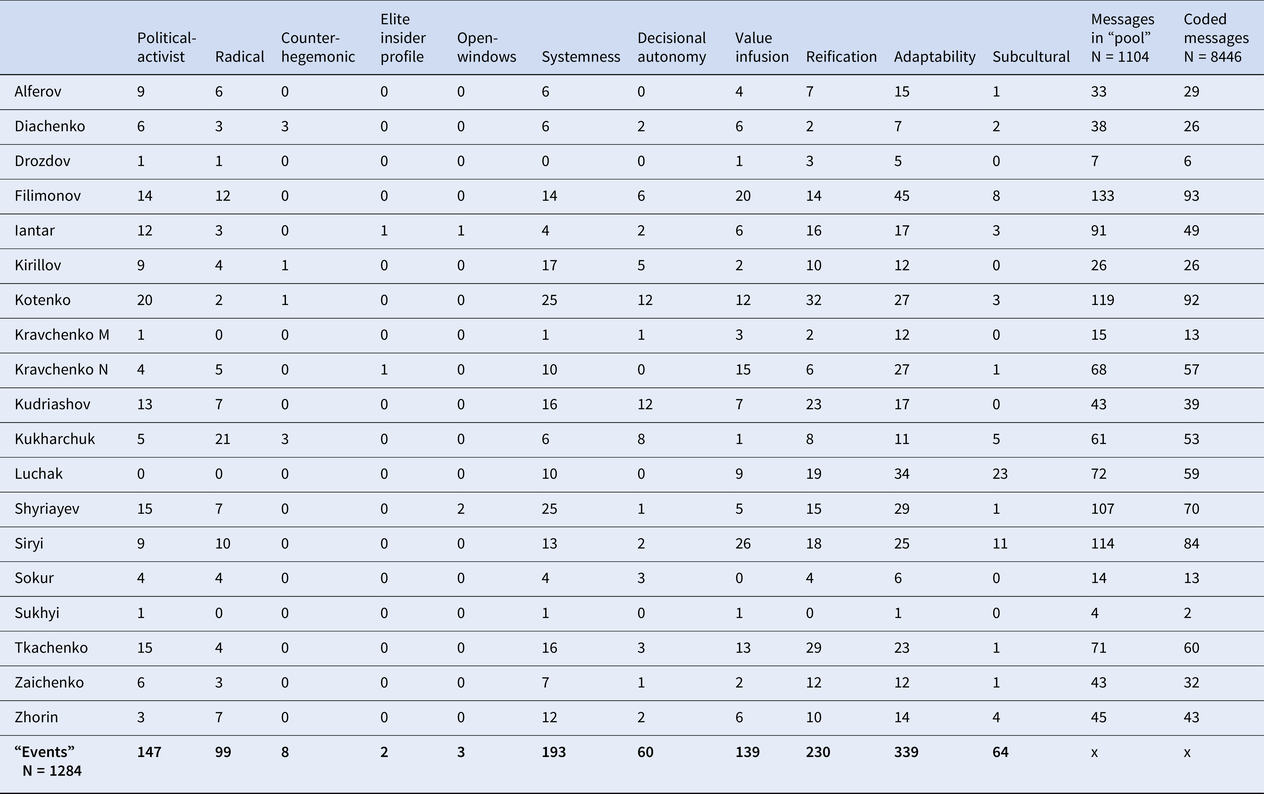
The quantitative data aggregated in Table III sheds unexpected light on the hypotheses advanced in this study. It was anticipated that most of the Azov movement entrepreneurs would be either political activists or political negotiators, since POS openings depend on a contender’s abilities to forge alliances with the ruling elites and state officials, and precisely these two types of profiles can do this most effectively. The reality, however, proved to be more complicated. Only a fraction of monitored Facebook posts showed that their authors considered the elites receptive toward Azov demands. On the contrary, both regional leaders and members of the High Council despise and distrust Ukrainian national elites.
This holds true for Biletskiy as well. He applies a balanced rhetoric congruent with a political activist profile, ostensibly “believing in street politics no less than in parliamentarian work” (Petsukh Reference Petsukh2016), and manifestly favoring direct “hands-on” action (Sheremeteva Reference Sheremeteva2017). Concurrently, his statements on elites are revealing in two regards. Firstly, he presents Azov as an “antisystemic” force (Petsukh Reference Petsukh2016; Kamenev and Andrikevich Reference Kamenev and Andrikevich2016), displaying negative attitudes against both the government and the opposition considered as two sides of the same token. This holds true for the president and his entourage (Koshkina Reference Koshkina2018). With regards to Avakov, the picture is more nuanced. Biletskiy certainly denies any of Avakov’s influence over Azov (Shcherbina Reference Shcherbina2018) and criticizes his political legacy. On the other hand, he is grateful for Avakov’s efforts to quell the separatists (Lelich Reference Lelich2016; Petsukh Reference Petsukh2016; Kamenev and Andrikevich Reference Kamenev and Andrikevich2016). Secondly, he provides details on the inaccessibility of power echelons for idealistic outsiders. Doing so not only does he demonstrate a high sensitivity toward the elite component of POS, but also uses his knowledge about the modus operandi of Ukrainian politics to depict it as corrupted with “deals between 3–4 big players deciding everything” (Petsukh Reference Petsukh2016). He admits being called to partake in voting (Petsukh Reference Petsukh2016), mostly for cash (Kamenev and Andrikevich Reference Kamenev and Andrikevich2016) and he realizes the impotence of single-member district MPs who lack party connections (Kamenev and Andrikevich Reference Kamenev and Andrikevich2016; Glukhovskiy and Gruzdiev Reference Glukhovskiy and Gruzdiev2018; Koshkina Reference Koshkina2018). Yet, Biletskiy emphasizes that he opposes such a system and uses his MP-status for the benefit of the movement. Those two rhetorical patterns clearly contribute to the image of Azov as a fresh and uncorrupted political player.
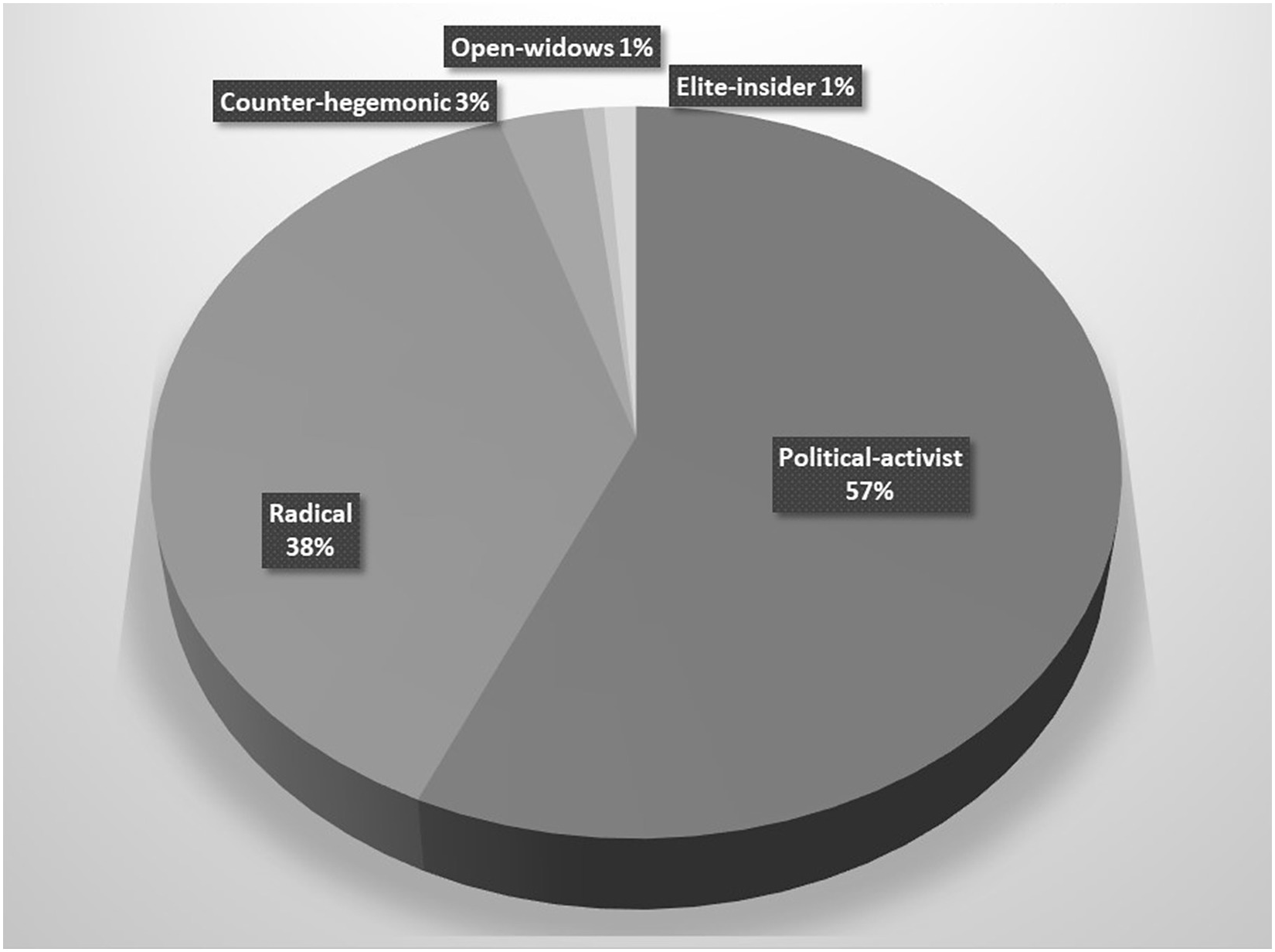
Other members of the Azov inner circle share Biletskiy’s mistrust toward elites: 40% of all posts express ideas consistent with a radical profile. Radicals neither believe in the march through the institutions nor elites’ receptiveness toward their claims, and they have faith solely in disruptive contention. However, an even higher amount of posts (see Figure 1) contain reliance on both political contention and state institutions. In other words, the data suggest that the Azov leadership predominantly fits the political activist profile; thus, Hypothesis 1 is partially corroborated. A Chi-square test was run to check the robustness of this finding. Following the prescribed procedure for the Chi-square test, we restated the Hypothesis as:
Null Hypothesis: The Azov leadership core belongs to a political activist profile no more frequently than to others.
Hypothesis 1: The Azov leadership core belongs to a political activist profile more frequently than to others.
Number of posts corresponding to profiles.

Given the unfitness of counter-hegemonic, open-windows, and elite-insiders results for the Chi-square test (occurrence must at least exceed 5), the test was run for political activist and radical profiles. With a rejection region set at 0.05 and the degree of freedom at value 1, the critical value for this test is 7.879. After having manually counted the test statistic using the standard formula X2 = Sum [(O-E)2\E], the result is: X2 = 9.36. Additionally, a Chi-square p value was counted on Excel. With the p value of 0.0022 being highly significant, it is safe to reject the Null hypothesis and claim that the Azov chiefs indeed tend to express ideas more often consistent with the political activist profile.
No quantitative data can tell what coded values actually mean. Therefore, to outline the generalized messages of the two biggest groups populating the Azov leadership, a switch to descriptive narration is necessary. A seemingly disparate radical statement may overwhelm with its versatility, for it ranges from a mild accusation that “the power-holders being deaf made nationalists act” (Alferov Facebook page) and simple conviction that “only civic pressure yields tangible results” (Zaichenko Facebook page) to calls for forceful action “because a crushed head of an ‘internationalist’ and a conquered red rag is not violence but an anti-violence vaccination” (Diachenko Facebook page) and overtly extreme chagrin caused be “ethnocrime” and “sodomites” conquering Ukrainian streets followed by promises to “rebuild our Ukrainian house ruined by hucksters” (Luchak and Siryi Facebook pages) combined with threats of “capital punishment to petty crooked politicians and officials” (Kukharchuk Facebook page). However, behind all the complexity, the radical message is quite simple: only contentious politics, direct action, and no cooperation with either politicians or officials serve the purpose.
Political activist announcements are more nuanced. Its proponents explain that “putting our best efforts to fulfill positive and unifying initiatives, we sometimes have no other option except direct action, which would make us heeded to” (Kotenko Facebook page), for “liberal claims are easily ignored, thus radical methods are occasionally required, because the current situation in Ukraine makes both strategies viable and mutually reinforcing. After all, Molotov cocktails at Maidan were more convincing than the negotiations at Mariyinsky Palace [the presidential residence], although the former could never substitute the latter” (Shyriayev Facebook page). With movement entrepreneurs acutely aware that contentious politics does not necessarily help to achieve desirable goals, the political activist message is that of cooperation with the state bureaucracy. Hence are numerous meetings with officials (Chiefs of the Civil-Military Administration, city council deputies, governors, judges) in order to “build a constructive dialogue with authorities” and to apply the “best instruments available to civil society” (Kirilov Facebook page). Political activist entrepreneurs perceive opportunities within political institutions; consequently, they avoid generalized blame of state agencies and often praise officials for provided support.
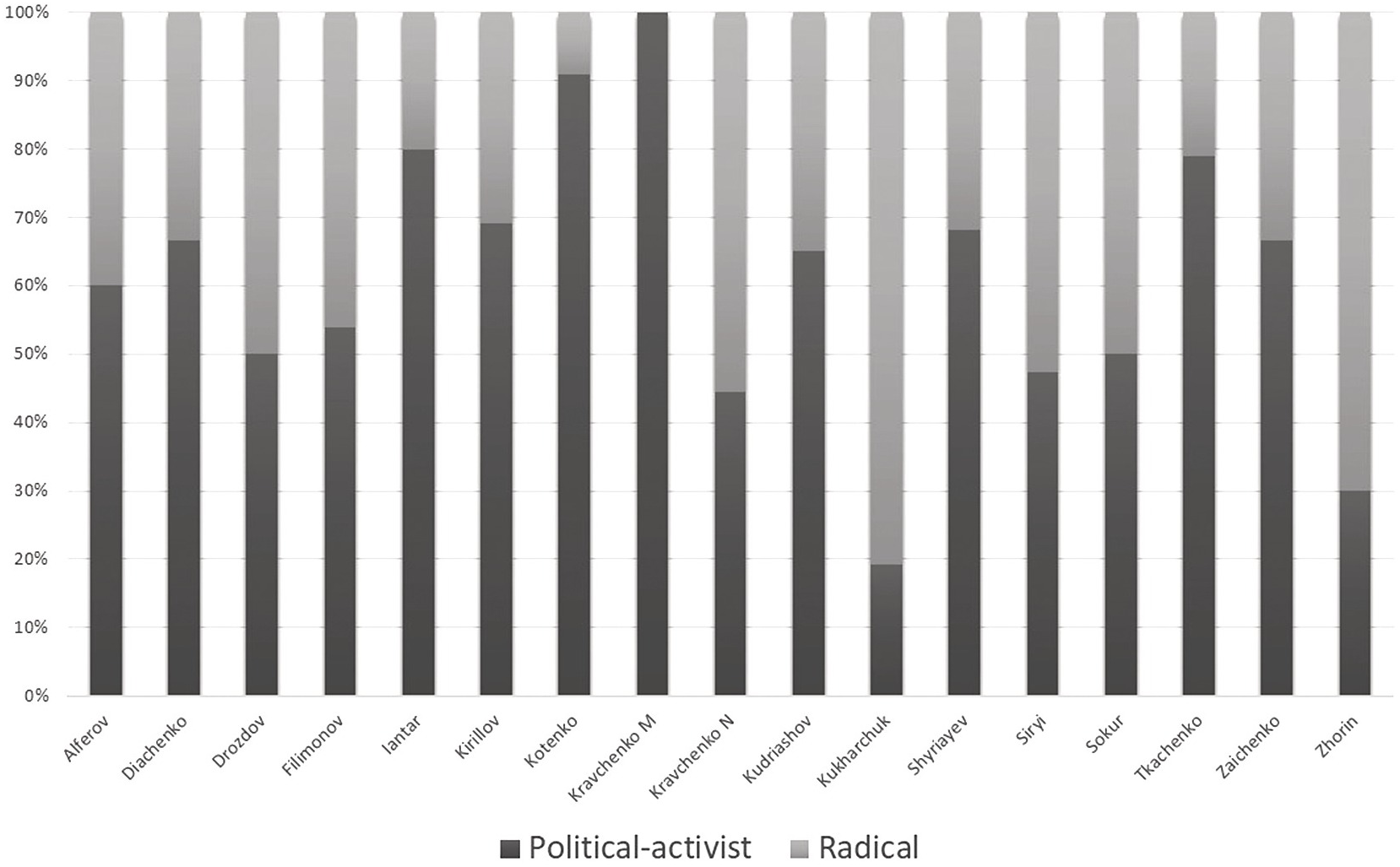
The majority of the political activist profile’s messages in our database could be deceptive. After all, those 57% might have been produced by one or two heavy users, whereas most of the Azov’s leaders may have radical perceptions. In order to control against such a possibility, we weighted the number of fits with two profiles for each individual actor (see Figure 2). The numbers suggest that although some individuals (Kukharchuk and Zhorin) clearly lean toward a radical profile, 10 belong preponderantly to the political activist profile, and five are opportunistic, that is: they express both messages given the circumstances.Footnote 16
Proportion of individual profile fits.

These statistics are instructive in two ways. Firstly, they show that within the Azov core political activists individually outnumber radicals, which further corroborates Hypothesis 1. Secondly, they reveal that belonging to either of these profiles is not preordained and most actors hold a mixture of views on the POS and effective ways to act within. In other words, Azov leaders are constantly testing whether and in which cases state officials could be allied with, correspondingly readjusting their preferences for solely contentious politics or a combination of contention and conventional action. In case a judge is likely to let out a pro-Russian separatist on an unjustified (as perceived by contenders) parole, Azov members adopt the radical stance and organize a protest. However, when a city mayor invites the Azov representatives to discuss youth policy, the same actors adopt the political activist stance and thank state officials for cooperation. The access points to the local state apparatus are, therefore, important predictors whether Azov leaders lean toward radical or political activist perceptions. Even more, it is safe to say that the type of activist is an indicator of the positionality of the activist in his local political environment. Why should someone strive for street protests, when the halls of power are open for his demands?
Hypothesis 2 needs to be restated, since no political negotiators were detected among the leadership core. In the subsequent pages, we will, therefore, test whether political activists seek to push further Azov’s institutionalization. Conversely, it is assumed that radicals have little interest and control over institutionalization.
Institutionalization was analyzed alongside five axes: systemness, value infusion, decisional autonomy, reification, and adaptability. These axes indicate whether the Azov movement develops its organizational structure, crystalizes collective identity, gains space for independent political behavior, penetrates public imagination, and is skillful enough in seizing new opportunities.
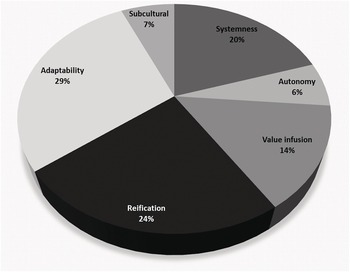
As Figure 3 illustrates, most of Azov’s institutionalization process is confined to adaptability, reification, and systemness. Indeed, 80% of all coded events relate to one of these domains. The lack of decisional autonomy came as a surprise: despite all its initiatives and occasional critical notes about other far-right organizations, Azov leaders prefer to preserve the image of a “united nationalist front” thus stressing the allied status of Freedom and Right Sector instead of a quest for autonomy. This itself is an indicator that the logic of playing on the electoral field (with a current requirement of achieving at least 5% to pass the electoral threshold) is at least as equally important as the pursuit of “brand uniqueness.”
Proportion of events in posts.

Adaptability is the most developed (or covered) axis of Azov’s institutionalization. The movement protests against illicit sand-digging in Kyiv, fights against poaching in Chernihiv, provides emergency assistance after the explosion at the ammunition depot near Cherkassy, supports animal rights activism, engages in “eco-nationalism,” fights drug distribution, has its stake in a local community building, and even grants protection to investigative journalists all over Ukraine. Furthermore, it has elaborated its own geopolitical project, “Intermarium,” a regional alliance of states between the Black Sea and the Baltics.
Most adaptability initiatives aim to transcend traditional far-right milieus and build new constituencies through service provided to victims of rule of law deficiency. Adaptability, thus, comprehends a meticulous strategy to reach out to social out-groups initially unresponsive to nationalist mobilization efforts. As such, adaptability means the minimization of what we label “subcultural references,” that is: ideas, symbols, and policies dear to hard-core nationalists but alienating to the broader public. In our database “subcultural references” take the form of lengthy quotations from programmatic texts of Ukrainian inter-war integral nationalism, Islamophobic calls to Muslim pogroms, hashtag “Hess,” jokes about “Adolf” and Romani people, etc. All “subcultural references” were coded as a separate entity (thus representing a counter-current within the adaptability domain). It amounted only to 7% of events, which reflects either marginalization or conscientious control over “subcultural references” in leaders’ Facebook profiles. Either way, this proves the strategy of reaching out to the broader public.
In this regard, Biletskiy’s media presence transmits key messages of the adaptability process toward a broader audience. That can be diverse pieces of information such as details on current numbers of followers (Sheremeteva Reference Sheremeteva2017); reassertions of the necessity to limit the movement to peaceful means to come to power (Glukhovskiy and Gruzdiev Reference Glukhovskiy and Gruzdiev2018); the provision of legitimation for street actions, since “there is almost no trust in law enforcement authorities, and there is dread on the streets: drug abuse, murder, robbery and the like” (Koshkina Reference Koshkina2018); and references to the importance of the “contemporary patriotic and nationalist subculture, which we do not intend to curtail” (Shcherbina Reference Shcherbina2018).
Moreover, a significant acceptance of electoral logic is observed. While Biletskiy insisted on a strict division of labor between the military and the political wing (Lelich Reference Lelich2016), he describes the transformation into a political party as a consequence of restraints imposed on the military field (Kamenev and Andrikevich Reference Kamenev and Andrikevich2016), that is “the stagnation on the front… making it unnecessary to be permanently present there” (Glukhovskiy and Gruzdiev Reference Glukhovskiy and Gruzdiev2018). This coincides with the rise of Biletskiy’s attendance rate of parliament sessions from a one-digit level up to 45% (Glukhovskiy and Gruzdiev Reference Glukhovskiy and Gruzdiev2018).
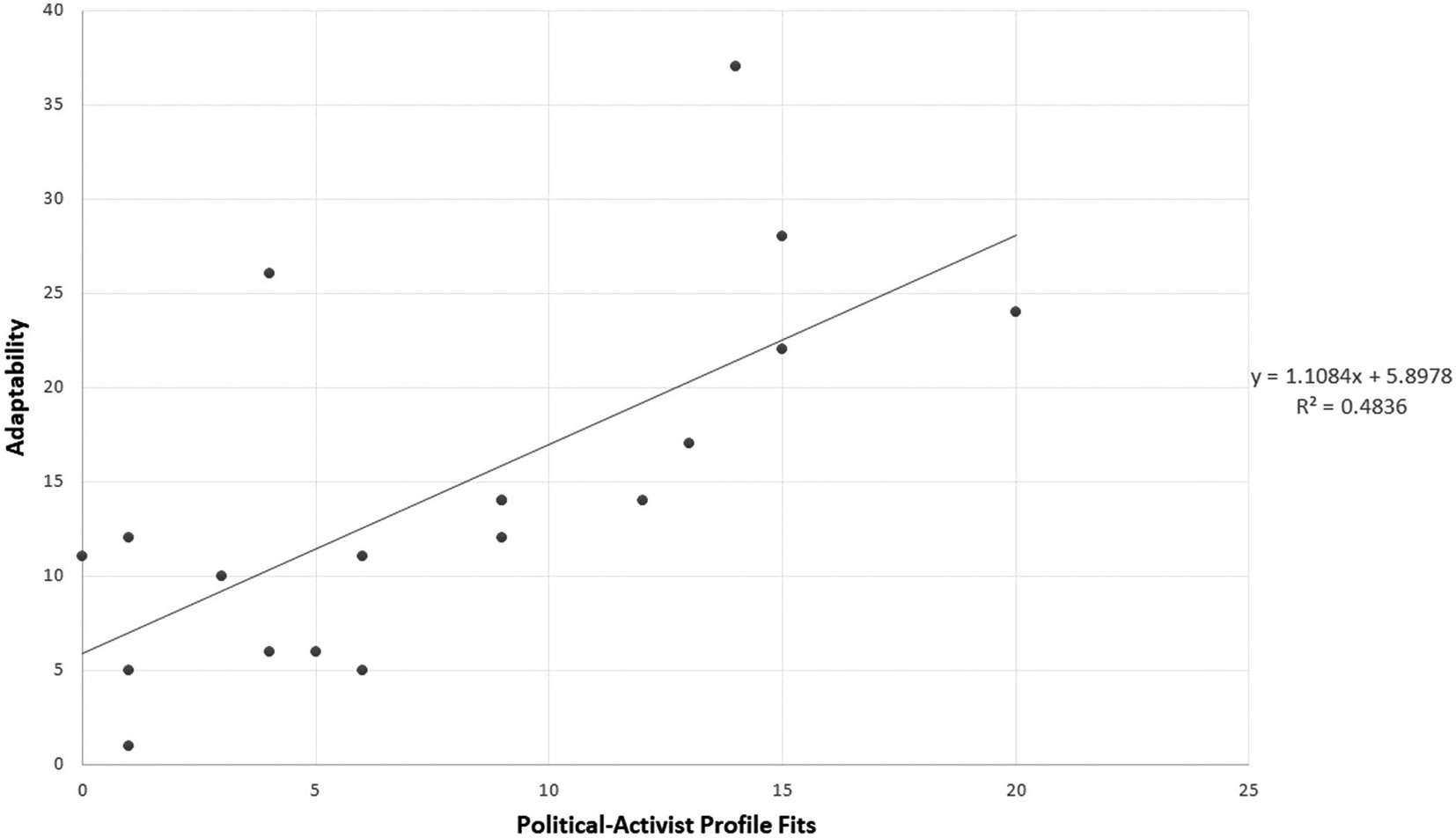
But are movement entrepreneurs gravitating toward the political activist profile indeed responsible for adaptation efforts? Counted by Excel software, the correlation between two categories is 0.498, which signals a moderate positive relationship. Moreover, when (for the logic discussed above) we subtract “subcultural references” from general adaptability, the correlation grows to 0.695. Finally, R-squared, a statistical measure of how close the data are to the fitted regression line, is 0.48 (see Figure 4). It is common practice applied in business and social sciences to consider R-square at 0.2 as a required minimum, with the 0.48 being moderate (Hair, Ringle, and Sarstedt Reference Hair, Ringle and Sarstedt2011). Certes, the Figure 4 presents some evident outliers, but the overall trend is no less undeniable: actors who prefer to combine contention with institutional venues have a greater tendency to promote adaptability in general and out-group activities in particular.
Political activism to adaptability relation.

The same is true for reification. Reification comprises two main subsets: (1) acceptance by established actors and (2) outreaching activities. Each is amply represented in our database. Nazar Kravchenko, one of Azov’s chiefs, meets the Counselor to the Minister of Healthcare and discusses healthcare reform; the Azov Zaporizhian regional branch participates in city council deliberations; Dnipro regional leader Denys Kotenko is given a special award by the city council; leaders of Odesa, Kharkiv, and Kyiv are granted numerous interviews in mainstream media. No less abundant are outreach activities: Azov members poster information on their activities at schools; they organize “Patriot Games” and summer camps for schoolchildren; they inform drivers on their rights in Dnipro; they invite inhabitants of Kyiv to attend public lectures on the history of the liberation struggle in Ukraine; they visit villages in Galicia to propagate their ideas; and several regional branches publish and distribute a free newspaper.
A statistically significant correlation is observed between the political activist profile and reification. With the value of 0.757, there is a strong positive relationship between two sets of data, which suggests that outreaching activities and the quest for acceptance by established actors occupy an important part of the political activist repertoire. The finding is especially revealing when compared to the role of the reification domain for radicals: with a statistically insignificant correlation of 0.065 it is safe to conclude that reification is virtually irrelevant for them.
This is equally true for the systemness axis. Systemness is an important component of Azov’s aims to develop professionalization of both leadership and rank-and-file members. Systemness has many aspects: Azov creates special women sections and a sergeant school for “National Guards;” it hires technical specialists (like cameramen or cooks); it holds special courses on party building and advocacy campaigns for its members; it conducts regular organizational meetings and sends its emissaries to establish networks of local party cells all over the countryside. Overall, the organization has clearly developed a bureaucratic approach to administration.
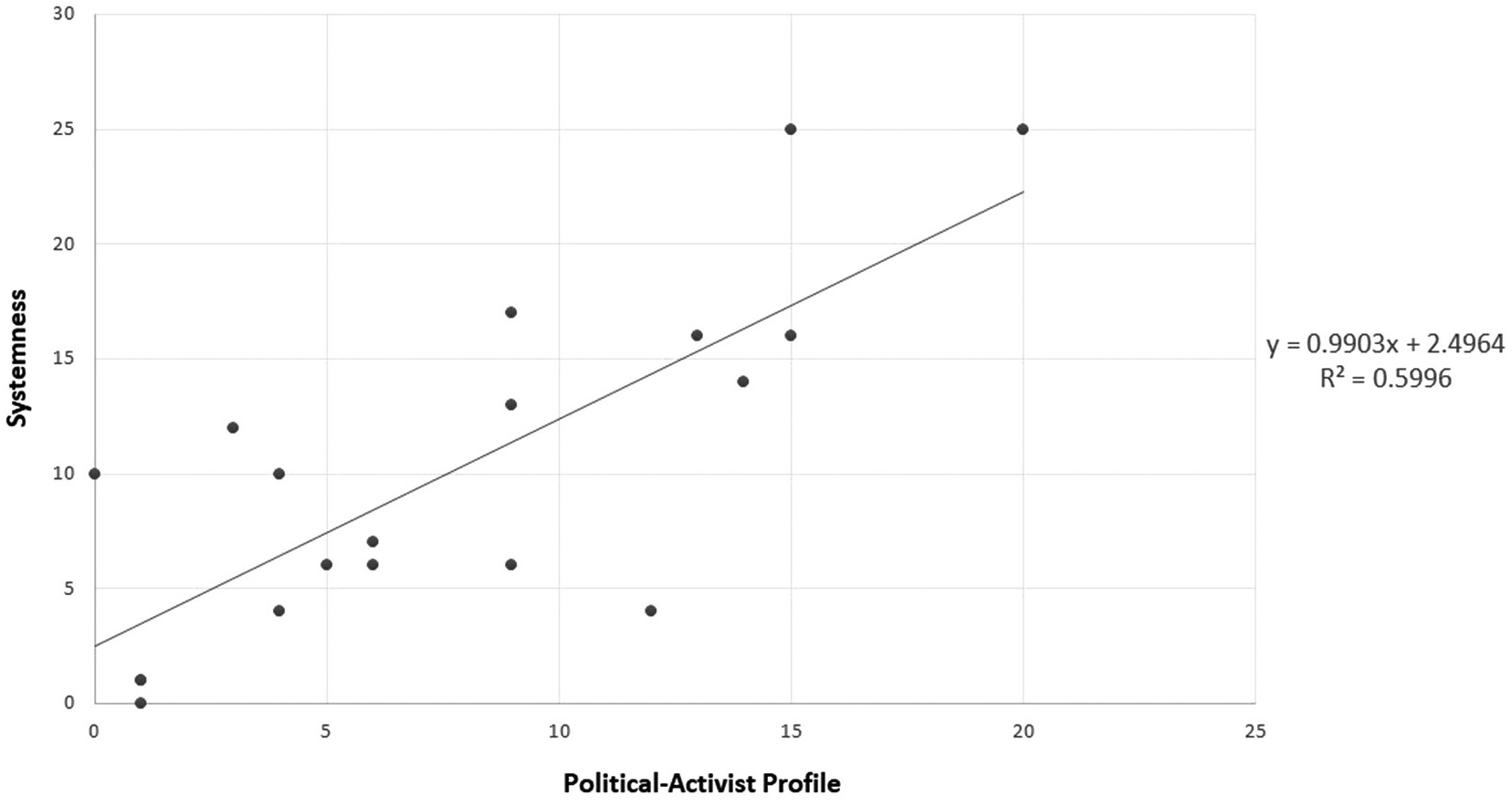
With the correlation between the political activist profile and systemness of 0.774 and an R-squared of 0.59 (see Figure 5), a strong positive linear relationship suggests that the political activist movement entrepreneurs pursue bureaucratization and professionalization, practice routine behavior, and develop a cadre policy. Once again, the correlation between the radical profile and systemness is 0.184, thus with no linear relationship.
Political activism to systemness relation.

The statistical data require further discussion: what do radical movement entrepreneurs do in Azov, if they care little about systemness, reification, and adaptability? Our best answer is: something else rather than conceive and control institutionalization. One must bear in mind that institutionalization means engaging in conventional politics, strengthening ties with political institutions, and currying favors for the popular base in exchange for electoral support. None of this makes sense for radicals who perceive both elites and state institutions as closed components of POS and who have confidence solely in political contention perfectly achievable through mobilization often of a smaller group of ideologically devoted partisans.
This line of thought, however, does not imply that radical movement entrepreneurs are inconsequential elements of the Azov movement. To begin with, they might not seek control over institutionalization but once it occurs, they jump on the bandwagon bringing resources, expertise in political contention, and moral support. After all, political activist entrepreneurs do not eschew street politics, they simply combine it with other means. Thus, in most instances, they will welcome their old pals to join.
Secondly, radical entrepreneurs might be responsible for something left undetected by our data-gathering methodology. We worked with information publicly disclosed by the actors who seek to appear less extreme and more acceptable to the public. The use of social media to communicate and to propagate one’s ideas is itself a viable indicator of moderation. It is, however, not inconceivable that given the well-established tradition of the Ukrainian far-right for secrecy some truly extreme ideas (political violence, racial persecutions, gay-bashing) are discussed in narrow circles outside of public attention. In other words, in the case of Azov, radical entrepreneurs might be the guardians of the extremist spirit who pass the “true” idea of the movement only to initiated and trusted members. Our database contains some circumstantial evidence: there is a moderate positive relationship (with the correlation value of 0.447) between “subcultural references” advanced by actors and value infusion events they post about. Since value infusion comprehends a set of techniques aiming to shape and amplify movement culture and collective identity—with special references to movement artifacts and heroes, with internal lectures and, possibly, sessions of ideological indoctrination—one might assume that “subcultural warriors” uninterested in institutionalization, but reluctant to abandon Azov might apply their expertise and their zeal in this domain. A prominent example is Ihor Luchak’s Facebook page replete with anti-liberal and xenophobic posts. His radical leaning is congruent with both the abundance of information on value infusion events and subcultural references.
Finally, movement entrepreneurs with radical profiles may be responsible for the current impression that Azov is the most noticeable far-right movement in Ukraine. It is worth stressing that Azov’s electoral prospects are rather poor: only 0.5 percent of voters are ready to support the party at the ballot (Ilko Kucheriv Democratic Initiatives Foundation 2018) thus trailing behind both Freedom and Right Sector. However, media coverage and public perception sees Azov as a vigorous, well-organized, and influential movement. Paradoxically, the ostensibly conflicting data (real electoral preferences versus alleged impact upon politics) might be correct overall. Azov’s main asset might be not its party structure but rather the broader network of highly mobilizable sympathizers able to put state officials under duress and extort desirable changes. This is precisely what intense policy demanders do. And their prime feature is that they are animated by a set of salient demands. To rekindle the fire of such demands through spectacular contentious performances—this is exactly what radical entrepreneurs contribute to the Azov movement.
Conclusions
The aim of this study was to understand the evolution currently happening to one of the most active far-right organizations in Ukraine. We demonstrated how Azov made use of POS openings during the revolution and the beginning of the war and performed in this regard better than other far-right organizations. At the same time, these developments set the stage for the institutionalization process that Azov is currently going through, a process largely enabled by the predominance of movement entrepreneurs with a particular perception of POS. Our original Hypothesis 1 stated that two specific profiles, political negotiator and political activist, dominate the leadership core. This prediction was only partially validated. Being relatively novice political actors and partly veterans who came from the trenches of the Donbas War, Azov leaders are not (yet) well connected within the broad political mainstream, and have—with the exception of Avakov—few acquaintances in the elite circles, and are eager to publicly water down those relations in order to present themselves as an uncorrupted alternative to the current political leadership. As a result, the Azov leadership is (at least rhetorically) mistrustful of elites and thus rarely perceives positive openings along the elite axis.
This precludes the presence of the political negotiator profile. However, the very same novelty compels Azov to improvise and innovate. The success of innovations often hinges on cooperative or at least nondeterrent behavior by the local administration and state officials. Hence, the reconciliatory stance adopted by Azov toward state institutions. Given that some of Azov’s initiatives (law and order, war on drugs) are congruent with officials’ prime tasks, they tend to accept such enterprises benevolently and thus push forward the recognition of Azov, which increasingly becomes a legitimate actor within mainstream politics. The same is true for good contacts to the media sphere, providing ample space for self-representation.
Concurrently, born out of street politics the Azov movement retained much dynamism and appraisal of political contention. This feature reinforces both the obvious leaning toward POS perceptions proper to a radical profile and those proper to a political activist profile, because in case of diminished state-capacity, especially evident within the regional POS, movement entrepreneurs perceive state bureaucracy (like city councils, local courts, etc.) as “pliable,” thus open, and intensify claiming to and pressing state officials through mass rallies or direct action in front of state institutions.
This study also reveals the importance of subnational POSs: For different regional leaders of Azov, different institutional venues are open. Some cooperate with local police, others cooperate with governors, yet others have no such venues and practice predominantly contentious politics. This favors coexistence and successful cooperation of two entrepreneurial types (the above-mentioned radical and political activist) which facilitated Azov’s development into significant intense policy demanders. Moreover, individually each member of the leadership core demonstrates features of both political activist and radical types, and such opportunistic behavior further corroborates the role of subnational POS.
Correlations reveal neither nature nor direction of causality. Our data just indicate the co-occurrence of entrepreneurial type and institutionalization. We suggest that political activist entrepreneurs deem cooperation with the state apparatus possible. However, it is equally conceivable that Azov members adopt political activist rhetoric because of preexisting political ties with mainstream politicians and state officials. Although our data provide no means either to confirm or to reject this inverse causal interpretation, we find it unlikely because of circumstantial evidence. To begin with, Azov leaders (Biletsky apart) have only recently advanced to the political stage, thus it is doubtful that they had attracted any attention from powerholders before they managed to rise to prominence through the Azov organizational structure.Footnote 17 Next, the idea that Azov movement entrepreneurs present themselves as political activist types due to covered cooperation with the establishment grants the Azov leaders extraordinary cunning and resourcefulness: they not only manage to hide it from the prying eyes of the media but also meticulously eradicate any political negotiator positions it would produce. At the same time this raises the question of why they fail to purge radical entrepreneurs. Lastly, and most importantly, the thrust of inverse causal interpretation is rather irrelevant to the general argument of the paper. Even if Azov movement entrepreneurs simply present themselves as political activist types, this stance facilitates movement institutionalization as development alongside the axes of systemness, value infusion, decisional autonomy, reification, and adaptability.
Our study of the Azov case also corroborates the recent trend in contentious politics studies, namely the rejection of a strict division between conventional and contentious politics. Being a radical social movement, Azov is likely to have used the benefits of penetration into institutional politics to further develop its organizational structure and reinvigorate both its media outreach and mobilizational potential. In that, it seems that it follows the trajectory of many far-right movements cum-parties in Western Europe (e.g., Alternative für Deutschland or Movimento 5 Stelle) and their “surprising” successes. In doing so, our case confirms the necessity to shift the focus to more subtle political processes under the radar of formal electoral politics. Nevertheless, a final note on caution does not hurt: the limitations of a single case study must not be ignored. Further comparative research is welcome. This would enhance a relational understanding of success within the far-right political field, be it within Ukraine or cross-nationally, and corroborate or reject conclusions about Azov as a somehow distinctive actor.
Disclosure.
Authors have nothing to disclose.
Appendices
Perception Profiles. Movement entrepreneurs’ types in italics are those which were expected to populate Azov based on our initial hypotheses. Bold are types proved to be empirically predominant.

Institutionalization axes and indicators.

Aggregated data.