1. Introduction
Air pollution can have serious health consequences. Case studies in Beijing have revealed that air pollution is linked with an increase in the mortality rate (Gao, Reference Gao1993; Xu et al., Reference Xu, Gao, Dockey and Chen1994; Chang et al., Reference Chang, Pan, Xie and Gao2003), an increase in visits to physicians (Xu et al., Reference Xu, Dockery, Christiani, Li and Huang1995), and low birth weight (Wang et al., Reference Wang, Ding, Ryan and Xu1997). Hammitt and Zhou (Reference Hammitt and Zhou2006) find that residents in Beijing are willing to pay premiums to prevent the adverse health effects related to air pollution, such as colds, chronic bronchitis, and fatalities, even though the willingness to pay (WTP) values are low. The Chinese government initiated a very large environmental improvement project in 2000 – the Dust Storm Sources Control Project (DSCP), planting trees in Beijing and neighboring provinces to prevent dust storms and ease other sources of pollution – but pollution is still very serious. Blue skies in Beijing are a rarity, mainly due to rapid growth in the city's population, large-scale expansion of manufacturing and construction industries, and a large increase in the number of automobiles (Fu et al., Reference Fu, Hao, He, He and Li2001; He et al., Reference He, Huo and Zhang2002; Benjamin et al., Reference Benjamin, Hélène, Jean, Yu, Wang and Yu2007).
There are two main methods to measure the economic value of air quality. Based on revealed preference methods, one uses hedonic techniques to estimate impacts of pollution on health, housing, or other asset prices. Applications of this method include Anderson and Crocker (Reference Anderson and Crocker1971) for the United States and Dasgupta et al. (Reference Dasgupta, Lucas and Wheeler2002) for Mexico and Brazil. Smith and Huang (Reference Smith and Huang1995) use a meta-analysis to comprehensively study the economic impacts of air quality from hedonic techniques. The other is the contingent valuation method (CVM), based on stated preference techniques. Current research on the valuation of air quality using CVM includes Canada (Leger, Reference Leger2001), Bulgaria (Wang and Whittington, Reference Wang and Whittington2000), India (Kumar and Rao, Reference Kumar and Rao2006), South Korea (Kwak et al., Reference Kwak, Yoo and Kim2001), Taiwan (Alberini, Reference Alberini1997), and Germany and France (Rozan, Reference Rozan2004). A comprehensive review of revealed preference and stated preference methods can be found in Bockstael and Freeman (Reference Bockstael, Freeman, Maler and Vincent2005). A recent review of CVM, including theory and applications, can be found in Carson and Hanemann (Reference Carson, Hanemann, Maler and Vincent2005). Cognitive psychology, such as decision theory, is trying to fill the gap between revealed preferences and stated preferences (Fischhoff, Reference Fischhoff, Maler and Vincent2005).
The CVM has been widely used for assessing the benefits of public and nonmarket goods and usually includes the continuous method and the discrete method (Ready et al., Reference Ready, Buzby and Hu1996). The continuous method includes the open-ended bidding approach and the payment card approach. The discrete method is also called dichotomous format and includes single-bounded and double-bounded formats. Ready et al. (Reference Ready, Buzby and Hu1996) point out that a continuous format generates a lower estimated WTP than a dichotomous choice (DC) format due to more yes-saying among DC respondents and more protest zeros in DC respondents when bid values are very high. They design a conservative survey approach using discrete methods in which all items and unit nonrespondents are assigned a response of ‘No’ to avoid such protest zeros.
Following the seminal work of Hanemann (Reference Hanemann1984) and Hanemann et al. (Reference Hanemann, Loomis and Kanninen1991), most practitioners including an NOAA expert panel (Arrow et al., Reference Arrow, Solow, Portney, Leamer, Radner and Schuman1993) prefer the discrete method to the continuous method. A difficult problem for the continuous method is that the data may have a peculiar distribution with a large number of zero and missing responses, which impede the use of continuous methods in nonmarket goods evaluation. Some research only uses the positive observations (Rozan, Reference Rozan2004), while other research takes the logarithm of the positive observations after dropping the zero responses or adding a very small number to the zeros, which are then included in the regressions in order to prevent negative predicted WTPs (Bateman et al., Reference Bateman, Langford, Turner, Willis and Garrod1995). Some research assumes that the true distribution of WTP bidding is censored at zero, and hence, Tobit regression is used (Halstead et al., Reference Halstead, Lindsay and Brown1991). Other methods for dealing with zero responses include the Spike Model (Kriström, Reference Kriström1997; Reiser and Shechter, Reference Reiser and Shechter1999), symmetrically-trimmed least squares estimation (Kwak et al., Reference Kwak, Lee and Russell1997), and least absolute deviations estimation (Yoo et al., Reference Yoo, Kwak and Kim2000).
However, the literature is not always clear on the causes of zero responses,Footnote 1 which can represent two different scenarios: protest zeros and true zeros. Protest zeros are generated when respondents do not accept some aspect of the hypothetical scenario described in the survey (Ready et al., Reference Ready, Buzby and Hu1996). Respondents give zero WTPs but their marginal utility of environment quality might not be zero, perhaps because they think other agents such as the government or polluters, rather than themselves, should pay for improvements in environmental quality, or they feel the survey is a waste of time. Valid zeros are those who actually have a zero marginal utility of environmental quality.
Besides zero responses, there are missing responses, where respondents do not answer due to a lack of knowledge or the perceived complexity of the open-ended question. For instance, some respondents may only have limited information about their own WTPs. They may know that they have a positive WTP but cannot give a specific number. Such missing respondents, viewed as incomplete observations, are often dropped in the literature. However, this may cause sample selection bias because they are not missing at random.
Zero and missing observations are a very common phenomenon in demand analysis. Cragg (Reference Cragg1971) suggested a double-hurdle model in which consumption behavior consists of two decisions: a participation decision, which is a binary choice probit model; and a consumption decision, which is a standard Tobit model. The two equations are assumed to be independent. Cragg's model was used by Goodwin et al. (Reference Goodwin, Offenbach, Cable and Cook1993) in an analysis of open-ended WTP. However, the assumption of independence between the two decisions causes the same problem as the standard Tobit model, in that latent variables representing cases of zero responses might be greater than zero.
In contrast to Cragg's model, Jones (Reference Jones1989) argues that the participation decision may dominate the consumption decision in a study of cigarette consumption in the United Kingdom. For example, only after a person decides to participate in smoking will a positive consumption of cigarettes be observed. Hence, only positive observations are included in the consumption equation. The model of Jones (Reference Jones1989) can avoid the problem of the standard Tobit model where the latent values of the zero responses might be greater than zero. The double-hurdle model has been applied in open-ended CVM analyses, such as Alvarez-Farizo et al. (Reference Alvarez-Farizo, Hanley, Wright and Macmillan1999); Martinez-Espineira (Reference Martinez-Espineira2006); and Hammitt and Zhou (Reference Hammitt and Zhou2006). However, the current literature does not pay much attention to the difference between protest zeros and valid zeros, or missing respondents. Following the logic of double-hurdle model, we can incorporate zero respondents and missing respondents into the decision procedure for open-ended bids.
The consistency between CVM estimates and actual behavior is a critical challenge for CVM in policy making (Carson and Hanemann, Reference Carson, Hanemann, Maler and Vincent2005). Fischhoff (Reference Fischhoff, Maler and Vincent2005) has a good review of the literature on efforts to apply cognitive psychology to CVM. He points out that there are two lines of research in this field: behavioral decision making and decision analysis. Research on behavioral decision making directly tests people's adherence to the axioms of choice in economics, characterizes the cognitive skills that facilitate (and constrain) rationality, and attempts to identify behaviorally realistic approaches to decision making. Decision analysis tries to elicit individuals’ probabilities and utilities associated with possible consequences of their actions.
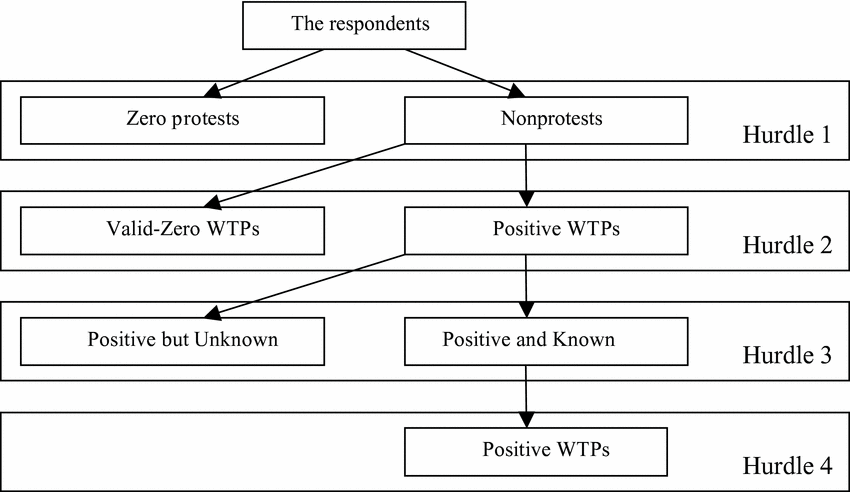
Facing a complicated problem, people usually make decisions sequentially, and the theory of sequential decision making has been widely used in computer science to model human behavior (Littleman, Reference Littleman1996). Based on decision theory, we propose a sequential decision model to incorporate zero and missing response into open-ended CVM and assume that there are four steps required to reach a positive and specific WTP for a respondent in a survey. The four steps are as follows: (1) whether or not to make a zero-protest bid; (2) whether or not to make a bid that constitutes a valid zero; (3) in cases where the respondent has a positive WTP, whether the respondent can indicate a specific number for WTP; and (4) the willingness-to-pay decision in cases where WTP is positive and known. We also assume each step is conditional on the last step. We believe that this order of decision making is reasonable. This four-hurdle model is used to analyze the willingness to pay for air quality in Beijing city with open-ended bidding.
2. Willingness to pay and utility
Alberini (Reference Alberini1997) derived WTP based on the expenditure function, but it is very difficult to employ this technique in empirical studies because utility levels are unknown. We can derive willingness to pay from the indirect utility function.
Suppose the indirect utility function for a respondent is V(p, q*, m), given income m, environmental quality q* and an exogenous price vector p. If she decides not to protest and participate in bidding, and she is willing to pay some money t (t ≥ 0) for improving environmental quality by e, the indirect utility function becomes V(p, q* + e, m − t). Under the market equilibrium, we have

Suppose environment improvement and income change are very small, and we can take the first-order approximation of V(p, q* + e, m − t),

Combining equations (1) and (2), we have

Equation (3) indicates that WTP may be zero for some person when her marginal utility of environmental quality ∂V(p, q*, m)/∂q* is zero, or when the marginal utility of money ∂V(p, q*, m)/∂m tends to infinity. We can give the following proposition.
Proposition 1: Those who have a zero marginal utility of environmental quality implying that they do not care about environmental quality, or those who have very large marginal utility of money implying that they are relatively very poor, would bid a zero WTP, which are valid zeros.
We can take the logarithm of both sides of equation (3) for all positive WTPs:

Furthermore, suppose the indirect utility function V(p, q*, m) has a constant-elasticity-of-substitution (CES) form, that is,

where ρ is a constant. Substituting equation (5) into equation (4), we have the following equation for the observed WTP that can be estimated:

Suppose current environmental quality q*and the anticipated improvement in environmental quality e are both given. Let α* ≡ (ρ − 1)ln q* + ln e, with α* then being a constant. Rewriting equation (6), we have the econometric model, which can estimate the relationship between WTP and income:

where β* = 1 − ρ. In the CES function, the elasticity of substitution between environmental quality and money is σ = 1 / 1 − ρ, so that we can calculate the substitution elasticity σ = 1 / β* from equation (7).
Proposition 2: If the utility function for the consumer is of the CES form, the income (expenditure) elasticity of WTP is the inverse of the substitution elasticity between environmental quality and money.
Surprisingly, the elasticity of WTP with respect to expenditure (income) has not been estimated often in the literature, except for a study for Bulgaria by Wang and Whittington (Reference Wang and Whittington2000), in which the estimated income elasticity of WTP for air quality is 0.27. This implies an elasticity of substitution between environmental quality and money of 1/0.27 ≈ 3.7.
3. Econometric model
When using equation (7) in practice, it would be difficult to incorporate zero and missing responses. Hammitt and Zhou (Reference Hammitt and Zhou2006) decompose the WTP into two parts in which the first part predicts whether an individual has a nonzero WTP and the second part predicts its magnitude, conditional on being positive. However, they did not incorporate protest zeros and missing responses into their study. If these observations are not randomly missing in the sample, the predicted values of WTP could be biased.
Fischhoff (Reference Fischhoff, Maler and Vincent2005) indicates that elicitation is a reactive measurement procedure. Facing complicated questions, people usually make decisions sequentially. Facing a question about WTP with open-ended bidding, a respondent can be assumed to make decisions sequentially, and the decisions can be sequentially disaggregated into four steps. (1) The first step is to decide whether or not to protest. If she decides to protest, her answer is not the true value. And only if she decides not to protest can we obtain the true value of WTP. (2) If the respondent does not protest, the second decision would be whether her WTP is zero or positive. (3) If WTP is positive, she will make the third decision, which is whether she can give a specific value for WTP. (4) Only if she can give a specific value can we reach the final step, where she states the value of her positive WTP. The decision-making process is shown in figure 1.
Four-hurdle model of WTP

Following this decision-making theory, a four-hurdle econometric model involving socioeconomic and demographic variables can be developed.
3.1 Zero-protest equation

where W 1i = x 1iβ1 + v 1i is a random utility function, determining the choice of zero-protesting behavior for respondent i. x 1i is a vector of observed independent variables and β1 is a vector of corresponding coefficients. v 1i is an error term with a standard normal distribution N(0, 1). When W 1i > 0, h 1i = 1, indicating that the respondent decides not to protest and participates in the bidding; otherwise she has a protest zero.
3.2 Valid zero-bidding equation

where W 2i = x 2iβ2 + v 2i is a random utility function determining the choice of valid zero-bidding behavior for respondent i conditional on h 1i = 1, which indicates that all the respondents facing the second hurdle should pass the first hurdle. x 2i is a vector of observed independent variables and β2 is a vector of corresponding coefficients. v 2i is an error term with a standard normal distribution N(0, 1). When W 2i > 0, h 2i = 1, indicating that the WTP for the respondent is positive; otherwise, her WTP is a valid zero.
3.3 Positive but unknown WTP

where W 3 = x 3iβ3 + v 3i is a random utility function determining if respondent i can give a specific WTP after she passes the second hurdle and knows she has a positive WTP. x 3i is a vector of observed independent variables and β3 is a vector of corresponding coefficients. v 3i is an error term with a standard normal distribution N(0, 1). When W 3 > 0, h 3i = 1, indicating that the respondent can give a specific figure for her WTP. Otherwise, she only has limited information about her WTP; she knows that her WTP is greater than zero but cannot give a specific number.
3.4 Willingness-to-pay equation

where zi is a vector of demographic variables except for income or expenditure. Equation (11) determines the WTP for respondent i who can give a specific positive number for her WTP. v 4i is an error term with a distribution N(0, σ2).
Equations (8)–(11) constitute a very complicated system that combines sequential binary choices and sample selectivity. If there are no restrictions on the coefficients or error terms, the model cannot be identified (Jones, Reference Jones1989; Waelbroeck, Reference Waelbroeck2005).
We assume this model is a Markov decision process (Littleman, Reference Littleman1996), so that vki is only correlated with the error v k − 1,i in the previous hurdle, k = 2, 3, 4, but not others. That is, v 4i is only correlated with v 3i; v 3i is only correlated with v 2i; and v 2i is only correlated with v 1i. Such an assumption implies that each hurdle is only conditional on the last hurdle, but cannot be affected by the next hurdle. This assumption seems to be a reasonable way of identifying the model.
With this assumption, the four-hurdle model reduces to three sample selection problems: two probit models with sample selection, which are equations (8) and (9), and equations (9) and (10), and one ordinary linear equation subject to sample selection, which are equations (10) and (11).
3.5 Probit models with sample selection
Probit models with sample selection have been used in the study of the choice of deductibles in insurance (van de Ven and van Praag, Reference Van de Ven and van Praag1981), loan defaults (Boyes et al., Reference Boyes, Hoffman and Low1989; Greene, Reference Greene1992), health status selection and health behavior (McQuestion, Reference McQuestion2000), and consumer adoption of computer banking technology (Lee et al., Reference Lee, Lee and Eastwood2003). Except for van de Ven and van Praag (Reference Van de Ven and van Praag1981), who used the Heckman two step estimation procedure, all models were estimated by maximum likelihood methods because they are more efficient (Greene, Reference Greene, Mills and Patterson2009). However, using maximum likelihood method may give two estimators for hurdles 2 and 3, because maximum likelihood methods fit each hurdle with both the previous hurdle and the next hurdle, which violates our assumption that each hurdle is conditional only on the last hurdle.
Following van de Ven and van Praag (Reference Van de Ven and van Praag1981), we suggest a recursive method to estimate the system of equations. After estimating equation (8) by ordinary maximum likelihood methods, we have

Assuming that the correlation coefficient between v 1i and v 2i is ρ12, we have

where λ1i = φ (− x 1i β1)/β1) Φ(x 1i β1), and φ(*) and Φ(*) are the standard normal pdf and cdf, respectively. By Heckman (Reference Heckman1979),

where

with

Let  2i = 2i/τ1i. If both sides of equation (13) are divided by τ1i, for τ1i > 0, equation (13) becomes

with 2i) = 0 and E(2i2|h 1i = 1) = 1.
We can replace λ1i and τ1i with consistent estimates  1i and
 1i. 1i and 1i can be estimated based on the probit model of equation (8) and a consistent ordinary least squares (OLS) estimate
 12 from the linear probability function for equation (13), because the OLS estimate of the linear probability function is consistent. However, the disadvantages of OLS are (1) the predicted probabilities may fall out of the interval [0, 1] and (2) inefficiency due to heteroscedasticity van de Ven and van Praag (Reference Van de Ven and van Praag1981). Also, a robust estimator
 12 can be obtained by iteratively substituting the consistent estimator 12 in equation (14) until it converges to 12.
In equation (15), we can test ρ12 = 0 by looking at the t-ratio. If ρ12 = 0 cannot be rejected, which indicates the hypothesis of noncorrelation between the error terms in the two equations cannot be rejected, we can estimate both equations independently, which can yield computational advantages.
We can repeat the above procedure to consistently estimate equation (10), following the estimation of equation (9). However, note that equation (11) is a linear equation, so that we can use the usual two-step procedure suggested by Heckman (Reference Heckman1979), after estimating equation (10).
4. Calculation of willingness to pay
If the hypothesis of independence between v 4i and v 3i cannot be rejected, we can simply drop the samples of positive but unknown WTPs to estimate WTP, because positive but unknown WTPs can be viewed as randomly drawn from the same distribution as the positive WTPs. However, if we reject the hypothesis of independence between v 4i and v 3i, those positive but unknown WTPs cannot be ignored in estimating WTP; otherwise, sample selection bias will occur. When the independence between v 4i and v 3i can be rejected, we propose an approach to calculate the mean and the median of the WTPs as follows.
Following Heckman (Reference Heckman1979), the expected value of WTP given sample selection can be written as

where λ3i = φ(x 3i β3)/Φ(x 3i β3) and η = ρ34σ, and ρ34 is the correlation coefficient between v 3i and v 4i.
After estimating equations (10) and (11) by the Heckman two-step procedure, we obtain the estimators  *,
 *,
 , and
 for α*, β*, γ, η as well as
 i by equation (10). We can then calculate the expected value of the dependent variable ln ti in cases where that value is expected to be unobserved, E(ln ti |h 3i = 0), conditional on the dependent variable being observed by equation (16). In this way, we can derive predicted values for all positive WTPs, whether observed or unobserved:

where  i is the predicted value of every positive WTP.
Note that the predicted values for valid zero WTPs for the four-hurdle model are still zeros, which is different from the Tobit model. The expected values of latent variables for valid zero WTPs in the Tobit model may be greater than zero. As a result, the mean and the median of the predicted WTPs for the Tobit model will in general be greater than those in the four-hurdle model.
It is possible that some respondents with valid zero WTPs may have small positive WTPs very close to zero, but they round off their answer to zero. If the real censoring threshold is not zero, the standard Tobit model is not consistent, while the Heckman two-step regression is still consistent (Carson, Reference Carson1988; Carson and Sun, Reference Carson and Sun2007). In this study, the smallest positive WTP for blue skies in Beijing is 10 yuan.
5. Data and estimation results
The survey on willingness to pay for improving air quality in Beijing was conducted in March 2006 by students in the School of Agricultural Economics and Rural Development at Renmin University of China, for assessing the environmental benefits of the Duststorm Sources Control Project. They randomly selected 3200 telephone numbers in Beijing. In order to obtain a high response rate, they called in the evenings and on weekends. Except for invalid phone numbers (nonresident numbers and unanswered calls), they obtained 464 numbers for residents, of whom 404 answered the survey. All respondents had to be older than 18 years old, and had to have lived in Beijing for at least 3 years. The latter requirement was imposed in order to ensure familiarity on the part of the respondents with dust storms in Beijing. Note that the telephone survey may miss some residents without telephones, most of whom are probably poor. This could bias the results.
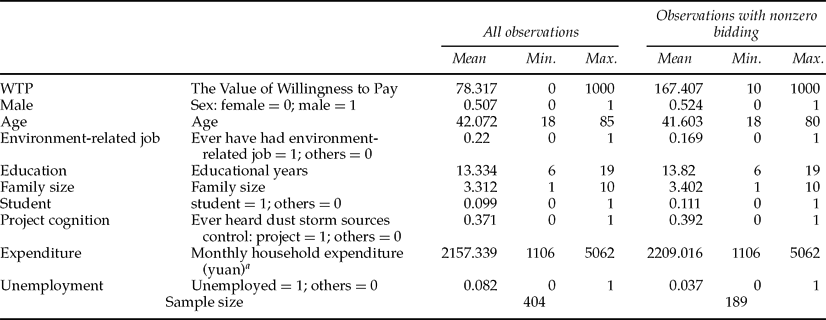
Descriptions of the variables and descriptive statistics for all 404 respondents and for the 189 respondents with positive and known WTP bids are reported in table 1.
Descriptive statistics for the survey in Beijing

Notes: aIn the survey, the respondents are asked about the monthly expenditure range. In order to fit the theoretical framework, following the lognormal distribution hypothesis of income (Balintfy and Goodman, Reference Balintfy and Goodman1973; Lin, Reference Lin2003), we assume household monthly expenditures are lognormal distributed and the data in this study fits it very well. Logarithm of the household monthly expenditure follows a normal distribution with mean 7.542 and standard deviation 0.539. We use the expenditure at the middlepoint of the cumulative distribution as the expenditure for the household falling into that range. That is 1106 for (~1500); 1694 for (1500–2000); 2259 for (2000–2500); 2877 for (2500–3000); 3327 for (3000–3500); 3745 for (3500–4000); 4069 for (4000–4500); and 5062 for (4500–).
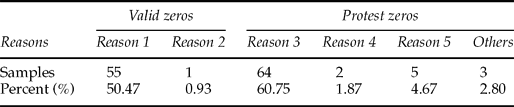
As shown in table 2, there are 74 observations which can be viewed as protest zeros. Their reasons for protesting include: (1) the government or polluters rather than individuals should be responsible for improving environmental quality; (2) it is not transparent as to how the government will use the money we pay; (3) environmental quality cannot be improved through any project; and (4) do not know how to answer the question. In particular, 64 respondents think that the government rather than individuals should pay for improving air quality in Beijing.
Reasons for zero responses

Notes: (1) Reason 1: Cannot pay because of economic reasons. Reason 2: Do not care about environmental quality. Reason 3: Environment improvement is the government's duty, not personal. Reason 4: Do not know how to answer. Reason 5: It is not transparent as to how the government will use the money. Others: One respondent thinks that polluter should pay for the pollution; two respondents do not believe any projects could improve air quality in Beijing.
(2) 111 respondents answered the reasons for zero WTPs and some gave multiple reasons. For the overlapped respondents between valid zeros and protest zeros, we treat them as protest zeros in our analysis.
Fifty-five respondents who bid zero cited economic reasons, and one bid zero because he did not care about environmental quality. These 56 samples can be viewed as valid zeros. However, some zero bids have multiple reasons. We assume that the reasons for protest zeros dominate the respondents’ behavior, so that respondents with overlapping reasons between valid zeros and protest zeros are classified as protest zeros in this study. Therefore, only 37 WTPs are valid zeros in this study.
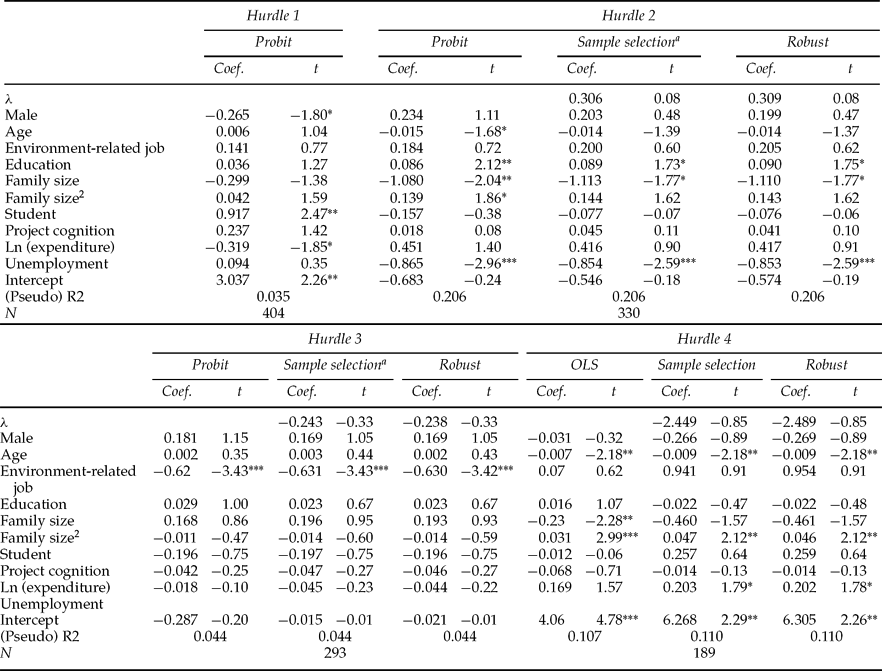
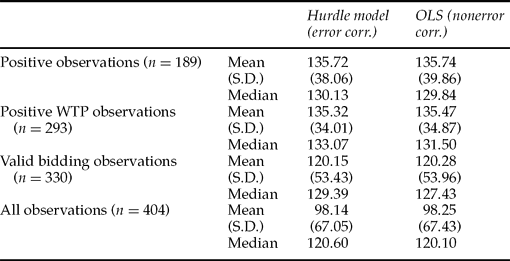
Embedding the different scenarios involving zero responses into the four-hurdle model, we report the estimation results both with and without error correlations in table 3. A robust estimation with iterative substitution of ρi,i + 1 is also reported for comparison. There are no large differences between the robust and nonrobust estimators. This implies that the hurdle model with error correlation converges well. The corresponding means and medians of the predicted WTPs are reported in table 4.Footnote 2
Estimation results for the four-hurdle model

Mean and median values of WTP with the hurdle model

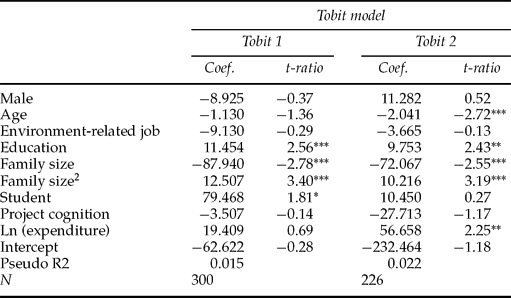
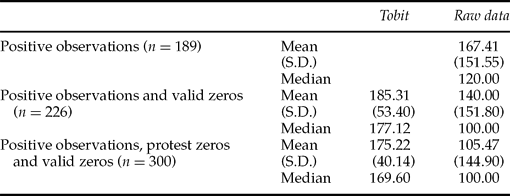
Lin and Schmidt (Reference Lin and Schmidt1984) compared the double-hurdle model and the Tobit model and found that the estimation results for the Tobit model may mix the different effects for different hurdles that are separated out in the double-hurdle model. For comparison purposes, we also report the estimation results for two Tobit models in table 5. We have to drop the positive but unknown WTPs in the Tobit models. The censored part of Tobit model 1 includes protest zeros and valid zeros and the censored part of Tobit model 2 only includes valid zeros. The corresponding mean and median values of predicted WTPs are reported in table 6.
Estimation results for Tobit models (dependent variables are WTPs)

Notes: Tobit 1: the censored part includes protest zeros and valid zeros; Tobit 2: the censored part only includes valid zeros.
*, ** , and *** indicate significant at 10%, 5%, and 1%, respectively.
Mean and median values of WTP with the Tobit model and raw data

6. Discussion
6.1 Model comparison
As table 3 shows, none of the estimated coefficients for λ in hurdle 2, hurdle 3, and hurdle 4 are statistically significant, which indicates that the null hypothesis of no correlation between error terms cannot be rejected. The differences in the estimation results for the two models are also not significant, except for the coefficient on age in the equation of valid-zero-bidding behavior, and the coefficient on family size and the coefficient on the logarithm of monthly expenditure in the WTP equation. The coefficient on age in the equation for valid zeros and the coefficient on family size in the WTP equation are statistically significant in the nonerror-correlation model but not in the error-correlation model. While the coefficient for logarithm of monthly expenditure in the WTP equation is marginally significant (10%) in the error-correlation model, it is not significant in the nonerror-correlation model.
Economic theory predicts that expenditure (income) should have a significant influence on WTP. Therefore, the following discussion is based on the results of the error-correlation model.
6.2 Zero-protest equation
The estimated coefficients on gender, student status, and the logarithm of expenditure in the zero-protest equation are statistically significant. This indicates that these three variables are important for protest behavior. The estimated coefficient on gender is −0.265, which indicates that probability of zero-protest bids is higher for males than females. The coefficient on student status is 0.917, which indicates that the probability of zero-protest bids by students is lower than that of other respondents, controlling for other variables. Furthermore, the negative sign on the coefficient of the logarithm of expenditure indicates that wealthy individuals are more likely to protest.
6.3 Valid zero-bidding equation
The coefficients for education, family size, family size squared, and employment status are statistically significant in the equation for valid zero-bidding behavior. The coefficient on education is 0.09, which implies that one additional year of education reduces the probability of a valid zero bid. The negative sign for the coefficient on family size and positive sign for family size squared indicates that the relation between probability of a nonzero bid and family size is U-shaped. As family size increases, the probability of a nonzero bid first decreases and then increases, with the turning point at about four (3.88) family members.
Economic theory predicts that poor people are more likely to bid zero. Therefore, it is reasonable that the estimated coefficient on unemployment is negative. Because the vast majority of unemployed respondents bid zero in this hurdle, only a few unemployed respondents could enter into the subsequent hurdles. Including the unemployment variable in these hurdles causes multicollinearity problems with the intercept, and so this variable was dropped from those hurdles.
6.4 Positive but unknown WTPs
Only the coefficient for ever having had environment-related work experience is statistically significant in this hurdle. It is −0.63, which indicates that the probability of indicating a positive but unknown WTP for those who ever have had environment-related work experience is higher than others, controlling for other variables. A possible explanation is that those who have had environment-related work experience are more aware of their own knowledge limitations and more hesitant to indicate a specific number.
6.5 Willingness-to-pay equation
In the fourth hurdle (willingness to pay), there are three coefficients that are statistically significant: age, family size squared, and the logarithm of monthly expenditure. The negative sign on the estimated coefficient for age implies that as age increases, people are willing to pay less for air quality. The positive sign for the coefficient on family size squared implies that the WTP for air quality is also a U-shape, first decreasing in family size and then increasing. Small size households and large size households are willing to pay more for air quality. The turning point is about five (5.01) family members.
The coefficient for the logarithm of monthly expenditure is 0.20, and it is marginally significant. This indicates that the expenditure elasticity of WTP is 0.20, close to the estimated value of 0.27 in the case study of Bulgaria (Wang and Whittington, Reference Wang and Whittington2000). Following Proposition 2, we can calculate the substitution elasticity between money and environmental quality as

This is a relatively high elasticity of substitution, implying that it is easy for residents of Beijing to make tradeoffs between environmental quality and income. However, because incomes in China are still very low, it is plausible that Beijing residents would sacrifice environmental quality to achieve economic growth, as the environmental Kuznets curve hypothesis predicts. As a result, the willingness to pay for environment quality would be low.
6.6 Tobit estimation results
Table 5 reports the estimation results for two Tobit models. The estimated coefficients for education, family size, family size squared, and student status are statistically significant in Tobit model 1 in which the censored part includes protest zeros and valid zeros. The coefficients for age, education, family size, family size squared, and logarithm of monthly expenditure are statistically significant in Tobit model 2 in which the censored part only includes valid zeros. The results indicate that the Tobit model may mix different effects in different hurdles, consistent with the findings of Lin and Schmidt (1984). For instance, the coefficients on logarithm of monthly expenditure are significant in the zero-protesting equation and the willingness-to-pay equation, but with different signs. The coefficient on logarithm of monthly expenditure in Tobit model 2 is also statistically significant, but not in Tobit model 1. It appears that the Tobit model coefficients mix the two effects: protest zeros and willingness to pay.
The estimated coefficient on student status is another example. This variable is important for zero-protesting behavior but not for other hurdles, as shown in the four-hurdle model. Though the coefficient on student status in Tobit model 1 is statistically significant, we do not know from the Tobit results if it is important for zero protesting, valid zero bidding, willingness to pay, or all of the above.
Education is also an example. In the four-hurdle model, we know that education is important for valid zero-bidding behavior, but not for willingness to pay. Even though the estimated coefficient for education in Tobit model 2 is statistically significant, we cannot separate out different effects for different hurdles.
6.7 Willingness to pay for blue skies in Beijing
Tables 4 and 6 report the mean and the median of willingness to pay for blue skies in Beijing based on the four-hurdle models and the Tobit models, respectively.
Mean and median values of WTP can be calculated based on all valid observations in the four-hurdle error-correlation model. Though protest zeros are not included, the information from these respondents can be reflected in the WTP values. The mean and the median WTPs are 120.15 and 129.39 yuan, respectively. The mean and the median are very close to each other, which indicates that the distribution of WTP values is more-or-less symmetric. They are also very close to those of the predicted values of the four-hurdle model without error correlation. Including protest zeros, the mean and the median of WTP for the error-correlation model are 98.14 and 120.60 yuan, respectively, which are slightly lower than those without protest zeros, as one would expect because more zeros are included in the calculation.
Table 6 reports the mean and the median predicted WTPs from the Tobit model and the raw data after dropping the positive but unknown WTPs. The mean and the median WTPs for Tobit model 2, which only includes valid zeros, are 185.31 and 177.12 yuan, respectively. Those for Tobit model 1, which includes valid zeros and protest zeros, are 175.22 and 169.60 yuan, respectively. They are much higher than those of the four-hurdle model. The main reason is that the expected values of the latent variables in the Tobit model for zero observations are greater than zero.
The mean and the median WTPs from the raw data, including only valid zeros, are 140.00 and 100.00 yuan, respectively. Those including both protest zeros and valid zeros are 105.47 and 100.00 yuan, respectively. They are close to the results of the four-hurdle model, but the variances are much greater.
Using 120.15 yuan as the average household WTP and considering that the per capita annual disposal income of Beijing was 19,978 yuanFootnote 3 in 2006 and the average household size for the whole sample is 3.31, we can calculate that the share of WTP for blue skies in disposable income is only about 0.18%. This is very low compared with the current literature. For instance, Wang and Whittington (Reference Wang and Whittington2000) find that people in the city of Sofia, Bulgaria would pay 4.2% of their income for air quality improvements.
7. Conclusions
How to deal with zero and missing responses is a very difficult problem in the contingent valuation method with open-ended bidding. This paper suggests a four-hurdle model in which the bidding behavior of the respondents is disaggregated into four steps: (1) zero-protest bids; (2) bids that constitute valid zeros; (3) in cases where the respondent has a positive WTP, whether the respondent can indicate a specific number for WTP; and (4) the willingness-to-pay decision in cases where WTP is positive and known. Each step is conditional on the last step. The model is found to be superior to the Tobit model because (a) the Tobit model might be inconsistent if the real censoring point is not zero; (b) the Tobit model often mixes different effects in different hurdles; and (c) the predicted values of the latent variables for zero observations in the Tobit model are in general greater than zero, which can make the mean and the median predicted WTPs much higher than in the four-hurdle model. The four-hurdle model is also superior to estimating WTP from the raw data because the variance is smaller.
The four-hurdle model is used to analyze willingness to pay for blue skies in Beijing, where air pollution is known to be very serious. The main findings are as follows:
(1) Males, nonstudents and wealthy individuals are more likely to make protest bids.
(2) Less educated and unemployed persons are more likely to bid valid zeros. And the relation between family size and the probability of nonzero-bidding behavior is U-shaped. Small-sized households and large-sized households are less likely to bid zero.
(3) Those who have had environment-related work experience are less able to give a specific number for WTP even though they know they have a positive WTP. A possible explanation is that these individuals ‘know what they don't know,’ that is they are aware of their own knowledge limitations in trying to formulate a specific WTP value.
(4) Older people are willing to pay less for improving air quality in Beijing, and the relationship between family size and willingness to pay is U-shaped. Small-sized households and large-sized households are willing to pay more for improved air quality in Beijing.
As microeconomic theory shows, if the consumer's utility function is of the CES form, the expenditure (income) elasticity of WTP is the inverse of the substitution elasticity between environmental quality and money. Our estimated expenditure elasticity of WTP is 0.20, and it is marginally significant; therefore, the substitution elasticity between environmental quality and money is about five (4.95). This is a high elasticity of substitution, implying that respondents are readily willing to make tradeoffs between environmental quality and income.
The mean and the median values of predicted willingness to pay for blue skies per household are, respectively, 120.15 and 128.60 yuan. On a per capita basis, WTP for blue skies is less than 0.2% of the per capita annual disposable income in Beijing. Willingness to pay for blue skies in Beijing is very low.
Finally, we should mention that econometric models with different orders for the four hurdles were also tried, though they do not fit the usual decision-making procedure. For instance, zero-protest bids and bids that constitute valid zeros were switched in the hurdle sequence, but difficulties in estimation were encountered. There were no statistically significant terms in the last hurdle, and the robust estimation did not converge.