Evacuations of hospitals have occurred in the United States recently as a result of tornadoes, hurricanes, and loss of power and as planned events during a move to a new location. The evacuations of hospitals for Hurricane SandyReference Espiritu, Patil and Cruz 1 , Reference Powell, Hanfling and Gostin 2 and Hurricane KatrinaReference Distefano, Graf and Lowry 3 - Reference Lowe 5 have recently been documented. Other hospitals have relocated as a result of new construction.Reference Fuzak, Elkon and Hampers 6 , Reference Jen, Shew and Atkinson 7 In addition, hospitals have recently recognized that they need to be able to relocate patients to other facilities in order to create surge capacity for pandemics. This has occurred with influenza, H1N1, and recent Ebola planning.Reference Scarfone, Coffin and Fieldston 8 - Reference Burkle 10 The ability to create surge capacity beds is important.Reference Jen, Shew and Atkinson 7 , Reference Campbell 11 , Reference Kanter 12 Recent events from the World Trade Center disasters to the Boston Marathon bombings have shed light on hospital and community disaster and pediatric disaster preparedness for mass casualty incidents,Reference Stamell, Foltin and Nadler 13 - Reference Shirm, Liggin and Dick 16 and the need to include pediatrics has become clear.Reference Lowe 5 , Reference Burkle, Williams and Kissoon 17 - Reference Milsten 23 Several task forces have been convened to discuss recommendations for care during pandemics and disasters.Reference Christian, Devereaux and Dichter 24 , Reference Kissoon 25
Our institution recently relocated to a completely new building 3.5 miles away from our original location in the city of Chicago on June 9, 2012. We describe here the overarching strategies and tools we developed to prepare, execute, and manage our evacuation and relocation in order to assist other health care facilities to be better prepared to safely and efficiently evacuate patients. This could serve in the event of a disaster, need for surge capacity, or relocation to another facility.
METHODS
Tool Development for Use in a Planned Evacuation
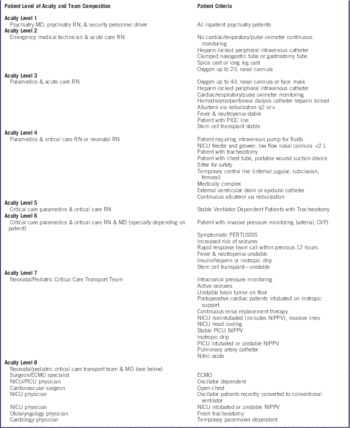
A number of tools were developed for the planned evacuation of our hospital. The initial tool was a level of acuity and team composition classification (Table 1), which categorized patients both to determine the composition of transport personnel to accompany each patient as well as the types of vehicle required. We modified a tool used by Denver Children’s Hospital for their hospital move.Reference Fuzak, Elkon and Hampers 6 Using this tool we were able to accurately determine the types and numbers of transport vehicles as well as plan personnel needs, including types of nursing support; numbers of acute care, critical care, and neonatal nurses; and composition of the neonatal/critical care transport team. Table 1 shows the level of acuity as well as the types of patients transported in each category. Inpatient psychiatry patients were transported via hospital shuttle with inpatient psychiatry staff.
Level of Acuity and Team Composition for Patient EvacuationFootnote a

a Abbreviations: CVP, central venous pressure; ECMO, extracorporeal membrane oxygenation; NICU, neonatal intensive care unit; NIPPV, noninvasive positive pressure ventilation; PICC, peripherally inserted central line; PICU, pediatric intensive care unit.
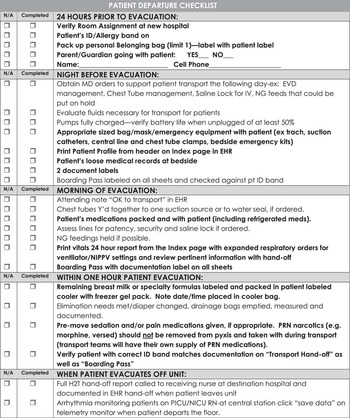
Our second tool was a patient departure checklist (Figure 1) created to prepare the patient for evacuation day. It included a list of items needing completion 24 hours in advance, the night before, and the morning of the evacuation.
Patient Departure Checklist. Used to prepare the patient for evacuation day. Preparation included 24 hours in advance, the night before, the morning of, and within 1 hour of the evacuation. Abbreviations: EHR, electronic health record; EVD, external ventricular drain; H2T, head to toe; IV, intravenous; NG, nasogastric; NIPPV, noninvasive positive pressure ventilation; NICU, neonatal intensive care unit; PICU, pediatric intensive care unit; PRN, as needed medication.

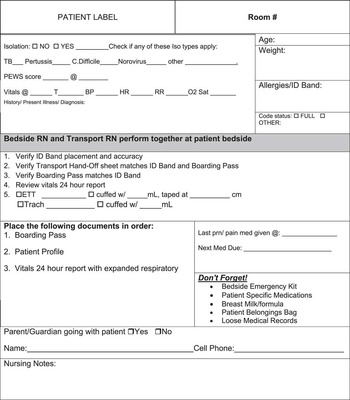
An evacuation handoff tool (Figure 2) was developed to give the necessary clinical information to the transporting team. This form was used by the bedside nurse during handoff to the transporting team. The bedside nurse from the originating hospital then gave a phone report to the accepting bedside nurse at the new hospital. In addition, this handoff tool was used by the transporting team to give any updates to the receiving nurse.
Evacuation Handoff Tool. Used for nursing handoff to the transporting team, to the receiving nurse, and by the transporting team to the receiving nurse. Abbreviations: BP, blood pressure; ETT, endotracheal tube; HR, heart rate; O2 Sat, oxygen saturation; PEWS, pediatric early warning system; RR, respiratory rate; T, temperature; TB, tuberculosis; Trach, tracheostomy tube.

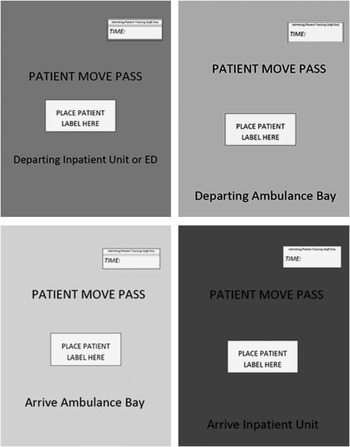
A patient tracking system was developed within the electronic health record (EHR). A 4-point boarding pass system was created as a visual backup to the EHR to track patients. Every patient was given 4 color-coded boarding passes (Figure 3). Patient tracking officers were stationed with portable computer workstations at each of the 4 locations. As each patient passed each of the 4 checkpoints—(1) departing the inpatient unit or emergency department at the originating hospital, (2) departing the ambulance bay at the originating hospital, (3) arriving at the new hospital ambulance bay, and (4) arriving at the new hospital inpatient unit—the transporting nurse would tear off the boarding pass and hand it to the patient tracking officers to update the EHR.
Patient Color-Coded Tracking System/Boarding Pass. Turned in at each of 4 checkpoints. The pass was then entered into the electronic health record so that patient location could be tracked.

By utilizing this patient tracking system, hospital leadership and physicians knew the location of every patient during the move. The EHR interface was set up to reflect the 4-part boarding pass system and could be viewed from any hospital computer.
System Preparation for Evacuation
Because this was a planned evacuation, efforts were made to not schedule any elective major surgeries the week leading up to the evacuation. Major surgeries were defined as those for which patients would still be inpatients at the time of the evacuation, assuming a routine postoperative course.
The Emergency Operation Plan and the Hospital Incident Command Structure was used before evacuation of the hospital, during the evacuation drills, and on the day of the evacuation. The event was considered a planned evacuation of the old hospital and relocation into a new hospital. An Incident Command team was formed and each member of the Incident Command team had a Job Action Sheet created for their role. The process included a series of tabletop drills, followed by simulations and debriefing sessions. These were attended by all members of the Incident Command team. The Job Action Sheets were modified after each drill. All members of Incident Command completed National Incident Management System training through the Federal Emergency Management Agency.
RESULTS
Testing the Level of Acuity Tool
Monthly census tracking exercises were held beginning 12 months before the planned evacuation. The census exercises were conducted in order for each unit to present the projected census as well as the classification level that would be required for transport. Specific needs for the patient were also identified, such as chest tubes, isolettes, bariatric beds, and isolation requirements. Patients requiring a physician as part of the move team were also identified to assist with physician resource planning for evacuation day. Census exercises demonstrated that the range of patients that the hospital needed to prepare for was 149 to 191. Additionally, critical care and neonatal physicians and nurses were involved in sequencing exercises for several months leading up to the evacuation. Sequencing exercises were done to determine the actual sequence of patients to be moved from the critical care units. We identified that we had a greater need for transport isolettes than the institution had available. This allowed us time to borrow isolettes from partner institutions and obtain an additional isolette from the ambulance vendor.
Drills
Simulation drills began 6 months before the evacuation date by using our Emergency Operation Plan process to test tools. The first evacuation drill was a half-day drill and tested the movement of patients from the inpatient floors to the ambulance bay. Six mannequins with actual patient information, equipment, patient belongings, and forms were moved from inpatient beds to their assigned staging location in the ambulance bay. This drill tested the tools developed: the patient acuity and team composition classification (Table 1), patient departure checklist (Figure 1), handoff tool (Figure 2), and patient tracking tool (Figure 3) through the EHR. All patients were tracked in the EHR. Checkpoints in the EHR that were tested were exiting the inpatient unit and exiting the ambulance bay. Evacuation routes, elevator traffic and staging locations, access control, communication devices, and availability of computer access and connectivity were also tested. In the debrief session following the drill, the Incident Command team found that the patient tracking mechanism worked well; however, patient movement from the inpatient units to the ambulance bay needed to be done more efficiently. It was determined that separate routes and exits would be used for patients from the acute care floors versus patients in the critical care units (pediatric intensive care unit, neonatal intensive care unit).
A full evacuation drill was held 6 weeks before the hospital evacuation using 10 volunteers as patients. This drill completed the entire move sequence from bed to bed. The actual routes were tested and time estimates were confirmed. The day started when the Incident Commanders received reports from their command staff and activated the Emergency Operation Plan and move sequence for these 10 volunteer patients. Route changes, patient identification, tracking, communication, and way finding issues identified from the preceding drills were tested again during the full drill. All patients were tracked in the EHR and all 4 checkpoints were tested.
During the drill, a decision was made that all patients would be seen by an attending physician before departure from the originating hospital as well as upon arrival at the new hospital. A template note was developed in the EHR to facilitate charting so as not to delay patient movement. Educational sessions were done with all attending physicians who would be involved in patient care on evacuation day to familiarize them with the charting requirements and documents.
On evacuation day, if patients were transported by the Neonatal/Pediatric Critical Care Transport Team, then the team used their regular charting. For patients whose acuity did not require the transport team, the transporting nurse charted on the handoff form (Figure 2).
Use of the Tools During the Evacuation: June 9, 2012
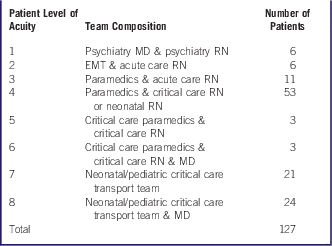
There were no safety issues during patient evacuation and transport. The entire evacuation took less than 14 hours. A total of 127 patients were transported to the new facility: 45 patients were moved via the Neonatal/Pediatric Critical Care Transport Team. Of these 45 patients, 24 were accompanied by an attending physician in addition to the critical care transport team. The other 21 were transported by the Neonatal/Pediatric Critical Care Transport Team without a physician. Three patients were moved with critical care paramedics, a critical care nurse, and a physician. Three additional patients were transported with critical care paramedics and a critical care nurse (no physician), 53 patients were transported with paramedics and either a critical care nurse or a neonatal nurse, 11 patients were transported with paramedics and an acute care nurse, 6 patients were transported with emergency medical technicians and an acute care nurse, and 6 psychiatry patients were transported on a hospital shuttle with psychiatry staff (Table 2). One patient required a police escort owing to extreme instability.
Level of Acuity and Team Composition During EvacuationFootnote a

a Abbreviation: EMT, emergency medical technician.
The average drive time for the 3.5-mile route was 8 minutes and the average transport time from exiting the floor at the old hospital to handoff at the new hospital bed was 60 minutes. Twenty-seven ambulances were used throughout the day to move 121 patients, and the hospital shuttle was used for the 6 psychiatry patients. Medical control for non-critical-care patients was provided by pediatric emergency medicine attending physicians. Medical control for critically ill patients was provided by a critical care attending physician or a neonatologist depending on patient location.
There was no patient deterioration en route during transport. Two patients did have a change in status prior to departure from the originating hospital that required a change in the move order sequence while those patients were stabilized. These were critically ill patients and their change in status was not related to the move.
DISCUSSION
Planning for a hospital evacuation is meticulous and time-consuming. Many details are involved. Documents in place for disaster planning can be used for a planned evacuation. Planning early is critical, as is including representatives from all hospital departments. Good communication plans with staff, families, and state and city officials about the evacuation is key to a seamless process. Utilizing Incident Command to oversee the evacuation is critical.
Planning for a 48-hour census reduction was paramount in our experience. In addition to the cancellation of elective surgeries, chemotherapy schedules were adjusted so that patients were not admitted for routine chemotherapy during the planned evacuation. Although we planned for high acuity and high census, a key to our success included reducing the inpatient census as much as possible to minimize the actual number of patients we needed to evacuate. Our census planning and diversion allowed for low census on the acute care floors on evacuation day. We did have high acuity on move day with over one-third of the patients requiring critical care transport. Due to our low census on the acute care floors, the evacuation of these floors was finished early in the day. However, due to high acuity and high census in the intensive care units, the critical care transports took until early evening.
In our preparations, it was very helpful to do the census exercises by using the acuity tool with equipment needs. By doing this, we identified that we had a greater need for transport isolettes than the institution had available. This allowed us time to borrow isolettes from partner institutions and to obtain an additional isolette from the ambulance vendor. Had we not had the additional isolettes, the evacuation would have taken longer, as we would have waited for the isolettes to return and be cleaned before using them for the next patient. In an unplanned emergency evacuation, we would not have enough transport isolettes. However, knowing this, we can access appropriate resources if the need arises.
The other tools created made the evacuation run more smoothly. The patient departure checklist allowed patients to be prepared for the evacuation. In an emergent evacuation, it would not be possible to review the checklists 24 hours before, the night prior, and the morning of the evacuation, but the list of key items is essential. This checklist was very reassuring to families. The handoff tool allowed for good communication between the bedside caregivers and the transporting team. This allowed for transfer of key information to allow for safe evacuation and transport. This form can be easily adopted in an emergent evacuation to provide key information. Our boarding pass system allowed everyone in Incident Command to see the flow of the patients and where each patient was at any given point in time.
Important lessons from the planned evacuation were to use current processes and procedures that staff are already familiar with as much as possible. Creating these documents and incorporating them into our disaster plan will make any unanticipated evacuation much easier. In addition, the census exercises showed that evacuating the acute care floors and the critical care floors simultaneously rather than in sequence was more efficient. During the evacuation, this allowed the acute care floors to be evacuated much earlier in the day, while the critically ill patients were transported throughout the process. The routes that were identified to populate the new hospital could be used to evacuate the building in the event of an emergency, and these routes have been incorporated into our disaster plan.
The use of evacuation drills to fine-tune all evacuation plans was essential. Multiple drills are needed and should start many months before patient evacuation day to allow time to incorporate changes. These drills have formed a basis for ongoing disaster drills. The planning, training, and documents created have now become part of our Emergency Operation Plan. In New York City and New Orleans, emergent evacuations took place during the hurricanes.Reference Espiritu, Patil and Cruz 1 - Reference Lowe 5 Having tools and processes in place as well as practicing evacuation drills can make such emergent occurrences run more smoothly. Any hospital can create and drill an evacuation plan by using similar tools rather than waiting for a crisis.
Agencies involved in our move included the Chicago Department of Transportation, the Office of Emergency Management and Communication, the Chicago Police Department, the Chicago Fire Department, the Chicago Department of Public Health, and the alderman of both wards. All agencies were eager to assist us in the planning of the drills and the evacuation, which improved communication between the hospital and the community. Members of the evacuation team became familiar with many leaders within our city government. Other local institutions were much more aware of the needs of our patients and the logistics of evacuation after the drills and the actual evacuation. We believe that Chicago is better prepared to evacuate a hospital after our collaboration.
The coordination of city, state, and federal agencies as well as public health departments is vitally important and has been shown in New York City and Boston.Reference Stamell, Foltin and Nadler 13 , Reference Gates, Arabian and Biddinger 14 In the event of an emergency evacuation, we would be in contact with the Office of Emergency Management and Communications of the City of Chicago as well as the Chicago Department of Public Health and the Illinois Department of Public Health, who would assist us in placing patients. Our hospital has participated in drills for accepting patients as well as sending patients to other facilities with pediatric beds in the city, state, and region. Multiple task forces have been created to study and make recommendations on community disaster preparedness across the country.Reference Lowe 5 , Reference Burkle, Williams and Kissoon 17 , 20 , Reference Bhave, Choudhury and Pemde 22 , Reference Christian, Devereaux and Dichter 24 , Reference Kissoon 25
CONCLUSIONS
Documents developed for a planned evacuation can be used for any planned or unplanned evacuation and can make things run more smoothly. Utilizing these documents in regularly scheduled disaster drills can keep staff members familiar with them and make their use in an actual disaster evacuation more seamless. We believe the strategies and tools we used to prepare, execute, and manage our evacuation and relocation would assist any health care facility to be better prepared to safely and efficiently evacuate patients in the event of a disaster, or to create surge capacity, and relocate them to another facility.
Acknowledgments
We thank Drs Denise Goodman, Elizabeth Alpern, Mark Adler, Susan Fuchs, and Karen Mangold for their review of the manuscript.