What are the policy consequences of the elimination of various barriers to international capital and labor mobility? Robert Frost, in Mending Wall, instructed that “Good fences make good neighbors.” Scholars have increasingly expressed this sentiment's converse, i.e., the pessimistic viewpoint that as the mobility of factors of production increases, international competition assumes a ”beggar-thy-neighbor” character. When “fences” separate countries and make it difficult for factors of production to move from country to country, governments can operate essentially as monopolistic suppliers of services. Governments can extract a price from the owners of productive resources in the form of taxes or can place regulatory restrictions on production without fear that factors of production will emigrate. When the “fences” fall and governments must compete with each other for the same resources, a state's or country's ability to tax or regulate diminishes; in the extreme, countries lose sovereignty over domestic policymaking (e.g., Andrews 1994 and Lee and McKenzie 1989).
The model that most scholars employ (implicitly or explicitly) to understand international or interstate competition is known commonly by its central prediction: the “race-to-the-bottom” (e.g., Oates 1972). To attract a mobile factor of production, one government might reduce its use of a policy instrument that lessens the rate of return on that mobile factor, such as high tax rates or restrictive environmental standards. This policy change creates a negative externality for competitor states or countries that must enact their own reforms to maintain competitive parity. In game-theoretic terms, the states are presumed to face an inescapable “Prisoner's Dilemma” in which every state has a dominant strategy to make its market more attractive than its neighbors' markets. In the game's unfortunate equilibrium outcome, the mobile factor may remain distributed the same as before barriers fell, but all countries and their citizens are in a worse condition, whereas owners of the mobile factor of production reap increased rewards.
Scholars have searched for globalization-induced convergence, and indeed for downward spirals, to confirm this prediction in policy areas such as environmental and labor market regulation. Tax competition in particular would have broad repercussions that extend beyond tax policy itself. If lower rates lead to a reduction in revenue that would accompany, policymakers would be forced to cut domestic spending, increase budget deficits, and/or shift the tax burden to less mobile factors of production. The empirical evidence for the race-to-the-bottom model, however, is weak. Vogel has found that the model is dissonant with actual trends in environmental regulation, and the same is true for tax policy—capital tax burdens have increased even as capital became more mobile, with the overall share of revenues provided by corporate income taxes rising from 7.7% in 1975 to 8.4% in 1996 (Genschel 2000). Many scholars have asked why race-to-the-bottom scenarios have failed to materialize. Existing explanations for the lack of a downward spiral of capital tax burdens fall into two camps. The first argues that globalization does create pressures to converge but that political institutions and organizations mitigate these pressures. The second school contends that key actors (firms especially) are not sensitive to changes in tax burdens abroad and hence have no reason to pressure governments to make any adjustments (e.g., Ganghof 1999; Swank 1998, 2002; Swank and Steinmo 2002).
We provide a new answer to this important question with both a new theory and new empirical tests that flow from that theory. Our formal model employs the analogy of a “tournament” to describe the strategic decisions that states face when competing for capital resources; the model has three features we wish to highlight, which have not appeared together in previous work. First, the model permits the responsiveness of capital flows to changes in tax policy to vary, allowing us to investigate the effects of capital markets' globalization. Second, the model incorporates incomplete information, particularly about the decisiveness of tax reforms in determining where capital will locate and about competing countries' costs of tax reform. Third, the model also incorporates a role for domestic politics and political institutions by acknowledging that countries face political costs for undertaking tax reform. We find that the presence of political costs reduces a country's incentive to enact reform, but they simultaneously reduce competing countries' incentives to reform. Domestic politics mitigates the pressures for tax rates to converge downward despite increased capital mobility. The formal model thus provides a theoretical explanation for the absence of the race to the bottom and, also, yields testable hypotheses about the conditions for tax reforms. We use this model to investigate the tax policy choices made in 20 OECD countries from 1980 to 1997.
MODELING THE COMPETITION FOR CAPITAL
The four tasks of this section are to introduce the standard race-to-the-bottom model, to modify that model by relaxing certain implicit restrictions, to solve for players' equilibrium strategies, and to employ the model analytically for deriving hypotheses. We perform this last task by computing “comparative statics,” determining how equilibrium strategies change with variations in key parameters of the model.
The Race-to-the-Bottom Model
The standard race-to-the-bottom model assumes that the competition for capital is best represented as a Prisoner's Dilemma.1
See Radaelli 1998 for an exception, employing a “coordination game” for transfer pricing.
The version of this game that is present in most textbooks is
discrete, such that countries would choose merely whether to cooperate (i.e., maintain current tax levels or high regulatory standards) or to defect (i.e., reduce tax rates or relax regulations). Instead, let us present a continuous version of the model, which bears some resemblance to the Bertrand (price-setting) model of oligopoly; in the next section we expand on this model by incorporating incomplete information. Assume that an investor announces her intention to invest an amount of capital, worth
k, in the national market offering the best rate of return. Suppose that
N countries compete for this capital investment by choosing a level of tax reform or tax reduction effort, denoted
ei for a generic country
i. Efforts to reduce tax rates improve a nation's attractiveness to potential investors by raising the rate of return; let
pi(
e) ≡
pi(
ei|
e−i) denote the probability of country
i winning the contest, given its own effort and the efforts of its competitors which are denoted
e−i. We assume that
pi(
e) is increasing in
ei and decreasing in
e−i. Countries derive positive utility from investments, but tax reductions also generate domestic political and economic costs, due to reduced tax revenues (holding the investment level constant) and to the transactions costs entailed in passing tax legislation. Let
ci(
ei) denote the cost to a country for its tax cutting effort; assume that for all
i,
ci(0)=0,
ci′>0,
ci″[ges ]0, and there exists
such that ci(ei)=∞ if
. That is, no costs are borne if the country makes zero effort at reform, whereas costs increase continuously and at a weakly accelerating rate up to a certain threshold level
(either an asymptote or a kink suffices).
To solve the model, we adopt the Cournot–Nash equilibrium concept, which assumes that each country best responds to the conjecture that each opponent j chooses its own optimal effort level, ej*. A country i thus solves the following:
where e−i*≡[prod ]j≠iej*. If there exists an interior solution, at which
, then we can identify a generic country's optimal behavior by evaluating the first-order condition (setting the first derivative with respect to ei equal to zero), revealing that ei* must satisfy
For a race to the bottom to occur, no interior solution may exist; i.e.,
. This requires the left-hand side to exceed the right-hand side for all
, given e−i*. There are two sufficient conditions for this inequality to hold, both of which are satisfied in the standard model. First, note that this standard model is symmetric, such that ei*=ej* for all i and j, and note the absence of uncertainty regarding investor behavior, such that the rank-order of countries' effort levels is perfectly deterministic of victory and defeat in the contest. Combined, these two assumptions imply that pi′(e*)=∞, such that when the countries exert the same equilibrium effort level,
for all
, for all i. At all symmetric strategy profiles up to the threshold effort level, every country individually prefers to increase its own effort by an infinitesimal increment, which would increase its probability of winning from 1/N to 1 if no competitor country changed its own strategy (this is a self-refuting expectation, however). The second sufficient condition for the race to the bottom, and an implicit assumption of the standard Prisoner's Dilemma-based model, is that the right-hand side equals zero in the first place or, at least, is constant; either way, c′i(ei*)=0 in the canonical model. If states can freely change their tax systems, tax rates will spiral downward because states quickly, completely and costlessly match other states' actions. Thomas (2000) demonstrates in a simple framework that the nature of the tax competition game changes as the costs attracting capital or jobs rise relative to the benefits, such that the competition for capital only approximates a Prisoner's Dilemma when costs are relatively low; Dehejia and Genschel (1999, 409) conjecture that “the competition for foreign tax base is subject to diminishing returns, and, therefore, is self-limiting.”
2 We note, however, that tax rates are strictly bounded above zero in the Dehejia and Genschel (1999) model because of assumptions they make about the production function and about the responsiveness of capital flows to tax policy. Specifically, they assume that α∈(−1, 0), where α parameterizes returns to scale. As a result, their endogenous parameter τ—which maps from the two countries' tax rates into their capital stocks—is also strictly bounded to an interval that excludes the possibility of either country possessing the entire capital stock. Relaxing this constraint could also eliminate their conclusion that, “the tax competition game reaches a resting point at a positive level of taxation for both countries. The race-to-the-bottom stops above zero taxation” (409).
In the next section, we present a new model that incorporates more realistic assumptions about the strategic environment. Our model differs from the Prisoner's Dilemma in three major ways. First, we do not assume that tax reduction is costless, and in fact, we permit cost levels to vary among the participants. Second, we do not assume that countries are perfectly informed of competitor countries' domestic political costs of tax reduction. Third, we do not assume that tax reducing effort is perfectly deterministic of the investors' decisions; rather, our model permits the possibility that other factors than tax cuts might influence investor decisions, and thus tax rate differentials are only probabilistically related to success or failure at winning investments.
A Tournament Model
Our model of the international competition for capital is based on the analogy of a tournament, in which countries' efforts to attract capital are rewarded with favorable investment decisions, but effort entails some perceptible (and variable) cost.3
Similar models have been applied mainly to the labor market (Lazear 1995; Lazear and Rosen 1981). Wheeler and Mody (1992) treat investment location decisions as a tournament.
Our model reflects the insight that countries make their decisions in the context of potentially great uncertainty, which can take at least two forms.
A first form of uncertainty regards competitors' preferences over tax reform. Countries may differ by the level of political costs they incur; in our model we permit costs to take on two values—low cost (denoted θL) and high cost (denoted θH)—where ci′ (x; θL)<ci′ (x; θH) for all x. Country i's information about cost types is interim, meaning that i knows only its own cost of tax reform (high or low) with certainty, although i possesses beliefs about other players' costs of tax reform. Results of future elections are unpredictable, and the domestic political characteristics of a country may change over time, thus competing countries' preferences over tax reform may be unpredictable. Yet we assume that sufficient information exists for countries to make reasoned decisions based on the expected cost profiles of competitors for capital; formally let λ represent the proportion of low-cost countries in the population and 1−λ represent the proportion of high cost countries.
A second form of uncertainty regards the relative weighting that tax reform has in the mind of potential investors.4
Although the precise amount of uncertainty is permitted to vary as a parameter in the model.
Assume that there exists an owner of capital who wishes to make an investment and that this investor prefers higher rates of returns to lower ones; this behavior is loosely consistent with the common Mean–Variance portfolio selection model (Markowitz
1952,
1959).
5 The “E–V criterion” holds that for two assets i and j—yielding expected returns Ri and Rj and variances σi2 and σj2, respectively—an investor prefers i to j if Ri[ges ]Rj and σi2[les ]σj2, with both equalities not holding simultaneously. If the investor is risk neutral, having linear rather than quadratic preferences, or if σi2=σj2, then the expected return is the sole criterion guiding the investor's decision.
As before, the investor announces her intention to invest
k in the country offering the best rate of return, and the announced reward structure is assumed to be credible.
6 Fidelity to the tournament analogy requires such a structure of preannounced winnings for players, depending on their rank-order.
Any model of tax competition must assume that investors are sensitive to different tax burdens in deciding where to locate investment. In a review of the empirical literature on taxation and firm behavior, Hines (
1999) is most emphatic that differences in tax rates do affect firm investment decisions, noting that “there is by now extensive quantitative evidence that international taxation influences the volume and location of foreign direct investment” (318–19). The Ruding Report surveyed European firms about how taxation affected their investment decisions and found that tax levels did enter the calculus of businesspersons. The proportions and types of firms that consider tax levels is the subject of continued debate. Mosley's (
2000) more recent interviews indicate that fewer than one in five considered taxation to be an important determinant of capital location. Devereux and Griffith (
1998) have found that tax rates do not affect American firms' decisions of whether to enter the European market in the first place but do affect where firms locate their investments within Europe. Low corporate tax rates could be part of an overall “menu” of policy inducements, but some investors might tolerate higher taxes if greater government revenues translate into beneficial expenditures, such as government investment in human capital (e.g., Garrett
1998 and Hall and Soskice
2001). Countries' rate-of-return advantages may thus have sources other than favorable tax treatment, including proximity to important downstream markets, beneficial workforce characteristics, relaxed immigration laws for highly skilled workers, and the presence of exploitable national resources.
We formalize the insight that taxes are not exclusively deterministic of investors' choices by permitting investors to possess some preexisting bias for or against the investment opportunities in country, which might result from characteristics of the country or of the investor him- or herself, professionally or personally. We assume that the countries competing for the investment do not observe investors' biases, although they do know their probabilistic distribution. Let ri denote the expected rate of return from a particular investment in country i, and let it depend on both the country's tax cutting efforts and a stochastic element si, such that ri≡ei+si. The stochastic component is observed by the investor—one might treat s(≡[prod ]i∈Nsi) as his or her type—but not by either country at the point of deciding on tax reform. (Thus a country i's information about the stochastic terms is ex ante, meaning that i knows neither si nor sj for any j≠i.) An investor's bias between a pair of countries i and j, denoted bij≡si−sj≡−bj,i, reflects the stochastic component of countries' rates of return.
For a generic country i, again let the probability that the investor chooses country i to be denoted pi(e)≡prob(ri>maxj{rj}, ∀j≠i|ei). Denoting by ki the capital investment in country i, then a country can predict that ki=k if and only if ri>rj, which is the case only if ei+si>ej+sj for all j. Country i can then infer the following relationships:
where si and sj are independently drawn from an identical distribution. Given the i.i.d. assumption, the expectation of bj equals 0, and consequently pi(e) can be defined as the product of cumulative distribution functions G(ei−ej), with G(0)=1/2.
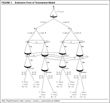
The extensive form game with N=2 is illustrated in Figure 1. Nature moves first by choosing the two countries' types; each country observes only its own type, as represented by each player's information sets. Each country chooses its tax reform effort, given its beliefs about the other country's type and given the knowledge that whether the investor rewards its efforts depends on the investor's biases. Nature then reveals the two countries' stochastic draws and the investor chooses where to invest k depending on rate-of-return advantages.
To solve the game, we must find the equilibrium levels of tax reform effort for each type and the optimal response of the investor to effort choices. First, we adopt the Bayes–Nash assumption that each chooses its type-contingent best response to its beliefs about opponents' types, which come from the population proportions of low- and high-cost types. Tax cutting efforts are chosen simultaneously, thus a strategy for a country maps from its type into an effort level. Assuming that types are uncorrelated and that players are symmetric except for what is denoted by type, we can denote by eL* the optimal choice by any low-cost type and by eH* the optimal choice by any high-cost type. Second, we assume that players are sequentially rational, meaning that after any history of the game, each player plays an optimal strategy for the remainder of the game, given his or her beliefs. This permits us to use backward induction to solve for the subgame perfect Cournot–Bayes–Nash equilibrium. We begin the analysis with the investor's decision-theoretic problem at the very end, with all uncertainty resolved. Investors derive higher utility from placing k in the country offering the higher expected rate of return (given the two countries' tax cutting efforts and the investor's own biases over the investment opportunities). A generic country i again solves the maximization problem:
where the latter equation substitutes for pi(ei|ej*) the cumulative density function G(ei−ej). Simply, country i's probability of winning equals the probability that its chosen effort level ei defeats all low-cost competitors and all high-cost competitors' choices (which are assumed to be, respectively, the equilibrium low- and high-cost effort levels). Using the former equation, a generic country i's first-order condition for a maximum yields
where θi denotes the type (low or high cost) of player i, and θ−i denotes the profile of competitor countries' types. The interpretation of this equation is that a country will, in equilibrium, exert just enough effort to equate the marginal benefit of tax reduction (increasing the probability of winning the competition for capital, multiplied by the gain from winning) with the marginal political cost of tax reduction. This equation already permits three inferences to be drawn.
Proposition 1
An increase in a country's costs will reduce a country's effort level in equilibrium, all else constant; thus low-cost countries expend greater effort than high-cost countries.7
If, as assumed, ci′ (x; θL)<ci′ (x; θH) for all x>0, then ci′ (y; θL) = ci′ (x; θH) only if y>x. Thus, if
and x>0, then
only if
.
Proposition 2
An increase in the stakes of “winning” will increase a country's effort level, all else constant.8
Suppose that
. If ci″ (x; θi)>0 for all x>0, and
, then
only if
for all i.
Proposition 3
An increase in tax reform effort's decisiveness will increase a country's effort level, all else constant.9
The proof follows directly from the stipulation that tax cuts are “more decisive” in regime A, compared to regime B, if and only if
for all x.
To deduce additional propositions from the model, we must impose further assumptions on the model's components. For example, we might specify precise functional forms, such as assuming that the political cost of tax reform is a linearly increasing function of effort levels. Let us instead focus our attention on the probabilistic success function, pi(·). The model of choice described above places the investor in the position of maximizing a random utility model. Hence if the stochastic component of countries' rates of return takes the type I extreme-value distribution (also known as the log Weibull distribution), such that it has density
and cumulative density
, then we have the multinomial logit model of McFadden (1976, 1979). Consequently,
Substitution of this functional form into the above maximization problem, and again taking the first order condition with respect to ei, yields the following:
Since this equality holds for both low-cost and high-cost countries, then it will be the case that
Consequently,
by substituting the above definition of p′i (e*; θi, θ−i) and rearranging terms, we find
Taking the natural logarithm of both sides of this equation and rearranging yields the following comparison of low-cost and high-cost types' equilibrium effort levels:
This equation can be simplified slightly by noting that the product of bracketed terms in the last two sets of parentheses resembles the sum of competitor countries' expected effort levels: (N−1) denotes the number of competitors, (λ) and (1−λ) denote the population proportions of low- and high-cost types, respectively, and
and
denote the exponent of the two types' equilibrium effort levels. This equation thus reveals that in equilibrium, the gap between the low- and the high-cost players' effort levels will depend on the logged ratio of costs at equilibrium effort levels and on the total expected efforts of competitors, which itself is a function of the number of countries and the relative frequencies of low- and high-cost types.
Performing a comparative statics analysis on this last equation permits us to express how changes in exogenous variables or parameters affect the optimal strategies of countries competing for capital; we derive the following two propositions.
Proposition 4
An increase in the difference between the two types' costs at equilibrium effort levels increases the gap between the two types' effort levels.
Proposition 5
An increase in the proportion of low-cost countries increases the gap between the two types' effort levels.10
This proposition is consistent with Swank 2002.
To summarize the model's conclusions, propositions one through five indicate that we should be more likely to observe one country undertaking tax cuts when the country's political cost of tax reduction is reduced, and we should observe all countries undertaking tax cuts when the amount of capital at stake increases, when tax cuts become more influential with respect to investor behavior, and when there are more low-cost countries in the population. These results suggest that the race-to-the bottom outcome is unlikely in equilibrium, since its occurrence depends directly on the distribution of countries' costs, plus—as shown earlier—on the stakes of winning and the decisiveness of tax reform in the minds of investors. It is to the task of testing these predictions that we now turn our attention.
EMPIRICAL ANALYSIS OF TAX COMPETITION
In this section, we evaluate the predictions of the formal model based on a time-seriescross-section analysis of effective tax rates on capital. We begin by addressing four methodological issues: how to operationalize domestic political costs, international capital mobility, and tax reform and how to aggregate variables to create “world” measures. We then rephrase our model's predictions specifically in terms of the variables and present our empirical findings.
Measuring Domestic Political Costs
Governments must resolve the tradeoff between making the domestic market more attractive to investment and sacrificing other political goals, such as maintaining spending levels or achieving fiscal balance and an equitable distribution of the tax burden. An important aspect of our analysis is the assumption that political costs and benefits of tax reform vary across countries who face the same international economic environment. We are not alone in this argument; Steinmo (1993) argues that differences in political institutions had a profound effect on the evolution of the tax systems of Sweden, the United Kingdom, and the United States. Hallerberg and Basinger (1998, 1999) find that during the period from 1986 to 1990, states with a single veto player generally matched the United States' 1986 change in marginal tax rates, whereas states with more than one veto player did not. Increases in “competitive” veto players have been shown to decrease the number and the breadth of tax reforms in OECD countries during the period from 1980 to 1997 (Wagschal 1999a, 1999b), and increasing the number of veto players has been shown to depress the passage of important legislation of all types (Tsebelis 2002). Moreover, Steinmo and Tolbert (1998) find that the overall tax burden is systematically related to the size of the largest party in parliament (a variable that is negatively correlated with the number of veto players). These legislative costs are not the sole factor worth considering, however, since politicians must also weigh the potential benefits of tax reform against economic and political costs that derive from their own partisan or ideological goals. Ganghof (2000) explains the lack of a race to the bottom in tax rates by noting that international pressures to lower tax rates might be countervailed by domestic pressure to keep taxes high. Political pressure from labor, due in part to worsening unemployment, made any shift to labor taxation or any reduction in social expenditures difficult. The option to increase deficits was not uniformly available to governments in the 1990's, especially for states in the European Union that faced the Maastricht criteria limitations on debt and deficit levels. Hence, while globalization might have increased the external pressure on governments to cut tax rates and burdens, governments did not respond because of countervailing internal pressures. Swank and Steinmo (2002) similarly assert that the welfare state's resilience combined with large fiscal deficits from the 1970s onward to make initiating sweeping tax cuts increasingly difficult.
For the purposes of empirical analysis, we wish to introduce a practical distinction between two different sorts of domestic political costs: transaction costs are associated with moving any piece of legislation through the legislative process; constituency costs are associated with potential opposition to tax cuts or particular tax reforms by pivotal actors within the legislative process. Transaction costs arise from (and increase with) the decentralization of the legislative process. These may be due to formal checks and balances, including the constitutional separation of powers in a political system. Even though bicameral systems are heterogeneous (Tsebelis and Money 1997) and executive powers range broadly across presidential systems (Shugart and Carey 1992; Shugart and Haggard 2001), a polity with multiple legislative chambers or a separately elected executive with a legislative veto will present a greater number of hurdles that a bill must overcome before becoming law. Transactions costs may also originate in less formal institutions, including standing committees with gatekeeping power and cabinet ministries with proposal control.11
Henisz (2000) looks at the number of independent branches of government, which includes the judiciary and subfederal institutions.
Previous research on tax reform has operationalized the magnitude of transaction costs by counting the number of veto players—or perhaps more accurately, veto
parties—in the legislative process (Hallerberg and Basinger
1998,
1999); a party is counted as a veto player if it is included in a governing coalition or holds the majority in a legislative institution.
This measure of veto players might be considered unsatisfactory because it does not consider the level of partisan or ideological conflict among the veto players. Tsebelis (1995, 2002) has shown that an increase in the distance between (partisan) veto players' ideal points may have two crucial effects: to reduce the likely magnitude of change from the status quo and to increase the likelihood that the new government will change the previous government's status quo. Therefore we consider ideological distance between veto players in the analysis that follows,12
Earlier versions of this paper reported results with both formulations of veto players. The results are largely the same, thus we report results for ideological distance only in the empirical section.
using data from Laver and Hunt assimilated by Tsebelis.
13 Laver and Hunt (
1992) asked experts to place parties on a left-to-right scale based on a set of specific questions, including one that focused on taxation (namely, whether a party argues that the government should “promote raising taxes to promote public services” to “promote cutting public services to cut taxes”).
14 The correlation between this dimension alone and the two aggregates that appear in Tsebelis 2002 that average additional measures of partisanship is above .9.
A second form of domestic political costs is constituency costs, which arise from the governing parties' potential opposition to tax reform or its policy repercussions (Swank 2002). Any reduction in one tax might force a government to reduce spending, increase deficits, avoid repaying debt, or shift the tax burden (such as onto less mobile factors of production). A governing party's constituents' preferences affect the costs of each of these options. For operational purposes, we represent constituency costs in terms of the governing parties' ideological positions. The logic for doing so can be traced back to Hibbs's argument, based on the “Phillips Curve,” that right-leaning parties generally count capital as stronger supporters than left-leaning parties and should, therefore, incur lower costs to cutting capital taxes than more labor-oriented parties (Garrett 1998; Hibbs 1977). We rely upon Tsebelis' coding of partisanship according to Laver and Hunt's scaling, but we standardize the variable to the range from 0 to 1, with lower numbers representing more left-leaning ideological attachments.
In the empirical work to follow, we address both whether an increase in the domestic political costs of reform has a direct, negative effect on a country's tax reform effort and whether increased political costs in one country have consequences abroad. Our tournament model reveals that an increase in the likelihood of facing a low-cost country in the competition for capital increases efforts at tax reforms in all countries. If an individual country's political cost of tax reform is reduced, via either a reduction in the number of veto players or a change in government partisanship, then all countries in the general population have an incentive to invest greater effort in tax reform than they had done before; the reverse is also true.
Measuring Capital Mobility
By cutting taxes, national policymakers hope to attract investment; as capital becomes more mobile over time, a small rate of return advantage may have much greater impact on the set of investors' decisions. At the heart of the race-to-the-bottom theory is an assumption that capital has become perfectly or near-perfectly mobile, such that capital can move so cheaply as to make the downward spiral in tax rates inevitable. In contrast, our model treats the level of capital mobility as an implicit parameter (affecting k, the amount of capital at stake) rather than as a constant. All else equal, increases in capital mobility should catalyze increased tax reform effort.15
As an anonymous reviewer correctly points out, financial capital will be more mobile than foreign direct investment. In practice, however, we know of no practical way of separating the two in the empirical analysis.
Hallerberg and Clark examine a range of measures common in the literature and conclude that, according to systemic measures of capital mobility (Andrews
1994; Frieden 1991; Hallerberg and Clark
1997), capital had already become mobile circa 1973, after the collapse of the Bretton–Woods system. This implies that capital is consistently mobile in the period we consider in this paper. Following Clark and Hallerberg
2000, we employ an alternative measure of capital mobility that is based on the capital controls that states imposed to prevent capital from leaving the country; Simmons (
1999) codes capital controls on an eight-point scale, based on information provided in the International Monetary Fund's annual
International Financial Statistics.
Measuring Tax Reform
How should one operationalize tax reform itself? A critical empirical matter is to identify the particular sorts of reforms relevant to the competition for capital. The question of what taxes owners of capital consider when making investment decisions inspired much recent work by or for the OECD, especially since different measures of the tax burden lead to different conclusions about relative levels of the burden across countries and over time (Cary and Tchilinguirian 2000; OECD 2000; Volkerink and de Haan 2000).
The simplest measure of tax policy (and its reform) that one could employ is the top marginal tax rate. The clearest disadvantage of using the marginal rate is that almost no firm (whether a corporation or an unincorporated business) ever pays it. The simple percentage of income or profits listed in the tax code fails to indicate the exemptions, loopholes, etc., that capital owners can use to reduce their tax payments below the statutory rate. Using the top tax rate has several advantages, however. First, the marginal rate is the basis for tax deductions: in most cases, it is not possible to deduct foreign taxes paid from one's home taxes beyond the level of the home marginal rate. Second, the statutory rate sets the parameters for two ways for firms to get around paying tax, transfer pricing and thin capitalization. Third, the top marginal rate plays an important signaling role about the tax burden of a country. Finally, as an OECD (2000) report points out, the marginal rates “are commonly an important factor in decision making on new investment” (7), therefore we consider central and general government marginal tax rates.16
Ganghof (1999) argues that investors care only about the overall tax burden they pay, and general government rates are most relevant. Hallerberg and Basinger (1999) counter that foreign investors are likely to know changes at the central government level rather than changes in a particular city or state. We therefore use both measures and thank Steffen Ganghof for making his data set available on marginal rates.
To address the shortcomings of marginal rates, we also examine a measure of “effective” or “implicit” tax rates, or what Volkerink and de Haan refer to simply as “tax ratios.”17
Their calculation differs from the previous method; as Volkerink and de Haan (2000, 11) note, these ratios “indicate real changes in the tax system that might be over- or understated by, for example, a tax-to-GDP ratio.”
The most common method is referred to in the literature as the Mendoza method (Mendoza, Milesi-Ferretti, and Asea
1997; Mendoza, Razin, and Tesar
1994). These ratios have the advantage of measuring the actual taxes paid, which implicitly include the combined effects of statutory rates, tax deductions, and tax credits,
18 In technical terms when defining the Mendoza rates, “the capital income tax ratio is defined as the product of the personal income tax ratio … and the sum of the operating surplus of private unincorporated enterprises … plus taxes on income, profits, and capital gains of corporations … plus taxes on property … and taxes on financial and capital transactions … over operating surplus of the economy” (OECD 2001, 16). Carey and Tschilinguirian follow this method but make a correction for imputed salaries from self-employment (19). A second possibility is to consider tax revenues as a share of GDP, as do Inclan, Quinn, and Shapiro (2001). Unfortunately for our purposes, this statistic is problematic for single-country research across time, and it is not acceptable at all for comparisons across countries because of differing accounting definitions (see OECD 2000, 27).
but have the disadvantage of classifying different revenues according to categories like “capital tax” and “labor tax” in somewhat ambiguous ways (OECD 2001). Following Swank and Steinmo (
2002), we complement the use of marginal rates with this methodology to compute the second of our dependent variables,
19 Swank (2002, chap. 7) uses the original Mendoza, Razin, and Tesar (1994) data set in his empirical analysis, as do Swank and Steinmo (2002).
although we rely on an updated data set that expands the set of countries and makes some technical corrections to the original Mendoza formula.
20 Carey and Tchilinguirian (2000) report data for the period 1980–97 for 29 OECD countries. Mendoza, Razin, and Tesar (1994) includes data for seven countries and has a data set that ends in 1998, while Mendoza, Milesi-Ferretti, and Asea (1997) has data for 17 OECD countries with a data set that ends in 1992.
Our expectation is that, because of tax deductions, credits, and the like, the actual effective tax burden should consistently be lower than the marginal rates, with the general government rates higher than the central government rates.
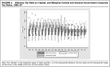
Figure 2 plots the effective rate of taxation on capital and the central and general marginal corporate tax rate. In 1980, the effective rate was 20 percentage points below the actual general government rate. By 1996–97, however, all three rates' medians had equalized. The average effective tax rate has remained remarkably stable over the 18 years in our data set, whereas marginal rates have decreased over time. All three measures of the tax burden have narrowed slightly over time, although this narrowing should not be exaggerated—there remains a 25 percentage point spread between the two whiskers of effective tax rates. Conventional stories of a “race to the bottom” would not expect such a large spread, nor would they anticipate that the effective tax rate on capital in aggregate has not changed appreciatively over the period.
Weighting Scheme
A final methodological issue concerns the weighting scheme we use in our regression analysis. Our model indicates that states consider what competitor states are doing with their tax policies. In empirical tests, how can one determine what a “competitor” country is in practice? We consider four alternatives. The first case is one where countries weight the probability of competing with another country based on the number of countries in the sample. That is, the likelihood that the United Kingdom competes with France for capital is simply 1/N, where N is the number of countries in the sample. We take the average values for the countries in the sample (excluding the country itself).
This weighting seems implausible, since presumably the United Kingdom competes for capital more frequently with France than with New Zealand. We therefore include in our empirical work three additional weights that governments themselves may use in evaluating potential competitors. The first weight is Gross Domestic Product (GDP), which captures the notion that states may pay greater attention to tax policies in larger economies than smaller economies; this weight appears commonly in the “gravity” models of international trade theory.21
Gravity models of trade also include a variable for the distance between countries. This variable is not relevant in our model because we assume that capital can travel across distances effortlessly compared to trade in goods.
The second weight is Foreign Direct Investment (FDI), capturing the notion that states are sensitive to capital
flows, i.e., that states pay attention to the tax profile of other states that have had recent success in attracting capital. The final weight is gross Fixed Capital Formation (FCF), capturing the notion that states are sensitive to capital
stocks, i.e., to potential, rather than actual, capital flows. In practice, these weighting schemes mean that changes in “larger” states should have a greater effect than changes in “smaller” states; that is, the United States' veto player profile or partisan profile should have greater effect on the “global” veto player ratio than an equivalent change in Finland.
22 It should be noted that we are weighting the impact of changes in tax rates, partisanship, etc., when we compute the relevant independent variable. This is not the same thing as computing a weighted least-squares regression.
Model Specification and Results
We include four control variables in our empirical analysis. The first is a country's economic growth rate (lagged one year since taxes are often levied on income generated in the previous year). When economic growth is strong, capital profits should increase and the share of firms paying capital taxes should increase as well, but when economic growth is weak, profits and the share of firms paying taxes should decrease, and tax cuts might be seen as an economic stimulus; we anticipate that the relationship between economic growth and the change in the capital tax rate will be positive. The second control variable that we include is a country's rate of inflation (also lagged one year), which can have two countervailing effects: On the one hand, inflation can increase profits so that the proportion of capital owners paying taxes increases; on the other hand, because one pays taxes based on income in the previous year, higher inflation reduces the effective tax burden. The third control variable that we include is the level of the tax rate (whether the marginal rate or the effective rate), since states with higher taxes may feel more pressure to initiate tax reform. Finally, we include the change in the tax rate on capital in competitor countries (using the four different forms of weighting competitor countries that we described above, to create a single index).
Let us now turn to examining four hypotheses derived from our theoretical model:
Hypothesis 1. Countries should engage in greater or more frequent tax reduction as the political costs of tax reform in the population of competitor countries decrease. Moves to the right politically or decreases in the ideological distance among veto players abroad reduce political costs.
Test of Hypothesis 1. World partisanship should have a negative coefficie nt; world ideological distance between veto players should have a positive coefficient.
Hypothesis 2. Countries should engage in greater or more frequent tax reduction as the decisiveness of tax reform in determining where investment will locate increases. Decreases in the use of capital reforms both abroad and at home increase decisiveness.
Test of Hypothesis 2. World capital controls should have a positive coefficient; domestic capital controls should have a positive coefficient.
Hypothesis 3. Countries should engage in greater or more frequent tax reduction as domestic political costs of tax reform—in the form of either transactions costs or constituency costs—decrease. Moves to the right politically or decreases in the ideological distance among veto players decrease costs.
Test of Hypothesis 3. Partisanship should have a negative coefficient; ideological distance should have a positive coefficient.
Hypothesis 4. Countries should be increasingly responsive to changes in tax rates abroad as the domestic political costs of tax reform and/or the domestic decisiveness of tax reform falls. The conditional coefficient of changes in tax rates abroad should increase as ideological distance decreases, partisanship moves to the right, and there are fewer capital controls imposed at home.
Test of Hypothesis 4. Conditional coefficients calculations (explained below).
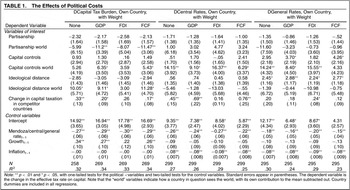
Table 1 displays regression results. The 12 columns correspond to four different weighting schemes (the unweighted model and the GDP-, FDI-, and FCF-weighted models), for three different dependent variables: the first quartet of regressions employs the change in effective tax rate on capital, the second quartet employs the change in central government's marginal corporate tax rates, and the third quartet employs the change in total marginal corporate tax rates.23
We also ran regressions with the absolute number of veto players instead of ideological distance. The results were broadly similar.
Results vary as a consequence of changing the dependent variable, thus we discuss the regressions using the effective tax burden separately from those using marginal rates.
24 The lag of the dependent variable was never significant, so we do not include it in the results. We also ran regressions assuming both a common AR(1) process and a panel-specific AR(1) process. The substantive results did not change under either assumption. We include country dummies to control for fixed effects, with the United States as the excluded dummy variable. We also reran the regressions with year dummies, although we do not report those results here. The advantage of including year dummies is that there may be year-specific effects that impact taxation levels that we address. The disadvantage is that they are highly correlated with the capital control variables; the mean variance inflation factor (vif) score, which indicates that there is no multicolinearity with a score less than one, is in the thousands when year dummies are included. As a result, some political variables have inflated coefficients. As Beck (2001) illustrates, including either country or year dummies in a regression when they are highly correlated with an independent variable of interest is problematic because of the effects on the coefficient of the independent variable. We therefore include country dummies but not year dummies. We also compute panel-corrected standard errors (Beck 2001). All regressions were run with Stata 8.
The effective tax rate regressions support two of the empirical hypotheses from our model when using either “stock” (GDP or FCF) variable as a weight for the political variables.25
The “nonstock” regressions also have variables with the same signs, although the political variables are often not significant. The difference between the “stock” and the nonstock results can be anticipated. It is unlikely that states treat each other equally in a competition game, which is the reason for including the weights and is the likely reason why standard errors are higher in the regression without weights. FDI net inflows, in contrast to the two stock variables, are more volatile. The correlation between the FDI in year t and that in year t−2, for example, is just .82, while it is .97 for gross capital formation. This suggests more “noise” in the use of FDI as one of the weights.
Hypothesis 1 anticipates that states respond to changes in the level of political costs among the states that are likely to be their competitors for capital. The second and fourth columns show that the “world” partisanship level is significant at the .01 level in the two regressions that weight countries' importance by their capital “stocks” (GDP or FCF). To get a sense of the practical effect of this variable,
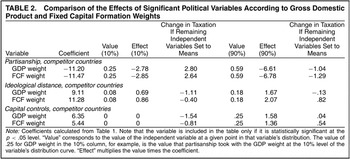
Table 2 displays the coefficients of significant political variables, the values those variables had at the 10% and 90% parts of their distributions, and the predicted value of the change in capital taxation if the remaining independent variables were set at their means. The table indicates that a rightward ideological movement in a given country's perception of competitor countries' partisanship leads to a decrease in the taxation of capital in one's home country. In the FCF-weighted model, a move from the 10% level (Japan's view of the world it faced in 1996) to the 90% level (Austria's view of the world in 1985) would lead to a cut in the taxation of capital of 3.93 percentage points. Holding the remaining independent variables at their mean valuess, the dependent variable's predicted value moves from a 2.64% increase in capital taxation at the first decile to a 1.29% cut in capital taxation at the ninth decile. Also consistent with Hypothesis 1, “world” ideological distance among veto players has the hypothesized effect in all of the regressions, and the coefficient is statistically significant at the .05 level in the GDP- and FCF-weighted regressions as well as in the unweighted regression.
Table 2 indicates that a decrease in a country's perception of competitor countries' transaction costs leads to decrease in one's own taxation of capital. In the FCF-weighted model, a move from the 90% level of veto players' ideological distance in competitor countries (how Denmark perceived the world in 1984) to the 10% level (how New Zealand perceived the world in 1987) leads to a decrease in the taxation of capital by 1.21 percentage points. Holding all independent variables other than world ideological distance at their means, the predicted value of the dependent variable changes from an 0.81% decrease in capital taxation at the first decile to 0.54% increase in capital taxation at the nineth decile.
The evidence from the effective tax rate regressions also supports Hypothesis 2: States are sensitive to changes in capital controls in competitor countries; this relationship has the correct sign in the first quartet of regressions and is statistically significant for both stock-weighted regressions. In the GDP-weighted regression, a move from the tenth to the ninetieth percentile in “world” capital controls leads to a 1.58% increase in the tax burden on capital. The FCF-weighted regression yields results that are similar in magnitude and statistical significance. We cannot, however, reject the null hypothesis that the domestic use of capital controls has no impact on tax reform decisions. This initial lack of evidence in the effective tax rate regressions regarding domestic politics obtains for Hypothesis 3, which predicts that domestic political costs should affect the degree of tax reform. The partisanship variable has the correct sign every time but never achieves statistical significance in the four effective rate regressions, and the ideological distance variable has the wrong sign.
The regressions employing marginal tax rates provide less evidence in support of Hypothesis 1 but do support Hypothesis 2: Changes in the use of capital restrictions in competitor countries do have a correctly signed and statistically significant effect in five of eight regressions. In other words, decreases in the world political costs of tax reform seem not to effect reductions in marginal tax rates, but a decrease in the world level of capital controls does lead to tax rate reduction. The regressions employing marginal tax rates provide stronger evidence for Hypothesis 3, which concerns the role of domestic political costs in the form of the ideological distance separating veto players. Countries in which the ideological distance among coalition partners is larger are less able to reduce their taxes. As mentioned above, partisanship again has the correct sign but is not statistically significant. Although changes in “world” partisanship or ideological distance do not appear to affect marginal tax rates at home, several control variables, especially domestic capital tax rates, have statistically significant effects in the expected direction. Thus, states with higher marginal rates make deeper cuts than states with lower marginal rates (although note that the intercept or constant term is positive, so this results does not constitute prima facie support for the race-to-the-bottom prediction). Furthermore, actual changes in marginal rates by competitor countries do lead to cuts in tax rates at home; note that our analysis is biased against finding consistent results regarding competitor countries' costs, since the actual changes—which are correlated with domestic political costs—are present and statistically significant in each regression and therefore “crowd” the partisanship and ideological distance variables.
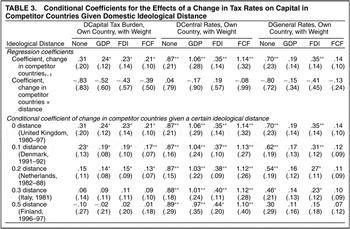
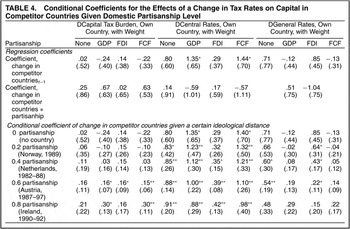
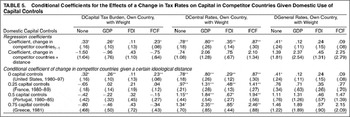
Let us turn our attention to Hypothesis 4, which predicts that the responsiveness of a country to changes in tax rates abroad is conditional upon domestic political costs. We perform the previous set of regressions again but now include the lagged change in tax rates and this variable's interaction with the domestic political cost variables. Tables 3 through 5 provide conditional coefficients for the range of values that ideological distance, partisanship, and capital controls take at home.26
Readers should note that the lag for change in competitor countries is interacted (instead of the nonlag version) because the interaction model is assuming that domestic players are responding to rate changes in place. The full set of results is available upon request. Essentially, the “world” results for ideological distance for the three dependent variables as well as the world results for capital controls in the statutory rate regressions remain as before. The world results for partisanship, however, weaken.
One should note that the interpretation of the coefficients of the interacted variables changes when an interaction term is introduced into the equation. The coefficient on ideological distance, for example, indicates the effects of distance only when the lag of the change in taxation in competitor countries is equal to zero. Similarly, the coefficient for the effects of the lag of the change in competitor countries indicates the effects of this variable when the ideological distance separating veto players equals zero.
Table 3 lists the conditional coefficients as well as standard errors for the effects of competitor countries' tax changes, based on the domestic veto player profile for the 12 regressions. In the effective rate regressions, the coefficients change consistently with theoretical expectations regardless of the weighting scheme. Countries' sensitivity to competitors' changes in effective tax rates increases as domestic ideological distance decreases, and they are most sensitive when ideological distance equals zero. Table 3 indicates that a country with great ideological distance between veto players (such as Italy's governing coalition in 1981) would not react to changes in effective rates abroad, while a one-party government (such as the United Kingdom during the entire period) would respond to changes in tax rates abroad by adjusting its own taxes by between 21% and 31% of the competitors' change. The marginal tax rate regressions using general government tax rates are substantively the same although less frequently significant, such that decreases in ideological distance at home do increase sensitivity to changes abroad. In contrast, ideological distance has little tangible effect on the conditional coefficients for central government rates.
Table 4 evaluates the effects of changes in tax rates abroad given domestic partisanship. The results are consistent with our theoretical expectations that a move rightward makes a country more sensitive to tax cuts abroad, although only for effective rates. A Labour government in Norway, for example, should act as if it is oblivious to competing countries' tax reforms, while a Fianna Fail government in Ireland should respond directly and proportionately to tax changes in other countries. The story is much the same for the effects of domestic capital controls, whose effects are evaluated in Table 5. When a country employs no domestic capital controls, like the United States for the entire period, countries react to changes in effective rates abroad. Any increase in domestic capital controls reduces states' sensitivity to other countries' changes, although again these results only accord to theory for our effective tax rate regressions.
Taken together, the empirical results suggest the following. First, governments are sensitive both to the threat of changes especially in effective tax rates abroad and to actual tax cuts by competitors. This sensitivity increases in four conditions: when capital restrictions are removed abroad, when no domestic capital controls are in place, when a “right” government is in power, and when the ideological distance between veto players is small. Simply, a prevalence of “right” governments and low-ideological-distance coalitions partners in competitor countries should lead the home country to lower the effective tax burden, especially when there are few restrictions on capital's movement. Meanwhile a prevalence of “left” governments and/or high–ideological distance coalitions abroad should allow a country to maintain or even increase the actual tax burden that capital pays. These patterns are less clearly supported for changes in statutory or marginal tax rates. Central government capital tax rates appear to be sensitive to changes abroad despite domestic costs, whereas domestic political costs have consistent direct effects, their indirect effects on a country's sensitivity to changes abroad in general government rates are ambiguous. It should be noted that this difference between effective and statutory rates parallels the findings of Swank and Steinmo (2002). Our empirical framework allows us to draw the additional conclusion that countries are conditionally sensitive to changes in competitors' rates, with ideological distance, partisanship, and capital controls all playing important roles.






Comments
No Comments have been published for this article.