


I. INTRODUCTION
The field of data mining for materials science and structure prediction is growing rapidly. Such an approach relies significantly on the availability of published crystal structures (Trujillo et al., Reference Trujillo, Gurung, Yu, Nayak, Alpay and Janolin2022). Many materials are not being studied as single crystals but rather as polycrystalline samples (“powders”), which is also usually the form that is relevant for applications. Structure determination from powder diffraction tends to be more challenging due to the lower number of inequivalent reflections. So, it is important to fully exploit the available data, including that from powder diffraction. While more and more studies are dedicated to structure prediction, the number of studies on structure determination from available data remains scarce (Reid et al., Reference Reid, Kaduk and Vickers2016; Reid and Kaduk, Reference Reid and Kaduk2021; Riesel et al., Reference Riesel, Mackey, Nilforoshan, Xu, Badding, Altman, Leskovec and Freedman2024).
Materials exhibiting the AIBIIXO4 (AI = alkali ion, BII = alkali-earth ion and related divalent ions, X = P, V, As) have been widely investigated due to their rich polymorphism (Isupov, Reference Isupov2002). While the phosphate family has been widely investigated, this is significantly less so for the other two families. Knowing that many materials within this family show interesting ferroelectric and ferroelastic properties, it is relevant to extend our knowledge of this class of materials. With this in mind, we have set out to investigate several vanadate compositions, namely AgCaVO4 and NaSrVO4 (Nénert, Reference Nénert2017; Nénert et al., Reference Nénert, O’Meara and Degen2017). In this paper, we report the crystal structure of another vanadate, RbCdVO4, using the reported experimental powder pattern that is contained in the ICDD PDF5 database as entry number 00-058-0728 (Zubkov and Tyutyunnik, Reference Zubkov and Tyutyunnik2007).
II. EXPERIMENTAL
A. X-ray powder diffraction and data preparation
The laboratory X-ray powder diffraction data have been reported with the entry PDF 00-058-0728 (Kabekkodu et al., Reference Kabekkodu, Dosen and Blanton2024). This measurement was collected with Cu Kα1 data within the 2Θ range of 2–120°. The chemical composition, based on weight percent, is as follows: Rb 27.3, Cd 36.9, V 16.3, and O 20.5. The sample was prepared by L. Surat at the Institute of Solid State Chemistry, Ural Branch of the Russian Academy of Sciences, Ekaterinburg, Russian Federation, from a mixture of RbVO3 (99.99%) and CdO (99.99%) at 870 K for 100 hours in the air. Powder diffraction was used as the source of the unit cell data.
B. Structure solution and refinement
Indexing of the pattern was performed using DICVOL (Boultif and Louër, Reference Boultif and Louër2004) as implemented in the HighScore suite (Degen et al., Reference Degen, Sadki, Bron, König and Nénert2014), using 20 reflections. The determined unit cells were a = 12.52 Å, b = 5.82 Å, c = 12. 47 Å, and β = 105.6° (F(20) = 41.2 (0.0078, 62)). This is in good agreement with the cell parameters mentioned in the entry number 00-058-0728 (Zubkov and Tyutyunnik, Reference Zubkov and Tyutyunnik2007). Refinement of the lattice parameters and peak-profile determination was performed by Pawley profile fitting, followed by a space group search (Markvardsen et al., Reference Markvardsen, Shankland, David, Johnston, Ibberson, Tucker, Nowell and Griffin2008) using the HighScore suite (Degen et al., Reference Degen, Sadki, Bron, König and Nénert2014). The compatible space groups were P21 and P21/m. Attempts to solve the crystal structure using the space group P21/m were unsuccessful. Consequently, we have attempted to use the space group P21.
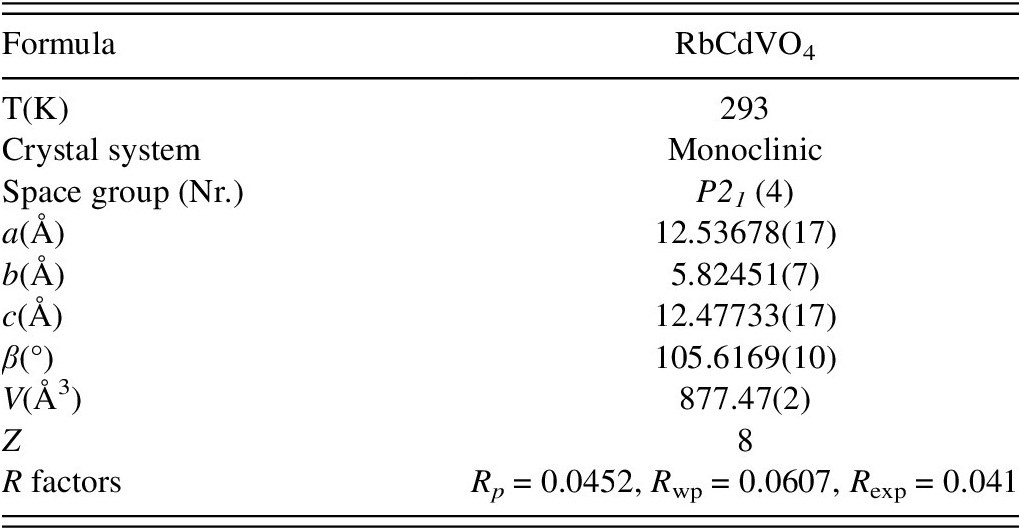
The structure solution was carried out using Charge Flipping as implemented within Jana2006 (Petricek et al., Reference Petricek, Dusek and Palatinus2014). Heavy atoms were easily found using charge flipping. Consecutive Fourier difference maps were used to locate the lighter vanadium and oxygen atoms. The last missing oxygen atom could not be located and had to be generated. Using bond angles and length restraints for the VO4 tetrahedra, the refinement quickly converged to acceptable values. U iso for all atoms were constrained to be equal as the data quality did not enable refining them independently. The final Rietveld fit is shown in Figure 1, while crystal data, data collection, and structure refinement details are summarized in Tables I and II.
Final Rietveld refinement of the phase RbCdVO4. The observed pattern (red dots), the Rietveld fit (black line), and the difference between observed and diffracted intensities (blue line) are shown together with the allowed Bragg reflections (green lines).

Data collection and structure refinement details of RbCdVO4

Atomic coordinates obtained from the Rietveld refinement of RbCdVO4

III. RESULTS AND CONCLUSION
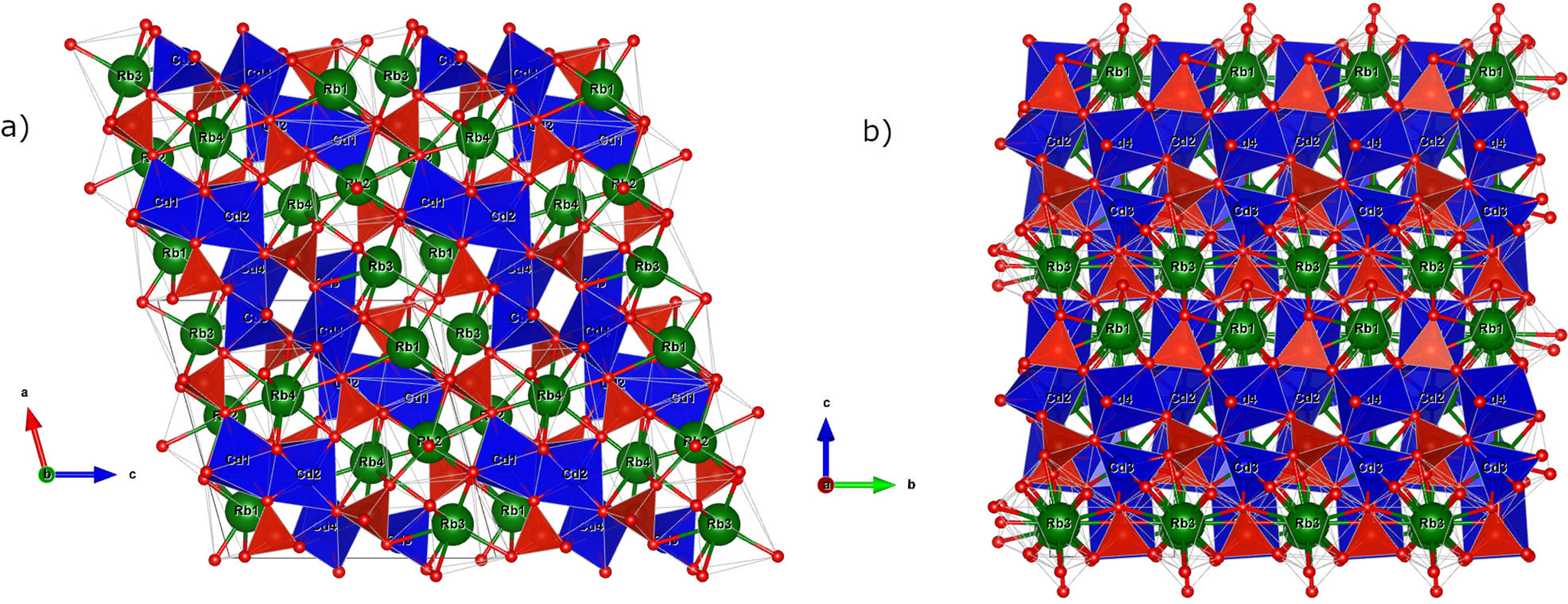
The crystal structure of RbCdVO4 is shown in Figure 2. The corresponding crystal structure cannot be related to any previously reported structures within the ABXO4 family. This is a completely different kind. Cd polyhedra are heavily distorted (represented in blue in Figure 2) as illustrated in the variation of the bond lengths given in Table III. Cd1/Cd2 polyhedra and Cd3/Cd4 polyhedra form dimers either sharing, respectively, a face or a corner. The dimers are connected via VO4 tetrahedra. The network of Cd polyhedra and VO4 tetrahedra forms channels propagating along the a-direction. Located in these channels are the heavy Rb atoms (green in Figure 2). While typically channels tend to contain the lightest elements, we notice that there are also heavy atoms occupying the channels in NaSrVO4 (Nénert et al., Reference Nénert, O’Meara and Degen2017). The environment of the various Cd atoms varies quite a bit. While the Cd1 and Cd3 polyhedra can be considered as an octahedron with small distortions, the octahedron of Cd2 is best described as a 4 short +2 long bond length. On the other hand, the Cd4 environment is strongly distorted and can be considered a strongly distorted square pyramid.
The crystal structure of RbCdVO4 projected along (a) the b-axis and (b) the a-axis illustrating the presence of channels occupied by the Rb atoms.

Selected bond lengths (in Å) as extracted from Rietveld refinement.

Such significant distortion of the Cd octahedra is not uncommon (Leclaire et al., Reference Leclaire, Grandin, Chardon, Borel and Raveau1993; Boudin et al., Reference Boudin, Grandin, Borel, Leclaire and Raveau1994); however, the strongly distorted square pyramid about Cd4 is rather unusual. However, we note that such an environment has been already reported for the compound Rb2CdSiO4 (Hansing and Möller, Reference Hansing and Möller2001).
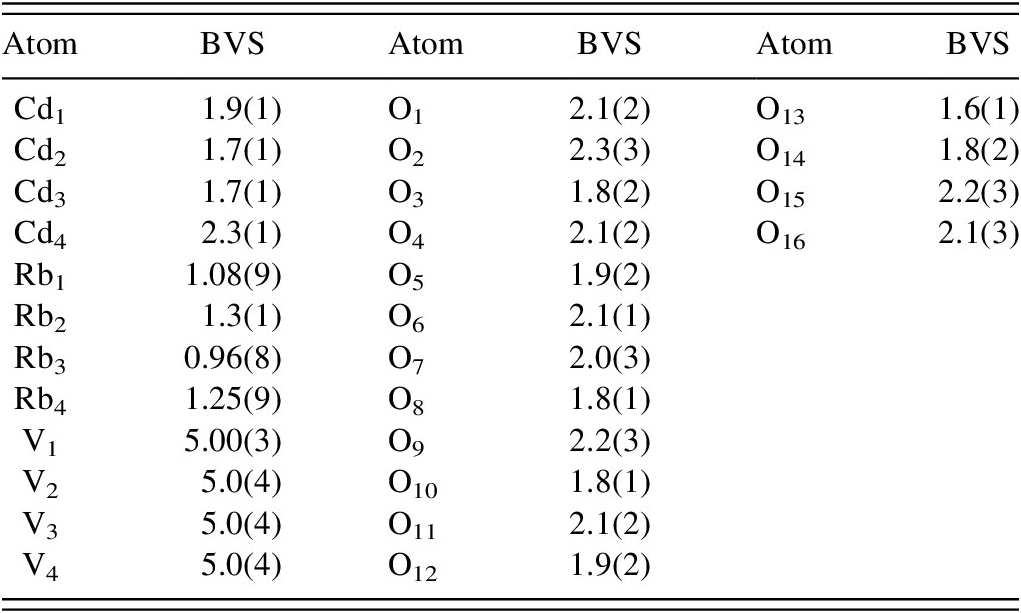
The bond valence sum (BVS) method is an important approach to assessing the chemical plausibility of inorganic crystal structure, and it can be used for the analysis of over- and underbonding effects (Brown, Reference Brown2009). Since we are dealing with a previously unreported structure type, we have run BVS calculations. We present in Table IV the BVS results for the various atoms. We find that the expected charges of the ions match reasonably well with the expected ones.
Bond valence sum analysis of RbCdVO4.

While the obtained BVS values are acceptable, note that the BVS for Cd2 and Cd3 are somewhat low. It turns out that Cd2 and Cd3 are the cadmium atoms with the strongest distorted environment. Even when using single crystal data, running a BVS analysis of the published data on Rb2CdSiO4 (Hansing and Möller, Reference Hansing and Möller2001) shows that the cadmium atom Cd1 has a significantly lower BVS compared with the Cd2 atom (1.8 vs. 2). Cd1 in Rb2CdSiO4 has a very similar environment to the Cd3 of our study, suggesting that the stronger the distortion, the further apart is the BVS compared with the expected value. Despite the lower precision of the as-determined structure compared to Rb2CdSiO4, it is remarkable that similar lower charges are found in the most distorted environment of cadmium.
Finally, as the structure was solved in the P21 space group, we have been investigating possible pseudosymmetry using the PSEUDO program (Capillas, Reference Capillas, Tasci, de la Flor, Orbengoa, Perez-Mato and Aroyo2011) from the Bilbao Crystallography Server to search for possible overlooked symmetry or possible displacive phase transition. Within the tolerance of 0.8 Å, no pseudosymmetry could be found. This suggests that while this material could potentially be used for nonlinear optical applications, ferroelectricity is likely to be absent. This work shows that if powder diffraction patterns associated with entries within the ICDD database are of sufficient quality, they can be used for structure determination even in the case of a rather complex structure (here, there are 28 atoms in the asymmetric unit cell).
DEPOSITED DATA
The CIF file related to these data is deposited with the ICDD. This can be requested by contacting ICDD at pdj@icdd.com.
COMPETING INTERESTS
The author declares no competing interests.