Introduction
Schubert’s setting of Psalm 92 (verses 2–9) is an extraordinary piece. Contextualizing it requires knowledge of Jewish liturgy, of Hebrew pronunciation and of the history of the Jewish community in Vienna, as well as a recovery of the nature of Schubert’s acquaintance with that community’s most celebrated musician, cantor Salomon Sulzer (1804–1890). The latter aspect has been dealt with on the basis of anecdotal evidence and conjecture and, barring dramatic new discoveries, must remain on such unsatisfactory footing. With regard to the other aspects, however, the discovery of a manuscript, the earliest extant source of the piece, enables and occasions a fresh scholarly look at Schubert’s only Hebrew composition.Footnote 1
Historical Background
We know that in the summer of 1828 Franz Schubert set the first part of Psalm 92 in Hebrew for four-part choir and baritone solo.Footnote 2 Based on its publication history and circumstantial considerations, it is fair to assume that the piece was intended for use in the Vienna synagogue, the Stadttempel (also called Seitenstettentempel), opened two years earlier. If we add to these considerations subsequent writings on the genesis of the piece, often in the hagiographic mode, we may be forgiven for believing that Schubert wrote this piece as a token of esteem for his friend Salomon Sulzer, the synagogue’s young prodigy cantor.
The piece was first published around 1840 in a volume of synagogue music collected by Salomon Sulzer. Bearing the Hebrew title Schir Zion, or Song of Zion, the volume contains works by Sulzer and other Viennese composers, including Ignaz Ritter von Seyfried (1776–1841), Joseph Fischhof (1804–1857), Wenzel Wilhelm Würfel (1790–1832), Franz Volkert (1778–1845), and, not least, Franz Schubert. Rooted in the classical idiom and relying on contributions by non-Jewish composers, Schir Zion marked a new approach to Jewish liturgical music; it was to become the core of the modern synagogue repertoire practised in Vienna. In Schir Zion, Schubert’s psalm setting is grouped with pieces for the Sabbath Evening worship service. The composition following it picks up the psalm text at the point where Schubert’s piece concludes. The simple recitative style of the latter piece, apparently for the cantor, suggests that it was included as a gap-filler to bring the psalm text to its rightful conclusion. Before Schir Zion was published (in 1840), it circulated in manuscript form. However, Eduard Birnbaum (1855–1920), a student of Sulzer’s and an outstanding collector of Jewish liturgical music and manuscripts, reports that none of the manuscript versions of Schir Zion known to him contained the Schubert setting of Psalm 92.Footnote 3
The published version of Schir Zion, which did contain Psalm 92, may have helped obscure this late Schubert composition from wider notice. Sulzer asserts that he had printed 1,000 copies of Schir Zion,Footnote 4 of which most, presumably, went into Jewish hands. In any case, being set in Hebrew, Schubert’s piece would have had little resonance in non-Jewish circles. The first attempt to render the piece in German, in a translation by Franz Flatz, is documented by a manuscript dating from 1858. It may have been the second edition of Schir Zion, published in 1865, that finally brought Schubert’s Psalm 92 to the attention of a wider musical public. It is perhaps no coincidence that in the same year we find a second rendition in German. This time Moses Mendelssohn’s elegant translation of the Hebrew Psalm provided the textual basis. Five years later, this German version appeared in print.
Sources
Today the most authoritative edition of Schubert’s Psalm 92 is in a recent volume of the Neue Schubert Ausgabe (henceforth NSA). The NSA reproduced the Hebrew setting and the German version with Moses Mendelssohn’s translation,Footnote 5 employing separate sources and stemma for each.Footnote 6 The main source for the Hebrew version in the NSA edition was a manuscript copy, source B, preserved in the Witteczek-Spaun collection, dating back to 1834 or 1835 (henceforth ‘Witteczek-Spaun’). In cases of doubt concerning the text underlay, Schir Zion, source D, was also treated as a primary source. These two primary sources, B and D, seem to have derived independently from the lost autograph. The German version based on Franz Flatz’ translation also appears to have derived independently. The NSA considers it source E, using it as a secondary source for the music.
According to Otto Erich Deutsch, in his thematic catalogue of Schubert’s works, first published in 1951, the autograph of Psalm 92 was lost, but had formerly been in the archive of the Viennese Jewish community. Deutsch (1883–1967) cites the aforementioned Birnbaum as the source of his information. Birnbaum, for his part, writing in 1897, cites Deutsch’s predecessor, Gustav Nottebohm (1817–1882), a pioneering figure in the study of musical sources. Nottebohm, who was especially noted for his study of Beethoven, produced the first catalogue of Schubert’s published works. It was Nottebohm who, in 1874, ascribed the autograph of Schubert’s Psalm 92 to the Jewish community archives in Vienna.Footnote 7 We do not know if Nottebohm ever viewed the autograph there; gathering the information he presents in his catalogue would not have required that he do so.Footnote 8 It is significant, however, that he refers mainly to the German version of the piece, mentioning the original Hebrew version and Sulzer’s first printed edition only as an aside.Footnote 9 Birnbaum, at the end of the nineteenth century, apparently did try to gain access to the autograph in Vienna. In any case, it was he who recorded its absence.
The New Source
Absent the autograph, the earliest extant source for Schubert’s Psalm 92 takes on a special significance. The earliest source until now, the Witteczek-Spaun manuscript (1834 or 1835), postdates the composition of the piece (and Schubert’s death) by six or seven years. Recently we have discovered an earlier manuscript source, in a volume embossed on its back cover with the date ‘1832’. The manuscript is in bound, oblong format (23.5 cm×32.0 cm, 172 pages) and contains 92 liturgical pieces in Hebrew. The beautiful Hebrew script, evidently the work of someone with knowledge of the craft of writing a Torah scroll, suggests that the volume was designed for Jewish use. The gold lettering on the front cover – ‘Gottesdienstliche Gesänge der Israeliten in Wien’ – connects the manuscript to the Viennese Jewish community. Henceforth we shall refer to this new source as ‘Israeliten’.Footnote 10 The provenance, purpose and ownership of ‘Israeliten’ are the proper topic of a further article by the present authors. Suffice it here to say that the volume may represent a step in the process of codifying the new liturgical repertoire of the Stadttempel – a process that culminated with the publication of Sulzer’s Schir Zion.Footnote 11
Schubert’s piece is labelled ‘No 7’ in ‘Israeliten’, where it fills seven manuscript pages (11–17). On the first page, the biggest visual element is the tempo indication ‘Andante’. To its right, written closely above the top stave, is the remark, ‘an ausgezeichneten Samstagen wird folgendes  gesungen’ (‘the following tov lehodos is sung on special Saturdays’). The scoring is given as ‘Sopran 1mo’ and ‘Sopran 2do’ (both using C1 clefs), ‘Tenoro’ (C4), ‘Basso’ (F4) and ‘Baritono Solo’ (F4). Only in the index at the end of the volume does Schubert’s name appear.
The arrangement of systems indicates that the copyist planned his work on Schubert’s piece carefully. The first and last pages (manuscript pages 11 and 17, respectively) each have three four-part systems, making economical use of the 12 available staves and containing almost all the music for choir without the baritone soloist. (The other pages all have two five-part systems.) The second page uses two five-part systems even though the solo stave is as yet empty. This choice creates a visual build-up to the baritone entrance, which falls neatly at the top of the third page.
Schubert’s piece in the ‘Israeliten’ manuscript has been subject to a number of creative and correcting hands. One hand, probably the earliest, copied the music, tempo indications and most of the text (bars 23 to 25 were left untexted). A later hand added the aforementioned titular phrase. The Hebrew part of that phrase, (tov lehodos, the actual title of the piece), may well have been executed by yet another hand. Finally, the margins and the score itself bear comments and corrections in pencil.
We will now consider the relationship of the new ‘Israeliten’ source to the other sources for Schubert’s Psalm 92. In its use of C-clefs, the new source resembles the version published in the first edition of Schir Zion. Indeed, Sulzer printed all the pieces there using C-clefs combined with an F-clef for the bass. Although Schubert, in his autograph scores, exercised flexibility in his choice of clefs, it should be noted that he used C-clefs in other works written around the same time as Psalm 92, including his fair copy of ‘Ständchen’ D. 920, the vocal score of ‘Glaube, Hoffnung und Liebe’ D. 954, and the Tantum Ergo in E-Flat D. 962. By contrast, the manuscript of Psalm 92 in the Witticzek-Spaun collection employs the more modern G-clef. Similarly, the part names are the same in ‘Israeliten’ and Schir Zion, but different in Witteczek-Spaun (which is scored for ‘Baritono Solo’, ‘Soprano’, ‘Alto’, ‘Baritono’ and ‘Basso’).
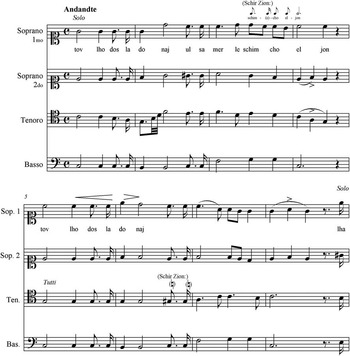
With regard to the music itself, however, some readings in ‘Israeliten’ differ from those in Schir Zion, but are identical to those in Witteczek-Spaun. In bar 6, for example, the Tenor’s g′♯, echoing the harmonic progression in bar 2, is a reading shared with Witteczek-Spaun but not found in Schir Zion, where a g′ appears (Example 1).
Schubert, Psalm 92, bars 1–8 (as in ‘Israeliten’ manuscript. Variant readings from Schir Zion in small type).

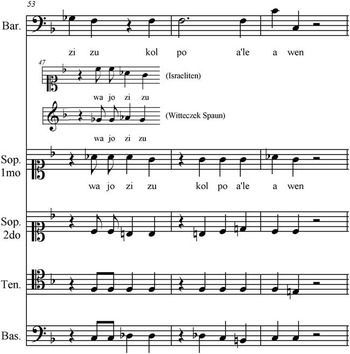
In other cases, ‘Israeliten’ offers independent readings. In the verse ‘Wajozizu kol poale awen’, for example, in bar 53, Schir Zion and the source based on the Franz Flatz translation agree on the Soprano Primo’s a′♭, while an obvious scribal error mars Witteczek-Spaun.Footnote 12 ‘Israeliten’ suggests a third, viable reading (c′′) (Example 2).
Schubert, Psalm 92, bars 53–55 (as in the first edition of Schir Zion). Variant readings from ‘Israeliten’ manuscript (corresponding bars 47–49) and Witteczek-Spaun manuscript.

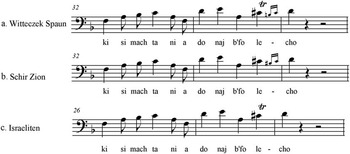
The treatment of ornamentation near the end of the Solo Baritone’s first phrase offers more variant readings. Witteczek-Spaun calls for a trill on c′♯ followed by a lower-neighbour (b) suffix (Example 3a). Schir Zion, on the other hand, omits the trill sign but prescribes a chromatic lower-neighbour (b♯) (Example 3b). This less-than-obvious choice may reflect Sulzer’s own idiom of ornamentation. By contrast, ‘Israeliten’ suggests a trill without a suffix (Example 3c). As will be argued below, such differences may be understood as more than simple textual variants; rather, they may reflect different levels of interpretative notation. With a specific soloist (Sulzer) in mind for Psalm 92, Schubert may have felt it unnecessary to specify each and every ornamental suffix. The earliest source – ‘Israeliten’ – may thus reflect intentionally unspecific notation on Schubert’s part. The two later sources, intended for audiences outside the Viennese Jewish community (Schir Zion) or even outside Jewish circles altogether (Witteczek-Spaun), no longer reflected the composer’s acquaintance with the soloist and needed to be more specific.
Schubert, Psalm 92, bars 32–34. Differing ornamentation in Baritone part. (a) Witteczek-Spaun manuscript (b) Schir Zion (c) ‘Israeliten manuscript’ (corresponding bars 26–28).

As we have noted, the editors of the NSA relied on Sulzer’s Schir Zion as the final word in all matters textual. Indeed, they had good reason to do so. Produced by and for people who understood Hebrew, Schir Zion possesses authority as a ‘Jewish’ source. The Witteczek-Spaun manuscript, by contrast, is not a Jewish source. It is therefore not surprising that here we find numerous inaccuracies, such as truncated (incomplete) verses and inconsistent and sometimes incorrect transliteration. Even in passages where Witteczek-Spaun is free of errors, the editors of the NSA often discarded its text underlay in favour of Schir Zion’s.
Our new source, ‘Israeliten’, puts things in a somewhat different light. Although clearly a Jewish source, ‘Israeliten’ often disagrees with Schir Zion on matters of text underlay, instead offering readings shared by the ‘non-Jewish’ Witteczek-Spaun. In the first verse, for example, ‘Israeliten’ and Witteczek-Spaun both accentuate the first syllable in the word ELJON ( , Heb., ‘Most High’), thus disagreeing with Schir Zion’s accentuation of the last syllable – ELJON (Example 1).
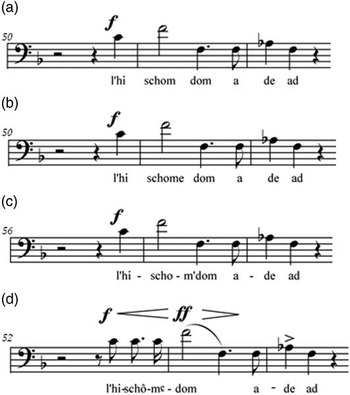
The word L’HISCHOMDOM ( , Heb., ‘[in order that] they be destroyed’) offers another example: ‘Israeliten’ and Witteczek-Spaun divide the syllables as L’HI-SCHOM-DOM, whereas Schir Zion groups the consonants as L’HI-SCHO-M’DOM (Examples 4a and 4c). Both readings are viable musical resolutions of the Hebrew. At some point, the pencil hand in ‘Israeliten’ added an ‘E’ between the ‘M’ and the ‘D’ (in bar 51). This solution follows the syllabic grouping found in Schir Zion, but goes even further, adding a full-fledged syllable (Example 4b).
Schubert, Psalm 92, bars 50–52. Differing text underlays for the Hebrew word L’HISCHOMDOM (a) ‘Israeliten’ manuscript (early hand) and Witteczek-Spaun (b) ‘Israeliten’ manuscript (later hand, pencil) (c) first edition of Schir Zion (corresponding bars 56–58) (d) third edition of Schir Zion, edited by Joseph Sulzer (corresponding bars 52–54).

While scholars may settle upon a single ‘correct’ transliteration for a given word, Biblical Hebrew, like other languages, allows some flexibility with regard to syllable division, especially when set to music.Footnote 13 The layers of hands in the ‘Israeliten’ manuscript, however, reflect a process wherein the theoretical ‘correctness’ of the transliteration gained in importance. Indeed, in order to accommodate the four-syllable variant L’HI-SCHO-ME-DOM, Salomon Sulzer’s son Joseph, in his republication of Schir Zion in 1905, went so far as to modify radically the musical rhythm (Example 4d). Other passages marked by pencil revisions in the ‘Israeliten’ source likewise received ‘corrective’ treatment by Joseph Sulzer.
In two crucial respects, however, ‘Israeliten’ demonstrates independence from both the Witteczek-Spaun and the Schir Zion sources for Schubert’s Psalm 92. First, the newly rediscovered Israeliten manuscript is unique in that its final cadence ends with L’OLOM ADONOJ ( , Heb., ‘In eternity, Lord’), the final two words of the original Hebrew verse. All other sources end with repetition of the penultimate word, L’OLOM (‘in eternity’). Here the ‘Israeliten’ source may be following a liturgical principle sometimes observed in setting Hebrew texts for synagogue use, namely that the original word order of sacred texts should be preserved, and repetition of words avoided. The fact that ‘Israeliten’ appears to follow this principle, while our other sources do not, may hint at a modification made in reaction to, or anticipation of, objections raised by the religious leadership of the community. If there is substance to this conjecture, it would in turn reaffirm that at some point Schubert’s Hebrew composition was, in fact, used in the synagogue.
The second difference concerns antiphonal symmetry – or lack thereof. In both Schir Zion and Witteczek-Spaun, the first three verses of the psalm, in C major, stretch over 28 bars, with each verse assigned once to four soloists and once to the choir for repetition. ‘Israeliten’, by contrast, omits the final choral repetition of the first section, flowing instead directly from the soloists’ statement of the third verse into the solo opening of the second section. As a result, the ‘Israeliten’ version of Psalm 92 is six bars shorter than the other two versions.Footnote 14
The disagreements between ‘Israeliten’ and Schir Zion, the ‘Jewish’ sources for Schubert’s Hebrew psalm, may lead us to re-evaluate the Schir Zion version. Perhaps the decade or so between Schubert’s death and the appearance of his Psalm 92 in Sulzer’s Schir Zion should alert us to the possibility that Sulzer delivered not a reproduction of the autograph, but an adaption.
Indeed, the variety of disagreements among all three Hebrew sources – ‘Israeliten’, Schir Zion and Witteczek-Spaun – all of which are situated at the same stemmatic level, may lead us to reconsider their stemmatic relationship to the lost autograph. One conclusion that some musicologists would be reluctant to embrace might be that the final state of the autograph was imprecise, or incomplete, on some difficult points. This may be a unique case in the Schubertian corpus in that, because of the Hebrew language, Schubert probably did not consider himself qualified to render a fair copy, at least not on his own. It is possible that he concluded his efforts with the production of a readable ‘rough draft’ to which Sulzer could set the text underlay according to his views on the subject. In fact, in the essentially oral tradition within which Sulzer was rooted, there may have been no need for a fair copy of Schubert’s synagogue composition. Of course, Schubert’s autograph probably did provide an ad hoc solution to the text underlay challenge; after all, Schubert himself must have had some textual basis from which to work. But as the work moved beyond the Stadttempel, it left behind the warmth of a local, living performance tradition and thus had to be codified more conclusively. Initially, synagogue musicians working from Schubert’s autograph, or from copies of the autograph, probably faced the task of resolving the syllable placement – and probably did so with confidence. By 1905, however, when Joseph Sulzer republished Schubert’s Psalm 92 in his edition of his father’s Schir Zion, times had changed. Demand for the Viennese liturgy had long since spread throughout Europe and across the Atlantic. By then, many consumers of Schir Zion would have found the task of resolving ambiguities of text underlay much more difficult.
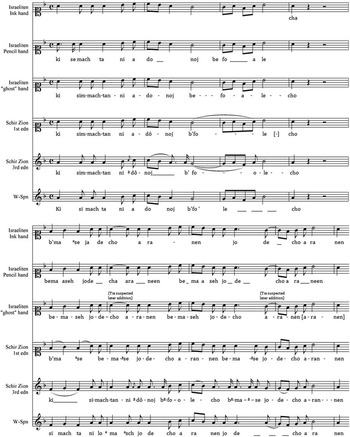
As we have seen, two distinct hands, one in ink and one in pencil, applied text underlay to Schubert’s piece in ‘Israeliten’. There is, however, also a third hand, which may reflect the text underlay in a parent manuscript, possibly even Schubert’s autograph. It is an invisible hand, betrayed only by the musical notation, in particular by the beaming of quavers and slurs. Indeed, copyists of Sulzerian and Schubertian circles seemed to have understood musical notation as indicative of melismata. Bars 23–31 (Example 5) provide a case in point. In the first edition of Schir Zion, beamed quavers (bars 29–30) and slurs (bar 27) consistently indicate melismata. Joseph Sulzer paid the same attention to fine notational detail in his edition of Schir Zion (for example, bars 24–25), as did the anonymous copyist of Witteczek-Spaun. In ‘Israeliten’, by contrast, the text underlay conflicts with the beaming and slurring (for example, in bars 28–29). For whatever reason, the copyist of the inked text in ‘Israeliten’ apparently discarded the text underlay of the parent manuscript, implementing another solution in its stead. Yet traces of the parent underlay remained in the slurs and beaming, which had already been preserved by the musical copyist. Thanks to the clues offered by the musical notation, ‘Israeliten’ effectively transmits not two, but three hands that tackled the problem of text underlay. In reverse chronological order: a pencil hand, an ink hand, and a ghostly third hand. All three should be considered separate, and equal, sources.
Schubert, Psalm 92, Soprano 1mo part, bars 23–31. Differing text underlays. ‘Israeliten’ Ink hand, ‘Israeliten’ Pencil hand, reconstructed ‘Israeliten’ underlay according to notation and beaming, Schir Zion first edition; Schir Zion third edition; Witteczek-Spaun.

Thus, we can see that the significance of ‘Israeliten’ as a source for Schubert’s Psalm 92 is two-fold. First, it provides numerous early readings. Second, it helps us observe copyists and editors wrestling with the Biblical Hebrew of Schubert’s Psalm 92, describing in the process a trajectory away from the performance practice of the original soloist and toward increasingly specific and prescriptive notation for general use. Essentially, we are witnessing here the transformation of Schubert’s Hebrew composition – parallel to the transformation of Jewish liturgical music as a whole – from an oral to a written tradition.
Conclusion
In this paper, we have presented a new, independent source for Schubert’s Psalm 92, a source that offers us several readings that differ from the main sources available until now, Witteczek-Spaun and Schir Zion. Our new source, the ‘Israeliten’ manuscript, adds a third dimension to the genealogy of the piece. ‘Israeliten’ calls into question the authority of Schir Zion with regard to the underlay of the Hebrew text. It implies that Schubert’s lost autograph may not necessarily be the immediate parent, in the usual sense of the word, of the sources available to us. It even suggests a detail or two about how the first parent, Schubert’s lost autograph, may have looked.
Biblical Hebrew, the original language of the Psalmist, presents a problem for the musicologist, as it did for the composer. The new source shows that no single solution to the challenge of Hebrew text underlay was obvious to the Jewish recipients of the piece, let alone to Schubert, its non-Jewish composer. By extension, the language difficulty in this particular case casts the Urtext ideal in a different light. A fair copy may never have existed. The lost autograph, if ever found, might not eliminate the difficulty of creating a conclusive critical edition.
In fact, the numerous variant readings among the relatively few extant sources (of which three sets of readings, preserved by hands ghostly, ink, and pencil, are given in ‘Israeliten’), open a window onto issues of music and text, revealing a dramatic shift over time. The initial textings of Schubert’s Psalm 92 in ‘Israeliten’ treat the language as a plastic entity that enables a simple notational rendition of lurking syllabic complexities, allows some freedom to the performers and avoids any authoritative statement on textual ‘correctness’. The ‘pencil’ hand in ‘Israeliten’ reveals discomfort with this linguistic ambiguity. By the end of the process, Joseph Sulzer commits himself fully to textual ‘correctness’ – and thus primacy of the text, resulting in dramatic changes to Schubert’s music.
If found, of course, the autograph would have significance for the story behind the piece. Sulzer family tradition held that Schubert composed his Psalm 92 for Salomon Sulzer as an esteemed personal friend. By the time of Sulzer’s death in 1890, Schubert’s autograph would have become a valuable family heirloom. Is it plausible that it would have languished unattended in an archive? Sulzer had 14 children; several became accomplished musicians in their own right. Certainly the autograph would not have escaped their attention. In a footnote to his 1905 republication of Schir Zion (in 1905), however, Joseph Sulzer mentions ‘Schubert’s manuscript’ without indicating its whereabouts nor whether he had ever consulted it.Footnote 15 There is no telling to what parts of the world Salomon Sulzer’s descendants might have taken Schubert’s autograph of Psalm 92.