
I. INTRODUCTION
Intense research activities and development in alternative and sustainable energy sources are stimulated by increasing global demand of electrical energy for portable electronics and mobile technology. The electrochemical energy storage systems (supercapacitors and pseudocapacitors) represent efficient and environmentally benign technologies as compared to intermittent solar and wind energy sources. Electrochemical supercapacitors are playing a vital role due to high power density, fast power delivery and long cycle life. These characteristics are complementary to batteries for uninterruptible back-up power supplies, load-leveling, power brakes in hybrid automobiles and hybrid electronics. Reference Lu, Zhao, Zhang, Li, Wang and Wang1,Reference Rajesh and Kumar2 Important to mention, the charge storage mechanism in supercapacitors are classified into: (i) electrochemical double layer, where the electrostatic charge is accumulated through surface ion adsorption on electrodes surface and (ii) pseudocapacitors, where charge is transferred in redox materials without altering the structure and composition (non-faradaic) that is stark contrast to battery processes which are faradaic. While supercapacitors possess higher theoretical specific capacitances due to higher specific surface area and higher power density, pseudocapacitors are also attracting attention owing to high energy density. Reference Zhu, Murali, Stoller, Ganesh, Cai, Ferreira, Pirkle, Wallace, Cychosz, Thommes, Su, Stach, Ruoff, Miller and Simon3–Reference Augustyn, Simon and Dunn6 Interestingly, in practical supercapacitors the two energy storage mechanisms often work concomitantly and their performance are expected to lie along Ragone plots diagonal. Since their inception, considerable efforts are devoted to explore high-performance electrodes with optimum surface morphology and microstructure. Among several electrode materials, while a range of nanocarbons showing supercapacitive behavior include activated graphene, Reference Simon and Gogotsi7 activated carbon (AC), Reference Gupta, Price and Heintzman8 nanoporous carbon from metal–organic frameworks, carbon nanotubes, Reference Gupta, Hughes, Windle and Robertson9 graphene (mono- to multi-layer, MLG) and functionalized graphene (graphene oxide; GO and reduced GO; rGO), semiconducting or π-conjugated polymers Reference Heinze, Fontana-Uribe and Ludwigs10–Reference Gupta and Price14 and transition metal oxides (TMeO)/hydroxides Reference Makino, Yamauchi and Sugimoto15–Reference Jing, Yang, Zhu, Hou, Wu and Ji20 such as RuO x , Mn x O y , Co x O y , VO x , FeO x , NiO, Ni(OH)2, Co(OH)2 exhibited attractive performance as pseudocapacitors. In spite of extensive exploit of diverse nanocarbons and transition metal oxides, they show limitation by themselves due to insufficient electrochemical activity, lifetime and high cost. The interest in strategic combination of TMeO and low-dimensional carbons is relevant since it generates synergistic and complementary effects yielding versatile properties to fit new functions for electrochemical (supercapacitor cathodes and battery anodes) and electroanalytical (chemical and biological sensing) applications, which is the focus of this study. Moreover, since the performance efficiency and specificity of energy storage devices depends on the design and architecture, understanding and controlling surface (redox) chemistry and physical–chemical processes is pivotal for the design of novel supercapacitors and sensing platforms. Alternatively, multifunctional hybrid electrodes assembly with strongly coupled inorganic/nanocarbon interfaces promote effective surface charge transfer and faster electron/ion transport (charging–discharging). Reference Dai21–Reference Huang, Qi and Zhang23 The continued interest in ‘hybrid’ supercapacitors (asymmetric and symmetric coin-like configurations) with pseudocapacitive contribution Reference Conway, Bliss and Wojtowicz24,Reference Lee, Yun, Park, Sharma, Song and Kim25 as alternative electrochemical energy storage devices is actively pursued due to their complementarity (i.e., coexistent specific energy and power densities, long cycle life, wider potential window and thermal operating range, low maintenance cost), as opposed to rechargeable secondary lithium-ion batteries and fuel cells.
Hybrids composites containing metal–graphene interfaces (see Fig. S1, Supplementary Material) are generally developed for numerous electronic, electrochemical, electroanalytical, and biological applications. Graphene which is a seamless atomic-thin sheet of sp 2 bonded carbon (sp 2 C) atoms has extraordinary physicochemical properties created classically for nanoelectronics and more recently it is an emerging candidate for electrochemical energy systems due to excellent specific surface area (∼theoretical approximately 2630 m2/g), higher electrical conductivity and mechanical strength. Likewise, graphene derivatives or functionalized graphene including GO with various surface functional groups and its reduced form (rGO) prepared using different reduction methods are equally promising. While epoxide (–O–) and carboxyl (–COOH) groups located on basal plane are major components, carbonyl (–C=O) and hydroxyl (–OH) distributed at the edges of nanosheets are minor components and preferential reduction of basal plane functional groups produces its reduced form using chemical (rGO), electrochemical [electrochemically reduced GO (ErGO)], and thermal (rGOHT) methods. Reference Gao, Jang and Nagase26 The present work integrates multilayer graphene (MLG on Ni foam) and a suite of functionalized graphene supports decorated with cobalt-based nanomaterials to form hybrid assembly platforms. The field of electrocatalysis has undergone tremendous advancement, in part, owing to improvements in cost-effective nanoscale design of non-noble-metal based stable (corrosion resistant) and efficient catalytic platforms as compared with expensive platinum catalysts. Reference Deng, Lia, Qiua, Zhoub and Hou27,Reference Wang, Dong, Wen, Li, Xiong and Chen28 They are also crucial for realization in alternative energy technologies (e.g., alkaline-based fuel cell, metal–air batteries, water splitting and flow cell). Through the development of novel synthesis methods, characterization techniques and theoretical methods, rationally designed nanoscaled electrocatalysts with tunable activity and selectivity are achieved.
Among conventional methods used to prepare metal oxides are chemical solution-phase, Reference Toupin, Brousse and Belanger29–Reference Meng, Chen, Zhao, Huang, Zhu, Huang, Fu, Geng, Yu, Chen and Zhi31 electrodeposition, Reference Makino, Yamauchi and Sugimoto15,Reference Ghosh, Ra, Jin, Jeong, Kim, Biswas and Lee32,Reference Zhao, Yang, Zhang, Feng and Zhang33 and hydrothermal synthesis. Reference Li, Zhang, Ji, Li, Zhao, Bai, Fan, Zhang and Ruoff34–Reference Zhao, Zhang, He, Zhang, Xia and Gao37 As for graphene nanosheets (GNSs), chemical vapor deposition produces monolayer to MLG, Reference Zhang, Zhang and Zhou38 modified Hummer’s method for GO Reference Hummers and Offman39,Reference Park, An, Potts, Velamakanni, Murali and Ruoff40 followed by chemical, Reference Eda and Chowalla41 electrochemical, Reference Viinikanoja, Wang, Kauppila and Kvarnström42 or thermal Reference Gao, Jang and Nagase26 reduction to yield its reduced form. The electrodeposition is recognized as a technologically feasible and economically superior technique for manipulation of nanostructures at either nucleation or synthesis stage for non-precious metal oxide-based electrocatalysts, key to offering unique physical–chemical properties. The electrodeposition proceeds through potential-assisted redox mechanisms of metal salts. On the other hand, the hydrothermal synthesis is based on chemical reactions involving the reagents containing corresponding metal element at high temperature and pressure in an autoclave environment that is Co2+ ions crystallized to Co3O4 nanostructures and simultaneous reduction of GO to rGO forming Co3O4/rGOHT hybrids. For these two preparation methods, the productivity and the size (on substrates) of the resulting products is governed by reactions driven by difference in redox (reduction/oxidation) potential. For example, the electrodeposition of manganese oxide (MnO2), various reducing agents such as manganese sulfate, potassium borohydride, hydrochloric acid, ethylene glycol, and carbon to reduce KMnO4 are utilized. Likewise for CoO/Co and Co3O4, cobalt nitrate, cobalt chloride, and cobalt carbonates in the presence of ammonia hydrate, cobalt diacetate, urea, and tartrate are used to reduce or oxidize their salts.
This work specifically prepares chemically bridged hybrids comprised of various graphene (MLG, GO, rGO, and ErGO) nanosheet supports decorated with cobalt oxide polymorphs (CoO and Co3O4) and cobalt nanoparticles (CoNP). Alternatively, the hybrid supercapacitors (i.e., supercapacitors with pseudocapacitive contribution) and electroanalytical platforms for enzymeless glucose sensing are prepared using versatile electrodeposition and facile hydrothermal synthesis approaches, with tunable surface morphology, tailored interfaces, optimized loading, and compositions, and mesoporous two- and three-dimensional graphene network channels with higher specific surface area. We synthesized and characterized these hybrids in terms of their microscopic structure and investigated their electrochemical and electrocatalytic properties with wide experimental parameter space (deposition time, environment, temperature, post-thermal treatment, and glucose concentration). This could affect the extent to which GO is chemically or electrochemically reduced, the composition, crystalline phases and rich surface/grain boundary and edge chemistry. We anticipate that these technical approaches are anticipated to show a great deal of promise with several key advantages: (i) enabling higher electrode/electrolyte contact area due to strong electrostatic/covalent coupling attained via chemical bridging between inorganic Co x O y nanomaterial and graphene support leading to improved charge/discharge rates, (ii) facilitating higher surface ion adsorption and charge transfer (interfacial activity) due to more ion accessible surface area, (iii) shorter diffusion path lengths for ion transport enabled by multiplexed two- and three-dimensional GNSs, (iv) better mechanical stability during electrochemical reactions improving cycle life and enhanced capacity retention, and finally, (v) augmenting electrochemical (re)activity and glucose detection specificity among other biomolecules in the blood plasma. Although several studies have shown progress toward these motives, Reference Dai21,Reference Sun, Hu, Luo and Huang43–Reference Gong, Li, Wang, Liang, Wu, Zhou, Wang, Reiger, Wei and Dai45 a comprehensive demonstration at one single place meeting relevant fundamental criteria for practical devices has yet to be presented, which is the focus of this work. Through systematic growth and characterization study and extensive evaluations for a set of cobalt-based and graphene-family nanomaterials using different synthesis approaches producing different interfaces and interphases, we attempted to elucidate their full potential as electrochemical electrodes combined with fundamental insights to establish structure-property-electrochemical (re)activity relationships. We also explored how nanostructures placed on different graphene supports are used to control electrochemical reactivity and focused on a model electrocatalytic reaction that is glucose electro-oxidation. The findings are discussed in terms of: (i) the mechanisms behind nanoscale control of reactivity such as the presence of low-coordinated sites in multi-materials and (ii) density functional theoretical calculations complementing the experimental study thus providing various contributions toward electrochemical reactivity and electrocatalytic activity during interfacial charge transfer and heterogeneous electron/ion transport processes on graphene–cobalt oxides and graphene–cobalt hybrids, arising due to orbital re-hybridization, pertaining to available finite electron density of states (DOS) at the Fermi level.
II. EXPERIMENTAL
A. Materials and methods
1. Preparation of GO, rGO, and ErGO
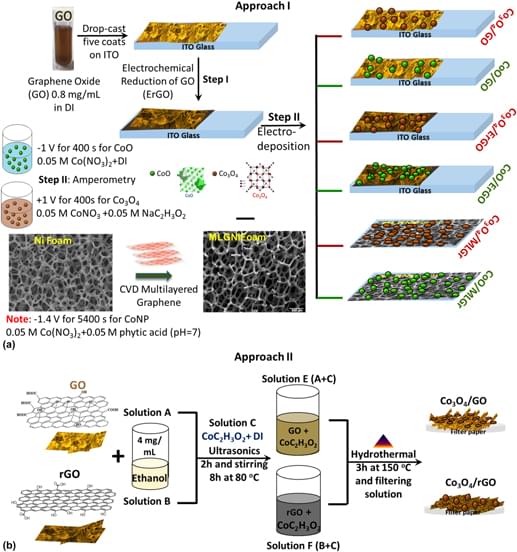
GO was prepared by modified Hummer’s method followed by chemical reduction using hydrazine monohydrate producing rGO. Reference Chen, Hu, Chen, Yan and Wu36 The GO dispersion of 0.8 mg/mL concentration in deionized (DI) water was stirred mildly for around 8 h followed by ultrasonication for approximately 40 min. The dispersion of rGO is also prepared in DI (Milli-Q) water with 1 mg/mL concentration, stirred and ultrasonicated. To synthesize thin films of GO and rGO used in this study and to determine an optimized configuration, we ultrasonicated these dispersions further for 30 min, drop cast followed by air dry on commercial SS321 (stainless steel AISI Grade 321), Ni foam and indium tin oxide (ITO)-coated glass substrates of 1 × 4.5 cm2 dimension. For electrochemical reduction, the GO overcoat substrates are immersed in aqueous electrolyte containing 1 M NaCl-based buffer media of pH = 11.85–12.0 operating in an amperometric mode at −0.9 V in a conventional three-electrode electrochemical cell with Pt sheet as counter electrode and Ag/AgCl as reference electrode for 900 s producing ErGO [see Fig. 1(a)]. Formation of ErGO relies on the removal of oxygen-related surface functionalities and the extent of reduction was monitored using Raman spectral G band position, which is red shifted by a few wavenumbers [Fig. S2(d), Supplementary Material] indicates successful reduction.
Schematic illustrations of (a) electrodeposition (Approach I) and (b) hydrothermal synthesis (Approach II) for graphene-based ‘hybrids’ with cobalt oxides and cobalt nanoparticles.

2. Preparation of cobalt oxides polymorphs and cobalt nanoparticles and their hybrids on graphene-family nanomaterials
In Approach I [Fig. 1(a)], the cobalt oxide polymorphs and cobalt nanoparticles are electrodeposited onto ITO-coated glass substrates by themselves and as hybrids onto graphene-family nanomaterials (GO, rGO, ErGO, and commercially available MLG on Ni foam). Briefly, 0.05 M Co(NO3)2·6H2O (cobalt nitrate hexahydrate) for CoO, 0.05 M Co(NO3)2·6H2O (cobalt nitrate hexahydrate) and 0.05 M sodium acetate tri-hydrate (NaC2H3O2·3H2O) for Co3O4 and 0.8 mM Co(NO3)2·6H2O and 0.05 M phytic acid (pH = 7) for CoNP dispersed in DI water were used in amperometric mode at −1.0, +1.0, and −1.4 V for 400, 400, and 5400 s, respectively (see Fig. S2, Supplementary Material). To ensure better crystallinity, the samples (except coated on MLG) were thermally treated at 450 °C in flowing Ar for 1 h following gradual cooling to 200 °C for 10 min and then brought to room temperature. Hybrids of Co3O4 with GO and rGO were also synthesized using hydrothermal technique presented as Approach II in Fig. 1(b). To obtain these composites, 4 mg/mL GO and rGO dispersion were prepared in 99.5% ethanol followed by mixing with 2 mg/mL cobalt acetate (CoC2H3O2) in DI water. Both mixtures were ultrasonicated for 2 h, heated and stirred at 80 °C for 8 h and the dispersions were transferred to individual hydrothermal autoclave chambers at 150 °C for 3 h and cooled to room temperature. The resulting powders of Co3O4/GOHT (and Co3O4/rGOHT) composites were air dried and mixed with carbon black and polyvinylidene fluoride in 80:10:10 ratio with NMP (N-methyl-2-pyrrolidone) organic solvent. These composite pastes were coated using a blade knife on copper foil and all samples were air dried at room temperature for more than 24 h and vacuum annealed at 120 °C for 3 h. All of the chemicals were purchased from Sigma–Aldrich and used without further purification. These strategic approaches afford scalable, uniform, optimized loaded GNSs that lead to enhanced topologically interconnectedness, three-dimensional framework ideal for energy storage producing electrical energy and as advanced cost-effective electrocatalytic sensors.
B. Sample characterization
1. Structural characterization
All the samples were characterized in terms of surface morphology, elemental composition distribution, microscopic structure, crystallinity, lattice vibration, electrical, electrochemical and electrocatalytical properties. Scanning electron microscopy (SEM) images were taken with an instrument (Model JEOL 6010Plus, JEOL Ltd., Peabody, Massachusetts) operating at primary electron acceleration voltage (V acc) of 15 kV and at constant current of 45 μA in secondary electron imaging mode collected with an in-lens SiLi detector equipped with an X-ray ISIS EDS system providing surface morphology. Samples for transmission electron microscopy (TEM) and selected area electron diffraction (SAED) were prepared by placing one to two drops of individual component and hybrids on commercial lacey carbon-coated Cu grids (Ted Pella Inc. CA) and allowing to air dry giving several regions and sufficient number of isolated flakes and particles. They were taken using JEOL instruments (Model 1400 Plus and Model 5400 Plus; JEOL Ltd.) operating in cryo-EM and SAED modes at 200 kV or 100 kV and 1 nA with a Be specimen holder, a Gresham SiLi detector with Moxtek AP3.3 window. For SAED patterns, we used 0.10 μm aperture producing a small spot size and spread the beam to increase the electron coherence length at the samples. TEM measurements provided nanoscale microstructure and determined interplanar spacing. Elemental mapping was also conducted using energy dispersive X-ray spectroscopy (EDX) integrated with the TEM instrument. Samples for these measurements were prepared by dispersing hybrid samples on carbon-coated holey mesh grids. The measurements were performed using a FEI Tecnai F20 microscope (FEI Company, Hillsboro, Oregon) with a field emission gun operating at 200 kV equipped with EDX detector. The measurements were carried out in the scanning TEM (STEM) mode using a nanoprobe with the probe size of ∼1 nm. STEM images were collected with a Fishione HAADF detector and EDX signals were measured. For each sample, representative regions were selected and elemental maps were collected using ES Vision software and the drift-corrected mapping mode.
For detailed understanding of the interactions between graphene derivatives and cobalt oxides and cobalt nanoparticles, we measured average and local crystal structure. The X-ray diffractograms (XRDs) were acquired with Siemens instrument Model D2000 (now Thermo Scientific, Waltham, Massachusetts) in Bragg–Brentano θ–2θ geometry where 2θ ranged between 8 and 70° using Cu Kα X-ray source (λ = 1.5405 Å) operating at voltage 45 kV and current 40 mA. The data were acquired at scan rate of 0.04°/s and to improve signal-to-noise ratio (SNR), we also measured at slower scan rate of 0.02°/s. Raman spectra were measured to determine the lattice vibrations at various points on the hybrids. The Raman spectra were recorded using a Raman spectrometer (Model InVia Renishaw plc, Renishaw, Hoffman Estates, Illinois) equipped with laser excitation wavelength 633 nm (E L = 1.92 eV) and ∼500 μW power incident at the sample, with edge filters cutting at ∼100 cm−1 and an objective lens of 50× used to provide spot size of ∼1–2 μm. The scattered light from the sample is collected in backscattering geometry, transmitted by a beam splitter and detected by charge-coupled device (CCD) camera. Extreme care was taken to avoid sample damage caused by laser-induced thermal degradation. Raman shift ranged from 120 cm−1 to 3400 cm−1 for Co containing hybrids, while for GO, rGOHT, ErGO, and MLG it was kept between 1100 and 3200 cm−1 with spectral resolution of 1 cm−1. Allowing more details of the interaction between graphene and cobalt oxides and nanoparticles, we measured room temperature electrical (I–V) properties (see Fig. S3, Supplementary Material). We made electrical contacts with colloidal silver paste and attached a Cu wire for connection and the data were acquired with Keithley 2400 source meter (Keithley Instruments, Solon, Ohio). We measured two point contact resistance and determined room temperature dc electrical conductivity (σdc) of the samples studied. The electrical conductivity for all of these hybrid films ranged between 2 and 10 S/cm.
2. Electrochemical measurements
A custom designed three-electrode electrochemical cell in asymmetric configuration and symmetric two-electrode coin cell CR2032 format were used for electrochemical measurements using a electrochemical workstation (CH Inc. Model 920D, CH Instruments, Austin, Texas) in cyclic voltammetry (CV), galvanostatic charging–discharging (or chronopotentiometry) and ac impedance spectroscopy (ac EIS) modes, where for three-electrode Ag/AgCl electrode and Pt wire of 3 mm diameter or foil were used as the reference and counter electrode, respectively. It is suggested that two-electrode cell configuration mimics the physical configuration, internal voltages, and charge transfer that occurs in a packaged supercapacitor and thereby provide indications of electrodes performance besides three-electrode cell, which is typically used to investigate electrode kinetics. The hybrid supercapacitors along with constituents are electrochemically characterized in 1 M KOH electrolyte within the potential range of −0.2 V and +0.8 V at various scan rates v = 10, 20, 50, 100, and 200 mV/s in CV mode. To prevent delamination of hydrothermal synthesized Co3O4/GOHT and rGOHT hybrids, we used 0.1 and 0.5 M KOH within the potential ranging −0.1 V to +0.65 V at various scan rates 1, 5, 10, 20, 50 mV/s. Galvanostatic charge–discharge cycling was conducted at current densities 1–15 A/g. Five sets of measurements were also carried out on each sample with initial current of 0.25 A for 0–50 cycles, followed by variation of potential at current of 0.20 A for 50–100 cycles, 0.10 A for 100–150 cycles, 0.05 A for 150–200 cycles, and 0.25 A for 200–250 cycles. The ac EIS measurements were conducted in the frequency range from 0.01 to 98 kHz at open circuit potential, 0.2–0.4 V with AC perturbation 10 mV. Gravimetric specific capacitance (C s) was calculated from dividing the capacitive charge (Q) obtained using half the integrated area of the cyclic voltammograms by active electrode mass (m) and the width of the operating potential window (V) following equation:
 $${C_{\rm{s}}} = {Q \over {m \cdot \Delta V}}{\rm{\ or\ }}{1 \over {mv({V_{\rm{f}}} - {V_{\rm{i}}})}}\int_{{V_{\rm{i}}}}^{{V_{\rm{f}}}} {I(V)\,{\rm{d}}V} \quad .$$
Using chronopotentiometry, discharge specific capacitance (C s) values was calculated by using charge–discharge current (I), potential change with discharge time (dV/dt), and the mass of the active electrode films following:
 $${C_{\rm{s}}} = 2{{I \cdot {\rm{d}}t} \over {m \cdot \Delta V}}{\rm{\ or\ }}2{I \over {m \cdot ({{{\rm{d}}V} \mathord{\left/ {\vphantom {{{\rm{d}}V} {{\rm{d}}t}}} \right. \kern-\nulldelimiterspace} {{\rm{d}}t}})}}\quad .$$
For electrocatalytic glucose sensing, the measurements were carried out in potential window 0.0–0.8 V at scan rate 5 mV/s for 1st, 2nd, and 5th cycles and in amperometric (i–t) mode to monitor current with discrete addition of 20 μL glucose extended by addition of uric acid (UA) and ascorbic acid (AA) molecules to simulate blood plasma environment in vitro.
3. Theoretical density functional theory (DFT) calculations
DFT is used to determine the electron DOS and charge transfer between graphene and Co x O y . Briefly, a monolayer graphene is modeled as two-dimensional hexagonal lattice with a calculated lattice constant of 2.45 Å, Reference Wesselowski and Wassiliew46 and the adatom-substrate systems were modeled with adatoms adsorbed on a (4 × 4), (2 × 2), and (2 × 1) graphene supercells. The CRYSTAL09 Reference Dovesi, Saunders, Roetti, Orlando, Zicovich-Wilson, Pascale, Civalleri, Doll, Harrison, Bush, D’Arco and Llunell47 program that employs Gaussian type basis set functions centered at the atoms were used for periodic DFT calculations with and without adatoms. Restricted (constrained relaxation) and unrestricted (relaxed) DFT with the hybrid PBE0 (Perdew–Burke–Ernzerhof) nonempirical/parameter-free functional Reference Ernzerhof and Scuseria48,Reference Adamo and Barone49 and the antiferromagnetic spin case (low spin configuration) were used to focus on the interface between cobalt oxides clusters and GNS. All atoms are treated by all-electron basis sets from Peintinger et al., Reference Peintinger, Oliveira and Bredow50 which are optimized for crystalline calculations (pob-TZVP, triple zeta valence potential with polarization basis set). These basis sets are developed from the original triple-ζ for valence plus single polarization function basis set by Ahlrichs Reference Weigend and Ahlrichs51,Reference Weigend, Häser, Patzelt and Ahlrichs52 (def2-TZVP basis set) through reduction in the number of Gaussians’ used (e.g., for carbon atoms the original def2-TZVP basis set [5s3p2d1f] is contracted to [4s3p1d]). Brillouin zone integrations were performed on a 24 × 24 Monkhorst–Pack grid, Reference Monkhorst and Pack53 which is also used for Fermi energy (E F) and the density matrix calculations (Gilat grid). Reference Gilat and Raubenheimer54,Reference Gilat55 The Fermi surface was smeared with a Gaussian of 0.005 Hartrees for convergence purposes. Moreover, the self-consistent field (SCF) energy convergence was achieved by using Anderson quadratic mixing, Reference Anderson56 coupled with additional mixing of the occupied orbitals with the virtual orbitals. The SCF energy threshold value for our calculations was set at 10−9 Hartrees for clean graphene substrates and the adatom–graphene systems to 10−7 Hartrees, suggesting covalent and electrostatic bonding (simulating experimental conditions in this work). A large integration grid (XLGRID as keyword), which is a pruned grid with 75 radial and 974 angular points and the XcrySDen graphical package for the charge density plots were used in this work. Reference Kokalj57
III. RESULTS AND DISCUSSION
A. Surface morphology and microstructure
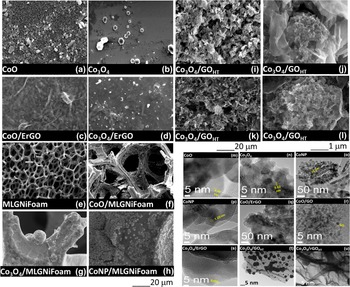
Figure 2(A) displays representative SEM images of a set of samples including MLG on Ni foam, electrodeposited CoO, Co3O4, CoNP/ErGO, CoO/ErGO, Co3O4/ErGO, CoO/MLG, CoNP/MLG, and hydrothermal synthesized Co3O4/GOHT and Co3O4/rGOHT hybrids. They reveal relatively uniform surface morphology by themselves and as hybrid composites wherein interconnected 3D porous network and crumpled silk-liked structured GNSs decorated with optimal Co x O y and CoNP loading is apparent. The microparticles with lateral size range 50–100 nm are spread irregularly on the GNS surface and it appears preferential deposition takes place at edges or on the walls, preventing GNS restacking. For the samples deposited using hydrothermal technique, many stacked irregular nanoplatelets are observed [see Figs. 2(f)–2(l)] and it is difficult to see scrolled GNS. Moreover, a few cobalt oxide nanoflakes or nanoparticles were loosely decorated on the GNS. It is conceivable that below a critical concentration of cobalt-based nanomaterials, the GNS may aggregate and form clusters decreasing the available specific surface for ion adsorption. To investigate the structural information of components and hybrids (cobalt-based nanostructures decorated GNS) at nanoscale, high-resolution TEM (HRTEM), and SAED results are presented in Fig. 2B and S4 (Supplementary Material), respectively. HRTEM images show polycrystalline structure and porous network consisting of thermal-treated nanoparticles of CoO, Co3O4, and CoNP with grain size distribution ranged 10–50 nm. Structural order is evident from the lattice fringe patterns which can be associated with the structural signatures of crystalline cobalt oxides, cobalt nanoparticles, and GNS decorated with these particles preventing graphene sheets aggregation. HRTEM images and SAED intensity patterns versus inverse of interplanar spacing (d hkl ) reveal the cubic lattice structure for CoO and normal cubic spinel for Co3O4: (Co2+O)[Co2 3+O3] with lattice fringe spacing with corresponding peaks of 0.233 ± 0.01 nm (2−22 or 311) and 0.286 ± 0.01 nm (220) yielding lattice constant a 0 = 0.82 ± 0.01 nm, which is marginally larger than the corresponding value reported in the JCPDS 42-1467 (0.808 nm) and JCPDS 30-0443 (0.423 nm). Reference He, Chen, Jiao and Wang58,Reference Xia, Tu, Zhang, Mai, Wang, Gu and Zhao59 Likewise, the spherical CoNP which has hexagonal closed packed structure shows well-resolved lattice spacing of 0.45 ± 0.01 nm (JCPDS 05-0727, a = b = 0.318 nm and c = 0.465 nm) Reference Liu, Yi, Wang, Qiu, Zhang and Li60 with almost monodispersed particle size distribution 15–20 nm. Some of the additional peaks in all of the hybrids are attributed to graphene. The elements C, Co, and O are identified and Co x O y loading distribution is also determined using EDX mapping. The EDX mapping shown in Fig. 3 for representative samples showed that Co to O ratios are rather uniform across most of the samples as expected for a single phase and optimal Co to C ratio ranged 15–30 at.%.
SEM (a–l) and TEM images (m–u) showing electrochemical deposited cobalt oxide polymorphs and graphene-based hybrids prepared using Approach I and II revealing the surface morphology and microstructure (scale bars are shown at the bottom of the images).

EDX mapping of elemental carbon (C), oxygen (O) and cobalt (Co) inside the highlighted regions including original images.

B. Nucleation and growth aspects
This section briefly describes the synthesis aspects associated with nucleation and growth steps involved in electrodeposition and hydrothermal reactions. The electrochemical nucleation Reference Gunawardena, Hills, Montenegro and Scharifker61 and growth processes on to various graphene supports are carried out using chronoamperometry [see Figs. S2(a)–S2(c), Supplementary Material]. The CV mode was used to define the oxidation or reduction potential of cobalt ions on GNSs as working electrodes. The current transients recorded during chronoamperometric tests were fitted with theoretical models to determine the areal number density of actives sites on graphene surfaces required for nucleation. These tests were made to electrodeposit nanostructured cobalt oxide polymorphs and cobalt nanoparticles. In this way, it was possible to compare the resulting data obtained from Scharifker and Hills (S–H) models Reference Scharifker and Hills62 with the effective nanoparticles density albeit qualitative obtained from SEM (∼105–106/cm2) images. Accordingly, two asymptotic solutions are predicted corresponding to instantaneous (i.e., instant nucleation followed by growth of formed nuclei at any surface active site) and progressive (i.e., simultaneous formation and growth of nuclei) nucleation. Fig. S2 (Supplementary Material) shows typical transient (i–t) curves for CoO, Co3O4, and CoNP on various graphene supports with varying degrees of oxygenated surface functional groups following diffusion-controlled growth. The pH 8 to 9 was chosen strategically to have a balanced nucleation followed by growth of smaller sized nanoparticles and de-aggregated particles. The increase in current is due to overlapping diffusion zones formed around growing nucleated sites. The decreasing transient obeys the Cottrell equation corresponding to planar diffusion. The current–time relationship from S–H model follows: Reference Weigend, Häser, Patzelt and Ahlrichs52
 $$I = \left( {{{zF{D^{{1 \over 2}}}C} \over {{\pi ^{{1 \over 2}}}{t^{{1 \over 2}}}}}} \right)\left( {1 - \exp \left\{ { - {N_0}\pi \left( {{{8\pi CM} \over \rho }} \right)D\left[ {t - {{(1 - {{\rm{e}}^{ - At}})} \over A}} \right]} \right\}} \right)\quad ,$$
where z F is molar charge transferred during electrodeposition, D the diffusion coefficient, C bulk concentration, t time, N 0 active sites number density, M molecular weight, ρ the density of the metal and A the nucleation rate per site. While it is proposed that the deposition follows instantaneous nucleation, but for longer time a deviation from theoretical asymptotic curve is observed attributed to contribution from proton reduction (hydrogen evolution reactions) onto cobalt nanoparticles and cobalt oxide compounds. Moreover, the local increase of pH induces the formation of cobalt hydroxide which reduces the flux of cobalt ions available to electrodeposition thus identified as growth-limiting factor. In fact, Palomar-Pardave derived a model for simultaneous proton reduction and electro-crystallization process following Reference Palomar-Pardave, Scharifker, Arce and Romero-Romo63 :
 $$I = \left[ {{z_{{\rm{PR}}}}F{k_{{\rm{PR}}}}{{\left( {{{2CM} \over {\pi \rho }}} \right)}^{{1 \over 2}}} + {1 \over {{{{N_0}} \over A}\pi \left( {{{8\pi CM} \over \rho }} \right)D{{\left( {At} \right)}^{{1 \over 2}}}}}} \right]\left( {1 - \exp \left\{ { - {N_0}\pi \left( {{{8\pi CM} \over \rho }} \right)D\left[ {At - 1 + \exp ( - At)} \right]} \right\}} \right)\quad ,$$
where k PR is rate constant of proton reduction reaction that can be modeled to equivalent Butler–Volmer type relationship. This model is used to fit the experimental curves to obtain theoretical N 0 (/cm2) and nucleation rate per site A. The variants of graphene i.e., with oxygenated surface functional groups and MLG as working electrodes behave differently reflected in Fig. S2 (Supplementary Material) that is analogous to metal with native oxygen that act as barrier layer to electrodeposition. As a result the nucleation and three-dimensional growth of spherical nanoparticles is affected by electronic conductivity through oxide layer, diffusion of metal ions through the oxide layer, and migration of metal ions across the oxide layer electric field. However, due to hydrous nature of oxygenated sites, it generates hydrogen and excess hydroxyl ions that may dissolve or replete this barrier locally. In contrast, for MLG (with only native oxygen), there is significant increase of cathodic current at −1.0 V and −1.4 V for CoO [Fig. S2(a), Supplementary Material] and CoNP [Fig. S2(b), Supplementary Material], supports our growth kinetic model. These potentials are chosen to describe the saturation in active sites number density and to optimize the particle size distribution. The average particle size, the number density of produced nanoparticles from SEM and TEM characterization and nucleation number density of active sites (N 0) estimated by current transients fitting with Eq. (2) yields 10–60 nm, 106–107/cm2 and 104–105/cm2, respectively. The two orders of magnitude difference is attributed due to unrandomized active sites distribution, surface roughness/corrugations/nanofolds of MLG and its variants where the nucleation takes place preferentially at the crumpled edge sites.
C. Crystalline structure
The structural parameters such as crystal phase, grain size, phase composition are strongly dependent on deposition parameters, including electrolyte pH, deposition time, current density, and amount of additives in electrolyte. To determine the average crystal structure, we obtained X-ray diffraction pattern shown in Fig. 4 for bare Co x O y , CoNP and hybrid composites. The expansion of GO lattice spacing i.e., d 002 = 0.63 nm, occurring at 2θ = 12–16° compared to parent graphite, which is d 002 = 0.34 nm, 2θ = 26° and rGO, is due to oxidation and possibly intercalation of water molecules. Important to note post-hydrothermal and electrochemical reduction of GO, the GO peak disappears in hybrids. Depending upon the type of graphene, they show diffraction peaks centered at 2θ = 23.1° (ErGO and rGO) and 2θ = 26.1° (MLG) attributed to (002) reflections. For graphene decorated with cobalt oxides, all the diffraction peaks are in accord with those characteristic indexed to spinel cubic Co3O4 (JCPDS 42-1467), cubic CoO (JCPDS 30-0443) and hexagonal closed packed Co (JCPDS card File no. 01-1254). They correspond to (111), (220), (311), (222), (400), (422), (511), and (440) for Co3O4 and (111), (200), and (220) planes for CoO occurring at 2θ = 36.5°, 41.6°, 44.6°, 47.5°, 50.7°, 61.5°. Actually, the XRD patterns (e.g., peak position and width) of the Co3O4 and CoO-based samples are similar unlike the changes observed in SEM and TEM images. The relatively broader peaks indicate medium range order and nanocrystallite grain size is determined following Debye–Scherrer’s equation: L hkl = Kλ/2β hkl cos θ hkl . The crystallite or X-ray diffracting domain size for the samples is estimated using the full width at half maximum of the (311) peak to be approximately 15–40 nm. To further characterize microstructure gaining insights into the chemical structure of hybrids, we used an invaluable nondestructive Raman spectroscopy (RS) technique to probe lattice vibration and molecular bonding. Figures 4(c), 4(d), and S5 (Supplementary Material) display first- and second-order Raman spectra in the spectral region 200–3100 cm−1 for representative samples of Co x O y , CoNP, GO, ErGO, rGOHT, MLG and corresponding hybrids. For a realistic comparison, the spectra were normalized to intense spectral band at wave number ∼1595 cm−1. The peaks at 188, 469, 515, and 676 cm−1 are associated with F2g, Eg, F2g, and A1g symmetry modes, respectively, in Co x O y and CoNP assigned following Refs. Reference Gupta and Carrizosa17 and Reference Yang, Liu, Martens and Frost64. The difference in the bands position for CoO (and CoNP) and Co3O4 is apparent and may be attributed to lattice crystal structure and level of oxygen or more appropriately the elemental ratio (C to Co and Co to O bonding). The two characteristic diagnostic peaks for a range of graphene are centered at 1370 cm−1 (disorder-induced D band) and 1595 cm−1 (in-plane stretching or tangential G band). The other Raman peaks of interest are second-order bands at 2670 cm−1 and 2920 cm−1 assigned to 2D and combination D + G band, respectively. Reference Gupta and Saxena65,Reference Ferrari and Basko66 All of the structural characterization results indicate that GNS and cobalt-related materials coexist and integrated successfully as hybrids. Keeping in view of microstructure and property correlations and graphene/cobalt oxides interactions the features in the Raman spectra are quantitatively analyzed and summarized in Figs. S6 and S7 (Supplementary Material). While the XRD revealed bulk phases, the Raman spectra allow the identification of local cobalt oxides species on surface, which has strong influence on electrochemical reactivity discussed in later sections below. Reference Tang, Li and Hao67,Reference Sun, Lv, Yang, He, Nie, Liu and Li68 Important to emphasize that cobalt oxides are limited or even inactive electrocatalytically by themselves, but their loading on conductive nanocarbon supports facilitate electrocatalysis by enabling surface hybridization thus activating chemical bonds, reactive sites, and promoting activity/reactivity discussed below in theoretical considerations. Furthermore, the activity depends upon Co x O y and CoNP mass loading on graphene support prohibiting aggregation and the graphene-cobalt hybrids can lead to a good bifunctional catalytic activity in alkaline solution namely, oxygen reduction, oxygen evolution, and hydrogen evolution reactions, in general and electrocatalytic glucose sensing, in particular. Reference Gupta and Carrizosa17,Reference Chaikittisilp, Torad, Li, Imura, Suzuki, Ishihara, Ariga and Yamaguchi69
XRD patterns of (a) Co x O y -based and (b) cobalt nanoparticles-based hybrids. The peaks of interest for graphene and of hybrids are marked with their (hkl) index along with substrates. All of the diffractograms are taken with Cu Kα X-ray source (λ = 1.5405 Å). Representative micro-Raman spectra excited at λL = 633 nm of (c) electrodeposited and (d) hydrothermal deposited hybrids showing characteristic D, G, 2D and D + G bands associated with GNSs and cobalt oxides. ITO: indium tin oxide; SS321: Stainless Steel AISI Grade 321.

D. Electrochemical properties
1. Cyclic voltammetry and ac impedance spectroscopy
To evaluate and quantify the electrochemical properties of various samples studied, we performed cyclic voltammetry measurements in 1 M KOH electrolyte. To determine pseudocapacitive contribution within hybrid electrodes, we also characterized electrodes composed exclusively of supercapacitive GNS. Figure 5 shows cyclic voltammograms for all of the hybrids exhibiting broad redox peaks in the potential range −0.2 to +0.8 V investigated. The cyclic voltammograms from graphene derivatives (see Ref. Reference Gupta, van Meveren and Jasinski16) is in stark contrast to hybrids which is nearly rectangular loop indicative of almost an ideal supercapacitor. Specifically, all hybrid electrodes displayed well-defined pseudocapacitive behavior with two sets of characteristic redox peaks centered at −0.15/+0.01 V (cathodic I/anodic II) and +0.2/+0.4 V (cathodic III/anodic IV) related to presumably two faradaic (redox) reactions relating the conversion between different cobalt oxidation states i.e., oxidation of Co(II) to Co(III) and Co(III) to Co(IV) described as follows Reference Dai21 :
 $${\rm{C}}{{\rm{o}}_3}{{\rm{O}}_4} + {\rm{O}}{{\rm{H}}^ - } + {{\rm{H}}_2}{\rm{O}} \leftrightarrow 3{\rm{CoOOH}} + {{\rm{e}}^ - }\quad ,$$
 $${\rm{CoOOH}} + {\rm{O}}{{\rm{H}}^ - } \leftrightarrow {\rm{Co}}{{\rm{O}}_2} + {{\rm{H}}_2}{\rm{O}} + {{\rm{e}}^ - }\quad,$$
and
 $$3{\rm{CoO}} + {{\rm{H}}_2}{\rm{O}} \leftrightarrow 3{\rm{C}}{{\rm{o}}_3}{{\rm{O}}_4} + {{\rm{H}}_2}$$
corresponding to the first and second redox couple, respectively. The CV loop was sufficiently rectangular, desirable for a supercapacitor and the rate capability was examined with various scan rates (10, 20, 50, 100, and 200 mV/s) and the rectangular area increased with increased scan rate as expected. Meanwhile, CoO and CoNP-based hybrids are compared with Co3O4-based electrodes showing larger integrated area cyclic voltammograms and therefore they have higher specific capacitance, C s. Fig. 6(a) and 6(c) show the variation of maximum current with square root of scan rate (v 1/2). A quasilinear behavior especially at higher scan rates is reminiscence of diffusion-limited (mass transport) phenomenon and plateaued behavior is reflective of heterogeneous diffusion and electron transport attributed to composite nature of hybrid electrodes. The magnitude of the ion current observed is governed by the Randles-Ševćik equation for a reversible transfer process,
 $${I_{{\rm{rev}}}} = 0.446FAC{\left( {{{FDv} \mathord{\left/ {\vphantom {{FDv} {RT}}} \right. \kern-\nulldelimiterspace} {RT}}} \right)^{0.5}}\left[ {{\rm{or\ }}{I_{{\rm{rev}}}} = (2.69 \times {{10}^5}){n^{{3 \mathord{\left/ {\vphantom {3 2}} \right. \kern-\nulldelimiterspace} 2}}}AC{D^{{1 \mathord{\left/ {\vphantom {1 2}} \right. \kern-\nulldelimiterspace} 2}}}{v^{{1 \mathord{\left/ {\vphantom {1 2}} \right. \kern-\nulldelimiterspace} 2}}}} \right]\quad .$$
Alternatively, they are representative of either a multielectron quasi-reversible (most likely for our hybrids) or a case of fully irreversible electron transfer process,
 $${I_{{\rm{irrev}}}} = 0.496{(\alpha n')^{0.5}}nFAC{({{FDv} \mathord{\left/ {\vphantom {{FDv} {RT}}} \right. \kern-\nulldelimiterspace} {RT}})^{0.5}}\left[ {{\rm{or\ }}{I_{{\rm{irrev}}}} = (2.99 \times {{10}^5})n{{(\alpha n')}^{{1 \mathord{\left/ {\vphantom {1 2}} \right. \kern-\nulldelimiterspace} 2}}}AC{D^{{1 \mathord{\left/ {\vphantom {1 2}} \right. \kern-\nulldelimiterspace} 2}}}{v^{{1 \mathord{\left/ {\vphantom {1 2}} \right. \kern-\nulldelimiterspace} 2}}}} \right]\quad ,$$
where A is the geometric area of the electrode (cm2), α is the transfer coefficient (usually presumed to be 0.5), F is Faraday constant (C/mol), D is diffusion coefficient (cm2/s), C is concentration (mol/cm3), v is scan rate (V/s), R and T are usual constants, n is the total number of electrons transferred in the electrochemical process and n′ is the number of electrons transferred before rate determining step. The analysis of current helped to determine D that ranged between 6 × 10⁻⁸ and 4 × 10⁻⁹ m2/s in decreasing order for CoO/MLG, Co3O4/MLG, Co3O4/rGOHT, CoO/ErGO, CoNP/MLG hybrids which further reduces for other hybrids. The C s of hybrid electrodes is calculated according to the following equation:
 $${1 \over {mv({V_{\rm{f}}} - {V_{\rm{i}}})}}\int_{{V_{\rm{i}}}}^{{V_{\rm{f}}}} {I(V)\,{\rm{d}}V} \quad ,$$
where m is the mass of active electrode material (g) measured using microbalance. Figures 6(b) and 6(d) present variation in C s with scan rate for hybrids prepared using Approaches I and II. We found that all electrodes show gradual decrease in C s with scan rate peaking at scan rate 10 mV/s, which are 550, 450, 370 F/g, and so forth. We also measured charging-discharging (V–t) profiles (see Fig. S8, Supplementary Material) and determined C s as follows:
 $${C_{\rm{s}}} = 2 \times {{I \cdot \Delta t} \over {\Delta V \cdot m}}\quad ,$$
where I is the applied discharge current, Δt is the discharge time after potential (IR) drop, and ΔV is the discharge potential window after IR drop, respectively. The factor of 2 is used because series capacitance is formed in a two-electrode system. The V–t profiles between 0 and −1.2 V at different current densities and cyclability of various electrodes exhibit stable performance in agreement with CV results and the fading in C s is possibly due to internal resistance and polarization of the electrodes. The C s values are comparable at specific current density 10 A/g to those determined using cyclic voltammograms. Moreover, C s of hybrid electrodes was significantly larger than that of graphene only electrodes with values of 60–80 F/g. Generally, the rate capability is strongly influenced by the surface ion adsorption, electrode/electrolyte accessibility, interfacial diffusion, and the charge transfer in or across the electrode. At higher scan rates, any of three processes is relatively slower which limits the rate and lowering the C s. However, relatively higher C s is attributed to nanosize cobalt-related particles and presumably exposed crystalline facets or planes having stronger specific adsorption as opposed to nonspecific adsorption in non-oriented particles, key to higher electroactivity. Although GNS have smaller supercapacitive contribution to the hybrid composites, they offer excellent electronic conductivity that allows to shuttle electrons between cobalt-related nanoparticles and current collector and mechanical robustness. Therefore the chemical bridging between graphene (ErGO, rGOHT, MLG) and cobalt (Co x O y and CoNP) building units into a single system enhanced the electrochemical behavior of ‘hybrid’ supercapacitor electrodes. Furthermore, the performance of three-dimensional graphene with mesoporous network and topologically interconnectedness in hydrothermally prepared hybrids allow partial hydrated/solvated ions transport combined with cobalt oxides. As a result, it increases the pseudocapacitive contribution to double layer capacitance to those reported for graphene/NiO and graphene/PAni electrodes and comparable to graphene/ MnO2. Reference Gupta, Price and Heintzman8,Reference Gupta and Price14,Reference Gupta, van Meveren and Jasinski16,Reference Kötz and Carlen70,Reference Gupta and Price71 Taken together, hybrids combining nanostructured inorganic materials with appropriate architectures introducing more defect site density in contrast to bulk counterparts show promise by exhibiting significantly improved electrochemical performance as ‘hybrid’ supercapacitors. The synergistic effects of chemical bridging make use of electrostatic and coordination interactions between negatively charged surface functional groups of GO, rGO, ErGO, and Co2+ ions, crumpled and flower-like surface morphology promoted tailored interfaces and topologically interconnected structures. Reference Gupta, Heintzman and Price13,Reference Gupta and Price14,Reference Gupta, van Meveren and Jasinski16,Reference Ghosh, Ra, Jin, Jeong, Kim, Biswas and Lee32,Reference Gupta and Price71–Reference Wu, Lin, Lin and Lee73 We attempted to calculate the energy density
 $$\left[ {E = {1 \over 2}{{{C_{\rm{s}}}{V^2}} \over m} \times {{1000} \over {3600}}} \right]$$
for each of these hybrid electrodes CoO/MLG, Co3O4/MLG, Co3O4/rGOHT, CoO/ErGO, CoNP/MLG reaching values to 52.4, 40.6, 35.5, 9.3, 8.1 W h/kg, respectively, at a power density
 $$\left( {P = {E \over {\Delta t}} = {{I\Delta V} \over {2m}} = {{{V^2}} \over {4m{R_{\rm{s}}}}} \times 1000} \right)$$
1.0 kW/kg following Ragone plot. These results suggest that the presence of GNSs as support for hybrid electrodes not only improved the electrical conductivity and mechanical stability, but also served as a functional charge transfer-like dopant to or from cobalt-based nanomaterial as reflected briefly from RS. Reference Gupta and Carrizosa17,Reference Gupta, McDonald, Carrizosa and Price74
CV (a and b) CoO-based and (c–f) Co3O4-based hybrids measured in 1 M KOH showing pseudocapacitive behavior. All the potentials are with respect to Ag/AgCl reference electrode.

Current versus square root scan rate showing quasilinear behavior and the gravimetric specific capacitance (C sp; F/g) with scan rate for (a and c) CoO-based and (b and d) Co3O4-based hybrids.

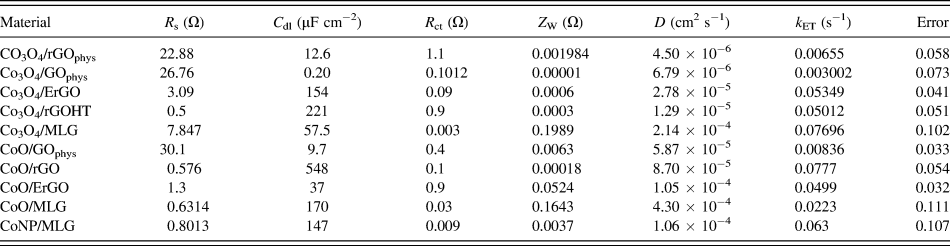
To further understand the reasons behind the unique supercapacitive performance of hybrid electrodes, electrochemical impedance spectroscopy (EIS) data were analyzed to investigate electrode kinetics, to quantify electronic and ionic contributions and surface diffusive behavior besides determining various circuit elements in bulk electrolyte and at the electrode/electrolyte interface. The impedance data were simulated by different circuit simulation modeling to fit experimental data using in-built ‘sim’ software with our electrochemical workstation. The equivalent circuit models proposed for fitting the impedance data are shown in Figs. 7(c) and 7(d) insets and the results are summarized in Tables I and II. The models consist of R s, equivalent series resistance (ESR) that includes ionic or bulk resistance of the electrolyte solution combined with interface resistance, the intrinsic and contact resistance at the electroactive material/current collector, Reference Celzard, Collas, Marêché, Furdin and Rey75 R ct, charge transfer resistance, Z W, Warburg impedance, C dl, double-layer capacitance as in Randles’ equivalent circuit and constant phase element (CPE; Q, n) equivalent circuit. Reference Hirschorn, Orazem, Tribollet, Vivier, Frateur and Musiani76–Reference Gupta, Aberg, Carrizosa and Dimakis79 Nyquist plots (−Z″ versus Z′) for representative hybrids are shown in Fig. 7(a) besides phase response Fig. 7(b) with semi log frequency. These plots exhibit good supercapacitor behavior with a straight sloping line (i.e., solid-state diffusion in bulk electrolyte and OH− ion diffusion into electrode) in the low-frequency and a small semicircle arc (i.e., solid-electrolyte interphase and grain boundary) in the high-frequency region. The phase change of almost 70o–80° indicates capacitive behavior of the hybrids. In principle, the ESR of the composite hybrid electrodes (<3.0 Ω), determined from high-frequency intercept at real Z′, is smaller than those of only components, Reference Lu and Zhou80 The arc in the high-frequency region corresponds to the charge transfer resistance (R ct) caused by the pseudocapacitive or faradaic reactions of electroactive electrode material, double-layer charging on the electrode surface (C dl) and Warburg impedance (Z W). Reference Tüken, Yazici and Erbil81 For macroelectrode and diffusion layer of infinite thickness,
 $${Z_{\rm{W}}} = {{{R_{{\rm{ct}}}}\lambda } \over {{{(\omega )}^{{1 \mathord{\left/ {\vphantom {1 2}} \right. \kern-\nulldelimiterspace} 2}}}}}{\rm{\ and\ }}\lambda = {{{k_{{\rm{ET}}}}} \over {2\sqrt D }}\quad ,$$
k ET is the heterogeneous kinetics on the electrode and D is the diffusion coefficient of the redox species. The slopping line within lower-frequency regime is a result of ion diffusion and mass transport from the electrolyte to the electrode surface (i.e., grain boundary interfaces) and diffusive resistance. Reference Adamo and Barone49 The increasing slope trend exhibits the capacitive nature related to the film charging mechanism that is typical characteristic for mesoporous electrodes with three-dimensional network. The lower R ct values for almost all of the hybrid electrodes studied imply an enhancement in the electronic and ionic conductivities of cobalt oxides with the presence of GNS support. It is important to note that the values of R ct is higher for some of the hybrid electrodes especially when modeled with CPE circuit model and physically adsorbed CoO and Co3O4 while complying these values with other electrodes. It justifies the usefulness of CPE model. Tables I and II summarize the impedance spectroscopy modeling results. Finally, the slope of the Nyquist plots in the low-frequency region tends to increase with the presence of underlying graphene support films, reflecting a decrease in the Warburg resistance (W) or faster electrolyte ion diffusion into the hybrids. Figures 7(c) and 7(d) show low frequency (C lf) capacitance variation for all hybrids studied derived following relationship:
 $${1 \over {{C_{{\rm{lf}}}}(\omega )}} = {{Z''(\omega )} \over {{1 \mathord{\left/ {\vphantom {1 \omega }} \right. \kern-\nulldelimiterspace} \omega }}}\quad .$$
Once again the C lf peaks for CoO/ErGO, Co3O4/rGOHT, Co3O4/ErGO, CoNP/MLG, and CoO/MLG hybrid electrodes are consistent with the results obtained using CV mode. The presence of GNS creates more electroactive sites and tailored interfaces thus facilitate the access of electrolyte ions and makes electron transport between graphene and cobalt-related nanomaterials easier. This suggests that these hybrids can be electrically simulated to an assembly of parallel RC components normal to the electrode surface. Such hybrid composite electrodes exhibiting charge trapping capabilities are indeed promising ‘hybrid’ supercapacitors. Considering the supercapacitor as a whole system for evaluating frequency dependent capacitive behavior, the capacitance C(ω) can be expressed as follows Reference Taberna, Simon and Fauvarque82 :
 $$C(\omega ) = {1 \over {j\omega Z}} = - \left( {{{Z''(\omega )} \over {\omega |Z(\omega ){|^2}}} + j{{Z'(\omega )} \over {\omega |Z(\omega ){|^2}}}} \right) = C'(\omega ) - jC''(\omega )\quad .$$
The low frequency of real part C′(ω) corresponds to effective capacitance of supercapacitor devices and imaginary part C″(ω) is related to the energy dissipation due to an irreversible process. The electrode response time (τ = 1/f m) is estimated from the frequency that corresponded to the maximum of the Bode plots of the imaginary capacitance as shown in Figs. 7(e) and 7(f) for CoO- and Co3O4-based hybrids, respectively. The increase in response time (from 0.38 s to 3 s and 0.46 s to 3 s) is due to larger RC constant and since the series resistance between electroactive materials/current collector is almost kept constant, this behavior is mainly due to significant increase in specific capacitance.
(a) Nyquist plot and (b) semilogarithmic phase behavior for (a) CoO and (b) Co3O4-based hybrids at V = +0.3 V revealing capacitive behavior (c and d) low-frequency capacitance C lf and (e and f) C″(ω) versus log of frequency behavior. The insets show the equivalent circuits used to fit the impedance data.

Summary of EIS simulations with traditional double-layer and related circuit elements and physical–chemical parameters.

Summary of EIS data simulations with ‘CPE’ and physical-chemical parameters.

These promising findings suggest advantages of graphene-based hybrids for electrochemical sensing and novel electrocatalysis platforms, which are also surface-sensitive phenomena. Prompted by reports in the literature, Reference Dai21,Reference Ding, Wang, Su, Bellagamba, Zhang and Lei83 we applied these hybrids to investigate non-enzymatic detection of glucose due to its paramount importance to diagnose and manage diabetes. In general, detecting glucose is indirect through glucose oxidase enzyme. Therefore, the need for enzymatic proteins-based sensors are expensive requiring cost-effective alternatives and compromises sensitivity, stability, and reproducibility in real-biophysical environment besides their response is sensitive to pH, temperature, and humidity. Several studies have shown that nanostructured cobalt oxides can catalyze glucose oxidation and capable of direct electrochemical detection. Reference Gupta and Price71,Reference Yang, Yi, Luo, Liu, Liu, Jiang and Liu84 However, limited knowledge is available about cobalt nanoparticles and cobalt oxide nanocrystals in terms of their relationships between glucose reduction catalytic activity and surface structure especially when supported on a conductive support to improve electrical conductivity. These are attributed to octahedral sites and exposed crystalline facets in spinel cobalt oxides to enhance electrocatalytic activity. Ding et al. Reference Gupta and Price71 demonstrated that glucose detection is optimized in low-strength alkaline solutions, and to correlate with our hybrid samples in this work, we have used 0.1 M KOH as base electrolyte. Figure 8 shows cyclic voltammograms for CoO/ErGO, Co3O4/MLG, Co3O4/rGOHT, and CoNP/MLG hybrids with two pairs of redox peaks (I/III and II/IV) resulting from reversible transition between Co3O4 and CoOOH and transition between CoOOH and CoO2, with reaction formulations shown above. With increasing glucose concentration and introduction (see Fig. 8) and scan rate (not shown), an apparent increase in oxidation current (i.e., peak II at +0.18 V for CoO/ErGO, Co3O4/MLG, Co3O4/rGOHT and peak IV at +0.38 V for CoNP/MLG) is observed, while other peak remains constant suggesting: (i) surface-sensitive electrochemical interfacial processes and (ii) glucose oxidation to gluconolactone catalyzed by conversion of Co3O4 to CoO and CoO2 to CoOOH i.e., CoO2 + C6H12O6 (glucose) → 2CoOOH + C6H10O6 (gluconolactone). Holding at oxidation potential of +0.4 V, the amperometric (i–t) response for CoO/ErGO, Co3O4/MLG, Co3O4/rGOHT, Co3O4/GOHT, and CoNP/MLG hybrids to successive addition of glucose to increasing concentration are measured as shown in Fig. 8(e). The glucose dose response curves are plotted in Fig. 8(f) deducing an extraordinary sensitivity of 4.57 mA/(mM cm2) in linear response ranging upto 100 or 120 μM (i.e., I = 2.11 [C]glucose). Langmuir isothermal theory was applied to fit the calibration curve. Reference Fogler85 Such sensitivity predicts remarkable sub 50 nM lower limit of detection (LOD) at SNR of 4. It is found that the LOD and sensitivity of two- and three-dimensional Co3O4/graphene composites is better than those of planar electrodes and Co3O4 nanowires. Reference Gupta and Price71,Reference Xiong, Si, Li and Liu86,Reference Liu, Wang, Wang, Yu and Zhang87 It is also shown that our graphene-based hybrids are insensitive to presence of biomolecules (UA and AA) in glucose simulating actual blood environment [see Fig. 8(g)] and therefore have potential as electrochemical sensor for practical use. These findings suggest that the electrocatalysis is related to the density of catalytic active centers/sites which underscores the significance of morphology and topology while rationally designing non-noble-metal-free efficient glucose sensors in addition to environmental remediation, energy storage, and conversion technologies.
Representative (a–d) cyclic voltammograms at scan rate 20 mV/s, amperometric response (e) with varying glucose concentration, (f) on addition to different analytes (UA = uric acid) and (AA = ascorbic acid) of various hybrids and (g) varying current response with glucose concentration along with zoomed in region for some of the hybrids.

E. DFT simulations
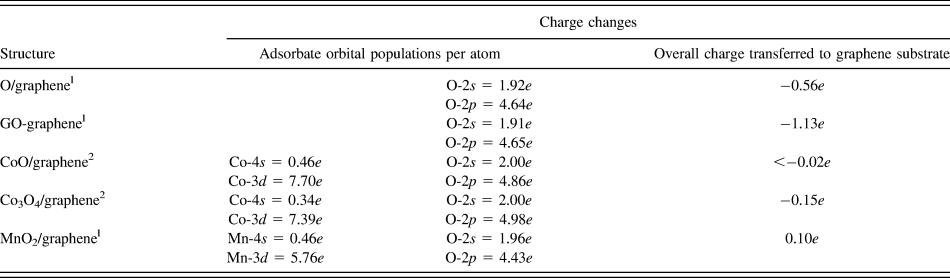
DFT ab initio simulations help to elucidate the fundamental properties at graphene–metal oxide and GO–metal oxide interfaces, particularly in terms of lattice stability, electronic structure (i.e., electron density of states; DOS, here onward) Reference Martin88 and interfacial charge transfer arising due to orbital re-hybridization. Schematic diagrams for the clean graphene support, clusters of adatoms Co (Co/graphene) and CoO on graphene sheet (CoO/graphene) are shown (top view, left panels) alongside comparative total and partial DOS spectra [see Figs. 9(a)–9(f)] as representative example revealing the most stable structure and for C p, Co s and d, and O s and p orbitals hybridization mixing and quantifying unoccupied and occupied states. Figures 9(g) and 9(h) show charge densities for GO-graphene and CoO/graphene relative to corresponding densities from superposition of atomic orbitals and the charge flows from blue region to the red region. From the electronic DOS behavior, the hybrids exhibit metallic behavior i.e., finite DOS energy levels within the Fermi level making a considerable contribution to the total DOS at EF and this behavior changes a little (albeit nonzero) with different Co/graphene and CoO/graphene interfaces shown in Figs. 9(a)–9(h) contributing toward substantial electroactive sites. However, the calculations of partial DOS show the electron contributions of Co d states prevail and the other contributions of 2p oxygen states (see Table III, for summary of surface charge transfer and doping type, which was predicted by the authors in their previous work using Raman spectral behavior Reference Gupta and Carrizosa17 ). This is consistent with statement that the graphene conductivity is never smaller than the minimum value of the quantum conductivity limit (thus a minimum or quantum capacitance of graphene). Thus it is possible to suppose that graphene islands can retain their unique properties in grapehene/Co x O y systems.
Schematics of GO-graphene, cobalt, and cobalt oxide clusters on 2 × 2 and 4 × 4 graphene supercell (top view). (a) Total electronic density of states spectra of graphene, O/graphene, GO-graphene, Co/graphene and CoO/graphene, (b and c) partial density of states spectra of O/graphene and GO-graphene for O s and p orbitals, (d) total electronic density of states spectra of clean graphene substrate, Co/graphene, and CoO/graphene and (e and f) partial density of states spectra of the CoO/graphene for Co s and d and O s and p orbitals. The vertical line is the Fermi level. Charge densities for (g) GO-graphene and (h) CoO/graphene relative to corresponding densities from superposition of atomic orbitals. Charge flows from blue (excess) regions to the red (deficient) regions.

Charge changes (or transfer) between adsorbates (adatoms) and graphene monolayer support relative to free atoms and clean graphene.

Note: Calculations on 12 × 2 and 24 × 4 graphene supports.
Moreover, it is worthy to mention that higher performance originates not only from the Gr/CoO interactions but also from the dimensional tuning of Co x O y , comparable to our experimental systems and better than commercial and expensive Pt nanoparticle catalysts supported on carbon. The isoelectronic charge contour plot drawn in Figs. 9(g) and 9(h) is a two-dimensional cut of the charge density from graphene to layer toward the oxygen atoms in CoO and Co3O4 complex. Table III provides the summary of the adsorbate orbitals per atom and the surface charge transfer (alternatively, doping type) between the adsorbate and the graphene support.
Adsorbates Co3O4, CoO, MnO2, and atomic oxygen on graphene cause charge transfers between the adsorbates and the substrate surface. More specifically, adsorption of MnO2 and CoO on graphene cause charge transfers from the adsorbates to the substrate of 0.1e and 0.15e, respectively. The exact opposite is observed for Co3O4/graphene and oxygen adsorbed on graphene. For CoO/graphene, the overall charges of the adsorbate and the graphene surface are unaffected of the adsorption. The Co–O and Mn–O bonds are covalent bonds. However, for CoO, MnO2, and Co3O4, we observe charge transfer from the metal 4s orbital to 3d orbital and to the oxygen 2p orbital. From these plots and the tabulated values, we infer that the charge transfer at graphene–metal oxide facilitated by the oxygen atoms is either p-type (electron deficient or negative sign) or n-type (electron excess or positive sign) providing low interfacial resistance experience by electron transport through hybrid interface. These calculations are consistent with the statement that the graphene conductivity is never smaller than the minimum value of the quantum conductivity limit. Thus, it is possible to suppose that graphene can retain its unique properties in graphene/Co x O y systems similar to other transition metal oxide–graphene interfaces. Reference Gupta, van Meveren and Jasinski16,Reference Gupta and Carrizosa17,Reference Gupta, van Meveren and Jasinski19 It is conceivable that nanostructures and the thin layer being accessible to the electrolyte result in the maximum utilization of the metal oxides (i.e., minimization of dead volume) and this conduction pathway provided by graphene supports becomes indispensable.
IV. CONCLUSIONS
We reported a series of graphene/cobalt nanohybrids that were strategically prepared by scalable electrodeposition and facile hydrothermal decomposition synthetic methods. We discussed the electrodeposition growth kinetics of nanostructured cobalt oxide polymorphs and cobalt nanoparticles on GNSs as effective support. By virtue of crumpled and flower-like surface morphology and topologically interconnected mesoporous network architectures revealed using electron microscopy, the dimensionality of GNSs combined with nanostructured cobalt oxides and cobalt nanoparticles, they exhibited significant interplay in determining the responses toward electrochemical and electrocatalytic (re)activity. It provides higher specific surface area, more solid–liquid interfacial contact area (electrode/electrolyte accessibility) for adsorption of ions and new conductive pathways for transport of electrons. Thus it facilitates higher energy storage capacity via redox mechanisms in addition to low internal resistance, improved cyclability and stability. The key findings are: (1) the nanostructured CoO, Co3O4, and CoNP are uniformly anchored on and within the GO, rGO, ErGO, and MLG sheets while optimal loading synergistically prevents graphene sheet aggregation. The two-dimensional planar structure is beneficial to homogeneous nucleation giving rise to higher density of electroactive sites and interfaces for redox reactions from nanoscale cobalt oxides, (2) the upper bound energy storage capacity C s was found to be >550 F/g for CoO/MLG followed by >350 F/g for Co3O4/rGOHT and CoO/ErGO hybrids. The planar contact area between the two distinct constituents is good for constructing a conductive network with a high electron transfer rate and a low resistance, (3) the three-dimensional multiplexed and highly conductive pathways provided by defect-free MLG and hydrothermal processed rGOHT scaffold architectures ensure rapid charge transfer and conduction due to larger accessible geometric surface area, (4) computational simulations via periodic DFT with and without transition metal adatoms on graphene and GO sheets complemented the experimental work as it determined the available DOS in the vicinity of Fermi level thus providing contribution toward electroactivity arising due to orbital re-hybridization, and (5) for enzymeless glucose detection, the CoNP/MLG, CoO/ErGO, and Co3O4/rGOHT platforms were ultrasensitive (<5 nM).
Supplementary Material
To view supplementary material for this article, please visit https://doi.org/10.1557/jmr.2016.484.
The supplemental material provides a brief introduction to graphene–metal oxide interfaces, the electrodeposition of nanostructured cobalt-related materials and electrochemical processing of graphene plots, electrical properties, selected-area electron diffraction data in terms of interplanar spacing, micro-Raman spectra and corresponding quantitative analysis, chronopotentiometry or galvanostatic charge–discharge potential profiles for hybrids, and impedance spectroscopy simulation fits using two different equivalent circuits for all the hybrids.
ACKNOWLEDGMENTS
The author (S.G.) gratefully acknowledges financial supports in parts by NSF EPSCoR Track RII subaward EPS-0814194, NSF EPSCoR RSP Award, NSF-MRI (Grant no. 1429563), WKU Research Foundation for start-up funds, internal RCAP-I, and FUSE Grants. The author also thanks Dr. Q. Lineberry (Chemistry) for XRD, Dr. J. Andersland (Biology) for SEM and TEM and P. Norris (Advanced Materials Institute) for AFM training to student co-authors.