Introduction
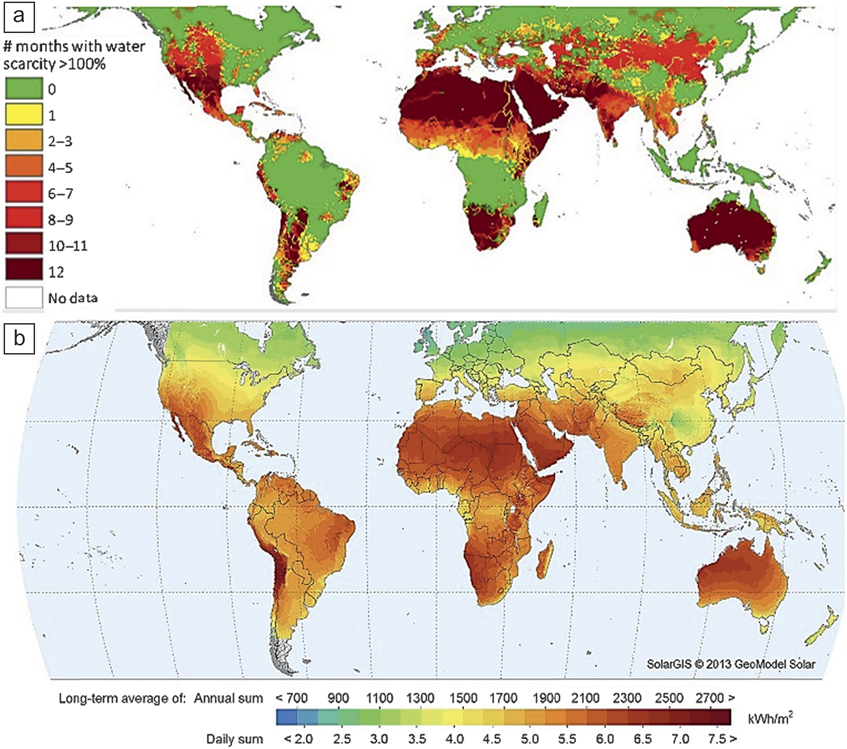
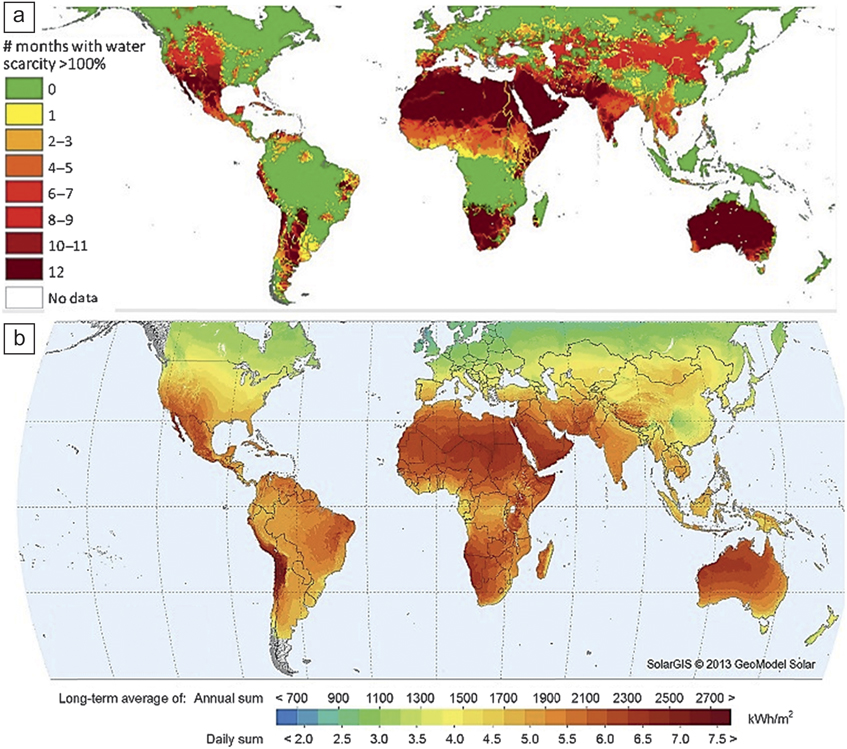
Many communities worldwide suffer from a shortage of fresh water resources (Figure 1a).Reference Mekonnen and Hoekstra1 In some cases, the water shortage is caused by geography and climate, while in others, economic reasons prevail, including the high cost of industrial installation for energy production and water purification, and the absence of available credit resources to invest in new infrastructure.Reference Elimelech and Phillip2,Reference Shannon, Bohn, Elimelech, Georgiadis, Mariñas and Mayes3 One of the most promising strategies to address the challenges of providing renewable energy and fresh water, especially to off-the-grid communities, is to make use of the freely available sunlight as the renewable energy source as well as the vast cold universe as the heatsink. Fortunately, most of the regions with high water shortages have a natural advantage of abundant solar-energy resources (Figure 1b).4
(a) Global water scarcity map. Many communities worldwide experience year-round water shortages. Adapted with permission from Reference Reference Mekonnen and Hoekstra1. © 2016 AAAS. (b) Global solar irradiation map. Regions with water shortages typically have higher-than-average solar resources.4
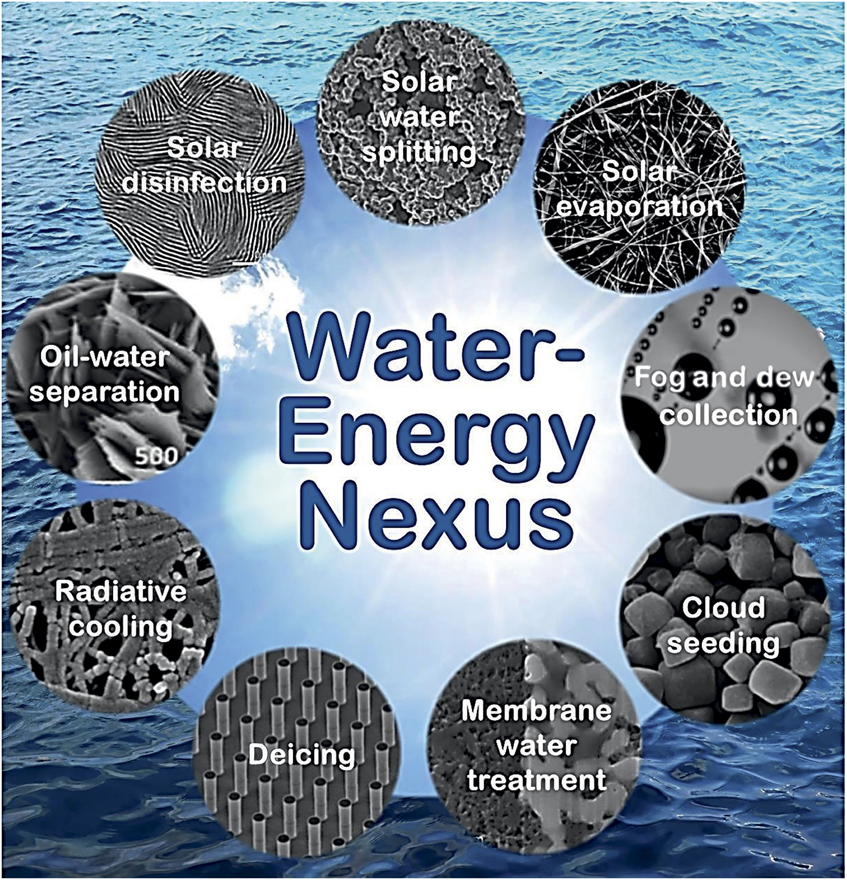
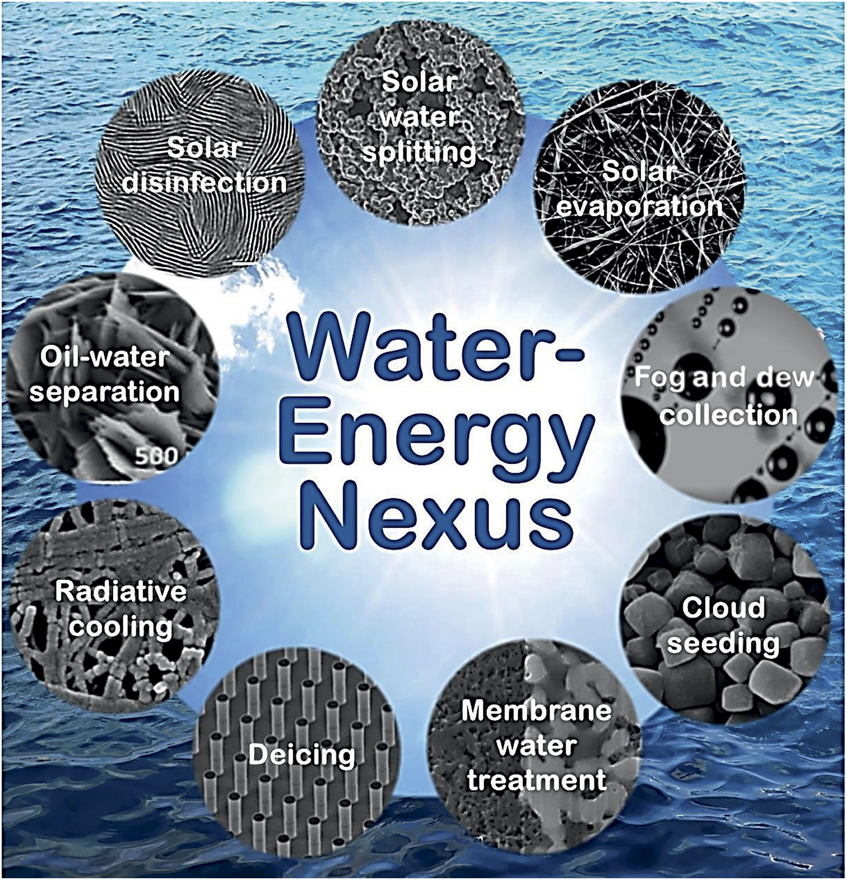
Sunlight can be harnessed to fuel chemical reactions, generate electricity in solar cells, disinfect water, and produce heat for terrestrial thermal engines, water desalination plants, and residential use.Reference Tiwari, Singh and Tripathi5–Reference Bermel, Yazawa, Gray, Xu and Shakouri8 In turn, passive cooling of roofs, solar cells, and individuals via engineering solar absorptance and thermal radiation properties of materials can save energy through reduced use of air conditioning and other electricity-consuming active-cooling technologies.Reference Zhu, Raman and Fan9–Reference Tong, Huang, Boriskina, Loomis, Xu and Chen15 Passive cooling of surfaces can also increase the efficiency of dew collection, helping to extract fresh water from the atmosphere.Reference Beysens, Muselli, Milimouk, Ohayon, Berkowicz, Soyeux, Mileta and Ortega16–Reference Al-Nimr and Haddad19 Examples of nanomaterials developed to advance emerging technologies in the energy-water nexus are shown in Figure 2.Reference Yu, Zhou, Huang, Sun, Qin, Bao, Goddard, Chen and Ren20–Reference Liu, Kong, Hsu, Yuan, Lee, Liu, Wang, Wang, Yan, Lin, Maraccini, Parker, Boehm and Cui28 We discuss some of them in detail next, while also referring the reader to the available extensive review literature.Reference Tiwari, Singh and Tripathi5,Reference Boriskina, Green, Catchpole, Yablonovitch, Beard, Okada, Lany, Gershon, Zakutayev, Tahersima, Sorger, Naughton, Kempa, Dagenais, Yao, Xu, Sheng, Bronstein, Rogers, Alivisatos, Nuzzo, Gordon, Wu, Wisser, Salleo, Dionne, Bermel, Greffet, Celanovic, Soljacic, Manor, Rotschild, Raman, Zhu, Fan and Chen7,Reference Lee, Choi, Kim and Nam29–Reference Dsilva Winfred Rufuss, Iniyan, Suganthi and Davies33
Examples of nano- and mesoscale materials developed to advance emerging technologies in the energy-water nexus. From the top, clockwise: solar water splitting (FeP/Ni2P nanoparticles on a Ni foam),Reference Yu, Zhou, Huang, Sun, Qin, Bao, Goddard, Chen and Ren20 solar evaporation (electrospun nylon/carbon fibers),Reference Jin, Chang, Shi, Shi, Hong and Wang21 atmospheric water collection (dew drops on spider silk fibers),Reference Chen and Zheng22 cloud seeding (TiO2 shell–NaCl core particles),Reference Tai, Liang, Zaki, El Hadri, Abshaev, Huchunaev, Griffiths, Jouiad and Zou23 membrane water desalination and waste water treatment (nanoporous carbon composite membrane),Reference Chen, Chen, Liang, Zhang, Fan, Yin, Huang, Zhang, Lai and Sheng24 deicing of surfaces (silicon micropillars covered with Ti nanowires),Reference Maitra, Tiwari, Antonini, Schoch, Jung, Eberle and Poulikakos25 passive radiative cooling (nanoporous polyethylene film),Reference Hsu, Liu, Song, Zhang, Peng, Xie, Liu, Wu, Catrysse, Cai, Zhai, Majumdar, Fan and Cui26 oil-water separation for treating produced water (nanostructured CuO mesh),Reference Liu, Raza, Aili, Lu, AlGhaferi and Zhang27 and solar microbial disinfection (vertically aligned MoS2 nanofilms).Reference Liu, Kong, Hsu, Yuan, Lee, Liu, Wang, Wang, Yan, Lin, Maraccini, Parker, Boehm and Cui28
Solar harvesting and cooling
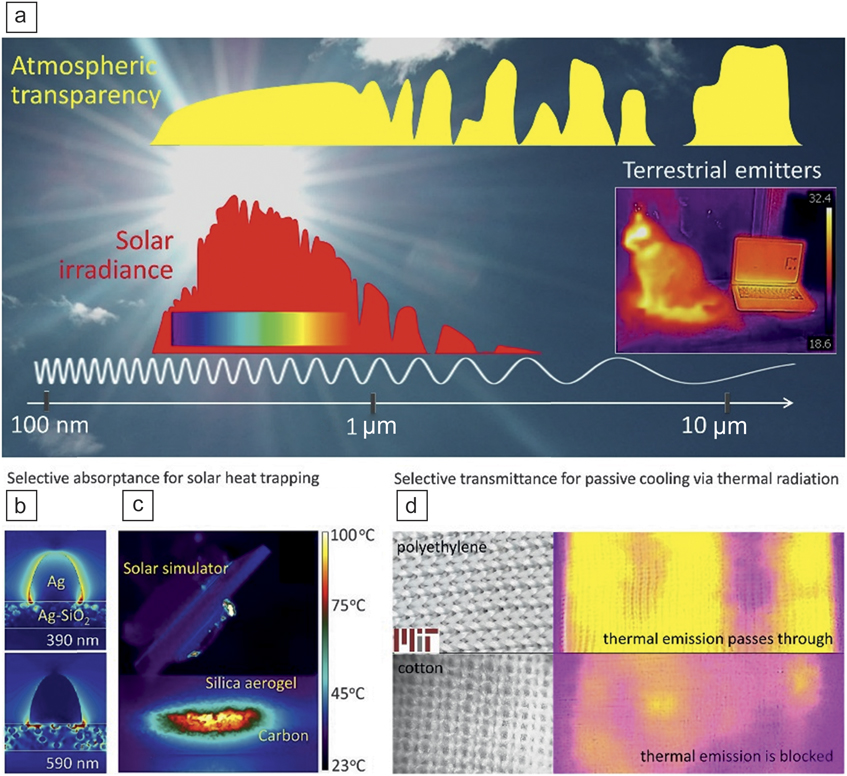
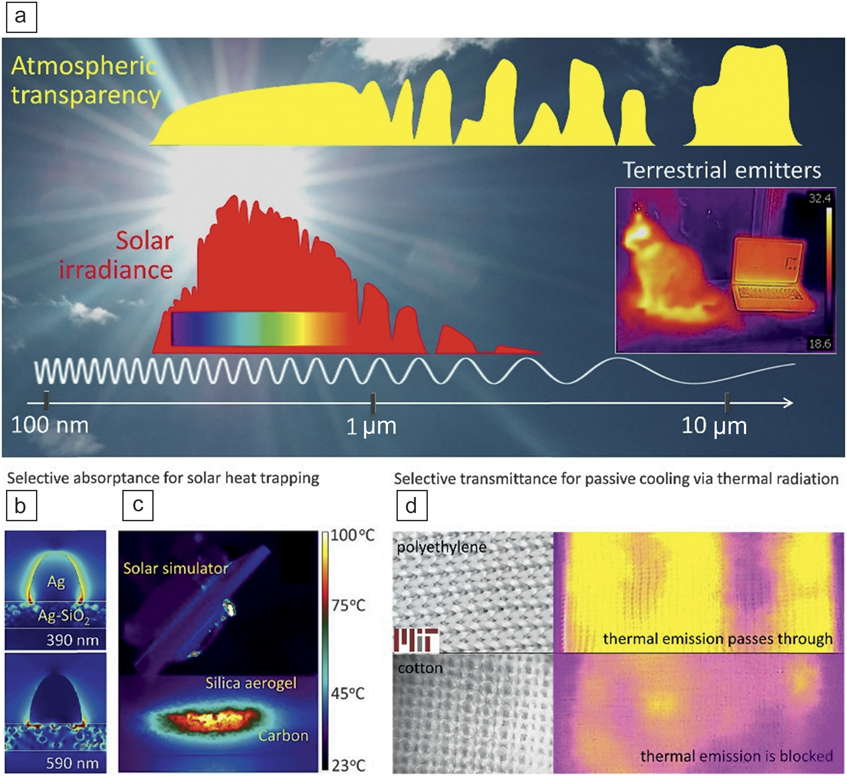
To harvest solar light and heat, materials need to be spectrally engineered in the broad range of wavelengths (Figure 3a), covering both the solar spectrum (∼0.3–2.5 μm wavelength) and the infrared emission spectrum of terrestrial emitters (∼2–15 μm, depending on the emitter temperature).Reference Boriskina, Green, Catchpole, Yablonovitch, Beard, Okada, Lany, Gershon, Zakutayev, Tahersima, Sorger, Naughton, Kempa, Dagenais, Yao, Xu, Sheng, Bronstein, Rogers, Alivisatos, Nuzzo, Gordon, Wu, Wisser, Salleo, Dionne, Bermel, Greffet, Celanovic, Soljacic, Manor, Rotschild, Raman, Zhu, Fan and Chen7,Reference Boriskina, Tong, Hsu, Liao, Huang, Chiloyan and Chen34–Reference Mojiri, Taylor, Thomsen and Rosengarten38 An ideal absorber should possess high spectral absorptance in the solar spectrum range, low infrared emittance to reduce radiative heat losses, excellent durability at elevated temperature in air and water, and low cost, combining inexpensive starting materials and scalable coating processes.Reference Cao, McEnaney, Chen and Ren39 Nonselective blackbody absorbers, including black fabrics, paints, and carbon-based materials, can be relatively inexpensive and provide high light absorption in a broad wavelength range.Reference Ni, Zandavi, Javid, Boriskina, Cooper and Chen40–Reference Siva Reddy, Kaushik, Ranjan and Tyagi42 However, they also emit thermal radiation over a broad range, which typically limits their use to either low-temperature applications such as conventional solar stills,Reference Ni, Zandavi, Javid, Boriskina, Cooper and Chen40,Reference Ni, Miljkovic, Ghasemi, Huang, Boriskina, Lin, Wang, Xu, Rahman, Zhang and Chen43,Reference Cooper44 or applications relying on concentrating sunlight to small areas with lenses and reflectors.Reference Weinstein, Loomis, Bhatia, Bierman, Wang and Chen6,Reference Boriskina, Tong, Hsu, Liao, Huang, Chiloyan and Chen34
(a) Wavelength spectra of solar radiation (red) and atmospheric transparency (yellow). Terrestrial objects emit thermal radiation in the mid to far-infrared spectral range, which overlaps with the transparency window in the atmospheric spectrum, allowing for their passive cooling via radiation into the ultra-cold of outer space. (b) Local electromagnetic field intensity distribution at two separate wavelengths within the visible spectrum in a broadband solar absorber that combines thin-film interference and localized surface plasmon resonance effects in an Ag-SiO2 nanocomposite structure.Reference Lu, Raza, Noorulla, Alketbi, Fang, Chen and Zhang57 (c) Local temperature distribution in the internally hot, externally cool solar absorber utilizing carbon foam as the blackbody absorber and a transparent silica aerogelReference Weinstein, McEnaney, Strobach, Yang, Bhatia, Zhao, Huang, Loomis, Cao, Boriskina, Ren, Wang and Chen60 as thermal insulation material. (d) Optical (left) and infrared (right) images of a human hand covered with wearable fabrics, which are either blocking infrared emission from the skin (cotton, bottom) or allowing it to pass through (polyethylene, top).Reference Zandavi, Huang, Ni, Pang, Osgood, Kamal, Jain, Chen and Boriskina68
Solar absorbers can be engineered by introducing metal nanostructures, such as nanoparticles, nanopores, and nanodisks, either on the absorber surface or inside its volume.Reference Bermel, Yazawa, Gray, Xu and Shakouri8,Reference Bermel, Lee, Joannopoulos, Celanovic and Soljacic35,Reference Mojiri, Taylor, Thomsen and Rosengarten38,Reference Cao, McEnaney, Chen and Ren39,Reference Chou, Xiang, Yoonkyung, Lee, Lenert, Rinnerbauer, Celanovic, Soljačić, Fang, Wang and Kim45–Reference Fei Guo, Sun, Cao, Liu and Ren48 Surface plasmon modes excited by incident sunlight on these nanostructures facilitate efficient absorption of solar photons and conversion of their energy into heat. The nanostructured solar absorbers can be tailored to simultaneously offer high reflectance (i.e., low emittance) at longer wavelengths, thus facilitating heat trapping.Reference Weinstein, Loomis, Bhatia, Bierman, Wang and Chen6,Reference Boriskina, Green, Catchpole, Yablonovitch, Beard, Okada, Lany, Gershon, Zakutayev, Tahersima, Sorger, Naughton, Kempa, Dagenais, Yao, Xu, Sheng, Bronstein, Rogers, Alivisatos, Nuzzo, Gordon, Wu, Wisser, Salleo, Dionne, Bermel, Greffet, Celanovic, Soljacic, Manor, Rotschild, Raman, Zhu, Fan and Chen7,Reference Boriskina, Tong, Hsu, Liao, Huang, Chiloyan and Chen34,Reference Peters, Goldschmidt, Löper, Groß, Üpping, Dimroth, Wehrspohn and Bläsi49–Reference Kraemer, Poudel, Feng, Caylor, Yu, Yan, Ma, Wang, Wang, Muto, McEnaney, Chiesa, Ren and Chen51
Other approaches to enhance solar absorptance rely on the use of thin-film, photonic-crystal, and graded-index coatings as well as mesoscale structures combining photonic crystals and thin films with nanoparticles.Reference Cao, Huang, Tang, Sun, Boriskina, Chen and Ren37,Reference Chou, Xiang, Yoonkyung, Lee, Lenert, Rinnerbauer, Celanovic, Soljačić, Fang, Wang and Kim45,Reference Kats, Byrnes, Blanchard, Kolle, Genevet, Aizenberg and Capasso52–Reference Zhou, Tan, Ji, Zhu, Zhang, Xu, Gan, Yu and Zhu56 Lithography-free fabrication techniques yielding nanocomposite films and coatings are especially attractive for solar-thermal applications owing to their cost effectiveness and scalability.Reference Cao, McEnaney, Chen and Ren39 An example of such scalable ultrathin nanocomposite film composed of silver (Ag) and glass (SiO2) materials is shown in Figure 3b.Reference Lu, Raza, Noorulla, Alketbi, Fang, Chen and Zhang57 This nanocomposite absorber traps sunlight in a broad frequency range via excitation of multiple plasmonic resonances. These resonances are excited at several frequencies overlapping with the solar spectrum, and exhibit different spatial distributions of electromagnetic field, as shown in Figure 3b. Multifrequency response of this absorber stems from its complex mesosale internal structure. As surface plasmon resonances decay, their energy is dissipated as heat, elevating the absorber temperature. Furthermore, both sunlight and heat can be trapped inside internally hot, externally cool solar absorbers capped with optically transparent yet thermally insulating materials (Figure 3c). Highly porous aerogels and foams are excellent candidates for thermally insulating absorber coatings due to their extra-low thermal conductivity values. They can be made optically transparent for the solar light by reducing the size of the pores to the nanoscale,Reference Ni, Miljkovic, Ghasemi, Huang, Boriskina, Lin, Wang, Xu, Rahman, Zhang and Chen43,Reference Tillotson and Hrubesh58,Reference Zhao, Yang, Bhatia, Strobach and Wang59 and can increase efficiency of blackbody absorbers such as carbon black particles. The infrared camera image shown in Figure 3c illustrates the use of optically transparent silica aerogel insulation to trap heat inside a solar-thermal receiver illuminated by artificial sunlight from a solar simulator.Reference Weinstein, McEnaney, Strobach, Yang, Bhatia, Zhao, Huang, Loomis, Cao, Boriskina, Ren, Wang and Chen60,Reference McEnaney, Weinstein, Kraemer, Ghasemi and Chen61
Spectrally selective coatings are also finding use in daytime radiative cooling applications.Reference Chan, Riffat and Zhu62–Reference Hossain and Gu64 Thermal spectra of terrestrial emitters peak in the mid-infrared range (∼7–15 μm). The earth’s atmosphere is transparent within this range, known as the “atmospheric transparency window” (Figure 3a). Mid-infrared photons can escape through this window into outer space, thus causing cooling. Most materials, including vegetation and commercial paints, have high emittance in the mid to far-infrared range, allowing for nighttime radiative cooling.Reference Eriksson and Granqvist12,Reference Eriksson, Lushiku and Granqvist65
Daytime radiative cooling is more challenging, as the thermal radiation process has to compete with heating via sunlight absorption. Recently, this challenge has been met by the development of spectrally selective surfaces that efficiently reflect sunlight and simultaneously emit efficiently in the mid-infrared. The refractive index engineering of multilayered structures consisting of hafnia (HfO2) and silica (SiO2) glasses resulted in daytime radiative cooling below the ambient temperature.Reference Raman, Anoma, Zhu, Rephaeli and Fan10,Reference Zhu, Raman, Wang, Anoma and Fan66,Reference Chen, Zhu, Raman and Fan67 Glass-polymer hybrid metamaterials as well as metal-lined polymer films have also been developed for daytime radiative cooling.Reference Zhai, Ma, David, Zhao, Lou, Tan, Yang and Yin13,Reference Kou, Jurado, Chen, Fan and Minnich14,Reference Beysens, Muselli, Milimouk, Ohayon, Berkowicz, Soyeux, Mileta and Ortega16 Optically transparent polymers such as polyethylene and poly(methyl methacrylate) (PMMA) offer opportunities to create inexpensive, lightweight, and large-scale films for practical applications.
Wearable technologies can also be adapted to incorporate passive radiative cooling functionality. Since human skin is an almost ideal blackbody emitter in the infrared spectral range, fabrics that exhibit a transparency window in the same spectral range can help skin cool via the thermal radiation mechanism (Figure 3d).Reference Zandavi, Huang, Ni, Pang, Osgood, Kamal, Jain, Chen and Boriskina68 Polyethylene is a polymer that exhibits uniquely low mid-infrared absorptance and high transmittance for thermal radiation from the skin. Polyethylene fabrics that combine visible opaqueness with infrared transparency have been theoretically predictedReference Tong, Huang, Boriskina, Loomis, Xu and Chen15 and later demonstrated to achieve skin temperature reduction by 1–2°C relative to conventional textiles.Reference Hsu, Song, Catrysse, Liu, Peng, Xie, Fan and Cui69–Reference Jafar-Zanjani, Salary and Mosallaei73 Visible opaqueness of the PE fabrics stems from light scattering by their internal microstructure comprised of either fibers or pores of 1–20 μm in size.
Water purification
Solar heat trapped by selective absorbers can be used for solar-driven water purification.Reference Raza, Lu, Alzaim, Li and Zhang74 Vapor generation for water distillation in solar stills is an ancient technologyReference Tiwari, Singh and Tripathi5 whose commercial adoption for large-scale applications has long been stymied by higher cost relative to membrane-based water purification techniques. However, passive solar technology offers an attractive solution for small-scale off-grid applications, especially in economically disadvantaged geographical locations or disaster zones. Recently, the interfacial solar vapor generation approach revived interest in solar distillation.Reference Neumann, Urban, Day, Lal, Nordlander and Halas75–Reference Liu, Huang, Hsiung, Tian, Wang, Han and Fratalocchi83
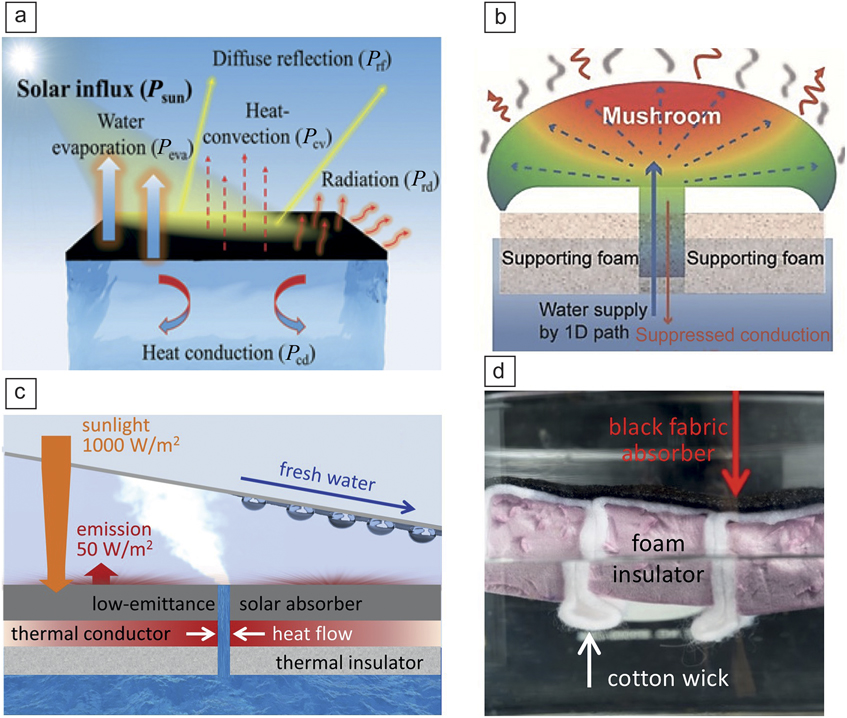
Interfacial evaporation occurs on the surface of water and can be achieved by using a solar absorber floating on the water surface (Figure 4a).Reference Ni, Zandavi, Javid, Boriskina, Cooper and Chen40,Reference Wang84–Reference Ni, Li, Boriskina, Li, Yang, Zhang and Chen86 To maintain high efficiency of the evaporation process, parasitic heat losses from the absorber should be minimized. These include optical loss (reflection) as well as thermal loss (heat conduction, convection, and radiation). To reduce all the losses, the absorber needs to be engineered to provide not only spectral selectivity, but also low thermal conductivity for vertical heat localization; a porous microstructure with high wettability for water transport; thermal, humidity and chemical stability; and opportunities for low-cost and scalable fabrication.
(a) Thermodynamic processes and energy balance in a floating solar still.Reference Wang84 (b, c) Thermal management and water path design strategies can increase solar still efficiency. (b) Vertical thermal isolation in mushroom structures reduces thermal losses.Reference Xu, Hu, Xu, Li, Zhou, Zhu and Zhu85 (c) Lateral thermal concentration in perforated floating stills enables water boiling under illumination by sunlight without any external optical concentrators.Reference Ni, Li, Boriskina, Li, Yang, Zhang and Chen86 (d) Optimizing the ratio of wicking and insulating surfaces mitigates effects of salt fouling and yields self-cleaning solar stills.Reference Ni, Zandavi, Javid, Boriskina, Cooper and Chen40
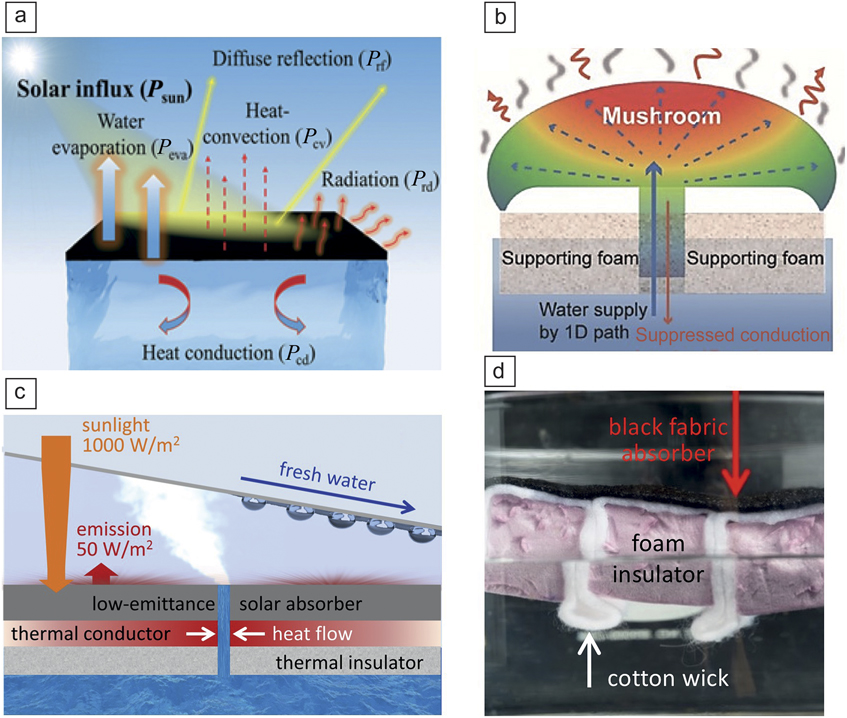
After demonstrations of the concept of heat localization for interfacial solar evaporation in high concentration plasmonic opto-nanofluids (i.e., suspensions of silica-core gold-coated nanoshells in water) and floating porous carbon foam absorbers,Reference Neumann, Urban, Day, Lal, Nordlander and Halas75,Reference Ghasemi, Ni, Marconnet, Loomis, Yerci, Miljkovic and Chen76,Reference Hogan, Urban, Ayala-Orozco, Pimpinelli, Nordlander and Halas87 many solar still designs and materials were reported. These included noble-metal nanospheres, nanoshells and nanorods,Reference Zhou, Tan, Wang, Xu, Yuan, Cai, Zhu and Zhu55,Reference Chang, Yang, Liu, Tao, Song, Shang, Wu and Deng78,Reference Wang, He, Liu, Cheng and Zhu81,Reference Wang, Liu, Tao, Shen, Yi, Zhang, Liu, Song, Zhang, Shang and Deng88–Reference Boriskina, Ghasemi and Chen92 less expensive carbon-based black absorbers,Reference Jin, Chang, Shi, Shi, Hong and Wang21,Reference Ni, Miljkovic, Ghasemi, Huang, Boriskina, Lin, Wang, Xu, Rahman, Zhang and Chen43,Reference Nafey, Abdelkader, Abdelmotalip and Mabrouk93–Reference Ito, Tanabe, Han, Fujita, Tanigaki and Chen95 and other exotic and nature-inspired materials, including paper, carbonized wood, leaves, and mushrooms.Reference Zhuang, Zhou, Xu, Xu, Hu, Li, Lv, Zheng, Zhu, Wang and Zhu79,Reference Liu, Jiang, Tadepalli, Raliya, Biswas, Naik and Singamaneni96–Reference Hong, Shi, Li, Zhang, Jin and Wang98 For example, the structure of mushrooms offers a restricted vertical water pathway, which was utilized in the development of efficient solar evaporators based on natural carbonized mushrooms (Figure 4b).Reference Xu, Hu, Xu, Li, Zhou, Zhu and Zhu85 High-temperature solar steam is of special interest for solar sterilization of food, waste, or medical equipment in off-grid locations,Reference Neumann, Feronti, Neumann, Dong, Schell, Lu, Kim, Quinn, Thompson, Grady, Nordlander, Oden and Halas99 and can typically only be achieved under concentrated sunlight and in pressurized systems. However, lateral thermal concentrationReference Ni, Li, Boriskina, Li, Yang, Zhang and Chen86 (Figure 4c) can increase vapor temperature up to the water boiling point by enlarging the ratio of solar absorption area to the evaporation area. Even higher steam temperatures can be reached in contactless solar stills, where a porous solar absorber is separated from the water surface by an air gap; it heats the water and the water vapor radiatively by emitting infrared photons.Reference Cooper, Zandavi, Ni, Tsurimaki, Huang, Boriskina and Chen100
Overall, passive solar-thermal desalination has high potential for applications in decentralized water purification and zero-liquid discharge desalination, especially for high-concentration brine treatment that presents significant challenges for membrane-based filtration technologies.Reference Ferrar, Michanowicz, Christen, Mulcahy, Malone and Sharma101–Reference Van der Bruggen and Vandecasteele103 Solar stills can be used for recycling valuable chemicals dissolved in brine and also produce water, and in combination with power generatorsReference Yang, Liu, Chen, Li, Duan, Xue, Xu, Xie and Zhou104 or solar-fuel generation systems,Reference Gao, Connor and Ho80 they show great promise for urgent survival needs in areas with both water and energy shortages. To avoid fouling of floating solar still materials with salts left behind by the evaporation process, optimum combinations of hydrophilic wicking and hydrophobic insulating materials have been proposed (Figure 4d).Reference Ni, Zandavi, Javid, Boriskina, Cooper and Chen40,Reference Liu, Chen, Guo, Cao and Jiang94
Owing to many improvements in materials and design strategies, single-stage solar still technology is gradually approaching the production rate of mature filtration-based technologies (40–400 L/m2/day for seawater filtration), with a solar vaporization rate of 18–23 L/m2/day recently demonstrated under natural sunlight with a hierarchically nanostructured gel based on poly(vinyl alcohol) (PVA) and polypyrrole (PPy).Reference Zhao, Zhou, Shi, Qian, Alexander, Zhao, Mendez, Yang, Qu and Yu105 This high evaporation rate exceeds the photothermal efficiency limit, indicating that the phase-change enthalpy of water in nanoscale-confined space can be reduced, which is of both fundamental and applied importance.
The efficiency of the solar evaporation process can also be increased by environmental energy harvestingReference Li, Li, Lu, Xu, Chen, Min, Zhu, Li, Zhou, Zhu, Zhang and Zhu82 and radiation loss recyclingReference Shi, Li, Jin, Zhuo, Shi, Chang, Hong, Ng and Wang106 strategies, as well as strategies to recover the latent heat of water vaporization, which is typically released into the environment once the vapor condenses in the fresh water collector.Reference Dongare, Alabastri, Pedersen, Zodrow, Hogan, Neumann, Wu, Wang, Deshmukh, Elimelech, Li, Nordlander and Halas107,Reference Politano, Argurio, Di Profio, Sanna, Cupolillo, Chakraborty, Arafat and Curcio108 A multistage solar still has been recently demonstrated, which recovers and reuses the latent heat several times prior to its release to the environment at lower temperature.Reference Chiavazzo, Morciano, Viglino, Fasano and Asinari109 This still enjoys both advantages of thermal-based desalination and membrane-based filtration processes, and uses commercial spectrally selective coating (TiNOX) for solar absorption as well as polyethylene films for thermal insulation. Such a multistage system yields a large-scale purified water production rate of 72 L/m2/day, which is one magnitude higher than that achievable with single-stage solar stills.
Atmospheric water extraction
The atmosphere holds 12,900 billion tons of fresh water, equivalent to ∼10% of the water in all of the lakes and six times the water in all rivers on Earth.Reference Schneider, Root and Mastrandrea110 Harvestable atmospheric water, including water vapor and water droplets in fog, is present even in very dry desert regions.Reference Schneider, Root and Mastrandrea110 Atmospheric water harvesting is emerging as an alternative approach for arid regions, landlocked, and remote communities.111 Fog harvesting is the most ancient way of collecting air water, which has been used by plants, animals, and humans worldwide to harvest fresh water. Many modern nanostructured materials used in fog harvesting actually mimic biological systems of plants and insects.Reference Zhang, Wu, Hedhili, Yang and Wang112–Reference Hou, Chen, Xue, Zheng and Jiang116 However, fog harvesting necessitates consistently high (close to 100%) relative humidity (RH) in air, which makes it a viable solution only in some locations.Reference Estrela, Valiente, Corell and Millán117,Reference Olivier and de Rautenbach118 In regions with fresh water scarcity, harvesting water vapor from air is a more meaningful approach.Reference McHugh, Morrissey, Reed, Hungate and Schwartz119
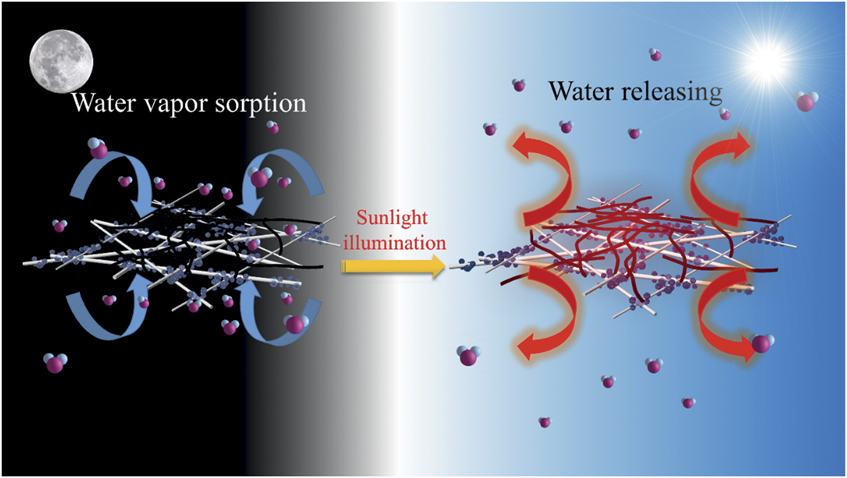
Active refrigeration is currently the most popular way to extract water from the atmosphere.Reference Wahlgren120,Reference Wikramanayake, Ozkan and Bahadur121 The method uses an engineered cold surface to cool the adjacent air mass below the dew point to produce water droplets via condensation.Reference Nilsson17,Reference Guan, Sebben and Bennett18,Reference Wikramanayake, Ozkan and Bahadur121,Reference Kim, Rao, Kapustin, Zhao, Yang, Yaghi and Wang122 A sorption-based approach for atmospheric water vapor harvesting is also gaining popularity (Figure 5), in which a water sorbent, such as metal–organic framework (MOF), anhydrate salts, deliquescent salts, is used to harvest water vapor from air, and it is then heated with assistance from photothermal material to release and subsequently condense the water.Reference Kim, Rao, Kapustin, Zhao, Yang, Yaghi and Wang122–Reference Wang, Liu, Wang and Wang125 Effective photothermal materials, such as carbon nanotubes, carbon black particles, and graphene, have been utilized to directly tap sunlight to drive the water vapor release out of the water vapor sorbents.Reference Zhao, Zhou, Shi, Qian, Alexander, Zhao, Mendez, Yang, Qu and Yu105 The solar-photothermal process along with an effective water vapor sorbent has recently delivered fully solar energy-driven autonomous atmospheric water generator devices.Reference Kim, Rao, Kapustin, Zhao, Yang, Yaghi and Wang122,Reference Kim, Yang, Rao, Narayanan, Kapustin, Furukawa, Umans, Yaghi and Wang123,Reference Li, Shi, Shi, Alsaedi and Wang126
Schematics of the working principle of an atmospheric water generator,Reference Li, Shi, Shi, Alsaedi and Wang126 based on the use of water sorbent materials such as metal–organic frameworks, anhydrate salts, or deliquescent salts.
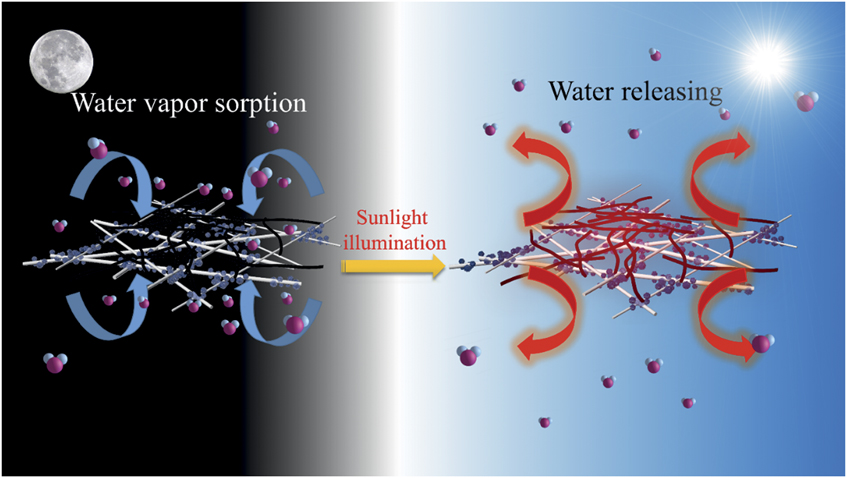
An efficient vapor sorbent should be capable of absorbing large amounts of water, even from air with reasonably low RH, and releasing most of the water at a relatively low temperature (60–80°C) achieved under sunlight illumination.Reference Ghasemi, Ni, Marconnet, Loomis, Yerci, Miljkovic and Chen76,Reference Li, Zhang, Shi and Wang127,Reference Liu, Yu, Feng, Bernard, Liu, Zhang, Duan, Shang, Tao, Song and Deng128 Conventional desiccants, such as silica gel, zeolite, and activated alumina have a wide water vapor sorption window, but require high temperatures (>160°C) to efficiently release most of the captured water.Reference Chua, Ng, Chakraborty, Oo and Othman129–Reference Desai, Hussain and Ruthven131 Recently, new material candidates have emerged that are capable of operation under sunlight. These include MOFs such as Zr6O4(OH)4(fumarate)6,Reference Kim, Rao, Kapustin, Zhao, Yang, Yaghi and Wang122,Reference Kim, Yang, Rao, Narayanan, Kapustin, Furukawa, Umans, Yaghi and Wang123 anhydrous and hydrated salt couples (CuCl2, CuSO4 and MgSO4),Reference Li, Shi, Shi, Alsaedi and Wang126 and hydrogels.Reference Nandakumar, Ravi, Zhang, Guo, Zhang and Tan132 It is expected that other sorbent materials will emerge in the near future with large water sorption capacities and easy water release. As research on photothermal conversion materials progresses, higher temperatures may be produced under natural sunlight, which would broaden the water sorbent materials pool.
Conclusion
As new technologies for water-energy nexus applications are developed and mature, they will inspire developments of new materials and application areas. Materials for daytime radiative cooling that help reduce the amount of energy needed for cooling buildings also find use in atmospheric water capture and dew collection.Reference Beysens, Muselli, Milimouk, Ohayon, Berkowicz, Soyeux, Mileta and Ortega16,Reference Guan, Sebben and Bennett18 On the other hand, light and heat trapping/spreading concepts and composite materials developed for solar water desalination technologies are now being adapted to engineer ice-phobic surfaces that use solar energy to prevent and mitigate ice formation.Reference Mitridis, Schutzius, Sicher, Hail, Eghlidi and Poulikakos133,Reference Dash, de Ruiter and Varanasi134 New composite material systems are emerging to replace the commonly used table salt in cloud-seeding applications.Reference Tai, Liang, Zaki, El Hadri, Abshaev, Huchunaev, Griffiths, Jouiad and Zou23,Reference French, Friedrich, Tessendorf, Rauber, Geerts, Rasmussen, Xue, Kunkel and Blestrud135,Reference Fisher, Lytle, Kunkel, Blestrud, Dawson, Parkinson, Edwards and Benner136 Many nanostructured materials used to address the challenges in the water-energy nexus continue to draw inspiration from existing natural solutions to engineering spectral selectivity, water wicking, vapor harvesting, and other functionalities.Reference Boriskina, Zandavi, Song, Huang and Chen71,Reference Zhuang, Zhou, Xu, Xu, Hu, Li, Lv, Zheng, Zhu, Wang and Zhu79,Reference Liu, Jiang, Tadepalli, Raliya, Biswas, Naik and Singamaneni96,Reference Chen, Gong, Zhu, Chen, Lacey, Jiang, Li, Wang, Dai, Yao, Song, Liu, Fu, Das and Hu97,Reference Ju, Bai, Zheng, Zhao, Fang and Jiang113,Reference Fu, Ansari, Zhou and Berglund137–Reference Zhai, Berg, Cebeci, Kim, Milwid, Rubner and Cohen144 Many challenges in materials engineering still remain, with the focus shifting to passive solar-driven operation, self-cleaning capabilities, and recyclability.Reference Ni, Zandavi, Javid, Boriskina, Cooper and Chen40,Reference Liu, Jiang, Tadepalli, Raliya, Biswas, Naik and Singamaneni96,Reference Zeng, Yao, Horri, Wang, Wu, Li and Wang145

Svetlana V. Boriskina is a research scientist in the Department of Mechanical Engineering at the Massachusetts Institute of Technology. She received her PhD degree in physics and mathematics from Kharkiv National University, Ukraine. She previously worked as a research fellow at The University of Nottingham, UK, and Boston University. Her research focuses on the development of smart fabrics for thermal comfort, new metamaterials to manipulate light in unusual ways, and solar-harvesting platforms to provide clean energy and fresh water to off-grid and disaster-stricken communities. Boriskina has authored 110 publications, served as the principal investigator (PI) or co-PI on multiple US Department of Defense, US Department of Energy, and NATO-funded projects, and holds many patents on sensor, energy-conversion, and desalination systems. She is currently a director-at-large at The Optical Society, and an associate editor of Optics Express and the Journal of Optics. Boriskina can be reached by email at sborisk@mit.edu.

Aikifa Raza is a research scientist in the Department of Mechanical and Materials Engineering of the Masdar Institute, Khalifa University of Science and Technology, United Arab Emirates. Her research interests include nano-/microfabrication and characterization for solar-thermal applications and the characterization of interfacial adhesive forces between different materials using the quantum nanomechanical atomic force microscopic approach. She has published more than 30 peer-reviewed papers and five book chapters. Raza can be reached by email at aikifa.raza@ku.ac.ae.

TieJun (TJ) Zhang is an associate professor of mechanical and materials engineering at the Masdar Institute, Khalifa University of Science and Technology, United Arab Emirates (UAE). He was a visiting assistant professor at the Massachusetts Institute of Technology, and a postdoctoral research associate at the Rensselaer Polytechnic Institute. He received the UAE National Research Foundation University-Industry Research Collaboration Award, and served as the PI of multiple research projects on energy and micro/nanotechnologies. He has authored more than 130 publications on phase-change heat transfer and microfluidics, nanomaterials synthesis and advanced microfabrication, solar-power generation and refrigeration cooling, subsurface multiphase flow and water treatment, and energy process dynamics and control. He is a member of The American Society of Mechanical Engineers (ASME) NanoEngineering for Energy and Sustainability Steering Committee and ASME Heat Transfer Division K18 Technical Committee. Zhang can be reached by email at tiejun.zhang@ku.ac.ae.

Peng Wang is an associate professor of environmental science and engineering at King Abdullah University of Science and Technology (KAUST), Saudi Arabia. He is affiliated with the Water Desalination and Reuse Center and KAUST Solar Center. His research interests include nano-photothermal material-assisted solar desalination, atmospheric water harvesting, smart materials-enabled solar cooling, oil/water separation, and energy harvesting. He has published more than 70 papers in prestigious journals and three academic books, and is on the advisory board of Advanced Sustainable Systems. Wang can be reached by email at peng.wang@kaust.edu.sa.

Lin Zhou is an associate professor of quantum electronics and optics engineering in the College of Engineering and Applied Sciences at Nanjing University, China. She is also a research scientist at Columbia University. Her research interests lie in nanophotonics, plasmonics, and related energy-conversion systems. Her current research focuses on nanophotonics design of plasmonic microstructures for solar-thermal conversion, and emerging materials for solar absorbers, solar desalination, and solar thermo-photovoltaics. She has published more than 40 peer-reviewed papers and one book chapter. Zhou can be reached by email at linzhou@nju.edu.cn.

Jia Zhu is a professor in the College of Engineering and Applied Sciences at Nanjing University, China. He received his MS and PhD degrees in electrical engineering from Stanford University, and worked as a postdoctoral fellow at the University of California, Berkeley, and Lawrence Berkeley National Laboratory. His scientific research interests lie in the areas of nanomaterials, nanophotonics, and nanoscale heat transfer. Zhu has received several prestigious awards, including the OSA Young Investigator Award (2017), Dupont Young Professor Award (2016), MIT Technology Review TR35 Award (2016), and the Recruitment Program of Global Experts (2014). He has published more than 60 papers and delivered more than 40 keynote/invited lectures at leading research institutions, international conferences, and the US Department of Energy. He is an advisory board member of Molecular Systems Design & Engineering. Zhu can be reached by email at jiazhu@nju.edu.cn.