

 $$\raster="fx1"$$
 $$\raster="fx2"$$
 $$\raster="fx3"$$
1 Introduction
1.1 Background
1.1.1 The Consumer Information Working Party was formed to explore the information needs of different people at different lifestages and how those needs could be better met. We chose to focus in particular on long-term savings and investments.
1.1.2 As actuaries, we feel we are uniquely placed to contribute in this area because of our technical expertise, wide ranging industry roles and core obligation to serve the public interest.
1.1.3 The timing of this work coincides with a significant opportunity to change how we approach communications – for example given the regulatory changes of the Retail Distribution Review and the legislative changes of Pensions Reform.
“A long way from ideal”
1.1.4 In July 2006, the ABI published its review of Yearly Statements (ABI, 2006). Its findings were not surprising based on previous research:
“To be useful, these statements should provide customers with necessary information on the performance of their products and prompt action where necessary. But we are a long way from the ideal.
Current pensions and investment statements are long and unappealing.
Layers of uncoordinated regulation make it difficult for customers to retrieve information. Poor design by the industry adds to the length and incoherence of these documents. IFAs do not often take the opportunity the statement presents to provide ongoing advice to the customer. In short, we all appear to overlook the customer.”
1.1.5 The report went on to propose some key recommendations, which were relevant to all forms of consumer information and would incorporate improvements based on known consumer behaviours.
1.1.6 However, in 2011 our communications are still far from ideal. On 15 January 2011, The Times published its view of where we are:
“the arcane lingo of pensions is not just the inevitable consequence of precise people (actuaries) colliding with the messy, real world. It is more sinister than that. Opacity, complexity and jargon have sometimes been deliberately introducedinto the system the more easily to bamboozle and overcharge the unwary.”
1.1.7 There are various possible reasons for our failure to transform consumer information so far. In particular, it may be because information providers are reluctant to invest in it significantly – especially when research findings consistently conclude that most consumers do not read their documentation.
1.1.8 However, our working party believes this is a false economy:
• Providing consumers with engaging information, which works with their known behavioural traits, will increase their propensity to save. This will benefit the industry as a whole, as well as narrow the long-term savings gap.
• On the other hand, not having engaging information leaves us exposed to future mis-selling issues (no matter how many caveats are put in the small print). From painful experience, such problems cost the industry huge amounts in compensation, resourcing, opportunity cost and, perhaps most importantly, lost trust from consumers.
1.2 Approach
1.2.1 In this paper we analyse the current state of consumer information for long-term savings and investments in the UK and propose a model for the future.
1.2.2 We build on the research report by Josh Corrigan and Wade Matterson in June 2009, “A holistic framework for life cycle financial planning” (Corrigan et al., Reference Corrigan, Matterson and Nandi2009).
1.2.3 Our ideas are founded on a strong belief in the role of advice in helping consumers make the best choices. The best outcome for a consumer is to receive excellent financial advice supported by engaging information they can easily understand. In cases where the consumer doesn't have access to advice it is even more important they can easily digest the available information.
1.2.4 Our primary audience for this paper is the Actuarial Profession. However, we also hope to lay the foundations for future work with other stakeholders (e.g. intermediaries, regulators, providers, journalists, the DWP).
1.3 Key Conclusions
1.3.1 We emphasise the following key points:
• The need for a segmented and tiered approach to consumer information. A one-size-fits-all method does not work with known consumer behavioural traits.
• The need to make the most relevant risks central in the information provided. This requires understanding of the consumer's objectives for their investment.
• The need for an ongoing relationship with consumers (whether adviser, provider or employer), rather than the current bias towards point-of-sale.
• The importance of a consistent consumer journey throughout the duration of their investment.
• The importance of learning from Behavioural Economics when designing communications, rather than only focusing on Plain English rules.
1.3.2 We propose a framework for consumer information (see Sections 3 and 4) and some outcomes which we believe are achievable over a three to five year time horizon (see Section 5). We also propose some first steps to begin the transformation in how the industry engages with consumers (see Section 5).
1.3.3 Our three proposed outcomes to transform consumer information are for information providers to:
1. Communicate savings progress relative to the consumer's goal;
2. Communicate risk and reward by reference to the chances of achieving the consumer's goal; and
3. Ensure communications are engaging, easy to digest and free of bias (meeting the Principles described in Section 3.2).
1.3.4 We urge the Actuarial Profession to take the lead in this area and propose six steps to focus on first:
✓ Champion cultural change with providers of information
✓ Explore how best to communicate financial risk and risk mitigations
✓ Develop new guidance on the provision of financial projections for consumers
✓ Promote rules of thumb – the savings ‘five a day’
✓ Provide independent decision aids for consumers
✓ Support the provision of better education on financial matters in schools
2 Current State of Consumer Information in the UK
Key points
Consumer engagement is currently hampered by:
• a one-size-fits-all approach to communications, in terms of both content and medium;
• insufficient application of knowledge about customer behaviours; and
• a lack of focus on ongoing communication rather than point of sale.
There is evidence of stronger engagement where these points have been addressed.
The industry will need to work even harder in future to achieve stronger consumer engagement, given the likely effect of the FSA's Retail Distribution Review to reduce the (already low) proportion of consumers who receive financial advice
Effective consumer information is crucial to help individuals understand their options and manage progress towards their financial goals. When this goes wrong it can be highly expensive and damaging for both consumers and the industry.
2.1 Consumer Insights
2.1.1 There is strong evidence that lifestage and personal life events impact on the financial decisions that households make to accumulate wealth. This suggests that more targeted approaches to consumer segmentation by financial services providers would be beneficial when preparing consumer information rather than adopting a one-size-fits all mentality. A single approach, which fails to acknowledge the potential lifestage of each consumer, may act as a barrier to engagement and understanding. Generic communications which are aimed at all consumers could be failing to convince the majority that there are appropriate investments to meet their specific objectives.
Segmentation
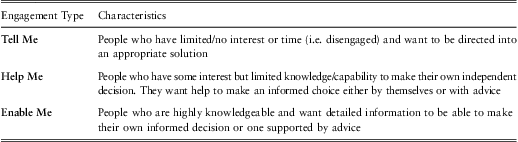
2.1.2 Segmentation of the market, which targets consumers with more focussed information, has the potential to increase engagement levels by making information more relevant to consumers’ objectives at different stages of their life. Some consumers just want to be told simple information (e.g. how to pay off debt). Others may require help in deciding which option to take (e.g. how much should they contribute to a workplace pension). Others may want to understand enough detail about savings and investments to make their own choice about how to save (e.g. pension or ISA). The three options could be described as ‘Tell me’, ‘Help me’ and ‘Enable me’.
2.1.3 There are many other ways to segment consumers, such as by attitude to saving, lifestage or life event. Information providers need to strike the balance between segmenting sufficiently to benefit consumer engagement, whilst being pragmatic about information available and the cost of multiple different communications.
Lifestage
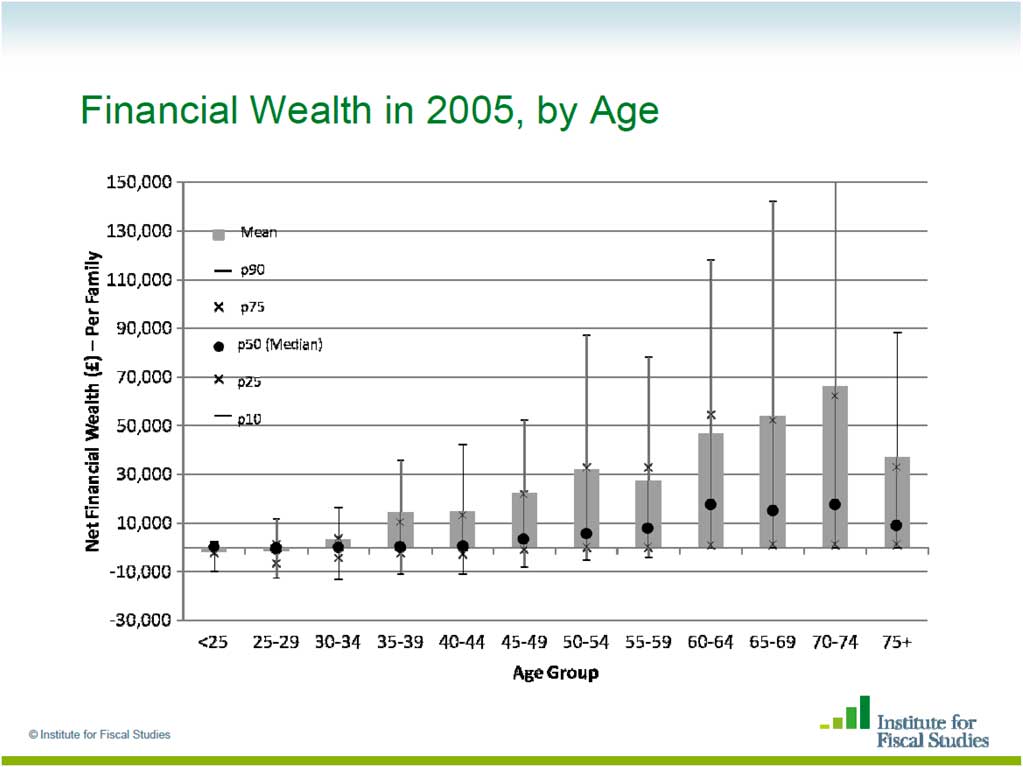
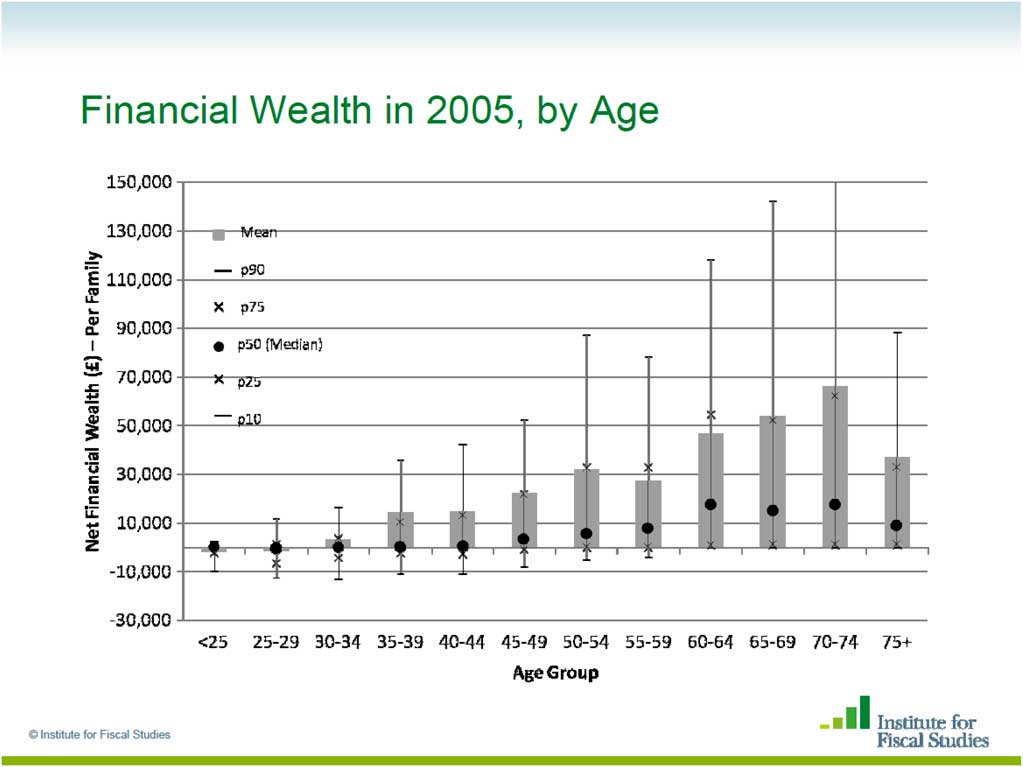
2.1.4 The lifestage effect on wealth is clearly illustrated by the five-yearly British Household Panel Survey (BHPS), one of the most comprehensive analyses of households’ wealth and savings habits. Financial and human capital naturally change with age and the analysis indicates clearly that financial wealth increases by age. In fact, in households headed by an individual aged under age 45, median financial wealth (which excludes current account balances, housing wealth and pensions assets) is typically zero. Figure 1 shows the spread of household wealth in 2005 with key percentiles marked.
Financial Wealth by Age (Crossley & O'Dea, Reference Crossley and O'Dea2010)
2.1.5 These findings are supported by the Office for National Statistics (ONS, 2009a) who also discovered that pensions wealth grows with age (until age 65). Further breakdowns of the ONS statistics show that the pensions’ wealth of members of defined benefit (DB) schemes is typically seven times more than that of occupational defined contribution (DC) scheme members. A contributing factor is likely to be the difference in average employer contributions for different scheme structures: 16.6% for DB schemes but only 6.1% for DC schemes. Other contributing factors include differing age profiles between DB and DC schemes and current shortfalls in DB funding levels. The trend for active membership of open DB schemes continues to fall – in 2010, ONS reported that active membership of open DB schemes has fallen to similar levels to DC schemes, from being at double this level just five years previously (ONS, 2009b).
2.1.6 Further, the ONS Wealth and Asset Survey (ONS, 2009a) showed patterns in savings, both for entering and exiting the financial marketplace. Whilst the likelihood of saving increases with age, with 45–54 year olds being most likely to save, over 55s save the most as a proportion of income. The figures showed a clear drop-off in the savings habits of younger age groups between 2001 and 2006. One potential driver for this may have been the changes in student loan arrangements introduced in 1999. If so, there may be implications from the latest changes in further education funding announced in 2010.
Life Events
2.1.7 Lifestage is an important driver for savings with rates tending to increase with age, as shown above. However, societal changes such as moving away from specified retirement ages imply that life events should be considered alongside lifestage. The ISER findings clearly showed that consumers react to personal triggers, including:
• Marriage and divorce reducing both the propensity to save and the amount of savings
• Death of a partner increasing the amount saved
• A direct correlation between the number of children and the reduction in propensity to save
• House purchase reduces the propensity to save but amounts saved are higher
• House owners generally save more than non-house owners although there is no correlation between the value of the home and the amount saved
• Paying off a mortgage leads to an increase in savings rates
• Starting employment is associated with an increase in savings
• The more workers in a household, the higher the saving rate although amount saved as a proportion of household income tends to be lower
• Becoming unemployed is associated with a drop in saving
• Entering retirement is also associated with lower saving amounts
Whilst the impacts listed may all be very intuitive, providers of consumer information often don't make use of this knowledge. For example, annual statements sent to pension customers are typically one-size-fits-all, rather than being adapted to fit with what the information provider knows about the customer.
Insufficient Savings Engagement
2.1.8 Even for older, relatively high-saving, consumers there are worrying trends. Saga's Saving Survey (Saga, 2010) quizzed more than 14,000 people over the age of 50 about their saving and spending habits as they approach retirement:
• 26% of 50–65 years olds are paying off credit or store card debt
• 1 in 4 are paying off loans or overdrafts
• 1 in 5 60–65 year olds are paying off their mortgage
This suggests a significant increase in debt amongst the older age groups since 2005 (see Figure 1).
2.1.9 Financial commentators speak frequently of a ‘savings gap’ and, more specifically, of the lack of provision for retirement. A recent report by Chatham House (2011) found that 60% of the population – those individuals with incomes today of up to £33,000 – will be reliant on the state pension for more than 50% of their retirement income. It has been estimated that the UK has the largest pension savings gap per person in Europe – with a shortfall of over £10,000 a year in retirement for every adult (£318 bn pa for the UK as a whole) (Aviva, 2010).
2.1.10 The financial services industry has an important role to play in increasing savings rates through enhanced consumer engagement, where possible. There may be some consumer groups who simply can't afford to save more. For example, when responding to criticism that the Retail Distribution Review (RDR) will reduce access to regulated financial advice, the FSA's RDR Interim Report (FSA, 2008) said “From our own research, it is not clear that there are large numbers of consumers with the means to save who are not currently doing so.” However, in other circumstances evidence has shown that consumers will save more if they are better engaged by information providers (e.g. see 2.2.4 in next section).
2.2 Consumer Information Touch Points
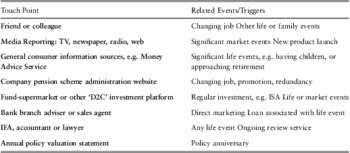
2.2.1 There are a number of patterns between consumers using the financial services market and how they prefer to seek out information about financial products. For example, younger people with the lowest level of wealth and savings are the least likely to seek professional financial advice but the most likely to ask friends and family or look online. At retirement, consumers are most likely to access professional financial advice. Judicious targeting of consumer information will be most effective if it both acknowledges the lifestage triggers and is delivered through the most comfortable medium for consumers. In particular, evidence shows that the delivery of consumer information by impartial bodies in situational circumstances (such as workplaces) is the most effective way to encourage consumers to save sufficiently to meet their financial objectives.
Sources of Information
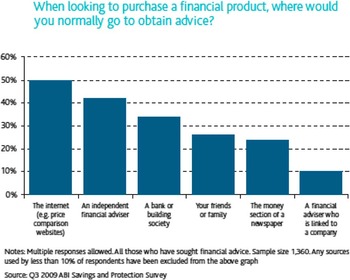
2.2.2 Whilst current consumer information is heavily biased towards paper format, consumers seek information from a variety of sources before purchasing financial products as shown in Figure 2:
Sources of Advice (ABI, 2010)

2.2.3 Whilst many people start off asking family and friends for advice, the internet remains the most popular choice for younger people. The internet can be a powerful medium if used effectively. However, since price comparison website owners may receive commission there is a risk they will emphasise particular quotes or use particular classifications which introduce bias in the outcome. The FSA is increasing its focus on price comparison websites and, in particular, considering whether they are straying into the area of giving advice.
Employers and other Situational Communication Opportunities
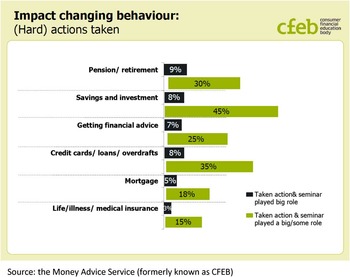
2.2.4 In the ABI survey (ABI, 2010, see 2.2.2), only 2% of people mentioned employers as a source of financial information yet the Money Advice Service (MAS)Footnote 1 has reported significant successes with workplace financial education. Following a successful pilot in 2005, MAS rolled out a workplace seminar programme aimed at reaching 3 million employees through 750 employers. The feedback from the seminars to date has been overwhelmingly positive with the huge majority of participants valuing the information, and feeling that it improved their knowledge and confidence in dealing with financial matters. In fact, MAS has evidence that the seminars have also resulted in nearly half of respondents taking action to improve their financial situation (See Figure 3):
Impact changing behaviour. Source: the Money Advice Service (formerly known as CFEB)

2.2.5 The Money Advice Service has also seen success in other situational circumstances, e.g. a rollout of a leaflet for new parents, distributed through midwives. The information included, delivered at an appropriate time to be relevant to the target consumers, resulted in nearly 1 in 5 recipients taking action as a direct result. This included reviewing their financial situation, paying off debt, opening Child Trust funds or checking their tax credit position. Another MAS success has been the Money Doctors service introduced for students in further education (Money Advice Service, 2010). Over 58,000 individuals have used the service, which offers information in ways designed to appeal to students. Indeed, 30% of students surveyed said it had helped them ‘afford to stay at University’.
Regulated Financial Advice pre-RDR
2.2.6 Engagement with financial advice is low, despite consumers expressing a preference to take financial advice before purchasing investment products (in ABI research). Two-thirds of consumers have never taken financial advice or have taken advice from only one source (Mintel, 2010). In part, this may be due to advisers targeting only those consumers with established wealth. Typically, advisers do not start working with a client until they are over 40 (Standard Life, 2010). Also, nearly a fifth of the population say they do not trust financial advisers and 38% of 25–34 year olds are put off seeking financial advice by the perceived cost (Institute of Financial Planning, 2010). Those who do take advice cite ease and convenience, their own lack of knowledge and time, and the expertise of the adviser as the main reasons.
Regulated Financial Advice post-RDR
2.2.7 From the end of 2012, the Retail Distribution Review will bring changes to the way in which retail investment products may be sold. In particular, explicit fees will be the charging model for advisers who are highly qualified. The FSA's aim is to create a more professional, sustainable market with less potential for advice to be biased by commission. The requirements for advisers being able to promote their services as ‘independent’ will be stricter. Consequently, more advisers are expected to provide advice on a restricted range of products.
2.2.8 The RDR only affects regulated advice and does not impact on organisations that provide guidance for consumers buying products. The debate on a simplified advice service, a cut-down version of full regulated advice, is still to be resolved. Hence, there are a range of different possible levels of ‘advice’ standards post RDR, with differing levels of consumer protection. This is likely to confuse consumers as they may not fully understand what is meant by regulated advice and many could perceive product information as advice. This heightens the importance of relevant consumer information.
2.2.9 Mintel's (2010) research indicated that 64% of adults would not be prepared to pay an explicit fee for investment advice. Even amongst those considered key IFA targets (investable assets of more than £50,000), only half would be prepared to pay an upfront fee. Where no regulated advice is given, firms can still take a commission to distribute a product. This route will be preferred by many to regulated advice. If RDR does result in more products being purchased without advice then the quality of consumer information will be even more critical as there will be no adviser to help the consumer understand the product.
Internet
2.2.10 The internet continues to grow as a source of information on financial products for consumers. Mintel's (2010) research found that the internet is empowering consumers with information to make more informed decisions and that online peer-to-peer advice is also growing in popularity through discussion boards. The internet can be a good starting point, comparable to asking friends or family for advice. However, the majority of complex buying decisions are still currently made face-to-face. This may be because a face-to-face meeting best facilitates the answering of more detailed questions and also boosts the consumer's trust of the answers as they can “look the other person in the eye”.
2.2.11 ABI research (ABI, 2010) found that 89% of people aged 18–34 would be happy to purchase a financial product over the internet. They also noticed that the growing number of online users has already shrunk the advice market for general insurance. Mintel's consumer research (Mintel, 2010) shows that almost 10% of people are able to find all the financial guidance or advice they need on the internet. However, ONS statistics (ONS, 2010) indicate that 60% of over 65s have never used the internet.
2.2.12 The introduction of fees for financial advice could increase the numbers of direct-to-consumer online investment transactions. In effect, more consumers will be taking responsibility for their own investment decisions.
Product Providers
2.2.13 Providers of investment products spend millions annually in designing mailshots, brochures, illustrations, annual statements and websites (some of which may be a regulatory requirement) for prospective and existing customers. Yet research by the Financial Services Research Forum (2011) indicates that active trust levels of large financial institutions are falling (Financial Services Research Forum, 2011). MAS also found that consumers prefer to receive information from bodies they perceive as being independent as opposed to, for example, provider-led workplace initiatives. In general older consumers are more trusting than younger consumers. This is despite the fact that older consumers are more likely to be those who have had poor experiences with providers, e.g. endowment mis-selling, pension mis-selling and Equitable Life.
2.3 Current Model for Consumer Information
2.3.1 Most information supporting long term savings and investments is product-driven with particular focus around the point-of-sale. There is little, if any, personalisation to the needs and goals of individual consumers. There are inconsistencies in the type and detail of information provided (over the lifetime of the product, across product types and between providers). So, whilst communications may meet the FSA's Treating Customers Fairly (TCF) outcomes on a stand-alone basis, there is a danger the lack of consistency across products and providers is a barrier to meeting outcome 3 overall. These issues need to be addressed to better engage with consumers.
TCF Outcome 3:
“Consumers are provided with clear information and are kept appropriately informed before, during and after the point of sale.”
2.3.2 A significant proportion of information produced by providers is due to regulatory requirements. Multiple regulators produce a complex web of overlapping regulation which is increasingly being directed from Europe. At the date of writing, reviews of several pieces of European legislation (including IMD, MiFID and UCITS IV, together with the development of PRIPs) as well as UK specific developments on the RDR and automatic enrolment are all likely to impact on information that consumers of long term savings and investment products will receive.
2.3.3 Most information is provided in relation to a single product. Particular focus is given to the point of sale where the customer must receive several documents and disclosures. Examples of this product information are outlined in sections 2.3.6 and 2.3.7.
2.3.4 In addition to being focused on products, communication is still primarily paper based. Some documentation is now provided by email and a growing amount of educational and marketing material is delivered via the internet. However, in general, the industry has failed to keep up with the changing ways in which individuals wish to receive communications. There are significant opportunities to improve in this area.
2.3.5 This section gives an overview of the current main consumer information documents, with the aim of highlighting some of the current challenges faced by consumers. There may also be additional information provided to the consumer by product manufacturers, advisers or employers.
Life and pensions
2.3.6 Here the main point-of-sale form is the “Key Features Document” (KFD). This describes the aims of the product, along with its charges and risks. The content of the KFD is defined by the FSA's Conduct of Business rule book. However, here also European Law may drive changes. The European PRIPs directive is expected to impact disclosure on investment products sold by life insurance companies.
2.3.7 The KFI, or “Key Features Illustration”, comes with the KFD. In many cases this is required to be client-specific and so may be printed off by the adviser as a document separate to the rest of the KFD. The projection is an illustration of what the policy may be worth in the future. As shown in the following example the projection is currently carried out on three bases to show the variability of potential returns.
WHAT MIGHT I GET BACK IF I KEEP THE CONTRACT IN FORCE FOR 10 YEARS?
• If your investment grew at 5% a year you would get £6,960
• If your investment grew at 7% a year you would get £8,410
• If your investment grew at 9% a year you would get £10,100
2.3.8 The KFI also contains detailed information on what the customer is paying into the plan and what the charges are.
2.3.9 There are several issues with the KFI, such as:
• None of the information included in the KFIs makes any reference to the consumer's goal (i.e. what they might be able to buy with their savings rather than focusing solely on “a number”). As well as reducing likely engagement, this means the most pertinent risks to the consumer achieving their goal cannot be highlighted.
• Although the maximum yearly projection rates of 5%, 7% and 9% (before tax) are stipulated, different providers often use different rates of return for the same underlying investment funds. This makes comparison across providers much more difficult.
• As all three return scenarios assume positive growth rates there is nothing to help the consumer understand either the potential downside risk or the implications of path dependency. Indeed, the highest projection rate for a cash fund is often lower than the lowest equity fund rate – which may lead consumers to conclude that equity funds always out-perform cash.
2.3.10 For pension products, the customer will typically receive a statement on an annual basis and this will include a revised projection of benefits. The content must comply with rules set by the DWP (the Board for Actuarial Standards provides guidance for statutory money purchase illustrations). Having different “regulators” for point of sale (FSA) and annual statements (DWP) can lead to significant inconsistencies in content and so to a fragmented consumer experience. However, the FSA and DWP are currently working together to try to address this.
2.3.11 The customer scenarios to use for the annual projection are prescribed by rules. This usually means the projection is inconsistent with that provided at point of sale (although providers can show additional scenarios if they wish). For example, the annual statements must assume that no tax-free lump sum is taken – which is rarely what the customer will choose in practice.
2.3.12 Annual statements have the same issues as point-of-sale documents. For example, they do not make any link between revised projected benefit amounts and a consumer's goals. This means they cannot provide any guidance on how close the customer is to achieving their objectives or on any actions that could improve the eventual outcome. There are no regulatory barriers stopping information providers from including goal-based information in addition to the minimum required for compliance.
2.3.13 In addition to KFIs and annual statements, many providers also make financial modelling tools available to consumers to help them make decisions. Some of these tools allow users to set goals and measure the likelihood of achieving these goals under various “what if” scenarios. However, the functionality available, the projection methods and the assumptions used vary by provider. Additionally, the results produced are not always consistent with the projections included in KFIs or annual statements.
Unit trusts and OEICs
2.3.14 Prior to 30 June 2011 the key point of sale document was the “Simplified Prospectus”. However, between 1 July 2011 and 30 June 2012 firms will have to replace the Simplified Prospectus with “Key Investor Information Documents (KIID)”. This change arises from UCITS IV, a European Directive. This is an example of how the European Union is increasingly setting regulation in the consumer framework around financial services products.
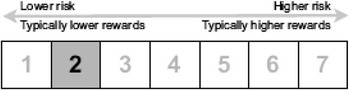
2.3.15 The KIID is a highly standardised document to facilitate comparisons between funds. It contains information on the fund objective, past performance and charges. Most notably, risk is graphically shown by rating each fund on a seven point risk and reward scale. The measure used to assess the rating is the volatility of the fund price over the last five years, where volatility is defined as a purely retrospective measure based on standard deviation of historic returns. An example of the KIID risk and reward profile is shown in Figure 4.
Risk and reward scale

2.3.16 The emphasis here is on only one type of risk – fund volatility – with no link to the consumer's individual circumstances or investment goal. Depending on the goal, other risks may have a much larger bearing on whether the consumer will achieve it. For example, if the consumer is saving for something in particular in 10 years, the price inflation of that particular item will have a significant bearing on the amount required. Indeed, the risk of long-term returns being lower than expected is much more pertinent to success than the yearly volatility of the investment.
2.3.17 Every six months, OEIC and unit trust investors receive valuations of their investments including the “short report” which provides information on the performance and investments of the fund. Again, these documents do not provide any link to an investor's goals and provide little guidance on the potential actions the consumer should consider taking.
2.3.18 The introduction of the KIID will improve the consistency of information made available across providers of OEICs and unit trusts. The European Insurance and Occupational Pensions Authority (EIOPA) has since proposed that a similar KIID should be introduced for pensions, which would further boost consistency across product types. However, the exclusive focus on short-term volatility rather than covering other risks that may be more relevant for longer term savers means the KIID may not be as useful as it could be. In addition, the standard Synthetic Risk and Reward Indicator (SRRI) within the KIID is likely to be inconsistent with other risk profiling tools, so creating a further source of confusion. Also, there is little to help the customer understand the impact of differing tax treatments when making comparisons. This is not ideal as often these different product types will be alternative choices for customers.
2.4 Behavioural Economics ImplicationsFootnote 2
2.4.1 Greater application of Behavioural Economics can help us deliver more effective consumer information. This can be as simple as reducing the number of options available to make action easier or, where appropriate, the use of default options for consumers. The introduction of auto-enrolment in the UK is a current example where a bold step is being taken to help consumers help themselves. Using such knowledge more often to improve consumer information would be a straightforward but significant step for the industry.
2.4.2 Behavioural Economics is a discipline that combines insights from psychology and economics. Areas such as behavioural finance, neuromarketing, neuroeconomics, and economic psychology are all concerned with similar topics.
2.4.3 Increasingly, Behavioural Economics is being applied in business and policy applications and the literature is having an influence on product design, design of financial systems and thinking on regulatory issues. Among the leading exponents of this approach is Cass Sunstein, who is currently one of the senior regulators in the Obama Administration. Policy agencies across the world have begun to explore the issues emanating from this literature, as evidenced, for example, by a number of recent high-profile events held by DG Sanco in Brussels. Businesses have also begun to place weight on the findings arising from this literature, with several companies pioneering new approaches to creating value based on this literature.
2.4.4 Key concerns of Behavioural Economics include: how people make judgments of risk and how they use intuition when forming assessments; how people manage risk in their day-to-day lives; how people represent and make decisions about the future; the role of procrastination and inertia in consumer decision-making.
2.4.5 In recent years improvements have been made in consumer information as a result of making communications easier to read, such as by implementing “plain English” language. Whilst this is an important step, in isolation it will not succeed in making communications engaging. For example, a 20 page caveat-filled number-heavy document landing on a consumer's doorstep is unlikely to engage them no matter how well it is written. It is important for providers of information to step back from focusing solely on the content of the message and plan how to position their communication to best engage the target consumer.
2.4.6 Behavioural Economics is central to developing more effective consumer information. It concerns the role that social, cognitive and emotional factors play in the financial decision-making processes of individuals and institutions. In this section we consider some of the lessons from Behavioural Economics and give examples of how they can be relevant to the development of a consumer information framework. Consideration of Behavioural Economics is particularly important in dealing with those consumers who cannot access regular financial advice.
2.4.7 Information Overload and Complexity:
Description: Many people are daunted by information that appears complex and will not have the patience or confidence to read and digest it.
Example: Annual statements on pension products contain more information than most people are willing to digest. Over time pension providers have attempted to improve statements with the best intentions of giving customers more information. As well as fund values and projections, statements now often include the number of units and unit price of each fund as well as a significant quantity of important information in the “small print”.
Impact: Information overload is a particular risk when the consumer needs to actively monitor whether their investment is on track to help them achieve their goal. It is a barrier to understanding and appreciation of slow yet significant changes that occur over time – and therefore likely to lead to a lack of appropriate action from the consumer.
Mitigation: It is crucial to structure information appropriately – to tier and layer content according to its relative materiality and importance. Detailed information should still be available, but in a way that enables the consumer to access and digest it. Further detail can be provided online or in appendices.
Also, the number of options should be kept to a minimum. This can be illustrated by an example from the USA. In an experiment (by Choi, Laibson and colleagues (Beshears et al., Reference Beshears, Choi, Laibson and Madrian2006), the authors simply reduced the number of options in a 401(k) pension from many down to two. This had the effect of doubling enrolment.
2.4.8 Inertia:
Description: People have a strong preference to maintain current positions even when advised otherwise.
Example: The tendency of consumers to remain contracted out (or in) to the State pension despite providers communicating strong logic for why the consumer should almost certainly act to contract back in (or out).
Impact: Inertia may lead to a lack of action which would otherwise improve the consumer's financial position.
Mitigation: Simply switching the default from “no action” to “action” has proved incredibly effective – where providers have assumed they have permission to take action on the consumer's behalf unless the consumer declines.
Another example is auto-enrolment, where employees are signed up for their company pension scheme unless they actively opt-out. In one USA study, Madrian & O'Shea (Reference Madrian and O'Shea2001) found 401(k) participation rates were boosted dramatically as a result of such an opt-out (rather than opt-in) policy:
• Women from 35% to 86%
• Hispanics from 19% to 75%, and
• Low income groups from 13% to 80%
2.4.9 Ambiguity aversion:
Description: Consumers are more averse to uncertain outcomes where the probabilities are unknown or hard to understand.
Example: Almost all pension customers choose a level annuity rather than one that increases over time. Most actuaries would agree that an increasing annuity is generally a better match to a pensioner's escalating living costs. However, individuals put more weight on the risk of dying before they've received “value-for-money” than the risk of stressful reductions in living standards because they've “lived too long”.
Impact: May lead to a less optimal financial decision and outcome for the consumer (especially if their fund was initially sufficient to maintain their required lifestyle with an escalating annuity).
Mitigation: Helping consumers understand the likelihood and impact of the main risks they are exposed to would support them in framing financial decisions more effectively.
2.4.10 Availability Heuristic:
Description: The Availability Heuristic is the fact that individuals attach greater likelihood to events that can easily be imagined.
Example: It's hard for a consumer to imagine what retirement will be like if it is a distant 20 or 30 years away. It's much easier for them to imagine the benefits of purchasing something now, or of a short-term low-risk investment.
Impact: This is a significant barrier to long-term saving, which is especially stark at younger ages. It can generate a spiral effect – since not saving at younger ages increases the average rate required for consumers to maintain living standards in retirement. It can then seem more daunting to start saving, leading them to delay for longer.
Mitigation: This is an area where individual advice can be very powerful. If that is not possible for the target consumer, the next best alternative is basic information to help them understand the impact of their decisions on their long-term wellbeing. This must, however, be delivered in a way which matches their engagement preferences to be effective.
2.4.11 Regret & Loss aversion:
Description: The empirically demonstrated tendency for people to weigh losses significantly more heavily than gains, typically 2 or 3 times.
Example: Investment market dynamics illustrate this behaviour well – investors are much more sensitive to losses than gains, so price falls can accelerate through lost confidence and contagious selling. It generally takes much longer for prices to rise again (which is likely to be due, in part, to loss aversion).
Impact: Sharp investment falls can lead to long-term savers making short term value judgements and concluding they should lapse their policy – because they have strong aversions to possible loss. This may be the wrong decision and they may even have still been on track to realise their long term goal.
Mitigation: Linking savings to the consumer's goal should help them focus on progress against that goal, rather than short-term fluctuations. More generally, communication of risks should be framed and assessed with respect to adverse outcomes, rather than symmetric definitions of risk such as the volatility of returns. This should support better understanding from outset and so more optimal decision-making when risk events occur.
2.4.12 Consumption versus savings decision:
Description: People are less willing to save more by reducing current consumption, but are willing to save more if the framing of savings is made from future salary increases.
Example: The effects of reducing current consumption are immediately obvious and people will generally avoid them. However maintaining consumption in the future rather than increasing it is much more palatable.
Impact: Savings for long-term planning are lower than they need to be leading to reduced standards of living in retirement.
Mitigation: The “Save More Tomorrow” example is perhaps the most widely cited intervention in Behavioural Economics. Thaler & Benartzi (Reference Thaler and Benartzi2004) trialled offering a pension whereby the contribution increases were triggered automatically at the point of salary review and were explained as being taken from future pay increases. This removed the immediate sacrifice feeling that people find particularly painful. The key result was that savings rates increased to 13.5% from 3.5%.
2.4.13 There is a significant quantity of literature on the topic of Behavioural Economics. For example, see the Journal of Economic Psychology, Journal of Behavioural Decision Making, Journal of Risk and Uncertainty and policy reports issued by bodies such as DG Sanco. Many industry bodies such as the FSA and DWP also provide research papers incorporating Behavioural Economics elements (see their respective websites).
2.5 Consumer Information Failures
2.5.1 There are a number of examples where inadequate consumer information has contributed to significant financial loss – both for customers (relative to their expectations) and the industry. Typically this has been because
a) the key risks of an investment were not adequately explained or linked to the chances of achieving the consumer's original goal; and
b) there was a lack of effective ongoing communication once the product was sold.
Endowment Mortgage Complaints
2.5.2 As access to credit relaxed during the late 1980s and significant numbers of people were encouraged to become homeowners, around 11 million endowment assurance policies were ultimately sold to repay the mortgage principal. Assumptions were made as to future events such as investment returns over the 25 year repayment period and premiums set to ensure repayment occurred provided the assumed investment performance and, hence, bonus rates were achieved.
2.5.3 In March 1987 (The Actuarial Profession, 1987), the Faculty of Actuaries received a paper on the sustainability of bonus rates during a transition from higher to lower investment returns. The potential for the required projection of benefits to mislead were discussed:
“What a marvellous sales presentation this gave the intermediaries who specialise in the mortgage market. The total outlay after tax is about the same as a principal and interest repayments, the loan would be repaid on the “conservative” assumption of 80% of reversionary bonuses (sometimes I cannot help feeling that some of the lending institutions think that this is a guarantee of some kind) and at the end we have got the other 20% of reversionary bonuses, plus terminal bonuses providing a very large capital sum. With this kind of presentation you could not fail and thus we have seen a tremendous boom in the sales of low cost with-profit endowment assurances in the mortgage market. What will happen when all these policies mature in 20 odd years’ time? Well I do not know, but I am glad to say that I will not be around to deal with the problem.”
Mr W Proudfoot FFA (died 1990)
2.5.4 Policies were sold with an illustration of projected maturity values based on lower and higher future return assumptions. The assumptions used varied over time and the projected fund values showed the possibility of significant surplus cash and limited losses. Given the high inflation environment the UK was accustomed to at the time, these projections must have seemed reasonable. However, there was usually no quantification of the risk that the policy might not pay off the mortgage or how big a shortfall might result.
2.5.5 The consumer was given (in most cases) detailed literature at point of sale which explained that the policy was not guaranteed to re-pay the mortgage. However, some believe that techniques used by sales forces to explain the policies tended to focus on the projected surplus and endowments were generally presented as a low risk option. It is unclear whether (some would say “unlikely that”) many consumers fully digested the ‘small-print’ in this literature.
2.5.6 The sales process typically led to the separation of the mortgage and the endowment. This in turn led to a lack of communication of the fact that the low interest/low inflation environment (which diverged from that illustrated in the endowment projections) also resulted in lower mortgage interest payments that could have allowed additional savings to be made.
2.5.7 The cumulative effect of tightened UK monetary policy, more conservative provider investment strategies and stock market falls was to make it almost certain that a significant number of policies would fail to fully re-pay the associated mortgage.
2.5.8 Consumers received yearly communications showing the latest investment value but these did not typically refer back to the customer's goal – whether their mortgage was likely to be repaid. Most customers had a low expectation that the product had any real risk of failing to pay off the mortgage, and there was no obvious reason to pay any attention to the annual updates. The result was that many consumers were unaware of the need to take action to keep their investment on track until it was too late.
2.5.9 Following a concerted campaign by consumer groups and regulatory intervention, the ABI produced a Code of Practice in September 1999. Customers started to receive statements showing whether the mortgage was projected to be re-paid using the standard FSA projection rates with a Red, Amber and Green classification. (Subsequently, firms used projection rates that were more representative of the underlying assets – to be consistent with a low inflation environment.) Red letters indicated a very high chance of the mortgage not being paid off and highlighted the need for immediate attention from the customer.
2.5.10 The number of consumers receiving Red letters increased dramatically by 2003 and this coincided with consumer campaigns to encourage people to bring complaints about the sales processes. This resulted in significant levels of mortgage endowment complaints from circa 0.1% of policyholders complaining at any one point in the early 2000s to around 15% at the peak of complaint volumes in 2005.
2.5.11 FSA data suggests that over 2.5 m policyholders have complained since the introduction of the Code. A reasonable estimate for a total cost of compensation paid and expenses incurred is £5 bn, based on the following data.
FSA confirmed that complaint re-dress had reached £2.9 bn as at April 2007 based on its survey data covering 80–90% of the market (FSA, 2007).
Thereafter, a further 500,000 complaints were recorded bringing the likely re-dress to c. £3.5–4.0 bn. Using data from a leading claims management firm, the expenses of dealing with complaints was of the order of 30% of the re-dress (FSA, 2011).
The Treasury Select Committee estimated in 2004 that the total shortfall for mortgage endowments was circa £40 bn (Treasury Select Committee, 2004).
Income drawdown policies
2.5.12 Income drawdown policies are an alternative to purchasing an annuity for a consumer to take their income in retirement from approved pension savings.
2.5.13 As part of the advice process, a Critical Yield Test became a generally accepted way to determine suitability (though not prescribed by the FSA). The yield is calculated deterministically as the rate of return needed to be achieved on the investment funds to maintain the amount of income being taken from the fund.
2.5.14 This is a very good example of an actuarial approach where the value of the test in the minds of the recipient is greatly exaggerated. The test has a binary outcome of pass/fail with many advisers and consumers taking it as a green/red light to proceed.
2.5.15 The reality is that a wide range of outcomes are possible versus an alternative guaranteed income. None of these outcomes are highlighted by the test. The test effectively ignores a number of significant risks such as annuity rates worsening or taking income in early years when fund values have dropped. Consumers who have gone into drawdown with an equity bias (to satisfy the critical yield) will have seen the amount of income they can safely secure from their pension savings dramatically reduced during the period 2007–2010.
2.5.16 There are many reasons to believe demand for income drawdown will increase substantially. There are increasing numbers of consumers due to retire over the next decade with significant amounts saved in defined contribution pension funds. The Government is legislating to increase the flexibility available to take retirement income and to remove the obligation to purchase an annuity. Insurance companies are faced with having to hold more capital to write guaranteed annuity products which is limiting capacity, increasing price and enhancing the motivation to promote alternatives. This is therefore a key area for focus in how the industry improves consumer information.
Target Date funds
2.5.17 The United States recently introduced the concept of “Target Date” funds. These funds start with a high equity investment content, which reduces down to more modest levels by the target date. The aim is to give investors an option which automatically reduces their risk as they draw close to retirement, so they don't have to take any action (“set & forget”). This concept addresses the consumer behaviour risk of inertia.
2.5.18 However, miscommunication regarding these funds has become a problem. They were originally sold as cautious ‘trust me’ products and were approved by US regulators as being suitable for default investment funds. The funds do not mitigate being exposed to equity performance entirely as typically funds were still 30% invested in equities at retirement. The expectation was that these funds would gradually be run down as income was taken over the retiree's lifetime and so some equity content was appropriate. In practice, many consumers ran down their funds much more quickly. The recent falls in equity markets has therefore caused a significant fall in values which was not expected from a ‘cautious’ default product.
2.5.19 This has been the topic of much debate in the USA and it is important we learn the consumer information lessons for the UK market.
2.6 Successes in other countries and industries
2.6.1 There are opportunities to learn from how other markets have tackled similar issues. It is often said that it is impossible to achieve high engagement in finance – due to its intangible and (perceived) unexciting nature. However, other markets with similar dynamics have made significant breakthroughs to the benefit of consumers. These give both hope and some specific lessons for improving consumer information in long-term savings and investments in the UK.
Learning from Financial Services in other countries
2.6.2 The New Zealand government established the KiwiSaver scheme in July 2007 to help people save for their retirement. It is a voluntary, work-based initiative whereby individuals make contributions direct from their salary, supplemented by employers’ contributions, tax credits and a kick-start from the government. Individuals can select from a variety of schemes offered by regulated financial services providers or use their employer's chosen scheme. The money can be accessed from the state retirement age, although there is also a means of using part of the funds to finance a first home.
2.6.3 Within 3 years of the scheme being started, take-up had reached 38% of the eligible population (Ministry of Economic Development, 2010). The take-up to date has been 3 times greater than originally forecast by their Treasury in 2006. Of particular interest was the high rate (56%) for 18–24 year olds as this age group does not usually participate in saving for retirement.
2.6.4 There is no doubt that the high take-up rate has been influenced by a generous financial contribution from the government. Notably, they have recently reduced this contribution and increased the minimum contribution for both employees and employers. However, the concept of the KiwiSaver is now believed to be sufficiently established to maintain the momentum that has been created.
2.6.5 Another significant factor in the success of the KiwiSaver has been the consumer information provided by the “Sorted” brand (owned by the Retirement Commission). Awareness of the Sorted websiteFootnote 3, established in 2001, is over 80% in under- 55 year olds (35% in over 65 year olds). More than a quarter of New Zealanders (population: approx 4.4 m) have visited the Sorted website whilst more than 7 out of 10 of those are repeat visitors. More than 4 in 10 visitors to the KiwiSaver section of the website subsequently joined the KiwiSaver scheme. In excess of 80% of Sorted visitors believe the website gives them enough information to make an informed decision about joining the KiwiSaver scheme.
2.6.6 Sweden took a different approach in trying to encourage consumer engagement with pensions following reforms to the state system which improved the link between contributions and benefits. Each year, individuals receive an ‘Orange Envelope’ containing a one-page statement. Benefit entitlements are built up in a similar way to a deposit account based on the contributions made. The statement includes projections indicating likely pension amounts for three different retirement ages and assuming two alternative rates of real wage increases. A link and password are provided to a website where consumers can view the Orange Envelope statement online, combine it with information from their private pension schemes and change the parameters for the projection. Thus the information is tiered – one-page for everyone with follow-up information for those who wish to know more.
2.6.7 Swedes readily identify with the concept of the Orange Envelope with a constant 90% (Swedish Pensions Agency, 2011) of individuals recalling receipt of one, 75% opening it and over half reading some of the contents. Of these, 70–80% report looking at the projection and 20% compare it with the previous year's benefit statement. Media coverage of the annual spring mailing of the orange envelope is strong and individuals rate their own understanding of the pension system better since its introduction.
2.6.8 Whilst this represents significant success, there is still room for improvement. In particular, there is no clear evidence that consumers act to improve their potential retirement savings based on the information they receive.
Learning from other industries
2.6.9 In October 2009, a Which? Review (Which, 2009) of gas and electricity bills concluded that,
“For the third survey running, overall customer satisfaction … ranges from mediocre to abysmal and is worse than any other sector”.
2.6.10 None of the bills reviewed met Plain EnglishFootnote 4 standards and many were poorly designed and laid out, appearing cluttered and complex. They frequently used undefined abbreviations and technical terms. Consumers complained that it was difficult, if not impossible, to see how the charges had been calculated. There were calls for a way to show the annualised cost of energy on the bill to make it easier to compare different suppliers and tariffs.
2.6.11 Some of these issues are being addressed by Ofgem, the industry regulator, as a result of their own Retail Market Probe. For example, suppliers will now have to provide an annual statement that shows the exact tariff name, as well as consumption over the previous 12 months and a forecast for the coming 12 months. Bills will also have to show an illustrative cost in pounds per year to enable consumers to compare prices more easily.
2.6.12 Perhaps the most heartening development is that providers are starting to seek to gain competitive advantage through the quality of their information – realising this is a topic that matters to consumers. For example, EDF has dedicated a large section of their website to explain what they are doing to make their bills easier to understandFootnote 5, promoting that:
“Your gas and electricity bills contain a lot of useful information. They show at a glance how much energy you used since your last bill, how this compares with the previous quarter and with the same quarter last year.
We're the first energy supplier to include this information – it could help you to use energy more efficiently and save on your energy bills.”
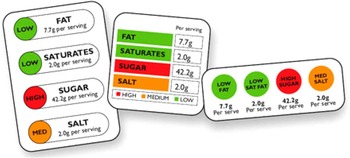
2.6.13 The food manufacturing industry has also been engaged with regulatory bodies over front-of-pack nutritional labelling. Up until September 2010, the Food Standards Agency was pivotal in promoting a “RAG” (red, amber, green) traffic light labelling system of nutrition on processed foods. Traffic light colour coding shows at a glance if the food has high (red), medium (amber) or low (green) amounts of fat, saturated fat, sugars and salt. Although there is no standard presentation, sometimes, the traffic lights are used in conjunction with numeric information on Guideline Daily Amounts (GDAs). To help colour blind consumers, some manufacturers indicate whether the proportion of each nutrient in a typical portion is HIGH, MED or LOW. Examples of typical labels are shown in Figure 5.
Red Amber Green food labelling (Source: http://www.brookes.ac.uk/student/services/health/healthy_eating.html)

2.6.14 This is a strong example of consumer information being used to simplify a complicated topic. Numerous research reports, as described on the Food Standards Agency websiteFootnote 6, indicated that consumers understood and preferred the traffic light approach – finding it easier and quicker to use than other alternatives. The initiative was strongly supported by consumer bodies such as Which? as well as medical organisations such as the British Heart Foundation, the National Institute for Clinical Excellence (NICE) and Diabetes UK.
2.6.15 Supporting retailers (such as Sainsbury's, Asda, Waitrose and Marks and Spencer) argued the new information encouraged food manufacturers to reformulate their offerings to more healthy versions.
2.6.16 However, there have been challenges to this traffic-light approach. Notably Kelloggs, Nestlé and Tesco refused to sign up to the voluntary scheme. Tesco argued it could be misleading and that their own research had indicated that consumers were confused about how to treat an “amber” light (the Food Standard's Agency's research concluded some consumers were more confused by Tesco's GDA approach, particularly those in lower socio-economic groups).
2.6.17 In 2010, the European Union voted against compulsory traffic light food labelling in favour of a mandatory back-of-pack standardised GDA table on the grounds that traffic lights can, at times, be misleading or too simplistic. During the same year, the new UK government also removed its support for traffic light labelling and transferred responsibility for labelling from the Food Standards Agency to the Department of Health.
2.6.18 Given the strong research indicating that consumers favour (and best understand) a traffic-light approach, there is nothing to prevent the industry from using the front-of-pack traffic light system in conjunction with the European mandatory requirements. It will be interesting to monitor the extent to which traffic light labelling is maintained.
3 Designing a Consumer Information Framework
Key points
We believe the application of this framework will deliver significant benefits in terms of more engaged and better informed customers. Higher engagement should naturally lead to more revenue for providers and distributors, whilst better understanding should mean lower costs from customer complaints and mis-selling claims.
3.1 Aims of the Framework
3.1.1 We define a possible framework for the provision of information to consumers of long-term savings and investment products that aims to address the issues described in section 2. We have not explicitly considered other types of financial product.
3.1.2 The consumer information framework is based on a number of Key Principles. Our intention is to help providers of information evaluate communication requirements across a range of circumstances – considering factors such as information content, delivery mechanism and presentational format.
3.1.3 The framework acknowledges that one size does not fit all and that consumer information requirements – content and delivery mechanism – depend on a range of factors:
• The consumer segment, information channel and level of engagement;
• The consumer's savings or investment goal, which will relate to their point in the financial lifecycle;
• Channel (e.g. direct, platform, adviser); and
• The consumer's personal preference (influenced, for example, by their level of engagement at the time).
3.1.4 We consider the practical application of this framework in Section 4. We have deliberately not attempted to prescribe any specific executions, such as specific information content or presentation style.
3.2 Principles of the Framework
3.2.1 Our framework for consumer information is based upon the following key principles:
Principle 1: Information should relate to a consumer's financial goals
• Financial goals should be framed in terms of consumption needs and wants
• Outcomes and risks should be assessed relative to the consumption goal
• All significant forms of asset and liability risk should be considered
Principle 2: The delivery of Consumer Information should facilitate consumer engagement:
• Segmentation Information should be designed to be appropriate for each consumer segment
• Tiering Tier information to each engagement level
• Format and Framing Present information in a format and frame to facilitate decisions
• Timing Time information to when people need to make decisions
• Consistency Ensure information is consistent across the full range of consumer touch points
Principle 3: Consumer Information should be free of bias
Principle 1: Information should relate to a consumer's financial goals
Anticipated Benefits
Improved outcomes for consumers through:
• Making more optimal financial decisions, by better understanding the link between different options and what they are trying to achieve.
• Taking risks only where it makes sense in relation to the desired goal.
Improved industry profits through:
• Higher new business sales, through helping consumers make the connection between the providers’ products and their goal.
• Increased retention, through enhanced consumer awareness of the savings level they are targeting to reach their goal.
• Reduced cost of complaints and mis-selling, through improved consumer understanding of risks in different financial products.
3.2.2 At the heart of engaging consumers is the first principle upon which a holistic framework for consumer information is based: that information should relate to a consumer's financial goals.
3.2.3 Traditionally, the provision of consumer information has focused on generic product characteristics, which take little account of the consumer's financial goals. In section 2.3, we noted that current UK regulation and evolving European-based legislation has tended to prescribe the use of standardised illustrations of risk and return. This ‘one-size-fits-all’ approach is likely to be of limited use to many consumers.
3.2.4 The purchase of a savings or investment product is ultimately linked to some financial consumption goal, cash-flow or liability. While the financial goal may be explicit or implicit, the consumer will use this as a reference for measuring the success or failure of the product purchased.
3.2.5 Many consumers will need help in articulating their goal, either from an adviser or from prompts or support in consumer information.
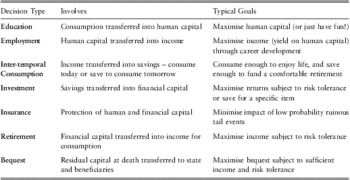
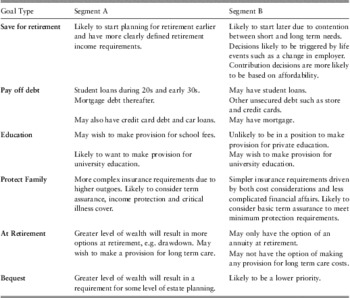
3.2.6 The main financial decisions people face and the goals they have vary over the course of a person's financial lifecycle, and are summarised in table 1.
Typical Goals by Lifestage

Based upon framework outlined in Corrigan et al., Reference Corrigan, Matterson and Nandi2009.
Sub-Principle 1.1: Financial goals should be framed in terms of consumption needs and wants
3.2.7 We believe that the correct framework is one that relates to the end consumption needs and wants of the consumer.
3.2.8 Importantly, financial wealth is of limited use in itself; it is simply a means to an end. For example, people can make significant errors of judgement when managing financial wealth in the pre-retirement stage if it is viewed independently of the amount of post-retirement income it is capable of supporting. A sub-optimal strategy will be followed if risks are inappropriately defined or limited primarily to capital market risks on financial wealth.
3.2.9 Instead, consumption cash flow requirements should always be at the heart of any strategy. As consumption reflects the liabilities of an individual or household, simplified asset liability management (ALM) principles and practices can then be applied to construct and manage an appropriately defined asset strategy.
Sub-Principle 1.2: Outcomes and risks should be assessed relative to the consumption goal
3.2.10 The best reference to use to frame alternative potential solutions should be based on the nature, risk factor drivers, expected size and timing of the consumption cash flows. Outcomes and risks should then be assessed relative to these cash flows.
3.2.11 Path dependencies become critical because of the importance of asset cash flow sizes, timings and drivers relative to their consumption counterparts. Long term average returns are no longer an appropriate measure as they fail to capture the impact (on achieving or not achieving the consumer's goals) of the order of returns experienced. Instead, the use of cash flow sensitive measures such as Internal Rates of Return (IRR) becomes necessary as these are sensitive to sizes and timings of cash flows.
3.2.12 By way of a simplified example, a pensioner has significant sensitivity to investment returns in the early part of their retirement as they begin to draw down on their capital. They will run out of money significantly quicker if they suffer a large negative return early in their retirement relative to in later years, as it has a much greater monetary impact even if the long term mean returns are identical.
3.2.13 The use of IRR measures becomes critical to assess the outcomes and risks of alternative strategies, given the materiality of retirement related cash flows such as:
• Higher contributions in pre-retirement years to make up for shortfalls,
• At-retirement lump sums, and
• High withdrawals during early retirement to fund active lifestyles.
3.2.14 An asset-liability approach enables risks to be framed in terms of probabilities and sizes of shortfalls relative to consumption goals. This provides a much more intuitive approach to defining and discussing risk tolerance with consumers, which becomes centred on the capacity for bearing risk.
3.2.15 We propose that the base strategy to which all alternatives should be compared to is the objectively definable minimum risk strategy. For example, the minimum risk strategy to meet core post-retirement expenditure may be an inflation-linked lifetime annuity (single or joint as appropriate). This strategy would then form an anchor point against which the benefit outcomes and risks of other types of pension, investment and insurance solutions could be assessed.
3.2.16 The parties involved (e.g. adviser, product manufacturer and distributor) should determine the minimum risk strategy for each situation. Where the consumption goals or cash flows are relatively uncertain, then a general proxy should attempt to be defined. For consumers the use of rules of thumb may help better decision making. More complex rules can be used for higher information tiers.
Sub-Principle 1.3: All significant forms of asset and liability risk should be considered
3.2.17 Most investment decisions define and frame risk solely in terms of asset return volatility. The result of this is that many other important risks are either ignored or not framed correctly. Return volatility is a symmetric measure of risk, which is not how consumers view the world (according to Behavioural Economics, people are much more unhappy about losses than they are happy about gains, refer to Section 2.4.11). The use of asset return volatility also leads to problems when attempting to define and capture a person's attitude to risk – focusing risk discussions around short-term outcomes rather than longer term savings goals.
3.2.18 Instead, we propose that risks should be defined holistically to include all those relevant to the consumption goal. This covers risks that impact the consumption cash flows themselves as well as those that relate to each potential strategy. These risks include asset allocation, market, interest rate, inflation, employment, correlation, mortality, longevity, health, liquidity, counterparty and legislative.
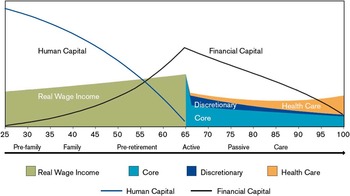
3.2.19 Risk exposures change considerably over a consumer's lifecycle. The drivers of these changes are the relative profiles of human and financial capital, both of which also changeFootnote 7. Life stages and life events impact these profiles directly, either suddenly through an event, or gradually through the passing of time. As these profiles change, a consumer's financial position, risk exposures, needs and wants will change. Understanding and planning for these life cycle changes is one of the central issues considered in modern finance and financial planning. The following diagram (Figure 6) illustrates a typical development of the profiles of human and financial capital for a person over their lifetime.
Typical consumer financial life cycle (Corrigan et al., Reference Corrigan, Matterson and Nandi2009)

3.2.20 The presentation and communication of risk alongside expected benefit outcomes is critical. These would need to be tailored depending upon the information tier involved.
Principle 2: The delivery of Consumer Information should take into account the circumstances of the consumer
Anticipated Benefits
Improved outcomes for consumers through:
• Information being more aligned to their specific needs and presented in a way that facilitates better engagement, leading to more optimal financial choices.
Improved outcomes for the industry through:
• Higher sales, retention and profitability by reaching out to consumers in a way which resonates and so increasing the value they place on the provider's offering.
Sub-Principle 2.1: Segment: Design information that is appropriate for each consumer segment
3.2.21 One of the challenges highlighted by different stakeholders (providers, advisers and consumers) is that the traditional ‘one size fits all’ model means that most of the information provided to consumers is ignored in the decision-making process. Significant variations exist in the relative value of information that is useful to support financial decisions by different people. As a consequence, it is fundamental that information should be appropriately segmented for each type of consumer.
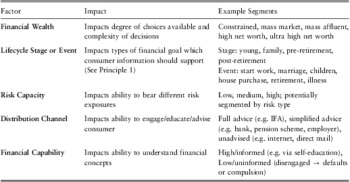
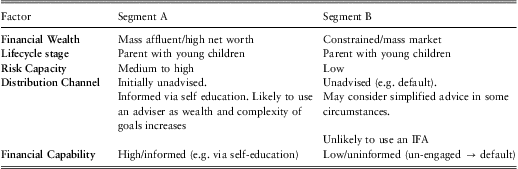
3.2.22 Whilst the definition of appropriate consumer segments can vary significantly by circumstance, some typical factors are outlined in table 2.
Segmentation examples

3.2.23 The above list is not exhaustive. Segmentation factors should be identified and used wherever a variation is expected to occur in how a person uses information to make a financial decision. There is a balance to strike between tailoring as much as possible whilst still being pragmatic and controlling communication costs.
3.2.24 Segmentation factors do not necessarily have to be independent of one another, and indeed may exhibit some correlation to one another (e.g. a HNW person seeking full advice is more likely to be older and have high financial capability). As a consequence, it is not necessary to have a separate information solution for every unique segment, but rather it is important to identify how information needs are likely to vary along the spectrum of each factor independently.
3.2.25 This approach will help drive consumer engagement by ensuring that the information delivered is relevant to the factors driving the decisions within each consumer segment (see Section 2.1).
Sub-Principle 2.2: Tiering: Tier information to each engagement level
3.2.26 Once the decision-making factors for a given segment have been defined, the information relevant to each factor needs to be structured in a way that is appropriate for each level/type of engagement people exhibit. It should aim to facilitate the evolving process of engagement towards the consumer making increasingly higher quality financial decisions.
3.2.27 Most people have insufficient knowledge to make optimal long term financial decisions due to the complexity involved. People generally start with low levels of knowledge and engagement which slowly rise as general awareness, the pressures of inaction and decision trigger points emerge. If information is not tiered accordingly it tends to disengage most people, as it leads either to insufficient information being provided or “information overload”.
3.2.28 A useful way of characterising people's level of engagement and the behaviour it engenders (as mentioned in 2.1) is outlined in table 3:
Tiers of Engagement
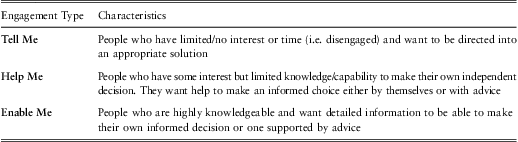
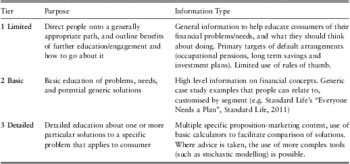
3.2.29 Each of these engagement types approaches financial decisions in a different way. Consequently they each respond very differently to consumer information. People can also progress through these tiers (in both directions) over time or be in two categories at the same time (e.g. one for long-term investment and one for short-term). In order to deal with the significant variation in knowledge and engagement levels that exist across the consumer landscape, different levels or tiers of information are required for the various stages in the consumer engagement process. A possible tiering structure is outlined in table 4.
Information tiering

3.2.30 The progress towards more detailed, sophisticated information is designed to facilitate more effective engagement over time. These tiers generally correlate to the various engagement levels (Tell me, Help me, Enable me) although there can be some overlap between them. Particular consumers may move through this process quickly, choose to jump in at a higher tier, or have different engagement levels for different types of decisions. Tiered information could also be presented together in layers for consumers, rather than independently, which may help consumers to self-select the level of information that is most engaging to them.
3.2.31 The key question that needs to be asked at each point is: “is the correct type of information being provided across a person's financial lifecycle to facilitate increased engagement and a high quality decision?”
3.2.31 Engagement should consider both intellectual and emotional factors, given that different types of people relate to information in different ways. Information content is critical to intellectual engagement, whilst the framing of information is critical to emotional engagement.
3.2.33 Many advice processes work similarly to the above, with advisers educating their clients to overcome their natural behavioural biases, in order to build engagement levels gradually.
3.2.34 Various information-generating tools exist to support each of the above tiers: from simple educational briefs to key features documents, through to standard and sophisticated financial modelling platforms. It is important that these tools are ‘joined-up’ as part of an integrated consumer communication framework, rather than being used independently in a disjointed manner.
Sub-Principle 2.3: Framing and Format: Present information in a format and frame to facilitate decisions
3.2.35 Once the appropriate type of information for each consumer tier and segment has been identified we must determine how best to present that information to facilitate effective decisions. Behavioural Economics tells us that people's decisions can be materially influenced by the way in which information is framed and presented (see section 2.4). Simple examples include: the use of positive versus negative frames, priming via biased lead-in information and the use of context to provide perspective.
Framing
3.2.36 In this context, it is important that information is framed in as neutral a way as possible to minimise any bias towards a particular solution. Specific consideration should be given to the choice of reference point when comparisons of different products or strategies are made, as this plays a dominant role in people making relative value decisionsFootnote 8. On this basis, we believe that the most appropriate reference point to use should be based upon the minimum risk position, as this is the only solution that can be objectively defined. The minimum risk solution should have regard to the individual's consumption goals and all relevant risk factors, as discussed in sub-principles 1.2 and 1.3.
3.2.37 It is critical that an appropriate framework is used to support effective financial decision-making. For example, the comparison of an annuity income level to the guaranteed return on a term deposit is unhelpful for many reasons, but one which is made frequently nonetheless. Principle 1 describes an appropriate framework for decision-making, based on the consumer's financial goals.
3.2.38 Judgement needs to be used in order to determine an appropriate trade-off between the completeness of information, which is necessary to avoid biases, versus the desire to simplify information for less engaged consumers as per sub-principle 2.2. There is tension between these two principles and judgement is required.
Format
3.2.39 In addition, people have different preferences for receiving information which has implications for the optimal way in which to communicate:
• Oral – conversations held either over the phone or via face-to-face meetings
• Written word – use of natural language in clear concise formats
• Visual – use of pictures, graphs, diagrams, illustrations
• Numeric – use of tables of numbers
3.2.40 Research undertaken by the Money Advice Service suggests that people have a clear preference for the written word in the form of clear concise natural language. As engagement levels increase through the tiers, however, we believe that the use of other information formats becomes increasingly important (although not necessarily dominant). For example, visual techniques can be invaluable in efficiently and clearly conveying complex information, such as product or holistic financial projection outcomes.
3.2.41 Information should be delivered to consumers in a way that facilitates engagement. Traditionally this has been in printed materials delivered by hand or post. Whilst we expect this to continue to be an important delivery mechanism for consumer information, web-based content is likely to become even more important. A key advantage of the web is the ability to enable consumers to find out more if they want to, without bombarding everyone with the finer detail.
3.2.42 The presentation of web information needs to be tailored to how people digest it. For example, simple financial calculators can be useful to facilitate engagement for the low to mid tiers but are unlikely to be sufficiently robust for use at higher tiers involving significant complexity.
Sub-Principle 2.4: Timing: Time information to when people need to make decisions
3.2.43 Information needs to be available to people at the point at which they are ready and able to make a decision, which can be significantly earlier than at the point-of-sale. For example, there is no point telling a 60 year old that they need to save 15% of their wage every year for retirement if they have only been saving 5% for the last 15 years and have little financial capital to draw upon to close the gap. Such information is needed much earlier than at or near retirement when consumers are able to act on it (and allowing the time required for them to work their way through the engagement process). Information is also needed post-decision or post-sale, in order to monitor progress against the consumer's goal and react to evolving circumstances.
3.2.44 Whilst some consumers will seek information when required to support proactive wealth management decisions, most make financial decisions reactively to a specific event occurring. Consumers are most likely to engage when a trigger event creates an immediate and compelling reason for them to do so (see Section 2.1).
3.2.45 There are two main types of trigger that lead people to need to make a financial decision: life events and market events. Life events include triggers such as starting work, getting married, having kids, getting divorced, retiring, becoming ill or inheriting money. Some of these events are controllable by the individual and all lead to a change in human capital, expenditure or risk exposures. Market events are not under the influence of individuals and lead to a change in financial wealth. Examples include equity market crashes or booms, interest rate changes, currency movements, counterparty credit default (e.g. from an employer of a DB pension plan or specific asset holding).
3.2.46 Consumer information should ideally be provided at these trigger points, even though they may not lead to a product sale. It should be relatively easy to determine when a market event has led to the individual's financial plan, strategy or product to move off-track. Identifying life trigger points is also increasingly possible through data mining approaches. This gives an opportunity to engage proactively with the consumer, building their trust by supporting them through any decisions required.
3.2.47 The provision of information around trigger points should serve to increase engagement. In the context of ongoing financial planning reviews, timing reviews proactively with respect to trigger points are likely to be more valuable and efficient than those whose timing is solely based upon duration since last review. Similarly, some believe that many of the industry failures relating to consumer information could have been avoided if providers of information had been proactive in communicating when triggers occurred (e.g. mortgage endowments, see Section 2.5).
Sub-Principle 2.5: Consistency: Ensure information is consistent across the full range of consumer touch points
Delivering Consumer Information via Multiple Touch Points
3.2.48 There are a broad range of consumer information touch points, which are accessed by different consumer segments, at different levels of engagement, and under a wide range of different circumstances. Consumers may receive information “by default” (e.g. when joining a new company pension scheme), or may seek information either in reaction to a life or market event, or as part of a more proactive financial planning process.
3.2.49 Currently, most consumer information is delivered in conjunction with the sale of a financial product. This focus on the point-of-sale is the result of detailed prescriptive regulation and the need to maintain clear audit trails. In contrast, many of the consumer's most important financial decisions do not take place at the “point-of-sale”. For example, key decisions are typically made before reaching the point of sale such as whether to save or spend, how to prioritise financial needs or what overall shape a financial plan should have. These decisions must also be reviewed “post-sale” to check whether savings are on track to achieve the required outcome, especially if in reaction to some event.
3.2.50 To support effective financial decision-making, consumer information should therefore be delivered across the full range of “touch points”, covering not just the point-of-sale, but also the pre-sale and post-sale engagement process.
3.2.51 While there are a wide variety of consumer information touch points, some of the most common are listed in table 5.
Example Touch Points

3.2.52 Different consumer segments will access information via different touch points. For example, HNW clients may approach an accountant or independent adviser, while mass market consumers (or consumers with low levels of engagement) may rely initially on other information touch points. Therefore, consumer information is more effective when the choice of touch points is selected based on the needs of the consumer segments being targeted.
3.2.53 Furthermore, the level of detail facilitated and the cost of delivering information vary significantly by touch point. By considered use of different touch points, a tiered communications strategy can be delivered to consumers in different segments or at different stages of engagement. As well as being more engaging for consumers, this will be more cost-effective than a scatter-gun approach.
Information should be Consistent Across Different Touch-Points
3.2.54 The content and format of consumer information will vary significantly to meet the needs of different segments and delivery channels. Yet it is important that consumer information is delivered so that consumers reach consistent decisions and experience broadly consistent financial outcomes.
3.2.55 The same consumer may access information via a number of different touch points as their level of engagement develops at different stages of the sales process: pre-sale, point-of-sale, post-sale. In order to ensure progressive engagement and effective ongoing decision-making, it is important that information delivered to the consumer is consistent across the different touch points
3.2.56 Material inconsistency in the information provided is likely to be confusing to the consumer and lead to disengagement. It could also result inconsistent decisions, unnecessary transactions, or “switching” within a financial plan.
Principle 3: Consumer Information should be free of bias
Anticipated Benefits
Improved outcomes for consumers through:
• More optimal financial decisions through reduced chance of being misled by biased metrics.
Improved outcomes for the industry through:
• Increased persistency and profitability through better alignment of consumers’ needs to product choices and so earning their trust.
3.2.57 For consumer information to facilitate effective financial decision-making it must be free of biases. This allows accurate and fair comparison and assessment of strategies, product options or fund choices in relation to financial goals.
3.2.58 Whilst unbiased consumer information is a worthy (self-evident) goal, it is difficult to achieve in practice. To narrow down the scope, we will define information bias as that which can lead, systematically, to decisions which are not in the best interests of the consumer.
3.2.59 While marketing or promotional information will by nature focus on a product or subset of products, typically from a single provider, strict regulation is in place to ensure this information is “fair, clear and not misleading”Footnote 9. The enforcement of those rules relating to promotional information is a regulatory issue and is not within the scope of this paper.
3.2.60 While consumer information may take many forms (e.g. qualitative versus quantitative, high-level versus detailed), most will include reference to how a financial product or plan has behaved in the past, or could behave in the future.
3.2.61 With this in mind, we will consider three key aspects of consumer information bias:
• Methodology or Model Bias
• Input or Assumption Bias
• Presentation Bias
Methodology or Model Bias:
3.2.62 This bias occurs where the underlying methodology on which information is based, typically an approximation of the true “real world” behaviour of a financial product, results in a systematic misinterpretation by the reader. While the approximation in the methodology may be transparent, its interpretation may result in sub-optimal decisions if poorly understood.
3.2.63 In Section 2.5 we highlighted the communication issues regarding income drawdown policies, where potential customers will typically receive a “critical yield” statement. The critical yield fails to convey the range of potential outcomes for the consumer's income – in particular the dependencies on the timing of returns and changes to relevant annuity rates. As a consequence, consumers tend to assume that their pension annuity level is secure so long as the realised return on their investments over the period exceeds the critical yield.
3.2.64 In this example, the method used to create the consumer information embeds two very important approximating assumptions (that returns are constant and annuity rates change in a specified way over the investment term). Whilst the information could never include all the different possible outcomes, the importance of these assumptions is unlikely to be fully understood by the consumer.
3.2.65 Unless consumers understand the implications of these simplifying assumptions and can interpret the illustration accordingly they will under-estimate the potential loss in the value of their pension, potentially leading to inappropriate decisions.
3.2.66 In relation to this type of bias, there is clearly a trade-off between increasing the complexity of the information (which should reduce bias) and keeping the information simple and accessible to a broad range of consumers, via a broad range of touch points.
3.2.67 Providers of consumer information should take responsibility to ensure that the methodology used to create the consumer information is “fit for purpose”. In doing so, they should take account of the other factors considered in this framework – e.g. target consumer segment, engagement level and touch point. Where simplifying assumptions are important for the circumstances, the information provider should highlight appropriate limitations of use in a way which doesn't feel like “small print” to the consumer.
Input or Assumption Bias:
3.2.68 Where the model or methodology for creating consumer information requires subjective or unobservable inputs to be specified, the choice of assumptions can impact the interpretation of the output and associated financial decisions. Where the choice of input assumption is not a reasonable and unbiased representation of the intended “real world”, this can lead to inappropriate interpretation and poor decisions.
3.2.69 As highlighted in Section 2.3, the Key Feature Illustrations for pensions demonstrate assumption bias. Providers have made different assumptions when projecting the same or similar funds. This may have led some consumers to the (wrong) interpretation that the same investment fund will deliver “better” outcomes under a particular provider. Industry standardisation for growth rate assumptions (e.g. by asset class) would help to remove this bias.
3.2.70 Stochastic or scenario-based projections require an even wider range of input assumptions than a deterministic projection. In this case a series of assumptions relating to average returns, risk (volatility) and inter-relationships between different variables will all impact on the interpretation of the information.
3.2.71 Providers of consumer information should be able to provide detailed documentation to justify any subjective input assumptions, identifying data sources and describing the methodology applied to convert the data into assumptions.
Presentation Bias:
3.2.72 While the underlying information content may be “accurate” or “reasonable”, variations in the way the information is presented or framed can bias decisions made by consumers.
3.2.73 As an example, product comparison websites or supermarkets enable consumers to rate financial products or funds on a number of different measures, e.g. price, historic performance or volatility, research rating, etc. However, while many products will include important features, which may be valuable to consumers, some of these might not be reflected by the simplest and most widely applied rating measures. This means that the product or option that best suits a particular consumer's needs may appear to be poorly rated, unless the consumer knows exactly which criteria to sort or filter on.
3.2.74 Both deterministic and stochastic projections can be misinterpreted unless presented appropriately and accompanied by consumer-friendly explanations and interpretive guidance.
Mitigating Bias in Consumer Information
3.2.75 Given the increasing financial lifecycle risks facing consumers, and the associated complexity of new financial products available to manage these risks, it is unrealistic to believe that information bias can be mitigated effectively through prescriptive regulation alone.
3.2.76 It should be possible to develop a clear set of industry guidelines for the provision of consumer information. Formal prescriptive regulation – such as developing a set of standard industry assumptions – is unlikely to be fit for purpose across the broad range of circumstances under which consumer information will be delivered and applied.
3.2.77 Providers of consumer information will need to take responsibility for ensuring it is fit for purpose and is described in sufficiently clear terms to mitigate the risk of misapplication and misinterpretation. The most important way to achieve this is to ensure the target consumer's circumstances and needs are fully considered when designing consumer information. In addition, the following checklist should be applied:
• Providers of consumer information should be able to demonstrate that the methodology applied is reasonable given the intended use and interpretation. This includes showing why it would not lead to systematic bias that is likely to lead to misinterpretation.
• Providers of information should be able to provide full and detailed documentation to describe the methodology and underlying assumptions used to create the information.
• The range of appropriate applications of consumer information should be stated clearly, together with any important limitations (described in a way which doesn't feel like “small print” to the reader).
• Providers of information should be able to demonstrate the nature and size of the possible impact of any simplifying assumptions.
• Providers of information should be able to demonstrate that steps have been taken to ensure users of consumer information are able to interpret the information appropriately (e.g. through consumer testing).
• Information should be easy to read and avoid jargon. It should use industry-consistent terminology such that consumers don't have to learn the provider's own terms if they already understand other products. The DWP's language guide may be a good reference point (DWP, 2011).
3.2.78 This is an area where the Actuarial Profession can support the provision of consumer information by engaging with regulators and inputting to industry best practice guidance.
3.2.79 Third parties supporting consumer understanding (e.g. advisers) should apply standard “due diligence” criteria when accessing and interpreting consumer information:
• What is the primary purpose of the information, from the perspective of the information provider? Is the information intended to market a product or service, or to support a financial decision?
• What decision is being informed by using this information? Is the information being used for the purpose it was intended?
• Is the supplier of the information independent of the products?
• Are there any possible biases in the methodology or assumptions used to create the information, or the way the information is being presented?
• What are the potential limitations of use of the information?
3.2.80 Where it is not possible to verify the above, consumers should seek alternative information sources.
4 Application of the Consumer Information Framework: Examples
4.1 In the previous section, we developed a proposal for a principles-based framework for Consumer Information. Our aim is to offer a template for providers of information to evaluate Consumer Information requirements across a range of circumstances.
4.2 In this section, we consider further how the framework could be applied to example consumer circumstances. Our intention is to demonstrate how the principles could be applied in practice, rather than to provide prescriptive guidance.
4.3 We have not illustrated communication designs that may help execute such an approach – to avoid the risk of narrowing subsequent discussions to specific solutions rather than the overall approach at this stage. However, there are many good examples of existing communications in the industry that would fit this framework.
4.4 Using the example segmentation model outlined in section 3.2.22, consider two consumer segments A and B that can be broadly characterised in table 6.
Example Consumer Types
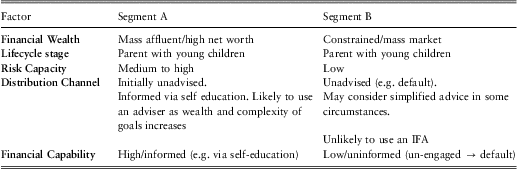
4.5 The differing characteristics of each segment will determine their engagement type and the tiers of information that will best support associated financial decision making.
4.6 When responding to a trigger event, Segment A's engagement type (see Section 3.2.28) may begin as ‘Help Me’ but will progress to ‘Enable Me’ as knowledge and engagement increases.
4.7 Individuals in Segment B will fall into the ‘Tell Me’ category but may progress to ‘Help Me’ over time as knowledge and engagement increases. Their initial touch points are likely to differ from Segment A and financial decisions are more likely to be taken on a reactive basis. Individuals in this segment may never progress to ‘Enable Me’.
4.8 While at a basic level the goals of both segments will be similar at each life stage, the greater financial wealth of individuals within Segment A will generally result in more options being available to them. They will therefore need to make a greater number of decisions in relation to long-term savings and investments. In contrast, individuals in Segment B are likely to continue to experience a greater contention between short-term and long-term needs which will constrain their ability to engage with and plan for longer-term financial goals. Some examples of the differing goals of the two segments are outlined in table 7.
Segment variation in financial objectives and associated financial decision-making

4.9 In the following sections we will take two different long term savings and investments goals – saving for university education and saving for retirement – and, for a selection of goal triggers, demonstrate how the principles of the framework can be applied.
Example 1: Saving for University Education
4.10 For both segments, the goal is to make provision for some or all of the costs associated with sending a child (or children) to university. In terms of cashflows, this goal can be articulated as either a lump sum requirement when university education begins or an income stream beginning at the start of the course and lasting for its duration. In both instances, the key risks are market risk and inflation risk – where inflation is specific to university fees and living expenses for students. There is also political risk attached to this goal as university fees are subject to change as government higher education funding policy is altered. Indeed, effective consumer information would have been vital in recent years when those saving for this goal in England and Wales were impacted so much by increases in fees.
4.11 Examples of the triggers, touch points and decisions required, along with some possible resulting information requirements, are considered below. The tables cover the initial stage at which the financial need is first recognised and the ongoing management of progress against the goal.
University Education goal
Initial Stage

Ongoing Requirements

Example 2: Saving for Retirement
4.12 In this example, the goal for both segments is to make provision for income in retirement. For Segment A, this goal may be defined initially in terms of aiming for a target percentage of salary on retirement. It may then become more clearly defined in terms of a more complex series of cashflows – taking into account lifestyle choices, expected long term care costs and bequests – as retirement approaches. For Segment B, the actual retirement income goal may be less clearly defined. Their aim may be to make some provision towards retirement saving while recognising other more immediate financial demands.
4.13 During the accumulation phase, the key risks are market risk and inflation risk. Inflation risk here relates specifically to the types of goods and services the consumer will buy in retirement. This inflation tends to be higher than the commonly quoted levelsFootnote 10, which tend to be reduced by electronic items that are typically bought by younger consumers.
4.14 These risks persist into the decumulation phase with longevity and morbidity risk becoming more important. Saving for retirement is also subject to political risk as decisions are often made based on the current tax regime which, if subject to change, may result in these decisions becoming sub-optimal in the future.
Initial Stage

Ongoing Requirements
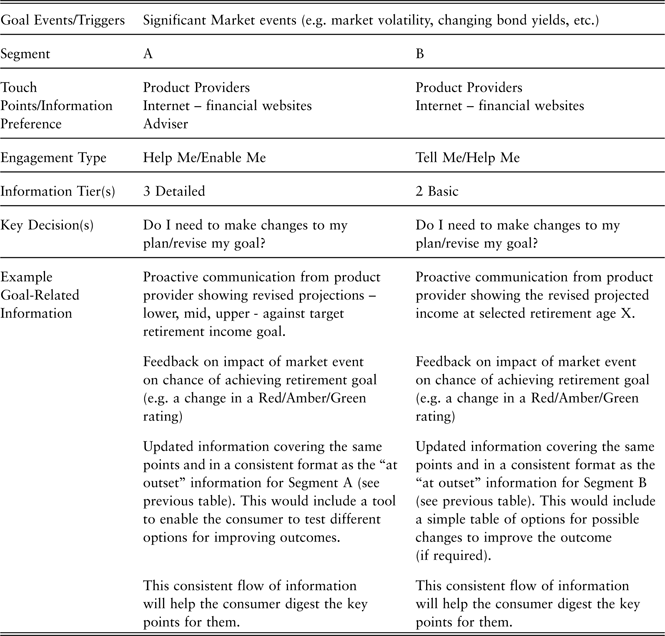
Approaching/At Retirement

5 Implementation
5.1 The earlier sections set out a proposed framework for a Consumer Information model. Arguably the most difficult challenge is how to implement such a model.
5.2 We urge the Actuarial Profession to take a lead in this area. The Profession has an opportunity to make good use of its core skills and to help put consumers at the heart of how we communicate. This is consistent with one of the strategic objectives set out in the Institute and Faculty of Actuaries Strategy in June 2011:
“to have a greater presence in public affairs, speaking out on issues where the Institute and Faculty can contribute, raising public awareness of the work of actuaries and the value we add to society, whilst working with government and others to shape policy.”
5.3 In order to gain wider insight into the way forward the working party held a workshop to help focus on the best actions to transform consumer information. In attendance were industry experts, consumer champions, financial advisers, regulators and academics. The most popular ideas from the workshop helped us to focus our vision into three key outcomes. We believe these are achievable and would help to significantly improve consumer information for long-term savings and investments in the UK. Recognising, however, that the vision may take several years to achieve, we also agreed some initial actions the industry could take as first steps towards these outcomes.
5.4 Our vision can be summarised into the following three outcomes. We believe providers of information should:
• Communicate progress with savings relative to the consumer's goal. For a pension, for example, providers could forecast the level of goods and services that will be afforded each year in retirement and compare this to a target level the consumer has chosen. This could be communicated pictorially – e.g. as a shopping trolley with food, holiday brochures, golf clubs or other illustrations of relevant goods and services. The “target trolley” could be shown alongside the “forecast trolley” to indicate how close the consumer is to meeting their goals with their current levels of saving. This would, in our view, be much more engaging than projections of numerical values which we believe mean little to most consumers.
• Communicate risk and reward by reference to the chances of achieving the consumer's goal (rather than defaulting to the short-term volatility of the fund choices). This would naturally lead to the most important risks and actions being highlighted – i.e. those that could have the largest impact on whether the goal is achieved or not. The communication of risks should be entirely consistent with the communication of progress towards the goal – e.g. if a provider uses the shopping trolley example above, risks should be explained by reference to their potential impact on the goods and services illustrated in the trolley.
• Ensure communications are engaging, easy to digest and free of bias (meeting the Principles described in Section 3.2). This includes, for example, keeping communications concise, with more information available online or on request. We would propose that regular progress statements should be no more than 4 pages long. All communications should be consistent throughout the consumer's experience – e.g. if the shopping trolley example is used, this should be the way progress and risks are communicated whether through a regular statement, during a phone call, on the internet or via any other point of contact.
By “providers of information” we include any individual or company involved in communicating to consumers about long term savings and investments (product providers, advisers, employers etc).
5.5 Of all the possible “first steps” actions we discussed at our workshop (see Appendix, with actions labelled A to Z), the following received the most votes – based on impact and achievability:
✓ Champion cultural change with providers of information
✓ Explore how best to communicate financial risk and risk mitigations
✓ Develop new guidance on the provision of financial projections for consumers
✓ Promote rules of thumb – the savings ‘five a day’
✓ Provide independent decision aids for consumers
✓ Support the provision of better education on financial matters in schools
Champion cultural change with providers of information
5.6 The first key step is to champion change by highlighting where improvements should be made and motivating the providers of the information to act. For example, readers of this paper could lobby within their own organisations to include the three outcomes proposed in 5.4 in their 3-year or 5-year business plans.
5.7 Almost any reader of this paper can contribute to this step. Actuaries work in a variety of fields and many will be either directly involved in communication or have a leadership role where they can influence information quality. Others will be involved in evaluating the financial benefits of different opportunities and can help to forecast the likely benefits of improving consumer information – on enhanced sales, customer retention and reduced risk.
5.8 Recognising the attributes of engaging consumer information is essential for success – for example, that meeting plain English standards is essential but not sufficient to avoid the pitfalls described in Section 2. We hope that Section 3 provides a useful framework to help evaluate the quality of information.
5.9 This step could be powerfully supported by updates to industry guidance, such as that provided by the Association of British Insurers, to reflect the points made in this paper.
Explore how best to communicate financial risk and risk mitigations
5.10 To support our second key outcome, more work is required to consider how best to communicate financial risk in relation to the consumer's goals. There are examples from other industries (see Section 2.6) where complicated risk information has been conveyed to consumers in a way they understand and value. We could then explain the actions the customer could take to mitigate the risks by demonstrating their positive impact in achieving the goal (e.g. to work longer or to save more).
5.11 At the heart of the answer may be the need for consistency across the industry. For example, the shopping trolley analogy in 5.4 could be particularly powerful if an industry standard interpretation were adopted – both in terms of presentation and content (e.g. allowance for tax). This would avoid consumers being bamboozled by many different interpretations of goal-setting and could generate awareness and engagement with savings through word-of-mouth. It would also standardise the terminology around risks and risk mitigation – e.g. “in that event, the golf membership comes out of the trolley unless I work an extra year”.
5.12 Members of the Actuarial Profession are well placed to consider this, being in the business of understanding and communicating financial risk (for example, as part of proposing optimal asset strategies given the liabilities the assets are backing). These skills can equally be applied to consumer investment.
5.13 This would be a valuable Working Party topic, especially if the Actuarial Profession engaged with consumer, adviser and employer experts to help inform and test different concepts.
Develop new guidance on the use of financial projections for consumers
5.14 The current regulatory regime for illustrations, which requires a “Key Features Illustration” (KFI) to be produced according to a series of prescriptive rules and associated rates of return, constitutes a significant component of the information provided to consumers. In 2.3.9, 2.3.12 and 3.2.69, we highlighted a number of weaknesses inherent in the current KFI regime which appear to conflict with the Principles for consumer information proposed in this paper:
• The basis for generating and presenting the KFI does not make any reference to the consumer's financial goal and therefore cannot consider the risks most pertinent to that goal.
• The core of the current illustration regime is based on three rates of return. As such, there is nothing to help the consumer understand either the potential downside risk or the implications of path dependency.
• Different companies use different growth assumptions for the same underlying funds (in Ireland this is addressed by the Society of Actuaries setting growth rates for each asset class).
5.15 This is an area where the Actuarial Profession can take the lead – by helping to develop more effective guidance to support the provision of more realistic projections, which reflect a consumer's financial goals and take into account all relevant risks. This guidance would likely include (but would not be restricted to) details relating to:
• The broad approach and appropriate methodology for generating illustrations of future outcomes from long-term savings or investment products,
• Guidance on the way illustrations of future outcomes should be framed in relation to a consumer's financial goals (links to 5.10 to 5.13),
• The basis for setting and validating underlying assumptions for all relevant risk factors and asset returns,
• The provision of documentation which explains the basis for the projection, the scope/limitations of applicability, and the underlying assumptions
5.16 The wide range of increasingly complex products and the diverse nature of consumer planning requirements, means there are likely to be significant challenges in developing a “one size fits all” set of rules to ensure consistent projections. Developing more detailed guidance around a set of clearly defined principles would place greater and more formal responsibility on the provider of the information to demonstrate compliance, and to ensure that the information was fit for purpose.
Promote rules of thumb – the savings “five a day”
5.17 Another popular idea is to promote some simple rules of thumb to help consumers understand how much they should save. The aim is to encourage more consumers to start thinking of their savings in relation to their future goals, ahead of information providers being able to achieve the three key outcomes in 5.4. This should boost engagement and savings levels.
5.18 The Actuarial Profession can lead on this by creating one or more suitable slogans and then promoting them to consumers. This could be the savings equivalent of the healthy eating slogan of “five a day”. If we can do this during 2012 the messages will be boosted by greater public awareness of long term saving thanks to the nationwide automatic enrolment campaign, which is due to reach more than 90% of the UK population.
5.19 The first step would be to come up with a suitable slogan, such as “Save half your age” (as a percentage of your salary).
5.20 Whilst a catchy slogan could be effective in reaching many consumers with a simple message, the downside is that it cannot be tailored to their individual circumstances. For some consumers, for example, a catch-phrase that encourages them to save more than they could afford may simply put them off saving at all. We therefore strongly prefer the longer term outcomes in 5.4 but believe this rule of thumb promotion is still a practical and beneficial step in the meantime.
Provide independent decision aids for consumers
5.21 Ahead of us being able to achieve the outcomes in 5.4, we could help consumers better understand what their financial goals and objectives are using decision aids. This should help them move up the engagement scale from “tell me” to “help me” to “enable me” (see Section 3.2.28). We know that consumers trust information most when it comes from a source they deem to be independent (see 2.2.13).
5.22 An organisation such as the Money Advice Service could play a powerful role here, supported by the Actuarial Profession, by providing ways for consumers to better understand their goals. They could also promote much of the information referred to in Section 4 for the “Tell Me” category.
5.23 The Money Advice Service already has significant consumer support available on its website (http://moneyadviceservice.org.uk/). We would recommend promoting in particular information such as:
• A list of questions consumers should ask themselves – a short, memorable and goal-oriented list (e.g. “What am I saving for?”, “When will I need the money?”), combined with where they can go for more help;
• Case studies to help consumers understand what “people like them” do; and
• A simple online tool to help illustrate potential savings outcomes (e.g. for retirement income and tax-free lump sum) based on different saving amounts or levels of investment risk. This could, for example, use shopping trolley illustrations as described in 5.4.
5.24 The Actuarial Profession could support the Money Advice Service in determining and promoting the key information. Indeed, it could carry significant weight with consumers and commentators alike if the information is endorsed by both parties.
Support the provision of better education on financial matters in schools
5.25 One way to promote the rules of thumb and the independent decision aids would be to incorporate these into learning at schools. This could help younger people plan for their future or at least be more prepared to do so in years to come. The students may also help such messages spread to other consumers through word of mouth.
5.26 Actuaries can play an important role here – supporting their local communities by visiting schools to explain some of the basics of Finance and planning for future goals. It would also help promote the Actuarial Profession as a career option.
Challenge and Opportunity
5.27 There are many practical challenges in making a step-change to the quality of consumer information in long-term savings and investments. Not least, the cost involved is a significant barrier and will only be overcome if providers of information believe the financial benefits give a sufficiently high return on investment. The expected benefits of achieving the outcomes in 5.4 can be hard for providers of information to quantify. However, our working party expects the case will be compelling in most situations if considered fully – especially if changes can be merged with mandatory work (like changes required for the Retail Distribution Review) to reduce cost. Indeed, we believe providers of information who take the lead in this area will realise a competitive advantage.
5.28 Arguably the most fundamental change required is to the way finance professionals think. The book “Nudge: Improving Decisions about Health, Wealth and Happiness” by Richard Thaler and Cass Sunstein (Thaler & Sunstein, Reference Thaler and Sunstein2008) proposes that there are two types of people: ‘humans’ and ‘econs’. ‘Humans’ make up the majority of the population – for whom the observations of Behavioural economics apply (see Section 2.4). The ‘econs’ category is reserved for the small proportion of people who have a tendency to act entirely rationally - actuaries being singled out by the authors as belonging to this category! We need to be able to think like ‘Humans’ rather than ‘econs’ if we are to provide effective and engaging consumer information for the majority of consumers.
5.29 The prize is significant. If we can act on our insight (see Section 2) and achieve the outcomes proposed in 5.4 we will drastically improve consumer information (see proposals in Sections 3 to 5). This will enable consumers to make better informed financial decisions and support a more prosperous community. We can also expect investment levels to increase if consumers are more engaged in long term savings and investments, supporting a more prosperous industry.
5.30 Finally: by taking the lead in this field, we will improve the public perception of the value actuaries add to society.
Acknowledgements
The working party would like to thank their Expert Panel for its support and challenge in producing this paper:
Anne Bell – Department for Work and Pensions
William Burrows – Adviser expert
Liam Delaney – Behavioural Economics expert
Teresa Fritz – Consumer expert
Robert Inglis – Board for Actuarial Standards
Michael Martin – Finance Industry expert
Elaine McCarthy – Money Advice Service
Keith Miller – Bancassurance expert
We would also like to thank Ed Ritchie and Terry Maxwell for their help in editing this paper.
All views and any errors are those of the Working Party and not the Expert Panel or Actuarial Profession.
7 Glossary
ABI: Association of British Insurers
DWP: Department for Work and Pensions
EIOPA: European Insurance and Occupational pensions Authority
FSA: Financial Services Authority
HNW: High Net Worth
IMD: Insurance Mediation Directive. This provides a set of ‘conduct of business’ rules for the sale of insurance products to ensure a basic harmonised level of consumer protection throughout the EU.
ISA: Individual Savings Account
MAS: Money Advice Service
MiFID: Markets in Financial Instruments Directive. This is a European Union Law that provides harmonised regulation for investment services across Europe.
OEIC: Open Ended Investment Company is a type of open-ended collective investment scheme
Ofgem: Regulates the electricity and gas markets in Great Britain.
PRIPs: Packaged Retail Investment Products. This is a European Commission initiative to achieve consistent and effective standards for investor protection across a wide range of investments.
SIPP: Self Invested Personal Pension
UCITS IV: Undertakings for Collective Investments in Transferable Securities Directives are a set of European Union directives that aim to allow collective investment schemes to operate freely throughout Europe.
Unit trust: A form of collective investment constituted under a trust deed
401(k): A type of retirement savings account in the United States, which takes its name from subsection 401(k) of the Internal Revenue Code
Appendix – Possible First Step Actions Considered
Full list of options suggested prior to or at the workshop on Transforming Consumer Information at Staple Inn on 24 January 2012. A short description is provided here for each potential action unless it has been described already in Section 5.

B. Grasping the opportunity of regulatory reviews
8.1 There could not be a better time for the Actuarial Profession to influence regulators, industry bodies and providers alike in the development of an effective consumer information framework. There is significant regulatory change in progress, such as the Retail Distribution Review, Solvency II, Pensions Reform, a Statutory Money Purchase Illustrations review and a DWP-led streamlining of disclosure regulations. Such volume of change is challenging for the industry, but it does provide a platform to make substantial consumer information improvements over the coming months.
8.2 Providers of information should work closely with regulators to request changes which would support more engaging consumer information.
8.3 Often, however, the regulations do not prevent improvements being made. Providers of information should also take the opportunity to review their approach to consumer information, so that any required system changes can be implemented together with other mandatory change. This approach could substantially reduce the cost of improving consumer information.
E. Introducing an independent watermark of quality
8.4 The ABI's Raising Standards initiatives had some success in encouraging providers to communicate “in plain English”. We could build on this by introducing a watermark based on the overall quality of consumer information. Providers of information would only receive and retain this watermark if their communications are engaging and consistent with a list of key principles (potentially as defined in Section 3).
8.5 This should better equip consumers to understand which providers of information they can rely on for useful and engaging communication. In turn, this should drive positive behaviour: consumers will be more likely to invest through an information provider who has earned the watermark, encouraging the industry as a whole to raise its standards. Higher standards of information might also encourage greater demand for long-term savings and investments and enhance the chances of consumers achieving their financial goals.
8.6 This could be run by the ABI or, especially given that information comes from many sources (not just insurers), from another source. For example, an industry-independent body such as the British Standards Institution (http://www.bsigroup.co.uk/) is one alternative we could explore.
G. Pensions: consumers to choose target living standard
8.7 This option would require consumers to select a target living standard from a small number of options, which each relate to an industry-standard monetary target. Communication to the consumer would then be in terms of their goal (and whether they are on track) rather than the monetary target.
8.8 This option may be difficult to implement if consumers have savings with different providers, however goals could be specific to each savings product.
H. Work closely with a handful of information providers
8.9 Similar to A, but this option would mean The Actuarial Profession would work closely with a handful of information providers to embed the framework proposed in Section 3of the paper, and generate a critical mass.
8.10 Ideally this would generate improvements by other providers as the standard of communication would improve throughout the industry.
I. Require consumers to choose a level of communication required
8.11 Consumers would choose the level of communication they required (e.g. low/mid/high). This would avoid consumers receiving unsolicited information and make the consumer think about their needs.
J. All projections required to be in real terms
8.12 Currently point of sale and post-sale information is generally in nominal terms with yearly statements expressed in real terms. To help explain the impact of inflation it would be beneficial for all projections to be expressed in real terms.
K. Better use of technology
8.13 Consumers generally receive information in paper format. However, greater use of technology could deliver information that is more suitable to many consumers e.g. by mobile application, email or on-line via an account with the provider. This way information could also be more easily tiered so that those who wish to be more involved could be guided to where further information could be found.
8.14 Consumers could also be guided to tools which could help them make decisions, such as projections on different premium levels etc.
L. Independent body – consumer advocacy
8.15 The Actuarial Profession could work with an independent body who could champion the need for better targeted information for the consumer and provide ratings of providers’ literature (similar to E).
M. Training for product providers
8.16 Training by consumer and behavioural experts to help product providers deliver suitable material to how to engage with consumers.
O. Different methods of delivery e.g. electronic
8.17 Similar to K, allow the consumer to have a choice as to how they receive information, post or email.
P. Deal with/Manage negative view of industry
8.18 The savings industry has gained a negative reputation through the various mis-selling scandals of the past. The industry needs to regain trust and seek to change the consumers’ view, so they can appreciate the products/services now on offer to enable them to achieve their savings aim.
Q. Mandatory testing of consumer material
8.19 Introduce compulsory testing of material against consumer information best practice. Guidelines would have to be developed which would need to be adhered to. This would need to be on a principles based approach as providers would want to be able to produce information in their own style and brand.
R. Audit of consumer information
8.20 Similar to Q, consumer information could be audited, although this would create extra governance which would be unlikely to be well-received by providers.
S. Stamp of approval by trusted body, e.g. Which?
8.21 Introduce an approval stamp from a trusted consumer body, so that consumers would know which providers provide suitable information to help them choose when purchasing a product (similar to E and Q).
U. Move away from numbers – more visual
8.22 Encourage providers to show progress towards a target in a more visual way which would help focus the consumer on their end target rather than just the numbers.
V. Engage directly with consumers, e.g. workshops
8.23 Engage directly with consumers to understand their behaviours towards saving and their needs. This could be achieved through workshops, polls or other forms of consumer research.
W. Increase knowledge about consumer needs and behaviour
8.24 Use information, research and data already collected to improve what we know about consumer needs and behaviour e.g. NEST, DWP, thus gaining further understanding on what the consumer would react to.
X. Develop ways of helping the consumer understand their savings
8.25 Develop tools or provide information to help the consumer understand how contributions (amount, duration etc.) make an impact on outcomes. This could be incorporated with K.
Y. Provide layers of information
8.26 Provide all consumers with layers of information, allowing them to delve as deep as the want to find what they need at the level they prefer. If the information is in paper format, a simple sheet giving the basic information with further information as an appendix, or preferably showing where further information is available on-line. (Similar to K)
Z. Use consistent language and terminology
8.27 Work with providers and the financial industry to form a consistent use of terminology as in 3.2.77.