Introduction
The early 21st century has seen the development of therapeutic agents targeting most key hallmarks of cancer (Ref. Reference Hanahan and Weinberg1), with varying degrees of impact on patient outcomes to date. A particularly powerful therapeutic approach has been the use of cyclin-dependent kinase inhibitors (CKIs), as reflected by their unprecedented impact on progression-free survival (PFS) in the first-line treatment of metastatic ER-positive HER2-negative breast cancer (Refs Reference Finn2–Reference Goetz4). Dysregulation of the cyclin D/cyclin-dependent kinase (CDK) 4/6 axis is observed across numerous tumour types (Refs Reference Malumbres and Barbacid5, Reference Musgrove6), and provided a strong initial impetus for therapeutic targeting. Meanwhile, emerging data point to greater complexity of additional mechanisms by which currently available CKI agents are thought to exert their anti-cancer effects.
This review aims to contextualise the current status of CKI therapy, by providing an overview of original and emerging insights into mechanisms of action, evidence supporting their current standard use, as well as recent and ongoing preclinical research and clinical trials of CKIs in various tumour types and clinical settings. In order to capture the overall direction of travel of the more than 300 currently registered clinical trials of combination strategies that include CKI agents, these are grouped and discussed according to molecular pathways and potential resistance mechanisms targeted by each combination category. This leads to a discussion of anticipated opportunities and challenges facing the clinical implementation of CKI therapy in coming years, including approaches to combination therapy, treatment sequencing, and the development of potential biomarkers.
Primary role of anti-cancer CKI therapy in cytostasis induction
The discovery of the D family of cyclins (D1, D2 and D3) in the early 1990s was followed by the identification of CDK4 and CDK6 a few years later (Ref. Reference Sherr, Beach and Shapiro7). Their crucial role in cell cycle transition from the gap 1 (G1) phase into the DNA synthetic (S) phase, known as the G1-S checkpoint, has since been well established, whereby activation of CDK4/6 through dimerisation with D-type cyclins allows phosphorylation of targets including Rb and resultant transcriptional activation, through release and reduced repression of E2F among other transcription factors (Ref. Reference Goel8).
Cyclin D expression is upregulated by mitogenic stimuli, and various pro-proliferative signalling pathways converge on the G1 checkpoint (Ref. Reference Lukas, Bartkova and Bartek9). These include the Ras/Raf/MEK/ERK, PI3K/AKT/mTOR, Wnt/β-catenin, JAK/STAT, NFκB and oestrogen/progesterone/androgen receptor signalling pathways. Conversely, the checkpoint is inhibited by the INK4 (A-D) family of endogenous CDK inhibitor proteins (p16, p15, p18 and p19, respectively) as well as members of the CIP/KIP families including Waf1/Cip1, Kip1, Kip2 (p21, p27, and p57, respectively) (Ref. Reference Sherr10). Whilst a comprehensive outline of the molecular pathways involving p53 is beyond the scope of this review, it should be noted that CDK2 is inhibited downstream of CDK4/6 by p21, which is transcriptionally induced by pro-apoptotic protein p53, which is in turn under the inhibitory regulation of murine double minute family proteins MDM2 and MDMX (Ref. Reference Wade, Wang and Wahl11).
In addition to upstream proliferative signalling, cyclin D-CDK4/6-Rb pathway activation occurs via a number of mechanisms in cancer. These include gene amplification or overexpression of cyclin D or CDK4/6, downregulation of miRNAs directed against CDK4/6, deletion or epigenetic repression of the INK4/CIP/KIP families, as well as inactivation of upstream tumour suppressors such as SMARCB1 (Ref. Reference Hamilton and Infante12). Key aspects of cell cycle control and the cyclin D-CDK4/6-Rb pathway with respect to the development of CKI treatment strategies are summarised in Figure 1. For further intricacies of cell cycle regulation including other cyclins and CDKs, we direct readers to extensive reviews elsewhere (Refs Reference Malumbres and Barbacid5, Reference Musgrove6, Reference Sherr10, Reference Vermeulen, Van Bockstaele and Berneman13–Reference Roskoski15).
Cell cycle control – current and future therapeutic opportunities.
Overview of cell cycle, emerging mechanisms of CKI action, other current targeted treatment strategies, and possible future oncological treatment approaches. CDK (cyclin-dependent kinase), CKI (cyclin-dependent kinase inhibitor).

A fundamental observation highlighting G1/S checkpoint regulators as potential drug targets has been that these are dysregulated in the majority of human solid tumours (Refs Reference Malumbres and Barbacid5, Reference Musgrove6). Key preclinical data emerged in the early 2000s, lending further support to the notion of CDK4/6 as potential therapeutic targets by inducing tumour cells to arrest in G1 phase. This included the demonstration that, whilst specific CDKs may be required for proliferation of specific cell types such as cardiomyocytes or haematopoietic cells, only the highly conserved CDK1 (implicated in mitosis) and no other CDKs (including CDK4/6) were essential for survival in mice, and Cdk4 knock-in or ablation of p21/p27 were associated with tumorigenesis in mouse models (Ref. Reference Malumbres and Barbacid14). Furthermore, preclinical studies demonstrated that inactivation of the cyclin D-CDK4/6 axis was compatible with normal development and crucially protected against tumour growth, as shown with c-Myc-driven skin neoplasms in Cdk4 knock-out mice and Erbb-2 or Ras-driven mammary cancers in cyclin D1 null or Cdk4 null mice (Ref. Reference Malumbres and Barbacid14).
The preclinical promises led to initially disappointing early clinical development of non-selective CDK inhibitors alvocidib/flavopiridol (anti-CDK1, 2, 4, 6, 7, 9) and seliciclib/roscovitine (anti-CDK 1, 2, 5, 7) due to unacceptable toxicity (Ref. Reference O'Leary, Finn and Turner16). Second-generation agents such as dinaciclib (anti-CDK1, 2, 5, 9) appeared of interest in phase I trials, but ultimately failed to show efficacy in phase II trials of various tissue types (Ref. Reference Asghar17). Improvements in potency and selectivity against CDK4/6 have since allowed clinically acceptable therapeutic windows for subsequently developed third-generation oral agents. Three such agents are approved for clinical use at present: palbociclib, ribociclib and abemaciclib, all with slightly different selectivity profiles (discussed further under Clinical Implementation). Preclinical and translational studies in recent years have confirmed the role of these CKI compounds in inducing cytostasis (Refs Reference Finn18–Reference Schaer23). Detailed chemical properties of these agents are summarised elsewhere (Refs Reference Roskoski15, Reference Poratti and Marzaro24). Numerous other agents are currently in earlier phase clinical trials (Table 1), whilst the development of many others has been terminated over the last decades (Ref. Reference Asghar17).
CKI agents currently licensed or in clinical development

ALL, acute lymphoblastic leukaemia; AML, acute myeloid leukaemia; CLL, chronic lymphocytic leukaemia; EGFRm, epidermal growth factor receptor mutated; GBM, glioblastoma multiforme; IV, intravenous; MBR, metastatic breast cancer; mTNBC, metastatic triple-negative breast cancer; NHL, non-Hodgkin lymphoma; NSCLC, non-small cell lung cancer; PO, oral; SCLC, small cell lung cancer.
Two studies (NCT04283773, NCT04012918) were excluded which did not include patients treated with CKIs (likely selected by search due to mention of CKIs in the background description).
Note: the numbers of registered trials in the table do not add up to the 562 studies identified, due to multiple agents included in a number of trials (e.g. physician's choice between palbociclib, ribociclib or abemaciclib) and due to three studies which did not specify CKI agents.
1 From 562 studies identified from the clinicaltrials.gov search on 16/11/2020. Search strategy: (cancer OR tumor OR tumour OR carcinoma OR neoplasm OR malignancy | palbociclib OR ribociclib OR abemaciclib OR CDK4/6 inhibit OR CDK 4 6 inhibit OR dinaciclib OR trilaciclib OR lerociclib OR roniciclib OR riviciclib OR voruciclib OR milciclib OR AT7519 OR P276-00 OR PHA-848125 OR G1T28 OR G1T38 OR alvocidib OR DB03496 OR seliciclib OR CYC202).
Emerging anti-tumour mechanisms of CKIs
CKI-mediated immune modulation
Intriguingly, work in recent years is yielding initially unanticipated insights into multiple, more complex and at least partly linked mechanisms through which CKIs appear to exert their anti-tumour effect. Arguably the most profound finding from the point of view of the potential for rapid clinical translation, has been the notion that CKI agents can promote anti-tumour immunity. Underlying mechanisms proposed to date relate both to direct effects on malignant cells as well as impacts on the tumour immune microenvironment. A translational study involving tissues from the NeoPalAna trial has shown that palbociclib or abemaciclib induce interferon and MHC expression, thereby strengthening the antigen-presentation capabilities of tumour cells (Ref. Reference Goel21). CKI-related immunogenic effects were attributed to CKI-induced reduction in E2F transcriptional activity, leading to reduced downstream DNA methyltransferase (DNMT1) expression, which in turn was proposed to cause hypomethylation and expression of key T-cell activation genes (Ref. Reference Goel21). In another study, a key mechanism of CKI-mediated immune regulation was presented as the reduction of repressive phosphorylation of the NFAT family of transcriptional activators of T-cell function by CDK6, leading to nuclear translocation of NFAT proteins and transcription of key downstream genes (IL2, IL3 and GM-CSF) (Ref. Reference Deng25). Enhanced intratumoural CD4+ and CD8+ T-cell recruitment and function were attributed at least in part to the CKI-mediated disruption of this CDK6 kinase activity (Ref. Reference Deng25). Notably, studies investigating impacts on immune cell dynamics suggest that CKIs may exert differential effects on distinct immune subpopulations. CKI exposure was able to reduce T regulatory cell (Treg)-related repression of CD8+ T-cell secretion of gamma interferon, a key determinant of T-cell effector function (Ref. Reference Deng25). The authors attributed the greater effect of CKIs on Tregs in contrast to other subpopulations to previously reported observations of higher CDK6 expression levels in this T-cell subtype (Ref. Reference Deng25). Another study, which found both tumour-resident and circulating Tregs to be reduced following abemaciclib treatment, alluded to comparatively higher levels of RB1 in Tregs as a potential explanation (Ref. Reference Goel21), however, these links are not yet fully understood.
The impact of CKIs on the expression of inhibitory checkpoint receptors or ligands was initially thought to be favourable. Early evidence from modest numbers of murine models included the observation of significantly reduced expression of PD-1, CTLA4, TIM-3 and LAG-3 in CD8+ T-cells following abemaciclib exposure (Ref. Reference Goel21): a finding recapitulated by a significant reduction in PD-1 and CTLA4 expression in tumour-infiltrating CD8+ and CD4+ T-cells, respectively, in palbociclib or trilaciclib-treated mice (Ref. Reference Deng25). However, more recent evidence suggests that CKI exposure rather appears to increase inhibitory surface protein expression. For instance, in vitro CD4+ and CD8+ T-cell exposure to abemaciclib resulted in upregulation of PD-L1 and TIM-3 among other inhibitory surface markers (Ref. Reference Schaer23). These findings were corroborated through extensive genetic experiments which demonstrated elevated PD-L1 expression through cyclin D1-3 ablation and CDK4 protein depletion in vitro and in mammary tumours in Ccnd1 knock-out mice in vivo, and decreased PD-L1 expression on introducing CDK4 in cell lines and cyclin D1 in Ccnd1 knock-out mice (Ref. Reference Zhang26). Mechanistically, CKI-induced increase in PD-L1 expression was shown to result from reduced phosphorylation of speckle-type POZ protein (SPOP) by cyclin D-CDK4 complexes, exposing SPOP to degradation and thus hampering its role in PD-L1 ubiquitination and proteasomal degradation (Ref. Reference Zhang26). Collectively, this provides a key preclinical rationale for combining CKI therapy with immune checkpoint inhibitors (ICIs). Indeed, significant anti-tumour effects of CKI-ICI combinations have been demonstrated, both in terms of tumour response in spheroid model systems and in vivo with extended overall survival of murine models treated with CKI-ICI combination therapy (Refs Reference Goel21, Reference Schaer23, Reference Deng25).
Senescence induction and autophagy
The Rb pathway is implicated in cell replicative senescence (Ref. Reference Salama27), and induction of a senescence-like cell phenotype is drawing interest as another impact of CKI agents. Following the demonstration of senescence in Cdk4-deficient mouse cell lines (Ref. Reference Zou28), a variety of tumour cell lines have been shown to display senescent features following CKI exposure (Refs Reference Yoshida, Lee and Diehl20, Reference Goel21, Reference Wiedemeyer29–Reference Bollard32). For instance, breast cancer cell line exposure to abemaciclib significantly increased the expression of beta-galactosidase (Ref. Reference Goel21), which is regarded as the principal biomarker of senescence (Ref. Reference Dimri33). A senescence-like phenotype, including beta-galactosidase, features of the senescence-associated secretory phenotype (SASP), as well as formation of senescence-associated heterochromatic foci and ATRX (chromatin regulator) foci, have also been observed in palbociclib-treated melanoma cells, along with in vivo evidence of SASP post-CKI treatment (Ref. Reference Yoshida, Lee and Diehl20). Failure of senescence induction was a key feature of palbociclib-resistant glioblastoma cell lines compared to those displaying CKI-induced reduction in Rb phosphorylation and associated senescence (Ref. Reference Wiedemeyer29). Requirements for CKI-induced senescence are under investigation, and reduced expression of MDM2 as well as ATRX-mediated suppression of HRAS expression are among key insights to date (Ref. Reference Kovatcheva31).
However, the precise nature of CKI therapy-induced senescence is not yet known. Some data indicate that CKI-induced senescence may only in part recapitulate classical senescence, exemplified for instance by a lack of concomitant SASP factor expression in the form of IL-6 and IL1 following abemaciclib treatment of breast cancer cell lines (Ref. Reference Goel21). Furthermore, preclinical studies have shown that CKI-induced senescence may cease on CKI withdrawal (Ref. Reference Morris-Hanon34), and that the degree of reversibility of senescence-like features may vary between cell lines, CKI dose levels and regimes (continuous administration favouring durable senescence induction) (Ref. Reference Bollard32). A more detailed understanding of the determinants of irreversible therapeutic senescence will thus be an important factor for clinical implementation. The potential issue of tissue-specificity has also been raised in the context of CKI-induced senescence – for instance, senescence inhibition through co-treatment with rapamycin had contrasting effects on palbociclib-induced senescence in melanoma cells (enhanced) and oesophageal cancer cells (reduced) (Ref. Reference Yoshida, Lee and Diehl20). Whilst senescence as an oncological therapeutic target has been envisaged for some time, more detailed characterisation of the intricate molecular networks involved in senescence is required, not least given the context-dependence of the contrasting pro- or anti-tumorigenic nature of some senescence factors (Ref. Reference Acosta and Gil35). It has been proposed that a closer understanding of such factors may allow future development of a sequential therapeutic approach involving initial CKI-mediated senescence induction followed by targeted senescent cell elimination (Ref. Reference Klein36).
Senescence, in turn, has been linked to autophagy and cellular metabolism (Ref. Reference Salama27), and these areas are also under investigation in relation to CKI therapy. Early evidence for therapeutic synergy between CKI agents and autophagy inhibition was reported in a study of co-administration of flavopiridol (first generation CKI) and chloroquine (autophagy inhibitor) in chronic lymphocytic leukaemia (Ref. Reference Mahoney37). Furthermore, a study in human and murine breast epithelial cells demonstrated enhanced senescence and CKI-induced inhibition of cell proliferation through co-inhibition of autophagy, as well as a key role of cyclin D1 in senescence and autophagy regulation (Ref. Reference Brown38). Subsequent studies in breast, ovarian, prostate, lung, pancreatic, colorectal and gastric cancer cell lines and patient-derived xenograft (PDX) murine models have further demonstrated autophagy induction by CKIs, as well as synergy between third-generation CKIs and autophagy inhibitors (including Lys05, Hydroxychloroquine, bafilomycin A1, and Spautin-1) in promoting senescence and inhibiting tumour growth (Refs Reference Vijayaraghavan39, Reference Valenzuela40). One study found that CKI-induced autophagy was not universal across all cell lines, but demonstrated synergy between CKI exposure and autophagy inhibition in cell lines which did display autophagy (Ref. Reference Okada41). However, some evidence from myeloma research has suggested that inhibition of CKI-induced autophagy may in fact reduce tumour kill (Refs Reference Iriyama42, Reference Iriyama43). Thus, the links between senescence, autophagy and cell cycle control are complex (Ref. Reference Mathiassen, De Zio and Cecconi44), and the role of autophagy inhibition using CKI therapy in cancer treatment is not yet clear.
Metabolism
Insights into cellular metabolism as a therapeutic target in cancer have been expanding for almost a century (Refs Reference Heiden45, Reference Tennant, Durán and Gottlieb46), and the role of metabolism specifically as a downstream target of CKI therapy is more recently under active investigation. This is on a background of evidence linking cell cycle control and metabolism, whereby sufficient and timely production of ATP and pro-tumorigenic metabolic intermediates is required to support rapid tumour cell proliferation (Ref. Reference Jones and Thompson47). The CDK4/6-Rb-E2F pathway is closely linked to cell metabolism. For instance, E2F1 regulates downstream genes involved in oxidative metabolism, and mitochondrial activity has been shown to function as a ‘switch’ from oxidative phosphorylation to glycolysis (Refs Reference Blanchet48, Reference Lopez-Mejia and Fajas49). D-type cyclins complexed with CDKs also regulate adipogenesis by interacting with peroxisome proliferator-activated receptor-gamma, and phosphorylation of insulin receptor substrate 2 by CDK4 promotes glucose uptake to fuel glycolytic metabolism (Ref. Reference Salazar-Roa and Malumbres50). Furthermore, CDK4 has been shown to have a role in phosphorylating and thereby inhibiting AMP-activated protein kinase (AMPK), a major metabolic regulator which promotes fatty acid oxidation in response to reduced ATP and concomitantly increased AMP/ATP ratios (Refs Reference Lopez-Mejia and Fajas49, Reference Lopez-Mejia51). The same group showed that oxidative metabolism was increased via de-repression of AMPK activity in murine models treated with abemaciclib. Another group has similarly reported that palbociclib exerts an anti-tumour effect by promoting AMPK activity in hepatocellular carcinoma (Ref. Reference Hsieh52). CKI-induced increase in oxidative phosphorylation causes a rise in reactive oxygen species, which may represent one mechanism by which autophagy is promoted by these agents (Refs Reference Vijayaraghavan39, Reference Salazar-Roa and Malumbres50, Reference Franco53). Metabolic alterations can be involved in resistance mechanisms to CKI therapy, as exemplified by the increase in mTOR activity following CKI exposure (Ref. Reference Franco53), and the metabolic impact of these agents is under investigation in different tissue types and cellular contexts as discussed later (‘Combination treatment strategies’ section).
Clinical implementation of CKI therapy: breast cancer
A wealth of preclinical or translational data support CKI development in a number of tumour types. This is reflected in the vast number of currently registered clinical trials involving CKIs (562 studies as of 16/11/2020) – these are summarised in Table 2.
Main tumour sites with altered Cyclin D-CDK4/6 axis and corresponding numbers of currently registered clinical trials (clinicaltrials.gov)

1 Studies identified from clinicaltrials.gov search on 16/11/2020. Search strategy as per Table 1.
Phase III registration trials
Breast cancer is the clear forerunner in the clinical implementation of CKI therapy, where three agents (palbociclib and ribociclib in 2017, abemaciclib in 2018–2019) have been approved as first-line therapy in combination with endocrine therapy (ET) in locally advanced or metastatic, ER-positive HER2-negative breast cancer by the FDA (USA), NICE (UK) and beyond. More recent consultations have led to the approval of the same agents in combination with fulvestrant in the setting of prior ET (abemaciclib and ribociclib in May and August 2019, respectively, and palbociclib in January 2020 in the UK).
The use of CKIs has a particularly compelling biological rationale in breast cancer. A significant proportion of tumours are addicted to the cyclin D-CDK4/6 pathway. Cyclin D is a well-established downstream target of ER signalling (Ref. Reference Lukas, Bartkova and Bartek9), which itself is upregulated in up to three-quarters of breast cancers (Ref. Reference Anderson54). Furthermore, Cyclin D1/D1b overexpression and CCND1 gene amplification rates have been reported in the order of 50–70%/22% and 15–20%, respectively (Ref. Reference Musgrove6). Upregulation of CDK4 and CDK6 expression, as well as downregulation of their inhibitors of the INK4 family are also seen (Ref. Reference Hamilton and Infante12). Early preclinical and clinical studies in breast cancer have been summarised in detail elsewhere (Ref. Reference Sherr, Beach and Shapiro7).
Landmark randomised double-blind placebo-controlled phase III international trials exceeded widely held expectations and led to the above approvals as a standard of care options for advanced/metastatic disease in the first line. The palbociclib registration trial (PALOMA-2, N = 666) demonstrated an absolute 10.3-month median PFS advantage with palbociclib plus letrozole (24.8 months), over letrozole alone (14.5 months), with a median follow-up of 23 months (Ref. Reference Finn2). The ribociclib registration trial (MONALEESA-2, N = 668) had a shorter median follow-up of 15.3 months, and median PFS was not reached in the treatment arm, however, concluded comparable PFS at 18 months of 63% with ribociclib plus letrozole, compared to 42.2% with letrozole alone (Ref. Reference Hortobagyi3). Bone marrow suppression and fatigue were the commonest Common Terminology Criteria for Adverse Events (CTCAE) grade 3–4 toxicities in both trials (including G3-4 neutropenia of 66.4% and 59.3%, respectively), although febrile neutropenia rates were low (1.8% and 1.5%, respectively) (Refs Reference Finn2, Reference Hortobagyi3). Electrocardiographic QT interval prolongation was noted in 3.3% of patients receiving ribociclib, and ECG monitoring is therefore mandatory in clinical practice (Ref. Reference Hortobagyi3).
As for the first-line abemaciclib registration trial (MONARCH-3, N = 493), this similarly demonstrated that median PFS was not reached in the combination treatment arm with abemaciclib plus an aromatase inhibitor (letrozole or anastrozole), compared to 14.7 months with aromatase inhibitor alone, with a median follow-up of 17.8 months (Ref. Reference Goetz4). Interestingly, as observed in the prior phase II trial MONARCH-1 (Ref. Reference Dickler55), severe neutropenia was less common with abemaciclib (21.1%) thus allowing for daily continuous administration (in contrast with the three weeks on, one week off regimes of ribociclib and palbociclib). Meanwhile, diarrhoea was more common toxicity in the MONARCH-3 trial, affecting 81.3% of all recipients of the abemaciclib plus aromatase inhibitor combination, of whom 9.5% experienced CTCAE grade 3 diarrhoea (compared to 26.1 and 35.0% diarrhoea of any grade, and 1.4% and 1.2% CTCAE grade 3 diarrhoea in the PALOMA-2 and MONALEESA-2 trials respectively) (Refs Reference Finn2–Reference Goetz4). No grade 4 diarrhoea was observed in any of the three trials.
Precise reasons behind differences in CKI toxicity profiles are not fully understood, however, it is thought that differences in their chemical properties play a role, including pharmacological differences in CDK4/6 binding selectivity (higher with palbociclib and ribociclib compared to abemaciclib) and target spectrum (wider with abemaciclib) (Refs Reference Sherr, Beach and Shapiro7, Reference Poratti and Marzaro24, Reference Hafner56). Whilst no head-to-head trials have been conducted to compare these agents with apparently similar efficacy, differences in toxicity profiles, dosing schedules and practical considerations may guide physician and patient choice in the clinic.
Overall survival data from these three first-line trials are not available to date. However, a separate large phase III randomised controlled trial of CKI plus ET in advanced ER-positive HER2-negative breast cancer demonstrated both progression-free and overall survival benefit to be statistically significant (Refs Reference Tripathy57, Reference IM58). This was the MONALEESA-7 trial of ribociclib in combination with letrozole in pre- or perimenopausal women (permitting one prior line of chemotherapy for advanced breast cancer, or prior neoadjuvant or adjuvant endocrine and chemotherapy), which reported overall survival of 70.2% versus 46.0% at 42 months with ribociclib plus ET versus ET alone (HR 0.71, P = 0.00973) as well as a reduction in time to progression in the CKI arm (Ref. Reference IM58). Recent meta-analyses also indicate significant improvements in overall survival with the upfront addition of CKIs to ET in ER-positive HER2-negative advanced breast cancer (Refs Reference Li59, Reference Schettini60).
Corresponding trials in the context of prior ET in the advanced disease setting have demonstrated survival benefit and similar toxicity profiles for the same three CKI agents in combination with fulvestrant. Median PFS in the CKI versus placebo arms were 9.5 versus 4.6 months (HR 0.46, P < 0.0001), 20.5 versus 12.8 months (HR 0.593, P < 0.001) and 16.4 versus 9.3 months (HR 0.553, P < 0.001) in the PALOMA-3, MONALEESA-3 and MONARCH-2 trials, respectively (Refs Reference Cristofanilli61–Reference Sledge63). The most prominent toxicity was again neutropenia in the former two studies involving palbociclib and ribociclib (any grade neutropenia 81% and 69.6%, grade 3–4 neutropenia 65% and 53.4%, respectively (Refs Reference Cristofanilli61, Reference Slamon62)), although febrile neutropenia rate was low in all three studies (0.9, 1.0, 0.9% respectively (Refs Reference Cristofanilli61–Reference Sledge63)). Meanwhile, diarrhoea was again the most common toxicity with the abemaciclib−fulvestrant combination (any CTCAE grade diarrhoea 99.8%, grade 3 diarrhoea 13.4%, no grade 4 recorded) (Ref. Reference Sledge63). Statistically significant OS benefit were reported by MONALEESA-3 (estimated OS at 42 months of 57.8% versus 45.9%, HR 0.72, P = 0.00455) (Ref. Reference Slamon64) and MONARCH-2 (median OS 46.7 versus 37.3 months, HR 0.757, P = 0.01) (Ref. Reference Sledge65). Although the median time to subsequent chemotherapy was significantly reduced in the experimental arm (17.6 versus 8.8 months, HR 0.58, P < 0.001), median OS was numerically but not statistically superior in the CKI arm of PALOMA-3 (34.9 versus 28 months, HR 0.81, P = 0.09) (Ref. Reference Turner66). The apparently smaller survival benefit with the palbociclib-fulvestrant combination compared to the other two CKI combinations should be regarded in the context of the trial population in PALOMA-3 which included more heavily pre-treated patients. In PALOMA-3, 78% of cases received prior therapy for advanced disease, including 25% receiving two and 10% receiving three or more prior lines in the metastatic setting, and notably 34% had received previous palliative chemotherapy (Ref. Reference Turner66). By contrast, patients included in MONALEESA-3 and MONARCH-2 were allowed only one prior line of ET (Refs Reference Slamon64, Reference Sledge65).
Adjuvant CKI trials
The use of CKIs is rapidly expanding beyond metastatic breast cancer in the clinical trial setting. As of 16/11/2020, there are 229 registered interventional clinical studies that involve CKI therapy in breast cancer (clinicaltrials.gov search: Condition or disease: [(breast) AND (cancer OR tumor OR tumour OR carcinoma OR neoplasm OR malignancy)], Intervention/treatment: [palbociclib OR ribociclib OR abemaciclib OR CDK4/6 inhibit OR dinaciclib OR trilaciclib OR roniciclib OR riviciclib OR voruciclib OR milciclib OR AT7519 OR P276-000 OR PHA-848125 OR G1T28 OR G1T38 OR alvocidib OR seliciclib OR CYC202]). These include studies of CKI therapy in early-stage disease, that is, in the adjuvant (13 studies, Table 3) and neo-adjuvant (34 studies, Table 4) settings.
Adjuvant CKI trials in breast cancer

CKI agents in alphabetical order, studies in order of registration date. Studies identified via clinicaltrials.gov on 16/11/2020.
Neoadjuvant CKI trials in breast cancer

CKI agents in alphabetical order, studies in order of registration date.
Studies identified via clinicaltrials.gov on 16/11/2020.
1 Studies testing novel drug combinations.
Currently registered studies on adjuvant CKI therapy in breast cancer (Table 3) are all in the setting of high risk ER-positive HER2-negative disease to our knowledge. The earliest registered adjuvant palbociclib study is PENELOPE-B (NCT01864746), a placebo-controlled phase III trial of adjuvant palbociclib given for a year in the context of residual breast or nodal disease following neoadjuvant chemotherapy and with a clinical-pathologic stage-oestrogen/grade (CPS-EG) score of ⩾3 (or 2 if nodal involvement at surgery). Results of this study are awaited following the completion of recruitment at 1250 participants. Meanwhile, the phase III non-placebo-controlled PALLAS (NCT02513394) study which was reported at ESMO 2020 did not demonstrate significant invasive disease-free survival (iDFS, 88.2 versus 88.5%, HR 0.93, P = 0.51) or distant recurrence-free survival (DFS, 89.3% versus 90.7%, HR 1.00, P = 0.9997) benefit from two years of adjuvant palbociclib in addition to standard ET, including on subgroup analysis (Ref. Reference Mayer67). Other registered adjuvant palbociclib studies are phase II trials, including NCT02040857, which reported toxicity rates similar to those seen in previous studies in advanced disease, as well as 1- and 2-year discontinuation rates of 21% and 37% respectively, where the latter figures confirmed the feasibility of 2-year adjuvant palbociclib with ET by not exceeding a 48% threshold (Ref. Reference Mayer68). Another phase II study, Appalaches (NCT03609047), is specifically selecting subjects aged 70 or above, in order to compare adjuvant chemotherapy followed by ET, versus an adjuvant experimental arm of a maximum of 2 years of palbociclib and at least 5 years of ET.
As for adjuvant ribociclib, there are currently four registered studies. EarLEE-2 (NCT03081234) was the phase III trial following the phase II EarLEE-1 (NCT03078751) study, which was withdrawn for reasons unrelated to safety. LEADER (NCT03285412) is a phase II study comparing intermittent versus continuous ribociclib (both in combination with ET), which reported interim results at ASCO 2020 indicating an early discontinuation rate of 29.6% (24/81) at the time and four cases of CTCAE grade ⩾3 hepatic toxicity (transaminitis), calling for close review of adverse event and tolerability profiles of adjuvant CKI therapy (Ref. Reference Spring69). It is noted that, as of October 2020, this study has updated its objectives to compare circulating tumour DNA (ctDNA) clearance at 12 weeks with ribociclib plus ET versus ET alone in patients with minimal residual disease. A phase III trial, NATALEE (NCT03701334) is currently evaluating iDFS and secondary survival end points using 3 years of ribociclib plus ET, with a current plan to recruit 5000 participants and complete the study in 2026.
The most promising adjuvant CKI study to date is the monarchE (NCT03155997) phase III trial reported at ESMO Virtual Congress 2020. This study compared 2 years of abemaciclib plus ET with ET alone (without placebo) and reported a statistically significant improvement in iDFS at 2 years, from 88.7% with ET alone to 92.2% with added abemaciclib (HR 0.75, P = 0.01) (Ref. Reference Johnston70). This contrasts with the aforementioned likely negative PALLAS trial, which may in part reflect the relatively higher-risk nature of patients enrolled in monarchE compared to PALLAS (nodal involvement ⩾ N2: 59.8% versus 37.8%, histopathological grade 3: 38.8% versus 29%, stage II:III ratio roughly 1:3 versus 1:1, in the respective experimental arms). Dose reduction (89.7% versus 68.1%) and adverse event-related discontinuation rates (27% (64.2% of 42.2%) versus 16.6%) also appear to have been greater in PALLAS compared to monarchE, respectively (Ref. Reference Johnston70) [ESMO Virtual Congress, Proffered Paper LBA12 – oral presentation, Erica Mayer, ‘PALLAS: A randomised phase III trial of adjuvant palbociclib with endocrine therapy versus endocrine therapy alone for HR + /HER2− early breast cancer’]. Further analyses of results from this and other ongoing studies above will be key in informing patient selection and potential treatment with CKI-ET combinations in the adjuvant setting in the next decade.
Neoadjuvant CKI trials
In the neoadjuvant setting (Table 4), palbociclib is the most frequently studied agent with 24 registered (predominantly phase II) studies. Of note, these include phase II studies in ER-positive HER2-positive patients such as the PALTAN (NCT02907918) and NA-PHER2 (NCT02530424) trials, in which palbociclib and ET were combined with trastuzumab. The latter study also included pertuzumab in the combination, and reported overall safety and efficacy in terms of reduction in Ki67 at 2 weeks and at surgery in an interim analysis (Ref. Reference Gianni71). The TOUCH (NCT03644186) trial is evaluating pathological complete response (pCR) rates in ER-positive HER2-positive patients following trastuzumab and pertuzumab combined with either paclitaxel or palbociclib-letrozole in the neoadjuvant setting. Novel combination approaches that include ICI agents are also under investigation. For instance, the ImmunoADAPT (NCT03573648) study is investigating the impact of a 28 day run-in period of tamoxifen with or without palbociblib, followed by the addition of avelumab (anti-PD-L1 ICI). The CheckMate 7A8 (NCT04075604) study is comparing responses to neoadjuvant palbociclib and anastrozole with or without the addition of nivolumab (anti-PD1 ICI) upfront or following a run-in.
Incorporation of gene expression signature-based patient selection in neoadjuvant palbociclib studies has been shown to be feasible, such as with the use of Prosigna (Ref. Reference Wallden72) in the randomised phase II NeoPAL study (NCT02400567) which signalled likely equivalent efficacy and greater safety of CKI-ET therapy over standard chemotherapy upfront (Ref. Reference Cottu73). The ongoing SAFIA (NCT03447132) phase III study is enrolling participants with intermediate or low risk based on OncotypeDX (Ref. Reference Paik74) scores below 31, allowing randomisation to fulvestrant plus palbociclib or placebo on the basis of an initial response to fulvestrant plus goserelin. Additionally, there is a focus on utilising the opportunity to study biomarkers of treatment response in the neoadjuvant setting. For instance, the large randomised phase II PALLET study (NCT02296801) in over 300 patients demonstrated increased rates of complete cell cycle arrest (CCCA) and thereby hampered tumour proliferation with the addition of palbociclib to letrozole, whilst also indicating that the relative paucity of radiological responses may reflect a reduction in apoptosis induction (observed as a reduction in cleaved PARP) due to cytostasis induction (Ref. Reference Johnston75). The POP (NCT02008734) study showed a reduction in cell cycle-related gene expression following neoadjuvant palbociclib, as well as a significant correlation between reduction in Ki67 with a reduction in phosphorylation of Rb, thus pointing to the lack of Ki67 reduction as a potential biomarker of CKI resistance (Ref. Reference Arnedos76). Other ongoing translational approaches include RNA-sequencing and ctDNA analysis as implemented in the NeoRHEA (NCT03065621) study.
As for currently registered neoadjuvant trials investigating ribociclib, there are three randomised phase II studies in ER-positive/HER2-negative early breast cancer, all of which are studying pathological treatment response in detail including pCR rates and Ki67 levels as a surrogate for CCCA (albeit with different cut-off values of Ki67). FELINE (NCT02712723) is a triple arm study of letrozole plus placebo, letrozole plus intermittent ribociclib, or letrozole plus continuous ribociclib, which recently reported that continuous and intermittent dosing regimens had similar efficacy and toxicity (Ref. Reference Khan77). Notably, whilst CCCA rates in the combination arm were double those of the placebo group at cycle 1 day 14 of neoadjuvant treatment, this difference was no longer seen in subsequent surgical specimens, triggering investigation into potential mechanisms of acquired CKI resistance (Ref. Reference Khan77). CORALEEN (NCT03248427) is evaluating neoadjuvant response to ribociclib plus letrozole versus standard chemotherapy (AC-T) at 24 weeks, using a low Prosigna recurrence risk rate as its primary endpoint. NEOLBC (NCT03248427) is treating patients with stage II/III disease with letrozole followed by randomisation to AC-T chemotherapy or ribociclib plus letrozole in cases with Ki67 ⩾ 1% on biopsy tissue at 2 weeks (or continuation of neoadjuvant letrozole if Ki67 < 1%). This study plans to investigate several additional endpoints using ChIP sequencing (to derive ERα DNA binding signatures) and RNA sequencing analysis of tissue obtained pre-treatment at 2 weeks of letrozole therapy alone.
The majority of neoadjuvant trials involving abemaciclib were newly registered in 2020, with the exception of one completed study named neoMONARCH (NCT02441946) which published results in the same year (Ref. Reference Hurvitz78). In this phase II study, previously untreated patients with ER-positive/HER2-negative early-stage disease were initially randomised to 2 weeks of abemaciclib plus anastrozole combination therapy or single-agent treatment with one of these drugs, and all patients were then treated with the combination for 14 subsequent weeks. This study demonstrated significantly increased rates (P < 0.001) of CCCA with abemaciclib monotherapy (58%) or combination therapy (68%) compared to anastrozole alone (14%). Importantly, a rebound increase in Ki67 expression was noted in cases for which combination therapy was withdrawn for 5 or more days before end-of-treatment tissue sampling, and combination therapy was associated with increased expression of IFNγ and PD-1-related pathways, reflecting previously discussed preclinical findings of CKI-induced immune modulation (‘Emerging anti-tumour mechanisms of CKIs’ section). All of these neoadjuvant CKI trials in breast cancer are currently scheduled to complete in the next decade by 2031.
Post-CKI progression
Despite impressive responses to first-line CKI therapy in ER-positive metastatic breast cancer, ultimate resistance is considered inevitable at present. An important question is whether CKI therapy can be continued beyond progression, and is under investigation in several clinical trials in advanced breast cancer. The first such study to complete to date is TRINITI-1 (NCT02732119), a phase I/II open-label trial which determined the recommended dosing of ribociclib, everolimus and exemestane triple therapy (phase I) and tested this in 104 women and men with ER-positive HER2-negative advanced breast cancer on progression on any CKI (phase II). One line of prior palliative chemotherapy was permitted, and participation was dependent on the lack of prior exemestane or mTOR inhibitor therapy as well as lack of symptomatic visceral or other disease judged to warrant non-endocrine treatment. This study commenced in 2016 and reportedly completed in February 2020, and published data in abstract form to date has reported safety and overall clinical benefit at 24 weeks of 41.1% (Ref. Reference Bardia79).
Another post-progression study is the MAINTAIN (NCT02632045) double-blind phase II trial, randomising female and male patients with ER-positive HER2-negative metastatic breast cancer following progression on CKI-ET to either fulvestrant plus ribociclib or fulvestrant plus placebo (substituting exemestane for fulvestrant in cases with prior fulvestrant therapy) (Ref. Reference Kalinsky80). This study will evaluate 24-week PFS and 12-weekly radiological (RECIST v1.1) overall response rate, and is currently due to complete in 2022. Palbociclib following progression on CKI therapy in advanced ER-positive HER2-negative breast cancer is also under investigation in the PACE study (NCT03147287). This is a triple-arm randomised phase II trial, assessing 2-year PFS and overall response rate with fulvestrant single-agent, fulvestrant-palbociclib doublet, or fulvestrant-palbociclib-avelumab (anti-PD-L1 antibody) triplet therapy. An accrual of 220 participants is planned along with molecular analysis including ESR/PI3K mutational status (Ref. Reference Mayer81), with currently estimated completion in 2024.
Combination treatment strategies to mitigate resistance
CKI resistance mechanisms – an overview
In order to maximise the duration of benefit from CKI agents, potential intrinsic and acquired resistance mechanisms have been the topic of intensive research in recent years. Broadly, these mechanisms relate to alterations in direct targets of CKI therapy, or alterations to mediators of mitogenic, metabolic or cell cycle-related signalling pathways.
Loss of Rb, and concomitant independence of G1-S cell cycle transition from regulation by CDK4/6, is perhaps the most well-characterised cause of intrinsic resistance to CKI therapy (Refs Reference Finn18–Reference Yoshida, Lee and Diehl20, Reference Dean82, Reference Qie83). For instance, RB1 loss has been identified as a common occurrence in basal-like breast cancer (Ref. Reference Herschkowitz84), which is associated with a greater incidence of CKI resistance (Ref. Reference Finn18). Alterations in Rb activity have also been observed in preclinical studies of acquired CKI resistance, such as with the demonstration of Rb loss in breast and ovarian cancer cell lines (Refs Reference Herrera-Abreu85, Reference Taylor-Harding86). Furthermore, sub-clonal de novo RB1 mutation has been highlighted as a mechanism of acquired CKI resistance in preclinical models of ER-positive breast cancer (Ref. Reference Herrera-Abreu85), with more recent translational work based on ctDNA analysis implicating de novo somatic RB1 mutations in the development of acquired resistance in patients receiving CKI therapy for metastatic breast cancer (Ref. Reference Condorelli87). RB1 loss has also been confirmed to be a key resistance mechanism in a recent whole-exome genomic analysis of tissues from ER-positive breast cancer patients following CKI resistance (Ref. Reference Wander88).
With regard to target amplification as a mechanism of acquired CKI resistance, this is exemplified by reduced CKI sensitivity in the context of CDK4 or CDK6 gene amplification (Refs Reference Cen89–Reference Yang91). Interestingly, a comprehensive genomic study of CKI resistance in ER-positive breast cancer identified the loss of cadherin-like protein FAT1 and reduced downstream Hippo pathway signalling as a direct cause of increased CDK6 expression through transcriptional activation by YAP and TAZ proteins. FAT1 loss was robustly associated with a poor clinical outcome with CKI therapy, although was itself a relatively infrequent observation in the cohort studied (Ref. Reference Li92). CKI resistance has also been attributed to aberrant expression of cell cycle genes, including elevated expression of CCNE1 and CCNE2 through increased copy number (Refs Reference Herrera-Abreu85, Reference Taylor-Harding86, Reference Wander88) or overexpression (Refs Reference Taylor-Harding86, Reference Min93–Reference Caldon95). High-level expression of low molecular weight isoforms of cyclin E, which can hyperphosphorylate Rb in malignant cells, has been associated with CKI resistance in preclinical models and significantly reduced PFS in patients with advanced ER-positive breast cancer treated with CKI-ET combination therapy (Ref. Reference Vijayaraghavan39). TP53 mutations as well as amplifications of p53 inhibitors MDM2 and MDM4 are recurrently observed in clinical samples from CKI-resistant breast cancers (Refs Reference Wander88, Reference Li92). In addition, complex interactions with upstream, downstream or parallel molecular pathways can play a key role in CKI resistance. In addition to autophagy and senescence induction and modification in cellular metabolism by CKI agents as discussed above, activation of receptor tyrosine kinases and upregulation of major signalling pathways including PI3K/AKT/mTOR (Ref. Reference Franco53) and RAS/RAF/MEK/ERK (Ref. Reference De Leeuw96) have also been linked to CKI resistance. These are discussed further with reference to specific combination treatment approaches.
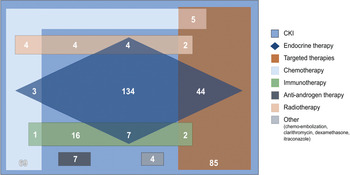
Rational co-administration of two or more agents is an established approach to optimising synergy and reducing treatment resistance in oncological practice, and a variety of combination strategies are under investigation in 388 currently registered clinical studies of CKIs (Fig. 2), including 137 studies on a variety of drug classes targeting specific signalling pathways or cellular processes other than ER signalling as of November 2020 (Table 5).
Overview of combination therapies in currently registered studies that include CKI agents.
Number of completed and ongoing interventional studies presented in Venn diagram form. Integers represent the number of studies and the combination of drugs being tested. Data from clinicaltrials.gov search on 16/11/2020, search strategy as per Table 1. On excluding observational studies and trials that did not involve combination treatment, 388 studies remained. The 391 combinations included in this Venn diagram include multi-arm studies involving multiple separate CKI combinations which were counted more than once.

Overview of currently registered combination trials of CKI agents and targeted therapies, grouped by molecular pathway

1 Data from clinicaltrials.gov search 16/11/2020: 137 interventional studies involving the combination of a CKI agent with a targeted drug.
2 Studies including endocrine therapy (ET) in the given drug combination.
Receptor tyrosine kinases
A major CKI combination strategy under investigation involves targeting altered receptor tyrosine kinase (RTK) pathways that drive mitogenic signalling in some cancers. This is supported by a growing body of preclinical data. In HER2-positive breast cancer, cyclin D1 and CDK4 have been implicated in resistance to HER2-directed therapy in studies of preclinical models and patient samples (Ref. Reference Goel97). CKI therapy has been shown to allow re-sensitisation to HER2 inhibition by reducing activation of TSC2 and thereby mTOR complex 1 (mTORC1), which in turn reduced negative feedback on the EGFR kinase family, thus producing a strong synergy between CKI and anti-HER2 therapy in murine breast cancer models (Ref. Reference Goel97). In addition, genomic alterations of HER2 and FGFR1/2 are recurrently observed in specimens from CKI-resistant tumours, and aberrant activation of these genes leads to resistance to CKI therapy in ER-positive breast cancer cells in vitro (Refs Reference Wander88, Reference Nayar98–Reference Formisano100). In vitro CKI resistance conferred by HER2 and FGFR pathway aberrations were overcome by combining tyrosine kinase inhibitors of HER2 (Ref. Reference Nayar98) or FGFR (Refs Reference Mao99, Reference Formisano100) with CKI-endocrine agents, respectively, and combination therapy induced complete and durable in vivo responses in 30% of PDX models (Ref. Reference Formisano100). Furthermore, amplification of CDK4, CDK6, CCND1/2 or CCNE11 may account for around a tenth of instances of resistance to osimertinib (EGFR T790M-specific inhibitor) (Ref. Reference Leonetti101), and the addition of palbociclib has been reported to resensitise cells to osimertinib (Ref. Reference Qin102) as well as afatinib (2nd generation EGFR inhibitor) (Ref. Reference Nie103) in vitro. Similarly, combining palbociclib with erlotinib (first-generation EGFR inhibitor) in EGFR-amplified models of oesophageal squamous cell carcinoma was shown to prevent erlotinib resistance in vitro and improve in vivo response to erlotinib in murine models (Ref. Reference Zhou104). This principle has been applied to typically CKI-resistant tumours such as pancreatic adenocarcinoma, in which the addition of an IGF1R inhibitor to palbociclib was shown to synergistically sensitise p16INK4A-mutated pancreatic tumour cell lines and PDX models (Ref. Reference Heilmann105).
Including the neoadjuvant combination trials discussed with respect to HER2-positive breast cancer, there are 23 currently registered clinical studies combining CKIs with eight different anti-HER2 agents (Table 5). These are phase I-II studies, with the exception of two ongoing phase III trials in metastatic HER2-positive breast cancer expected to complete in 2023–2025 (NCT02947685, NCT02344472). The two registered phase I CKI-FGFR inhibitor combination studies (NCT04483505, NCT03238196) are investigating ER-positive HER2-negative metastatic breast cancers with FGFR amplifications. Recent translational evidence to support these studies includes a subgroup analysis of baseline tissue samples from 391 (of 668) patients enrolled in the MONALEESA-2 trial, which demonstrated a statistically significant reduction in PFS in patients with above median (22.21 months) compared to below median (mPFS not reached at 32-month follow-up) FGFR1 gene expression (HR 0.56, 95% CI 0.36–0.87, P = 0.01) (Ref. Reference Formisano100). CKI combinations with inhibitors of the IGF RTK pathway are under investigation in early phase trials, using a palbociclib-ganitumab (anti-IGF1R antibody) combination in relapsed Ewing sarcoma (Ref. Reference Shulman106) and an abemaciclib-xentuzumab (anti-IGF1/2 antibody) dual therapy in ER-positive HER2-negative breast cancers and other solid tumours (Ref. Reference Yee107). All 13 currently registered anti-EGFR plus CKI combination studies are phase I-II trials in colorectal, non-small cell lung cancer (NSCLC) and head and neck cancer, of which inhibitors selective for EGFR mutations such as T790M are limited to studies in NSCLC (Table 5). At present, the majority of these 44 CKI-RTK inhibitor combination trials have stated expected completion dates between 2021 and 2027.
PI3K/AKT/mTOR pathway
Significant research efforts are ongoing in the development of CKI combinations with agents targeting PI3K/AKT/mTOR signalling, which is among the most commonly altered pathways across tumour types (Ref. Reference Janku, Yap and Meric-Bernstam108). Inhibitors of this pathway have demonstrated anti-tumour activity, with the earliest regulatory approvals seen in breast cancer and haematological malignancies (Refs Reference Janku, Yap and Meric-Bernstam108–Reference Markham112). However, their utility is ultimately limited by the emergence of resistance, triggering preclinical studies investigating whether links between PI3K and CDK4/6 signalling pathways can be therapeutically exploited to prevent, delay or treat acquired resistance. The synergy between CKIs and PI3K inhibitors has indeed been demonstrated in a number of in vitro and PDX models including nasopharyngeal carcinoma (Ref. Reference Wong113), melanoma (Ref. Reference Vilgelm114), PIK3CA mutated ER-positive breast cancer (Ref. Reference Vora115), ER-positive breast cancers (Ref. Reference Herrera-Abreu85) and triple-negative breast cancer (Ref. Reference Teo116), where the latter study also found this combination to increase anti-tumour immune activation.
CKIs have been shown to repress TSC2 phosphorylation with the effect of reducing downstream mTORC1 activation (Ref. Reference Goel97), and successful combinations of CKIs with compounds such as anti-HER2 or anti-IGF1R agents were associated with further repression of mTORC1 (Refs Reference Goel97, Reference Heilmann105). Inhibition of mTOR and mTORC1 signalling were shown to be necessary for CKI-induced senescence in a vemurafenib-resistant melanoma model, and reduction in mTOR signalling, synergistic cytostasis induction and tumour growth inhibition was achieved through dual CKI and mTOR inhibition with palbociclib and rapamycin co-administration (Ref. Reference Yoshida, Lee and Diehl20). Meanwhile, concurrent CKI and mTOR inhibitor treatment elicited sustained tumour growth inhibition in in vivo and in vitro models of pancreatic adenocarcinoma, which was associated with suppression of CKI-induced mTOR-mediated increases in metabolic pathways including glycolysis and oxidative phosphorylation (Ref. Reference Franco53). Another metabolic role of mTORC1 activation has been suggested to be glutamine addiction in the context of cyclin D1 overexpressing oesophageal squamous cell carcinoma models, and a preclinical combination of telaglenastat (glutaminase 1 inhibitor) and metformin (to suppress associated oxidative phosphorylation) showed anti-tumour activity against CKI-resistant cells both in vitro and in PDX models (Ref. Reference Qie83).
Emerging clinical data suggest tolerability and potential benefit of combining CKI-ET with inhibition of the PI3K/AKT/mTOR pathway, as exemplified by the aforementioned TRINITI-1 study (NCT02732119) of a ribociclib-exemestane-everolimus combination in metastatic breast cancer. A phase II ribociclib-everolimus combination study in leiomyosarcoma and dedifferentiated liposarcoma (SAR-096/NCT03114527) presented at ASCO 2020 did not demonstrate radiological response, but did highlight a median PFS of 19.6 weeks, ranging up to 84 weeks, in a pre-treated study cohort with as many as nine previous lines of therapy (Ref. Reference Movva117). In addition, interim results of the TAKTIC (NCT03959891) phase Ib study presented at the same meeting highlighted mainly cytopenia-related toxicity but no dose-limiting toxicities when combining AKT1/2/3 inhibitor ipatasertib with palbociclib and fulvestrant in pre-treated ER-positive HER2-negative metastatic breast cancer after progression on any CKI. The combination resulted in 5 of 25 cases with partial response or stable disease (Ref. Reference Wander118). A palbocilib-fulvestrant combination with or without ipatasertib is also under investigation in the phase Ib/III IPATunity150 study (NCT04060862) in ER-positive HER2-negative metastatic breast cancer.
Other ongoing clinical trials are investigating CKIs in combination with PI3K inhibitors, PI3K/mTOR dual inhibitors and mTORC1/2 inhibitors (Table 5), all of which are early phase studies with the exception of one phase III randomised controlled trial. This is the INAVO120 trial (NCT04191499) (Ref. Reference Turner119) which will evaluate PFS, ORR, clinical benefit rate and other secondary endpoints using palbociclib plus fulvestrant with GDC-0077 (PI3Kα inhibitor) or placebo as a first-line therapy in ctDNA or biopsy-confirmed recurrent or metastatic PIK3CA-mutated ER-positive HER2-negative breast cancer occurring within a year of adjuvant ET. This follows safety and dosing data from a multi-arm phase Ib study (NCT03006172) which is including this combination (Ref. Reference Jhaveri120). The same trial (NCT03006172) has also planned an arm that adds metformin to the GDC-0077 + palbociclib + fulvestrant combination. Another study investigating metabolic aspects of CKI therapy is a phase Ib/II trial (NCT03965845) combining palbociclib and telaglenastat in advanced solid malignancies refractory to standard treatment.
Ras/Raf/MEK/ERK pathway
Dual MAPK pathway and CDK4/6 inhibition is under investigation, including in tumours with frequent aberrations in RAS genes. Preclinically, co-administration of MEK inhibition and CKI therapy was synergistic in a murine model of NRAS-mutated melanoma (Ref. Reference Kwong121). Similarly, studies in KRAS-mutant colorectal cancer models have demonstrated synergistic tumour growth inhibition between CKIs and MEK inhibitors where MEK inhibitor monotherapy had been largely ineffective (Refs Reference Lee122, Reference Pek123), and the combination was functionally observed to downregulate a KRAS-associated gene expression signature enriched for mitotic genes such as FOXM1 (Ref. Reference Pek123). In KRAS-mutant non-small cell lung cancer cell lines and murine models, acquired resistance to palbociclib was shown to relate to upregulation of the FGFR-MEK-ERK pathway, these resistant cells respond to MEK and ERK inhibition, and that the drug combination can prolong time to CKI resistance (Ref. Reference Haines124). Activation of the MAPK signalling pathway has been implicated in phenotypically aggressive acquired CKI resistance, and MEK inhibition was able to sensitise CKI-resistant prostate cancer models (Ref. Reference De Leeuw96).
Strikingly, in addition to Rb-dependent senescence induction through SASP expression, CKI-MEK inhibitor combinations have been shown to enhance natural killer cell infiltration and activation through an expression of SASP-related chemokine (CCL2, CCL4, CCL5, CXCL10, CX3CL1) and cytokine (IL-15, IL-18, TNF-alpha) expression, respectively, and sustained NK cell activity was demonstrated to be necessary for tumour response and prolonged survival in murine models of Kras-mutated lung carcinoma (Ref. Reference Ruscetti125). Furthermore, CKI exposure triggered metabolic reprogramming including increased oxidative phosphorylation and mTOR pathway upregulation in preclinical pancreatic cancer models, where added MEK inhibition produced sustained cell cycle arrest and senescent features (Ref. Reference Franco53). Such findings highlight the complex nature of the interconnected emerging mechanisms of CKI action.
In terms of clinical studies, earlier work on CKI combinations with inhibitors of the Ras/Raf/MEK/ERK pathway began in melanoma research. Following the successful improvement in tumour response and survival using combined BRAF and MEK inhibition in BRAF V600-mutant advanced melanoma (Ref. Reference Eroglu and Ribas126), efforts to improve these further with additional combinations have included CKIs. The phase Ib/II (NCT01543698) triple therapy trial of BRAF and MEK inhibitors encorafenib and binimetinib plus ribociclib initially reported (in abstract form) 4 complete and 18 partial responses along with 15 cases with stable disease in a cohort of 63 participants with BRAF-mutant tumours, but also noted an adverse event-related discontinuation rate of over twenty per cent (Ref. Reference Ascierto127). A recently published update on 126 participants in this study described favourable response rates and safety of BRAF/MEK dual inhibition in BRAF-mutated metastatic colorectal carcinoma and melanoma, but did not include outcomes of the triple combination with ribociclib (Ref. Reference Sullivan128). The addition of CKI therapy (and other targeted agents) in the context of resistance to dual BRAF and MEK inhibition with encorafenib and binimetinib is also under investigation, and the safety of triple therapy with ribociclib in the phase II LOGIC2 (NCT02159066) study in BRAF V600-mutant advanced melanoma was reported at ASCO 2020 (Ref. Reference Dummer129). Previous preclinical data suggested that such triple therapy may be less effective in the context of resistance to BRAF inhibition (Ref. Reference Martin130), and disease control rate and median PFS in the ribociclib combination cohort of LOGIC2 were modest at 26.3% and 2.1 months respectively (Ref. Reference Dummer129).
Early phase clinical studies of CKI and MEK-inhibitor doublet combinations are also underway. The phase Ib/II NCT01719380 study combined ribociclib with binimetinib in patients with NRAS-mutated melanoma initially reported partial response or stable disease in twelve of 14 participants in 2014 (Ref. Reference Sosman131). In 2015, a phase Ib (NCT02065063) study combining palbociclib with MEK-inhibitor trametinib demonstrated safety and partial responses in an NRAS-mutated colorectal cancer patient, and a melanoma patient with no known RAS or BRAF aberrations (Ref. Reference Sullivan132). In 2017, the phase Ib NCT01781572 study also reported on the safety and potential benefit (4 and 7 out of 16 participants achieving partial responses and stable disease, respectively), with the ribociclib-binimetinib combination in NRAS-mutant melanoma (Ref. Reference Schuler133). Current clinical trials are also investigating other frequently RAS-mutated tumour types. In KRAS and NRAS-mutated metastatic or unresectable lower gastrointestinal tumours, a palbociclib-binimetinib combination is being compared to standard third- or later-line tipiracil hydrochloride chemotherapy in a randomised phase II (NCT03981614) study with anticipated completion in 2022. A phase I/II (NCT03170206) study of palbociclib-binimetinib combination therapy in KRAS-mutant advanced non-small cell lung cancer is also ongoing and currently due to complete in 2024.
ERK inhibition is more recently being combined with CKI agents in early phase clinical trials. The phase I (NCT03454035) trial of an ulixertinib-palbociclib combination is ongoing in advanced cancers, with a plan for an expansion cohort focusing on pre-treated patients with metastatic pancreatic cancer. Several early-phase combination trials have started investigating CKI combinations with ERK inhibitor LY3214996, including NCT04391595 which will combine this drug with abemaciclib in patients with recurrent glioblastoma. A newly commenced phase II (NCT04534283) study is combining LY3214996 with abemaciclib in patients with advanced cancers that harbour BRAF, RAF1, MEK, ERK or NF1 mutations. A phase Ib/II (NCT04616183) study of LY3214996 plus cetuximab, with or without abemaciclib, in advanced left-sided colorectal cancer with prior progression on an EGFR-inhibitor agent (and conversely without baseline KRAS, NRAS, EGFR, BRAF or MEK1 mutations), has also recently been registered. The only publicly available results from registered CKI-ERK combination trials to our knowledge come from the large phase I (NCT02857270) study combining LY3214996 with abemaclib in advanced solid malignancies, although this data is currently limited to the LY3214996 dose-escalation part which showed single-agent responses in 14% of 51 participants (Ref. Reference Pant134).
While results of these combination studies are awaited in coming years, studies investigating resistance mechanisms to novel combination strategies are already being undertaken in the preclinical and translational settings. In the case of resistance to CKI-MEK inhibitor combinations, for instance, functional studies of acquired resistance in NRAS-mutant cell lines and genetically modified cells via CRISPR knock out screens have identified activation of Ras/Raf and PI3K/AKT pathways as important factors (Ref. Reference Hayes135). Detailed genomic characterisation of serial tissues from a patient undergoing several lines of therapy for recurrent advanced melanoma revealed a small subpopulation with a specific PIK3CA mutation (E545K) which had undergone clonal expansion during CKI-MEK inhibitor therapy (Ref. Reference Romano136). The latter study also employed in vitro and in vivo functional approaches, and identified S6K1-S6 signalling as an upregulated downstream pathway by the PIK3CA mutation in question, and demonstrated sensitisation of the same cells to CKI-MEK inhibitor therapy through exposure to S6K inhibition. These studies highlight the importance of thoughtful clinical trial schemas that incorporate opportunities for informative tissue collection, translational analysis and valuable insights into molecular underpinnings of resistance to be fed back into ongoing or subsequent trials of novel therapeutic approaches.
Immune checkpoint inhibitor combinations
As discussed with regard to the emerging property of CKIs in enhancing anti-tumour immunity and novel CKI-ICI combination therapies in breast cancer, preclinical and translational studies have demonstrated synergy between CKIs and ICIs (Refs Reference Goel21, Reference Schaer23, Reference Hurvitz78). In addition, a study has utilised a single-cell RNA sequencing strategy to identify a transcriptional ‘program’ in melanoma which reflects immunologically ‘cold’ states present prior to immunotherapy and thereby predicts poor response. Importantly, this study demonstrated that the addition of CKI therapy could sensitise tumours shown to be largely resistant to ICI monotherapy and reverse the immune-exclusion ‘program’ (Ref. Reference Jerby-Arnon137). Such findings have attracted significant clinical interest, as reflected by the 26 phase I and II trials of CKI-ICI combinations registered as of November 2020. These studies span five CKI agents (palbociclib, ribociclib, abemacicli, dinaciclib and trilaciclib) and nine ICI agents (atezolizumab, avelumab, durvalumab, nivolumab, pembrolizumb, spartalizumab and INCMGA00012, LY3300054 and LY3321367) in fifteen tumour types (summarised in Table 6), and are currently expected to complete by 2025.
Overview of currently registered CKI-ICI combination trials

aData from clinicaltrials.gov search 16/11/2020: 26 interventional studies involving the combination of a CKI agent with a ICI agent.
Several of these ongoing studies were reported in abstract form at the 2020 ASCO virtual congress. This included a phase Ib study of dinaciclib plus pembrolizumab in patients with advanced triple-negative breast cancer with up to two prior lines of chemotherapy (Ref. Reference Chien138). As expected based on prior clinical data on palbociclib, grade 3 or higher toxicities did not include diarrhoea but mainly neutropenia. Although response rates were modest overall (five in 29 cases), one patient notably demonstrated a complete radiological response, and a significant correlation between baseline immunohistochemical MYC staining and response was noted (Ref. Reference Chien138). In addition, interim results from 28 patients with ER-positive HER2-negative advanced breast cancer in a phase Ib study (NCT02779751) of an abemaciclib-pembrolizumab combination were reported to indicate partial response in 29% and clinical benefit (defined in this study as the lack of progressive disease for 6 months or longer) in 46% of participants, and grade 3 or 4 toxicities including neutropenia, diarrhoea and transaminitis (Ref. Reference Rugo139). The same drug combination was studied in squamous NSCLC (maximum one previous line of platinum chemotherapy) or KRAS-mutant non-squamous NSCLC with 1% or higher PD-L1 tumour staining (no prior chemotherapy) under the same trial registration (NCT02779751) (Ref. Reference Pujol140). Interim analysis of 25 participants identified similar adverse events except for the addition of pneumonitis, and partial response rates in KRAS-mutant and squamous NSCLC patients were 24% and 8% respectively (Ref. Reference Pujol140). The efficacy of this combination had not been clearly superior to historical figures of monotherapy in this interim analysis, but remains to be assessed in the final analysis.
Other cell cycle mediators
Multiple cell cycle mediators have been investigated in a number of preclinical CKI combination studies. One group of apoptosis-related genes of interest is the BCL2 family. BCL2 is an anti-apoptotic member frequently upregulated in ER-positive breast cancer, and co-administration of CKI-ET with BCL2 inhibitor venetoclax resulted in potent apoptotic responses in vitro and in PDX models of ER-positive breast cancer without compromising CKI-induced immunogenicity in immune-competent mice (Ref. Reference Whittle141). In vitro synergy between voruciclib and venetoclax was also recently reported in chronic lymphocytic leukaemia cells cultured in the presence of bone marrow stromal cells (Ref. Reference Lesnick142). Phase I clinical trials of CKI-venetoclax combinations are ongoing in breast cancer and acute myeloid leukaemia (Table 5). Another preclinical approach to apoptosis induction has been the combination of CKI and proteasome inhibitor agents. CKI co-administration was found to enhance apoptosis induction by bortezomib in in vivo and in vitro multiple myeloma models (Ref. Reference Menu143). The prolongation of synchronous early G1 cell cycle arrest by CKI exposure was found to enhance bortezomib-induced apoptosis via downregulation of anti-apoptotic protein IRF4 and upregulation of Bim and Noxa (pro-apoptotic BH3-only members of the Bcl2 family (Ref. Reference Kale, Osterlund and Andrews144)) in preclinical myeloma models (Ref. Reference Huang145). This combination has been found to be safe in early phase testing with a response rate of 20% in relapsed myeloma (Ref. Reference Niesvizky146), and a multi-arm phase I/II study in pre-treated high-risk myeloma is ongoing which includes an abemaciclib-ixazomib-palidomide-dexamethasone arm (NCT03732703) (Ref. Reference Auclair147).
Other studies have focused on the MDM family of endogenous repressors of p53. Amplifications of MDM2 as well as CDK4 are frequent in sarcomas (Refs Reference Tisato148, Reference Laroche-Clary149), and co-administration of palbociclib and MDM2 inhibitor idasanutlin was shown to synergistically promote apoptosis and thereby suppress in vitro and in vivo tumour growth and prolong survival of PDX models of de-differentiated liposarcoma (Ref. Reference Laroche-Clary149). It has also been shown in preclinical melanoma models that CKI sensitivity relies on the ability to suppress MDM4 expression through inhibition of arginine methyltransferase PRMT5, that loss of this ability leads to CKI resistance, and that co-administration of CKI and PRMT5 inhibitors can re-sensitise resistant cells and delayed acquisition of resistance (Ref. Reference AbuHammad150). MDM2 inhibition has been shown to promote senescence via p53 stabilisation (Ref. Reference Efeyan151), and suppression of MDM2 following CKI exposure in liposarcoma, breast, lung and glioma cell lines has been linked to sustained senescence induction (Ref. Reference Kovatcheva30). Post-CKI reduction in MDM2 expression has retrospectively been linked to a trend toward a favourable response to CKI therapy in a small number of patients with liposarcoma (Ref. Reference Kovatcheva30). Results from currently registered early phase trials combining CKIs with either p53/MDM2 interaction inhibitor siremadlin (NCT04116541, NCT02343172) or with dual p53/MDM2 and p53/MDMX interaction inhibitor ALRN-6924 (NCT02264613) are awaited.
CKI resistance mediated by the PI3K pathway in melanoma cells was found to require inhibition of p21, an inhibitor of cell cycle re-entry via downstream CDK2 (Ref. Reference Vilgelm114). This study showed that CKI monotherapy led to increased inactivation of p21 through cyclin D1 upregulation (Ref. Reference Vilgelm114). MDM2 inhibition reduced suppression of p53 which in turn induced p21 expression and CDK2 inhibition, and CKI and MDM2 inhibitor co-administration led to RB dephosphorylation, cell cycle arrest and tumour response in PDX models (Ref. Reference Vilgelm114). Repression of p21 can also occur epigenetically through histone deacetylase (HDAC) activity (Ref. Reference Zupkovitz152), and the frequent occurrence of abnormal HDAC expression is a target of single-agent HDAC inhibitor or combination therapy strategies in cancer (Ref. Reference Suraweera153). Following the observation that HDAC inhibition can increase p21 expression and promote cell cycle arrest, co-administration of palbociclib and entinostat (HDAC inhibitor) in preclinical HER2-negative breast cancer models has reportedly resulted in synergistic anti-tumour activity (Ref. Reference Lee154). Phase I clinical studies of CKIs in combination with HDAC inhibitors are ongoing in advanced gynaecological cancers (NCT04315233, NCT04498520).
Future directions: challenges and opportunities
The next decade is projected to see an explosion in data from clinical and translational studies evaluating CKIs in a variety of tumour types. The majority of phase III studies are in breast cancer, whereas clinical studies of other tumour types are predominantly in early phase development. In addition to providing safety and efficacy data for specific treatment contexts, ongoing studies will begin to address key unanswered questions regarding optimal strategies for the clinical implementation of CKI therapy.
Strategies for sequencing CKI agents need to be defined in different tumour types. In ER-positive HER2-negative breast cancer, phase III registration trials have separately demonstrated the efficacy of CKI-ET combinations both in the first-line metastatic setting as well as in the context of prior ET for advanced disease. However, the addition of CKI agents to ET confers additional toxicity, and it is not known in which circumstances CKI therapy is best-utilised upfront or as a later-line treatment. This is under investigation for instance in the SONIA phase III trial (NCT03425838), which plans to randomise 1050 ER-positive HER2-negative advanced breast cancer patients to either first-line CKI plus an aromatase inhibitor followed by second-line fulvestrant, or first-line aromatase inhibitor followed by second-line CKI-fulvestrant. Post-CKI-progression studies as well as neoadjuvant and adjuvant CKI studies are also under way in breast cancer as previously discussed. If CKIs are approved in the early breast cancer setting, the next question will then be whether/in which circumstances CKIs might subsequently be reused in later lines. In addition, clinical data comparing CKIs with standard therapies are emerging. The PEARL phase III study randomised metastatic breast cancer patients with known resistance to aromatase inhibitor therapy to either palbociclib-ET (exemestane or fulvestrant) or capecitabine, and demonstrated no significant PFS advantage of the former (Ref. Reference Hans, Cottu and Kirova155). Several other phase III studies investigating the efficacy of CKI-ET versus chemotherapy in metastatic (PADMA/NACT03355157, RIBBIT/NCT03462251, AMBRE/NCT04158362, NCT03905343) and early breast cancer (ADAPTcycle/NCT04055493) are ongoing.
Given the complex mechanisms of CKI action as discussed above, dose scheduling may have important impacts on efficacy. Optimal scheduling approaches are not yet fully understood. For instance, a study in murine models of ER-positive breast cancer found in vivo CKI-ICI synergy to be robust when anti-PDL1 therapy was administered one week after commencement of abemaciclib (i.e. in a ‘phased’ schedule) whilst concurrent treatment with the same agents mimicked the modest results derived from abemaciclib monotherapy (Ref. Reference Schaer23). Another group found treatment with palbociclib for 8 days to be equivalent to that of continuous administration in a preclinical system (Ref. Reference Yoshida, Lee and Diehl20), which if translated into clinical practice could have the value of reducing toxicity. However, CKI-induced cytostasis may be reversible and require continuous exposure in some tumour types or cellular contexts (Ref. Reference Bollard32). Clinical and translational studies are also investigating the effects of scheduling, with mixed results to date. Some studies have shown no difference in efficacy between intermittent or continuous administration (Ref. Reference Khan77), however, the observation of a rebound tumour growth phenomenon on temporary pre-operative cessation of CKI exposure (Ref. Reference Hurvitz78) or of the loss of initially biopsy-proven neoadjuvant CKI-induced cell cycle arrest in subsequent surgical specimens (Ref. Reference Khan77) are a cause of concern which warrant further investigation.
The role of approved CKI agents will also need to be defined in relation to other treatment modalities used in standard clinical practice. For instance, although palliative radiotherapy is commonly used in metastatic breast cancer management, current clinical literature on the effect of combining CKI therapy with radiotherapy is sparse (Ref. Reference Beddok156). Single-institution case series of patients with metastatic breast cancer receiving RT in addition to CKI therapy in routine clinical practice to date have indicated that additional toxicity, CKI dose reduction or discontinuation rates associated with concurrent administration of standard doses appear to be limited (Refs Reference Beddok156–Reference Huang158). Based on this, the continuation of CKI therapy during palliative RT has been advocated by some (Ref. Reference Meattini157), however, trial data are required to prospectively evaluate the safety and optimal dose scheduling of CKI-RT approaches. Twelve phase I and II clinical trials investigating combinations including CKIs and radiotherapy in breast, head and neck, nasopharyngeal, pancreatic cancer and glioblastoma (Table 7) are currently registered, but have not been published to our knowledge. In the meantime, preclinical studies have provided mixed reports on increased radiosensitivity (Refs Reference Lee159–Reference Johnson161) or reduced radiation-induced toxicity (Refs Reference Naz160, Reference Weiss162) with concurrent CKI therapy. In fact, the impact of combining DNA-damaging agents with CKIs appears to be a double-edged sword. CKI-induced cell cycle arrest may protect against DNA damage and thereby myelotoxicity (Refs Reference Hart163, Reference Salvador-Barbero164), and clinical studies investigating the potential for myelopreservation using CKI-chemotherapy combinations are ongoing (NCT04607668, NCT03041311). In contrast, the combination can amplify cytotoxicity where CKI agents abrogate repair of radiotherapy- (Ref. Reference Johnson161) or chemotherapy-induced (Ref. Reference Frankell165) DNA damage. Overall, evidence to date indicates that the optimal timing of co-administration or sequential therapy with CKIs and DNA-damaging agents is highly complex, and represents an important area of ongoing research.
Overview of currently registered clinical trials involving CKI-RT combinations

aData from clinicaltrials.gov search 16/11/2020: 12 interventional studies involving the combination of a CKI agent with radiotherapy.
Ultimately, effective use of CKI agents will require the development of robust, prospectively validated biomarkers. A key challenge at present is that ER positivity is the only biomarker for CKI therapy available for routine use, and is limited specifically to the context of metastatic breast cancer. Oncogenic post-translationally cleaved low-molecular-weight isoforms of cyclin E have been found to have prognostic significance in a study of ER-positive breast cancer (Ref. Reference Vijayaraghavan39), but their potential role as predictive biomarkers require further investigation in future clinical trials. The potential roles of a variety of genes and their protein products relating to the G1/S checkpoint as predictive biomarkers for CKI therapy have been investigated, including Rb, p16 and cyclin D1, however, their robustness and clinical utility has not been confirmed to date (Ref. Reference Goel8). Numerous ongoing clinical trials aim to address this need for effective biomarkers by incorporating translational aims around patient stratification and investigating molecular mechanisms behind treatment efficacy or resistance as previously discussed.
Ongoing technical advances are likely to play a key role in expanding the possibilities for CKI biomarker development and further characterisation of mechanisms of CKI action and resistance. Cutting-edge multi-omics studies are contributing to new insights into the pharmacological properties of CKI agents (Ref. Reference Hafner56) as well as such extensive biomarker discovery efforts (Ref. Reference Tong166). For instance, a large-scale genomic study using 551 oesophageal adenocarcinoma samples identified that over half of cases harboured genomic events (such as aberrations in CDK6 or CCND1/3) predicting susceptibility to CKI agents, and provided functional evidence for these predictions in 13 cell lines (Ref. Reference Tong166). Recent functional genomic studies of CKI activity and resistance are also taking advantage of emerging technologies such as CRISPR-Cas9 gene editing to allow systematic genome-wide surveys – such studies have identified resistance mechanisms in single- or combination-therapy contexts relating to RTK, PI3K, MAPK, JAK/STAT, Wnt, E2F and Hippo signalling pathways, and have proposed rational combination strategies to mitigate these in melanoma, breast and bladder cancer models (Refs Reference Hayes135, Reference Whittle141, Reference Asghar167). Single-cell technologies, including imaging for phenotypic characterisation and single-cell RNA sequencing approaches, are providing powerful approaches to studying the behaviours of distinct tumour cell populations, and have supported targeted combination therapy strategies such as CKI-PI3K inhibition to sensitise PIK3CA-mutated TNBC, CKI-ICI combinations to mitigate ICI resistance in melanoma, and sequential anti-HER2/cabozantinib/ICI treatment in CKI-resistant HER2-positive breast cancer models (Refs Reference Jerby-Arnon137, Reference Asghar167, Reference Wang168).
Expanding computational capabilities are key in enabling increasingly complex analyses of data from novel-omics studies. In addition, mathematical modelling approaches may also play increasingly key hypothesis-generating and testing roles with regard to developing in silico CKI response predictions (Refs Reference Drusbosky169–Reference Hafner171) or modelling tumour cell behaviour and evolution of CKI resistance (Ref. Reference Bacevic172). Developments in ctDNA sequencing and computational approaches are extending the limits of detection (Ref. Reference Wan173), and ongoing studies are assessing the potential utility of ctDNA analyses in the minimally invasive assessment of CKI response (NCT03285412, NCT03065621) or detection of acquired resistance mutations (Refs Reference Condorelli87, Reference Turner119) which may guide selection for clinical trials of specific combination strategies (NCT04191499). In addition, advances in radiological imaging techniques have shown early promise for enhanced assessment of CKI response compared to standard imaging – as exemplified by the use of 11C-choline PET and 18F-FLT PET imaging to assess responses to milciclib-treated murine models of lung cancer and palbociclib-treated patients with mantle cell lymphoma, respectively (reviewed in (Ref. Reference Gerwing174)) – and may contribute to improvements in non-invasive assessment of in vivo response in patients receiving standard or investigational CKI-based treatments.
Conclusion
In summary, we anticipate the clinical application of CKI therapy to expand beyond their current use in metastatic breast cancer in coming decades. Preclinical studies to date have begun to shed light on the exquisite complexity of the interlinking mechanisms of CKI action, and their further molecular and cellular characterisation in different tumour and treatment contexts will likely be key in identifying useful biomarkers of CKI response. Ongoing technical advances have the potential to improve tissue, blood and imaging-based assessment of tumour response and biomarker development in order to enhance future personalised medicine approaches to CKI therapy. Careful synthesis of emerging data from translational studies as well as the vast number of current and future clinical trials will be critical in the development of optimal therapeutic combination and sequencing strategies to maximise benefit from CKI-based treatment across different tumour types.
Financial support
This research received no specific grant from any funding agency, commercial or not-for-profit sectors.
Conflict of interest
MR: no conflicts of interest to report. ES: personal fees for consulting advisory role (AstraZeneca, Astellas, BMS, Celgene, Five Prime, Gritstone Oncology, Merck, Servier and Zymeworks).